Helm by Sarah Hall Summary, Characters and Themes
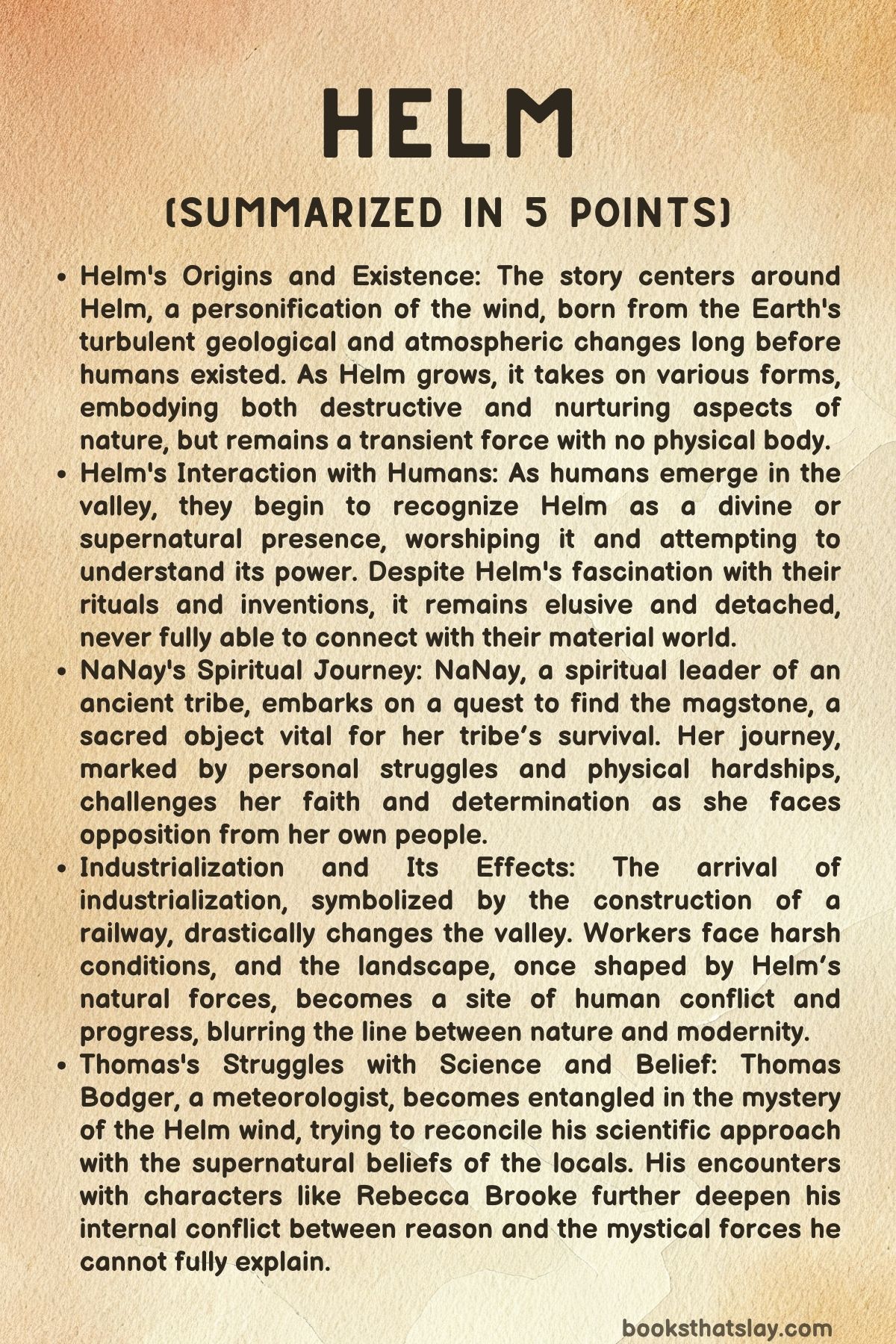
Helm by Sarah Hall is a deeply atmospheric and thought-provoking novel that brings together themes of nature, power, and the interplay between humanity and the environment. It follows the journey of Helm, a personification of the wind, which emerges as a force of nature long before humankind’s existence.
The narrative explores Helm’s transformation from a formless entity into a being with power over the elements. Through Helm’s interactions with humans and the changing landscape, the novel delves into ideas of existence, control, belief, and the inevitability of progress. The book navigates a world where the natural world, with its destructive forces, contends with humanity’s relentless desire to understand and conquer.
Summary
The novel Helm by Sarah Hall begins with the creation of Helm, a being that is not born in the traditional sense but instead forms from the tumultuous early atmospheric and geological changes of Earth. This mysterious force of nature, which embodies both calm and destructive elements, emerges with the wind and becomes a shaping presence on the planet.
As Helm takes shape, it exists without physical form, experiencing fleeting moments of immense power as it influences the wind and weather patterns, though it lacks the permanence of physical life.
As Helm watches the evolution of life on Earth, it witnesses the birth of early creatures, plants, and more complex forms of life, including humans. However, its existence is transient, and it faces an existential dilemma about its impermanence.
Unlike the creatures below it, Helm’s identity remains elusive, and its power, though formidable, is temporary. Despite this, Helm forms a deep connection to the land, feeling a kind of kinship with the emerging human beings who live in the valley below.
As the humans begin to settle in the area, they initially view Helm with awe and reverence. They attribute divine or supernatural qualities to the wind, calling it a god or spirit, trying to understand and appease its power through rituals.
Over the centuries, Helm is given different names by these people, each one a representation of their ever-changing understanding of the force of nature. Even as humans build their civilizations, Helm remains a constant, mysterious force, capable of both nurturing life and destroying it.
The narrative shifts to follow NaNay, a young member of an ancient tribe who experiences a vision of the magstone, a sacred object that must be placed at the ceremonial site, Magsca. Despite initial skepticism from the tribe’s elders, NaNay’s vision of the magstone becomes central to her tribe’s survival.
Determined to find the magstone, NaNay embarks on a journey, facing both personal and emotional struggles along the way. Her path leads her to the Halron mountain, where she believes the magstone is hidden, marking the culmination of her quest and her rise as a spiritual leader within her tribe.
Meanwhile, Michael Lang, an astrologer and occultist, arrives in the valley of Eden, where Helm resides. His presence is tied to his work in the occult, and he is seeking answers to the supernatural forces in the area.
His interactions with the local people and his own personal journey set the stage for the exploration of belief, knowledge, and the impact of Helm’s presence on humanity.
As time passes, industrialization begins to take hold in the valley, symbolized by the construction of a railway line from Settle to Carlisle. The advent of the railway represents both human ambition and the clash with nature.
The workers, or navvies, who construct the line are subjected to dangerous conditions, and many of them meet untimely deaths. This industrial progress is in direct contrast to Helm’s ancient power, which continues to influence the natural world around it.
Though the human world advances, Helm remains an untamable, unpredictable force, unyielding to human control.
In the midst of these changes, a strange balloon appears in the sky, capturing Helm’s attention. The balloon, with two aristocrats aboard, Henry and Claudine, floats high in the air, seemingly defying the natural laws Helm represents.
Helm watches their flight with fascination, observing their carefree enjoyment of the dangerous situation, which contrasts sharply with the power it holds. As the balloon begins its rapid descent, Helm is briefly tempted to interfere but decides against it, and the balloon crashes harmlessly.
The incident is a reflection of humanity’s ability to defy nature, yet their inventions remain fragile and subject to the forces of the world.
As the novel progresses, Thomas Bodger, a meteorologist, becomes involved in the study of the Helm wind. He arrives at the Grange, a large estate, where he meets Rebecca Brooke, a mysterious woman who is deeply connected to the land and its energies.
Their conversations are filled with tension, as Rebecca views the Helm wind not just as a scientific phenomenon but as something mystical and powerful. Thomas, focused on rational inquiry, struggles to reconcile his scientific approach with the inexplicable experiences he encounters.
While Thomas remains captivated by Rebecca, he also finds himself caught up in the industrial developments of the area. He witnesses the transformation of towns, such as Millom, from squalid places to bustling industrial hubs, but he grows uneasy with the level of control exerted over the workers.
His work on understanding the Helm wind continues, but it becomes increasingly entangled with his personal dilemmas and his relationship with Rebecca. Their interactions reveal the deeper connections between the scientific world and the spiritual beliefs surrounding Helm.
The narrative also introduces Janni, a young girl whose troubled home life and worsening health leave her isolated. Her connection to Helm becomes more pronounced as she experiences strange visions and sensations related to the wind.
She believes that Helm watches over her, and as her condition worsens, she finds herself drawn to the mountain where Helm resides. In a climactic moment, Janni reaches the summit, where she experiences Helm’s power in its fullest form.
The storm intensifies, and Janni’s body struggles against the elements, but she feels the presence of Helm guiding her to her destiny.
In the final stages of the novel, the forces of nature and human progress continue to clash. The railway, the balloon, and the ongoing industrial advancements symbolize humanity’s drive to conquer and control the natural world, but Helm, as an untamable wind, remains an ever-present force.
As scientists begin to study Helm more rigorously, it transitions from a mystical, supernatural force to a natural phenomenon, though its power remains as mysterious and uncontrollable as ever. The novel concludes with Helm still affecting the lives of the people in the valley, a force that continues to shape the world in ways that humanity cannot fully comprehend.
Characters
Helm
Helm is the central figure of Helm by Sarah Hall, embodying the wind itself. It is an ancient, elemental force born long before human existence, taking on various identities throughout the novel.
Despite its lack of a permanent form, Helm is capable of great power, controlling the weather and creating storms that wreak havoc on the valley below. What defines Helm is its impermanence.
While the natural world evolves, Helm remains a transient presence, which becomes a source of existential crisis. This impermanence gives Helm a sense of detachment from the creatures that live and die around it.
The relationship Helm shares with humans is complex and shifting. Humans view Helm as a mysterious force, sometimes worshiping it as a deity or spiritual being.
Over time, as Helm becomes more anthropomorphized in human thought, it finds itself both revered and misunderstood. Despite this increasing recognition, Helm remains elusive, never fully grasped by human minds.
Helm’s role in the story is to represent the untamable forces of nature, constantly interacting with the development of human civilization, from the earliest forms of human worship to the arrival of scientific inquiry. Helm’s journey mirrors the changing relationship between humanity and the natural world, reflecting both the awe and fear that nature inspires.
NaNay
NaNay is a pivotal character in the novel, a member of an ancient tribe who plays a crucial role in the spiritual and physical journey of the tribe. NaNay’s experience begins with a near-death vision in which she sees a sacred object, the magstone, essential for the tribe’s survival.
This vision sets her on a mission to retrieve the magstone, even as her tribe’s leaders are skeptical of her vision. NaNay’s role evolves as she becomes a spiritual leader, her conviction in the importance of her vision growing stronger despite personal struggles, including physical and emotional abuse.
Her journey is one of perseverance and self-discovery, navigating the fine line between personal suffering and her responsibility to her tribe. NaNay’s determination and spiritual connection to the world around her are at the heart of her character, and her struggles symbolize the tension between belief and doubt.
She is ultimately a figure of resilience, facing challenges head-on, driven by a belief that the magstone holds the key to her people’s future.
Michael Lang
Michael Lang is introduced as an astrologer and occultist who brings a different perspective to the story, one rooted in mysticism and the supernatural. His journey in the valley of Eden intersects with Helm, as Michael tries to understand the strange phenomena associated with the wind.
While deeply involved in exorcism and occult practices, Michael’s character is one of internal conflict. He grapples with his identity and the role of the occult in a world increasingly influenced by science and industry.
Michael’s interactions with the local people and the mystery of the Helm wind force him to reconsider his own beliefs and the limits of his knowledge. At the same time, Michael is portrayed as a figure of power, his understanding of the occult granting him influence, but it is also clear that he is not fully in control of the forces he is dealing with.
The character of Michael adds a layer of complexity to the exploration of belief, power, and the natural world, as he navigates the blurred lines between science and mysticism.
Thomas Bodger
Thomas Bodger is a scientist whose focus on meteorology brings him into contact with the strange and mysterious Helm wind. His journey represents the rise of industrialization and the scientific era, as he attempts to make sense of the natural world through rational observation and inquiry.
However, Thomas’s scientific mindset is constantly challenged by the supernatural elements around him, especially the mysticism surrounding the Helm wind. His interactions with characters like Rebecca Brooke show the tension between science and belief, as Rebecca’s intuitive understanding of the world clashes with his methodical, analytical approach.
Thomas’s character also reflects his personal struggles, particularly with his troubled marriage to Sara. His internal conflict between professional ambition and personal dilemmas mirrors the external conflict between scientific rationalism and mystical forces.
As Thomas delves deeper into the mystery of Helm, his understanding of the world begins to shift, and he must come to terms with the limits of his own knowledge.
Rebecca Brooke
Rebecca Brooke is a complex character whose presence in the novel introduces a layer of mystery and spirituality. Married to the Colonel, she lives in the Grange, a place that symbolizes both the physical and spiritual dissonance within the story.
Rebecca’s character is enigmatic, her behavior unpredictable and often at odds with the scientific worldview of Thomas Bodger. She is drawn to the Helm wind and seems to possess an intuitive, almost mystical understanding of the world, contrasting sharply with Thomas’s analytical perspective.
Rebecca’s aloofness, coupled with her cryptic comments and deep connection to the land, places her as a figure of intrigue and tension in the novel. She also plays a key role in challenging Thomas’s beliefs, forcing him to confront the inadequacies of his scientific understanding.
Through Rebecca, the narrative explores themes of belief, power, and the unexplainable forces that shape human existence, making her an essential character in the unfolding story.
Jesse Symonds
Jesse Symonds is a character that represents the rise of industrialization in the valley. As the owner of the Millom foundry, he is responsible for transforming a squalid town into a bustling industrial hub.
His character is marked by ambition and a drive to improve the region, though his methods raise questions about the costs of progress. While Thomas Bodger admires the physical changes in the town, he becomes increasingly uneasy about the control Symonds exerts over the workers.
Symonds embodies the tension between industrial development and the human cost of progress, serving as a reminder of the darker side of the industrial revolution. His character is a reflection of the broader theme in the novel of the collision between the natural world, represented by Helm, and the encroachment of human industry.
Janni
Janni is a young girl whose tragic story unfolds as she struggles with both personal and familial challenges. Her character represents innocence and vulnerability, particularly as she faces the harsh punishments of her mother and the growing suspicions of the village.
Janni’s physical and emotional turmoil culminates in her eventual connection to the Helm wind, symbolizing her personal struggle and her desire for something greater than her circumstances. The wind, as a force of nature, becomes her guide, and her journey mirrors the broader themes of survival, belief, and the pursuit of something transcendent.
Janni’s final moments, reaching the summit of the mountain and embracing Helm, are symbolic of her acceptance of her fate and her connection to the vast, untamable forces of the natural world.
Dr. Selima Sutar
Selima is a character who represents the modern, scientific approach to understanding the natural world, but she too becomes ensnared by the mysteries surrounding the Helm wind. Her character is marked by growing paranoia and a sense of danger, as the storm and the Helm phenomenon begin to overwhelm her.
Selima’s struggle is both personal and professional, as she grapples with her own fears and the enigmatic forces she is trying to study. Her ultimate realization that the Helm phenomenon controls the world around her symbolizes the futility of human attempts to control nature.
Selima’s character serves as a reminder of the powerlessness of individuals in the face of forces far beyond their understanding.
Themes
The Power of Nature and Human Understanding
In Helm, nature is not only a backdrop for human existence but a central, living force that shapes every aspect of life. Helm, as the wind, symbolizes the uncontrollable, unpredictable, and timeless power of nature that both nurtures and destroys.
Throughout the novel, Helm’s presence is felt in the atmosphere, affecting the evolution of the Earth and the lives of its inhabitants. The relationship between humans and Helm evolves from fear and awe to a more scientific curiosity, but it is always clear that Helm remains a force beyond full human comprehension.
As humans attempt to understand and control Helm through rituals, prayers, and later scientific inquiry, they are confronted with the limitations of their understanding. Despite the advancements of technology, such as the construction of the railway and meteorological studies, Helm cannot be fully tamed or explained.
It represents a force that continues to defy human attempts at control, remaining elusive and powerful. The presence of Helm in the daily lives of the characters also highlights the tension between human ambition and the vast, uncontrollable forces of the natural world.
Whether in the form of storms or the subtle winds that influence the human characters’ fates, Helm reflects the complexity of nature that humans can observe but never fully master.
Spirituality, Belief, and Mysticism
The novel is deeply concerned with the intersection of belief, spirituality, and the natural world. As Helm interacts with humans, it transcends its status as merely a weather phenomenon, taking on supernatural and divine qualities in the eyes of the early human inhabitants.
In their primitive understanding of the world, humans worship Helm, assigning it names and rituals in an attempt to appease or connect with it. Over time, this belief evolves, with Helm becoming anthropomorphized and intertwined with the spiritual practices of various tribes.
NaNay, as a spiritual leader, embodies this quest for connection with the unseen forces, driven by her visions and prophecies. She insists on the importance of a mystical object, the magstone, which she believes is essential for the survival of her people.
Her journey highlights how belief can drive human action, even in the face of skepticism and suffering. On the other hand, characters like Thomas struggle with the tension between their rational, scientific minds and the mystical explanations of the world around them.
His encounter with Rebecca and the elusive qualities of Helm leave him unsettled, as he attempts to reconcile his understanding of the world with the mysterious forces that cannot be quantified. The novel suggests that spirituality, whether rooted in ritual or in a more personal connection to the natural world, is an essential part of human existence, shaping individual identities and collective cultures.
The Evolution of Human Society and Industrialization
A key theme in Helm is the evolution of human society and the dramatic transformation brought about by industrialization. The arrival of trains in the valley marks a pivotal moment in the narrative, symbolizing the transition from a nature-driven, rural existence to one dominated by human-made structures and machines.
The construction of the railway and the harsh conditions faced by the navvies represent both the promise and the cost of progress. The natural landscape, once shaped only by the forces of wind and weather, is now being altered by human hands to accommodate industrial growth.
This shift introduces new tensions, as the advancement of technology and industrialization brings both excitement and destruction. Workers die under dangerous conditions, and the valley’s pristine environment is altered irrevocably.
Helm, as an eternal force, stands in contrast to this human-driven progress, as it cannot be contained by the trains or the advancements of science. The contrast between Helm’s ancient power and the burgeoning industrial world reflects broader themes of human hubris and the cost of technological advancement.
Despite all of humanity’s progress, Helm remains a constant reminder that nature’s forces cannot be completely subdued.
The Struggle for Identity and Personal Transformation
Throughout Helm, characters undergo significant struggles with their own identities and the forces that shape them. Helm’s existential crisis—its inability to have a permanent form or fixed identity—mirrors the internal struggles of many of the human characters.
Helm’s fluidity and constant transformation reflect a larger theme of personal evolution. Characters like NaNay and Michael Lang also undergo personal transformations as they grapple with their roles within their communities and their understanding of the world.
NaNay, despite facing personal abuse and skepticism, pursues her spiritual quest with unwavering belief, finding her identity not in conformity but in the strength of her vision. Michael, meanwhile, navigates his role as an occultist and astrologer, struggling with his own internal conflicts and a need for deeper understanding of the natural forces at play.
For Thomas, the journey toward self-awareness is deeply connected to his scientific endeavors, but his encounter with Helm forces him to confront the limitations of his own rational worldview. Through their respective quests, the characters explore their connections to larger forces, whether natural or spiritual, and come to understand that identity is not static but fluid, shaped by the evolving circumstances of their lives.
The theme of personal transformation also extends to the more minor characters, such as Janni, whose connection to Helm symbolizes her own transformation into something greater than herself, even as she faces physical deterioration. This theme suggests that personal growth and transformation are often inextricably tied to the external world, whether that be the natural forces or the societal changes unfolding around them.
The Human Connection to the Unseen and Unknowable
One of the central themes in Helm is the human connection to the unseen and unknowable forces that shape the world. Helm, as a mysterious and powerful force, represents something that cannot be fully understood or explained by human knowledge.
This theme is particularly evident in the characters’ interactions with Helm, who is simultaneously revered and feared. Early humans, struggling to make sense of the world around them, interpret Helm as a deity or spirit, ascribing to it powers beyond their understanding.
Even as the characters evolve, and their understanding of the world becomes more rational and scientific, Helm continues to evade full comprehension. For instance, Thomas Bodger, a meteorologist, seeks to study Helm as a scientific phenomenon, yet he cannot reconcile the strange, inexplicable qualities of the wind with his logical framework.
Similarly, Rebecca Brooke’s mystical perspective on the wind contrasts with Thomas’s scientific view, showing the tension between rational thought and spiritual or supernatural beliefs. The novel suggests that humans have a deep, intrinsic need to understand the world around them, yet there will always be forces that remain beyond their reach.
This theme resonates with the broader human experience—an ongoing search for meaning and knowledge in a world that is both governed by natural laws and infused with mysteries that defy explanation. The wind, in its shifting forms, serves as a reminder of the vast, untamable elements that exist beyond human control, and the story reflects the humbling realization that there are always forces at play that remain beyond our understanding.