Hidden Pictures Summary, Characters and Themes
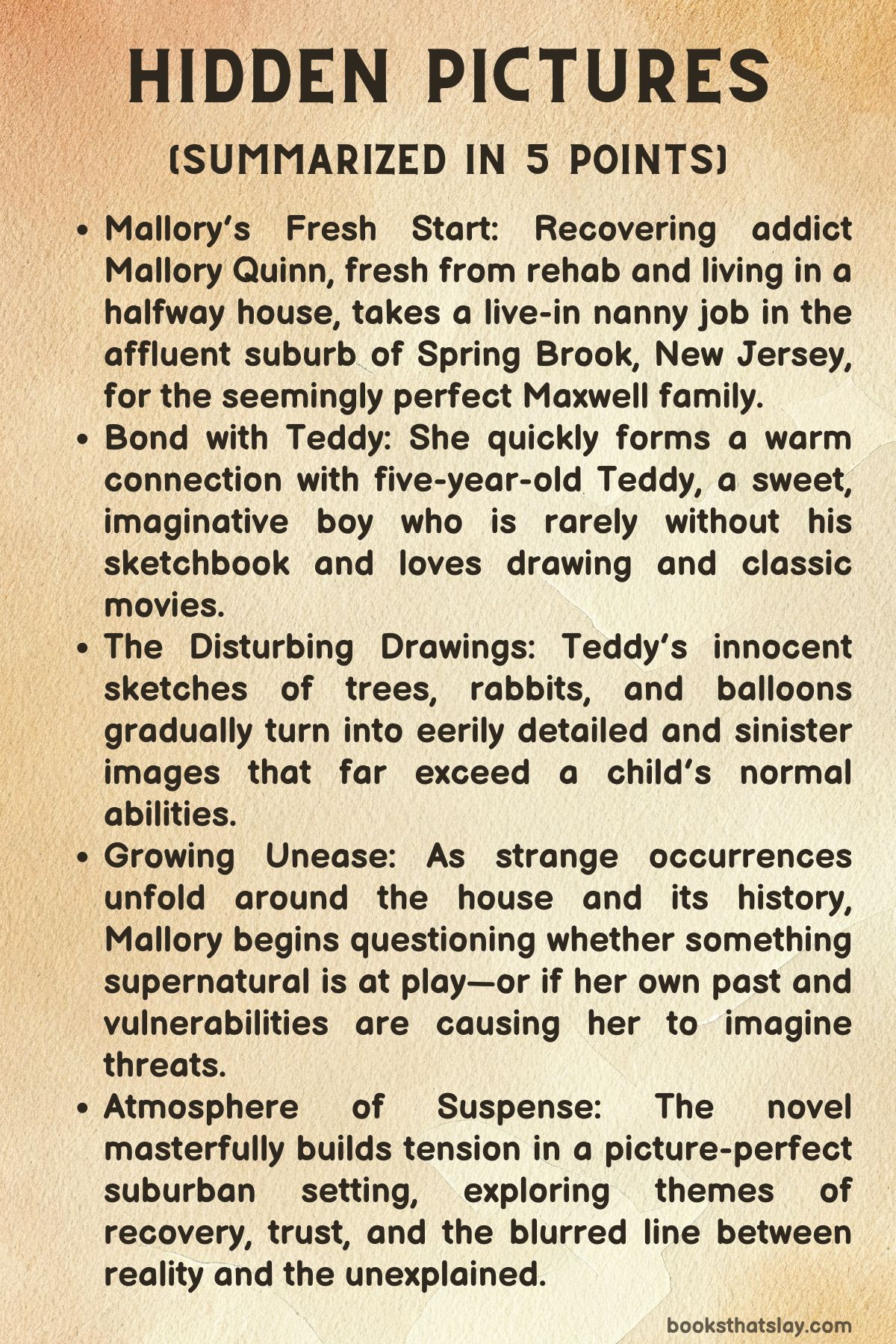
Hidden Pictures by Jason Rekulak is a psychological thriller that delves into the complexities of recovery, guilt, and the supernatural. The story follows Mallory Quinn, a woman recovering from addiction who becomes a nanny for a young boy named Teddy.
As she builds a new life, she begins to suspect that Teddy’s imaginary friend, Anya, might not be imaginary at all, but a malevolent force tied to the mysterious history of the house. The novel explores themes of identity, trust, and the haunting remnants of the past, all set against the eerie backdrop of a seemingly idyllic family home.
Summary
Mallory Quinn, 21 and eighteen months sober, lives in a Philadelphia halfway house and works at a daycare. Haunted by guilt over a car accident that killed her younger sister (and her own descent from prescription painkillers into heroin), she clings to routines, nightly runs, and meetings with her sponsor Russell.
Russell connects her with Ted and Caroline Maxwell, a wealthy couple in the affluent suburb of Spring Brook, New Jersey. They need a live-in summer nanny for their five-year-old son, Teddy.
Caroline, a polished VA hospital worker, is warm and supportive; Ted, a tech professional, is initially wary of Mallory’s past but warms up after seeing Teddy’s instant bond with her.
The Maxwells offer Mallory the guest cottage behind their large home with a pool, along with a strict list of house rules: limited screen time, no religion or superstition discussed with Teddy, emphasis on science and discipline, healthy eating, and no overnight guests. Mallory moves in, thrilled by the stability, her own space, and the chance to prove herself.
She quickly grows fond of Teddy, a shy, imaginative boy who loves drawing, playing make-believe, and classic films like The Wizard of Oz. He mentions his imaginary friend, Anya, whom he talks to and draws with.
Early on, Mallory meets two key locals. Adrian, a friendly young landscaper from a well-off family, sparks an immediate connection; Mallory lies about her past, presenting herself as a former Penn State runner on scholarship.
Next-door neighbor Mitzi is an eccentric, marijuana-smoking spiritualist who reads auras and gossips freely. Mitzi warns Mallory about the cottage’s dark history: decades earlier, in the late 1940s, a young artist named Annie Barrett lived there and mysteriously disappeared—rumored to have been murdered, with her body never found.
The Maxwells discourage contact with Mitzi, but her stories plant seeds of curiosity.
Teddy’s drawings start innocently—trees, rabbits, balloons—but soon turn disturbing. One depicts a man dragging a woman’s lifeless body through the forest.
Over time, the sketches become eerily detailed and lifelike, far beyond a typical five-year-old’s ability. Teddy draws with his right hand despite being left-handed, and his behavior grows odd.
Mallory notices the drawings seem to tell a sequential story of violence, burial, and a woman in distress. She begins to suspect that Anya is not imaginary but a supernatural force—possibly the ghost of Annie Barrett—using Teddy as a medium to reveal a long-ago murder.
Doubting her own perceptions (and fearing others will blame her recovery), Mallory investigates quietly. She secretly monitors Teddy via a baby monitor/camera and enlists Adrian’s help to research Annie Barrett.
Mitzi pushes the occult angle, suggesting a séance with a Ouija-style spirit board. During one attempt, strange things happen—the planchette moves on its own, producing jumbled letters—though Mitzi later dismisses it.
Mallory hears unexplained voices and buzzing sounds in the cottage (which she initially attributes to mosquitoes or her imagination). As her obsession grows, tensions rise with the Maxwells.
Caroline remains skeptical and protective of their “science-based” household, while Ted shows mixed signals, at times supportive and at others uncomfortably attentive toward Mallory.
The Annie Barrett trail proves largely a red herring, a clever misdirection that builds classic haunted-house atmosphere. The real horror emerges through human deception.
Mallory uncovers inconsistencies: Teddy claims never to have flown on a plane, contradicting the Maxwells’ story of living abroad; the child’s drawings and behaviors don’t fully align with the family narrative. Mallory’s digging reveals the devastating truth: Teddy is not the Maxwells’ biological child.
He—she—is actually Flora, a girl kidnapped as a toddler from her mother, Margit (a Hungarian immigrant). Caroline, believing Margit unfit, confronted her, tased her, and in the ensuing struggle, Margit died (or was left for dead and buried alive by Ted).
To cover up the crime and evade detection, the Maxwells cut Flora’s hair, dressed her as a boy named Teddy, and passed her off as their own son, claiming they had been living overseas.
The supernatural element is real but protective, not malevolent. “Anya” is Margit’s spirit—her name sounding like a child’s version of “Mama.” Margit has been communicating through drawings (using Teddy/Flora’s hand) to expose the truth and protect her daughter.
The ghost never acts violently until the climax; the pictures serve as clues to the kidnapping and murder.
The story hurtles toward a violent confrontation. Mallory uncovers enough evidence—hidden photos, inconsistencies, and more drawings—to confront the Maxwells.
Caroline, increasingly unhinged and desperate to preserve her “perfect” family, arrives armed with a gun. In the chaos, she shoots and kills Ted (who wavers and even tries to help Mallory escape at one point, revealing his conflicted feelings).
Caroline attempts to silence Mallory permanently, intending to frame her as a relapsed addict who snapped. In the struggle, Margit’s spirit possesses Teddy/Flora long enough for the child to grab a knife and fatally stab Caroline in self-defense, saving Mallory.
The police arrive to find Ted and Caroline dead, with young Flora covered in blood. The child is returned to her biological father, Jozsef.
The “haunting” resolves: Margit’s spirit has fulfilled its purpose—revealing the truth and protecting her daughter.
In the bittersweet epilogue, set about a year later, Mallory has reconciled with her own mother and continues her recovery. She and Adrian remain connected.
Mallory visits Flora (now living as a girl again with her father). The child is quiet and distant at first, trying to move on from the trauma, but ultimately offers a small gesture of affection—a hug and a pamphlet playfully titled “MALLORY’S RECIPES.” Mallory reveals that the novel itself is the book she wrote for Flora: a record of the truth, to be read someday when (or if) the girl wants to understand what happened that summer and how Mallory fought to free her.
Characters
Mallory Quinn
Mallory Quinn is a complex and multi-dimensional character, shaped by a difficult past and a strong desire for personal growth. In Hidden Pictures, she is introduced as someone in recovery, having battled addiction for many years.
At the start of the story, Mallory is living at a halfway house and working as a daycare assistant, which reflects her desire for stability and her commitment to moving forward. She is portrayed as introspective and self-aware, always reflecting on her past decisions, especially her involvement in the experimental study and its aftermath.
Mallory is driven by a strong need to rebuild her life, and this motivation pushes her to take the job as a nanny for the Maxwell family. She forms a bond with young Teddy, and her protective instincts emerge strongly as the story progresses.
Mallory’s deep vulnerability stems from her past trauma and addiction struggles, but she also demonstrates remarkable resilience as she navigates the increasingly bizarre and supernatural occurrences in the Maxwell home. Despite her growing anxiety about the house’s history and the strange events surrounding Teddy’s imaginary friend, Anya, Mallory remains determined to protect Teddy and help him, even when faced with disbelief from the Maxwells.
Her journey is one of self-discovery, coming to terms with her past while trying to make sense of the eerie, mysterious forces at play in her new life.
Teddy Maxwell
Teddy Maxwell is a gifted and imaginative young boy, whose curiosity about life and death leads him to question the boundaries of reality. He is the son of Caroline and Ted Maxwell, though his true origins are kept secret throughout most of the story.
Teddy’s deep fascination with old movies, particularly The Wizard of Oz, highlights his old soul, and he prefers films with artistic merit over popular children’s entertainment. His relationship with Mallory, the nanny, evolves into one of deep affection, with the two sharing games, playful moments, and an evolving understanding of one another.
However, as the story progresses, Teddy’s behavior takes a darker turn. His drawings, depicting disturbing scenes involving a mysterious woman named Anya, signal something more sinister at play.
Teddy’s interactions with Anya, an imaginary friend who seems to have a troubling influence on him, become central to the narrative’s supernatural elements. Despite his youth, Teddy exhibits a level of awareness and complexity that adds to the sense of unease in the story.
His true identity is revealed later on, further complicating his relationship with Mallory and the Maxwells. Throughout the story, Teddy is not just a child caught in a strange situation, but a key player in the mystery surrounding the house and its past.
Caroline Maxwell
Caroline Maxwell is the seemingly warm and caring mother in Hidden Pictures, presenting an image of calm and control. She is dedicated to her family and takes an active role in ensuring that Mallory integrates smoothly into the household as Teddy’s nanny.
However, as the story unfolds, Caroline’s true nature becomes more ambiguous. Her strictness and hidden secrets start to surface, particularly her insistence on maintaining a picture-perfect, science-focused household devoid of religion or superstition.
Caroline’s concern for Mallory’s past addiction and her willingness to hire her despite Ted’s objections suggest that she sees something in Mallory that others might overlook. However, as tensions build between Mallory and the supernatural occurrences involving Teddy, Caroline becomes increasingly hostile and skeptical of Mallory’s claims.
Her eventual violent confrontation with Mallory exposes her darker side, as she aggressively tries to silence Mallory’s growing suspicions about the truth behind Teddy’s past. Caroline’s actions throughout the book suggest that she is not merely a protective mother, but someone willing to go to extreme lengths to keep her family’s secrets buried.
Ted Maxwell
Ted Maxwell, Caroline’s husband, is initially portrayed as skeptical and wary of Mallory’s past. He expresses concerns about hiring her as a nanny, particularly due to her history of addiction.
Ted’s reservations about Mallory’s suitability for the job create a tense atmosphere between him and Mallory, especially during their first meeting. Despite his coldness, Ted’s character slowly evolves as he relaxes in Mallory’s presence and begins to value her opinions.
However, Ted remains distant, and his reluctance to fully embrace Mallory’s role in their family reflects deeper insecurities and unresolved issues, particularly about the truth of Teddy’s origins. Ted’s apparent emotional numbness and his frequent moments of self-doubt create an atmosphere of tension and unease, especially as Mallory uncovers the unsettling truth about their family.
Ted’s eventual breakdown and acceptance of Mallory’s warnings about the supernatural events are followed by a shocking twist in the narrative, which further complicates his character arc and his relationship with Mallory and Caroline.
Adrian
Adrian is a landscaper who works for the Maxwells, and his character provides an intriguing contrast to the primary family dynamics. He becomes a source of support for Mallory as she begins to investigate the mysteries surrounding Annie Barrett and the strange happenings in the Maxwell home.
Adrian’s physical presence and warm demeanor make him an approachable figure, and Mallory feels a strong connection with him as they delve into the history of the house. Adrian’s involvement in the investigation brings new insights into the supernatural occurrences, and his willingness to help Mallory reveals a layer of empathy and curiosity.
Although Mallory is hesitant to reveal the full extent of her past, Adrian’s calm and supportive nature provides a sense of comfort. Throughout the story, Adrian serves as a grounding influence for Mallory, offering help and companionship during her time of distress.
His role as an ally and his pursuit of answers contribute to Mallory’s sense of empowerment as she uncovers the truth behind the eerie events.
Mitzi
Mitzi, the Maxwells’ neighbor, plays a crucial role in unraveling the mystery surrounding Annie Barrett and the strange history of the house. Her stories about the cottage’s past, including the disappearance of Annie Barrett, introduce a dark element to the narrative.
Mitzi’s insistence that the house is haunted and her suggestion that Mallory use a Ouija board to communicate with spirits highlight her superstitious nature and her willingness to delve into the occult. Despite her eccentric behavior, Mitzi is a source of valuable information for Mallory, offering crucial details about the house’s dark history.
However, her role in the story also serves as a reminder of the tension between skepticism and belief, as Mallory grapples with the supernatural occurrences around her. Mitzi’s advice and her warnings about the house add layers of intrigue and danger to the unfolding mystery.
Themes
Addiction and Redemption
Hidden Pictures explores the complexities of addiction and the challenging journey toward recovery. Mallory Quinn’s struggle with substance abuse is at the core of her character arc, and the book delves deeply into her battle with her past and her attempt to rebuild her life.
Mallory’s initial attempt to escape the reality of her addiction leads her to make poor decisions, including participating in an experiment that she later questions. Her journey toward sobriety is not simple; it is filled with uncertainty, self-doubt, and external pressures that threaten her stability.
The halfway house where Mallory lives and the sponsorship from Russell are significant symbols of support, emphasizing the importance of community and personal accountability in overcoming addiction.
The Maxwells’ decision to hire Mallory as a nanny offers her a new chance at life. This role, which initially seems to be a straightforward job, serves as a metaphor for her chance at redemption.
Her relationship with Teddy, as well as the trust the Maxwells begin to place in her, is pivotal to her healing process. Mallory’s constant reflections on her past and her determination to maintain her sobriety, despite external challenges like her history and the unsettling events surrounding Teddy, highlight the difficult but rewarding process of personal redemption.
Ultimately, Mallory’s journey underscores the theme that recovery is a continual process that requires both internal strength and external support, with setbacks often complicating progress. This theme is explored through her inner struggles, her need for validation, and the ever-present tension between her recovery and the temptation to relapse.
Truth and Deception
The theme of truth and deception runs throughout Hidden Pictures, as Mallory finds herself in a world full of hidden secrets and lies. From the moment she enters the Maxwell family home, there is a subtle undercurrent of deception that she gradually uncovers.
Mallory’s initial acceptance of the Maxwells’ seemingly perfect family life is soon shattered as she begins to question the discrepancies in their story, particularly concerning Teddy’s past. The Maxwells’ refusal to openly discuss certain aspects of their lives—such as Teddy’s history and the mysterious events surrounding the house—builds an atmosphere of suspicion, leading Mallory to dig deeper.
As Mallory discovers more unsettling details, including the strange drawings and Teddy’s connection to a ghost, she realizes that the Maxwells have been hiding a dark secret. This theme reaches its climax when Mallory uncovers the shocking truth about Teddy’s true identity and the Maxwells’ involvement in his abduction.
The lies they’ve built around Teddy’s origins force Mallory to confront the uncomfortable reality of her role in their deception. Even the Maxwells’ behavior—Caroline’s cold, manipulative nature and Ted’s passive resistance—reveals layers of deception that contribute to Mallory’s growing isolation.
The theme of truth is also intertwined with Mallory’s personal journey. Her struggle with her addiction is itself a battle between facing the harsh truth about herself and retreating into denial.
Throughout the story, Mallory is forced to confront her past, the lies she has told herself, and the manipulations that others have perpetrated. The shocking revelations about Teddy’s history force Mallory to reconcile her own past mistakes with the need to protect the truth, even when it is painful.
Childhood and Innocence
Childhood and innocence are explored through the character of Teddy, a young boy with a deep curiosity about life, death, and the supernatural. Teddy’s fascination with old films, particularly The Wizard of Oz, speaks to his innocence and imaginative nature.
His relationship with Mallory is nurturing, as she takes on the role of a caretaker who offers him guidance and affection. However, as the story progresses, Teddy’s innocence begins to unravel, particularly as he becomes involved in the eerie drawings linked to Anya, an imaginary friend with a dark and sinister presence.
Teddy’s transformation from an innocent child into someone connected to something far darker reflects the loss of innocence, as he grapples with the unexplained events surrounding the house and his encounters with the spirit of Annie Barrett. Mallory’s protective instincts for Teddy emphasize the tension between preserving the purity of childhood and the harsh realities that can interrupt it.
Her concern for Teddy’s well-being grows as she witnesses his disturbing drawings and begins to understand the connection between his fantasies and the haunting spirit. Ultimately, the loss of innocence is not just about Teddy’s exposure to evil forces but also about Mallory’s realization that her role in his life is more complicated than she had initially believed.
Furthermore, the theme of childhood innocence is symbolized by the way the Maxwells handle Teddy’s upbringing. They impose strict rules and maintain a controlled environment, shielding him from the outside world in an attempt to protect him from harm.
However, this overprotectiveness is also part of the deception, as they hide the truth of his past. The loss of innocence, then, is not just about Teddy’s experiences with supernatural forces, but about how the truths of his origin are kept from him and Mallory.
This theme asks profound questions about the nature of childhood, the forces that shape a child’s development, and the price of shielding them from painful realities.
The Supernatural and the Unexplained
The supernatural element is a key theme, where ghostly events and mysterious phenomena plague Mallory’s time with the Maxwells. At first, these occurrences seem like figments of Mallory’s imagination or possibly a result of her past drug use, but as the story progresses, they become more real and disturbing.
The figure of Anya, Teddy’s imaginary friend, initially appears to be a harmless creation, but as Teddy’s drawings become more unsettling, it becomes clear that Anya might not be a figment of a child’s imagination at all.
The house itself, with its strange history and connection to the long-lost Annie Barrett, seems to hold a malevolent force that influences the events within it. Mallory’s suspicion grows as she links Teddy’s drawings to the stories of Annie’s disappearance, and she begins to believe that the spirit of Annie is using Teddy as a medium to communicate.
The supernatural elements in the story are layered with tension and fear, leaving Mallory—and the reader—uncertain about what is real and what is imagined. This theme creates a constant undercurrent of unease, as Mallory tries to navigate the fine line between supernatural phenomena and her own mental state.
Ultimately, the supernatural is tied to the theme of powerlessness. Mallory’s vulnerability, both from her past and her struggle to gain the Maxwells’ trust, makes her an unreliable narrator in the eyes of others.
The growing presence of Anya and the unsettling events that take place within the house make it hard for Mallory to maintain her credibility, especially as the Maxwells remain dismissive of her concerns. The supernatural serves as a metaphor for the unresolved issues in Mallory’s life, and it forces her to confront the unseen forces that have shaped her past.
It is only when she begins to understand the true nature of the haunting that she can finally take control of her life and fight for Teddy’s safety.