Hidden Potential by Adam Grant Summary and Analysis
Hidden Potential: The Science of Achieving Greater Things by Adam Grant is a non-fiction book about how people grow into excellence, especially when they don’t start with obvious advantages. Grant argues that talent is often overrated and that progress depends more on how we learn, how we practice, and the support systems around us
Through stories from chess, business, sports, music, rescue missions, and spaceflight, he shows that potential isn’t a fixed trait—it’s something that can be built. The book focuses on practical ideas: becoming better learners, aiming for high standards without chasing flawlessness, and using mentors, structure, and smart practice to keep improving over time.
Summary
A group of middle-school chess players arrives at a national championship with almost none of the advantages their rivals take for granted. The dominant teams come from elite programs where chess is treated like a serious academic subject—students start young, receive structured instruction for years, and train with excellent coaches.
By comparison, the Harlem team, the Raging Rooks, is made up of kids who learned late, practiced wherever they could, and lived with daily pressures far outside the tournament hall. They also have no buffer: the scoring rules allow big teams to drop weak results, but the Raging Rooks have barely enough players, so every game matters.
Their coach, Maurice Ashley, pushes them to compete with discipline and composure. Early in the tournament, they begin upsetting stronger opponents, including a surprise win by their lowest-rated player.
As the rounds continue, they climb into the top tier and enter the semifinals among the leading teams. Then the momentum breaks.
A few painful mistakes turn wins into draws and losses. One player collapses emotionally after blundering away a strong position.
Another match begins so badly that the coach can’t bear to watch. The team drops in the standings, and their path to the title looks nearly impossible.
Instead of letting disappointment take over, the coach brings them back to what they can control: their decisions, their focus, their steadiness. To have any chance, they must win their remaining games and hope other teams slip.
In the final round, they fight with urgency. Two players deliver checkmates that keep the dream alive.
Their captain, Kasaun Henry, faces a higher-rated opponent from the powerhouse school and battles through a long endgame. When he finally wins, the result sends a shock through the tournament—and the teams ahead of them stumble at the same time.
The Raging Rooks tie for first place and become national champions. They celebrate in disbelief, not only because they won, but because they proved that rapid growth is possible when effort is directed well and a strong culture holds under pressure.
The victory becomes a starting point rather than an ending. Maurice Ashley’s coaching gains attention, and later he helps build a wider chess movement in Harlem that leads to more national titles, more programs, and more opportunities for students who had been overlooked.
The story also follows what happens after the tournament: the players grow into accomplished adults in fields like engineering, leadership, filmmaking, and education. Their achievement becomes evidence that ability can bloom when people gain access to learning, support, and high expectations.
From there, the book steps back to ask what allows people to improve faster than expected. It begins with a metaphor from nature: sea sponges survive mass extinctions by constantly pulling in what they need, filtering out what harms them, and adapting to extreme conditions.
That “spongelike” mindset becomes a model for learning. The book contrasts different approaches to growth, showing how some people react defensively or protect their ego, while others actively seek input and treat development as a long-term project.
The goal is to become the kind of learner who hunts for useful information, screens out noise, and keeps adjusting.
Mellody Hobson’s childhood illustrates how learning capacity can change a life. She grows up in Chicago as the youngest of six children in a family living with repeated financial crises—shut-off utilities, evictions, instability that makes school harder.
She starts out behind and struggles to read, landing in remedial classes. Yet she improves, builds confidence, and later rises into major leadership roles in finance and corporate governance.
Her story is used to challenge a common explanation that success is mainly about working harder than others. The book points to research on the Protestant Reformation to argue that large economic differences were driven less by work intensity and more by literacy.
When communities gained reading skills, they gained access to knowledge, jobs, and mobility. In other words, the ability to learn opened doors that effort alone could not.
Hobson’s progress also shows what active learning looks like. She pushes herself to finish difficult books, stops to look up unfamiliar words, and treats confusion as a signal to gather more information rather than a reason to quit.
Later, when she gets access to a mentor in investing, she meets him regularly and studies until she can speak fluently about markets and decisions. The book highlights a simple but powerful shift: rather than asking for vague “feedback,” she and others learn to ask for “advice,” which invites concrete suggestions that can be acted on.
A sports example reinforces the same idea. Julius Yego, a javelin thrower from rural Kenya, starts with almost no facilities and no coach.
He trains alone, using videos and whatever learning tools he can find, and slowly builds elite technique. His rival, Ihab Abdelrahman, has clear physical advantages and early success, but struggles to sustain progress when outside support fades.
The contrast is not about who has the better body; it’s about who takes ownership of learning. Yego actively searches for instruction, experiments, adapts what he sees to fit his style, and keeps improving through setbacks and injuries.
The book then turns to the problem of perfectionism. Through the story of architect Tadao Ando—who teaches himself design through intense study and practice—it argues that excellence is not the same as flawlessness.
Ando chooses what to optimize and what to accept as “good enough,” protecting the core of his vision without getting stuck trying to make every detail ideal. This connects to the author’s own experience in diving: obsessing over tiny errors creates hesitation and stalls progress, while clear targets and repeated attempts build confidence and skill.
A similar pattern appears in the theater world, where choreographer Twyla Tharp faces harsh criticism, sorts it carefully, focuses on repeated issues, and makes focused changes that transform the production into a major success. The lesson is to treat evaluation as information, not as a final verdict on ability.
Support from others becomes another major theme. The book introduces “scaffolding” as temporary help that arrives at the right moment, fits the specific obstacle, and then fades as a person gains strength.
One example comes from music: Evelyn Glennie, who becomes profoundly deaf, is told she lacks the ability to succeed. With the guidance of a teacher, she learns to “hear” through vibrations, training her body to sense rhythm and pitch in a different way.
Her progress comes from a sequence of challenges that stretch her without crushing her, showing how well-designed support can build independence.
Finally, the book emphasizes persistence paired with smart strategy. A rescue story from the Chilean mining disaster highlights how a blocked plan can be saved by a creative alternative—and how persistence includes pushing ideas through resistance until the right decision-maker listens.
The long arc of José Hernández, who dreams of becoming an astronaut, brings the point home. He applies again and again for years, collecting rejections with almost no guidance.
Rather than repeating the same approach, he expands his skills in ways he believes NASA values, building credentials and experiences that fit the selection system. When he finally reaches the finalist stage, he gets the chance to explain the obstacles he overcame—details that never appeared in the earlier screening.
Even after another rejection, he continues contributing, and eventually he is selected and reaches space. His story shows that long-term growth often requires both stamina and adjustment: keeping the goal while changing the route.
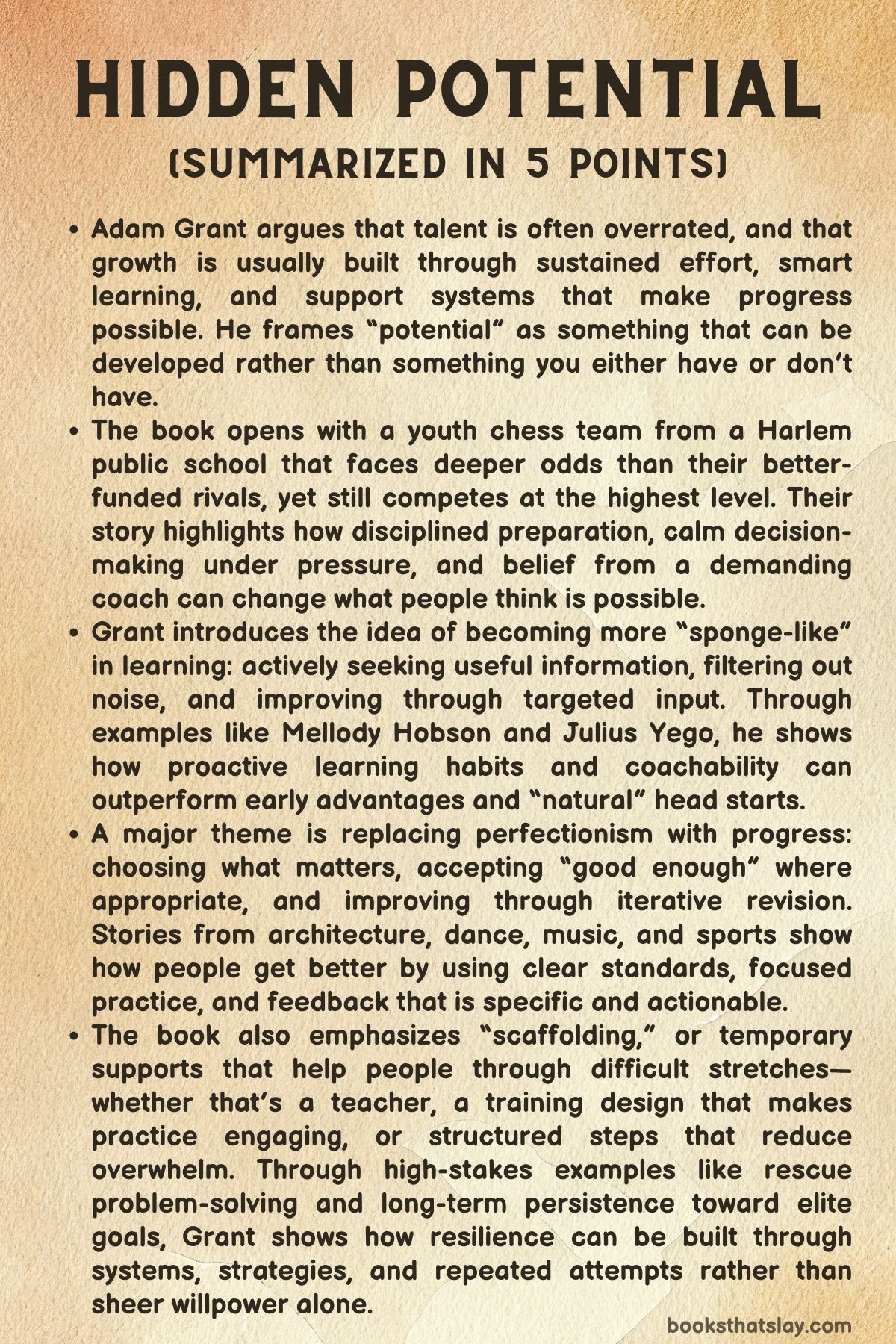
Across all these stories, Hidden Potential argues that people rise not because they were born ready, but because they become better learners, practice in smarter ways, accept high standards without chasing perfection, and rely on supportive structures that help them climb to the next level.
Key Figures
Adam Grant
In Hidden Potential – Adam Grant, Adam Grant functions as both storyteller and synthesizer: he threads together chess, biology, business, sport, art, and personal experience to argue that growth is not reserved for the naturally gifted but can be built through the right systems and mindsets. He positions himself inside the narrative at key moments—especially when describing his struggles with public speaking and perfectionism—to demonstrate that improvement is often uncomfortable, unglamorous, and slow, even for someone already successful in one domain.
His role is also that of a curator of examples: he does not treat any single person as a solitary hero, but instead repeatedly highlights how environments, mentors, feedback, and practice design shape what people become. Through his presence, the book’s voice stays practical and humane: he admits blind spots, shows how advice differs from vague feedback, and models the exact kind of “absorbing and filtering” behavior that he calls spongelike learning.
Kasaun Henry
In Hidden Potential – Adam Grant, Kasaun Henry is framed as a high-pressure leader in the making, a young player whose growth happens in public and under constraints that offer little margin for error. As captain of the Raging Rooks, he embodies both the promise and fragility of emerging talent: he can build an advantage and still make a serious mistake, and he can also recover, recalibrate, and fight through a long endgame against a higher-rated opponent when everything is on the line.
His background—learning chess relatively late, practicing in a park, and navigating an environment shaped by poverty and instability—makes his competitive composure especially meaningful because it is not portrayed as innate calm but as earned self-control. The narrative uses his arc to show that potential is not a fixed trait revealed by early privilege; it is something shaped by exposure, discipline, and the ability to refocus on controllable decisions when momentum breaks.
Maurice Ashley
In Hidden Potential – Adam Grant, Maurice Ashley appears as the catalytic builder of possibility—the coach who not only teaches chess but also constructs belief, structure, and standards where none previously existed. He is defined by a mix of intensity and purpose: he pushes the team hard, but his pressure is tied to a mission to challenge stereotypes about intellectual excellence and to prove that overlooked kids can perform at elite levels.
When the team falters, his leadership becomes psychological as much as technical; he regroups them by narrowing their attention to decisions rather than outcomes, essentially training emotional regulation as a competitive skill. His later trajectory—stepping away from coaching to pursue his own mastery and becoming the first African American chess grandmaster—extends the theme that scaffolding works in both directions: he supports others, then reshapes his own path.
He also represents continuity, because his impact outlives the tournament win and becomes a seed for a broader movement in Harlem chess.
Charu Robinson
In Hidden Potential – Adam Grant, Charu Robinson is depicted as a bridge between the original underdog victory and the long-term expansion of opportunity that follows it. As one of the original Raging Rooks, Charu’s significance grows after the championship, when the story shifts from a single triumph to a sustained ecosystem of teaching and mentorship.
Serving as an assistant coach and later teaching chess across New York City schools, Charu becomes an example of how achievement can convert into service, and how the most durable form of success is often the ability to reproduce it in others. The narrative implies that Charu’s development is not only about personal accomplishment but about multiplying access—turning what was once rare in low-income schools into something more available, normal, and institutional.
Jonathan Nock
In Hidden Potential – Adam Grant, Jonathan Nock represents the “afterlife” of early transformation: he is one of the proofs that the skills built through disciplined learning can translate beyond the original arena. The mention of him becoming a software engineer and company founder is not treated as a random career update; it functions as evidence that the habits cultivated in a demanding chess environment—problem solving, patience, calculation, and resilience after setbacks—can become portable strengths.
His character is therefore less about a single dramatic scene and more about what the chess story implies: that when overlooked students are given structured challenge and real standards, they can build trajectories that would have looked improbable from the outside.
Francis Idehen
In Hidden Potential – Adam Grant, Francis Idehen is presented as another form of long-run outcome: academic and leadership attainment that counters the low-expectation narrative often attached to students from under-resourced communities. His later degrees from Yale and Harvard and senior leadership roles are positioned as the continuation of a pattern established in the chess arc—early barriers do not preclude elite performance when learning is accelerated through coaching, belonging, and demanding practice.
Francis’s role in the summary functions as an emblem of institutional navigation: he becomes someone who not only performs well but moves through highly selective systems, suggesting that the confidence and discipline developed in the Raging Rooks experience can scale into environments that are traditionally gatekept.
The Raging Rooks Team Members
In Hidden Potential – Adam Grant, the Raging Rooks collectively operate as a single character with many faces: a team defined by constraint, urgency, and mutual dependence. Unlike their rivals with deep benches, they cannot hide a weak performance because every result counts, which forces an unusually intense kind of accountability and cohesion.
Their early upset—especially by the weakest player defeating a much higher-rated opponent—signals that the book is less interested in the predictable stars and more interested in the conditions that let unlikely breakthroughs occur. Their mid-tournament collapse, emotional volatility, and eventual recovery reveal a central point: potential is not a smooth upward line, and composure is trained, not gifted.
By winning through a combination of skill, steadiness, and the ability to refocus after mistakes, they become a living argument against deterministic views of talent.
Dalton Team and Dalton Chess Program
In Hidden Potential – Adam Grant, Dalton is less a villain and more a symbol of accumulated advantage and systematized excellence. The school’s chess program is depicted like an academic pipeline—early exposure, structured instruction, constant coaching, and abundant practice time—so Dalton represents what happens when resources and expectations align from the beginning.
Their deep roster also embodies structural protection: they can drop low scores and still compete, which mirrors how privilege often includes buffers against failure. By having the Raging Rooks defeat Dalton’s top player in the deciding moment, the narrative does not claim that training is irrelevant; instead, it reframes training as something that should be distributed more widely.
Dalton’s role is to highlight the contrast between excellence that is cultivated early through institutional support and excellence that is constructed later through urgency, coaching, and grit.
The Dark Knights Team and Harlem Chess Movement Leaders
In Hidden Potential – Adam Grant, the Dark Knights and the wider Harlem chess movement represent the conversion of a single improbable win into a repeatable model. Their back-to-back championships after Maurice is asked to coach again are used to show that the first victory was not a fluke but an early signal that the right scaffolding can consistently produce elite outcomes.
The later continuation—Dark Knights winning again even with a new coach—matters because it proves that the “engine” is not one charismatic leader alone; it is the establishment of norms, methods, and community belief that persist beyond any one person. This part of the narrative elevates the concept of legacy: once a path exists, more people can walk it.
Mellody Hobson
In Hidden Potential – Adam Grant, Mellody Hobson is portrayed as a case study in late-start learning and proactive absorption, someone whose childhood instability could have hardened into limitation but instead becomes fuel for growth. Her early struggle—starting school unable to read and placed in remedial classes—creates a sharp contrast with her later stature as co-CEO and influential board leader, but the narrative resists reducing her to a simple “work hard” moral.
Instead, she is framed as spongelike: she learns to take in information deliberately, insists on finishing challenging books by looking up what she does not know, and continuously expands her capacity to learn rather than merely proving she can endure. Her internship routines—meeting John Rogers, studying markets, building fluency by doing the unglamorous work repeatedly—show that her success is tied to how she learns, not just how long she works.
She also illustrates humility and adjustment, especially in her relationship with Bill Bradley, where she chooses growth over ego by asking how to improve after receiving painful but credible critique.
Mellody Hobson’s Mother
In Hidden Potential – Adam Grant, Mellody Hobson’s mother appears as the constant force inside chaos, raising six children while enduring relentless financial emergencies. Although she is not analyzed through many direct scenes, her presence defines the environment that shapes Mellody’s early life: evictions, utilities shut off, and instability that could easily shrink a child’s sense of what is possible.
As a character, she embodies endurance without romanticizing hardship; the summary uses her not to claim that suffering is automatically character-building, but to show what Mellody had to navigate before the story even begins. Her role is foundational: she represents the unseen labor and resilience behind many success narratives, and she also underlines how much of “potential” can be suppressed or revealed depending on whether a child’s environment offers stability, instruction, and opportunity.
John Rogers
In Hidden Potential – Adam Grant, John Rogers functions as a practical mentor who makes learning concrete through routine, exposure, and standards. By meeting Mellody at McDonald’s on Saturdays and pushing her to study newspapers and markets until she can speak intelligently about investing, he provides a form of scaffolding that is both accessible and demanding.
He is not portrayed as a savior who hands her status; he is portrayed as someone who structures her attention and raises the level of conversation she is able to enter. His mentorship is also an example of how expertise is transmitted: not through vague encouragement, but through repeated immersion, accountability, and the expectation that she can learn a new language of ideas.
Bill Bradley
In Hidden Potential – Adam Grant, Bill Bradley is the embodiment of high-quality critique—feedback that hurts, but lands because it comes from credibility, care, and understanding. His warning that Mellody can dominate rooms like a “ball hog” is framed as a turning point because it reveals a blind spot that success can create: competence can become over-control, and leadership can slip into taking too much space.
What makes him significant is not just the comment but the conditions around it: he is positioned as someone whose experience gives him authority, whose intent is constructive, and whose relationship with Mellody allows honesty. The moment becomes a lesson in what separates growth from defensiveness: Mellody recognizes his care, asks how to improve, and changes her behavior, turning discomfort into development and eventually into a deeper bond that opens doors through introductions.
Sascha Becker
In Hidden Potential – Adam Grant, Sascha Becker appears as an explanatory character rather than a dramatic one: an economist whose research helps shift the reader away from simplistic beliefs about why some groups prosper. His role is to support the book’s argument that achievement often comes from learnable skills and social systems rather than inherent virtue.
By linking Protestant regions to higher literacy and income and then emphasizing literacy as the key mechanism, his presence in the narrative helps the author reframe cultural explanations of success into skill-based, teachable explanations. Becker represents the analytical backbone behind the moral message: change the inputs—like reading—and you change outcomes.
Ludger Woessmann
In Hidden Potential – Adam Grant, Ludger Woessmann complements Sascha Becker as part of the research lens that redirects credit from vague notions of work ethic to the concrete power of literacy. His contribution matters because it reinforces a central theme of the book: what looks like a character trait in the outcome is often a skill that was cultivated earlier by institutions and incentives.
By emphasizing that proximity to the Reformation predicts literacy and that literacy explains income differences, Woessmann’s role is to strengthen the argument that human potential expands when learning tools spread. He is less a person in a story and more a voice in the book’s logic, making the case that education and capability-building can be the true engines of inequality reversal.
Martin Luther
In Hidden Potential – Adam Grant, Martin Luther appears as a historical catalyst whose insistence on universal scripture literacy unintentionally becomes a mass educational intervention. The book uses him not to debate theology, but to show how a moral or cultural movement can transform economic and social outcomes through a very specific mechanism: reading.
Luther’s character function is symbolic: he stands for the idea that when a society makes a skill widely necessary and widely taught, it reshapes who can succeed. In the logic of the narrative, he represents the power of creating conditions where learning becomes unavoidable and supported rather than optional and elitist.
Sea Sponges
In Hidden Potential – Adam Grant, sea sponges operate as a metaphorical character—a living model of resilience and intelligent adaptation without intelligence in the usual sense. Their biology becomes a story about selective absorption: they take in water, capture nutrients, expel bacteria, and filter waste, surviving catastrophes that erase most species.
The summary emphasizes their longevity, regeneration, and ability to restart growth when conditions improve, turning them into an emblem of how progress can be non-linear and restartable. Their purpose is not cute symbolism; it is to give the reader an image for learning behavior: absorb what nourishes growth, filter out what poisons attention, and keep adapting through instability.
Julius Yego
In Hidden Potential – Adam Grant, Julius Yego represents proactive learning under extreme scarcity, someone who does not wait for infrastructure, coaching, or permission. Training alone in rural Kenya, he builds skill by hunting for instruction wherever it exists, eventually teaching himself technique through YouTube videos in an internet café and translating that knowledge into an unconventional but effective style.
His story highlights a particular kind of agency: not only persistence, but curiosity and self-directed correction when the normal supports are absent. The contrast with a more advantaged rival sharpens his character: Yego is not just hardworking; he is adaptive, and he treats learning as something he can assemble from fragments.
Even his Olympic silver after an injury narrows him to one valid throw, emphasizing that his excellence includes the ability to deliver under constraint when perfection is impossible.
Ihab Abdelrahman
In Hidden Potential – Adam Grant, Ihab Abdelrahman is portrayed as talented and initially ascendant, a late starter who surges quickly and possesses clear physical advantages in javelin. Yet his arc is used to illustrate a vulnerability that often hides inside success: reliance on external structure.
When support disappears, he stops training, implying that his learning orientation is reactive rather than self-sustaining. He becomes a contrast character—someone who can excel when conditions are favorable but does not build the internal system needed to keep improving when conditions change.
The narrative does not mock him; it uses him to show that coachability and talent are not enough if the learner does not take ownership of acquiring instruction and adapting independently.
Tadao Ando
In Hidden Potential – Adam Grant, Tadao Ando embodies disciplined self-education and the courage to be imperfect in the pursuit of excellence. Racing back after the Kobe earthquake to find that none of his 35 buildings collapse or crack positions him as someone whose standards are real and tested, not aesthetic.
His poverty and lack of formal training sharpen the book’s theme that expertise can be built through obsession, iteration, and choosing what matters most. Most importantly, Ando is used to redefine perfectionism: he rejects the illusion of getting everything right and instead decides what to optimize and what to accept as “good enough,” even when that means leaving comfort flaws in place to preserve the design’s vision.
His “green apple” symbol deepens the characterization—he is someone committed to staying unfinished, treating growth as a lifelong posture rather than a phase that ends once mastery is reached.
Eric Best
In Hidden Potential – Adam Grant, Eric Best appears as the coach who rewires a perfectionist’s relationship with performance. Working with the author as a diver, Best recognizes that obsessive attention to detail can freeze action, especially under pressure, and he counters it with concrete targets and a healthier definition of excellence.
By teaching that a “10” means excellence rather than perfection, he gives the author permission to attempt difficult dives that are “good enough,” creating space for progress that perfectionism was blocking. His function in the narrative is a form of scaffolding: he provides a temporary mindset structure that helps the learner move through a narrow window where fear, pride, and overcontrol would otherwise halt growth.
Twyla Tharp
In Hidden Potential – Adam Grant, Twyla Tharp is presented as a professional whose greatness includes the ability to metabolize criticism rather than deny it. When her Chicago debut of Movin’ Out is heavily criticized, she does not treat reviews as personal attacks or ignore them as noise; she sorts them, looks for patterns, and focuses on repeated complaints that indicate real weaknesses.
Her willingness to reuse choreography to add a prologue shows her pragmatism: she is not precious about novelty when the goal is improvement. Tharp’s character illustrates a mature creative mindset where revision is not humiliation but craft, and where resilience includes the ability to decide which critiques to absorb and which to discard.
Evelyn Glennie
In Hidden Potential – Adam Grant, Evelyn Glennie personifies the idea that limitations can be navigated through alternative pathways rather than surrendered to. Rejected by a prestigious institution and told she lacks ability, she is forced into a crossroads where the world’s definition of musical capacity conflicts with her desire to perform.
With the right teacher and method, she learns to “hear” through vibration across her body, an approach that reframes deafness not as an endpoint but as a constraint requiring a different system. Her development is described like leveling up—progressive challenges that are hard but achievable—so her story becomes a template for scaffolding: build skill through steps that stretch capability without breaking motivation.
She represents a form of mastery rooted in sensory creativity, persistence, and redesigned practice rather than conventional talent metrics.
Ron Forbes
In Hidden Potential – Adam Grant, Ron Forbes functions as the precise kind of scaffolder the book argues we all need at the right time: he does not merely encourage Evelyn Glennie, he invents a method that makes growth possible. Teaching her to practice barefoot and interpret vibration is not a gimmick; it is an instructional redesign tailored to her obstacle.
He embodies the idea that great teaching is diagnostic and adaptive, identifying the core barrier and building a bridge around it. His role also highlights temporariness: scaffolding supports development until the learner can stand independently, and the point is not dependence on the teacher but the emergence of capability that was previously inaccessible.
Brandon Payne
In Hidden Potential – Adam Grant, Brandon Payne is portrayed as an architect of practice who understands that repetition alone is not the engine of improvement—engagement is. Because he himself was limited athletically and reluctant to drill, he develops a philosophy that takes boredom seriously as a performance risk and designs game-based workouts that make effort compelling.
His training approach relies on scoring, timing, and constant variation, turning practice into an environment where attention stays alive and progress is measurable. Payne represents the book’s belief that the best systems do not force people to endure learning; they make learning addictive in a healthy way.
His character stands for the craft of coaching itself: designing conditions where hard work is sustainable because the process is rewarding.
Stephen Curry
In Hidden Potential – Adam Grant, Stephen Curry is depicted as a case of underestimated potential that blooms through a combination of well-designed practice and love for the process. Initially viewed as physically limited and underrated, he becomes a record-setting shooter not by grinding joylessly but by training in an environment that turns difficulty into a challenge he wants to return to.
The narrative uses him to illustrate that elite performance is often less about a single breakthrough and more about thousands of intentionally structured reps that build confidence, creativity, and consistency under pressure. Curry’s character is important because he disrupts the stereotype that only the naturally imposing dominate in sport; his story argues that obsession with craft, combined with smart scaffolding, can rewrite what a “prototype” of greatness looks like.
Igor
In Hidden Potential – Adam Grant, Igor is portrayed as a problem-solver whose most valuable trait is not technical authority but persistence in persuasion and creative recall under pressure. Facing a blocked rescue shaft, he does not accept brute force failure as final; he reaches back to something remembered from school and translates it into a workable mechanical concept, imagining an industrial claw tool like an arcade machine.
His character becomes a study in practical ingenuity: having an idea is not enough, because he must also navigate bureaucracy, dismissal, and inertia, repeatedly pushing the concept upward until the Chilean mining minister approves it. Igor’s persistence is not stubbornness for its own sake; it is directed persistence, focused on clearing a specific obstacle so a larger plan can proceed.
He represents the book’s theme that solutions often come from recombining old knowledge in new contexts—and then fighting for that recombination to be taken seriously.
The Chilean Mining Minister
In Hidden Potential – Adam Grant, the Chilean mining minister appears briefly but plays a decisive institutional role: the person whose authority turns a marginalized idea into an approved plan. The minister’s immediate approval contrasts with the prior two days of dismissal Igor faces, underscoring how innovation can be blocked less by feasibility than by hierarchy and risk aversion at lower levels.
As a character function, the minister represents the gatekeeper who can accelerate action when convinced, illustrating that systems matter not only in learning but in crisis response. The minister’s role is also a reminder that persistence often needs a target: Igor’s breakthrough required reaching someone with the power to say yes.
The Rescue Workers and the Miners
In Hidden Potential – Adam Grant, the rescue workers and miners serve as collective characters representing endurance, coordination, and trust in a fragile chain of action. Their role in the summary is not to individualize heroism but to show how success depends on many people executing reliably after a key obstacle is removed.
The miners’ emergence—one by one, culminating with the foreman last—turns the story into a narrative of sustained completion rather than a single climactic moment. They embody the human side of high-stakes persistence: the emotional weight of repeated failed attempts, the discipline to keep trying, and the shared relief when effort finally converts into life-saving results.
José Hernandez
In Hidden Potential – Adam Grant, José Hernandez is portrayed as an embodiment of long-horizon persistence, someone whose dream survives boredom, rejection, and invisible barriers. His commitment begins in childhood wonder and evolves into decades of deliberate preparation: degrees in engineering, strategic career moves, and repeated applications that fail without explanation.
What makes his character especially compelling in the book’s logic is the mismatch between his lived difficulty and what the selection system initially sees—his migrant farmworker background, language challenges, interrupted schooling, and labor demands are largely absent from the early application filter. José’s arc becomes a critique of selection systems as much as a celebration of grit: he is repeatedly rejected not because he lacks capability, but because the screening criteria emphasize different signals.
His eventual breakthrough—becoming a finalist, finally being able to tell his story in person, accepting an engineering role, and later being selected as an astronaut after fifteen years—illustrates how persistence becomes powerful when paired with strategic adaptation. He does not merely endure; he changes his profile, broadens skills he believes matter, and keeps moving toward the goal even when the path shifts.
Adela
In Hidden Potential – Adam Grant, Adela functions as the emotional stabilizer and belief-holder during José Hernandez’s longest stretch of discouragement. When repeated rejection erodes his morale, her encouragement becomes the support that keeps persistence from collapsing into resignation.
She is not shown as someone who carries him forward through magical positivity; she represents grounded partnership, the kind that reminds someone of their own story when the system refuses to validate it. Her presence reinforces one of the book’s recurring messages: endurance is rarely a solo performance, and even the most individual dream is often sustained by someone who refuses to let temporary failure define the person they love.
Duane Ross
In Hidden Potential – Adam Grant, Duane Ross appears as a symbol of institutional continuity and the hidden face of gatekeeping. As the longtime head of astronaut selection who signed José Hernandez’s prior rejection letters, he represents the system that repeatedly says no without explanation, even when the applicant is growing stronger.
His later personal call after José becomes a finalist adds a human layer to what had felt like a faceless process, showing that even rigid systems contain individuals who can recognize quality once it becomes visible through the right channel. Ross’s role also sharpens the theme that selection is not a pure measure of worth; it is a filter shaped by priorities, and sometimes the difference between rejection and opportunity is simply reaching a stage where the full person can be seen.
Themes
Potential as a product of conditions, not a fixed trait
The opening chess story sets a clear contrast between polished advantage and raw possibility. The Raging Rooks arrive without the early training pipelines, private coaching, and institutional support that define Dalton’s dominance, yet they still perform at the highest level when the environment shifts from “who has the best résumé” to “who can execute today.” That gap between resources and results becomes a lens for Hidden Potential to challenge the habit of treating talent as a permanent label.
The team’s situation is structurally harder—no extra players to absorb losses, no margin for an off day—so their success cannot be explained away as luck or a single breakout star. It is framed as evidence that ability is often hidden by unequal access to practice, instruction, and belief.
Their coach, Maurice Ashley, is not portrayed as a magician who discovers genius; he is portrayed as someone who creates conditions where effort becomes organized, pressure becomes manageable, and mistakes become information instead of identity. The narrative also makes room for the idea that potential can be invisible even to the person who has it.
Many of the players are navigating poverty, instability, and low expectations, which can shrink the range of futures that feel realistic. The championship becomes less a fairy-tale ending and more a demonstration that performance can change quickly when training is focused, standards are clear, and a group is treated as capable of excellence.
The later ripple effects—more programs, more coaching, more students entering tournaments—extend the theme beyond individual triumph into community transformation. What looks like personal greatness is repeatedly shown to depend on opportunity, guidance, repetition, and a system that stops confusing privilege with merit.
Learning that filters noise and converts setbacks into usable input
Survival is introduced through the image of sea sponges: organisms that endure catastrophe by continuously processing what the environment offers, keeping what helps and rejecting what harms. That metaphor becomes a practical model for learning in Hidden Potential—not passive consumption, but active selection.
The point is not “take in everything,” because much of what people receive is distracting, discouraging, or irrelevant. The difference-maker is the ability to decide what information deserves attention and what should be discarded.
Mellody Hobson’s trajectory is a direct example: early academic delay is not treated as proof of limitation; it becomes a starting point that changes once she gains access to reading and then chooses to keep going past the minimum. Her insistence on finishing a difficult book by looking up unknown words shows learning as a series of small, repeated decisions to stay with confusion long enough to turn it into clarity.
The same filtering skill appears in her later market training with John Rogers, where she repeatedly studies and discusses until fluency replaces intimidation. This theme also exposes how ego can corrupt learning.
When someone seeks confirmation, they interpret vague praise as evidence of competence and tune out critique as unfair. When someone seeks growth, they look for specific, actionable guidance and treat discomfort as a signal that improvement is possible.
The author’s shift from asking for “feedback” to asking for “advice” captures this transformation: “feedback” often triggers judgment and defensiveness, while “advice” invites concrete suggestions that can be tested. Over time, this approach turns criticism into a tool rather than a threat.
The theme insists that learning is not mainly about intelligence; it is about building habits that keep extracting value from experience—especially the uncomfortable parts—until progress becomes predictable.
Scaffolding: support that arrives at the right moment and then steps back
A repeated pattern across the stories is targeted help that does not replace effort, but shapes it. The concept of scaffolding describes support that is tailored to a specific obstacle, delivered during a window when it can make the biggest difference, and removed once the person can stand on their own.
This is not presented as coddling; it is presented as intelligent design. Evelyn Glennie’s path illustrates this with unusual clarity.
She is told she lacks ability, and her deafness is treated as a hard boundary, yet her teacher Ron Forbes changes the task itself: “hearing” becomes sensing vibration, practice becomes embodied, and difficulty increases in carefully sized steps. The support is technical, emotional, and strategic—he provides a new method, a belief that competence is possible, and a progression that prevents overwhelm.
The chess team receives a similar kind of structure. Maurice Ashley does not merely motivate; he sets standards, trains composure, and refocuses attention on decisions rather than outcomes when momentum breaks.
That shift matters because pressure can cause talented people to collapse into fear, while well-scaffolded performers keep making good choices even when the situation turns hostile. The rescue story adds another dimension: scaffolding can also be organizational.
Igor’s plan is initially dismissed, not because it is irrational, but because the system defaults to established channels and familiar solutions. He persists upward until someone with authority can evaluate the idea on its merits.
Once approved, the team keeps attempting and failing in a controlled way until the claw finally works, showing that scaffolding sometimes means permission, resources, and patience rather than technical instruction. The theme argues that the myth of the self-made achiever hides the real mechanics of progress.
People grow faster when someone helps them choose the next doable step, protects them from unproductive collapse, and then gradually removes the supports so competence becomes theirs.
Excellence without perfection: choosing what to optimize and what to accept
The stories about Tadao Ando, diving practice, and creative revision all push against a common trap: treating flawless execution as the price of participation. Ando’s buildings survive an earthquake zone not because he obsesses over every possible detail in a frantic attempt to control reality, but because he is disciplined about priorities—structural integrity and the core design vision take precedence, while some comforts or conveniences are allowed to be merely adequate.
This approach reframes mastery as selective focus. It is not laziness; it is clarity about what matters most.
The author’s experience as a diver shows what happens when that clarity is missing. When every tiny element becomes a referendum on self-worth, difficult moves create paralysis.
Under that mindset, a single mistake feels catastrophic, so the body hesitates and the mind tightens—exactly the conditions that produce failure. The coaching shift to defined target scores and the idea that a “10” represents excellence rather than literal perfection changes behavior because it makes progress measurable and safe enough to attempt.
Instead of aiming for an impossible ideal, the performer aims for a high standard that still allows learning to occur through imperfect tries. Twyla Tharp’s response to harsh reviews extends the theme into creative work.
Rather than defending every choice or rewriting everything in panic, she sorts criticism, looks for repeated points, and makes focused changes that address what is actually blocking the audience’s experience. This is a disciplined way to revise: respect the signal, ignore the noise, and improve the work without surrendering its identity.
The “green apple” image reinforces the idea that growth is compatible with being unfinished. The theme ultimately treats perfectionism as a misdirected desire for control and acceptance, while excellence is portrayed as commitment to improvement, honest assessment, and courageous repetition.
By redefining success as “better than before” rather than “never wrong,” the book frames long-term achievement as something more stable than mood, applause, or fear.
Practice that builds love for the process, not just tolerance for pain
Training is often described as grind, sacrifice, and punishment, but Hidden Potential repeatedly shows that sustainable improvement depends on enjoyment, variation, and meaning. The concept of deliberate play challenges the assumption that serious practice must be miserable to be effective.
Evelyn Glennie’s progress depends on structured challenges that are difficult yet engaging—each step is hard, but it feels like advancement rather than endless suffering. The basketball training approach designed by Brandon Payne makes the same point with different tools.
Instead of repetitive drills that reward compliance, he creates game-based workouts with time pressure, scoring, and constant variation. The structure makes effort feel like competition rather than chores, which changes motivation.
Stephen Curry’s development is explained less by heroic willpower and more by a practice environment that makes him want to return the next day. This theme matters because many people can endure discomfort for short bursts, but few can sustain it for years without a deeper fuel source.
Enjoyment here is not shallow entertainment; it is the satisfaction of challenge, the curiosity of new constraints, and the immediate feedback of measurable progress. The theme also quietly addresses how inequity affects practice.
When resources are scarce, training can become rigid, stressful, and humiliating, especially if a learner is made to feel behind. Deliberate play becomes a way to reduce the psychological tax of improvement by making learning feel like a place of agency rather than judgment.
Julius Yego’s self-teaching through YouTube in an internet café shows how play and experimentation can emerge even without formal facilities. He tests technique, adapts what he sees, and turns scarcity into a reason to be inventive.
By presenting practice as something that can be designed, not merely endured, the book reframes discipline as a relationship with the process. People stick with what feels meaningful, and they improve faster when practice is built to keep them engaged long enough for compounding gains to appear.
Persistence that evolves: repeating the goal while upgrading the strategy
Several arcs show persistence not as stubborn repetition, but as endurance paired with adaptation. The rescue story demonstrates this at a group level: the team fails for days with the claw mechanism, yet continues because the attempt is structured, purposeful, and tied to a larger plan.
Failure is not treated as a verdict; it is treated as part of the path. José Hernandez’s astronaut journey makes the same argument at the individual level over a much longer timeline.
He applies again and again, but the important detail is that he keeps changing what he brings to the application. He seeks cues about what NASA values, builds credentials that align with that reality, and widens his capabilities in ways that strengthen operational readiness.
Even when he receives little information from the process, he finds other signals and continues shaping himself toward the target. The emotional low point—crumpling the rejection letter—does not become the end because support from his wife and his own commitment reorients him from humiliation to action.
This theme also highlights how selection systems can hide potential. Early screenings prioritize certain markers that may correlate with performance, but they can miss context, resilience, and growth capacity.
José’s background as a migrant farmworker is not visible in the paperwork, yet it represents years of coping with instability, learning under constraint, and working through exhaustion—qualities that matter in high-stress environments. When he finally reaches a stage where he can tell his story, evaluators can see a fuller picture of what he has built.
The result is not a simple victory narrative; he is rejected again even after being a finalist, then offered a different entry point, and only later reaches his original dream. The theme insists that persistence is most powerful when it is humble enough to accept detours and smart enough to keep improving the method.
Endurance becomes productive when it is paired with learning, strategic changes, and the willingness to keep going without turning setbacks into identity.
Challenging who gets recognized as capable
The chess championship is framed not only as a sports story but as a confrontation with assumptions about intelligence and belonging. The Raging Rooks are students from Harlem, navigating poverty, violence, and instability, entering an arena historically dominated by schools with money, coaching, and early access.
Their win forces observers to reconsider what they think they are seeing when they call someone “gifted.” It is not just about individual confidence; it is about social perception. Maurice Ashley’s mission is explicit: he wants to challenge the idea that certain groups are less suited for intellectual excellence.
That motive matters because stereotypes do not merely offend; they influence funding, coaching attention, expectations, and opportunities to compete. When a team is assumed to be weaker, they may receive less rigorous instruction, fewer invitations, and lower-quality feedback, which can become a self-fulfilling cycle.
The later spread of chess programs and minority participation shows how one visible success can open doors for many people who were previously excluded, not by rules but by habits of neglect. Mellody Hobson’s story carries the same theme into corporate leadership and education.
Beginning behind in reading and placed in remedial tracks could have become a permanent label, yet her growth exposes how early sorting mechanisms can mistake delayed exposure for limited ability. Her later mentorship—especially the candid advice about how she comes across in rooms—shows that inclusion also involves learning the unwritten rules that powerful spaces often assume everyone already knows.
The theme is not “become someone else”; it is “gain access to the skills and norms that gatekeepers use.” Julius Yego’s rise through self-teaching also fits here: he is not handed legitimacy; he earns it in a system that did not plan for him. Across these stories, recognition is shown as something that can lag behind reality.
Capability can exist long before it is acknowledged, and the book argues for widening access to coaching, practice design, and real chances to prove competence—so potential stops being hidden mainly because the world failed to look.