Hope and Destiny Summary, Characters and Themes
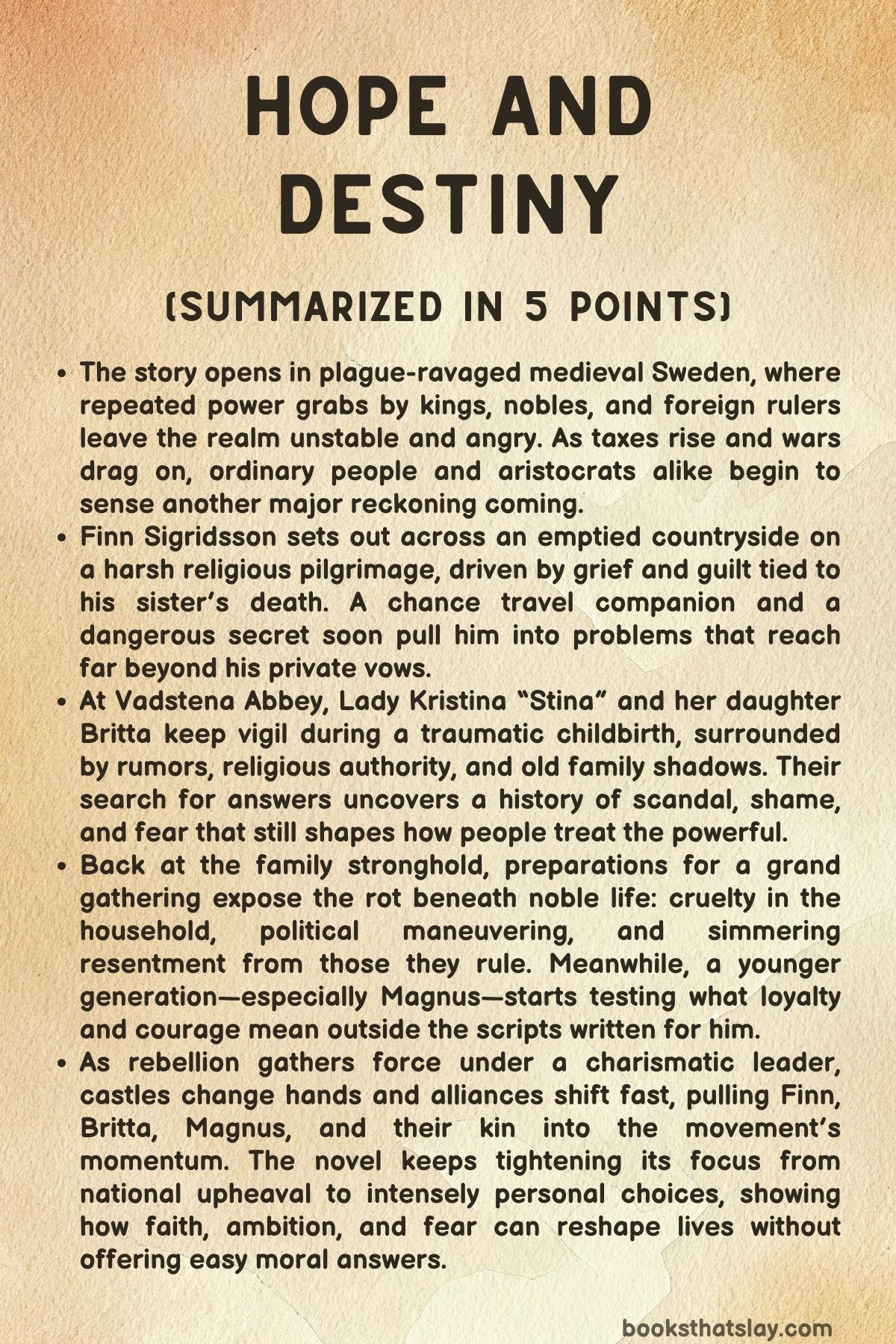
Hope and Destiny by Niklas Natt och Dag is a historical novel set in Sweden as the country staggers from plague, dynastic maneuvering, and growing rebellion against foreign rule. Power shifts between kings, councils, bishops, and great families who treat castles, taxes, and even faith as tools.
Into this uneasy world step people with private burdens: a penitent man walking to saints’ relics, a noble household trying to keep control as old curses and newer politics tighten, and young fighters pulled toward a popular uprising. The book pairs national upheaval with intimate choices that leave lasting damage.
Summary
Sweden is still scarred by the Black Death and the political bargains that followed. With crown lands pledged for loans and then hoarded by ambitious nobles, the balance of power has tilted away from the king and toward great families who treat the realm like property.
Rulers change through invitation and betrayal: Magnus is replaced by Albrekt of Mecklenburg, and later Margaret of Denmark and Norway is brought in with the same expectation that she can be controlled. Instead, Margaret consolidates authority, installs foreign bailiffs, and forces Swedish magnates to fight among themselves.
When she dies, her heir Eric rules three kingdoms, and by the early 1400s resentment boils: conscription bleeds Swedish districts, taxes rise, and foreign officials take what they want. By 1434, rebellion is no longer a rumor.
Finn Sigridsson walks through this hollowed countryside alone. He has chosen hardship on purpose, stuffing stones into his pack and gravel into his shoes, as if pain itself can pay a debt.
He believes his sister Ylva died in sin and is suffering after death, and he hopes that prayers at churches and relics—especially at Vadstena, where Saint Birgitta’s remains are kept—can lighten her punishment. Finn’s life has narrowed to ritual: stop at shrines, speak the prayers, sleep in churchyards, and keep moving.
At a roadside tavern, Finn meets a young churchman who calls himself Olaus Jonae, also known as Olof Jonsson. Olof is smooth, deferential, and eager to attach himself to a stronger traveler.
He claims he fears outlaws and spreads frightening stories about a murderous forest figure named Tor the Walker. He notices Finn’s fine dagger and learns Finn serves Sir Bengt Stensson at Cuckoo’s Roost, a stronghold tied to the blue-and-gold noble line.
Olof says he is burdened with iron ingots and hints at future payment, but Finn reads the meeting as a sign and agrees to help without charge.
At Vadstena Abbey, Lady Kristina “Stina” waits with her daughter Britta. Their young relative Mara, seventeen and pregnant, has been in labor for days.
The abbey’s strict prayers and routines grind on as Stina keeps vigil, exhausted and restless. Britta notices an elderly nun sneaking out at night to pray at a grave marked with their family’s coat of arms.
When Stina searches the churchyard she finds the grave: Karin Stensdaughter and an infant buried long ago, both of their blue-and-gold line. The stone is tended with unusual care, and Stina becomes determined to uncover who the old nun is and why she is there.
Back at Cuckoo’s Roost, Bengt Stensson wakes ill-tempered and hungover as preparations begin for a major Midsummer gathering of the many sons of the late Sir Sten. Bengt worries about missing people, outstanding bills, and the future of depopulated estates.
He dictates letters to summon help and to press Stina to return. His authority in the household is harsh and selfish; he drinks heavily, abuses servants, and treats the peasantry as livestock needed to refill empty fields.
Even within his own family, leadership is contested, with relatives and in-laws ready to seize control while Stina is away.
On the road, Finn and Olof lose their way in heavy rain and spend a freezing night under an oak. Finn speaks about Ylva’s death and his fear that she lacked the proper rites.
Olof mocks relics and piety, then reveals his real purpose: he produces a document and claims he holds power from church authorities to cancel Finn’s penance—for a fee of one silver mark, to be collected later. Finn feels cornered, cheated, and furious.
Their argument becomes a clumsy fight. Olof overpowers Finn long enough to choke him, and Finn, desperate, strikes back with a rock.
Olof collapses, mortally wounded.
Finn searches the load he has been carrying and discovers it is not iron at all but silver coins in multiple pouches. Panic hits: someone will look for this money, and he will be blamed.
He hides the treasure under an uprooted tree in a water-filled crevice, weighing it down and masking the spot. Then, in a grim attempt to misdirect any investigation, he mutilates Olof’s corpse in the way Olof had described Tor the Walker doing, turning fiction into a frame.
Shaken and sick with guilt, Finn continues to Vadstena, trying to cling to the pilgrimage as if it can still mean something.
At the abbey, Stina confronts the old nun and forces her to speak. The nun explains that curses live on fear and repetition, and she tells a story rooted in the abbey’s past.
Ingegerd Knutsdaughter, Saint Birgitta’s granddaughter, entered the convent, rose high, and later fell into scandal: sexual misconduct, corruption, and emptied coffers. When removed from office and left ruined, Ingegerd pronounced a curse against the blue-and-gold family: their love would end in blood.
Not long after, Karin Stensdaughter of that line came to give birth at Vadstena and died, and her baby followed. Now Mara, another woman of the line, is laboring, and the old nun prays at her door in dread.
Finn arrives in Vadstena carrying his own secret. He drinks, hears talk of trouble in the north, and learns the bishop’s men are in town and will travel to Cuckoo’s Roost for Midsummer.
Finn enters the great abbey church, prays at Saint Birgitta’s reliquary for Ylva, and then notices Britta. Their meeting pulls Finn into Stina’s anxious circle.
As Mara’s condition worsens, Stina turns to Bishop Knut Bosson, a churchman tied to the same noble network. Knut is found in a squalid, wine-soaked tent, but once roused he confirms the family stain behind the curse: Ingegerd was his half-sister, born from an affair that threatened Birgitta’s standing and the family’s wealth.
To protect reputations, Ingegerd’s identity was hidden and she was placed where she could be watched. Knut admits how self-interest shaped his choices, how he benefited from access to abbey wealth, and how Ingegerd was discarded when she became inconvenient.
Mara’s labor ends in disaster. The baby is born dead, and Mara barely survives.
Stina is forced to pay for the infant to be buried in consecrated ground, but the nuns will not allow a marker. Finn digs the grave.
Stina’s grief hardens into rage, and she humiliates Ingegerd’s memory at the grave, as if contempt can cancel a curse.
Other conflicts arrive on horseback. Nils Stensson, one of the blue-and-gold sons, reaches Vadstena too late to save the child.
He clashes with Karl Crofter, Mara’s half-brother, who reveals jealousy and a possessive claim over her. The encounter ends with threats and secrets that promise future violence.
Nils leaves for Cuckoo’s Roost as the family gathers for Midsummer, where alliances and ambitions are already forming.
The national crisis accelerates through Engelbrekt’s uprising. Magnus, Bengt and Stina’s son, slips away from home, obsessed with weapons and training, hungry for a role beyond suffocating noble life.
He ends up among Engelbrekt’s forces and is confronted by Eric Puck, a bitter enemy who condemns the nobles as thieves living off peasant suffering. Finn, now tied to Magnus, defends him, and their paths bind to the revolt as it grows from local anger into a sweeping campaign.
Engelbrekt’s host takes Västerås with startling speed, helped by weak garrisons and local support. Magnus witnesses the power of a people moving together and begins to change, marked as one of them.
Inside the captured castle, he and Finn find Hebbla Albrektsdaughter, a noble girl left behind and humiliated by a Danish maid who hoped rebels would punish her. Instead, Magnus and Finn protect Hebbla, and she becomes both a political asset and a human reminder of what war does to the vulnerable.
While Engelbrekt advances, Nils hunts the trail of Olof Jonsson. In taverns and villages he learns Olof invented Tor the Walker to frighten travelers into joining him, because his saddlebags were heavy with cash.
In Motala, Nils forces a priest to admit what Olof truly sold: indulgence letters that promised relief from penance in exchange for money. In the forest, Nils finds Olof’s mutilated corpse and takes a seal that proves the scheme carried official authority linked to the bishop and even to noble arms.
The lie has become a death, and the death has become a tool for wider plots.
Engelbrekt’s rebellion reaches Stockholm in winter. He confronts German magistrates, declares King Eric stripped of rule, seizes hostages, and forces the crisis into open fighting.
The city’s defenses buckle under pressure from within and without, and the attack turns brutal in narrow streets and towers. Engelbrekt tries to restrain slaughter, offering safe passage where he can, but blood still stains the snow.
Noblemen such as Bo Stensson are pulled into the fighting, sickened yet committed, because the future is being seized in real time.
As the revolt spreads, the blue-and-gold family fractures. Bengt betrays Engelbrekt, prompting retaliation and chaos.
Castles burn, loyalties shift, and rumors swirl about Magnus’s whereabouts. Magnus and Finn ride through devastated provinces where raiders have left corpses and desperate survivors.
Finn tries to keep Magnus away from the worst danger, lying about routes, but the tide of events pulls them back toward Engelbrekt anyway.
Magnus eventually returns home changed, restless, and distant, while Stina clings to him as proof she hasn’t lost everything. Boats arrive carrying Engelbrekt’s closest men, and the family’s involvement becomes unavoidable.
In a private meeting in a grove, Engelbrekt tells Magnus their time together is finished, that he must return to the formal responsibilities of command and politics. Magnus hears rejection, calculation, and betrayal.
In a moment of collapse and rage, he seizes an axe left behind and kills Engelbrekt.
The aftermath is stunned and quiet. No one immediately takes vengeance on Magnus, but everyone understands the act will reshape the struggle.
Engelbrekt’s body is carried to the shore and washed for burial. Finn, haunted by his own secret crime and by the way stories become traps, tries to steady Magnus as grief floods him.
Those around them foresee what comes next: a scramble for power, factions turning on each other, and a war that will not stop simply because one leader is dead.
Characters
Finn Sigridsson
Finn is shaped by guilt so intense that it becomes a way of life. He turns grief for his sister into a self-appointed theology of pain—stones in his pack, gravel in his shoes—because he needs suffering to feel like action, and action to feel like redemption.
That inner program makes him both compassionate and dangerously rigid: he can be gentle in churches and tender in prayer, yet he can also snap into brutality when cornered, as seen when humiliation and fear ignite the fight with Olof. After killing Olof, Finn’s morality doesn’t vanish; it fractures.
He tries to survive the consequences with practical intelligence—hiding the silver, staging the corpse to match the “Tor the Walker” legend—but every pragmatic choice deepens his spiritual panic, because he knows he has not merely sinned; he has rewritten reality to escape judgment. Across the story, Finn becomes a living bridge between old-world belief and the new-world violence: his faith is sincere, but it is continually contaminated by what he does to endure.
Ylva Sigridsdaughter
Ylva is absent in body but present as the gravitational center of Finn’s identity. She is remembered not simply as a loved sibling, but as the trigger for a worldview: that salvation can be bargained for through suffering, and that a death “done wrong” poisons the living.
Her deathbed choice—keeping her lover close and dying without proper anointing—becomes the detail Finn cannot forgive, because it suggests love can outrank doctrine, and he cannot tolerate that ambiguity. In the narrative she functions as both wound and excuse: Finn’s devotion to her soul is real, yet it also allows him to postpone facing his own loneliness, anger, and the darker satisfactions that come with feeling righteous.
Olaus Jonae (Olof Jonsson)
Olof is a practiced predator in religious clothing, a man who understands that fear and hope are currencies more reliable than coin. He attaches himself to Finn with a polite, clerical mask, then tests boundaries—first by story, then by insinuation, finally by the indulgence document itself—until he can convert Finn’s piety into profit.
His genius is not sophistication but opportunism: he manufactures “Tor the Walker,” he amplifies rumors of unrest, he carries silver disguised as iron, and he manipulates institutional authority by wearing it like costume. Yet his death reveals the risk of living by fabrication; the story he invented becomes the template of his own mutilation, and in that grim symmetry the book shows how lies can escape their maker and return as fate.
“Tor the Walker”
Tor is not a person so much as a weaponized narrative, a monster assembled out of fear, rumor, and the public’s need to explain violence without confronting the ordinary human greed behind it. Olof uses Tor as a traveling tool—an imagined fiend that pushes strangers into companionship and compliance—because myth can herd people faster than reason.
After Olof dies, Tor becomes a scapegoat Finn can hide behind, which is exactly how such legends work: they turn specific guilt into anonymous terror. Tor’s power in the story is therefore diagnostic; he measures how fragile law is and how eager a traumatized society is to believe that evil is in the forest rather than in the heart.
Lady Kristina “Stina”
Stina is a study in controlled endurance breaking under invisible pressures. At first she appears as a vigilant caretaker—keeping watch at Vadstena, managing a family crisis, trying to interpret signs—but her deeper arc is about the exhaustion of being a noblewoman whose body, lineage, and emotions are treated as political infrastructure.
The “turn of life” diagnosis lands like a sentence, not because she mourns fertility in itself, but because it strips her of a role that gave her meaning and bargaining power. Her growing indifference and gloom read as both biological change and spiritual dislocation in a world that offers women few legitimate vocabularies for despair.
When she urinates on Ingegerd’s grave, the act is not petty; it is an eruption of rage at a system that asks women to pay generational debts in blood while men convert scandal into strategy. Stina’s love for her children is real, but the story makes clear that love does not protect her from the brutal arithmetic of lineage.
Britta
Britta is positioned between innocence and initiation, and her defining trait is sensitivity sharpened into perception. She notices what adults dismiss—the old nun’s nightly movements, the atmosphere of dread around Mara’s labor, the emotional weather in her mother—because she is not yet numb.
Her shame about plugging her ears to Mara’s screams is telling: she is empathetic, but she also recognizes her own limits, which makes her human rather than saintly. Later, the memory of fleeing Castle Cut and “tasting terror and freedom” suggests Britta is learning that fear can be intoxicating when it breaks routine and reveals agency.
She becomes a moral witness to collapse, one of the few characters who consistently tries to understand rather than dominate, and her urging to leave at the end reads like hard-earned clarity: she sees how quickly power games turn everyone into fuel.
Mara
Mara’s story is the most intimate expression of the book’s theme that love and blood are never far apart in a society obsessed with inheritance. Seventeen, pregnant, and trapped in prolonged labor, she becomes a battleground where family anxiety, religious ritual, and rumor about curses converge.
What makes Mara compelling is that she is not reduced to symbolism; she is exhausted, frightened, intermittently hopeful, and her endurance is depicted as bodily reality rather than romantic martyrdom. Her relationship with Nils carries a sense of tenderness and imbalance at once—genuine attachment shadowed by the fact that she is young, vulnerable, and socially trapped.
The death of her child and her survival leave her in a liminal state: she remains alive to continue the family line, yet that very survival is stained with grief that will shape every future decision.
Sister Eufemia
Eufemia embodies the convent’s practical spirituality: she is compassionate but unsentimental, a midwife who understands the body’s limits and speaks plainly about them. Her conversation with Stina about the “turn of life” shows a rare kind of authority—female, experienced, rooted in observation—yet it is also constrained by the era’s framework, where physiological change is easily interpreted as spiritual vulnerability.
Eufemia’s presence stabilizes scenes that might otherwise spiral into superstition, but she cannot stop the story from becoming tragic; her competence is one of the book’s quiet cruelties, because even skill cannot always rescue women from childbirth’s roulette.
Ingegerd Knutsdaughter
Ingegerd is the story’s central ghost of scandal—royal-blooded, closely watched, briefly exalted, then publicly ruined. The tale told about her is drenched in hypocrisy: she is condemned for sexual transgression while male power brokers profit from secrecy and money, and her alleged emptying of coffers reads like either corruption or desperate leverage in a world that has already decided she is a problem to be managed.
The curse attributed to her—love ending in blood—functions as both revenge fantasy and bitter prophecy, because in this society women’s love is routinely punished through childbirth and political marriage. Whether Ingegerd truly cursed the family matters less than the fact that the family believes she did; belief is enough to turn every birth into a trial and every death into confirmation.
Bishop Knut Bosson of Linköping
Knut is clerical authority with the temperament of a nobleman: indulgent, self-serving, and skilled at turning sin into administrative detail. His revelation about Ingegerd reframes the “curse” as a family crime—scandal concealed to protect wealth and sainthood politics—making him a symbol of how religious institutions can be used to launder reputation.
The wine-soaked tent and his immediate demand for more drink are not incidental; they show a man insulated from consequence, able to confess without penitence because confession itself becomes another form of control. His offer to bring Stina in his convoy is similarly double-edged: it reads like protection, but it also reads like recruitment into his sphere, where secrets are currency.
Sir Bengt Stensson
Bengt is aristocratic entitlement stripped of heroism. He is constantly irritated, constantly consuming—beer, control, bodies—and he treats both household and peasantry as instruments to be coerced back into productivity after plague has hollowed the land.
His assault on the laundress is not only personal brutality; it is a miniature portrait of his worldview, where fear is a legitimate tool and other people exist to absorb his frustration. Yet Bengt is not written as a simple monster; his anxieties about depopulation, his fixation on preparations and debts, and his desperation to manage appearances reveal a man terrified of decline.
His later betrayal of Engelbrekt shows the same pattern: he wants the uprising’s benefits without surrendering dominance, and when control slips, he would rather burn the board than share it.
Bo Stensson
Bo functions as Bengt’s mirror and partial corrective: he is capable of blunt realism and loyalty to broader strategy, and he seems less intoxicated by daily cruelty than his brother. His physical reaction during the Stockholm assault—vomiting after Engelbrekt kills defenders—marks him as someone who cannot fully metabolize violence even while participating in it.
He also carries the family’s political continuity, moving through the rebellion with an eye for positioning without the same overt sadism Bengt displays. Still, Bo is not pure; he benefits from the same hierarchy, and his choices show how even “better” nobles remain entangled in systems built on extraction.
Kari Sharp (Kari, Bo’s wife)
Kari is power expressed through competence. When Stina is away, Kari does not hesitate to take charge of Bengt’s household, and the fact that this is accepted shows her authority is recognized even among men who otherwise dismiss women.
She operates as a household strategist, reading motives and managing logistics with a coolness that contrasts with Stina’s more emotional unraveling. Kari’s sharpness suggests survival: in a world where formal power is male, she practices a different kind—administrative, social, quietly coercive.
Magnus Bengtsson
Magnus begins as a boy trying to invent himself in secret, training with a hidden sword in a sunlit glade as if effort alone can conjure identity. His closeness to his goshawk and his distance from people signal a hunger for a relationship that is loyal, simple, and wordless—something politics cannot contaminate.
When he joins Engelbrekt’s camp, Magnus becomes a boundary figure between nobility and common uprising, and his marked cheeks with charcoal symbolize a brief, intoxicating belonging outside his class. His bond with Engelbrekt is the emotional core of his arc: it offers him meaning, purpose, and perhaps the first adult recognition he trusts.
That is why the break devastates him, and why the killing is both incomprehensible and inevitable; when Engelbrekt tells him their time is over and speaks like a politician, Magnus experiences it as the death of the only truth he had. The axe blow reads as a tragic collision between adolescent absolutism and the compromises of leadership—Magnus cannot endure being loved conditionally, so he turns love into blood.
Nils Stensson
Nils is ambition dressed as duty. He pursues Olof’s trail with determination that looks like justice, but his methods—intimidation, coercion, leaving a priest trapped in a grave—reveal a man who considers cruelty an acceptable tool when it serves his goals.
His relationship with Mara complicates him; he can be tender and protective, yet the age gap and the timing of conception suggest a dynamic where his needs and plans have shaped her fate. Nils also reads the political winds quickly: he understands that Bengt’s betrayal makes the family suspect, and he tries to position himself as the replacement center of gravity.
In him, the book shows the nobility’s survival instinct—adaptable, ruthless, and always ready to turn moral language into leverage.
Karl Crofter
Karl is jealousy given teeth. His revelation as Mara’s half brother makes his aggression toward Nils more than rivalry; it becomes a claim about ownership, blood, and who deserves intimacy.
He accuses Nils of arriving too late, but beneath that accusation is his own frustrated desire, which he admits in the ugliest possible way—rejoicing in the baby’s death and threatening future conflict. Karl represents a recurring danger in the book: men who translate longing into domination, then call it justice.
His departure does not resolve anything; it plants a long fuse.
Eric Puck
Eric Puck is the voice of class hatred sharpened into personal threat. He confronts Magnus as a symbol, not an individual—“parasite,” land thief, noble leech—and he promises the kind of anonymous death that rebellion makes possible.
Yet Puck is not a moral spokesperson; he is also a bully who targets vulnerability and retreats into darkness when challenged. Finn’s violent response to him is telling: Finn is defending Magnus, but he is also defending the fragile possibility that Magnus can exist among common fighters without being reduced to a caricature.
Puck therefore functions as a pressure test for the rebellion’s soul—whether it will become justice or simply inversion.
Engelbrekt Engelbrektsson
Engelbrekt is depicted as charisma under strain: a leader who wants legitimacy, restraint, and strategic cleanliness, but whose body and circumstances keep dragging him toward urgency and myth. He captures castles with minimal bloodshed when possible, speaks across languages, and crafts a narrative of justice—grain, commerce, welfare—that is meant to unite rather than merely conquer.
Yet he is also burdened by the people’s hunger for miracles, as seen when the sick are brought to him like a saint. That devotion is a trap: it elevates him beyond human scale and punishes him for any compromise.
His private conversation with Magnus, where he admits that powerful men say what they must to gain what they covet, is the story’s bleak thesis spoken aloud. When Magnus kills him, it is not only a murder; it is the collapse of a hope that power might remain honest without being destroyed by either politics or love.
Harald Esbjörnsson
Harald is the rebellion’s hard backbone, a man who understands violence as labor and leadership as responsibility. He marks Magnus with charcoal, escorts Hebbla, breaches tower doors, and tries to keep the uprising’s brutality from turning into indiscriminate slaughter.
His grief after Engelbrekt’s death is not performative; it is the anguish of someone who knows how fragile a movement is and how quickly a single death can turn purpose into chaos. His self-blame over the forgotten axe underscores his character: he carries responsibility like a physical weight, and that weight only increases as the story darkens.
Hebbla Albrektsdaughter
Hebbla embodies the human collateral of politics: a foster daughter moved like property, then punished for someone else’s cruelty. Her humiliation—locked naked in a cold bath—turns her into a symbol of how women are used to absorb men’s violence and resentment, but her voice afterward refuses to let her be only a symbol.
By explaining Lina’s motive and the count’s abuse, she exposes a hidden economy of exploitation within noble households. When Bengt keeps her as an “honored guest,” the phrase itself is chilling: honor becomes another form of captivity, and Hebbla must navigate safety that is inseparable from being useful.
Lina (Hebbla’s maid)
Lina is written as desperation curdled into betrayal. Her decision to strip Hebbla and lock her away is cruel, but it is also intelligible as an act by someone trapped in nightly abuse who wants the system to punish someone else for what it has done to her.
She does not seek liberation in a clean way; she seeks revenge through displacement, hoping rebels will do to Hebbla what the count does to her. Lina’s role forces the reader to confront how victimhood can reproduce violence, and how limited agency can turn into catastrophic choices.
Count Hans of Eberstein
The count represents foreign rule as both administrative and intimate violence. Publicly he is a political figure escorted out of Västerås; privately he is implicated in predation through Hebbla’s account of Lina’s suffering.
This duality matters because it shows how occupation is experienced not only as taxes and bailiffs but also as household tyranny, where the powerful treat bodies as privileges. His removal without slaughter also highlights Engelbrekt’s attempt to keep the uprising from becoming a massacre, even when the enemy is morally abhorrent.
Melker Göts
Melker’s role—presenting the keys and enabling a bloodless opening—casts him as a hinge character, someone inside the occupied structure who decides that the old order is no longer worth defending. In a story full of dramatic oaths, his action is quietly revolutionary: he turns a siege into a transfer, suggesting that power often collapses not from assault but from withdrawal of cooperation.
Henrik Styke
Henrik Styke is stubborn authority at the local level, refusing to yield Ringwall until fear is engineered into inevitability. His eventual negotiation after the belfry rises shows a pragmatic self-preservation that contrasts with heroic fantasies of last stands.
In the book’s logic, he is neither noble nor villainous; he is a man trying to survive the tide, proving again that most political outcomes are decided by calculation rather than conviction.
Axel Tott
Axel Tott represents restoration as revenge. The roadside of hanged and broken bodies in Varberg signals what happens when old power returns wearing the language of order: punishment becomes spectacle, and justice becomes a warning.
In a narrative already saturated with death, Axel’s violence feels different because it is institutional, deliberate, and meant to teach submission.
King Eric of Pomerania
Eric is the distant crown felt as pressure rather than presence: wars along borders, conscription that doesn’t return, foreign bailiffs, taxation and plunder. His rule is the kind that turns resentment into inevitability, making rebellion less an ideological choice than a survival response.
Even when he is not on the page, the consequences of his governance structure the world: hunger, occupation, and the sense that the kingdom is being spent like coin.
Queen Margaret
Margaret appears as political intelligence that outmaneuvers the nobles who think they can puppet her. Her tactic—drawing nobles into quarrels while installing loyal bailiffs—reveals a ruler who understands that control is maintained through appointments and administration more than declarations.
Yet her death by plague also underlines the era’s brutal randomness: even the most capable strategist is vulnerable to the same disease that hollowed the countryside Finn walks through.
Albrekt of Mecklenburg
Albrekt is introduced as a pawn invited to the throne, then becomes a cautionary example of what happens when a supposed puppet tries to rule. His attempt to curb noble estates triggers backlash and shows the central tension behind many crises in Hope and Destiny: sovereignty versus oligarchy, crown authority versus noble property, and the endless cycle of invitations and betrayals that masquerade as “legitimate” politics.
Bo Jonsson of House Gryphon
Bo Jonsson is the archetype of the noble accumulator, turning plague-era desperation into a long conquest of pledged estates until he effectively controls the Baltic corridor. His brilliance is financial and legal rather than purely martial; he reshapes the kingdom by treating land as collateral and debt as leverage.
Even after his death, his legacy persists as a template for elite manipulation—invite a ruler, constrain them, replace them—so his shadow hangs over later generations that repeat his methods with less certainty and more chaos.
Sten Bosson of Oakwood Manor
Sten inherits a political machine and believes he can run it, but his arc demonstrates how strategies decay when conditions change. He repeats Bo Jonsson’s invitation tactic with Margaret and expects to govern through her, only to be used instead, turned into an instrument for dismantling the very injustices his faction benefited from.
His frustration and death capture the story’s irony: those who try to control the crown often end up revealing how little control they truly have once a capable ruler enters the game.
Sir Sten (the family patriarch remembered by Bengt and Bo)
Sir Sten’s presence is mostly memorial, yet it shapes the siblings’ sense of inheritance as burden. He represents the old ideal of knighthood and lineage pride, but also the generational gravity that keeps sons reenacting patterns they barely understand.
When Bengt and Bo speak of him, the tone is not simply reverent; it is haunted, as if the past is not guidance but a trap that tightens whenever the present grows unstable.
Themes
Power built on debt and opportunism
Silver shortages after the plague turn the crown into a borrower and the nobility into creditors, and that transaction quietly becomes a new constitution. Estates pledged as “temporary” security slide into permanent private possession, and the people who hold the paper end up holding the country.
The pattern repeats across decades: Bo Jonsson leverages unpaid loans to put Albrekt on the throne, then Sten Bosson assumes he can do the same with Margaret. Each time, the figure invited to “rule” arrives with their own agenda, and the inviter discovers that the real danger is not the weak monarch but the strong administrator who learns how to use offices, bailiffs, and legal restoration to disarm the aristocracy.
Authority stops being a sacred inheritance and becomes a tool that can be hired, redirected, and weaponized. That atmosphere shapes every household decision at Cuckoo’s Roost: invitations, hostages, marriages, letters, and even Midsummer hospitality carry the logic of bargaining.
When leaders treat the realm as collateral, loyalty becomes transactional, and betrayal becomes a rational option rather than a moral rupture. The later rebellion under Engelbrekt grows out of this logic too.
The uprising is not only a clash of classes; it is a consequence of rulers behaving like lenders and merchants, and of subjects learning that legitimacy can be transferred the way property is transferred. When the gates of Stockholm finally give way, it feels like the endpoint of a long lesson: power belongs to whoever can turn paperwork, fear, and timing into obedience.
Plague, depopulation, and the long shadow of loss
The plague is not merely a historical backdrop; it is a continuing condition that shapes land, bodies, and imagination. Empty farms, fallow fields, and half-populated roads make the world feel morally unmoored, as if ordinary rules of community have been thinned out along with the people.
Bengt’s crude demand that peasants “breed” so the estate can be worked shows how catastrophe can strip empathy from the ruling class and reduce human life to labor supply. The countryside’s physical sparseness also amplifies isolation, which is why Finn’s pilgrimage reads less like a journey through villages and more like a passage through gaps—gaps in population, gaps in safety, gaps in certainty about what the dead require from the living.
Later, when war returns and bodies lie rotting in thawing snow, the book suggests that disaster stacks rather than replaces itself: plague hollows society, then conflict arrives to exploit the hollowing. Survivors drifting into predation are not presented as monsters from nowhere; they are what emerges when hunger, grief, and fear become a permanent environment.
Even leadership is infected by this atmosphere. Margaret dies of plague, and the succession that follows feels less like a smooth handover than another instance of fate taking a bite out of human plans.
The repeated sense that any family line can end suddenly—through sickness, childbirth, or violence—presses characters into urgency and superstition, but also into harsh practicality. In such a world, love and mercy are not sentimental virtues; they become scarce resources that people hoard, trade, or waste.
Religion as comfort, commerce, and control
Faith in Hope and Destiny functions as a shelter for suffering, but it is also a market and a weapon. Finn’s penance is deeply personal: he hurts his own body to negotiate with the unseen, believing pain can purchase relief for Ylva.
That belief gives him a purpose strong enough to carry him across dangerous roads, yet it also makes him vulnerable to anyone who knows how to mimic spiritual authority. Olof’s sale of indulgences exposes the thin line between pastoral care and exploitation: a document with seals, names, and the right language can turn guilt into revenue.
The book does not present Finn as foolish; instead it shows how grief creates a hunger for certainty, and how institutions—official or counterfeit—can feed on that hunger. Vadstena’s relics and routines provide real solace, especially in scenes of sleepless vigil and communal prayer, yet the same sacred setting becomes a place where scandals are buried, reputations protected, and money demanded even for an infant’s burial in consecrated ground.
The church is both a moral authority and a gatekeeper of dignity. The curse story around Ingegerd demonstrates how religious narratives can discipline families across generations: even nobles who control land and men can be psychologically governed by the fear that a spoken sentence at death has legal force in the universe.
Bishop Knut’s confession makes the political side of sanctity even clearer—saintly causes, Roman approval, and family honor merge into one ledger. In that world, religion is never only belief; it is paperwork, public image, rumor, and leverage.
People pray because they need meaning, but they also fear what prayer can be turned into when others control the language of salvation.
Guilt, penance, and the private need for punishment
Finn’s self-imposed suffering is the most visible form of penance, but the theme runs through many characters as a quiet engine of behavior. Finn begins with a goal he can name—helping Ylva—yet after Olof’s death the logic of penance changes.
His pain is no longer only an offering; it becomes a coping method for a reality he cannot undo. The murder forces him into a new relationship with his own conscience, and his choice to stage the corpse as Tor the Walker shows guilt operating alongside calculation.
He does not simply hide evidence; he reshapes the moral story that others will tell, because an external story can sometimes smother an internal one. This is the book’s darker insight: people seek punishment not only from God but from narrative.
If the world believes in a forest fiend, then a human killer can almost disappear inside that belief. Stina’s despair and “turn of life” carry a different form of guilt—less about a single act and more about identity slipping out of reach.
Her sudden crying alone after Eufemia’s words suggests a grief for a self that is ending, and a fear that her emotional numbness is a kind of betrayal of duty. Bengt’s cruelty adds yet another angle: he behaves as though he is beyond shame, but his drinking, irritability, and compulsive domination imply someone trying to outrun an inner accusation by becoming louder than it.
Even Magnus’s later act—killing Engelbrekt—can be read through this lens. He does not do it for gain; he collapses afterward.
The moment feels like a collision between devotion and humiliation, where the need to punish the person who “ended” their bond becomes indistinguishable from a need to punish himself for believing in it.