Hot Desk Summary, Characters and Themes
Hot Desk by Laura Dickerman follows Rebecca Blume, a midlist editor trying to stay afloat amid a chaotic workplace overhaul, complicated authors, and a personal life that keeps slipping out of her control. When the death of legendary writer Edward David Adams—known as the Lion—unexpectedly pulls her into his literary estate, Rebecca discovers that her own family is entangled in his past.
As she navigates office politics, an unexpected rival-turned-romantic complication, and her mother’s long-buried history, Rebecca is drawn into a story that spans generations. The novel blends workplace comedy, publishing satire, and emotional revelation as Rebecca learns what she truly wants.
Summary
Rebecca Blume returns to her publishing house, Avenue, to find that her private office has been replaced with a desk-sharing system requiring her to alternate days with a stranger named Ben. A cactus left on the desk becomes a symbol of everything she resents about the new setup.
Her friend Gabe arrives with gossip about the new “ginger editor,” and the two commiserate about the forced cheeriness expected of employees in the new environment. As Rebecca tackles email disasters, her assistant Chloe rushes in to say that Ami Ito—her intimidating boss—wants her immediately.
In Ami’s office, Rebecca learns shocking news: Rose Adams, widow of the famed author known as the Lion, has requested a meeting specifically with Rebecca. The Lion avoided agents, worked closely with one editor, and left a legacy surrounded by myth.
Securing his estate would elevate Avenue’s reputation. Ami demands to know why Rose requested Rebecca, but the only connection Rebecca can think of is that her mother once interned at the Lion’s magazine decades earlier.
Though Rebecca has no explanation, Ami insists she take the meeting. The opportunity could define her career.
As office gossip spreads, Rebecca feels overwhelmed and irritated, especially when coworkers hint she should break up with her boyfriend, Max. By the end of the day she feels wrung out and heads to the apartment she shares with her friend Mimi.
After calling her mother to share the news, she becomes unsettled by Jane’s evasiveness about her past with Rose. That night, frustrated and confused, Rebecca vents anonymously in the company’s “Office Life Inbox,” unaware of how important those messages will become.
The novel then introduces Ben, her unseen desk partner. At home in his cramped walk-up, Ben talks with his eccentric sister Ava and fends off messages from his ex.
He browses the Office Life Inbox, amused by the anonymous complaints about desk sharing, and contributes one himself under the username “KMarx. ” Ben is also deeply interested in the Lion’s work and excited about rumors that the estate may be acquired by his company.
The narrative flashes back to 1981, where a young Jane—Rebecca’s mother—arrives for her first day as an intern at the East River Review, the literary magazine run by the Lion. Jane meets fellow interns Rose and Drew, and the three quickly bond.
Rose is captivating and confident, drawing Jane into the center of a world she had only read about. Their shared enthusiasm and early friendship form the emotional root of the decades-long secret that still shapes their lives.
Back in the present, Rebecca travels to meet Rose Adams. At Rose’s elegant home, she nervously pitches ideas about revitalizing the Lion’s work for younger readers.
Rose reveals that she and Jane had once been inseparable, a truth Jane has never shared with her daughter. She also reveals something even more astonishing: the Lion left behind a full handwritten novel, hidden until his death.
Rose wants Jane to read it.
Rebecca reels from the disclosure, only to have her boyfriend break up with her by text. She later goes to a dinner party hosted by her friend Stella, drinks heavily, and fires off messages to her mother demanding answers.
Jane finally admits that she and Rose were once extremely close. Rebecca becomes determined to learn more.
While Rebecca struggles through a chaotic day of meetings and coffee-shop disasters, the story shifts to Jane. Rose has asked her to read the newly discovered manuscript.
Jane reluctantly visits the old townhouse where they once worked. Inside, Rose explains that the manuscript contains a fictionalized account of events from their youth.
Jane reads it and is shaken. The manuscript depicts an encounter with Teddy Adams—the Lion himself—that has haunted her for decades.
When Rebecca later joins Jane and Rose for dinner, the truth is revealed: during a blizzard in 1982, Teddy forced himself on Jane. Jane kept the experience secret out of shame and fear she had betrayed Rose.
Teddy’s manuscript presents the event in a self-serving light, and Rose insists the book must never be published. Complicating matters, Teddy’s troubled son Atticus wants to use the manuscript for his own gain.
Rose asks Rebecca to help persuade him to abandon his plan.
Rebecca’s path collides with Ben’s when she ends up at the bar where he works after a disastrous night out with Atticus. Atticus behaves recklessly, and Ben throws him out.
Rebecca manages to steal the manuscript from Atticus’s bag before he leaves. She and Ben, charged with adrenaline and confusion, share a sudden, intense kiss that neither fully understands but both remember vividly.
Flashbacks reveal how Jane’s life unraveled in 1982 after Teddy assaulted her. Unable to face Rose, and overwhelmed by shame and grief, she fled New York, leaving behind the world she once longed to join.
In the present, Ben begins working closely with Rose and Jane as they start shaping a collaborative memoir about their past. Rebecca, feeling left out and unsure of Ben’s intentions, argues with him over text.
Their simmering attraction clashes with their professional tension.
Atticus, unexpectedly sober and apologetic, invites Ben to the literary magazine’s anniversary celebration at Oceaan House. Once there, Ben reconnects with Rose and Jane, who are energized by the memoir’s progress.
Rebecca arrives soon after, and she and Ben slip away to clear the air. They admit they have been thinking about each other constantly.
Their conversation softens into laughter, shared cupcakes, and another kiss before they hurry back to hear Rose read one of Teddy’s early stories. Rebecca holds Ben’s hand through the reading, and later the two finally spend the night together.
The story returns to Jane, who reflects on the choices that shaped her life and the years she spent away from New York. Now reunited with Rose and working on their memoir, she feels both sorrow and relief.
Rebecca joins her the next morning and reveals her own plans: she’s leaving Avenue to join her friend Stella’s social-media venture. She also shyly admits that Ben stayed over, and Jane is delighted.
In the epilogue, a New York Times review describes how Rose has republished Teddy’s work with feminist framing and how Rose and Jane’s joint memoir, Inside the Lion’s Cage, has become an important literary document. Jane’s own first novel is forthcoming, edited by Rose at Hawk Mills.
The women who once shared a cramped office as interns, separated by ambition, trauma, and time, have finally rebuilt their bond. Rebecca, having confronted the past and found unexpected love, is poised to start a new chapter of her own.
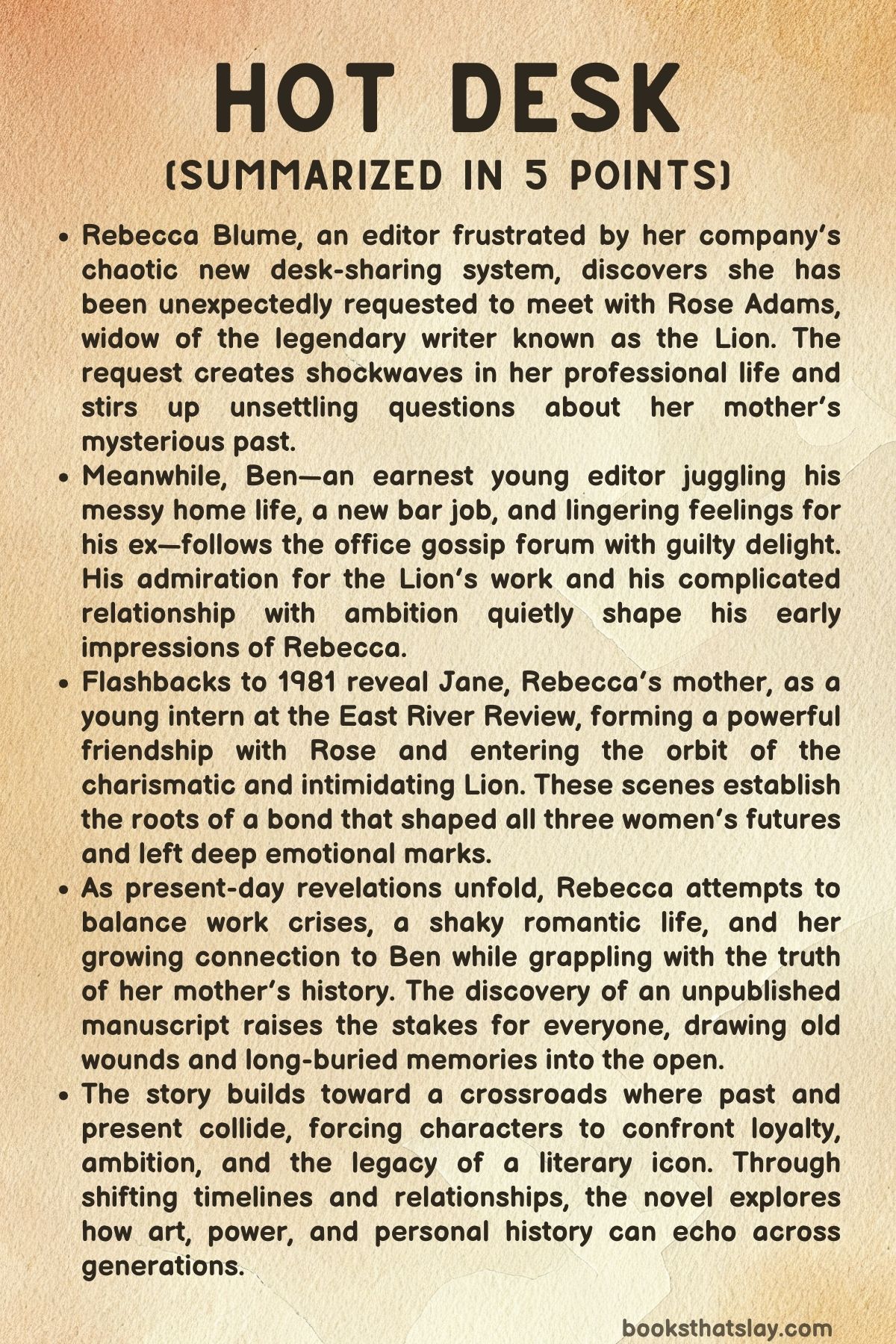
Characters
Rebecca Blume
Rebecca emerges as the emotional and professional anchor of Hot Desk, a woman caught between ambition, insecurity, and the lingering shadows of her mother’s past. Working as an editor at Avenue Publishing, she is competent and perceptive but often overwhelmed by the chaotic realities of modern workplace culture—open-plan hot-desking, performative Zoom culture, and gossip-heavy office dynamics.
Her interior voice is sharp, self-deprecating, and often defensive, reflecting the pressure she feels to maintain control in an environment where her authority is constantly diluted. Rebecca’s arc is shaped by two parallel forces: her own career aspirations and the buried history between her mother, Jane, and the late literary giant Edward “the Lion” Adams.
As she uncovers that her professional breakthrough is tangled with a painful family past, she oscillates between pride and guilt, excitement and unease. Her turbulent romantic life—marked by an unsatisfying relationship with Max and a slow-burn connection with Ben—mirrors this confusion, revealing her struggle to trust her own desires.
Rebecca ultimately evolves into someone capable of confronting truth, supporting her mother, and forging a new career path free of both corporate stagnation and inherited silence.
Ben Heath
Ben is Rebecca’s unexpected foil and romantic counterpart, a young editor with an easygoing façade that masks ambition, sensitivity, and lingering heartbreak. His loyalty—to his sister Ava, to his dog Butch, and even to the dysfunctional publishing world—is a defining trait, as is his wry humor, often expressed anonymously through the “Office Life Inbox.”
Though he begins as Rebecca’s annoying desk-sharing rival, his scenes at Betty Jack’s reveal his steadiness, his capacity for caretaking, and his quiet moral compass. Ben reveres the Lion’s writing, but his admiration is not blind; when confronted with the truth of Teddy Adams’s abuse, he is willing to rethink his relationship with the work he idolized.
His professional involvement with Jane and Rose’s memoir shows his maturity as an editor, and his growing emotional connection with Rebecca displays vulnerability beneath his sarcastic defenses. Their chemistry builds gradually until it erupts at Betty Jack’s and blossoms into something tender, honest, and deeply grounding for them both.
Ben becomes not just a love interest but a stabilizing presence who walks with Rebecca through the unraveling of her family history.
Jane Blume
Jane is the quiet heart of the novel’s intergenerational story, a woman who has spent decades carrying a trauma she felt she had no right to name. In her youth, she was bright, idealistic, and deeply drawn to the literary world, thrilled to intern at the East River Review alongside Rose in the early 1980s.
Their friendship was electric, intimate, and foundational—until Teddy Adams shattered Jane’s confidence and sense of self. Her silence afterward arises from a profound mix of guilt, shame, and fear of hurting Rose, who was then in a romantic relationship with Teddy.
Jane’s life trajectory—leaving New York, abandoning her writing, and burying the most formative year of her life—reflects the cost of unspoken trauma. In the present, she appears as a loving but intrusive mother, unable to fully express her past but achingly aware of its consequences.
When she finally reunites with Rose and confronts the manuscript that exposes Teddy’s manipulation, Jane’s strength, empathy, and resilience come to the forefront. She evolves from someone defined by silence into a woman reclaiming her voice, ultimately authoring her first novel and reconnecting with her lost creative self.
Rose Adams
Rose is a dazzling figure who moves between eras with an almost cinematic presence. In her youth, she is magnetic—stylish, artistic, and charismatic—instantly forming an intense bond with Jane as they laugh their way through their first day at the East River Review.
Her early relationship with Teddy Adams is marked by naïveté and admiration, the kind that often grows around brilliant but predatory men. Decades later, she is both formidable and gracious, the widow in charge of safeguarding Teddy’s legacy.
Her decision to reveal the hidden manuscript to Rebecca and Jane and her willingness to confront the truth about Teddy mark her as a woman of bravery and emotional intelligence. Rose balances grief, loyalty, and moral clarity, ultimately steering Teddy’s posthumous reputation toward accountability by commissioning feminist introductions to his reissued works.
Her restored friendship with Jane becomes the emotional resolution of the novel, and her role in shaping their joint memoir symbolizes her transformation from muse to author of her own history.
Teddy “the Lion” Adams
Teddy’s presence haunts the novel even after death, his charisma and talent casting a long shadow across generations. To the public, he is a genius whose mythic persona overshadows the complexities of his private life.
To those who knew him intimately, he is far more troubling—a man capable of warmth, mentorship, and manipulation in equal measure. The unpublished manuscript he leaves behind becomes a literal and symbolic artifact of his narrative control, portraying events between him, Jane, and Rose through self-serving voices that distort the truth.
Teddy represents the archetype of the celebrated male writer whose power allows him to exploit the women around him while shaping the story of that exploitation. His son Atticus, his widow Rose, and his former intern Jane all live in the wake of his choices.
Even as he remains offstage, his influence is the central conflict of the novel, and the act of revising, reframing, or rejecting his narrative becomes an act of empowerment for the characters he once overshadowed.
Atticus Adams
Atticus is the volatile, wounded son of Teddy Adams—charismatic in bursts but primarily erratic, insecure, and desperate for attention in all the wrong ways. His substance abuse, outrageous behavior, and constant attempts to monetize his father’s legacy all stem from a profound loneliness and a lifelong struggle to matter.
Beneath the bravado lies a boy still hurt by Teddy’s emotional absence. His confrontation with Rose, Jane, and ultimately himself reveals surprising emotional depth; he is not malicious so much as lost.
His erratic night with Rebecca at Betty Jack’s contrasts sharply with his later sober honesty, and his acceptance of the need for rehab is one of the novel’s more quietly hopeful turns. Atticus embodies the destructive legacy of genius mythmaking, showing how the children of such men often inherit chaos instead of stability.
Gabe
Gabe serves as Rebecca’s long-standing friend and workplace confidant, offering both cutting humor and genuine emotional support. His ability to weave gossip into insight provides comic relief, but he also functions as a mirror for Rebecca, calling out her blind spots, teasing her out of spirals, and grounding her in shared office camaraderie.
Though not central to the main plot, his presence enriches Rebecca’s world and gives her someone with whom she can be her unguarded self. His easy banter and unfiltered opinions highlight the absurdity of the modern workplace, adding levity to the book’s heavier themes.
Chloe
Chloe is Rebecca’s relentlessly cheerful assistant—the type of overenthusiastic worker who thrives in corporate structures Rebecca resents. Her optimism and boundless energy often irritate Rebecca, but Chloe’s organizational precision and genuine admiration for Rebecca’s work add subtle warmth to their professional relationship.
She represents the new generation of publishing professionals, steeped in social media fluency, efficiency, and corporate-friendly pep. Chloe also contrasts Rebecca’s world-weariness, subtly highlighting how burnout has shaped Rebecca’s relationship to her job.
Mimi
Mimi, Rebecca’s older roommate, is a comforting, eccentric presence whose Upper West Side apartment becomes a refuge from the chaos of Rebecca’s life. With her birds, cocktails, snacks, and maternal fussing, she functions as a surrogate parental figure, offering stability and acceptance when Rebecca feels adrift.
Mimi’s gentle wisdom and ritualized domestic habits stand in stark contrast to the competitive, unpredictable world of publishing. Her quiet support helps Rebecca navigate both her career uncertainties and the unraveling of her mother’s history.
Ava
Ava is Ben’s brilliant, irreverent sister, a professor whose sardonic humor and intellectual swagger shape Ben’s emotional world. Their sibling dynamic—filled with teasing, affection, and shared cynicism—reveals Ben’s softer interior and the family bonds that keep him grounded.
Ava’s skepticism about Ben’s literary idolization of the Lion foreshadows the moral complexities that later unfold. She acts as a truth-teller, unafraid to puncture pretension and provide the blunt perspective Ben sometimes needs.
Max
Max is Rebecca’s emotionally distant and ultimately disposable boyfriend, a man who occupies space in her life without offering meaningful connection. His abrupt breakup over text symbolizes Rebecca’s deeper malaise—her tendency to settle, to tolerate mediocrity, and to avoid confronting her own dissatisfaction.
His exit becomes a catalyst for Rebecca’s personal growth, clearing space for her relationship with Ben and reminding her that she deserves passion, honesty, and reciprocity.
Stella
Stella, a glamorous and influential figure in Rebecca’s social circle, represents ambition and reinvention in contrast to Rebecca’s stagnation. Her exclusive supper clubs, creative ventures, and bold personality make her a tastemaker in their world.
She is supportive yet provocative, nudging Rebecca toward risks she’s afraid to take. Stella’s role in Rebecca’s eventual career shift toward social-media work marks her as a quiet but persistent force of change, expanding the boundaries of what Rebecca believes is possible for herself.
Drew
Drew is the gentle, idealistic fellow intern who joins Jane and Rose in their youthful trio. His presence in the 1981 storyline adds warmth and camaraderie; he is earnest, encouraging, and perceptive.
As the only male intern uncorrupted by the toxic hierarchy of the East River Review, he functions as a counterpoint to Teddy’s predatory power. Drew’s eventual death, revealed later, adds emotional weight to Jane’s memories and reflects the fragility of the friendships that shaped her youth.
His kindness and support remain part of the nostalgia and grief that inform the memoir Jane and Rose ultimately write.
Lady Paulette
Lady Paulette, one of Rebecca’s demanding authors, embodies the humorous frustrations of modern publishing. Dramatic, fussy, and prone to last-minute whims, she adds levity to Rebecca’s workloads while illustrating the emotional labor editors must perform.
Her presence also underscores Rebecca’s competence and patience, reminding readers of the everyday challenges that accompany her loftier literary ambitions.
Alice
Alice is another of Rebecca’s authors, one whose constant reinventions and obsessive wellness regimens test Rebecca’s professional diplomacy. Her chaotic creative process, self-involvement, and dramatic pivots highlight the imbalance between authorly ego and editorial patience.
The coffee shop meeting where Rebecca spirals into embarrassment thanks to Alice’s monologues exemplifies Rebecca’s precarious juggling of personal dignity and professional obligation.
Richard and Frank French
Richard, the dependable managing editor, and Frank French, the jargon-loving, corporate-buzzword-spewing senior figure, represent two archetypes of the publishing office. Richard is practical and grounding, while Frank embodies the hollow managerial rhetoric that frustrates Rebecca.
Their contrasting styles critique the bureaucracy and trend-chasing tendencies of modern corporate culture. Frank particularly provides comedic tension through his obsession with “boundaryless workplaces,” symbolizing the absurdity of workplace reinvention that ignores human needs.
Butch
Though a dog, Butch is an important companion in Ben’s life—loyal, gentle, and emotionally attuned. His presence symbolizes stability, comfort, and unconditional love.
In contrast to the chaotic relationships and professional entanglements around them, the bond between Ben and Butch provides a quiet emotional anchor. Their shared walk-up life, bar shifts, and routines highlight Ben’s groundedness and capacity for caretaking.
Themes
Ambition, Recognition, and the Costs of Professional Desire
Ambition in Hot Desk is rarely presented as a triumphant ascent; instead, it appears as a force that shapes identities, fractures relationships, and pushes characters into morally ambiguous territory. Rebecca’s longing for professional acknowledgment becomes tangled with her jealousy, insecurity, and exhaustion, revealing how modern work culture reframes ambition as both a personal asset and a source of chronic self-questioning.
Her desperation to secure the Lion’s estate is not driven merely by career advancement but by a fear of becoming invisible in a shrinking, chaotic industry that no longer values stability or loyalty. Ben, too, views the Lion’s work as the key to proving his taste and seriousness in a world that often reduces young editors to interchangeable labor.
The earlier timeline mirrors this hunger with Jane and Rose, who enter the East River Review with wide-eyed hope, only to learn how ambition can blur into competition, hero worship, and dangerous vulnerability. Teddy’s literary prestige becomes a gravitational force that warps the aspirations of those around him, convincing interns that proximity to brilliance is a form of accomplishment.
Over time, the characters realize that ambition without boundaries invites exploitation, resentment, and self-betrayal. The novel ultimately reframes professional desire as something that must be reclaimed rather than eradicated, encouraging characters to define success on their own terms—Jane by writing again, Rebecca by leaving a dysfunctional workplace, Rose by reshaping her husband’s legacy instead of guarding it passively.
Ambition becomes meaningful only when decoupled from the people and institutions that have misused it.
Feminist Reclamation of Narrative Authority
A core theme emerges as the characters confront who gets to shape stories, who is erased within them, and who must fight to reclaim authorship. The unpublished manuscript exposes how Teddy, revered publicly as a literary giant, manipulated narrative truth to protect himself and control the women around him.
Jane’s trauma is reframed in his pages as a consensual encounter, not an assault, transforming her into a character rather than a person. The novel confronts this erasure directly as Rose and Jane decide the manuscript must never see the light of day.
Their decision is not an act of censorship but a refusal to let a powerful man’s framing overwrite the lived experience of the women he harmed. In the present, this theme resurfaces as Rebecca and Ben debate whether genius can be separated from wrongdoing; their arguments reflect broader cultural battles around legacy, accountability, and the myth of the untouchable male artist.
The eventual memoir written by Jane and Rose becomes a triumphant reversal: instead of being silenced or misrepresented, they take control of the narrative, articulate the truth in their own voices, and redefine the Lion’s legacy through a feminist lens. By the time Jane prepares to publish her first novel decades later, the story affirms that reclaiming creativity is an act of survival.
The novel positions women’s voices not merely as counterpoints to established histories but as necessary correctives that restore agency, complexity, and moral clarity.
Friendship as a Lifelong Bond and a Site of Wounds
The friendship between Jane and Rose provides the emotional backbone of the story, illustrating how formative young adulthood can be and how deeply those early bonds can shape a lifetime. Their connection at the East River Review is electric, immediate, and full of shared hope, presenting friendship as a place of belonging and creative nourishment.
Yet the same intensity makes the eventual rupture devastating. Jane’s silence after the assault—driven by shame, fear, and a belief that she has betrayed Rose—illustrates how trauma can isolate survivors even from those they love most.
The years of separation show how easily misunderstandings, unresolved wounds, and unspoken truths can calcify into distance. When they reunite decades later, their conversation becomes a release of emotions withheld for a lifetime, revealing that friendship has the power both to injure and to heal.
Their decision to write their memoir together becomes an act of restoration, allowing them to rebuild trust through shared vulnerability and honesty. The contrast with Rebecca’s friendships—lighthearted, supportive, and rooted in contemporary urban life—adds another dimension.
It shows how friendships adapt across eras, yet remain essential structures of emotional survival. In the final sections, Jane and Rose’s renewed closeness conveys a powerful affirmation: while romantic relationships and careers may falter, certain friendships endure, reshaping themselves with time but retaining their capacity to anchor and transform.
Power, Exploitation, and the Culture of Literary Idolatry
The novel consistently examines how power operates within creative industries, exposing the subtle and overt ways institutions enable exploitation. Edward David Adams is the clearest embodiment of this theme: a celebrated author whose charm, authority, and artistic reputation protect him from scrutiny and allow him to behave harmfully without consequence.
His charisma becomes a smokescreen that convinces interns and colleagues to accept his behavior as eccentric rather than abusive. Through the 1980s chapters, the book shows how the literary world—with its cult of genius, reverence for difficult men, and disregard for young women’s boundaries—creates conditions for misconduct to be normalized.
In the present, Rebecca encounters a different but related form of power imbalance, one tied to corporate jargon, dwindling resources, and humiliating policies masquerading as “innovation. ” Desk-sharing, constant surveillance, mandatory cheerfulness, and relentless productivity pressures replace the older, more romanticized forms of exploitation but remain harmful in their own right.
The story presents power as something that shifts form across decades but retains its capacity to limit autonomy and distort relationships. By confronting Teddy’s legacy, supporting Atticus’s attempt at recovery, and refusing to perpetuate institutional silence, the characters challenge the systems that once controlled them.
Their acts of resistance—big and small—suggest that power can be redistributed when people refuse to accept the narratives handed to them.
Reinvention, Healing, and the Possibility of New Beginnings
Throughout the novel, characters repeatedly confront the need to shed old identities and create new versions of themselves. Jane’s life is defined by the consequences of one traumatic moment, yet the story gives her a path toward healing through confession, reconnection, and creative rebirth.
Rose reimagines her role from protector of a literary icon to curator of a complicated legacy, embracing transparency over mythmaking. Rebecca, initially stuck in a cycle of workplace frustration and relationship complacency, undergoes her own awakening as she faces heartbreak, professional chaos, and unexpected love.
Her decision to change her career path becomes a declaration of independence rather than defeat. Ben, meanwhile, learns to let go of idealized artistic heroes and build a more grounded sense of self rooted in real relationships instead of idol worship.
The evolving romantic connection between Rebecca and Ben reflects this broader theme of renewal: their bond grows out of honesty, vulnerability, and mutual recognition rather than games or power struggles. The novel closes on images of characters working, loving, and creating with renewed purpose, showing that healing is not a single transformative event but an ongoing process of choosing a different future.
Reinvention becomes the antidote to stagnation, offering each character a way to reclaim their life after loss, regret, or disillusionment.
Legacy, Memory, and the Uneasy Weight of the Past
The question of what one leaves behind—creative, emotional, or relational—shapes nearly every storyline. Teddy’s legacy looms large, not simply as a celebrated writer but as a complicated figure whose personal failings disrupt the myth of his greatness.
The discovery of his hidden manuscript forces characters to question whether a legacy should preserve truth, protect reputation, or serve the needs of survivors. Jane’s memories of her internship become the key to understanding why she abandoned her talent and how her silence shaped her life’s course.
Rebecca inherits these buried histories without fully understanding them, illustrating how the past extends its influence across generations. Rose becomes the steward of both Teddy’s reputation and her own youth, navigating the tension between honoring history and confronting its darker aspects.
Even Ben, in his devotion to the Lion’s work, exemplifies how nostalgia can distort perceptions of the past, influencing how the present is interpreted. The memoir that Rose and Jane eventually write transforms individual memory into shared testimony, positioning truth as a legacy more valuable than any literary achievement Teddy produced.
By the time the characters reach the epilogue, the novel suggests that legacy is a living construct shaped by those who choose to tell the story—not a static monument left behind by the dead.