Hot Girl Murder Club Summary, Characters and Themes
Hot Girl Murder Club by Ashley Winstead is a contemporary crime thriller about women, power, celebrity, revenge, and the uneasy distance between justice and punishment.
Moving between a present-day murder investigation and events from the past, the book follows detective Grey Holloway, pop star Scout Sage, Scout’s closest ally Isabel Cruz, and several women drawn into a secret network created to protect those whom powerful institutions have failed. What first appears to be a case involving celebrity vigilantism gradually expands into a much older mystery involving Hollywood predators, political ambition, buried crimes, personal guilt, and women whose lives have been shaped by the consequences of male power.
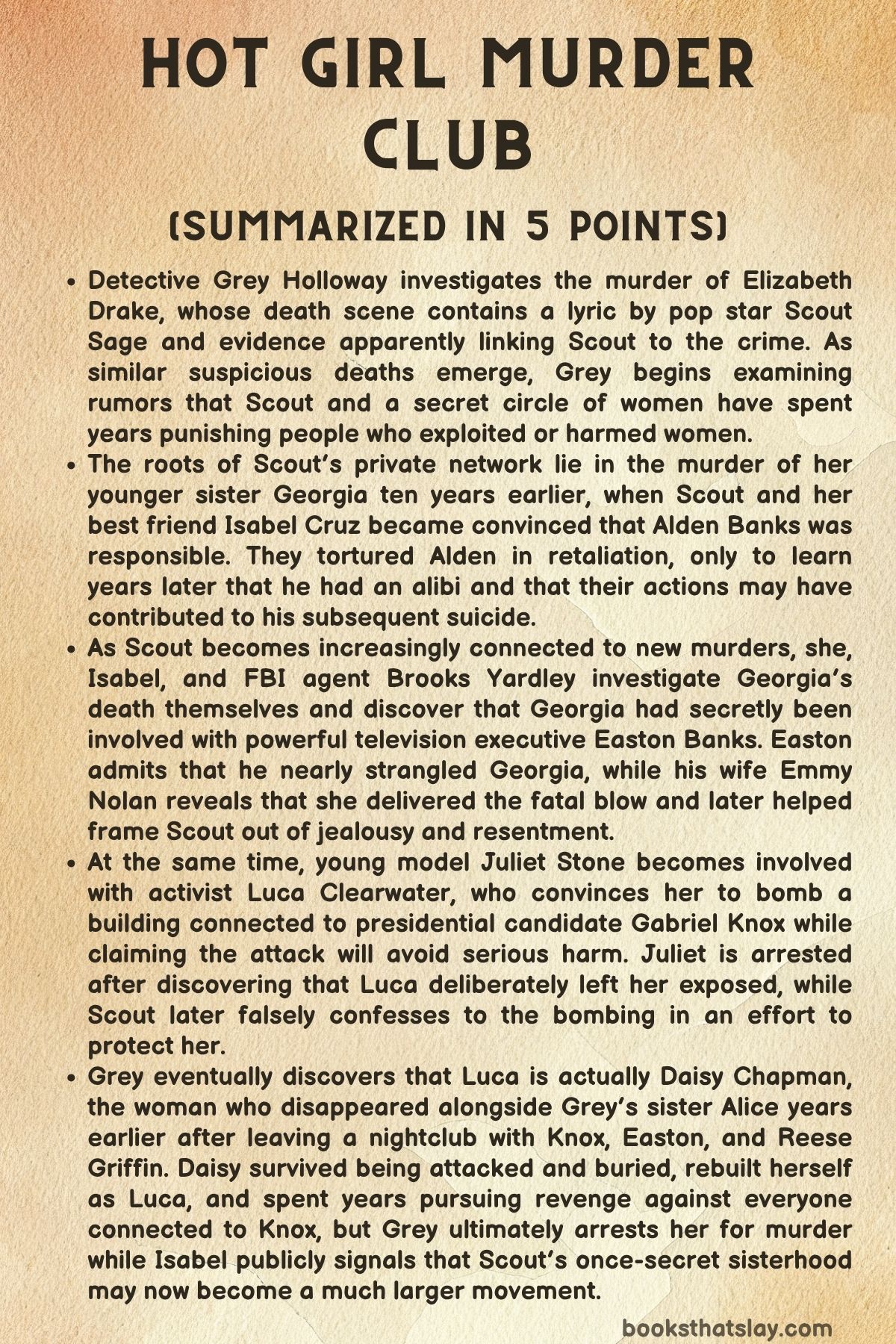
Summary
Detective Grey Holloway is called to the Bel Air home of Elizabeth Drake, a wealthy woman who has been shot in the temple. Grey is immediately unsettled by Drake’s resemblance to her, but the more disturbing detail is a message written in the victim’s blood: “I EAT TRAITORS FOR BREAKFAST,” a lyric by famous singer Scout Sage. Drake once worked for disgraced Hollywood producer Reese Griffin and was accused of helping him gain access to young women and defending him when his abuses became public.
Grey’s new partner, veteran detective Carmen Ellis, believes Drake’s death is one in a series of suspicious punishments connected to Scout and the women around her. Other deaths have also mirrored the wrongs committed by their victims, and some crime scenes contain Scout’s lyrics, leading Ellis to imagine a secret female network that retaliates against men and women who have harmed other women.
The roots of that suspicion stretch back ten years. At nineteen, Isabel Cruz arrives at a lavish Hollywood Christmas party with her best friend Scout, Scout’s younger sister Georgia, and Isabel’s boyfriend Brooks Yardley, hoping the evening will help launch Isabel and Scout’s careers.
Georgia spends part of the evening with Alden Banks, the son of powerful television executive Easton Banks, who appears intensely attached to her. Hours later, Georgia is found dead in the pool house with evidence of strangulation and a fatal head injury, while Alden quickly becomes the person Scout and Isabel believe must be responsible.
The police investigation produces no decisive evidence against Alden, and the Banks family’s resources make Scout and Isabel fear that wealth will protect him. Consumed by grief and anger, they secretly enter Alden’s room, restrain him, interrogate him, and carve Georgia’s name into his chest, believing they are imposing the punishment the justice system will not provide.
The next day, Alden is found dead by hanging in the same pool house where Georgia died. Police interpret the name cut into his body as a confession and conclude that guilt drove him to suicide, but Isabel understands that their attack may have pushed an innocent person toward death, while Scout refuses to regret what they did.
Over the following decade, Scout becomes a famous singer while Isabel abandons her own acting ambitions and becomes Scout’s assistant, strategist, and closest confidante. Together they quietly build a network of women who help others facing exploitation, harassment, coercion, and institutional indifference, usually relying on professional pressure, damaging information, social influence, or threats rather than murder.
Eighteen-year-old model Juliet Stone becomes one of the latest women to seek their help. Her agent, Danny Peterson, has trapped her in an exploitative contract and manipulated her debt, so Scout, Isabel, model Cybele Laurent, designer Miranda Preston, and the others confront him and force him to release Juliet from the worst conditions.
Grey meanwhile continues investigating Scout despite discovering that Ellis has become dangerously obsessed with proving the singer’s guilt. Grey has another private investigation occupying her as well: twelve years earlier, her older sister Alice disappeared after working at the Serpent Room nightclub, where Grey now secretly works occasional shifts in the hope of discovering what happened to her.
Journalist Rosie Wright independently begins investigating rumors surrounding Scout’s female circle and publishes an exposé portraying it as a vigilante organization. Instead of turning the public against Scout, the article makes her even more popular, while Rosie’s research into Georgia’s death uncovers evidence that Alden may never have killed her.
The situation worsens when Rosie is murdered and another Scout lyric is left behind. Scout’s hair has also been discovered at Elizabeth Drake’s murder scene even though Scout insists she never knew the woman, leaving Scout and Isabel convinced that someone is deliberately constructing evidence against her.
They turn reluctantly to Brooks, now an FBI agent. His investigation leads them to Dakota Banks, Alden’s sister, who reveals that Alden had a genuine alibi during Georgia’s murder and shows them Scout’s engraved knife, proving Scout and Isabel attacked him before his death.
Further witnesses confirm that Georgia had rejected Alden because she was secretly involved with another man. Scout and Isabel eventually discover photographs proving that the man was Easton Banks himself, Alden’s father, who had been carrying on a hidden relationship with Georgia despite the enormous difference in their ages and power.
The photographs reveal something else. Easton, Reese Griffin, and rising politician Gabriel Knox had frequently partied with young women at the Serpent Room, and two bottle-service workers disappeared after spending a night with them; one of those women was Grey’s sister Alice.
While this investigation develops, Juliet becomes fascinated by political activist Luca Clearwater and her Green Lions movement, which openly challenges Gabriel Knox. Juliet believes Scout’s private network is too cautious and limited, whereas Luca speaks about changing entire systems rather than helping individuals one case at a time.
Luca gradually isolates Juliet from the women who first protected her and persuades her to participate in a radical plan against Knox Aeronautics. Juliet carries an explosive device into the company’s tower believing it will damage property without seriously harming anyone, activates it, and escapes into a protest crowd before a much larger blast than she expected tears through the building.
At the same time, Scout and Isabel confront Easton at his Malibu home. Easton admits that he was having sex with Georgia on the night she died and that he strangled her until she lost consciousness, but he insists he did not strike the fatal blow.
Easton’s wife, Emerson Banks, then appears with Scout’s gun. She is actually Emmy Nolan, an aspiring actress Scout and Isabel knew years earlier, and she has altered her appearance until she strongly resembles Scout.
Emmy finally reveals what happened on the night of Georgia’s death. Hidden inside the pool house, she witnessed Easton strangling Georgia; when Georgia unexpectedly began breathing again, Emmy saw an opportunity to gain power over Easton and struck Georgia in the head with a heavy lamp, killing her before helping Easton conceal what had happened.
Emmy also confesses that she has been framing Scout for the recent murders because she has spent years resenting Scout’s fame. Her jealousy made her willing to cooperate with another woman who wanted Easton and people connected to Gabriel Knox eliminated, revealing that the framing operation is larger than Emmy alone.
Scout nearly kills Easton and Emmy in revenge, but Isabel persuades her not to cross that final boundary. Emmy then grabs the discarded gun and shoots Easton herself, only for Brooks to enter after secretly listening to the confrontation through a call Scout had left connected; Emmy is arrested, and her confession finally establishes the truth about Georgia.
Meanwhile, Juliet is arrested for the bombing after surveillance cameras record her carrying the device. She realizes Luca lied about disabling the cameras, and police reveal that an anonymous caller identified Juliet before the explosion, making it clear that someone deliberately positioned her to take responsibility.
Scout and Isabel gather the women their network has helped over the previous decade. By combining what each person knows, they discover that Elizabeth Drake, documentary filmmaker Simon Markham, murdered journalist Rosie Wright, Easton Banks, and the bombing all connect not primarily to Scout but to Gabriel Knox.
Grey also discovers that the physical evidence against Scout has been manipulated. Genuine pieces of Scout’s hair and fingernails could be purchased through a disturbing celebrity-memorabilia market, proving that somebody could easily have planted Scout’s DNA at a murder scene.
Scout’s group offers Grey evidence connecting Luca to the conspiracy, but Scout wants Juliet spared in return. When Grey explains that Juliet cannot simply be released after being recorded committing the bombing, Scout makes an extreme decision and falsely confesses to carrying out the attack herself, hoping that her appearance, fame, money, and legal resources can create enough uncertainty to protect Juliet.
Grey confronts Luca and learns the truth about her identity. Luca is Daisy Chapman, the Serpent Room employee who disappeared with Alice twelve years earlier, and reconstructive surgery after a nearly fatal assault allowed her to create an entirely new identity.
Daisy explains that she and Alice left the nightclub with Gabriel Knox, Reese Griffin, and Easton Banks for an isolated afterparty. The men drugged and assaulted them, eventually believing both women were dead and burying them in the desert, but Daisy managed to crawl out of her grave and survive while Alice remained buried near a property controlled by Knox.
Luca spent the next twelve years trying to expose Knox while becoming increasingly willing to kill anyone she believed had protected him. Elizabeth Drake knew information about Knox’s desert property but would not reveal it; Simon Markham had previously helped suppress evidence connected to Alice’s disappearance and later created political propaganda for Knox; Rosie had begun getting too close to the conspiracy.
Luca believes institutions are incapable of defeating men like Knox and argues that direct removal is justified when legal systems repeatedly protect powerful offenders. Grey understands Luca’s rage because both women have built their adult lives around Alice, yet she refuses Luca’s belief that purpose excuses murder and arrests her for the killings.
Afterward, Scout prepares to face prosecution for the bombing confession while Isabel destroys documents that could expose their network. Brooks, however, knows Scout could not have committed the bombing because he was listening to her confrontation with Easton when the explosion occurred, and he challenges Isabel to stop defining her life entirely through protecting Scout.
Two weeks later, Luca has been arrested, Scout has been cleared of the murders, Gabriel Knox is under investigation for Alice and Daisy’s disappearance, and he has abandoned his presidential campaign. Scout still faces prosecution because of her false bombing confession, while the public remains divided between those who see her as a criminal and those who regard her as a symbol of resistance.
Outside the courthouse, Scout refuses to acknowledge the rumored female organization. Isabel makes a different choice: she turns toward the crowd and performs the network’s secret cross-like gesture, transforming a hidden symbol into a public declaration and allowing the idea of their sisterhood to become larger than the women who originally created it.
Characters
Grey Holloway
Grey Holloway is shaped by discipline, skepticism, and an almost defensive devotion to evidence. She became a detective partly because her father’s failed effort to solve Alice’s disappearance destroyed both his reputation and eventually his life, leaving Grey determined never to confuse desperate belief with proof.
That history explains why Carmen Ellis’s theory about Scout initially attracts and repels her at the same time. Grey recognizes the emotional logic of searching for hidden connections, but she fears becoming another investigator who allows obsession to determine what evidence means, which is why Ellis’s increasingly unstable behavior feels like a warning about Grey’s own possible future.
Grey’s strength in Hot Girl Murder Club lies in her ability to change her conclusions when facts demand it. She pursues Scout aggressively when the evidence appears convincing, but she also accepts that Scout may have been framed when the DNA evidence can be explained through purchased memorabilia.
Her confrontation with Luca becomes the strongest test of her identity because Luca possesses what Grey has wanted for years: the truth about Alice. Grey can understand Luca’s anger more intimately than almost anyone else, yet she still arrests her because she believes justice loses its meaning when personal conviction becomes permission to decide who deserves to die.
Scout Sage
Scout begins as an ambitious nineteen-year-old who sees Hollywood as a world she can conquer through nerve, talent, charisma, and relentless self-belief. Georgia’s murder changes that ambition permanently by attaching Scout’s later success to unresolved grief, anger, and the conviction that powerful institutions will protect the people they value most.
Her attack on Alden establishes the dangerous element within her character: when Scout becomes certain that someone is guilty, certainty can feel more important to her than proof. Learning that Alden was innocent therefore destroys more than an old assumption, because it forces her to recognize that the first act she considered justice was actually an act against another victim.
Throughout Hot Girl Murder Club, Scout occupies an unstable position between protector and potential executioner. The network surrounding her has genuinely helped vulnerable women, but her instinct when facing unbearable wrongdoing repeatedly moves toward irreversible punishment, particularly when she confronts Easton and Emmy.
What prevents her from becoming indistinguishable from the people she condemns is not innocence but restraint at crucial moments. Isabel persuades her not to execute Georgia’s killers, and Scout’s later willingness to accept responsibility for Juliet’s bombing shows that the same extremity that makes her dangerous can also make her extraordinarily self-sacrificing.
Isabel Cruz
Isabel is arguably the hidden architect of the women’s network. Publicly, she appears to be Scout’s assistant and closest companion, but privately she designs rituals, selects operations, controls information, organizes threats, manages risks, and turns Scout’s celebrity influence into an effective system of protection.
Her defining conflict is between loyalty and identity. Isabel loves Scout deeply and regards Georgia as family, but that devotion repeatedly requires her to suppress her own ambitions, desires, relationship with Brooks, and need for recognition.
Unlike Scout, Isabel never fully escapes the guilt surrounding Alden’s death. She spends the next decade trying to transform uncontrolled revenge into carefully limited intervention, which explains why Scout’s desire to kill Easton horrifies her even after they learn how deeply he harmed Georgia.
The ending represents Isabel’s first major decision to claim ownership over the history she helped create. By giving the secret gesture publicly, she refuses to let her work disappear behind Scout’s fame and begins defining herself as more than the person who keeps another woman’s life functioning.
Juliet Stone
Juliet enters the story as an exploited eighteen-year-old whose early success has given other people control over her money, career, and choices rather than genuine independence. Danny Peterson’s manipulation has taught her that institutions and contracts can preserve exploitation while still appearing legitimate, which makes Scout’s network feel revolutionary when it succeeds where ordinary legal help has failed.
Her gratitude quickly develops into ideological hunger. Juliet does not merely want protection; she wants to become the kind of woman capable of protecting others, and she begins interpreting caution as cowardice once the public movement surrounding Scout grows.
Luca exploits precisely this desire. By praising Juliet’s courage, framing extreme action as moral sacrifice, and isolating her from older women who question her choices, Luca convinces Juliet that carrying an explosive device is proof that she has moved beyond victimhood.
Juliet therefore demonstrates how easily empowerment can be manipulated when a young person desperately wants purpose and belonging. Her decision is serious and dangerous, but the book also makes clear that Luca deliberately controls the information, arranges the surveillance failure, and allows Juliet to bear risks she does not fully understand.
Luca Clearwater / Daisy Chapman
Luca is both a survivor and a murderer, and the difficulty of separating those identities gives her unusual moral complexity. As Daisy Chapman, she survives an assault that nearly kills her, escapes from a grave, undergoes reconstructive surgery, and spends twelve years carrying the knowledge that Alice did not escape with her.
Her entire adult identity becomes an answer to survivor guilt. Building the Green Lions, pursuing Gabriel Knox, and searching for Alice allow her to convert helplessness into action, but over time the mission becomes broad enough to justify almost anything.
Luca stops distinguishing clearly between exposing wrongdoing and destroying people who obstruct her goals. Drake, Simon, and Rosie become acceptable casualties because Luca believes their choices helped sustain Knox’s power or prevented the truth from emerging.
Her manipulation of Juliet exposes the contradiction inside her political philosophy. Although she condemns powerful people for treating vulnerable individuals as disposable, she ultimately treats Juliet as disposable when sacrificing the teenager becomes useful to the movement she has created.
Emmy Nolan / Emerson Banks
Emmy begins as an insecure aspiring actress whose hunger for recognition becomes inseparable from resentment. At the Christmas party, rejection by powerful men does not make her question the system exploiting young women; instead, it makes her furious that she has not been selected for the attention and opportunities she believes other women receive.
Georgia’s near death presents Emmy with the first situation in which she possesses power over someone more influential than herself. Rather than helping Georgia, she kills her because doing so gives her leverage over Easton, turning another woman’s vulnerability into a route toward status.
Her later transformation into Emerson Banks reveals the emptiness of what she gains. Wealth and marriage do not resolve the insecurity that originally drove her because Scout achieves the one thing Emmy still cannot manufacture: widespread admiration.
Her decision to frame Scout is therefore deeply personal. Emmy wants not simply to avoid responsibility for Georgia but to destroy the woman whose fame has become living evidence of everything Emmy believes she deserved and never received.
Georgia Sage
Georgia spends much of the story as a memory interpreted by other people. Scout and Isabel preserve her as a beloved younger sister, Alden idealizes her romantically, and investigators initially reduce her life to the circumstances of her murder.
The later discovery of her secret relationship with Easton restores some of the complexity that grief had removed from her identity. Georgia was making choices, hiding parts of herself, testing social boundaries, and living a private emotional life that the people closest to her did not understand.
Her death also becomes the event through which numerous characters justify later decisions. Scout uses it to explain revenge, Isabel uses it to motivate protection, Ellis carries guilt about failing her, Alden dies beneath the weight of a false accusation, and Emmy uses the murder to build a future for herself.
Georgia consequently remains absent physically while exerting enormous influence over the living characters. The tragedy is intensified by how rarely their later actions reflect what Georgia herself might actually have wanted.
Brooks Yardley
Brooks initially appears as Isabel’s supportive boyfriend, comparatively removed from Scout’s intense ambitions and the women’s complicated friendship. Georgia’s murder draws him permanently into their history, first as a suspect who is cleared and later as someone who watches Isabel emotionally close herself away from him.
His later career with the FBI reflects his own response to helplessness. Where Scout and Isabel create an unofficial system outside the law, Brooks moves deeper into formal law enforcement because Georgia’s death leaves him wanting the authority and investigative tools he lacked when he was young.
His relationship with Isabel is important because he eventually rejects the competition she has unconsciously created between romantic love and loyalty to Scout. Rather than demanding that she abandon one part of herself, he asks what she would choose if she regarded her own needs as equally important.
That question helps Isabel recognize how thoroughly she has treated her own life as secondary. Brooks therefore becomes less important as a conventional romantic resolution than as the person who finally insists that Isabel is worthy of being somebody’s first concern.
Carmen Ellis
Carmen Ellis first appears in the past as the young officer who privately warns Scout and Isabel that the Banks family’s influence may make prosecuting Alden extremely difficult. Her sympathy comes from seeing two devastated young women collide with the unequal reality of a system in which money affects whose version of events receives protection.
Years later, the unresolved case has hardened into personal guilt. Ellis becomes obsessed with the possibility that Scout created a vigilante organization after Georgia’s death, and that obsession leads her to trespass, collect garbage, steal potential evidence, and interpret almost every coincidence as confirmation.
Her character warns against assuming that good motives protect an investigator from bad methods. Ellis wants to uncover wrongdoing, but her emotional investment becomes so strong that she begins seeking confirmation rather than testing possibilities.
She also serves as a dark parallel to Grey. Both women carry unresolved losses connected to cases that institutions failed to solve, but Grey eventually recognizes that preserving doubt is essential when evidence remains incomplete.
Easton Banks
Easton represents institutional power operating through charm, professional status, wealth, and private impunity. As a major television executive, he occupies a world where dangerous behavior can be known by colleagues without necessarily producing consequences until that knowledge becomes useful to someone else.
His relationship with Georgia shows the severe imbalance between his public authority and her youth. Even if Georgia considered the relationship consensual, Easton benefits from age, experience, status, secrecy, and an entertainment culture accustomed to protecting men like him.
His behavior during Georgia’s death reveals the depth of his cowardice. He strangles her until she loses consciousness and, when she unexpectedly survives, allows Emmy to “take care” of the situation rather than protecting Georgia or accepting responsibility.
Years later, his willingness to testify against Emmy cannot erase his role. He may not deliver the fatal blow, but his choices create the circumstances in which Georgia becomes vulnerable to someone who sees murder as opportunity.
Alden Banks
Alden is introduced through Scout and Isabel’s suspicion, which encourages the reader to interpret his fixation on Georgia as evidence of dangerous possessiveness. His awkward attention, intense feelings, and proximity to Georgia make him an easy person around whom a convincing accusation can form.
The later revelation of his alibi forces a complete reassessment. Alden was devastated because Georgia rejected him, became heavily intoxicated, and remained unconscious in Dakota’s room during the period when Georgia was killed.
His death becomes one of the book’s most serious challenges to revenge based on certainty rather than proof. Scout and Isabel believe they are confronting a murderer, but their grief allows them to treat suspicion as conviction and violence as legitimate punishment.
Alden therefore becomes a second victim of Georgia’s murder. His innocence does not make every aspect of his behavior admirable, but it makes the punishment inflicted upon him an irreversible moral failure that shapes Isabel and eventually destabilizes Scout’s entire understanding of the organization they created afterward.
Gabriel Knox
Gabriel Knox spends much of the narrative physically distant from the central investigation, yet his influence lies behind many of its most important events. He is wealthy, politically ambitious, and sufficiently powerful that people around him learn that protecting him can be professionally rewarding while challenging him can be dangerous.
The revelations about Alice and Daisy establish the criminal reality beneath his public image. He participates in the night that leaves Alice buried and Daisy nearly dead, while evidence is later suppressed and witnesses become afraid to speak openly.
Knox also functions as the justification around which Luca builds increasingly extreme choices. His ability to escape consequences convinces her that ordinary institutions cannot remove men like him and that direct destruction is therefore necessary.
The book does not use Knox merely as an individual villain. He represents a structure in which wealth, political influence, professional alliances, reputation management, and institutional fear reinforce one another strongly enough that a person can become difficult to hold accountable through normal channels.
Alice Holloway
Alice exists in Grey’s life first as an absence. Her disappearance shapes Grey’s career, damages her father, and creates a mystery that Grey continues investigating even when doing so risks repeating the obsessive patterns that destroyed her family.
The flashback showing Alice alive is therefore important because it restores a personality behind the cold case. She is sociable, impulsive, financially insecure, fond of nightlife, and deeply affectionate toward Grey, making choices that seem ordinary within the environment where she works.
Her decision to attend the afterparty is not presented as consent to what later happens. She is thinking about money, independence, and a future in which she can provide a welcoming home for her younger sister.
Alice’s fate also exposes the long-term effect of hidden violence. Her disappearance changes Grey, her father, Daisy, and eventually the political careers and criminal investigations surrounding Gabriel Knox, showing how a crime concealed successfully at one moment can continue shaping lives for decades.
Rosie Wright
Rosie is ambitious, persistent, ethically flexible, and convinced that uncovering a major story justifies aggressive investigative methods. When her editor dismisses her original investigation into a powerful crisis-management company, she does not abandon the subject but joins the company undercover and continues collecting information herself.
Her fascination with Scout’s network is partly journalistic and partly intellectual. She recognizes that a group of women bypassing formal institutions would represent a new kind of social power and becomes determined to understand its origins.
Rosie’s weakness is that she sometimes treats other people’s pain as material before fully appreciating the danger around it. Her investigation into Georgia, Alden, Ellis, and Scout grows increasingly personal until she reaches information that threatens people involved in much older crimes.
Her murder demonstrates why investigative truth can become dangerous when influential people depend upon secrecy. Ironically, the journalist who tries to expose a hidden network of women eventually uncovers a far more consequential hidden history surrounding Knox.
Dakota Banks
Dakota grows up surrounded by wealth but receives little of the emotional security that privilege is assumed to provide. Her father is distant, her mother avoids reality, and Dakota learns early that the adult men around the family possess private lives that are far less respectable than their public reputations.
Her sarcasm and cynicism operate partly as defenses against this environment. Unlike Scout and Isabel, she knows Alden did not kill Georgia because she personally watched over him while he was intoxicated during the crucial period.
Dakota’s anger toward Scout is therefore grounded in genuine loss. From her perspective, her brother was accused, tortured, humiliated, and ultimately driven toward death for something he did not do.
By preserving Scout’s knife and eventually revealing Alden’s alibi, Dakota becomes the person who forces Scout and Isabel to confront the most damaging truth about their own history. She turns the story away from a simple narrative of failed justice and toward the consequences of imposing punishment before certainty exists.
Cybele Laurent
Cybele is one of the strongest examples of how Scout and Isabel’s network can function constructively. As a successful model who understands the exploitative mechanisms of the industry, she immediately recognizes how Danny Peterson has trapped Juliet and uses her own professional status to create leverage against him.
Her protectiveness is practical rather than romanticized. She knows that helping vulnerable women requires money, influence, information, and preparation, and she does not assume every confrontation will remain polite.
Cybele also serves as a counterweight to Juliet’s increasing attraction to Luca. She recognizes that Luca’s interest in the women’s network may be less about cooperation than appropriation and correctly senses that Luca wants access to their celebrity influence.
When Juliet is arrested, however, Cybele does not abandon her simply because the younger woman ignored warnings. Her continued concern reinforces the network’s central promise that support should not disappear the moment someone makes a disastrous decision.
Miranda Preston
Miranda operates as another experienced member of Scout’s circle who values solidarity but also understands the need for boundaries. She participates in the effort to protect Juliet from Danny and accepts the network’s willingness to use significant social pressure against people who exploit vulnerable women.
Her conflict with Juliet develops when Juliet starts treating secrecy as a form of moral failure. Miranda understands that the network survives because members do not expose one another unnecessarily, particularly when some of their methods could create serious legal consequences.
Her anger when Luca publicly claims Scout’s support for a political protest is therefore not simple conservatism. Miranda recognizes that Luca and Juliet are attempting to spend Scout’s reputation and expose other women without their consent.
She represents a version of activism built around responsibility to the people already inside a community. That position may look less dramatic than Juliet’s desire for mass action, but the later bombing demonstrates why Miranda’s suspicion of uncontrolled escalation is justified.
Frances “Franny” Vogel
Franny is positioned differently from the detectives, activists, celebrities, and survivors because she primarily interprets events rather than directing them. As a history graduate student studying popular culture, she believes gossip, celebrity images, informal communication, and symbolic gestures deserve to be taken seriously as historical forces.
The Green Lions rally initially seems to validate that belief in exhilarating terms. Franny believes she is witnessing a political movement transform celebrity culture into collective action, only for the Knox Aeronautics explosion to expose the violent consequences that can accompany such transformation.
At the courthouse, she again occupies the position of witness. Isabel’s silent gesture confirms for Franny that movements do not require complete factual knowledge about their origins once symbols become collectively meaningful.
Her presence at the ending therefore helps explain how private action becomes public mythology. Franny understands that future history may be shaped less by whether outsiders can prove every detail of the original network than by what thousands of people decide its symbols mean.
Reese Griffin
Reese Griffin embodies the normalized predation surrounding powerful entertainment figures. More than one hundred women eventually accuse him of harassment and assault, yet his career is supported for years by employees, associates, professional intermediaries, and an industry culture willing to overlook what influential men do in private.
Elizabeth Drake’s connection to Reese shows how abusive systems require more than a single offender. Assistants, executives, publicists, lawyers, colleagues, and other beneficiaries can become part of the machinery that protects access and suppresses accountability.
His relationship with Easton and Gabriel also places him inside the older network connected to Alice and Daisy. Their night at the desert property reveals the extreme behavior possible when wealthy men believe money, loyalty, and institutional weakness will protect them afterward.
Although Reese spends the present-day story in prison, his past actions continue creating consequences. The people he harmed, those who enabled him, and the alliances he maintained remain central to murders, investigations, political ambitions, and buried evidence years later.
Elizabeth Drake
Elizabeth Drake initially appears only as a murder victim, but the investigation gradually complicates her moral position. Her history as Reese Griffin’s highly paid assistant connects her to allegations that she helped arrange meetings with young women, facilitated his access to them, and publicly defended him.
Her murder is framed by the word “traitor,” suggesting that the killer views Drake not merely as someone associated with an abusive man but as a woman who betrayed other women. That accusation reflects one of the story’s repeated questions about how responsibility should be assigned to people who help powerful offenders operate.
Later revelations show that Drake also possessed information about Gabriel Knox’s desert property and the women taken there. Luca befriended her partly to obtain that information, but Drake refused to reveal what she knew.
Her death therefore emerges from a morally complicated history in which she is neither reduced to an innocent stranger nor treated as someone whose questionable choices make murder legitimate.
Simon Markham
Simon initially seems connected to the murders because he dies from the same drug combination that killed his wife, filmmaker Kathryn Burgeon. The deliberate symmetry encourages the belief that someone is punishing him for a suspected role in Kathryn’s death.
His later connection to Gabriel Knox changes the significance of his murder. Simon had once worked as an LAPD crime-scene photographer and helped suppress the investigation surrounding Alice and Daisy’s disappearance in exchange for money.
He later participates in a different form of protection by preparing a favorable documentary intended to support Knox’s presidential ambitions. Luca therefore interprets him as both a past accomplice and a present propagandist.
Simon illustrates how concealment can evolve across a lifetime. He does not need to occupy the same role forever to continue protecting the same powerful person; professional skill, silence, storytelling, and selective presentation can all serve the larger purpose of keeping damaging truth from public view.
Lila Baumgarten
Lila is an important example of compromised ambition within a discriminatory institution. She understands that Hollywood operates as a boys’ club and recognizes Easton’s inappropriate relationships with much younger girls, yet she does not immediately expose him simply because exposing him would be morally necessary.
Instead, she hires Rick Flores to gather evidence and preserves that information until Easton attempts to promote another man over her. Only then does she use what she knows, resulting in Easton’s quiet removal and her own professional advancement.
Her behavior complicates any simple division between women who resist abusive systems and women who support them. Lila is disadvantaged by the same sexist culture that protects Easton, but she also learns how to exploit evidence of other women’s vulnerability for strategic gain.
She therefore demonstrates how corrupt institutions can train even those they exclude to adopt transactional methods. Survival and advancement inside an unjust system do not automatically produce solidarity with everyone else harmed by that system.
Rick Flores
Rick Flores is opportunistic, financially motivated, and ethically ambiguous, yet his archive becomes essential to uncovering truths that more respectable institutions suppressed. He documents Easton, Reese, Gabriel, young women, hotels, drugs, private gatherings, and the hidden relationship between Easton and Georgia.
His photographs also connect Alice and Daisy to the three powerful men on the night they disappear. Rick attempted to sell some of the information to police, only to encounter intimidation serious enough to convince him that certain people could not safely be challenged.
Rick does not preserve evidence because of pure civic duty. He understands information as an asset that might eventually be sold, which means his usefulness emerges partly from the same transactional instincts found elsewhere in the entertainment world.
Yet the story also demonstrates that motives and outcomes do not always align neatly. Evidence collected for money can still reveal truth, while evidence handled by institutions supposedly devoted to justice can be buried, ignored, or manipulated.
Danny Peterson
Danny represents exploitation that hides behind contracts rather than overt criminality. He enters Juliet’s life when she is extremely young, helps arrange circumstances that make her dependent on him, takes an enormous portion of her earnings, and later manipulates a personal loan into another source of control.
His behavior is particularly dangerous because much of it has been structured to remain technically defensible. Juliet’s attempts to obtain legal help fail not because nothing harmful is happening but because harmful conduct can exist inside agreements that appear legitimate on paper.
When Scout’s group confronts him, Danny initially relies on the assumption that his professional power will protect him. He becomes aggressive only after realizing that Cybele and Scout possess enough influence to damage the reputation on which his business depends.
Danny therefore demonstrates why the women’s unofficial system attracts people like Juliet. Conventional institutions may recognize only clear violations, while exploitative people often survive by operating precisely in the territory between legality and fairness.
Themes
Justice, Revenge, and the Danger of Certainty
The boundary between justice and revenge is constantly tested by characters who have legitimate reasons to distrust conventional systems. Hot Girl Murder Club repeatedly presents situations in which formal institutions fail, powerful people escape consequences, and victims discover that money, status, professional connections, or carefully written contracts can make wrongdoing extremely difficult to punish.
The danger begins when failure of the system becomes evidence that private certainty is enough. Scout and Isabel believe Alden killed Georgia and therefore treat their conviction as authority to restrain, torture, and permanently mark him, only to discover years later that he was innocent.
That revelation becomes the moral standard against which later actions must be judged. Isabel understands that righteous anger does not prevent mistaken punishment, while Scout continues struggling with the temptation to believe that some crimes are so terrible that immediate personal retaliation is justified.
Grey faces the same question from the opposite side. Luca can give her the truth about Alice and can prove that institutions genuinely helped powerful men bury serious crimes, yet Grey still refuses to accept Luca’s argument that institutional failure gives an individual the right to become investigator, judge, and executioner at once.
The story therefore refuses the easy conclusion that legal justice is always sufficient, but it also refuses to present revenge as a reliable replacement. Its central warning is that moral certainty becomes most dangerous precisely when the person acting feels completely justified.
Female Solidarity, Power, and Responsibility
Female solidarity appears in several sharply different forms, preventing the idea of sisterhood from becoming automatically virtuous. Scout and Isabel’s network can be generous and effective: women combine money, celebrity, industry knowledge, legal expertise, gossip, social access, and professional influence to protect people who would otherwise face powerful opponents alone.
Juliet experiences this solidarity at its best when the women confront Danny. Nobody blames her for trusting him, becoming financially dependent, or failing to escape by herself; instead, women with greater power deliberately use that power on behalf of someone with less.
The same principle becomes more complicated when loyalty demands secrecy or protection after serious mistakes. Juliet wants the network to become a mass movement, while Scout and older members understand that expanding without limits could endanger every participant and turn private protection into uncontrolled political action.
Emmy and Luca reveal darker forms of female alliance. Emmy cooperates with another woman not because she believes in shared liberation but because destroying Scout serves her resentment, while Luca manipulates Juliet’s need for belonging and treats the teenager as a usable instrument.
The novel therefore distinguishes solidarity from simple cooperation between women. Genuine solidarity requires responsibility toward the people whose trust is being used, particularly those with less experience, less status, or fewer choices.
Celebrity, Mythmaking, and Political Influence
Celebrity functions as a form of power long before it becomes openly political. Scout’s fame allows her network to threaten reputations, mobilize media attention, pressure exploitative professionals, and create consequences that ordinary individuals could rarely produce alone.
At the same time, fame makes Scout vulnerable to narratives she cannot control. Rosie’s article is intended as an exposé but turns her into a folk hero, murder accusations increase public fascination, and strangers begin treating the rumored group as proof that women can create their own systems of accountability.
Juliet sees this cultural enthusiasm as an opportunity for expansion, while Luca understands that symbols can mobilize people more effectively than private facts. By attaching herself to Scout’s reputation, Luca can give the Green Lions greater cultural force without needing Scout’s actual agreement.
Franny provides the clearest intellectual perspective on this process. She recognizes that gossip, gestures, clothing, celebrity images, slogans, rumors, and informal stories can become historical forces because people organize their identities and political emotions around them.
The ending completes that transformation. Isabel’s gesture does not provide the crowd with documents proving exactly how the original network operated, but proof is no longer necessary for the symbol to acquire public meaning.
The private organization becomes mythology, and mythology becomes a social movement. Once that shift occurs, neither Scout nor Isabel can fully determine what the story will mean to the people who inherit it.
Guilt, Identity, and the Need to Repair the Past
Many major characters construct their adult identities around something they failed to prevent. Grey becomes a detective after Alice disappears and her father collapses beneath the unsuccessful investigation, while Scout and Isabel organize years of interventions after Georgia’s murder and their disastrous punishment of Alden.
Brooks enters federal law enforcement partly because Georgia’s death leaves him remembering his own helplessness. Carmen Ellis becomes obsessive because she believes she failed Scout and Isabel when they were young, and Luca creates an entirely new identity after surviving the night Alice does not.
These characters repeatedly convert guilt into action because action offers the possibility of believing that the past can still be repaired. Sometimes that produces constructive choices, such as Grey continuing to search for Alice or Isabel trying to create controlled methods for protecting women who lack institutional power.
At other times, guilt becomes dangerous because no future punishment can actually restore what has been lost. Scout discovers this after Georgia’s killers are finally identified: solving the murder provides truth, but it cannot return Georgia, erase Alden’s death, or recover the decade spent organizing life around vengeance.
Luca experiences the same trap on a larger scale. Her entire political identity develops from surviving when Alice did not, until punishing Knox and everyone who protected him begins to feel like the only possible justification for having lived.
The story ultimately suggests that guilt can motivate meaningful change only when people accept that repair has limits. The past can be acknowledged, exposed, and answered, but attempts to erase it through punishment risk creating new victims whose suffering becomes another burden carried forward.