How to Kill a Crime Writer Summary, Characters and Themes
How to Kill a Crime Writer by Sarah Lotz is a comic, self-aware murder mystery about grief, creativity, family, and the unusual power fictional characters can hold over both writers and readers. After successful crime novelist Annie Morrissey dies in what appears to be a household accident, her anxious daughter Niamh is confronted by Leah Overton, the fearless private investigator from Annie’s bestselling novels.
What begins as an impossible encounter becomes an investigation into Annie’s death, forcing Niamh to question her mother’s neighbours, confront painful memories, and reconsider the fictional woman she once saw as a rival for Annie’s affection.
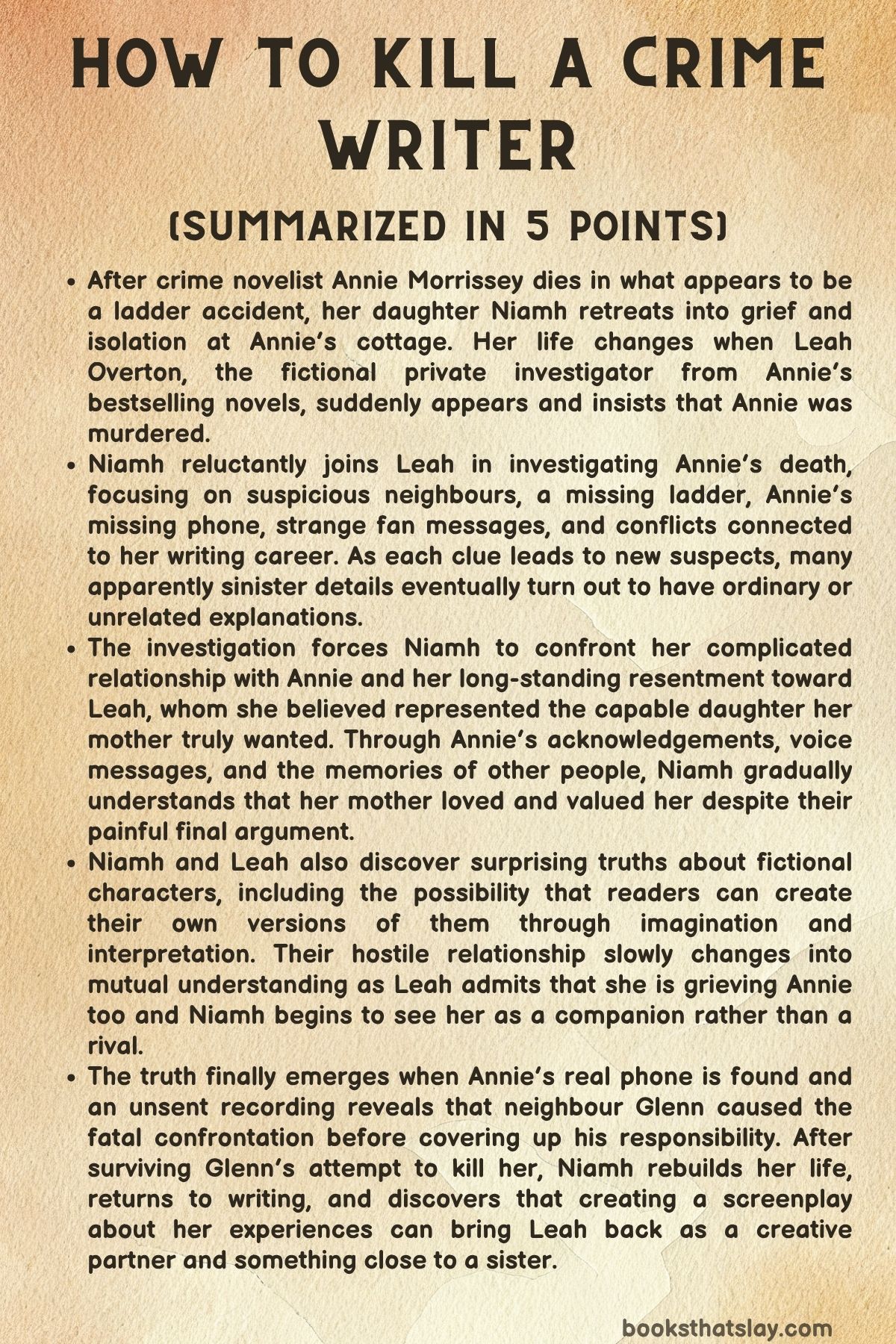
Summary
Crime novelist Annie Morrissey dies outside her cottage in the rural Shropshire hamlet of Buckstone, apparently after falling from a ladder while repairing a damaged gutter. The official explanation seems straightforward, but her daughter Niamh knows that Annie was terrified of heights, had been suffering from shoulder pain, and was unlikely to attempt such a repair herself.
Four months later, Niamh is living alone in Annie’s cottage with Brian, her mother’s cat. Grief and chronic anxiety have reduced her existence to gaming, television, comfort food, and avoidance of almost everyone around her.
Her isolation is broken when Leah Rebecca Overton suddenly appears in the kitchen. Leah is the private investigator from Annie’s bestselling crime series, a character Niamh knows especially well because she helped her mother create her years earlier.
At first Niamh assumes she is hallucinating, but Leah behaves independently and even interacts with Brian. She cannot touch physical objects and cannot enter the downstairs cloakroom, yet her presence is otherwise persistent enough to convince Niamh that something far stranger than an ordinary grief-induced vision is occurring.
Niamh’s reaction to Leah is complicated by years of resentment. When Annie first began writing, creating Leah had been something mother and daughter enjoyed together, but as Niamh struggled with university, confidence, anxiety, and direction, Leah became increasingly competent, brave, disciplined, and successful.
Niamh came to see Leah as the daughter Annie would have preferred. That belief became especially painful after a final argument in which Annie angrily said that Leah was at least doing something with her life, words Niamh never had the chance to resolve with her mother before Annie died.
Leah eventually reveals why she has appeared: she believes Annie was murdered. Niamh reluctantly agrees to investigate, partly because the facts surrounding the death are troubling and partly because she hopes resolving Leah’s “unfinished business” will make her disappear.
The missing ladder becomes one of their first major problems. Annie owned a foldaway ladder, but it has vanished, and her missing mobile phone creates another unanswered question.
Their investigation focuses on the people living around Annie. Glenn, the neighbour who discovered the body, is a retired police officer married to Janet, while unpleasant property owner Ray Fiddle had been involved in disputes with Annie over local development.
Lady Sheila Ripley and her niece Tracey also attract attention because Annie had apparently drawn material from Sheila’s past while writing her final completed novel, Overlooked. Sheila’s history includes her marriage to Sir Bernard Ripley, whose fatal hunting accident carries an uncomfortable resemblance to the suspicious death at the centre of Annie’s fiction.
Reading Overlooked becomes important for Niamh in another way. She discovers Annie’s acknowledgement crediting her with helping make the writing career possible, directly challenging Niamh’s belief that her mother considered her a failure.
For the first time, Niamh fully allows herself to mourn. The emotional release does not make Leah disappear, however, proving that the unfinished business concerns more than accepting Annie’s death.
Niamh and Leah continue chasing possible suspects and increasingly strange clues. They find a damaged phone near Ray’s property, discover anonymous messages from a fan called GinnyRebel757 on Annie’s computer, and learn that another crime writer, Rose Parkinson, also died after becoming closely associated with an obsessively capable fictional female investigator.
The apparent pattern leads them to Rose’s son Jamie. Niamh approaches him deceptively at a grief-support café, but their shared social anxiety creates a genuine connection, and Jamie later reveals that his mother deliberately ended her life after becoming deeply unhappy with both her writing career and her fictional creation.
GinnyRebel turns out to be Gina, a devoted reader whom Niamh meets at a crime-writing festival in Wales. Rather than being a dangerous obsessive, Gina had developed a friendly private correspondence with Annie about their cats.
The encounter produces a more extraordinary discovery. Leah can see a second version of herself apparently created through Gina’s fan fiction, and Niamh eventually sees this distorted alternative Leah too, suggesting that fictional characters may exist differently in the imaginations of different readers.
At the festival, Niamh also confronts Annie’s agent, Caro Canto. Caro explains that Annie had stopped producing meaningful work and was experiencing pain, brain fog, depression, and other symptoms that Caro suspected were connected to menopause, so her urgent attempts to contact Annie had been motivated by concern rather than financial or professional hostility.
Niamh then finally listens to the voice messages Annie left before her death. One contains a disturbing revelation: frustrated with Leah, Annie announces that she intends to kill the character in her next novel.
Niamh immediately begins to suspect Leah herself. She wonders whether the fictional investigator somehow manipulated Annie into her death and has now attached herself to Niamh so that Niamh will continue writing her adventures.
Pretending to trust Leah, Niamh suggests that they create a new screenplay together. Although the proposal begins as a trap, the collaboration unexpectedly revives Niamh’s long-abandoned pleasure in storytelling.
Eventually Niamh accuses Leah directly. Leah is horrified by the allegation and reveals that she too has been grieving Annie, whom she regards as her mother because Annie created her.
Their confrontation finally destroys the idea that they must compete for Annie’s affection. Leah admits her own fears and vulnerabilities, while Niamh begins to recognise that the apparently invincible detective has always been far less emotionally secure than Annie’s novels allowed her to appear.
When Niamh and Leah return from Wales, Annie’s missing ladder suddenly reappears. Recent security footage shows Tracey returning it, apparently placing suspicion directly on the person Niamh had considered one of the kindest people in Buckstone.
The explanation is far stranger but much less sinister. Sheila had stolen the ladder, along with Glenn’s garden ornaments and several other objects, as part of a habit of taking possessions from neighbours who irritated her.
Sheila was also responsible for the large number of empty sherry bottles discovered in Annie’s recycling, meaning Annie had not secretly been drinking. Tracey had merely found the stolen objects and returned the ladder while Niamh was away.
With one suspicious clue after another receiving innocent explanations, Niamh and Leah begin to believe Annie’s death really was an accident. Yet Leah remains, suggesting that something important has still been missed.
The answer finally emerges when Glenn clears Niamh’s overgrown garden and Annie’s real phone is found beneath vegetation near the chestnut tree. An unsent recording from Annie’s final evening captures the arrival of a man at the cottage.
The voice belongs to Glenn. Annie’s chestnut tree had annoyed him because it affected his satellite reception and dropped leaves into his immaculate garden, so he entered her property while believing she was away and attempted to cut its branches himself.
Annie returned unexpectedly and confronted him. During the argument she followed him onto the ladder and fell, but Glenn, frightened that his trespassing and actions would be exposed, chose not to call for help and instead arranged the scene to resemble an ordinary household accident.
When Niamh discovers the truth, Glenn attacks her and attempts to stage her death as suicide by trapping her inside Annie’s car with exhaust fumes entering the vehicle. Leah is absent, forcing Niamh to depend on everything she has learned rather than waiting for her fictional companion to rescue her.
Niamh stays calm, remembers a zip-tie escape technique she once practised with Annie, and benefits from having forgotten to refill the car because the engine eventually runs out of petrol. She escapes into the downstairs cloakroom, calls the police, and survives.
Glenn is arrested and eventually pleads guilty. Janet refuses to protect him with a false alibi, while surveillance evidence further destroys his attempt to conceal what happened.
With Annie’s death finally explained, Niamh chooses to remain in the cottage rather than retreat from the life surrounding it. She becomes closer to her father and Daphne, continues seeing her neighbours, attends Jamie’s grief group, and begins participating in the world rather than watching it from a place of fear.
The resolution of Annie’s death causes Leah to disappear, and Niamh discovers that she genuinely misses the woman she once considered an unbearable rival. She begins writing the screenplay they had imagined together, and the act of writing brings Leah back.
This time Leah returns not as an unwanted manifestation demanding an investigation but as Niamh’s creative partner. Their relationship has changed from jealousy and hostility into something resembling sisterhood, allowing Niamh to move forward without abandoning either Annie’s memory or her own creative ambitions.
Characters
Niamh Morrissey
Niamh is the emotional and psychological centre of How to Kill a Crime Writer, and much of her development comes from the difference between what she believes about herself and what her actions gradually prove. She initially defines herself through failure: she dropped out of university, abandoned screenwriting, struggles with severe social anxiety, depends heavily on avoidance, and assumes that other people view her with the same disappointment she directs toward herself.
Her grief intensifies this pattern because Annie’s death allows Niamh to freeze emotionally while also preserving the guilt created by their final argument. She avoids the garden, her mother’s bedroom, the attic, Annie’s messages, the neighbours, and almost every object capable of forcing her to acknowledge that Annie is permanently gone.
Leah initially seems to represent everything Niamh believes she lacks, yet investigating alongside her gradually reveals abilities Niamh has dismissed. She learns to question people, recognise inconsistencies, travel alone, confront intimidating strangers, improvise under pressure, reconnect with creativity, and eventually survive Glenn without Leah physically beside her.
Her growth is therefore not a transformation into Leah. Niamh succeeds by combining some of Leah’s determination with qualities that are specifically her own, including caution, empathy, technological awareness, humour, self-reflection, and an understanding that real danger cannot be treated like a fictional action scene.
Leah Rebecca Overton
Leah begins How to Kill a Crime Writer as an almost comic embodiment of the invincible crime heroine: physically imposing, blunt, confident, relentless, impatient with weakness, and accustomed to solving problems through confrontation. Because Annie wrote her to move rapidly from one dangerous case to another, Leah has very little understanding of ordinary waiting, domestic routine, social embarrassment, emotional recovery, or the consequences that fictional narratives conveniently skip.
Her early treatment of Niamh is harsh because she interprets anxiety as inaction and caution as incompetence. Yet the book gradually exposes how much fear exists underneath her apparently complete self-possession, particularly when she encounters mundane situations Annie never prepared her for and when she sees the disturbing alternative version of herself created by Gina’s imagination.
Leah’s relationship with Niamh becomes most meaningful when both stop treating the other as a rival. Leah admits that Annie was effectively her mother as well, giving her investigation an emotional purpose that she had previously hidden behind detective language and certainty.
By the end, Leah has become capable of humour, reassurance, compromise and affection. Her transition from idealised fictional heroine to something closer to a sister allows her to become more emotionally complete without losing the formidable qualities that originally defined her.
Annie Morrissey
Although Annie dies before the central events begin, she remains present everywhere in the novel through her cottage, books, possessions, voice messages, friendships, unfinished writing and the two women who are mourning her. The reader initially encounters her through Niamh’s guilt, which means Annie can appear demanding, disappointed and emotionally careless.
Gradually, that simplified image becomes more complicated. Annie certainly pushed Niamh toward independence and said something cruel during their final argument, but her acknowledgements, messages and conversations with other people reveal deep pride in her daughter and a persistent desire for Niamh to build a life rather than surrender to fear.
Annie’s difficulties during her final months also challenge Niamh’s habit of interpreting behaviour as personal judgment. Her inability to write and her growing depression appear connected to physical and hormonal changes that she herself was only beginning to understand.
Her relationship with Leah carries another form of parental complexity. Annie created a fearless woman for entertainment and repeatedly subjected her to violence, loss and emotional repression, never imagining that Leah might experience those events as an actual life.
Glenn
Glenn is effective as an antagonist because his crime grows from something embarrassingly ordinary rather than a grand criminal conspiracy. His obsession with tidiness, boundaries and control turns Annie’s chestnut tree into an intolerable irritation because its leaves and interference with his satellite signal offend the orderly environment he believes he is entitled to maintain.
His former career in the police gives his behaviour an additional dimension. Glenn understands investigations well enough to recognise the consequences of his actions, and instead of seeking help after Annie falls, he uses that knowledge to protect himself by arranging circumstances that support an accidental-death explanation.
The distinction between Annie’s death and Glenn’s later attempt to kill Niamh is especially revealing. Annie’s fall may not have been a planned murder, but Glenn’s decision to leave her unaided establishes his moral cowardice, while his deliberate attempt to kill Niamh proves how quickly self-preservation can turn that cowardice into calculated violence.
Janet
Janet initially appears suspicious because of her police-dispatch background, guarded behaviour and unusual coldness toward Niamh. Her presence encourages both Niamh and Leah to imagine that Glenn and Janet could operate as an experienced law-enforcement pair capable of concealing a crime.
The truth makes Janet more tragic than sinister. She has spent years living with Glenn’s controlling personality and is deeply unhappy, suggesting that his need to dominate his surroundings affects his household as much as it affects his relationship with his neighbours.
Her eventual refusal to provide Glenn with a false alibi becomes a quiet but significant act of moral independence. Janet does not become a dramatic hero, but she finally stops allowing her husband’s version of events to determine her own conduct.
Tracey
Tracey functions as an important test of Niamh’s developing ability to trust people without becoming completely naïve. She is warm, practical, generous and attentive, qualities Leah immediately regards with suspicion because Leah’s fictional instincts encourage her to believe excessive kindness must conceal something.
When security footage shows Tracey returning Annie’s missing ladder, the evidence appears to justify Leah’s distrust. Niamh, however, resists turning one unexplained action into proof of murder, demonstrating that she has learned to investigate without automatically adopting Leah’s assumptions.
Tracey’s explanation confirms that her kindness is largely genuine. She is caring for Sheila through illness, addiction and increasingly unpredictable behaviour, and much of what looked secretive comes from the difficult responsibility of protecting an older relative’s dignity while managing the consequences of her actions.
Lady Sheila Ripley
Sheila initially resembles the sort of eccentric aristocratic figure who naturally attracts suspicion in a country-house mystery. Her history, manor, connection to Annie’s research and confusing remarks create the impression that Buckstone may contain an old crime whose consequences have somehow reached Annie.
The truth is more human and considerably stranger. Sheila was not born into privilege but entered the manor as a worker before marrying Bernard, and her later behaviour is shaped by age, illness, grief and recurring problems with alcohol.
Her habit of stealing small objects from neighbours who annoy her is both comic and revealing. It transforms several threatening clues into evidence of petty resentment while also showing how readily other characters impose dramatic explanations on behaviour they do not understand.
The memory of Thelma gives Sheila additional emotional weight. Her continuing attachment to the former resident of Annie’s cottage suggests that grief can remain active for years, making Sheila another variation on the novel’s wider examination of people learning, or failing, to live after loss.
Ray Fiddle
Ray is deliberately unpleasant enough to look guilty even when he is not. He is rude, aggressive, self-interested and hostile toward the local community, and his planning dispute with Annie gives Niamh and Leah a plausible reason to consider him dangerous.
His behaviour also allows the story to examine the difference between fictional confrontation and real-world threat assessment. Leah repeatedly wants Niamh to pressure Ray more aggressively, while Niamh understands that provoking an angry man when she is physically vulnerable carries consequences that fictional investigators rarely have to consider.
When Niamh later returns with actual leverage and successfully obtains his CCTV footage, the confrontation demonstrates her development. She has not become reckless; she has learned to choose when a risk is necessary and how to enter it with a purpose.
Caro Canto
Caro initially attracts suspicion because she is Annie’s literary agent, had been urgently trying to contact her, and stands to remain professionally connected to the profitable Leah Overton series after Annie’s death. Niamh’s growing distrust of the publishing business makes Caro temporarily fit a theory in which authors become disposable once their fictional properties acquire sufficient commercial value.
Her explanation reverses that interpretation. Caro had recognised symptoms in Annie that resembled experiences of other women she knew and was urging her to seek medical support rather than continue struggling in silence.
Caro therefore represents one of the novel’s repeated warnings against treating incomplete evidence as a finished narrative. Her professional pressure was real, but Niamh initially assigns the wrong motive to it because murder investigation encourages her to convert every conflict into possible guilt.
Meera
Meera serves as one of the most reliable links between Niamh and the version of Annie that existed outside the mother-daughter relationship. As Annie’s friend and executor, she can provide practical information about the aftermath of the death while also correcting some of Niamh’s most painful assumptions.
Her revelation that Annie moved partly because she wanted Niamh to become more independent initially seems cruel. Yet Meera also makes clear that Annie loved her daughter deeply, allowing Niamh to understand that frustration and love can exist simultaneously.
Meera’s importance lies in this emotional balance. She neither idealises Annie nor accepts Niamh’s belief that every difficult choice made by her mother was evidence of rejection.
Jamie Parkinson
Jamie initially enters the story as a possible source of evidence about another dead crime writer, but he becomes important because his grief resembles Niamh’s without duplicating it. Both are socially anxious adult children trying to understand mothers whose deaths left behind unresolved questions.
Niamh approaches him dishonestly, which forces her to confront the ethical cost of treating real people like characters in an investigation. Their connection becomes genuine precisely because Jamie refuses to remain merely a source of information.
His eventual admission that Rose intentionally ended her life allows both characters to reconsider guilt. Niamh’s attempt to explain destructive relationships between authors and their creations unexpectedly gives Jamie a way to separate his mother’s suffering from the idea that her death represented a rejection of him.
Gina / GinnyRebel757
Gina initially appears threatening because anonymous messages from GinnyRebel757 combine obsessive fandom, references to Leah’s fictional cat and an apparent connection to another dead crime writer. The investigation encourages Niamh to convert passionate fan behaviour into evidence of dangerous obsession.
Meeting Gina undermines that assumption. Her messages to Annie were part of a private friendship centred on their cats, and her attachment to Leah comes from recognising qualities beneath the character’s surface bravado.
Gina also expands the novel’s ideas about readers and fictional ownership. The alternative Leah produced through her fan fiction suggests that once characters enter the minds of readers, authors no longer exercise complete authority over what those characters mean.
Rose Parkinson
Rose is never an active participant in the present-day events, yet her history provides an important parallel to Annie’s. She created the highly capable investigator Carrie Ng, became increasingly unhappy with her writing career, and eventually reached a point where the relationship between her identity and her successful creation had become deeply damaging.
Her death initially appears to support an extravagant theory about someone targeting crime writers. Instead it offers a darker psychological parallel in which creative success can become a form of confinement when a writer feels unable to escape the character or expectations that made that success possible.
Rose also prevents Annie’s difficulties from being treated as unique personal failure. Through Rose, the novel considers how commercial expectations, criticism, identity and creativity can place intense pressure on writers long after a successful series has stopped being emotionally rewarding.
Niamh’s Father
Niamh’s father is a relatively understated presence, but his conversations with his daughter help stabilise her memories of Annie. His confirmation of Annie’s severe fear of heights becomes relevant to the investigation, while their shared recollection creates one of the first moments when Niamh can discuss her mother without completely retreating into avoidance.
His relationship with Niamh also improves as she becomes more willing to engage with other people. He represents family connection that remains available even after the person who once stood at the centre of that family has died.
Daphne
Daphne, Niamh’s stepmother, contributes to the network of people attempting to care for Niamh even when Niamh would rather isolate herself. Her calls and concern occasionally feel intrusive from Niamh’s perspective, but the story gradually places them within a larger pattern of support rather than control.
She also helps connect Niamh with Meera when Niamh’s strange questions about Annie become concerning. Like several supporting characters, Daphne demonstrates that accepting help does not automatically mean surrendering independence.
Brian
Brian initially appears to be comic relief, particularly because a newspaper report misleadingly describes him as Annie’s surviving “son.” Yet his ability to perceive and interact with Leah is one of the earliest pieces of evidence that Niamh may not simply be hallucinating.
He also represents continuity between Annie’s life and Niamh’s. Caring for Brian gives Niamh a living responsibility connected to her mother, while his unexpected friendship with Petticoat provides another example of Niamh incorrectly assuming conflict where none exists.
Petticoat
Petticoat helps draw Niamh physically and socially beyond Annie’s cottage. Walking the dog encourages her to notice Buckstone, spend time outdoors and experience the countryside without treating it exclusively as the place where her mother died.
The supposed hostility between Petticoat and Brian also becomes part of Niamh’s increasingly elaborate suspicions about Tracey. Discovering that the animals are actually friends humorously reinforces the novel’s repeated distinction between interpretation and reality.
A. J. Tillman
A. J. Tillman has a relatively small role but contributes significantly to the book’s discussion of writers and fictional creations. By publicly performing as Fluffy Carrington, Tillman demonstrates an unusually visible form of identification between author and character.
His joke about wanting to kill Fluffy but feeling controlled by the character helps Niamh imagine a more sinister relationship between authors and successful creations. Even though her resulting theory is wrong, the conversation pushes her toward understanding that commercial characters can develop expectations and identities that their creators no longer fully control.
Themes
Grief, Guilt, and Learning to Live After Loss
Niamh’s grief is initially expressed through avoidance rather than open mourning. She stays inside Annie’s cottage but refuses to engage with the places and objects most strongly associated with her mother, turning the home into both a refuge and a container for everything she cannot face.
Her guilt makes the grief harder because Annie died immediately after an argument that never received a resolution. Niamh therefore mourns not only her mother but also the apology, reconciliation and future conversations that are no longer possible.
Leah’s arrival forces physical movement before emotional acceptance. Each stage of the investigation requires Niamh to enter another avoided room, hear another memory, speak to another person or reconsider something she had decided was too painful to examine.
The eventual solution of Annie’s death matters, but emotional recovery has already begun before the culprit is identified. Reading Annie’s acknowledgement, listening to her messages, talking with Jamie, revisiting memories and allowing herself to cry all help Niamh replace a single guilt-dominated version of her mother with a fuller understanding of their relationship.
The novel does not suggest that grief disappears once the truth is known. Instead, Niamh becomes capable of carrying Annie’s absence while continuing to participate in ordinary life, relationships and creative work.
Fiction, Authorship, and Who Owns a Character
How to Kill a Crime Writer repeatedly questions whether fictional characters belong entirely to their creators once readers begin imagining them independently. Leah begins as Annie’s creation, but her appearance after Annie’s death gives literal form to the idea that a successful character can outlive the person who originally invented her.
Niamh complicates authorship further because she helped create Leah. She supplied important characteristics and even the name, yet Annie became publicly recognised as the sole author whose career depended on the character.
Gina introduces the reader’s role into this relationship. Her fan fiction produces a version of Leah that differs dramatically from Annie’s original, suggesting that readers inevitably remake characters through interpretation, desire and personal identification.
Leah herself eventually resists the assumption that an author knows everything about a creation. She believes Niamh understands her better than Annie did, a statement that challenges the authority usually granted to creators over fictional identity.
The ending offers collaboration rather than ownership as an alternative. Niamh writes with Leah instead of treating her purely as inherited intellectual property, allowing character and writer to negotiate boundaries in a way Annie never imagined.
Anxiety, Passivity, and the Development of Agency
Niamh begins the story convinced that she is fundamentally passive. She compares herself with Leah’s extraordinary competence and concludes that courage belongs to certain kinds of people while she is naturally suited to hiding, procrastinating and avoiding difficult situations.
The investigation gradually exposes the weakness of that judgment. Niamh does not suddenly stop experiencing anxiety; she attends events while panicking, confronts people while frightened, makes mistakes while investigating and frequently needs time to recover.
Agency therefore becomes the ability to act while fear remains present rather than the complete absence of fear. This distinction is crucial because Leah initially treats bravery as effortless forward movement, reflecting the unrealistic structure of the crime novels in which she was created.
Niamh eventually teaches Leah that real people must consider physical vulnerability, legal consequences and emotional exhaustion. At the same time, Leah teaches Niamh that anxiety cannot be allowed to make every decision on her behalf.
Their influence becomes fully visible during Glenn’s attempt to kill Niamh. Leah is absent, but Niamh can draw upon the habits she has learned while still relying on her own memory, caution and improvisation, proving that confidence has become internal rather than borrowed.
Suspicion, Storytelling, and the Danger of Turning Life into a Mystery
The investigation repeatedly demonstrates how easily people construct dramatic explanations from incomplete information. A missing ladder, empty alcohol bottles, an abandoned phone, anonymous fan messages, neighbourly feuds and suspicious behaviour all seem capable of supporting murder theories when viewed in isolation.
Most eventually receive ordinary explanations. Sheila stole the ladder, the sherry bottles belonged to her rather than Annie, Ray owned the damaged phone near his property, Gina’s alarming messages were affectionate cat jokes, and Brian’s apparent conflict with Petticoat was actually friendship.
These reversals are comic, but they also expose a serious weakness in investigative thinking. Once Niamh and Leah decide Annie was murdered, nearly every unusual detail becomes material for a story in which somebody must be guilty.
Leah is particularly vulnerable because she comes from fiction, where details usually exist for narrative reasons and suspicious behaviour normally contributes to a solution. Real life contains coincidences, unrelated conflicts, embarrassing secrets and unresolved oddities that have nothing to do with a central crime.
The final revelation works because Glenn’s guilt is discovered through evidence rather than dramatic personality. By learning to separate possibility from proof, Niamh becomes not only a better investigator but also a more careful interpreter of other people.