If Books Could Kill Summary, Characters and Themes
If Books Could Kill by Kate Eberle is a romantic thriller with a self-aware premise: a woman who trusts fictional romance more than real relationships accidentally wishes herself into an author’s next novel, only to discover that the author has switched genres and written a murder story.
What begins as an absurd fantasy soon becomes a test of survival, identity, trust, and emotional courage, as Roxie Mitchell fights killers while questioning how much of her life is truly her own choice. The book balances danger, comedy, romance, and commentary on storytelling while asking whether love matters less simply because unusual circumstances brought two people together.
Summary
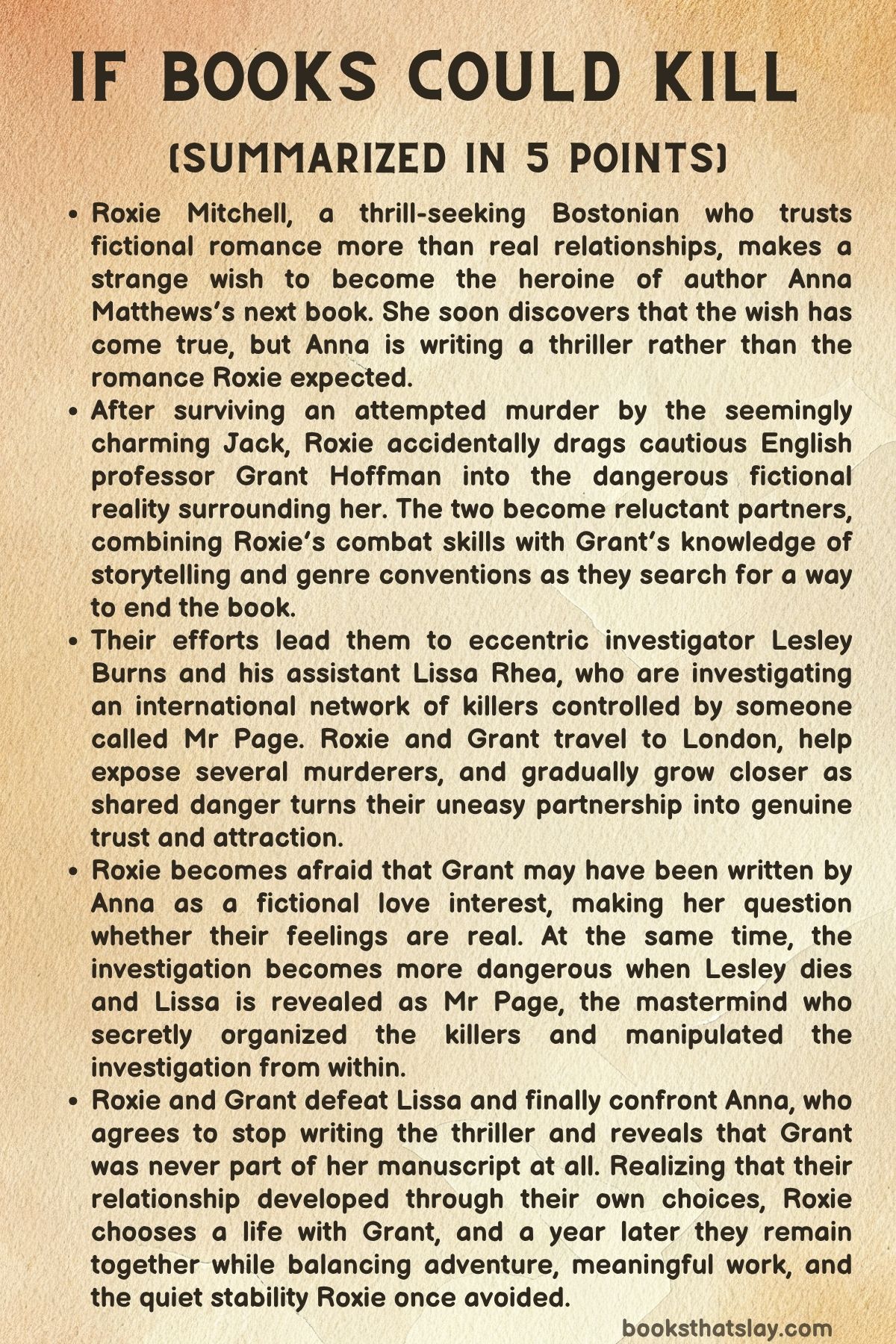
Roxie Mitchell is a thirty-year-old Bostonian who structures her life around freedom, excitement, and escape. She trains seriously at the Combat Zone gym and possesses formidable fighting skills, but she refuses to turn that ability into a permanent career, preferring temporary work that allows her to travel whenever ordinary life begins to feel restrictive.
Her closest friend, Steph, is a pediatric surgeon who shares Roxie’s enthusiasm for romance novelist Anna Matthews. Roxie loves romance novels precisely because their emotional risks are controlled by the promise of satisfying endings, whereas real relationships frighten her because they demand vulnerability without guarantees.
One freezing evening, Roxie encounters a mysterious street performer with strange swirling eyes and jokingly wishes that she could become the heroine of Anna Matthews’s next novel. The figure throws purple glitter over her and grants the wish, an incident Roxie initially dismisses until a series of unlikely events begins suggesting that something impossible has actually happened.
At the Boston Public Library, Roxie meets Jack, a charming man who appears almost perfectly suited to a romance heroine. He is attractive, intelligent, socially conscious, interested in books, and immediately interested in her, while news simultaneously breaks that Anna Matthews has begun writing again after years of silence.
Roxie tracks down the supernatural being responsible for her wish and learns that the figure, now appearing as an older woman called the Giver, can assume different forms. The Giver confirms that Roxie has become the protagonist of Anna’s new book, meaning that events Anna writes will manifest around her, although Roxie retains enough free will to force the fictional narrative to adjust to her choices.
The situation initially seems exciting because Anna has always written romance, and Jack appears to be Roxie’s ideal fictional hero. That assumption collapses during a private date in the library when Jack tries to kill her, forcing Roxie to recognize that Anna’s new project, called “Todeskuss,” is a thriller rather than a love story.
Roxie escapes Jack by stealing an Uber, only to discover that the car still contains a passenger named Grant Hoffman, a Boston University English and creative-writing professor. Grant is cautious, anxious, rule-conscious, and deeply attached to his quiet routines, making him almost the exact opposite of Roxie, and he understandably believes that the blood-covered woman who has kidnapped him is either dangerous or mentally unstable.
Roxie takes Grant to a remote cottage belonging to Steph’s family, hoping to hide while she determines how to stop Anna from writing. Jack tracks them down, attacks Roxie, and nearly kills her before Grant intervenes with a cast-iron frying pan, apparently killing Jack and leaving both Roxie and Grant implicated in events they believe may disappear if the fictional story can somehow be ended.
The Giver later explains that Roxie cannot simply cancel her wish. Anna must finish or abandon the book, fictional people and consequences should disappear afterward, but real people who have been drawn into the narrative will remember what occurred; worse for Grant, he has now become part of the story and cannot simply return to his old life while Roxie continues without him.
Roxie and Grant decide to find Anna personally after learning that she will appear at public events in London. Before they can focus entirely on the author, however, they encounter wealthy amateur investigator Lesley Burns and his resourceful pink-haired assistant Lissa Rhea, who reveal that Jack belonged to an international group of murderers hiding behind an online book club.
The supposed literary group uses coded quotations and publication details to organize killings under the direction of a mysterious figure known as Mr Page. Lesley recruits Roxie and Grant to help expose members of the network, and because their investigation is also heading toward London, Roxie accepts despite Grant’s repeated objections to deliberately inviting more danger.
Their London operations expose several killers, including the Pedicab Raptor, the Tent Destroyer, the Take-away Taker, and the Money Butcher. Each confrontation teaches them more about Mr Page’s organization, which has evolved from a community where murderers shared their crimes into a competition in which participants kill for status, money, and the approval of their unseen organizer.
The investigation also changes Roxie and Grant. Roxie teaches Grant self-defense and begins to respect the courage required for him to act despite constant fear, while Grant’s knowledge of narrative patterns repeatedly helps them recognize traps, motives, and possible developments that Roxie’s physical confidence alone cannot solve.
Their differences increasingly complement one another. Roxie acts quickly and accepts danger as part of living, while Grant pauses, plans, worries, and searches for structure, yet Roxie begins to realize that what she once considered dullness in Grant is actually evidence of stability, loyalty, and a life rooted in people who care whether he returns.
Their emotional connection becomes harder for Roxie to ignore when they are supposedly assigned to pose as a romantic couple at a Cotswolds inn. The mission turns out to have been invented by Lissa as an attempt to push them together, but the fake relationship, shared room, growing physical attraction, honest late-night conversations, and Grant’s clear admiration leave Roxie frightened that Anna may have written him specifically as her love interest.
That fear becomes stronger when they attend a museum gala while pretending to be a wealthy married couple and finally kiss. Roxie retreats because she cannot decide whether her feelings belong to her or to Anna’s plot, but Grant argues that even if circumstances brought them together, his experiences and decisions still belong to him.
Their conversation ends when both are kidnapped by Alistair Walton-Hornsby, the aristocratic killer known as the Money Butcher. Grant unexpectedly reveals that he is an accomplished historical fencer, helping them escape, and when Roxie later prepares to risk herself alone by jumping into the Thames, Grant refuses to abandon her and jumps beside her.
After surviving, they stop resisting their feelings and begin a genuine relationship. Roxie recognizes that Grant offers something very different from the temporary encounters she has always preferred: excitement combined with trust, humor, emotional safety, and the frightening possibility of permanence.
Grant also reveals his unresolved grief over his father, who expected him to enter the family business and distanced himself when Grant chose literature and academia instead. Their conversations teach Roxie that relationships do not become meaningless because they end imperfectly, while Grant describes Roxie as the person who does not remove his fear but gives him enough confidence to act in spite of it.
The thriller plot soon becomes more dangerous. A property where Alistair is being held explodes, Alistair disappears, and Lesley suddenly dies from what appears to be a heart attack, leaving Roxie, Grant, and Lissa grieving while another message from Mr Page announces that the serial-killer competition will end with a face-to-face meeting in an abandoned underground station.
At the meeting, the apparent ally becomes the central villain. Lissa reveals that she is Mr Page, explaining that the identity comes from her own name and that she deliberately encouraged everyone to imagine a male mastermind while using her harmless, cheerful persona to manipulate Lesley’s investigation from inside his household.
Lissa admits that she began killing after murdering a former boyfriend who had humiliated her, eventually creating the online group so that killers could connect without exposing themselves. She later transformed it into a competition and exploited Lesley’s wealth, access, and poor cybersecurity, even murdering him by tampering with his medication when he came too close to identifying her.
She attempts to turn Roxie against Grant by presenting fabricated messages supposedly proving that he betrayed her. Roxie and Grant have already identified Lissa as their main suspect, however, and their trust is strong enough that the deception fails; they have also removed the ammunition from Lesley’s guns and arranged for Grant’s phone to transmit Lissa’s confession to the police.
Lissa attacks them anyway, eventually trapping Grant on railway tracks as a train approaches. Roxie chooses Grant over continuing the fight, rejects Lissa’s claim that love has made her weak, defeats her, and helps bring the serial-killer organization to an end.
With the thriller reaching its conclusion, Roxie knows she must finally confront Anna and ask her to stop writing. Grant supports the decision despite knowing that the end of the book may separate them, and before Roxie goes to Anna alone, he asks her simply to thank the author.
Anna is shocked when Roxie appears at her event but accepts the supernatural explanation and agrees to abandon “Todeskuss.” The greatest revelation comes when Roxie passes along Grant’s thanks and Anna has no idea who Grant is.
Anna explains that Grant never appeared anywhere in her manuscript. Roxie had originally stolen the Uber alone, several romantic situations had very different contexts in Anna’s version, and Anna had never created a love interest for Roxie at all.
Roxie finally understands that Grant was always a real person whom she accidentally pulled into the altered reality. Because the Giver allowed Roxie to make genuine choices, those choices changed the direction of Anna’s thriller until Roxie and Grant created a relationship that the author herself had never planned.
When the fictional alterations disappear, Roxie finds Grant again in the real world. With no author arranging their future and no guarantee of a happy ending, Roxie admits that she is still afraid of what commitment may bring but chooses to remain with him anyway.
A year later, they are still together. Roxie has accepted a permanent training position at the Combat Zone, Grant is developing his own thriller, they balance adventurous experiences with quiet domestic routines, and Anna remains in contact with Roxie, confirming through the abandoned manuscript that Grant truly never belonged to her fictional design.
Roxie ultimately understands that the relationship she values was not produced by a perfect romantic formula. It grew from decisions made under pressure, mistakes, grief, trust, humor, fear, and the ordinary life that followed, showing her that a happy ending matters less as a final destination than as the freedom to continue choosing what comes next.
Characters
Roxie Mitchell
Roxie is the emotional and narrative center of If Books Could Kill, and her most important contradiction is established immediately: she is fearless about physical danger but deeply cautious about emotional commitment. Fighting, travel, spontaneous decisions, and uncertain adventures excite her because she trusts herself to react, while relationships frighten her precisely because strength and reflexes cannot protect her from disappointment, abandonment, or grief.
Her preference for temporary employment reflects the same pattern. Refusing a permanent position allows her to describe herself as independent and adventurous, but the book gradually reveals that constant movement also protects her from becoming attached to anything strongly enough that losing it could hurt.
Her wish to enter one of Anna Matthews’s novels therefore exposes the fantasy beneath her lifestyle. Roxie wants romance when it arrives with a guaranteed ending, and she wants danger when she can imagine herself in control of it; being forced into a thriller removes both forms of security.
Her relationship with Grant becomes the test that changes her most profoundly. At first she treats him as an accidental complication, then as a useful partner, then as someone she might desire, and finally as someone whose continued presence matters enough to make uncertainty worth accepting.
Roxie’s courage also develops a new meaning. Early in the book, she thinks of bravery through physical action, but by the end she understands that remaining with someone without knowing how the relationship will end requires a kind of courage that jumping from bridges, fighting killers, or traveling alone never demanded from her.
Grant Hoffman
Grant begins as the comic opposite of Roxie: a cautious English professor who worries about laws, consequences, careers, injuries, schedules, and almost every danger Roxie treats as manageable. His anxiety is never simply a joke, however, because he lacks Roxie’s fighting background and narrative status, making his fear a rational reaction to being kidnapped and unexpectedly trapped inside a murderous story.
His greatest strength is intellectual rather than physical. Grant understands storytelling, genre patterns, language, punctuation, motivation, and structure, and this knowledge becomes essential as the investigation grows more complicated.
One of the strongest ideas in If Books Could Kill emerges through Grant’s definition of courage. He is brave not because he stops feeling afraid, but because he repeatedly acts while fully aware of how frightened he is, and Roxie eventually recognizes that his willingness to continue beside her may demand more courage than her own instinctive comfort with danger.
Grant’s family history also explains his attachment to stability. His unresolved relationship with his father has taught him that endings can arrive before people are ready, leaving him with grief and anger that cannot be neatly corrected afterward.
His romance with Roxie works because he does not ask her to become dependent. He values her independence, wants her choices to remain her own, and ultimately gives her the emotional freedom to decide whether she wants him rather than presenting himself as someone she needs for survival.
Lissa Rhea
Lissa is constructed around the danger of being underestimated. Her pink hair, enthusiasm, humor, matchmaking, technical competence, and apparently harmless role as Lesley’s assistant encourage both the other characters and the reader to categorize her as colorful support rather than as a serious threat.
Her identity as Mr Page reveals how carefully she has exploited expectations. She allows everyone to imagine an older, powerful, probably male criminal mastermind while she remains physically close to the investigation, gaining access to information, money, suspects, and Lesley’s trust.
Her history with Craig explains the emotional origin of her violence without excusing it. Humiliation becomes the story she tells herself to justify retaliation, and once murder gives her a feeling of power, she expands personal revenge into an ideology in which hurting others becomes a way to prevent herself from feeling powerless again.
Lissa is particularly effective as Roxie’s opposite because both women fear emotional pain but respond in completely different ways. Roxie tries to avoid attachment, whereas Lissa turns rejection into bitterness and control, ultimately treating love as a weakness because admitting its value would force her to face the pain she never processed honestly.
Her murder of Lesley marks the clearest point at which her playful surface disappears. She is willing to destroy someone who trusted her simply because his curiosity threatens her security, demonstrating that beneath the jokes and matchmaking lies a person who values control more than human connection.
Lesley Burns
Lesley initially appears almost absurdly theatrical. His wealth, unconventional detective work, dramatic behavior, strange weapons, and enthusiasm for elaborate investigations make him seem like a character who has walked directly out of a detective adventure.
The revelation about his younger sister Agnes gives those eccentricities emotional weight. His detective identity grows partly from the childhood games they shared, making his adult pursuit of mysteries a way of continuing an imaginative life that Agnes never survived long enough to experience.
Lesley therefore represents adventure driven not by restlessness but by memory. Unlike Roxie, who initially moves constantly to avoid permanence, Lesley commits himself to a strange vocation because one permanent loss shaped him so strongly that he chose to carry it forward.
His trust in Lissa also becomes tragic. The person closest to his work is simultaneously sabotaging it, using his resources, managing the flow of information, and eventually killing him when he approaches the truth.
His death affects Roxie because it destroys her attempt to separate fictional people from real emotional consequences. Whether Lesley originated in Anna’s writing becomes irrelevant once Roxie has known, valued, and mourned him.
Anna Matthews
Anna is initially treated by Roxie almost as an unseen god because her writing determines the changing world around the protagonist. Every attack makes Roxie increasingly angry at the author, especially because she assumes Anna knowingly controls the suffering surrounding her.
Meeting Anna changes that interpretation. Anna has no knowledge that the events she writes are becoming real and is therefore not deliberately tormenting Roxie; she is simply an author working through a dark creative period following personal difficulty and divorce.
Her abandoned thriller also reflects her own uncertainty as a writer. She has moved away from romance because of disappointment, yet Roxie’s refusal to become bitter eventually reminds Anna that hope and love still interest her.
Most importantly, Anna’s ignorance of Grant proves that her authorial control has limits. Roxie’s choices can redirect the story beyond Anna’s intentions, turning Anna from an all-powerful manipulator into another person forced to recognize that characters, stories, and real lives can move in directions their creators never expected.
Jack
Jack first appears as an almost suspiciously ideal romantic stranger. He is attractive, charming, interested in books, apparently compassionate, and willing to engage seriously with the romance fiction Roxie loves, making him seem like the reward attached to her wish.
His attempted murder exposes the danger of Roxie trusting genre expectations more readily than reality. She assumes that because the circumstances resemble the beginning of a romance, Jack must occupy the role of romantic hero.
As a killer, Jack is cold, calculating, and entertained by violence. His transformation from charming date to predator also introduces the book’s repeated warning that people cannot be understood simply by the roles they appear to occupy.
Jack remains important even after his apparent death because his connection to the larger murder network expands the story beyond one isolated attacker. He becomes the first evidence that Roxie is dealing not with a single threat but with an organized system.
Steph
Steph serves as Roxie’s closest connection to her ordinary Boston life. She shares Roxie’s love of romance novels but is otherwise much more settled, having committed herself to a demanding career as a pediatric surgeon.
Her observations challenge Roxie’s habit of presenting avoidance as freedom. Steph recognizes that Roxie’s refusal to accept a permanent role at the Combat Zone may be less about loving flexibility and more about fearing what happens when she admits that something truly matters to her.
That insight also applies to Roxie’s romantic life. Steph does not need to participate directly in the supernatural adventure to influence Roxie because she understands the emotional pattern Roxie has been repeating long before the wish occurs.
The Giver
The Giver functions as the supernatural cause of the entire situation but deliberately refuses to control its outcome. Appearing in different physical forms while retaining distinctive swirling eyes, the being establishes the rules rather than providing easy solutions.
The most significant rule is that Roxie retains free will. Anna’s fiction can shape circumstances, introduce dangers, and alter the world, but Roxie’s genuine decisions force the narrative to adjust around her.
The Giver therefore makes choice more important than fate. Roxie receives what she wished for, but the meaning of that wish depends entirely on what she does once fantasy becomes dangerous.
Detective Inspector Walter “Wally” Akinyemi
Wally is positioned as a suspicious figure partly because of his hostility toward Lesley. His attempts to block parts of the investigation, especially when Howard seems prepared to reveal information, make Roxie and Grant consider whether he could be connected to Mr Page.
His role demonstrates how easily personal conflict can resemble criminal motivation when viewed through a thriller framework. Because he and Lesley share a difficult professional history, genuine resentment becomes evidence that appears more sinister than it actually is.
Ultimately, Wally becomes part of the mechanism that brings Lissa down. Grant’s decision to transmit her confession to him and the police confirms that institutional authority, though frequently irritating and mistrusted, is not automatically the enemy.
Alistair Walton-Hornsby
Alistair, the sixteenth Earl of Colchester, embodies the exaggerated theatricality of the serial-killer competition. His wealth, title, manner, mansion, trophies, and sword fight with Grant make him appear almost too perfectly suited to the role of an aristocratic thriller villain.
His presence also allows Grant to reveal an unexpected side of himself. When Grant displays genuine skill with historical fencing, Alistair unintentionally exposes how incomplete Roxie’s earlier perception of the nervous professor has been.
Alistair later functions as an important false suspect for the identity of Mr Page. His criminality is real, but his dramatic appearance makes him easier to suspect than Lissa, whose harmless image gives her far greater protection.
Leah Reynolds
Leah Reynolds, Anna Matthews’s assistant, initially becomes an obstacle when Roxie and Grant attempt to reach the author. Her refusal to admit Grant is entirely reasonable from her perspective because his repeated emails describe kidnapping, fictional reality, and supernatural danger in language that sounds like the behavior of an unstable stalker.
Her role briefly reminds the reader how extraordinary Roxie and Grant’s claims would sound outside their own experience. What they know to be true looks irrational when seen from an ordinary point of view.
Martin
Martin is introduced as a possible suspect during the fabricated Cotswolds mission because he is single at a romantic retreat and appears unusually comfortable being there alone. Roxie and Grant project suspicion onto him partly because the situation encourages them to treat ordinary differences as clues.
He turns out to be a pleasant writer who is perfectly capable of enjoying his own company. Martin therefore quietly challenges the assumption that being alone is evidence of loneliness, resentment, or incompleteness.
The misunderstanding in which he believes Roxie and Grant are propositioning him also provides comic relief. More importantly, it exposes how badly Roxie and Grant are hiding the emotional tension beneath their supposedly fake relationship.
Heather Fiorello
Heather represents a highly performative model of romance. Her attention to appearances and proposals encourages Roxie to measure relationships according to external milestones rather than private emotional truth.
Her advice reflects the social pressure Roxie already resists. By treating partnership as something that should lead toward recognizable public achievements, Heather unintentionally emphasizes why Roxie distrusts conventional romantic expectations.
Nicholas Fiorello
Nicholas presents a more direct challenge to Roxie’s identity. His belief that men prefer women who need them suggests that female independence damages romantic desirability.
Grant’s response to Nicholas becomes more important than Nicholas himself. By arguing that being chosen by an independent person is especially meaningful, Grant gives Roxie a model of love that does not require weakness, dependence, or surrender of identity.
Vincent Skaggs
Vincent Skaggs, the Pedicab Raptor, is one of the killers linked to Mr Page’s organization. His targeting of vulnerable tourists illustrates how the network turns predatory behavior into organized competition.
His fear when he believes Mr Page may be involved reveals that the killers themselves are controlled by the organization. When Vincent later dies brutally after failing, it becomes clear that participation offers neither safety nor loyalty.
Mickey Greenwood
Mickey Greenwood, known as the Tent Destroyer, transforms personal resentment connected with a failing tent business into murderous violence against homeless people. The absurdity of his grievance contrasts sharply with the seriousness of his crimes.
His behavior demonstrates how members of the network construct narratives that allow them to see themselves as justified. Rather than face failure or responsibility, Mickey turns frustration outward and treats vulnerable strangers as targets.
His final act of setting himself on fire rather than accepting capture shows how thoroughly the competition has corrupted its participants. Status within Mr Page’s system has become more important to him than survival.
Howard
Howard, the Take-away Taker, targets food-delivery couriers and manipulates tracking systems so that victims can disappear. His operation brings Grant into the role of bait and forces Roxie to confront how uncomfortable she has become with placing him in danger.
Howard becomes especially important when he appears willing to talk after his capture. Wally’s aggressive attempt to stop him from explaining his motives or revealing information about Mr Page helps redirect suspicion toward the detective.
Raj
Raj is the captive courier discovered during the confrontation with Howard. Although his role is smaller than those of the investigators and killers, his presence prevents the mission from remaining an abstract hunt for clues.
He represents the ordinary victims affected by the serial-killer competition. Roxie and Grant are pursuing a mystery, but Raj reminds them that people outside their strange supernatural circumstances are also being endangered.
Agnes Burns
Agnes, Lesley’s younger sister, died of cancer at eight, but her influence remains central to understanding Lesley. Their childhood detective games created the imaginative world that Lesley continues to inhabit as an adult.
Her memory gives purpose to his eccentric life. Rather than treating childhood imagination as something to discard, Lesley turns it into a way of honoring the future Agnes never received.
Craig
Craig appears only through Lissa’s account of her past, yet he becomes the person around whom she builds her origin story. His rejection and humiliation of her become the event she uses to explain her first murder and the beginning of her desire for revenge.
The story does not present his treatment of Lissa as justification for what follows. Instead, Craig’s role shows how Lissa converts personal pain into permission to harm others rather than accepting vulnerability, grief, or rejection as experiences she must process.
Arthur
Arthur, Grant’s cat, is a minor presence but an important symbol of the life Grant had before Roxie. Grant worries about Arthur during the chaos because the cat belongs to the ordinary routines and responsibilities that Roxie initially dismisses as restrictive.
By the end, Roxie shares quiet evenings with Grant and Arthur. The cat therefore becomes part of the domestic stability Roxie once avoided but eventually learns to value alongside adventure.
Themes
Courage as Action in the Presence of Fear
Courage is repeatedly separated from fearlessness in If Books Could Kill. Roxie begins with a physical definition of bravery because she can fight, travel alone, chase killers, jump from moving vehicles, and accept dangers that would terrify most people, so she naturally assumes that being comfortable with risk makes her unusually courageous.
Grant gradually complicates that belief because he is frightened throughout much of the story and rarely hides it. He worries about injury, legal consequences, death, his career, his cat, Roxie’s safety, and the possibility that he exists only to be killed for dramatic effect, yet he repeatedly chooses to act despite having every reason to retreat.
Roxie eventually understands that fearlessness can sometimes make action easier rather than braver. Grant’s intervention against Jack, his participation in the investigations, his self-defense training, his refusal to let Roxie jump into the Thames alone, and his decision to accompany her toward the final confrontation all occur while he remains deeply afraid.
The same idea changes Roxie emotionally. Fighting a murderer is familiar to her, but admitting that she loves Grant without any guarantee that he will remain in her life demands a form of courage she has spent years avoiding.
By the conclusion, bravery is no longer measured by how little fear a person experiences. It is measured by the willingness to choose, commit, protect, speak honestly, and continue living even when fear remains fully present.
Free Will, Authorship, and Personal Choice
The supernatural premise creates a constant struggle between written destiny and individual choice. Anna can create situations around Roxie, introduce killers, change locations, and establish a thriller framework, but the Giver makes clear that Roxie still possesses free will and that the fictional world must adapt whenever her genuine decisions move in another direction.
This distinction becomes crucial because Roxie initially assumes that anything resembling a literary convention must have been written for her. When romance begins developing with Grant, she worries that their attraction has no value because Anna may simply have designed him to satisfy another narrative role.
Grant rejects the idea that circumstances determine the meaning of a choice. Even if two people meet because of coincidence, fate, an author, or supernatural interference, their reactions afterward can still belong to them.
The final revelation proves his argument in the strongest possible way. Anna never created Grant, never wrote him as Roxie’s love interest, and never intended many of the romantic situations Roxie interpreted as evidence of authorial manipulation.
Roxie and Grant effectively create a new direction through their decisions. The story therefore treats freedom not as complete independence from outside circumstances but as the ability to respond to circumstances in ways that cannot be fully predetermined.
Emotional Vulnerability and the Fear of Permanence
Roxie’s resistance to permanent employment and serious relationships comes from the same emotional instinct. Temporary jobs, distant travel, brief romantic encounters, and constant movement allow her to leave before disappointment, obligation, grief, or dependence can develop enough power to hurt her.
Her love of romance novels initially appears to contradict this attitude, but it actually supports it. Fiction allows her to experience emotional tension while trusting that the author will eventually deliver an ending that makes the risk worthwhile.
Grant threatens that system because he is not safely contained inside a book. Once Roxie cares about him, she must confront the possibility that real love may involve arguments, separation, grief, boredom, mistakes, or an ending she cannot control.
Steph’s comments about the Combat Zone position reinforce the same conflict. Roxie may genuinely value freedom, but she also repeatedly avoids choices that would force her to admit that a place, profession, or person matters enough to become part of her identity.
Her eventual commitment to Grant and acceptance of permanent work do not mean that she has abandoned independence. Instead, she learns that choosing to stay can be just as active and courageous as choosing to leave, especially when remaining offers no guarantee against future pain.
Fiction, Genre Expectations, and Real Life
Genre conventions constantly influence how the characters interpret events. Roxie expects Jack to be a romantic hero because his introduction resembles the beginning of a love story, Grant analyzes danger according to thriller structures, and both repeatedly try to determine whether events are occurring because Anna has written recognizable narrative patterns around them.
These expectations sometimes help them survive. Grant’s understanding of storytelling allows him to anticipate escalation, question suspicious coincidences, identify the likely importance of certain developments, and eventually recognize that the story is approaching its final confrontation.
At other times, genre becomes a source of misunderstanding. Roxie becomes so convinced that Grant must be a manufactured love interest that she distrusts her own emotions, while dramatic suspects such as Alistair appear more likely to be Mr Page simply because they look more like conventional villains than Lissa does.
The ending refuses the idea that life can be reduced to a predetermined genre. Grant was never written into Anna’s manuscript, and Roxie’s choices push events away from the author’s intended emotional direction.
The book ultimately suggests that fiction can give people useful language for understanding fear, love, hope, and possibility, but real meaning comes from what people choose after the recognizable pattern ends. Roxie and Grant do not receive certainty; they receive the chance to continue together without knowing what kind of story their future will become.