House of Rayne Summary, Characters and Themes
House of Rayne by Harley Laroux is a horror-romance set on the isolated, storm-lashed Blackridge Island, where superstition, grief, and desire shape nearly every corner of daily life. The story follows Rayne Balfour, a guarded islander carrying the weight of a violent family past, and Salem Lockard, a heartbroken visitor searching for quiet after a broken engagement.
Their unexpected connection unfolds against a rising threat haunting the woods—an ancient being tied to Rayne’s lineage. As winter closes in and the island’s rules grow stranger, the women must untangle dark secrets, confront a monstrous presence, and decide how far love can reach in the face of real danger.
Summary
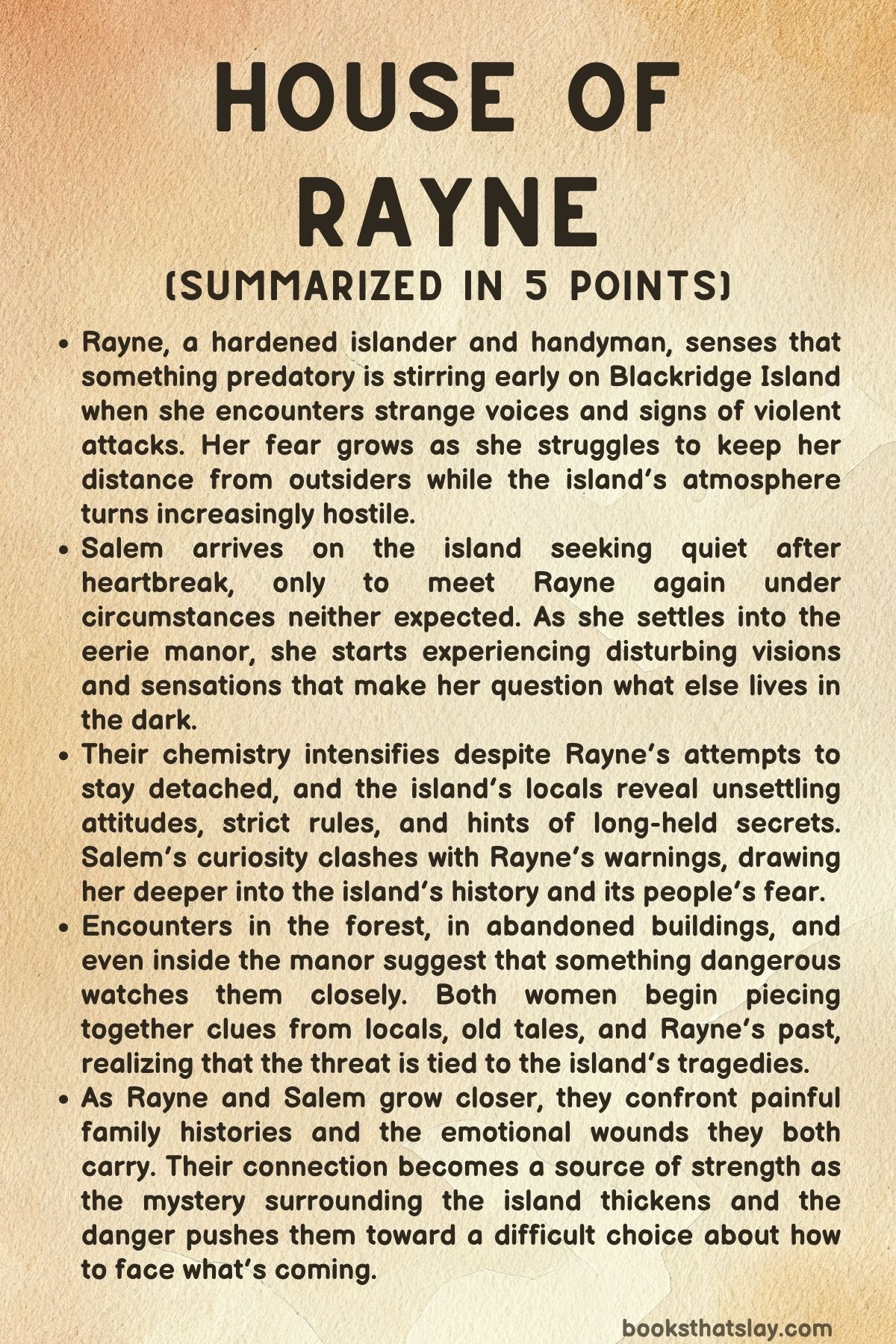
Salem Lockard arrives on remote Blackridge Island for what she hopes will be a quiet biking retreat after her fiancé abruptly called off their wedding. She expects little more than solitude and fresh air, but her first surprise comes when she checks in at Balfour Bed-and-Breakfast and discovers the owner is the same woman she had a nameless, intoxicating encounter with the night before.
Rayne Balfour, blunt and wary of emotional entanglement, does her best to treat Salem like any other guest, yet both of them feel the tension of a connection neither expected to revisit.
Before Salem’s arrival, Rayne has already noticed strange signs in the wilderness—a mutilated deer, cold weather arriving too early, and the eerie voice of something stalking the trees. She has lived her entire life with the island’s whispered warnings about an entity that wakes during the deep winter months.
That fear mixes with the stress of seeing Salem again, and Rayne’s instincts tell her that this season’s danger is approaching far sooner than it should.
Salem’s first days at the manor are filled with uneasy encounters. She senses rot in certain hallways, glimpses a red, corpse-like figure in her bathroom, and feels watched while out biking.
Rayne, who has always tried to avoid discussing the island’s superstition, becomes troubled when she finds damp footprints in Salem’s former room and hears disembodied whispering. She moves Salem nearer to her own quarters for safety, though she pretends it’s just for practical reasons.
Their attraction intensifies despite Rayne’s efforts to stay distant.
The island’s village adds another layer of unease. Salem meets Ruth Miller, a devout local whose cold judgment makes her feel unwelcome.
Rayne brings Salem into town for supplies, showing both her softer side with children and her hyper-vigilant wariness around the woods. Rumors of a missing teenage girl deepen Rayne’s anxiety.
She confides to Salem that the island’s people believe a dangerous being—sometimes called an angel—comes during the winter storms. The monstrous presence is tied to Rayne’s own family history, though she struggles to open up about it.
Their relationship grows more complicated as Salem, shaken and lonely, leans increasingly on Rayne for comfort. They share moments of closeness, then awkward distance, then charged intimacy again.
Rayne tries to keep emotional boundaries, but Salem’s sincerity breaks through her defenses. When Salem is harassed by Ruth and then accidentally startled into a vulnerable moment with Rayne, the two women finally begin to talk honestly about their pasts.
Rayne admits she has no idea how to handle wanting someone so much. Salem admits she’s afraid of being left behind again.
The island’s danger escalates when Salem finds an eviscerated deer and meets an injured hunter who claims he didn’t kill it. Rayne grows desperate after Salem returns late one night, soaked and shaken from the woods.
She brings her to the greenhouse—her one place of peace—and opens up about her mother Melanie’s murder, an event the island twisted into a myth. In turn, Salem reveals the heartbreak that brought her to the island.
Their shared vulnerability closes the distance between them, and their relationship deepens into something neither can dismiss.
But the threat haunting Blackridge is no longer lingering at the edges—it begins to invade the manor itself. Salem slips into a vivid, terrifying vision where she meets the ruined spirit of Melanie Balfour, who begs her to destroy the creature that holds her trapped.
Salem wakes to find physical evidence from her dream among the decorations. Rayne discovers a long-hidden tape recorded by her mother, revealing that Rayne’s father murdered her as part of an occult ritual designed to summon and bind the monstrous entity.
The truth shatters Rayne’s understanding of her own past and confirms that the creature is real, powerful, and tied to Melanie’s bones.
Determined to end it, Rayne studies her father’s ritual book with Salem. They learn the creature can only be banished if the bones anchoring it are destroyed.
Before they can plan further, a terrified child radios them from a nearby farm. Rayne and Salem race through a snowstorm to help, encountering the aftermath of a grisly attack.
The creature, having taken the farmer’s form, ambushes them. It drags Salem off into the forest and leaves Rayne following a blood trail through ice and darkness.
Salem wakes in the abandoned lighthouse, injured and trapped within the creature’s nest of bones and rot. There she finds Melanie’s skeleton carved with ritual markings.
Rayne reaches her, and together they retrieve the bones and try to escape as the creature closes in on them. In the lighthouse’s upper room, Salem smashes the bones while Rayne prepares a kerosene-soaked barrel to burn them.
The creature attacks, the staircase collapses, and fire begins to spread. Forced onto the narrow outer platform, Rayne lights the fuel and pushes Salem off the edge to save her before the flames erupt.
Salem surfaces in the freezing ocean and crawls to shore. The burning lighthouse collapses in the distance, and she believes Rayne is lost until Melanie’s peaceful spirit appears, guiding her down the beach.
There she finds Rayne alive but unconscious. After Salem revives her, the two watch the final glow fade as the creature dies and Melanie is released.
Three years later, Rayne and Salem have begun a new life in Colorado with Rebecca and Rachel, the two young sisters they rescued. Rayne runs a landscaping business, and their home is filled with the stability both once longed for.
On a camping trip arranged as a surprise, Rayne proposes to Salem with the girls’ help. Salem accepts, ready for the future they fought so hard to reach—though a small crimson glimmer in the forest hints that some stories never fade entirely.
Characters
Rayne Balfour
Rayne is the emotional and narrative core of House of Rayne, a woman shaped by trauma, isolation, duty, and a fierce instinct to protect others in spite of her deep fear of connection. As the owner of Balfour Manor and a longstanding islander, she carries the weight of a cursed lineage.
Her mother’s brutal murder and her father’s descent into occult fanaticism have left her scarred both emotionally and spiritually, with the tangible presence of the supernatural haunting her daily life. Rayne’s personality is steeped in survivalism; she is guarded, gruff, and deeply practical, accustomed to facing horrors alone.
Yet beneath her hardened surface lies a profound tenderness that she tries desperately to hide. This vulnerability surfaces most clearly around Salem, whose presence disrupts Rayne’s strict emotional boundaries.
Her dominance in sexual and relational dynamics becomes a paradoxical source of safety and control, as she equates taking charge with protecting those she cares for. Rayne’s internal struggle—between the belief that she is cursed and the desire to be loved—makes her journey compelling.
Through Salem, she is forced to confront not only the physical monster stalking the island but also the monstrous legacy her father left her. Ultimately, Rayne evolves from a solitary guardian resigned to inevitable loss into a woman willing to fight for a future where love is possible.
Her survival at the lighthouse and her later life in Colorado illustrate that healing for her is ongoing, but for the first time, shared.
Salem Lockard
Salem begins House of Rayne adrift, heartbroken, and seeking escape after the collapse of her engagement. Her initial appearance—arriving at a bar in a daze, hungry for distraction—suggests fragility, but her character quickly reveals far greater strength.
She is imaginative, empathetic, and deeply intuitive, someone whose anxiety does not diminish her capacity for bravery. Salem is drawn to beauty and emotion, which makes her susceptible to fear but also fiercely attuned to the uncanny forces on the island.
Her attraction to Rayne goes beyond lust; she recognizes the pain behind Rayne’s stoic demeanor and meets it with openness rather than retreat. Salem is also more resilient than she initially believes—she faces supernatural terror, injury, and isolation with remarkable grit.
Her visions, interactions with Melanie’s spirit, and sheer determination in the lighthouse demonstrate that her courage is rooted in love rather than bravado. As the relationship deepens, Salem becomes Rayne’s emotional anchor, offering gentleness and trust where Rayne expects rejection.
Her evolution is one of reclaiming agency: she moves from someone running away from a collapsed life to someone running toward a future she actively chooses. In the epilogue, it is clear Salem has grown into a nurturing, steady presence, embracing family and long-term commitment with the same bravery that carried her through the horrors of Blackridge.
Melanie Balfour
Melanie functions as both a tragic memory and a supernatural guardian in House of Rayne. In life, she was Rayne’s loving mother, gentle and artistic, doing her best to shield her daughter from the encroaching darkness of her husband’s obsession.
Her murder, orchestrated by Picard as part of an occult pact, turns her into a martyr whose death anchors the island’s curse. In death, however, Melanie persists as a protective force.
Her ghost appears fragmented and terrifying at times, warped by years of being bound to the angel through her ritual-carved bones. Yet her intentions are unmistakably maternal.
She tries repeatedly to warn Salem, leads her toward the truth, and ultimately guides her to Rayne’s body after the lighthouse fire. Melanie embodies both suffering and hope.
She is a reminder of the generational trauma inflicted by Picard, but she also represents a break in that cycle: a mother whose final act is not to curse her child but to free her.
Picard Balfour
Picard looms over the story like a malignant shadow. Although dead before the book begins, his influence poisons the island and his daughter’s life.
As a pastor who devolved into zealotry and ritualistic cruelty, he represents the corruption of faith into fanaticism. Picard weaponized religion to mask his crimes, manipulating his congregation and family with fear and authoritarianism.
His murder of Melanie and his attempt to bind the angel through runic sacrifice reveal a man who chose power over humanity, and control over love. The rituals he left behind become Rayne’s responsibility to decode and destroy, forcing her to confront the legacy of violence he created.
Picard’s character stands as a symbol of patriarchal harm, spiritual distortion, and the way communities can enable cruelty when draped in the language of righteousness.
Ruth Miller
Ruth embodies the oppressive moralism of Blackridge Island. Rigid, judgmental, and steeped in religious dogma, she reflects the way fear and superstition warp a community’s values.
Her disdain for outsiders—especially women like Salem—and her cruelty toward Rayne demonstrate her commitment to conformity and control. She uses morality as a weapon, policing behavior and reinforcing the island’s culture of silence around supernatural events.
Ruth serves as a non-supernatural antagonist, one whose presence underscores that human malice can be as damaging as any monster stalking the woods. Her character functions as a reminder that the horror of Blackridge is not only the angel but also the society that grew around it.
Andy, Rebecca, and Rachel
This family represents the fragile innocence still present on Blackridge Island and the everyday people struggling to survive in a dangerous place. Andy is practical and deeply protective, aware of the island’s threats and willing to act quickly, as shown by the bells on his property and his readiness with a rifle.
His death signals the point at which the angel’s terror becomes inescapable. Rebecca and Rachel, by contrast, reflect hope, resilience, and the desire for connection.
Rebecca’s curiosity and affection toward Rayne reveal that even in a place shrouded by fear, trust can form. After the tragedy that claims their father, the girls become part of Rayne and Salem’s chosen family.
Their adoption by the couple in Colorado marks a symbolic healing—children once trapped on a cursed island now raised in safety and love.
Sheriff Keatin
Sheriff Keatin is a figure of weary responsibility, a man intimately familiar with the island’s dangers yet constrained by the community’s reluctance to confront the truth. He respects Rayne and understands her connection to the land’s supernatural threats, trusting her judgment in ways others do not.
Although unable to stop the angel directly, he provides a thread of structure and human support in a setting where most authority figures fail. His calm, understated presence highlights how isolated Rayne is: even the sheriff cannot fully protect the island, leaving her to shoulder the curse alone.
Martin and George
The elderly hunters Martin and George illustrate the unpredictability and vulnerability of those who have lived their entire lives on Blackridge. Initially appearing as harmless old men, their storyline reveals the island’s escalating danger.
George’s disappearance and Martin’s traumatized condition after encountering the mutilated deer serve as early indicators that the angel has awakened. Their fates underscore how indiscriminate the creature’s violence is and how even experienced islanders are unprepared for its power.
Themes
The Haunting of Trauma
Rayne and Salem enter House of Rayne already carrying wounds that predate the supernatural horrors of Blackridge Island, and the story uses the island’s dangers to expose how deeply trauma shapes both women’s daily instincts, vulnerabilities, and ways of loving. Rayne’s entire adult life is built around containment—of fear, memory, and desire.
Her father’s brutality and zealotry left her with a worldview where isolation is equal to safety, where she must constantly anticipate danger and minimize her emotional footprint to survive. The island amplifies these instincts, forcing her into a perpetual state of vigilance that she can never quite turn off, even in moments of intimacy.
Salem’s trauma takes a different form: she is disoriented by abandonment, shame, and chronic anxiety that pits her mind against her own perceptions. Her recent heartbreak cracks open older insecurities, leaving her constantly questioning whether her feelings are valid or exaggerated.
When the supernatural events begin, the two women react through these preexisting wounds—Rayne with grim readiness and hyper-control, Salem with spiraling self-doubt and a desperate need for stability. What changes over the course of the narrative is the way their traumas begin to realign rather than conflict.
The island becomes a crucible that forces them to see the shapes of each other’s pain and learn to respond without judgment or retreat. This shared reckoning gives the supernatural threat emotional weight; the creature is more than a monster, it is a manifestation of generational violence and buried grief.
By confronting it together, Rayne and Salem confront the versions of themselves built by fear. Survival becomes synonymous with healing, not by erasing trauma but by allowing it to be witnessed, understood, and eventually unbound.
Desire, Vulnerability, and Power
Desire in House of Rayne is never simple or decorative; it is tied to agency, fear, and the hunger for connection that both women try so hard to suppress. The erotic energy between Salem and Rayne is charged not because it is forbidden or dangerous in a superficial way but because both characters treat intimacy as a threshold they cannot cross without risking parts of themselves they have kept locked away.
Salem’s submissive desire is rooted in trust rather than helplessness, and Rayne’s dominance is grounded in responsibility rather than control. Their physical encounters expose layers of emotional truth that neither woman is prepared for.
Each intimate moment presses them into a state of openness that starkly contrasts with the secrecy and repression surrounding them on the island. Power in their dynamic reveals itself as something reciprocal: Rayne has the physical strength and confidence to take charge, but Salem has the emotional insight and steadiness to anchor Rayne’s unraveling fears.
The danger outside the manor intensifies this interplay, especially when they use their connection as a way to counter the suffocating presence of the “angel. ” Vulnerability becomes a form of resistance against the island’s isolating darkness.
As their relationship deepens, sexual desire shifts from escape to affirmation—it becomes the language through which they negotiate boundaries, find solace, and build trust. The novel presents power not as domination over another but as the willingness to be known fully, even when everything outside urges them to hide.
Isolation and Community
Blackridge Island is more than a remote setting; it is a social ecosystem defined by deeply entrenched habits of silence, surveillance, and ritual. The isolation is geographical, emotional, and cultural, and every resident is shaped by the pressure to conform to the island’s unspoken rules.
Rayne lives at the center of this tension—bound to a community that resents her lineage yet depends on her skills and presence. The islanders maintain a façade of piety and order, but beneath it lies an undercurrent of fear and complicity.
Missing girls, curfews, and whispered warnings form an everyday backdrop, suggesting a population that has learned to endure horror rather than resist it. Salem, arriving as an outsider, immediately senses the brittle rigidity of the place: churchgoers who speak like a chorus, neighbors who monitor one another, families who treat survival as a moral duty.
Her discomfort highlights how normalized dread has become for the locals. Yet despite the community’s coldness, pockets of humanity surface—Andy’s protective parenting, the innocence of his daughters, the sheriff’s weary pragmatism.
These small gestures show that even within an oppressive environment, people cling to their own fragile ways of caring. The island’s isolation ultimately becomes a test of whether connection can thrive in a place designed to suppress it.
Rayne and Salem’s bond grows precisely because it defies the island’s culture of distance. In the end, their escape represents more than physical departure; it is a symbolic rejection of a community that chose tradition and fear over truth and compassion.
Generational Violence and Cursed Inheritance
Rayne’s relationship with her parents—especially the revelation of her father’s rituals and Melanie’s murder—casts a long shadow across the narrative. The rituals described in Picard Balfour’s book turn the idea of inheritance into something monstrous.
Instead of passing down protection, wisdom, or belonging, he leaves Rayne a legacy marked by blood and chains, binding a supernatural terror to the island and to their family name. Melanie’s attempts to shield Rayne, both in life and after death, complicate this inheritance.
Her spirit embodies the opposite impulse: the desire to break the cycle even at unimaginable cost. Rayne becomes the battlefield where these conflicting legacies collide.
She carries the emotional scars of Picard’s manipulation while also carrying the memory of a mother who tried to speak through silence and violence to preserve her future. Salem, though not tied to the curse by blood, becomes entwined through love and proximity, demonstrating how generational violence can ensnare even those who merely brush against its edge.
The climax at the lighthouse—destroying Melanie’s ritual bones—symbolizes the destruction of the physical and spiritual anchors that allowed the curse to persist. It is not just a victory over a supernatural creature but a severing of an inherited burden that would have otherwise defined every moment of Rayne’s life.
By breaking the bones, Rayne and Salem rewrite a lineage that was meant to trap them, forging one built on choice rather than fear.
Love as Transformation and Rebirth
Amid the dread and violence, the heart of House of Rayne is a love story shaped by mutual recognition. Rayne and Salem are not simply two people who fall for each other under dramatic circumstances; they become catalysts for each other’s self-understanding and growth.
For Rayne, love is a force that pulls her out of self-imposed emotional exile. Her feelings for Salem dismantle her belief that attachment only invites suffering.
The more she cares, the more she confronts the parts of herself she has learned to bury—the tenderness she never allowed herself to show, the longing for family, the hope that life can contain more than fear. Salem, meanwhile, discovers strength she never attributed to herself.
Her anxiety does not vanish; rather, she begins to trust that she can move through fear instead of being defined by it. Love becomes the framework in which both women allow themselves to imagine a future not dictated by past pain or the island’s looming dread.
Their escape and later life in Colorado illustrate love’s capacity to rebuild what trauma tried to break. Adopting Rebecca and Rachel expands this transformation, turning survival into creation.
The proposal scene reinforces how far they have come—love becomes a home, a shelter, and a promise of continuity. Even the faint crimson glow Salem perceives hints that healing is not linear, that remnants of fear can coexist with hope.
Yet the story makes clear that love, freely chosen and fiercely protected, has the power to reshape identities, relationships, and destinies.