I Am Not A Serial Killer Summary, Characters and Themes
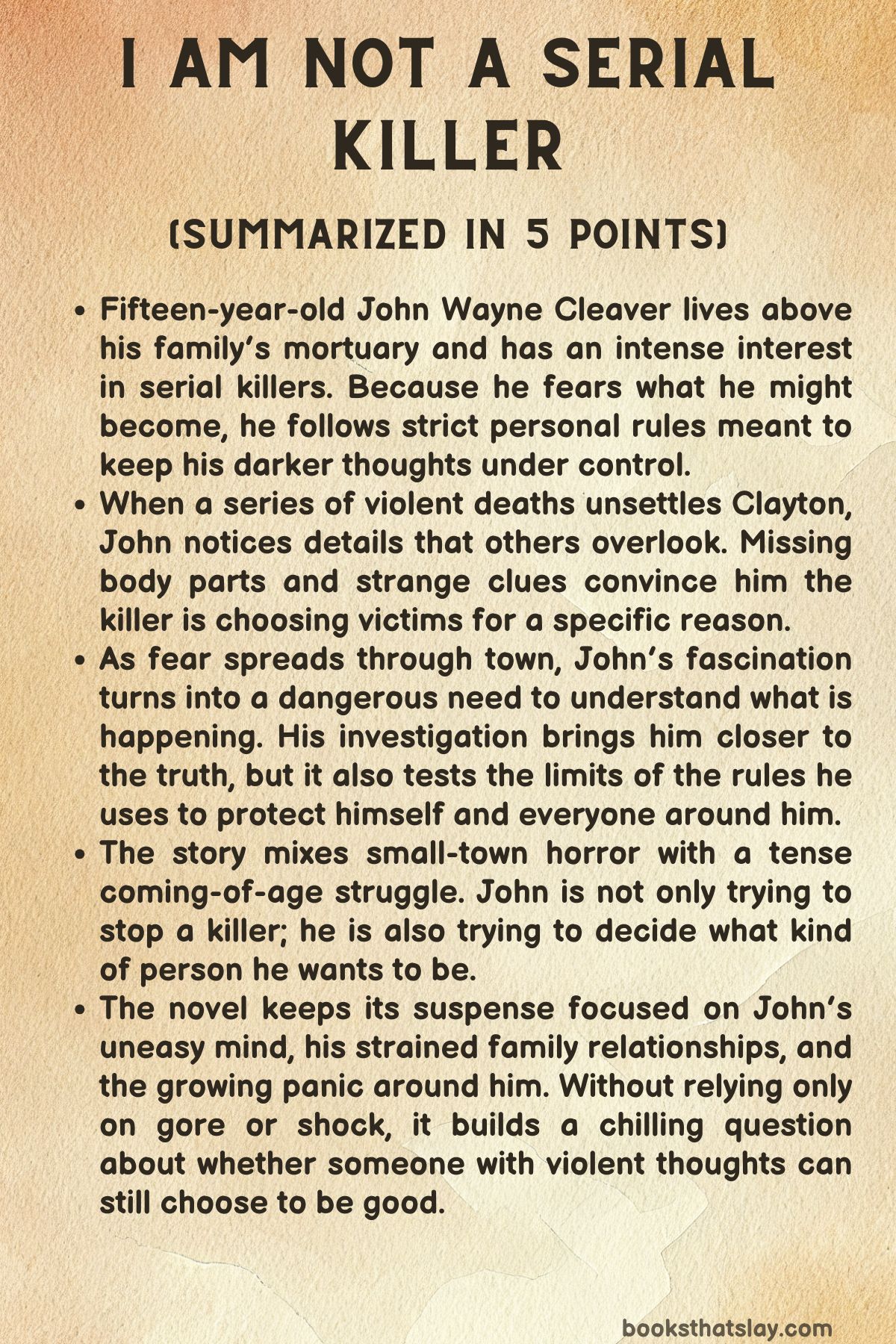
I Am Not A Serial Killer by Dan Wells is a dark young adult thriller about John Wayne Cleaver, a teenager who knows far too much about murder and fears what he might become. Living above his family’s mortuary, John spends his days around death while trying to control the violent thoughts he keeps hidden behind strict personal rules.
When a series of brutal killings begins in his small town, John sees patterns others miss. The story mixes psychological suspense with supernatural horror, using John’s disturbing self-awareness to explore fear, identity, control, and the thin line between monster and human. It’s the 1st book of the John Cleaver series.
Summary
In I Am Not A Serial Killer, fifteen-year-old John Wayne Cleaver lives in the small town of Clayton, where death is part of everyday life for him. His mother owns the local mortuary, and John helps prepare bodies with her and his aunt Margaret.
He understands embalming, listens carefully to the details of death, and feels more comfortable around corpses than around living people. This makes him unusual, but what truly troubles him is his obsession with serial killers.
John studies them constantly, not only because he is interested in them, but because he fears he might become one.
John has built rules to control himself. He avoids certain thoughts, tries not to stalk people, and forces himself to be polite even when he feels nothing.
He knows he lacks normal emotional responses and worries about the violent urges inside him. His therapist, Dr. Neblin, tries to help him manage these fears without treating him like a monster.
John’s mother, however, finds his interest in murder deeply disturbing, especially because he is growing older and more secretive. She wants him to be normal, while John knows that normal behavior is something he has to practice.
The story begins with an ordinary death: Mrs. Anderson dies quietly of old age, and her body is brought to the Clayton mortuary. At nearly the same time, the town is shaken by a far more violent death.
Jeb Jolley is found behind the Laundromat, his body torn open in a savage attack. The police and townspeople are horrified, but John is fascinated.
When Jeb’s body arrives at the mortuary, John studies the wounds during preparation and notices details that do not fit a simple animal attack. The body has been opened with terrible force, and one of Jeb’s kidneys is missing.
John believes the killer is not an animal, but a human murderer taking body parts. He begins thinking like the killer, trying to understand the pattern.
Soon another victim is found: Dave Bird, a farmer, has been killed and one of his arms is missing. The murders create panic across Clayton.
People begin calling the unknown murderer the Clayton Killer, and fear spreads quickly. John notices that the missing parts are not random trophies.
The killer seems to need specific organs and limbs.
A reporter named Ted Rask arrives and makes the murders even more public. He reports on strange black sludge found near the crime scenes and says it contains unusual human DNA.
He also suggests the killings may connect to an older disappearance in the area. Before he can reveal more, Rask becomes another victim.
His body is found gutted, with a leg missing. The town grows more frightened, and suspicion begins to fall on outsiders and vulnerable people.
John starts watching the people around him with sharper attention. He eventually notices a suspicious drifter and becomes convinced the man may be the killer.
When the drifter joins John’s elderly neighbor, Mr. Crowley, on an ice-fishing trip, John follows them in secret. He expects the drifter to attack Crowley.
Instead, he sees something impossible. Mr. Crowley changes into a clawed, inhuman creature and kills the drifter.
John realizes that the real murderer has been living quietly next door.
Mr. Crowley is not merely a killer. He is a demonlike being who has hidden inside a human life for decades.
The black sludge comes from him, and the missing body parts are being used to repair his failing human form. John now faces a terrible truth: the monster terrorizing Clayton is real, and he is also an elderly man with a wife, a home, and a life that looks ordinary from the outside.
Rather than immediately go to the police, John begins handling the discovery himself. Part of him wants to stop Crowley, but another part is excited by the hunt.
He sends anonymous notes to Crowley, trying to frighten him and gain control over him. This is dangerous for several reasons.
Crowley is strong and desperate, and John’s own rules begin to weaken as he allows himself to stalk, threaten, and manipulate someone. John tells himself he is fighting a monster, but he knows he is also enjoying it.
John investigates Crowley’s past and realizes that the creature once replaced an entire human body, becoming Bill Crowley. Now, however, the body is breaking down, and Crowley cannot fully renew himself.
Instead, he takes individual parts from victims to keep himself alive. The murders are acts of survival, but they are still cruel and horrifying.
Crowley’s need grows worse as John pressures him, and more people suffer because of it.
One of the deaths hits close to John’s life when Greg Olson, the father of John’s friend Max, is killed. John understands that his interference may have pushed Crowley into greater desperation.
This guilt does not stop him, but it adds weight to his actions. Meanwhile, Clayton grows unstable.
People are angry, scared, and eager to blame someone. Rumors spread, innocent people become targets of suspicion, and the town begins to feel capable of violence itself.
John keeps stalking Crowley and planning a trap. He uses a GPS tracker and secretly enters the Crowley house, gathering information and setting things in motion.
Dr. Neblin notices changes in John and becomes concerned. He begins following John, trying to understand what his patient is doing.
This puts him directly in danger. Crowley discovers the trap and kills Neblin, leaving John devastated but also forced to act quickly.
John moves Neblin’s body to keep Crowley from using it for parts. This decision is cold and practical, and it shows how far John is willing to go when he believes it is necessary.
Without access to a fresh body, Crowley weakens badly. He becomes desperate and crawls toward John’s house, searching for what he needs to survive.
The final confrontation comes at the mortuary, the place where John has spent so much of his life around death.
John’s mother comes outside, unaware of the full danger. John leads her into the embalming room, where the tools of the mortuary become weapons.
He uses the trocar and vacuum equipment against Crowley, stabbing and draining the creature. Crowley collapses into black sludge.
In his final moments, he asks to be remembered. His death is not presented as simple victory.
John has killed a monster, but he has also seen that the monster had a life, a wife, and a need to be seen as more than a beast.
After Crowley dies, John and his mother call the police, but they hide the supernatural truth. The official story allows the authorities to believe that the Clayton Killer escaped after attacking the Crowleys and killing Neblin.
Kay Crowley survives and helps protect John by explaining away parts of what happened near her house. The town slowly begins to return to normal, though the fear and rumors do not disappear at once.
John later visits Kay and learns more about Crowley as a husband. She remembers him with love, and this complicates John’s understanding of evil.
Crowley was a killer and a creature that fed on human bodies, but he was also capable of devotion. This troubles John because he has always tried to divide the world into rules, categories, and warning signs.
Crowley proves that monsters can appear human, and that human feelings can exist in monstrous lives.
By the end of I Am Not A Serial Killer, John has survived the murders and saved his town, but he is not cured of his own darkness. He still has violent thoughts, especially about Brooke, and he knows the dangerous part of himself remains present.
What changes is his willingness to rebuild his rules and keep trying. He also begins reconnecting with his mother.
She has seen more of who he is and chooses not to abandon him. John’s struggle continues, but he is no longer facing it completely alone.
Characters
In I Am Not A Serial Killer, Dan Wells builds the characters around fear, hidden violence, loneliness, and the uneasy question of what makes someone monstrous. Each major character reflects a different side of John Wayne Cleaver’s world: death as a family business, murder as an obsession, love as a weakness, and self-control as the only thing separating a person from the darkness inside them.
John Wayne Cleaver
John Wayne Cleaver is the central character of the book and one of its most psychologically complex figures. At fifteen, he is intelligent, observant, emotionally detached, and deeply fascinated by serial killers.
His interest is not casual curiosity; it is tied to his fear that he may become one himself. Because he recognizes disturbing urges within himself, John creates strict personal rules to prevent himself from hurting others.
These rules show that he is not simply dangerous, but also self-aware. He understands that something inside him is wrong, and much of his character is built around his struggle to control it.
John’s life above the family mortuary shapes the way he sees death. Unlike most teenagers, he is comfortable around dead bodies and understands the physical details of death with unsettling calmness.
This makes him unusually prepared to recognize patterns in the murders, especially when he notices missing body parts and realizes that the killer is not acting randomly. His intelligence allows him to see what others miss, but his excitement about the murders also reveals the frightening side of his personality.
John wants to stop the killer, yet part of him is thrilled by the hunt. This tension makes him both heroic and disturbing.
His conflict with Mr. Crowley also becomes a mirror of his own inner life. Crowley is an actual monster hiding in human form, while John fears that he is a human being hiding a monster inside himself.
By stalking Crowley, threatening him, and setting traps, John begins crossing the boundaries he created for himself. He is not motivated only by justice; he is also drawn to the power and intensity of the situation.
This makes his victory complicated. He saves his mother and defeats a murderer, but he does so by using the darker parts of himself.
By the end of the story, John does not become completely normal, nor does he magically lose his violent thoughts. His growth lies in his renewed effort to control himself and connect with others.
His relationship with his mother improves because she chooses not to abandon him, even after seeing how frightening he can be. John remains dangerous, but he is also trying.
That struggle between impulse and restraint is what defines him as a character.
Mr. Crowley / Bill Crowley
Mr. Crowley is the main antagonist of the story and one of the most tragic characters in the book. On the surface, he appears to be an elderly neighbor, gentle and ordinary enough to escape suspicion.
His public identity depends on familiarity. People think they know him because he has lived among them for years, but this ordinary appearance hides something ancient, violent, and unnatural.
His role is frightening because he proves that evil can live quietly beside people without being noticed.
As the killer, Crowley is brutal and practical. He does not kill only for pleasure or spectacle; he kills because his human body is failing and he needs replacement parts to survive.
This makes his violence different from the kind John initially expects. John thinks in terms of serial-killer patterns, trophies, and psychological rituals, but Crowley’s murders are acts of physical survival.
He is monstrous not only because he kills, but because he treats human bodies as materials to be harvested. His need makes him desperate, and his desperation makes him increasingly dangerous.
Yet Crowley is not written as a simple villain. His relationship with Kay reveals that he has experienced real love and domestic tenderness.
He wants to be remembered, which suggests that he is not just a creature of appetite but someone who fears disappearance and loneliness. This makes him more unsettling, because he is both a loving husband and a predator.
The story refuses to make him purely evil in a simple way. Instead, he becomes a figure who shows how affection and horror can exist in the same being.
Crowley also functions as John’s dark opposite. Both characters have monsters within them, but Crowley has given himself over to his nature while John is still fighting his.
Crowley hides his monstrosity behind a human life, while John hides his impulses behind rules. Their conflict is therefore not just a fight between boy and demon; it is a battle between surrendering to darkness and resisting it.
Crowley’s death is necessary, but his sadness complicates the reader’s feelings about him.
John’s Mother
John’s mother is an important emotional force in the story because she represents family, fear, responsibility, and unconditional love. As the woman who runs the mortuary and raises John, she lives close to death every day, but John’s fascination with murder still frightens her.
She can accept death as part of work, but she struggles to accept her son’s coldness toward it. This difference creates tension between them.
She sees John not only as unusual, but as someone who may be slipping beyond her ability to understand.
Her fear of John is painful because it is mixed with love. She does not want to believe that her son could be dangerous, yet his behavior gives her reasons to worry.
Her alarm shows how isolated John is, even within his own family. The person who should know him best cannot fully reach him.
This makes their relationship emotionally important because John’s greatest fear is not only becoming a killer, but being abandoned once people see what is inside him.
During the climax, John’s mother becomes directly involved in the danger when Crowley comes toward the house. Her presence raises the emotional stakes because John is no longer investigating from a distance; he must protect someone he loves.
The embalming room confrontation also connects the family business to John’s survival. The tools of death become the tools that save his mother’s life.
By the end, her choice to stay with John matters deeply. She sees more of his darkness than she ever has before, but she does not reject him.
This acceptance does not erase her fear, but it gives John something he desperately needs: proof that he is not alone. Her character helps turn the ending from a simple victory over a monster into a fragile moment of emotional repair.
Dr. Neblin
Dr. Neblin is John’s therapist and one of the few adults who tries to understand John instead of simply fearing him. His role is crucial because he gives language and structure to John’s inner struggle.
Through their conversations, John’s rules and self-control become clearer. Dr. Neblin recognizes that John’s thoughts are disturbing, but he also treats him as a person who can make choices.
This makes him a stabilizing influence in John’s life.
Unlike many people around John, Dr. Neblin does not reduce him to a strange or dangerous boy. He listens carefully and tries to help John manage his impulses.
This makes him one of the more compassionate characters in the story. However, his compassion does not mean he is naive.
He becomes suspicious when John’s behavior changes, and he senses that something more serious is happening. His concern leads him closer to the truth, but also places him in danger.
Dr. Neblin’s death is significant because it removes one of John’s strongest safeguards. He is not just another victim; he is a person who represented order, guidance, and restraint.
When Crowley kills him, John loses someone who helped him keep his darker self under control. This makes the final stages of the story more dangerous because John must rely on his own rules without the person who helped him understand them.
His character also shows the limits of therapy in a world where the threat is both psychological and supernatural. Dr. Neblin can help John face his inner monster, but he is not prepared for a literal monster.
His death deepens the tragedy of the story and forces John into greater independence.
Kay Crowley
Kay Crowley is Mr. Crowley’s wife, and her character adds emotional complexity to the villain. She is not presented as monstrous; instead, she appears as an elderly woman connected to the ordinary domestic life Crowley has built.
Through her, the reader sees that Crowley was not only a killer hiding among people, but also a husband who could love and be loved. This complicates the moral world of the story.
Kay’s survival is important because she becomes a living witness to the human side of Crowley. After the violence ends, John visits her and learns more about the man Crowley had been to her.
Her defense of John also helps protect him from suspicion, showing that she is not merely a passive victim of events. She plays a quiet but meaningful role in shaping how the aftermath is understood.
Her grief makes Crowley harder to dismiss as only a creature. If Kay loved him, and if he loved her, then the story asks the reader to hold two truths at once: Crowley was a murderer, and Crowley was capable of tenderness.
Kay therefore helps deepen one of the book’s central questions: whether being monstrous completely erases the value of love, memory, and devotion.
Aunt Margaret
Aunt Margaret is part of John’s family and works in the mortuary, helping prepare bodies alongside John’s mother. Her presence strengthens the sense that death is not unusual in John’s home; it is part of family routine.
Through her, the mortuary becomes not just a workplace, but a shared family environment where John’s unusual comfort with corpses develops.
Although she is not as central as John or his mother, Aunt Margaret contributes to the atmosphere of the story. She represents the practical, ordinary side of death care.
In a book filled with murder, fear, and supernatural horror, the mortuary work shows that death itself is not always violent or evil. Sometimes it is simply a duty that must be handled with professionalism.
Her role also helps explain why John is so different from other teenagers. He has grown up around embalming, bodies, and adult conversations about death.
Aunt Margaret is part of that background, making John’s world feel believable and specific. She helps form the environment that makes John both useful in the investigation and emotionally detached from things that would horrify others.
Jeb Jolley
Jeb Jolley is the first major murder victim whose death reveals the horror threatening the town. Although he does not function as a developed active character for long, his body becomes extremely important to the plot.
The brutal condition of his corpse allows John to recognize that the killing is not normal. The missing kidney becomes one of the first clues that the murderer is taking specific body parts.
Jeb’s death changes the mood of Clayton. Before him, death can still seem natural, as with Mrs. Anderson.
After him, death becomes violent, invasive, and terrifying. His murder introduces the pattern that drives John’s investigation and begins the public panic around the Clayton Killer.
In this sense, Jeb’s importance lies less in his personality and more in what his death exposes.
His body also reveals John’s unusual nature. Where others would react with horror, John responds with fascination and analysis.
Jeb therefore becomes a turning point not only in the mystery, but also in the reader’s understanding of John. Through John’s reaction to Jeb’s corpse, the story shows both his brilliance and his disturbing emotional distance.
Dave Bird
Dave Bird is another victim whose death confirms that the killer is following a pattern. As a farmer, he represents the ordinary working life of the town, which makes his murder feel like an attack on the community itself.
His death expands the danger beyond one shocking incident and proves that the killer will strike again.
The missing arm from Dave’s body helps John understand that the murderer is not simply mutilating victims randomly. This discovery pushes the investigation forward because it reveals that the killer is searching for parts.
Dave’s death therefore deepens the mystery and brings John closer to understanding Crowley’s need for physical repair.
Dave also matters because his murder increases the fear spreading through Clayton. The town begins to feel unsafe in every direction.
The killer is not targeting only one type of person or one isolated place. By killing someone like Dave, the murderer turns ordinary life into something vulnerable and frightening.
Ted Rask
Ted Rask is the sensational reporter who brings public attention to the murders. His role in the story is tied to information, fear, and spectacle.
He reports on the Clayton Killer and reveals details that intensify the town’s panic, including the strange black sludge and the connection to unusual human DNA. Through him, the murders become not only private tragedies but public events.
Rask’s character shows how media attention can magnify terror. He is interested in the story because it is shocking, and his reporting feeds the community’s fear.
However, he is not merely spreading rumors; he also uncovers information that points toward the supernatural truth. This makes him useful and dangerous at the same time.
He helps expose the pattern, but his knowledge makes him a target.
His death is especially important because it shows that getting close to the truth has consequences. When he is killed and found missing a leg, the pattern of body-part theft becomes even clearer.
His murder also silences a public voice that might have revealed too much. Rask’s character therefore represents both the power and danger of uncovering hidden violence.
The Drifter
The drifter is a misleading figure in the story because John initially believes he may be the killer. His suspicious behavior and outsider status make him an easy person to suspect.
This reflects both John’s investigative instincts and the town’s tendency to fear those who seem different or unfamiliar.
His role is important because he leads John to the truth by accident. When John follows him and watches the ice-fishing trip, he expects the drifter to attack Mr. Crowley.
Instead, the scene reverses John’s assumptions completely. Crowley transforms and kills the drifter, revealing that the harmless-looking neighbor is the real monster.
The drifter therefore functions as a red herring, but also as the key to exposing the truth.
His death also shows the danger of relying on appearances. The person who looks suspicious is not the true threat, while the person who seems safe is deadly.
This lesson matters throughout the story because Clayton’s fear often turns toward the wrong people. The drifter’s character, though brief, helps shift the book from a serial-killer mystery into supernatural horror.
Max
Max is John’s friend and serves as one of the few connections John has to normal teenage life. Through Max, the story shows the social world that John struggles to participate in.
John is not completely isolated, but his friendships are limited and often strained by his emotional detachment.
Max becomes more important when his father, Greg Olson, is killed. This brings the horror closer to John’s personal life and shows that the murders are not abstract puzzles.
They destroy families and affect people John knows. Max’s grief forces John to confront the human cost of the investigation and of his own interference with Crowley.
As a character, Max highlights John’s difficulty with empathy. John can understand facts, motives, and patterns, but emotional responses are harder for him.
Max’s loss challenges John because it demands a kind of feeling that does not come naturally to him. Through Max, the story reminds the reader that the murders are not only clues; they are tragedies.
Greg Olson
Greg Olson, Max’s father, is one of Crowley’s later victims, and his death is especially important because it is connected to John’s actions. After John begins threatening and pressuring Crowley, Crowley grows more desperate, and Greg becomes one of the people who pays the price.
This makes his death morally complicated for John.
Greg represents the innocent people caught between John and Crowley. He is not part of the investigation, and he is not seeking danger.
His death shows that John’s attempts to control Crowley have consequences beyond what John intends. This forces the reader to question whether John’s private war with Crowley is entirely heroic.
His murder also affects Max, making the violence personal within John’s limited circle of relationships. Greg’s role may not be large in terms of direct action, but his death deepens the emotional and ethical stakes.
It shows that John’s cleverness can be dangerous when it is mixed with secrecy and pride.
Brooke
Brooke is important because she represents John’s attraction, social awkwardness, and continuing danger. John’s thoughts about her reveal that his struggle does not end with Crowley’s death.
He still has violent impulses, and Brooke becomes one of the people connected to those thoughts. This makes her role psychologically significant even if she is not central to the murder plot.
Through Brooke, the story shows the gap between John’s desire to seem normal and his disturbing inner life. He wants to participate in ordinary teenage feelings, but those feelings are tangled with darker fantasies.
This makes his character more unsettling because his danger does not appear only in moments of supernatural conflict. It exists in everyday situations too.
Brooke also helps show why John needs rules. His thoughts about her prove that his self-control is not temporary or situational; it must be rebuilt and maintained constantly.
Her character therefore reflects the ongoing nature of John’s internal battle. The monster outside may be gone, but the monster inside John remains.
Mrs. Anderson
Mrs. Anderson’s death at the beginning of the story is quiet and natural, which makes it an important contrast to the murders that follow. She dies of old age, and her unnoticed body arrives at the mortuary just as the town is shaken by violent death.
This contrast establishes two kinds of mortality: ordinary death and monstrous death.
Her role is small but meaningful because she helps set the atmosphere of the book. The mortuary is a place where death is handled calmly and professionally, and Mrs. Anderson’s body belongs to that world.
Her death is sad but not terrifying. It is part of life’s natural ending.
By placing her death beside Jeb Jolley’s brutal murder, the story immediately shows how different Crowley’s violence is. Mrs. Anderson reminds the reader that death itself is not the horror.
The horror comes from violation, predation, and the stealing of bodies for unnatural survival. Her character helps create that contrast.
Themes
The Fear of Becoming a Monster
John’s greatest conflict is not only the danger outside Clayton but the danger he believes exists inside himself. His interest in murder, his fascination with bodies, and his fear that he may become a serial killer make him live under constant self-surveillance.
He creates rules not because he trusts himself, but because he does not. This makes I Am Not A Serial Killer a story about identity under pressure: John is terrified that his thoughts define him, even when his actions show discipline and restraint.
His pursuit of Crowley becomes especially disturbing because it gives him a moral reason to stalk, threaten, and manipulate someone. The line between hunting evil and enjoying the hunt becomes harder for him to separate.
Yet the ending suggests that being a monster is not decided by dark impulses alone. John still has violent thoughts, but he also chooses protection, control, and connection.
His struggle shows that morality depends not on being free from darkness, but on resisting it.
Control, Rules, and Self-Restraint
John’s rules are his way of surviving himself. They give structure to urges he cannot fully explain and help him move through normal life without harming others.
These rules are not simple habits; they are barriers between thought and action. When Crowley appears, John’s system begins to weaken because the murders give his darker interests a real target.
He can justify watching, planning, and threatening because Crowley is dangerous, but this justification also allows him to enjoy behavior he normally forbids himself. The theme becomes more complex because control is shown as necessary but fragile.
John is not cured by rules, therapy, or family love, yet each of these gives him a way to remain human. When Dr. Neblin dies, John loses one of the few people who understood his struggle, making his self-control even more urgent.
By the end, rebuilding his rules matters because it shows that restraint must be chosen again and again.
Appearance Versus Reality
Clayton seems like an ordinary town filled with familiar people, but beneath that ordinary surface lies fear, violence, and deception. Mr. Crowley appears to be a harmless elderly neighbor, yet he is responsible for the killings.
John appears cold, strange, and dangerous, yet he becomes the person most capable of understanding the threat. This reversal challenges easy judgments about good and evil.
The town’s fear leads people to suspect outsiders and blame the wrong people, while the real killer hides in plain sight as a trusted member of the community. The mortuary also supports this theme because it exposes the reality of death behind the polished rituals people use to make loss seem peaceful.
John’s life above the mortuary means he is always close to truths others avoid. In I Am Not A Serial Killer, appearances often protect lies, while uncomfortable truths become necessary for survival.
The story suggests that evil is not always obvious, and goodness may look unsettling from the outside.
Isolation, Family, and the Need for Connection
John is emotionally isolated because he believes no one can fully understand him. His mother fears his obsession with death, his peers treat him as strange, and even his attempts at normal interaction often feel artificial.
This isolation increases his danger because secrecy gives his darker side more room to grow. Dr. Neblin provides one form of connection by helping John speak honestly about his thoughts without immediate rejection.
His death is therefore not only a plot loss but an emotional one, because John loses a guide who helped him stay grounded. John’s relationship with his mother becomes especially important near the end.
When she refuses to abandon him, she offers the acceptance he has feared he could never receive. That acceptance does not erase his violent thoughts, but it gives him a reason to keep fighting them.
The theme shows that connection cannot magically fix John, yet it can help him choose responsibility over surrender.