I, Medusa Summary, Characters and Themes
I, Medusa by Ayana Gray is a captivating retelling of the ancient Greek myth of Medusa, reimagined through a fresh lens. It explores the transformation of Medusa from a beautiful mortal into the infamous Gorgon, cursed by Athena.
In this version, Medusa’s struggle with her identity, her relationships with her sisters, and her complex feelings toward the gods are at the forefront of the story. Gray weaves themes of power, revenge, and the search for self-acceptance, giving a voice to a character long vilified in mythology. The novel delves into Medusa’s emotional journey as she navigates a world of gods, monsters, and her own monstrous transformation.
Summary
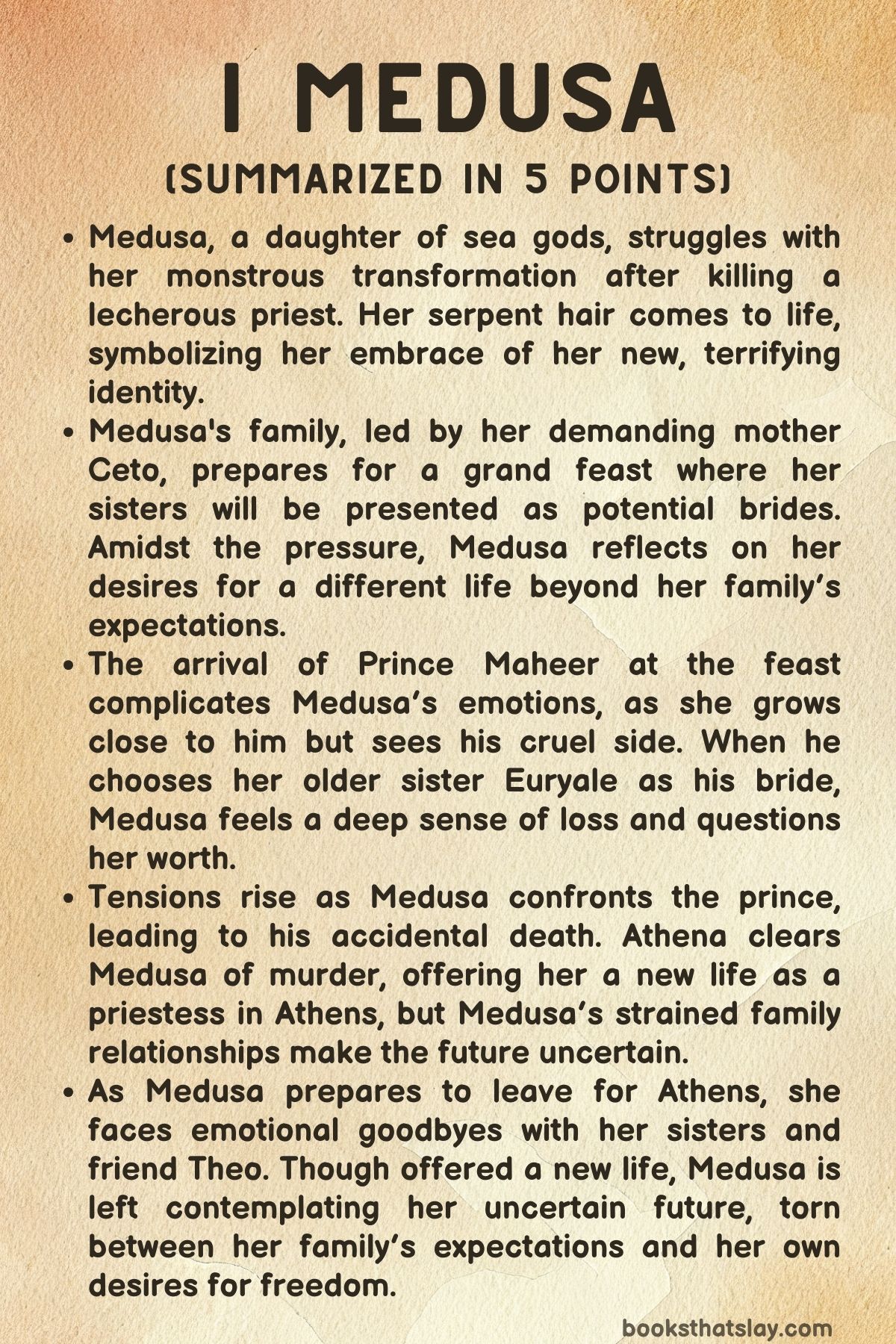
The story of I, Medusa unfolds in two primary timelines, one focusing on the life of Medusa, the daughter of the sea gods Phorcys and Ceto, and the other on the tension within her family during a significant event – a grand feast meant to celebrate the potential marriage of one of Phorcys and Ceto’s daughters. Medusa, a young, dark-skinned woman, struggles with a deep inner turmoil.
She seeks a blessing from a priest in a small, secluded temple, hoping to find some sense of peace. However, the temple is dilapidated and the priest skeptical, though he agrees to help after Medusa’s confession.
As the encounter turns increasingly unsettling, the priest becomes lecherous, prompting Medusa to reveal her true nature. She is no mere mortal, but a being with the power to turn people into stone.
In a desperate act of self-preservation and vengeance, Medusa kills the priest by transforming his body into stone. The act leaves her exhausted, but also detached, as her serpent-like hair comes to life, marking her as a creature of monstrous abilities.
The second timeline shifts to Medusa’s family, dominated by her powerful mother Ceto. Ceto imposes perfection on her daughters, especially during a dance rehearsal for an upcoming spring feast, which also serves as a social event where Medusa’s sisters will be presented as potential brides to noble suitors.
Medusa longs for a different life beyond the island, though she feels a certain bond with her mother despite her cruelty. At the feast, the gods of the Sea Court arrive, and Medusa, along with her sisters, performs a dance.
The event takes a dramatic turn when Poseidon, the king of the sea, unexpectedly makes an appearance. Medusa, who admires him from afar, is unnerved when Poseidon briefly looks at her.
Meanwhile, Prince Maheer, a demigod and son of Ares, arrives with a gift—a captured lion—desiring to take one of Phorcys’s daughters as his bride. Medusa’s family hopes to marry Maheer into their ranks for political and social advantage.
As the prince considers which of the three daughters to choose, Medusa becomes caught between the fear of being left behind by her sisters and the desire for something more, especially after a brief connection with Maheer. Ultimately, Maheer chooses Euryale, Medusa’s older sister, as his bride.
While happy for Euryale, Medusa feels a sense of loss, questioning her own worth and identity, particularly after an unsettling encounter with Poseidon and a sea nymph in the gardens. Her sister Stheno hints at Maheer’s cruelty, suggesting that the lion he brought was trained with slaves, revealing a darker side to his character.
Despite Medusa’s growing dread, the prince’s decision stands, and the family moves forward with the marriage. Medusa is left questioning her place in the world, feeling betrayed and powerless in a society dominated by gods and men.
Euryale’s marriage to Prince Maheer is seen as an opportunity to elevate the family’s status. However, Medusa worries about her sister’s well-being, believing the marriage will imprison her.
Stheno, however, points out that immortality means nothing lasts forever, and that Euryale will eventually be free when Maheer passes. Despite this, Medusa cannot shake her concerns.
One night, Medusa has a troubling dream in which she sees Euryale attacked and killed by a lion. Medusa shares her fears with her sister, but Euryale downplays the situation, revealing that Maheer once hit her when she refused his advances.
This admission enrages Medusa, prompting her to take action.
Determined to protect her sister, Medusa confronts Maheer, offering him precious gemstones to call off the marriage. When he mocks her, tensions escalate, and Maheer attempts to assault Medusa.
In the ensuing struggle, Maheer accidentally dies when he falls and hits his head on a table. The next morning, Medusa fears the consequences of her actions, but her family dismisses her involvement.
Athena arrives to investigate, and Medusa, terrified, admits to the crime. Surprisingly, Athena clears Medusa of murder, deeming Maheer’s death an accident, and praises her bravery.
She offers Medusa a place as a priestess in Athens, an opportunity to leave the island and escape her current life.
As Medusa prepares to leave for Athens, tensions rise within her family. Medusa’s parents, Ceto and Phorcys, argue, and Medusa witnesses a violent outburst from Phorcys, leaving her feeling more isolated than ever.
On the day of her departure, she bids farewell to her sisters. Euryale forgives Medusa, but their bond is strained, while Stheno offers a seashell necklace as a parting gift.
Medusa also shares an emotional goodbye with her friend Theo, but their dreams of leaving together are dashed. Her father reminds her of the responsibility she bears to represent the family in Athens.
Upon arrival in Athens, Medusa participates in the Panathenaia festival, a sacred event honoring Athena. During the festival, she experiences her first chariot race, which is both thrilling and violent, with one driver likely killed in the chaos.
Later, Medusa learns of her friend Apollonia’s assault by soldiers, which disturbs her deeply. Medusa vows to seek justice, but when she confronts Kallisto, the perpetrator of the abuse, she is forced to humiliate herself to protect Apollonia.
Apollonia is eventually expelled from the temple, and Medusa grapples with the unfairness of the situation. Athena reveals to Medusa that Apollonia’s dismissal was due to her lack of chastity, but Medusa struggles with the explanation.
She returns home to find her father cold and indifferent, further alienating her from her family.
Back on the island, Medusa learns of the Olympians’ role in taking many of her siblings, leaving her feeling abandoned by both her family and the gods. Tensions with her father, Poseidon, only deepen, and Medusa begins to question her place in both the mortal and divine worlds.
In a final confrontation with Athena, Medusa rejects the goddess’s manipulation, choosing instead to define her own path. She returns to her sisters, finding solace in their company but also recognizing the ongoing conflict between her desires for freedom and the constraints of her existence.
Medusa’s journey, filled with loss, betrayal, and personal growth, leads her to a place of self-awareness. She has learned to navigate the complexities of her identity, her powers, and her relationships with those around her.
The novel ends with Medusa on the island with her sisters, awaiting whatever the future may bring.
Characters
Medusa
Medusa, the protagonist of I, Medusa, is a complex character defined by her internal turmoil, strength, and evolving self-awareness. Initially, Medusa is depicted as a young, dark-skinned woman with a deep sense of inner conflict.
She begins her journey seeking a blessing from a priest in a secluded temple, revealing her vulnerability and yearning for a better life. However, this moment quickly turns dark when Medusa reveals her monstrous abilities, including the power to turn others into stone, which she uses to kill the priest in an act of self-preservation.
This event marks the beginning of her transformation into a figure caught between mortality and monstrosity.
Throughout the story, Medusa grapples with the expectations placed upon her by her family, especially her mother, Ceto, and the pressures of her immortal heritage. Her mother demands perfection, pushing her daughters to perform at a high level, particularly during the feast where Medusa’s sisters are presented as potential brides.
Medusa, however, feels a disconnect with this life. She is torn between her family’s expectations and her own desires for freedom and escape.
Her growing disillusionment with the world around her is further exacerbated by her strained relationship with Poseidon, who initially seems to offer her a form of connection but leaves her feeling confused and betrayed.
Medusa’s strength becomes more apparent as she learns to control her powers. However, she remains deeply conflicted, especially when faced with the violence her powers bring.
As the story progresses, Medusa becomes increasingly isolated, unable to reconcile her actions with the person she wishes to be. Her sense of justice, however, leads her to a path of vengeance and self-discovery, culminating in a final confrontation with Athena.
Ultimately, Medusa rejects the gods’ influence and defines her own path, embracing her newfound strength and identity while remaining connected to her sisters on the island.
Euryale
Euryale, Medusa’s older sister, is a central figure in I, Medusa, embodying the complexities of familial loyalty and sacrifice. Initially, Euryale is betrothed to Prince Maheer, a political move that her family sees as a way to elevate their status.
Despite the external appearance of contentment, Euryale’s inner turmoil surfaces as she confides in Medusa about her true desires. She longs for freedom, despite her marriage being viewed as a necessary step for their family’s advancement.
Her vulnerability is highlighted when she admits to having been struck by Prince Maheer, a moment she brushes off but which deeply disturbs Medusa.
Euryale’s strength lies in her resilience, though she remains trapped in the expectations placed upon her. Her eventual marriage to Maheer, despite her lack of affection for him, signifies the compromises she is forced to make in order to protect herself and her family.
Euryale’s relationship with Medusa becomes strained, particularly after Medusa’s actions lead to the prince’s death. While Euryale initially struggles with Medusa’s interference, she eventually forgives her, but their bond is forever altered.
Euryale represents the tragic sacrifices women often make within patriarchal structures, constantly balancing their desires for autonomy with familial obligations.
Stheno
Stheno, Medusa’s second sister, plays a crucial role in shaping Medusa’s perceptions of power and violence. Unlike Medusa, who is often conflicted by the brutal acts they perform, Stheno embraces their powers with a sense of cold detachment.
She takes pleasure in turning men to stone, a reflection of her hardened view of the world. Stheno’s approach to their cursed existence is more pragmatic, even cruel, as she relishes the control and fear they inspire in others.
Stheno’s coldness often isolates her from Medusa, who feels increasingly disconnected from her violent tendencies. However, Stheno’s role as the more dominant force in the family dynamic is undeniable.
Her actions, such as turning Linus to stone after he makes crude advances, reveal a ruthlessness that contrasts sharply with Medusa’s internal struggle. Over time, Stheno becomes more entrenched in their violent lifestyle, seeing no way out of their cursed existence.
Her relationship with Medusa becomes increasingly strained, as Medusa finds it difficult to reconcile her own sense of justice with the cruelty her sister embraces.
Ceto
Ceto, Medusa’s mother, is a powerful sea goddess who embodies the complexities of parental control and the harsh expectations placed on her daughters. She is a figure who demands perfection from her children, often pushing them to meet impossible standards.
Ceto’s behavior, particularly during the preparations for the feast where her daughters are to be presented as potential brides, is domineering and cruel. Her obsessive need for control is evident in how she molds her daughters into what she believes is their destined role in the world.
Despite her harshness, there is a sense of maternal care beneath her actions, as Ceto’s ultimate desire is to protect her daughters and ensure their survival in a world ruled by gods and men.
However, Ceto’s overbearing nature strains her relationship with Medusa. The pressure she places on her daughters, particularly Medusa, only heightens Medusa’s sense of alienation.
The conflict between Ceto and Phorcys, Medusa’s father, further underscores the family’s dysfunction. Ceto’s resentment toward the Olympians and her fixation on perfection set the stage for Medusa’s eventual break from the family, as she seeks a life beyond the oppressive expectations her mother imposes.
Phorcys
Phorcys, Medusa’s father, is a less prominent but significant figure in I, Medusa. His cold and indifferent nature contributes to Medusa’s sense of isolation.
He is primarily concerned with using his family’s status to gain power, rather than nurturing emotional connections with his daughters. Phorcys’s relationship with Ceto is marked by tension and conflict, particularly when he physically strikes her during an argument.
This violent outburst further exacerbates Medusa’s feelings of alienation, as she finds herself caught between her parents’ turmoil and her own quest for independence. Phorcys represents the patriarchal forces that seek to control and manipulate, further complicating Medusa’s sense of belonging and identity.
His lack of emotional support for Medusa makes her eventual departure from the island all the more poignant, as she seeks to find herself in a world beyond her family’s oppressive grip.
Poseidon
Poseidon, the god of the sea, plays a pivotal but complicated role in Medusa’s life. Initially, he appears to offer Medusa a sense of connection and understanding, especially after the death of Prince Maheer.
Medusa’s feelings toward Poseidon are conflicted, as she is torn between her loyalty to the gods and her own growing sense of autonomy. Poseidon’s cold indifference toward her return home, as well as his desire to use Medusa to further his own political aims, underscores the complex and often exploitative relationships between mortals and gods.
Poseidon’s actions leave Medusa questioning her place within the divine order, as she begins to realize that the gods, including him, are more concerned with their own agendas than with her well-being. This realization contributes to Medusa’s eventual rejection of the gods and her decision to carve her own path, free from their manipulation.
Theo
Theo, Medusa’s confidante and friend, represents the human relationships that Medusa longs for but ultimately cannot sustain. Their friendship provides Medusa with a brief respite from the turmoil of her family and the gods.
However, when Medusa’s journey takes her further into isolation and self-discovery, her connection with Theo fades. Their parting marks a bittersweet moment in Medusa’s life, as it highlights the deep sense of loss she experiences in her quest for freedom.
Theo’s role in Medusa’s story is subtle but significant, serving as a reminder of the life Medusa could have had if her world were not defined by divine curses and the expectations of her family.
Themes
Power and Responsibility
In I, Medusa, power plays a central role in shaping the characters’ lives, particularly Medusa’s. Her transformation into a creature capable of turning anyone into stone symbolizes the weight of power and its consequences.
Initially, her powers are a form of self-preservation, a response to the priest who tries to harm her. As the story progresses, Medusa becomes increasingly conflicted about using her powers, especially as she observes her sisters, Euryale and Stheno, growing more ruthless and reveling in their ability to control life and death.
Power in the hands of the Gorgons becomes both a source of protection and destruction. While Stheno and Euryale embrace their powers, turning men to stone without hesitation, Medusa feels the moral cost of their actions.
This internal struggle deepens when she meets Apollonia, a former friend, and her desire to protect her clashes with the violent nature of her existence. Medusa’s reluctance to kill the young man who arrives on the island, as well as her eventual decision to spare him despite her sister’s actions, reflects her growing understanding of the responsibilities tied to power.
Her journey highlights the tension between using power for survival and the moral burden it imposes, particularly when one’s actions affect others.
Family and Isolation
The theme of family is intricately woven into I, Medusa, influencing the characters’ motivations, conflicts, and personal growth. Medusa’s relationship with her family is central to her emotional turmoil.
Her mother, Ceto, imposes perfection and status upon her daughters, and this pressure affects Medusa profoundly. While she longs for a different life outside the confines of her family, she remains entangled in the expectations and manipulations of her parents.
The dynamics within Medusa’s family grow even more strained as Medusa’s father, Phorcys, shows disdain for her aspirations. This tension is further exacerbated during the grand feast, where Medusa’s sisters are presented as potential brides for political gain.
Medusa’s inability to meet these expectations leads to a deep sense of isolation, and as the story progresses, this feeling of being an outsider intensifies. The more she distances herself from her family’s ideals, the more she realizes that her existence is shaped by forces beyond her control.
Medusa’s isolation deepens as she journeys into a world dominated by gods and men, where her desires and individuality are often crushed under the weight of societal expectations. The eventual departure from her family, first for Athens and later for Cyrene, marks a turning point in her search for independence, though she continues to struggle with her identity and the sacrifices made for the sake of family.
Identity and Transformation
The theme of identity and transformation is deeply explored in I, Medusa, as Medusa’s physical and emotional evolution reflects the larger narrative of self-discovery and acceptance. Her transformation into a monster, cursed by Athena, is not only a literal change but a symbolic one, marking her shift from a young woman filled with potential to a creature feared by both gods and mortals.
Initially, Medusa tries to navigate her new identity, torn between her previous life and the monstrous abilities she now possesses. Her physical transformation—her snake hair and the power to turn others to stone—force her to reckon with who she has become and how society perceives her.
Medusa’s struggle with her identity is compounded by her family’s expectations and the pressure to conform to societal norms. As she watches her sisters embrace their monstrous identities, Medusa grows more conflicted about the path they are taking.
The contrast between her sisters’ growing cruelty and Medusa’s reluctance to harm others illustrates her internal battle between embracing her powers and maintaining her humanity. Her encounter with Apollonia further complicates her sense of self, as her desire to protect her from the dangers of their cursed existence highlights Medusa’s yearning for a life not defined by her powers.
Over time, Medusa comes to realize that her transformation is not only about her powers but also about how she chooses to shape her future. Her rejection of Athena’s manipulation and her decision to find her own way reflect her desire to reclaim her identity, not as a monster, but as an individual with agency and purpose.
Freedom and Entrapment
The concept of freedom versus entrapment is another crucial theme in I, Medusa. Medusa’s journey is defined by her struggle to break free from the confines of her family, the gods, and societal expectations.
From a young age, Medusa yearns for freedom, particularly from her overbearing mother, Ceto, and the rigid structures of their family life. The grand feast where her sisters are presented as potential brides for political advancement serves as a stark reminder of the limited options available to women in her world.
As Medusa watches her sisters conform to the roles expected of them, she becomes increasingly aware of her own entrapment. Her brief connection with Prince Maheer, who ultimately chooses her sister Euryale as his bride, forces Medusa to confront the idea that her desires and worth are secondary to the needs of the family.
Even when she is offered a potential escape through Athens and the priesthood, Medusa is still bound by expectations, this time those of the gods and the higher powers she encounters. The theme of entrapment reaches its climax when Medusa realizes that her powers, once seen as a means of survival, have come to define her in ways that further isolate her.
She is trapped by her identity, her family, and the fear of being consumed by her own rage. Ultimately, Medusa’s decision to leave the island and seek a new life in Cyrene represents her desire for autonomy and freedom.
However, the shadow of her past continues to haunt her, reminding her that true freedom is something that must be continually fought for, even when it comes at great personal cost.