‘Salem’s Lot Summary, Characters and Themes
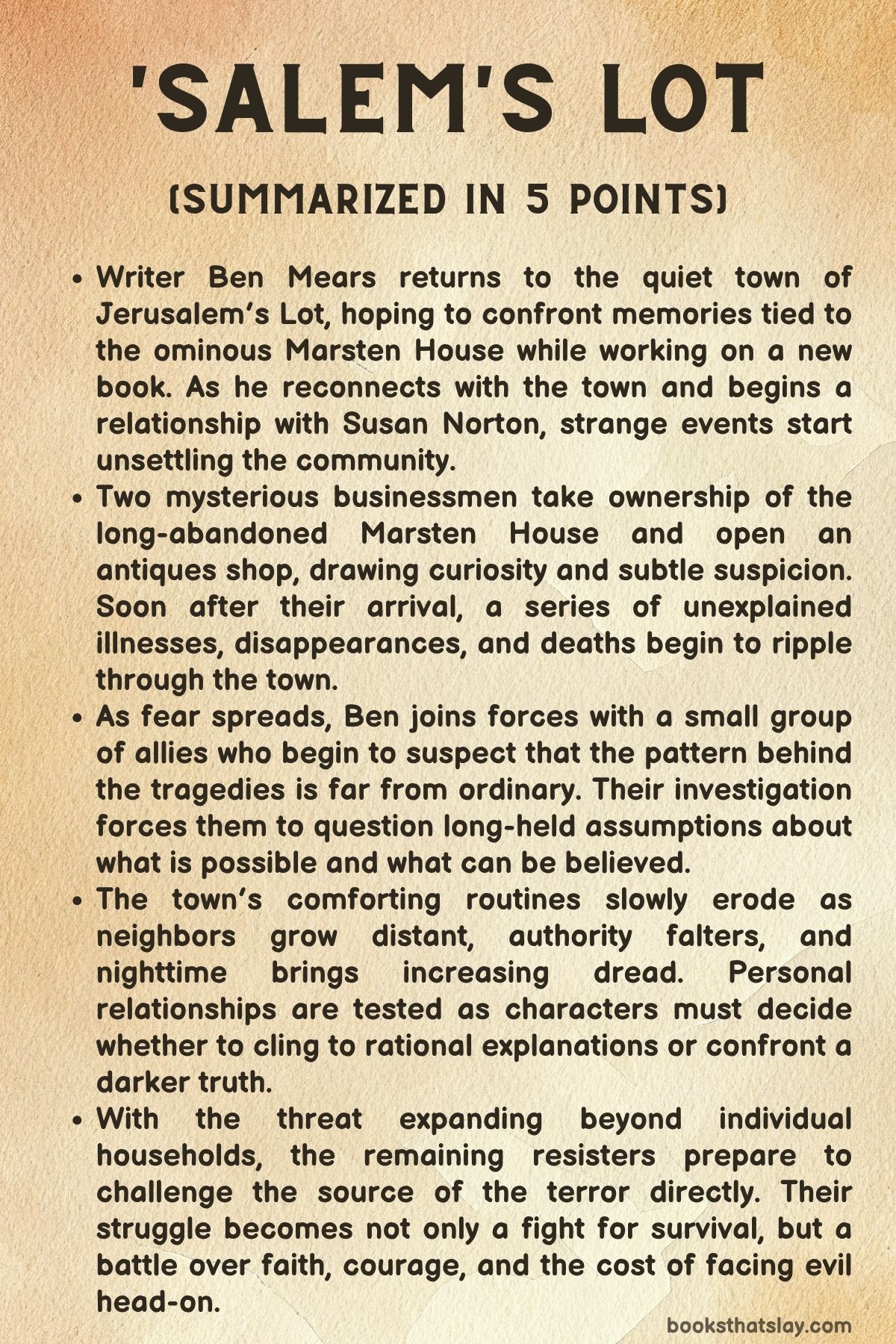
‘Salem’s Lot by Stephen King is a small-town horror novel set in Jerusalem’s Lot, Maine, where everyday life begins to rot from the inside after two strangers take an interest in the town’s most infamous landmark: the Marsten House. Writer Ben Mears returns after decades away, hoping the place will help him finish a new book and settle old fears.
Instead, children vanish, neighbors fall ill, and the town’s calm routines become cover for something hungry. As disbelief collapses under mounting evidence, a handful of people try to fight back with faith, stubborn courage, and the ugly knowledge that the enemy can wear familiar faces.
Summary
Ben Mears, a moderately successful author, returns to Jerusalem’s Lot in early September 1975 after twenty-five years away. He carries grief from his wife Miranda’s death and a private obsession with the Marsten House, a large, decaying place on a hill that has scared the town for decades.
As he drives in, he sees the house again and feels the same dread he felt as a child when he entered it on a dare and fled after seeing a terrifying figure in the upstairs room where the former owner, Hubert Marsten, died.
Ben tries to rent the Marsten House while he writes, but learns it has already been purchased. Around the same time, he meets Susan Norton, a young woman from town reading one of his novels in the park.
Their conversation is easy, and they quickly begin spending time together. Susan’s mother, Ann Norton, is wary of Ben, partly because Susan has been dating Floyd Tibbits and partly because Ben represents a wider world that Ann distrusts.
Susan, however, is drawn to Ben’s seriousness and his sense that the town has a shadow it refuses to name.
The town’s new excitement also centers on an antiques shop opened by Richard Straker, a polished, charming man who claims to be in business with a partner named Kurt Barlow. Straker’s manners win over many locals, but he keeps Barlow out of sight.
Behind closed doors, Straker is devoted to his unseen partner with a zeal that seems religious and cruel. Realtor Larry Crockett privately remembers how unusual the sale was: Straker and Barlow bought not only the Marsten House but also a defunct laundromat that becomes their shop, and the deal left Crockett feeling as if he had signed something he did not fully understand.
Then children begin to disappear. One night, brothers Danny and Ralphie Glick take a shortcut through the woods.
Something in the darkness takes them; Danny staggers home later, shocked and barely coherent, but Ralphie is gone. Searches turn up nothing.
The town tries to treat it like a tragedy that can be managed with searches, prayer, and time, but unease spreads. Straker arranges deliveries to the Marsten House, including a large crate that frightens the men who handle it.
In the Marsten House cellar, one of them sees what looks like a bundle of a child’s clothes, and the suggestion of Ralphie’s fate becomes impossible to ignore.
Soon after, Danny grows strangely ill and dies in the hospital with symptoms that doctors tentatively label as a form of anemia they cannot explain. The quick sequence—Ralphie missing, Danny dead—hits the Glick family and the town like a single blow.
At Danny’s funeral, his father collapses in grief, and Father Callahan, the local priest, tries to speak comfort over the coffin. The words about “new life” land with an eerie force no one understands at the time.
Ben grows closer to Susan, and in private he tells her that his new novel began as a story about the town but has turned into a story about the Marsten House and the kind of evil that can cling to a place. He has researched Hubert Marsten and learned disturbing details: Marsten had ties to violent crime, and children vanished during the years he lived in the house.
Ben admits that as a child he convinced himself the house held something alive inside it. Susan wants rational explanations and suspects Ben’s fear is old trauma returning in a new form.
Ben also befriends Matthew Burke, a high-school English teacher with a sharp mind and a growing dread about recent events. Matt listens to Ben’s story about the Marsten House and begins connecting it to what he has heard from a doctor friend, Jimmy Cody, about Danny Glick’s blood loss.
Matt’s imagination supplies a possibility he is embarrassed even to consider: vampires. He tries to argue himself out of it, but more signs appear.
The cemetery groundskeeper, Mike Ryerson, grows pale and sick and begins obsessively locking his doors and windows at night. Matt notices a mark on Mike’s neck that looks like a bite.
Matt offers Mike a safe place to sleep at his house. That night, Matt hears Mike upstairs speaking as if to welcome someone inside, then hears a window latch click and something feeding in the dark.
By morning Mike appears dead, yet the room’s details—especially the open window—do not make sense. Matt calls Ben in panic and tells him to bring a crucifix or some sort of holy token.
Ben arrives, and they confirm Mike has no pulse. When Jimmy Cody examines the body, he declares Mike dead, but the strange circumstances linger.
Matt and Ben decide they cannot report their suspicions without being dismissed, so they make a plan to watch the grave later, hoping to confirm what they fear.
The situation worsens before they can act. Floyd Tibbits attacks Ben in jealousy, beating him badly enough to land him in the hospital.
While Ben is recovering, more people fall into the same unnatural decline: bodies are found not breathing but not yet decomposed, and then those bodies vanish. The town’s routines continue, but with holes appearing in them—missing workers, dark houses, and people who will not answer their doors.
Meanwhile, Danny Glick returns as a predator. A mother in a trailer park loses her baby, and whispers spread about pale figures in windows and scratching sounds at night.
Susan still struggles to accept the vampire explanation, but her certainty breaks when she hears the inhuman voice of Mike Ryerson after he rises and confronts Matt. Matt drives the creature away with a crucifix, but the shock triggers a heart attack that lands him in the hospital.
Now Susan has heard enough to believe, even if she hates believing it.
A key witness emerges in an unexpected form: Mark Petrie, a brave and stubborn boy who recently moved to town. Mark is targeted in his bedroom by Danny Glick, who scratches at the window and calls to be let in.
Mark feels a powerful pull to obey, but he grabs a cross-shaped object from his monster display and uses it as a weapon. When Danny forces his way inside, the cross burns Danny’s flesh and drives him away.
Mark’s survival gives the adults proof that belief and resistance matter.
Ben and Susan visit Matt in the hospital. Matt, too weak to act directly, assigns roles: he will research and plan; Ben and Susan will bring Jimmy Cody into their circle; they must also recruit Father Callahan, who can supply holy authority and tools.
Jimmy Cody, confronted with the pattern of strange deaths and missing bodies, admits that medicine has limits and agrees to help investigate. He arranges a night at a funeral parlor to watch over the body of Margie Glick, Danny’s mother, who has died after growing increasingly intolerant of sunlight.
At the funeral parlor, Margie rises as a vampire and attempts to feed. A makeshift cross glows in Ben’s hand and drives her back, but she escapes, leaving Jimmy shaken and injured.
The group now knows the threat is spreading and that time is running out.
Susan, frustrated by delays and terrified that inaction will mean more deaths, decides to act on her own. She approaches the Marsten House with a crude stake, thinking that confronting the source directly is better than waiting.
Mark Petrie intercepts her; he has been investigating too. Together they break into the house and discover how deep the rot goes.
Inside, they find evidence of ritual and cruelty, including a disturbing book and signs that the cellar is the heart of the danger. Their intrusion fails when Straker returns, realizes Susan’s car has betrayed her presence, and knocks them unconscious.
Susan is taken to the cellar to be offered to Barlow. Mark is restrained upstairs but manages to free himself and attack Straker with an improvised weapon, knocking him out.
Mark then faces the worst choice of his life: flee or try to save Susan. He goes for her, but hears the moment Barlow claims her.
Mark escapes, but Susan is lost.
Afterward, Susan returns to Mark’s window as a vampire, begging to be invited in and trying to tempt him with the promise that the change is pleasant. Mark refuses, seeing misery behind her beauty.
Her visit confirms the enemy’s tactic: it uses love, familiarity, and longing as tools.
Ben, devastated by Susan’s fate, joins forces with Mark, Jimmy Cody, and Matt’s guidance from the hospital. They bring Father Callahan into the truth.
Callahan is shaken but also stirred by the idea that the battle may be real and not merely metaphor. The group prepares to strike at the Marsten House in daylight.
When they enter, they find Straker dead and displayed as punishment for his failure. In the cellar, they find a taunting letter from Barlow, who has moved to a new hiding place for the day.
Barlow has also left Susan behind as bait and mockery. Ben, forced to accept what she has become, drives a stake into Susan’s heart, and the act breaks him.
The war becomes personal and chaotic. Barlow attacks Mark’s home, killing Mark’s parents.
Callahan confronts Barlow with a cross, but Barlow challenges the priest’s faith directly. Callahan hesitates, and in that hesitation the power drains from the symbol in his hand.
Barlow demonstrates that without belief, the tools are empty. He forces Callahan into a blasphemous communion by making him drink vampire blood.
Afterward, Callahan discovers the church itself rejects him; he cannot enter, and he flees town in disgrace and terror.
Now only Ben and Mark remain. Jimmy Cody dies in a trap laid by vampires in Ben’s boardinghouse basement, and Matt Burke dies of a second heart attack at the hospital.
The town is collapsing into silence and darkness, with many residents already converted and hidden in basements, barns, and crawlspaces, waiting for night.
Ben and Mark focus on one goal: find Barlow in daylight and destroy him. Clues lead them back to Ben’s boardinghouse, where they discover a sealed, newly padlocked cellar space.
With holy water and sheer resolve, Ben breaks in and finds Barlow’s coffin. The boardinghouse’s victims lie between them and it, a grim reminder of what the town has become.
They haul the coffin out. As sunset approaches, they open it and find Barlow awake, staring.
Mark is caught in Barlow’s hypnotic control and nearly turns a gun on Ben, but Ben knocks Mark unconscious and fights alone against time. He scrambles for the stake and hammer, and as darkness arrives and Barlow begins to rise, Ben manages to drive the stake home.
Barlow withers into dust, and something in the air seems to release, as if a pressure has lifted.
Ben and Mark escape the town, but the victory is incomplete. Without Barlow, the remaining vampires still exist, scattered through Jerusalem’s Lot and the surrounding area.
Ben returns once to bury the dead and sees that the town is truly finished. Over the following months, reports continue of disappearances, livestock killed, and fear spreading outward.
Ben and Mark keep moving, trying to survive and plan a final cleansing.
In the end, they decide they must go back. They return with holy water blessed far from Maine and set fire to the brush leading toward the Marsten House.
They know burning one building will not erase every vampire, but they also know fire destroys hiding places and forces the enemy into the open. Their fight is no longer about saving the town—it is about stopping the infection from traveling farther.
The flames begin to creep toward the house on the hill, and Ben and Mark prepare to continue the hunt.
Characters
Ben Mears
Ben is a man trying to turn fear into something useful. He comes back to Jerusalem’s Lot believing he can face the Marsten House on his own terms—use it for a book, use it to settle an old terror, use it to prove he has control over the past.
That belief collapses as soon as the town’s troubles start matching the shape of his memories. What defines Ben isn’t bravery as a natural trait, but bravery as a decision he keeps making while afraid.
His grief for Miranda sharpens his guilt and makes him quick to blame himself for the harm that reaches people close to him, especially Susan and later Mark. As the threat becomes real, Ben shifts from observer to participant: the writer who once watched human behavior for material becomes someone who must act, even when action means doing something he cannot emotionally survive in any clean way.
By the end, his sense of duty is stripped down to a single stubborn rule—evil has to be met, not explained.
Mark Petrie
Mark is the clearest example of courage in the story because he refuses to bargain with disbelief. He has a child’s directness, but he’s not childish; he processes danger fast, trusts what he sees, and adapts.
Where many adults keep looking for “reasonable” answers long after the evidence has turned unreasonable, Mark accepts the rules of the threat and works within them. That’s partly because his imagination is trained by monster media, but the important part is his discipline: he doesn’t freeze when the horror tries to hypnotize him, and he doesn’t romanticize what he’s facing.
Mark’s confidence can look like arrogance, yet it’s really a survival strategy—clarity is how he stays alive. Once his parents are killed, he becomes emotionally older in an instant, but he doesn’t become numb.
His bond with Ben forms because Mark needs an adult who will treat the truth seriously, and Ben needs someone whose belief doesn’t wobble. Their partnership becomes a substitute family built out of necessity and trust.
Susan Norton
Susan begins as someone who wants a larger life than the town offers, but she still thinks the world is basically explainable and that danger has boundaries. Her relationship with Ben is attractive partly because he represents escape and possibility, yet she also resists being guided by his fears.
Susan’s skepticism is not stupidity; it’s her way of staying in charge of her own mind. The tragedy is that her desire to reclaim control pushes her into the worst possible gamble—going to the Marsten House alone.
She acts from a mix of frustration, pride, and genuine concern, and she underestimates how quickly the situation has moved beyond ordinary risk. After she is turned, the story uses her to show how the vampire presence corrodes love by copying it: her beauty becomes more intense but less human, and her attempt to lure Mark at the window carries both predatory purpose and a trace of personal suffering.
Susan’s arc is one of lost agency—first she fights to keep it, then it’s taken from her in the most absolute way.
Richard Straker
Straker is the novel’s face of cultivated evil: polite, orderly, persuasive, and entirely ruthless. He understands how to use a small town’s social habits—gossip, admiration for refinement, suspicion of outsiders—to build cover for what he and Barlow are doing.
His charm isn’t warmth; it’s a tool he deploys with precision, especially on women in town and on people who want to feel included in something “classy.” Under the surface is a deep cruelty and a kind of devotional zeal. Straker behaves less like a partner and more like a servant carrying out a sacred assignment, and that servitude gives him confidence—he thinks history is on his side.
His end also reveals the hierarchy at the heart of the threat: he is dangerous, but he is still disposable. When he fails, he is punished without sentiment, which exposes how little human loyalty matters in the world he chose.
Kurt Barlow
Barlow is not just a killer; he is a force that reorganizes a community around fear and hunger. Unlike Straker’s social manipulation, Barlow’s power is direct and ancient in its logic—dominate, feed, multiply.
He understands people quickly, not in a compassionate sense, but in the way a predator understands prey. He uses temptation, grief, and doubt, and he enjoys the moment when a person realizes the rules have changed.
His confrontation with Father Callahan highlights Barlow’s real weapon: not strength alone, but the ability to turn belief into weakness by forcing a crisis of faith. Barlow’s choices are strategic—he relocates, leaves messages, sets traps, and treats the town like territory to be converted rather than merely hunted.
Even when he is destroyed, the damage he has done keeps moving on its own, which makes him feel larger than a single body. He represents contagion: once he arrives, the town’s private ugliness and passivity become fuel for a disaster that spreads.
Matthew Burke
Matt is the story’s mind at work under pressure. He begins as an intelligent, skeptical teacher who knows literature well enough to recognize the vampire pattern, but he resists believing it because belief would demand action and would make him sound insane to everyone else.
What makes him valuable is that he doesn’t stop at naming the monster—he turns recognition into planning. His role becomes that of organizer and interpreter: he gathers clues, assigns tasks, and helps others move from panic to purpose.
Matt’s heart attack is not just a plot event; it mirrors what the truth does to ordinary life. His body cannot handle the stress of the reality he has uncovered, yet his mind stays committed.
Even from a hospital bed, he tries to keep the group focused on method rather than desperation. His death strips the remaining characters of structure and forces Ben and Mark to act without guidance, underlining how fragile resistance can be when it depends on one person’s steadiness.
Father Donald Callahan
Callahan enters as a priest worn down by the smallness of his parish and by a modern sense that evil is mostly human weakness. He wants to believe in something absolute again, but he’s also cynical and tired, and that inner split becomes his weakness.
When the vampire crisis emerges, it offers him what he secretly craves: proof that the battle between good and evil is real in a way that demands a church response. Yet Callahan’s faith is more complicated than his job title suggests.
He carries doubt, habit, and a longing for certainty, and Barlow exploits that by forcing a moment where symbols only work if belief is whole. Callahan’s collapse is devastating because it isn’t presented as cowardice; it’s presented as a human failure under a pressure designed to break him.
Afterward, his rejection by his own church is a brutal externalization of his internal shame. He becomes a man exiled from the role that once defined him, living with the knowledge that faith can be tested and found wanting.
Jimmy Cody
Cody represents practical decency confronted with the impossible. As a doctor, he is trained to trust evidence and procedure, and what he encounters in the Lot breaks the categories he relies on.
His willingness to listen is what makes him essential; he doesn’t accept the vampire explanation because it’s exciting, but because the facts keep refusing to fit ordinary medicine. Cody’s courage is quiet and professional—he helps because people are dying and because it’s his nature to step toward emergencies.
He also shows how thin the line is between rationality and superstition when the world changes: he can call medical science “white magic” not as a joke, but as an honest admission of uncertainty. His death is especially grim because it comes through planning and ambush, a reminder that goodness and competence are not protection.
Cody’s presence raises the stakes by showing that even the most grounded adult can be pulled into the fight and still be lost.
Larry Crockett
Crockett is a portrait of moral compromise that feels ordinary rather than dramatic. He is a businessman who convinces himself that a profitable deal is just business, even when his instincts warn him something is wrong.
His transaction with Straker and Barlow carries the shape of a bargain he doesn’t want to name, and he tries to bury his discomfort under routine and self-justification. Crockett isn’t a supernatural villain; he’s the type of man who helps evil move into town by looking away at the crucial moment.
He also shows how corruption can be passive—he doesn’t need to worship Barlow to be useful to him. Once the town begins collapsing, Crockett’s earlier choices look less like harmless opportunism and more like opening a door that cannot easily be shut.
Parkins Gillespie
Gillespie is the local lawman trapped inside the limits of normal thinking. He notices patterns, follows procedure, and tries to keep order, but he is working with assumptions that the enemy does not share.
His investigation touches the right places—background checks, interviews, checking alibis—yet the real cause is outside his training. Gillespie’s tragedy is that he isn’t incompetent; he is simply equipped for a world where crimes have human motives and human methods.
As bodies vanish and witnesses refuse to speak, the town’s institutions start failing, and Gillespie becomes a symbol of that failure. His presence highlights how easily authority becomes irrelevant when it cannot even name what it is facing.
Nolly Gardner
Nolly functions as the town’s eyes and ears, the deputy who hears the talk and watches the small shifts in behavior. He embodies the communal instinct to interpret life through gossip and local history, and that instinct is both useful and limiting.
Nolly can sense when something is off, but he also lives inside the town’s social web, where admitting the truth would be socially and psychologically costly. He helps show how a community can notice danger and still avoid confronting it directly, because direct confrontation would mean admitting that the familiar world has become unsafe.
Eva Miller
Eva, the owner of the boardinghouse where Ben stays, represents a kind of grounded kindness. She’s not heroic in the conventional sense, but she offers stability and care in a town that is sliding toward paranoia and silence.
Her home becomes a central space where ordinary routines—meals, conversations, tenants coming and going—continue even as the threat grows, which makes the later invasion of that space feel especially violating. Eva’s role emphasizes what is being lost: the possibility of neighborly life that isn’t shaped by fear.
Ann Norton
Ann is a controlling parent whose idea of safety is tightly tied to predictability and social approval. She is suspicious of Ben not only because he is older and worldly, but because he disrupts the script she has imagined for Susan’s future.
Her attitude shows how small-town respectability can be its own kind of cage, built from expectation rather than affection. Ann’s vulnerability is that she can be charmed by the appearance of refinement, which helps explain why Straker’s polish works so well in the Lot.
She illustrates how people can mistake manners for goodness, and how that mistake becomes dangerous.
Floyd Tibbits
Floyd is jealousy without self-control, a man whose identity depends on possession and status. His attack on Ben isn’t just romantic rivalry; it’s a violent attempt to reassert dominance in a situation where he feels replaced and humiliated.
Floyd’s later fate also shows how quickly human ugliness becomes irrelevant once the supernatural threat takes over. He begins as a local problem—an angry man with a temper—and ends as another body in the larger pattern.
His arc underlines how the town already contains violence and cruelty before the vampires arrive, which makes it easier for disaster to take root.
Danny Glick
Danny is one of the first transformations that forces the town’s horror into focus. As a boy, he represents innocence in a simple, recognizable form, and his conversion turns that innocence into a weapon.
What makes Danny frightening is not only what he does, but how he does it: he uses a familiar voice and a child’s face to ask for entry, turning trust into a trap. His presence at Mark’s window shows the vampire method clearly—permission matters, weakness can be exploited, and love or sympathy can be used as leverage.
Danny becomes a marker for the town’s point of no return.
Ralphie Glick
Ralphie’s disappearance is the wound that never closes for the town, because it begins as a missing-child tragedy that everyone understands and then becomes something no one wants to imagine. Even when the truth becomes clearer later, Ralphie’s role remains that of the first taken, the sacrifice that signals the new order being established.
He represents how the horror starts quietly, before the town has language for it, and how denial can flourish in the gap between fear and proof.
Mike Ryerson
Mike is one of the first adults whose change is witnessed closely enough to remove all doubt. His slow decline—fatigue, fear of night, obsessive locking of doors—resembles illness at first, which makes it easy for others to rationalize.
His turning is terrifying because it happens within domestic space, in a borrowed bedroom, under the care of someone trying to help. When he rises, Mike becomes an example of how the vampires steal not only lives but also the sense of safety inside friendship and hospitality.
His threat to Matt is personal, and it helps push Matt from speculation into certainty.
Dud Rogers
Dud is a minor figure whose importance comes from what his disappearance signals: the town’s margins are being consumed too. He lives close to the dump, in a space associated with refuse and isolation, which makes him an easy target and an early sign that something is hunting at night.
Dud’s fate shows how the vampires expand their control by picking off people who are less protected by community attention.
Sandy McDougall
Sandy appears as a snapshot of exhausted, overwhelmed young parenthood, and that snapshot matters because it shows the town’s strain before the supernatural threat fully takes center stage. Her anger and desperation are human and ugly, and they suggest how fragile care can be under poverty, isolation, and stress.
When her baby becomes a victim later, the earlier scene makes the loss feel harsher, because it happens in a household already cracking. Sandy’s presence reinforces the idea that the town’s suffering has ordinary roots that the vampires then exploit.
Randy McDougall
Randy is presented as helpless life in its most basic form, and his death is one of the moments that makes the horror feel completely unbounded. He isn’t part of any feud or choice, and he cannot defend himself, which makes what happens to him feel like proof that no moral logic will protect the innocent.
Randy’s role is brief, but it intensifies the sense that the town is being emptied by a predator that does not discriminate.
Tony Glick
Tony embodies raw parental grief and the refusal to accept loss. At the funeral, his breakdown exposes how fragile the town’s social calm really is.
His pain is also a kind of protest against the unnaturalness of what is happening, even though he cannot name it. Tony’s presence emphasizes the human cost behind the vampire pattern: every conversion and disappearance leaves behind people whose minds keep demanding explanations that reality will not provide.
Themes
The Corruption of the American Small Town
Jerusalem’s Lot presents itself as an insulated, almost preserved community—quiet streets, familiar faces, inherited houses, and a shared sense of history. That surface calm creates the illusion that nothing truly catastrophic could happen there.
In ‘Salem’s Lot, the town is not destroyed by an invading force so much as exposed. The arrival of Barlow and Straker does not introduce evil into a pure environment; instead, it activates what was already dormant.
The novel repeatedly shows that the town is filled with quiet resentments, petty cruelties, infidelities, greed, and emotional neglect. These flaws may seem minor compared to vampirism, but they form the soil in which the supernatural threat takes root.
The vampires do not conquer through open warfare. They convert.
That slow infection mirrors how moral compromise already functions in the town. Larry Crockett justifies questionable business decisions.
Neighbors gossip but avoid direct confrontation. Parents misunderstand or dismiss their children’s fears.
Authority figures rely on routine even when routine fails. The town’s decline feels almost inevitable because it is built on complacency.
When people begin disappearing, most residents prefer rational explanations over unsettling possibilities, even when evidence mounts. The refusal to imagine something monstrous allows the monster to multiply.
By the time the majority of the town has been turned, daily life continues in fragments. People rise, go to work, and maintain habits while others sleep in basements and barns, transformed.
This split existence reflects a deeper truth: the community was already divided between appearance and reality. The novel suggests that evil thrives where people value comfort over truth.
The vampires simply make literal what was metaphorical all along—the town was spiritually drained before it was physically consumed.
Faith, Doubt, and the Power of Belief
Belief in ‘Salem’s Lot is not abstract; it has measurable consequences. The effectiveness of crucifixes, holy water, and ritual depends not on the objects themselves but on the conviction behind them.
This is most clearly demonstrated in Father Callahan’s confrontation with Barlow. The priest represents institutional religion, yet his personal faith is unstable.
He longs for a clear embodiment of good and evil, but when confronted with one, his doubt surfaces. In that hesitation, the cross loses its power.
The novel presents belief as something that must be active and whole; symbols without conviction are inert.
This theme extends beyond organized religion. Mark Petrie’s survival against Danny Glick reveals that belief does not need to be traditional to be effective.
Mark does not carry theological certainty; he carries unwavering acceptance of what he has seen. His confidence in the reality of vampires gives strength to the cross he wields.
In contrast, adults who cling to rational explanations for too long place themselves at risk. The narrative suggests that the refusal to believe in the face of evidence can be as dangerous as blind superstition.
At the same time, the novel does not offer simple reassurance that faith guarantees victory. Callahan’s fall demonstrates that belief can falter under pressure.
The horror lies not only in physical danger but in spiritual vulnerability. Evil challenges identity and conviction at their core.
The struggle becomes internal as much as external. By linking supernatural survival to psychological certainty, the story frames faith not as ritual performance but as moral clarity under threat.
Isolation and the Failure of Community
Despite the apparent closeness of small-town life, many characters operate in isolation long before the vampires take over. Marriages are strained, children are misunderstood, and individuals carry private shame or frustration.
This emotional separation becomes critical once the threat emerges. Characters who suspect something is wrong hesitate to share their fears because they anticipate ridicule or disbelief.
That hesitation fragments resistance.
Ben, Matt, and Susan form a small alliance because they choose to trust one another with uncomfortable truths. Their cooperation stands in contrast to the broader town, where communication is limited by pride, embarrassment, or social expectation.
Even law enforcement and medical professionals struggle to coordinate effectively because their frameworks for understanding events differ. The vampires exploit this fragmentation.
They operate at night, in private spaces, targeting individuals one by one rather than confronting groups.
The transformation process intensifies isolation in a literal sense. Victims withdraw from daylight and from ordinary interaction.
Families watch loved ones grow pale and distant but cannot fully articulate what is happening. When those individuals rise as vampires, they return alone to windows and doorways, asking to be invited inside.
The threshold becomes symbolic: entry requires permission, and permission is granted individually. There is no collective defense mechanism.
By the end, organized resistance has dwindled to two people. The collapse of community becomes complete.
The novel suggests that shared belief and open communication might have slowed the spread, but secrecy and denial accelerate it. Isolation becomes both a symptom and a cause of destruction.
The Persistence of Evil and the Limits of Victory
The destruction of Barlow might appear to signal triumph, yet the ending of refuses clean resolution. The town is not restored.
Many vampires remain scattered, and the infection spreads beyond its original borders. This outcome reframes the conflict: evil is not a single entity to be eliminated but a condition that replicates and survives.
Barlow’s death does not undo the transformations already completed. Former neighbors remain predators.
Buildings still stand as reminders of what occurred. The Marsten House, long associated with corruption, symbolizes how places can absorb and preserve malevolence across decades.
Even when burned, its influence lingers. The narrative implies that certain environments accumulate darkness through repeated acts of cruelty, and those accumulations are not erased easily.
Ben and Mark’s decision to continue hunting reflects an acceptance of unfinished work. Their task is not heroic in a celebratory sense; it is exhausting and indefinite.
The novel avoids presenting good as overwhelmingly dominant. Instead, good is stubborn, fragile, and sustained through effort.
Victory requires continual vigilance.
This theme also interacts with personal loss. Destroying Susan as a vampire does not restore her humanity; it only prevents further harm.
Justice and healing are not identical. The emotional damage persists even after the physical threat is reduced.
The story’s final image of fire moving toward the Marsten House captures both hope and uncertainty. Purification may begin, but it does not promise completeness.
Evil can be fought, but it cannot be dismissed as temporary or simple.