I See You’ve Called in Dead Summary, Characters and Themes
John Kenney’s novel, I See You’ve Called in Dead, is a tragicomic examination of mortality, grief, friendship, and the ordinary choices that shape a life. It follows an obituary writer who accidentally publishes his own death notice and is forced to confront how little he has participated in his existence since his marriage collapsed.
Through awkward funerals, unexpected relationships, neighborhood gatherings, and devastating personal loss, the book argues that remembering death should not produce despair. Instead, awareness of life’s limits can encourage honesty, attention, generosity, and the courage to love people while they are still present.
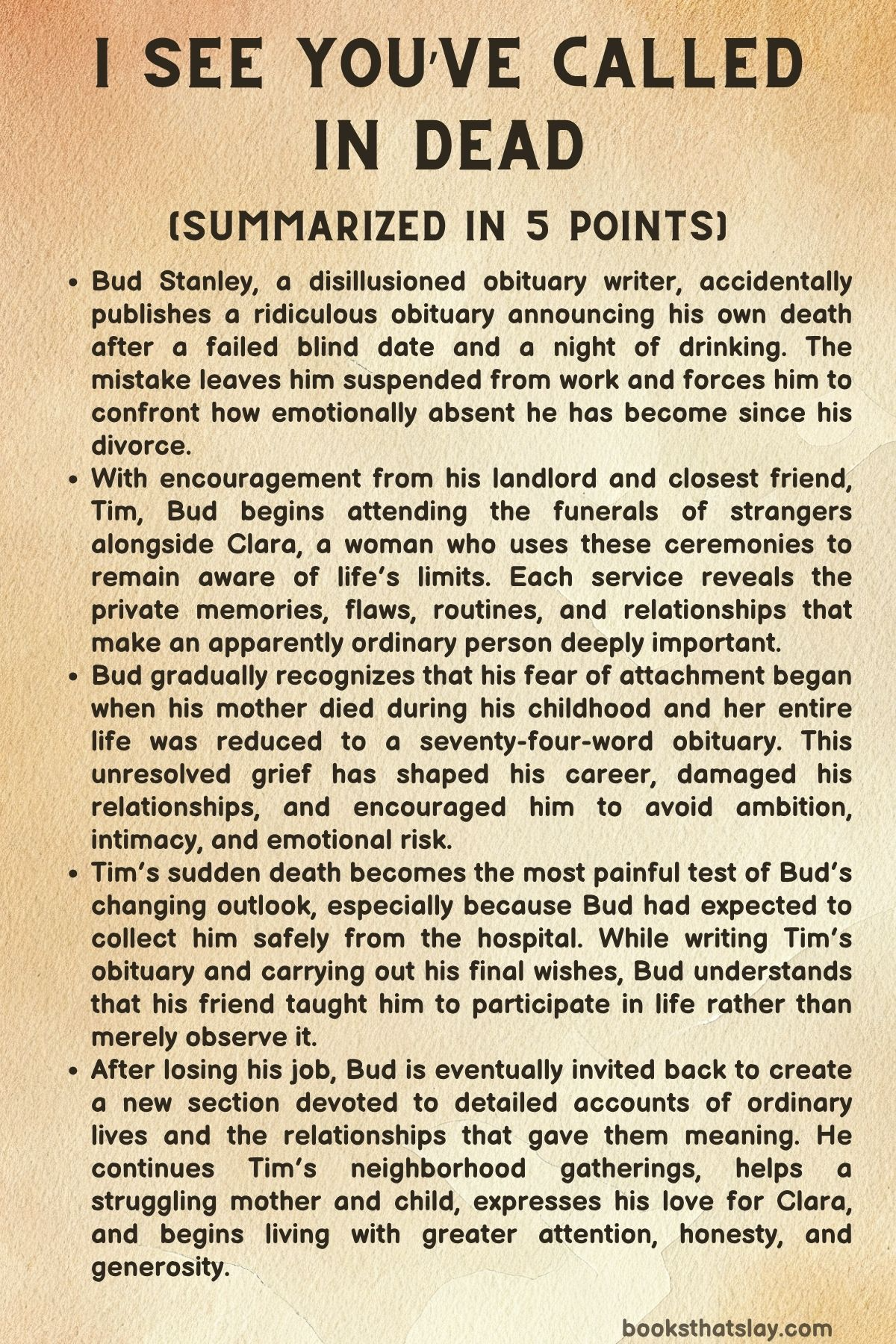
Summary
Bud Stanley is a forty-four-year-old obituary writer whose professional understanding of death has not helped him understand how to live. He has written hundreds of accounts of other people’s lives, but his own existence has narrowed into work, alcohol, online distraction, loneliness, and memories of the marriage that ended two years earlier.
At the beginning of the year, Bud makes ambitious resolutions involving health, travel, reading, romance, and personal improvement. Almost immediately, he abandons them, reinforcing his belief that meaningful change is possible for other people but not for him.
His coworker and closest office friend, Tuan, arranges a blind date with a woman named Diane. Bud arrives at a Brooklyn bar with flowers and briefly invents an elaborate future with an attractive stranger, only to discover that she is Diane and has arrived to explain that she has reunited with her former boyfriend.
The boyfriend is waiting outside and soon enters the bar. Humiliated, Bud pretends that the flowers were intended for the bartender, makes several uncomfortable jokes, and watches Diane leave with the man she has chosen over him.
Bud returns to his nearly empty apartment and begins drinking whiskey. An email from his former wife, Jen, informs him that her mother, Judy Bennett, has died and invites him to the wake because Judy had always liked him.
The attached obituary also reveals that Jen now has a young daughter named Chloe. Confronted with evidence that Jen has created a complete new life while he has remained emotionally suspended, Bud begins composing a ridiculous obituary for himself.
In the false account, Bud becomes an accomplished musician, performs surgery on himself, marries several women, and achieves various impossible feats. While intoxicated, he places the joke inside the protected publication system used by his employer and accidentally sends it through an international news service.
The next morning, Bud discovers that the world believes he is dead. His professional profiles contain condolences, his brother calls from China, his building pass has been cancelled, and the company’s computer records identify him as deceased.
At the office, his coworkers react as though they have seen a ghost. Tuan reads the absurd obituary aloud and enjoys Bud’s embarrassment, but he also understands that the incident may end Bud’s career.
Human Resources suspends Bud, confiscates his identification, and disables his accounts. His boss, Howard Ziffle, then meets him at a nearby bar and explains that Bud may face dismissal, legal action, and permanent exclusion from journalism.
Howard’s anger is intensified by his personal history with Bud. Years earlier, when Howard’s wife Emily died of cancer, Bud drove him to the hospital, wrote Emily’s obituary, and supported him through the first period of grief.
Howard believes Bud has stopped caring about his subjects and therefore lost the quality that once made him a gifted obituary writer. He tells Bud that remembering death can make life appear extraordinarily valuable and orders him to wake up before he wastes what remains of his time.
Bud confesses the situation to Tim Charvat, his landlord and closest friend. Tim uses a wheelchair following a traffic accident, yet he has built a socially rich existence around artists, musicians, writers, neighbors, gatherings, and acts of generosity.
Tim does not accept Bud’s claim that he is simply waiting for the company investigation to finish. He sees that Bud has been waiting for years, observing his own life rather than making choices within it.
Bud attends Judy Bennett’s wake and sees Jen for the first time since their divorce. Their marriage had begun with excitement and promise, but a miscarriage created an emotional distance they could not repair, after which Jen resumed a relationship with an Englishman named Ben and left Bud.
At the wake, Bud meets Clara, a mysterious woman who admits that she sometimes attends the funerals of strangers. She believes these ceremonies contain lessons about living and invites Bud to attend the funeral of Dr. Samuel Gauss.
Bud and Tim go to the service, where the priest repeatedly uses the wrong name and Mrs. Gauss publicly describes her husband as an unfaithful and difficult man. Clara appears afterward and sends them to another wake, beginning a series of encounters with strangers’ deaths.
The funerals are often uncomfortable, comic, and unpredictable. At a Polish wake for Jan Kaminski, Bud accidentally offers the family his horse instead of delivering a traditional condolence, yet the mistake helps him connect with the mourners rather than remaining a detached observer.
Clara explains that she once worked in finance and private equity, where ambition, money, a destructive affair, and emotional isolation contributed to severe depression. After receiving treatment, she began attending funerals to remind herself that life is occurring in the present rather than at some future stage when everything is finally secure.
Clara takes Bud swimming in the freezing spring ocean. The cold frightens and hurts him, but it also makes him feel intensely awake, and their conversation afterward becomes one of the first occasions on which he speaks openly about his failed marriage, his mother’s death, his career, and the false obituary.
Bud’s relationship with Tim also becomes increasingly important. Through Tim, he sees how a person can respond to limitation not by denying suffering but by continuing to create relationships, experiences, and opportunities for other people.
Tim challenges Bud to spend a day using a wheelchair, exposing the physical barriers, exhaustion, planning, staring, pity, and humiliation that Tim faces during ordinary activities. The experiment gives Bud only a small understanding of Tim’s life, but it also reveals how much strength lies behind his apparent ease.
Bud’s seven-year-old neighbor Leo offers another perspective on fear and mortality. Leo records facts in notebooks and performs obsessive rituals because he worries that failing to complete them might cause a meteor to destroy the world.
Bud treats Leo seriously and does not mock his fears. In return, Leo speaks to him with unusual honesty, explaining that his deceased sister Lucy remains alive inside the thoughts of those who remember her and that even a mayfly’s single day constitutes an entire lifetime.
As Bud attends more funerals, individual deaths begin to affect him. The wake of Molly Donnelly and her six-year-old son Eddie transforms an accident he had previously ignored online into the destruction of two specific lives filled with routines, jokes, photographs, affection, and expected tomorrows.
The funeral of Ava Gutierrez produces an especially direct message. Ava’s father says that she did not want to die because she genuinely valued her life, and he urges the mourners to stop postponing the words and actions they consider important.
After the service, Tim presses Bud to discuss the death of his mother. Bud responds with anger, accusing Tim of being preachy and self-satisfied, while Tim tells him that he treats life as a spectator sport because participation would expose him to additional loss.
Bud eventually confronts the memory he has avoided. His mother, Louise, died when he was twelve after a brief illness, and the adults around him failed to explain clearly what was happening.
Bud and his brother accidentally witnessed efforts to revive her. At the wake, he touched her cold arm and emotionally withdrew from a world that continued functioning as though the most important person in his life had not disappeared.
Louise’s obituary contained only seventy-four words and omitted the gestures, habits, humor, warmth, and private details that made her his mother. Bud recognizes that his career began partly as an attempt to correct that injustice by proving that ordinary people deserved to be remembered fully.
He apologizes to Tim, and both men acknowledge the pain behind their argument. Tim reveals that after his accident he abused alcohol and drugs, mistreated people, and attempted to destroy himself before his family and friends helped him rebuild.
Bud admits that he fears death because he is uncertain whether he has ever truly lived. Tim explains that the only way to reduce fear is to face it directly, which is why their attendance at funerals matters.
Meanwhile, Bud and Clara become emotionally closer, but Clara reveals that she will soon leave for Bhutan to teach for a year and study the country’s concept of Gross National Happiness. Bud is hurt, yet he decides that five remaining days can still contain meaningful experiences.
Leo’s birthday becomes a large neighborhood block party. His family releases a balloon for Lucy, while Bud, Clara, and Tim later take a helicopter flight over New York, giving Tim the rare experience of leaving his wheelchair behind and seeing the city from above.
That evening, Tim suddenly collapses and is taken to the hospital with deep vein thrombosis. He jokes with the nurses, identifies Bud as family, and appears likely to be released the next morning.
Bud plans to collect him but stops to buy Tim’s favorite pizza and root beer. During that short detour, Tim suddenly dies, leaving Bud to identify the body in the hospital morgue while the city continues its ordinary activities outside.
Tim’s death destroys the emotional distance Bud had maintained around mortality. He forces his way into the office to write the obituary, where Tuan has already begun drafting it and Howard allows Bud to complete the work.
At the funeral, Bud explains that Tim taught him how to live by refusing to treat suffering as a reason to stop participating. Louisa later gives him a letter in which Tim says that Bud also saved him, leaves him the house, and asks him to continue the salon, help another struggling tenant, and make a sincere effort to be happy.
Bud is eventually dismissed from United World Press. During his disciplinary hearing, however, he accepts responsibility for the false obituary while arguing that the company’s approach to death has become impersonal and inadequate.
He insists that obituary writers must meet families, attend wakes, listen to memories, and understand why a supposedly ordinary life mattered. Facts are necessary, but they cannot communicate the full meaning of a person’s existence.
Before Clara leaves for Bhutan, Bud finally tells her that he loves her. She responds that she loves him as well, allowing their separation to be defined by honesty instead of another unspoken regret.
During the months after Tim’s death, Bud grieves through walking, running, reading, maintaining Tim’s home, listening to old messages, and spending time with Tuan. He gradually accepts that returning to life does not require forgetting the dead.
Bud moves into Tim’s apartment and rents his old home at a greatly reduced price to Mariel, a hotel cleaner studying for her GED, and her son William. By doing so, he fulfils Tim’s request to offer another struggling person the opportunity Tim once gave him.
Howard later invites Bud back to establish a new feature called Life Stories, devoted to detailed accounts of extraordinary ordinary people. Bud insists that Tuan join the project and begins his first assignment by listening for hours to a widow describe fifty-seven years of marriage.
The widow’s most meaningful memory is not a public achievement but the glass of water her husband placed beside her bed every night. Bud finally understands that a life is preserved through such acts of attention, and he returns to obituary writing with renewed purpose.
He still cannot explain death, but he no longer believes understanding it is necessary before one can live. Every morning offers another opportunity to create a life worth remembering, and every person is writing that account through choices made before the ending arrives.
Characters
Bud Stanley
Bud Stanley is the narrator and central consciousness of I See You’ve Called in Dead, and his accidental obituary reflects the emotional condition in which he has been living. Although physically alive, he has withdrawn from ambition, intimacy, curiosity, and hope, allowing disappointment to turn temporary grief into a permanent identity.
His humor serves both as a talent and a defense mechanism. Bud can recognize absurdity in funerals, corporate bureaucracy, failed dates, family conflicts, and even his own pain, but he often uses jokes to prevent other people from reaching the feelings beneath them.
His work as an obituary writer gives him an unusual relationship with mortality. He knows facts about death and has spent years reducing lives to carefully written paragraphs, yet repeated exposure has made him emotionally distant from the individuals behind those facts.
Bud’s professional decline begins after Jen leaves him, but the deeper origin of his withdrawal is his mother’s death. Witnessing Louise’s final moments at twelve teaches him that love can disappear suddenly and that the world will continue regardless of personal devastation.
The seventy-four-word obituary written for Louise becomes a hidden source of both anger and purpose. Bud enters obituary writing because he wants ordinary people to receive the recognition his mother was denied, but he eventually forgets that motivation and begins treating the dead as assignments.
His false obituary therefore functions as more than a drunken mistake. It publicly declares his death at the exact moment when his emotional life has reached a state of suspension, forcing institutions, friends, relatives, and Bud himself to examine whether he has been living meaningfully.
Bud’s development occurs through relationships rather than solitary revelation. Tim challenges his passivity, Clara teaches him to remain present with discomfort, Tuan demonstrates loyalty without sentimental language, Leo offers direct observations about fear, and funeral mourners transform anonymous deaths into individual lives.
He does not become fearless or completely healed. His growth lies in accepting that grief, uncertainty, embarrassment, love, and loss are unavoidable parts of participation rather than evidence that participation should be avoided.
Tim’s death becomes the most severe test of Bud’s transformation. Instead of returning permanently to emotional numbness, he writes Tim’s obituary, attends to the body, supports Esther and Louisa, preserves the salon, helps a new tenant, and continues the work Tim considered meaningful.
By the end, Bud has recovered the moral foundation of his profession. He understands that remembering a person requires attention to habits, relationships, private kindness, and ordinary rituals rather than simply recording dates and achievements.
Tim Charvat
Tim Charvat is Bud’s landlord, closest friend, moral challenger, and the emotional center of I See You’ve Called in Dead. His physical paralysis contrasts with Bud’s psychological paralysis, because Tim continually creates movement and connection even though his body imposes severe restrictions.
Before his accident, Tim enjoyed privilege, travel, work at Sotheby’s, romantic love, and physical independence. The collision that leaves him paralyzed destroys the future he expected and forces him to rebuild his identity under conditions he never chose.
Tim’s wisdom is not effortless optimism. He experiences rage, addiction, self-destructive behavior, sexual humiliation, physical pain, and two suicide attempts before reaching a point at which a small desire to live becomes the foundation for recovery.
Because his understanding has been earned through suffering, Tim refuses to accept Bud’s excuses. He recognizes that Bud’s waiting, joking, and self-criticism are strategies for avoiding vulnerability, and he repeatedly demands that his friend make choices instead of observing life from a safe emotional distance.
Tim can be forceful and occasionally intrusive. His insistence that Bud confront his mother’s death contributes to their argument, showing that his desire to help can become controlling when he assumes he knows what another person is ready to face.
Nevertheless, his actions consistently reveal generosity. He offers Bud an apartment when Bud is isolated, organizes salons for overlooked artists, supports wheelchair performers, provides community for neighbors, and leaves instructions designed to continue helping others after his death.
The wheelchair experiment demonstrates how easily outsiders underestimate his daily effort. Tim’s graceful movement hides the constant calculations required to enter buildings, cross pavements, reach objects, endure staring, and negotiate spaces designed without him in mind.
His relationship with Bud contains humor, impatience, loyalty, anger, and genuine dependence. Tim helps Bud rejoin life, but his final letter reveals that the relationship was mutual and that Bud’s presence also gave Tim companionship and purpose.
Tim’s sudden death denies Bud the comfort of preparation. Their last affectionate conversation appears to promise another meeting, making his absence a powerful demonstration that ordinary plans can be interrupted without warning.
His influence survives through Bud’s actions rather than through supernatural certainty. The inherited house, continued salon, new tenant, Life Stories project, and Bud’s altered approach to friendship all extend Tim’s values into the future.
Clara
In I See You’ve Called in Dead, Clara enters Bud’s life as an unusual stranger at Judy Bennett’s wake. Her practice of attending unfamiliar funerals initially makes her appear mysterious, but it soon becomes clear that she is trying to repair a life once governed by achievement, guilt, depression, and emotional avoidance.
Her earlier career in finance offered money, status, beautiful property, and expensive possessions. These signs of success failed to protect her from loneliness, a damaging affair with a married colleague, and the shame of placing work above relationships.
Clara’s deepest regret concerns her father, Joseph. She delayed visiting him because of professional obligations and was not present when he died, leaving her with a permanent example of how postponement can become irreversible.
Treatment teaches her to pay attention to immediate experience rather than expecting accomplishment to create a stable identity. Her funeral visits are therefore a deliberate practice through which she reminds herself that time is limited and that ordinary moments should not be treated as preliminary stages.
Clara challenges Bud without attempting to control him. She asks questions, invites him into discomfort, and encourages honesty, but she does not offer simple solutions or pretend that fear can be eliminated.
Her relationship with Bud develops through conversation, shared vulnerability, physical sensation, humor, and mutual recognition. The cold swim represents her philosophy because feeling alive requires Bud to experience fear and discomfort directly rather than analyzing them from a distance.
Clara’s departure for Bhutan prevents the romance from becoming an easy reward for Bud’s growth. She continues pursuing her own purpose, while Bud must decide whether to express love even when the future of the relationship remains uncertain.
Her response at the airport confirms that honesty matters even when circumstances cannot be controlled. By telling Bud that she loves him, she gives their separation emotional completeness rather than allowing it to become another source of regret.
Tuan
Tuan is Bud’s coworker, friend, critic, and eventual professional partner. His elegant appearance, sharp insults, political arguments, and refusal to display conventional tenderness allow him to protect emotional vulnerabilities created by bullying, displacement, rejection, and shame.
As a Vietnamese refugee and openly gay man, Tuan has constructed a life in New York after experiences that taught him how cruel families and communities can be toward difference. His confidence is therefore partly an achievement built against years of pressure to disappear or conform.
Tuan’s humor resembles Bud’s, but he uses it differently. While Bud often jokes to retreat from emotion, Tuan uses mockery to conceal acts of care that might otherwise leave him feeling exposed.
After Jen leaves, Tuan repeatedly brings Bud food and coffee, invites him to social events, and prevents him from becoming completely isolated. He never labels these actions as compassion, yet their consistency reveals deep loyalty.
His response to the false obituary combines amusement with concern. He enjoys Bud’s humiliation, but he also contacts an editor about employment and later begins Tim’s obituary before Bud reaches the office.
Tuan’s time on Fire Island reveals the personal cost behind his wit. Surrounded by gay friends who have also experienced rejection, he participates in a community where survival is expressed through laughter, openness, affection, and celebration.
His uncertainty about Lucas shows that he remains vulnerable despite his intelligence and confidence. Like Bud, he fears being hurt, although he is more willing to risk connection.
Bud’s insistence that Tuan join the Life Stories project recognizes his professional ability and personal importance. Their partnership suggests that friendship can be sustained through argument, teasing, practical support, and affection that does not require constant declaration.
Leo
Leo is an intelligent and unusually observant child in I See You’ve Called in Dead, whose notebooks represent his attempt to create order within an unpredictable world. He records numbers, animal facts, scientific information, and everyday details because knowledge gives structure to experiences that might otherwise feel overwhelming.
His obsessive-compulsive fears cause him to tap, blink, and complete rituals designed to prevent imagined disasters. The belief that a missed action could cause a meteor strike demonstrates how responsibility and anxiety have become distorted inside his mind.
Bud’s treatment of Leo reveals a patient and nurturing side that Bud rarely acknowledges in himself. He listens seriously, provides notebooks, answers questions honestly, and admits that adults also invent frightening mental stories.
Leo’s deceased sister Lucy gives him a personal understanding of grief. Rather than treating death as total disappearance, he believes that dead people continue inside memory, conversation, ritual, and the influence they leave on others.
His observation about the mayfly becomes important to Bud’s relationship with Clara. A life does not become meaningful only because it lasts a long time, and a brief period can still contain complete experiences of love, fear, discovery, and connection.
Leo also struggles socially, particularly when approaching other children at his birthday celebration. His courage is therefore not the absence of anxiety but the effort to participate while anxiety remains present.
His explanation of obituary writing at the end shows that he has absorbed Bud’s renewed purpose. To Leo, the profession is not primarily about death but about remembering the good a person did while alive.
Howard Ziffle
Howard is Bud’s boss, mentor, and one of the few people willing to confront him professionally and personally. His anger over the false obituary comes from concern for journalistic truth as well as disappointment in a writer whose abilities he once respected.
His relationship with Bud was transformed by the death of his wife, Emily. Bud supported him during her illness, drove him to the hospital, wrote her obituary, and remained present during the first painful weeks afterward.
Howard therefore knows that Bud is capable of emotional attention. His criticism is severe because he sees that Bud has abandoned qualities he once possessed rather than simply lacking talent.
He treats obituary writing as an ethical responsibility. Incorrect facts do not merely violate professional standards; they distort the final public record of individuals who can no longer correct the mistakes.
Howard’s discussion of memento mori introduces the idea that awareness of death can intensify appreciation rather than produce despair. His command that Bud wake up becomes one of the earliest direct challenges to Bud’s emotional sleep.
Although Howard participates in the disciplinary process, he continues protecting Bud when possible. He allows him to write Tim’s obituary, fires the disrespectful temporary worker, and later creates the Life Stories project around Bud’s renewed vision.
Jen
Jen is Bud’s former wife in I See You’ve Called in Dead, and the person whose departure appears to have caused his collapse. Their relationship once gave Bud a sense of direction, belonging, professional stability, and an imagined future.
The miscarriage changes their marriage by creating pain neither partner knows how to discuss. Instead of grieving together, they become emotionally separated, demonstrating how silence can transform shared suffering into isolation.
Jen eventually resumes her relationship with Ben Finch-Atwell and leaves Bud. Her decision is painful and morally complicated, but the novel does not reduce her to a simple betrayer because the marriage had already become damaged by withdrawal and failed communication.
When Bud sees her at Judy’s wake, she has adopted parts of Ben’s lifestyle and become the mother of Chloe. Her new family shows Bud that time has continued moving even while he has treated the divorce as an unfinished present.
Jen represents both genuine loss and the story Bud tells himself about that loss. His belief that her departure proves he is unworthy becomes one of the ideas he must challenge before he can risk loving Clara.
Louise Stanley
Louise is Bud’s mother in I See You’ve Called in Dead, whose early death shapes his personality, profession, and fear of attachment. Although she is absent from the present action, her loss remains active in nearly every part of his adult life.
The adults around Bud fail to explain her illness honestly. Their silence leaves him unprepared for her death and teaches him that unbearable events may arrive without warning or meaningful guidance.
Seeing attempts to revive her and later touching her cold body creates a sharp division in Bud’s emotional development. He responds by closing himself off from feelings that seem capable of destroying him.
Her seventy-four-word obituary becomes a symbol of inadequate remembrance. It preserves basic information but excludes the gestures, sounds, habits, humor, and affection through which her sons actually knew her.
Bud’s career can be understood as an attempt to rewrite his mother’s final public record for every ordinary person he encounters. His recovery begins when he remembers that an obituary should communicate not only that someone lived, but how that person made life feel to others.
Gerry Stanley
Gerry is Bud’s older brother and the son who appeared more successful, confident, and closely connected to their father. Bud’s comparison with him contributes to a long-standing belief that he is the lesser member of the family.
The brothers share the trauma of witnessing their mother’s death, but they do not develop a language for discussing it. Their emotional distance suggests that family members can experience the same event while processing it in entirely separate ways.
During the scattering of their father’s ashes, an undignified accident causes the brothers to laugh together. The moment briefly restores a closeness that adult responsibilities, competition, and unspoken grief had weakened.
Gerry’s advice about marriage and family irritates Bud because it sounds overly confident. Beneath it, however, lies genuine concern that his brother has allowed disappointment to become a permanent way of life.
Gerald Stanley Sr.
Gerald Stanley Sr. is Bud’s quiet and emotionally reserved father. He finds satisfaction in work, tools, gardening, and routine but never develops a deeply expressive relationship with his younger son.
Bud is uncertain whether his father failed him or whether both men lacked the ability to communicate. This uncertainty prevents Gerald from becoming either an idealized parent or a clear villain.
His later life in Florida, including increased sociability and several marriages, suggests that people may contain qualities their families never fully see. Bud’s limited understanding of him also supports the novel’s argument that a person cannot be reduced to the role observed by one relative.
The comic scattering of his ashes rejects the idea that grief must always be dignified. Laughter does not erase love or unresolved pain; it becomes another honest response to the strange physical realities of death.
Esther
Esther is Tim’s Hungarian housekeeper, caretaker, friend, and chosen family member. Her harsh jokes, affectionate hitting, cooking, and practical presence create a form of love grounded in daily service rather than verbal declaration.
She understands Tim’s needs without reducing him to his disability. Their relationship contains irritation and familiarity, suggesting years of shared routine in which care has become natural.
After Tim’s death, Esther initially attempts to remain functional. Her eventual collapse against Bud reveals the depth of her attachment and confirms that her role in Tim’s life extended far beyond employment.
Esther’s grief also brings Bud into the responsibilities of chosen family. He must support the person who once supported Tim, continuing the network of care his friend created.
Louisa
Louisa is Tim’s sister and one of the people who remained loyal during his most destructive period. She helps sustain him when pain, addiction, rage, and suicidal despair make him difficult to reach.
Her relationship with Tim demonstrates that love may require endurance rather than idealized understanding. She does not cure him, but her refusal to disappear helps preserve the possibility that he might eventually choose life.
After his death, Louisa shares responsibility for the funeral and gives Bud the letter Tim wrote a year earlier. By delivering it, she allows Tim to communicate gratitude, practical wishes, and hope beyond his death.
Louisa also recognizes Bud as an essential part of Tim’s family. Her inclusion of him confirms that chosen relationships can possess the same emotional legitimacy as biological ones.
Julia Felder
Julia is Bud’s elderly neighbor and a lively member of Tim’s community. She responds to Bud’s false death with scolding, humor, and immediate advice that he find another wife.
Her directness prevents Bud from turning himself into a tragic figure. She treats him as someone who has behaved foolishly but still possesses the ability and responsibility to improve.
Julia’s piano performance during Tim’s gathering shows the value of communal creativity. She contributes not because she seeks recognition but because music, friendship, and participation make an ordinary evening meaningful.
Judith
Judith is the therapist Bud sees after Jen leaves him. She identifies the patterns through which he converts painful events into permanent judgments about his worth and future.
She challenges his assumptions that every loss is his fault, that the worst outcome is inevitable, and that current feelings will never change. Her work exposes the difference between an emotional reaction and an objective truth.
Judith also connects Bud’s fear of abandonment to the deaths and departures of important women. By pointing out that Bud is approaching the age at which his mother died, she identifies the hidden boundary beyond which he struggles to imagine a future.
Although Bud does not immediately change, her language later helps him understand his habits. The therapeutic insights become meaningful only when relationships and events force him to experience their truth.
Judy Bennett
Judy Bennett is Jen’s mother, and her death begins the sequence that brings Bud into contact with Clara and the world of strangers’ funerals. Her affection for Bud survives the end of his marriage, which is why Jen invites him to the wake.
The event places Bud face-to-face with Jen’s new family and confirms how much life has occurred without him. Judy’s death therefore connects his former life to the personal transformation that follows.
Her wake also demonstrates how funerals bring together people whose relationships to the deceased are not always easily defined. Bud arrives as a former son-in-law, while Clara appears without any personal connection at all.
The People Remembered at the Funerals
Samuel Gauss, Jan Kaminski, Molly and Eddie Donnelly, Ava Gutierrez, and Vincenzo Marchetti are not developed through direct action, but their lives are reconstructed through the people who mourn them. Each funeral provides Bud with a different challenge to his habit of emotional detachment.
Samuel Gauss’s widow rejects idealized mourning and publicly acknowledges his flaws. Her anger demonstrates that death does not erase betrayal, resentment, or contradiction.
Jan Kaminski’s wake becomes a communal celebration in which language mistakes, alcohol, family customs, and shared memory help Bud connect with strangers. His life is preserved through participation rather than formal dignity.
Molly and Eddie force Bud to confront the human meaning behind a news report he once ignored. Their photographs and household routines reveal how anonymous tragedy becomes personal when the lost future is imagined in detail.
Ava Gutierrez represents a person who valued her life and wanted more of it. Her father’s eulogy clarifies that awareness of death should motivate immediate action rather than passive dread.
Vincenzo Marchetti is remembered through music, cars, youth, family stories, and humor. His funeral proves that affection can be expressed through laughter and specificity rather than solemn praise.
Mariel and William
Mariel is a hotel cleaner studying for her GED while raising her son, William. She enters Bud’s life after Tim’s death when Bud becomes responsible for deciding how to use the apartment he previously occupied.
Bud rents the home to her for far less than she can afford. The decision shows that Tim’s influence has become part of Bud’s behavior rather than remaining a collection of remembered advice.
Mariel and William represent continuation after loss. By giving them stability, Bud transforms inherited property into an opportunity for another family and fulfils Tim’s request to help someone who needs a chance.
Themes
Mortality as a Guide to Living
Death is presented not simply as an ending but as a perspective through which daily existence becomes clearer. Bud begins the story surrounded by mortality professionally, yet his familiarity with death has produced numbness rather than wisdom.
The accidental publication of his obituary creates a symbolic death that removes his professional identity and exposes the emptiness of his routines. In I See You’ve Called in Dead, being declared dead becomes the event that forces Bud to question whether he has actually been alive in any meaningful sense.
The funerals teach him that remembering mortality does not require constant sadness. The awareness that conversations, meals, bedtime rituals, friendships, and relationships can end suddenly gives those experiences greater value while they are occurring.
Tim’s philosophy embodies this idea most clearly. His paralysis and suicide attempts have given him direct knowledge of despair, yet he chooses to build gatherings, support artists, cultivate friendships, and create new experiences.
Bud eventually understands that death does not need to be solved before life can be appreciated. Accepting uncertainty allows him to express love, repair friendships, grieve honestly, change his work, and use Tim’s inheritance generously.
Mortality becomes constructive when it produces attention rather than fear. The novel’s final idea that everyone is an obituary writer suggests that each action contributes to the account others may one day tell.
Grief, Avoidance, and Emotional Survival
Bud’s emotional withdrawal begins as a survival response to childhood trauma. After witnessing his mother’s death and discovering how quickly the world continues afterward, he learns to protect himself by limiting attachment and separating facts from feelings.
That strategy initially allows him to function, but it later damages his marriage, career, friendships, and sense of possibility. Avoidance does not remove grief; it allows grief to influence decisions without being openly recognized.
The miscarriage within Bud and Jen’s marriage demonstrates how shared pain can isolate people when neither partner possesses the language to discuss it. Their loss becomes a silent barrier, and the absence of honest mourning contributes to the collapse of their relationship.
Clara and Tim offer parallel examples of trauma that remains active until confronted. Clara’s depression grows from guilt, ambition, and emotional disconnection, while Tim’s paralysis leads to rage, addiction, and suicide attempts.
Neither character presents recovery as a clean or permanent victory. They learn to notice destructive thoughts, accept support, remain present with discomfort, and continue choosing life despite recurring pain.
Bud’s grief after Tim’s death shows his growth because he no longer escapes entirely into numbness. He cries, writes, listens, remembers, walks, runs, supports others, and gradually carries the loss into a renewed life.
The Value of Ordinary Lives
Obituaries traditionally emphasize public achievements, professional titles, awards, and notable events. The novel repeatedly questions whether these categories can communicate why a person mattered to those who knew them.
Louise Stanley’s brief obituary records facts but fails to preserve the experience of having her as a mother. Its inadequacy shapes Bud’s belief that ordinary people deserve language capable of representing their humor, habits, affection, and private influence.
The funerals reinforce this principle through specific memories. Molly and Eddie become real through photographs and bedtime rituals, Vinny through music and family stories, and Greta Chartoff’s husband through the nightly glass of water placed beside his wife’s bed.
Such details may appear insignificant from a public perspective, yet they reveal the substance of relationships. A repeated act of kindness can communicate more about a marriage than an entire list of accomplishments.
Tim’s salon extends the same respect to living people. Artists who may never become famous are given space to perform, create, and feel that their work deserves attention.
Bud’s Life Stories project represents the professional expression of this lesson. By listening directly to families, he replaces impersonal data collection with an approach that recognizes every person as ordinary in public and extraordinary within a network of relationships.
Friendship, Community, and Chosen Family
In I See You’ve Called in Dead, Bud initially imagines his problems as private failures that must be solved alone. His transformation reveals that a meaningful life is created through relationships in which people challenge, irritate, support, forgive, and remain present for one another.
Tim provides Bud with housing, friendship, experiences, moral pressure, and a community. His home becomes a gathering place where music, film, food, argument, and imperfect creativity allow overlooked people to feel connected.
Tuan demonstrates a quieter form of loyalty. His sarcasm prevents open sentimentality, but his food deliveries, invitations, job search, obituary draft, and professional partnership consistently protect Bud from isolation.
Leo offers companionship across an age difference. Bud gives him respect and patience, while Leo gives Bud uncomplicated truths about memory, fear, and the completeness of even a brief life.
Clara’s relationship with Bud is based on honesty rather than rescue. She does not promise permanent security but helps him practise presence, emotional disclosure, and love without guarantees.
After Tim’s death, chosen family becomes visible through action. Bud supports Esther and Louisa, inherits responsibility for the house, continues the salon, helps Mariel and William, and carries Tim’s generosity into relationships Tim will never witness.
Community does not prevent death or suffering, but it changes how they are experienced. Loss remains painful, yet the care exchanged among people ensures that a life continues to produce meaning after physical presence has ended.