House of Rayne Summary, Characters and Themes
House of Rayne by Harley Laroux is a supernatural horror romance about two women who meet by chance and discover that their attraction has drawn them into a much older conflict. Laroux combines an isolated island, a haunted manor, religious violence, family secrets, and a creature that steals human voices.
At its center are Rayne Balfour, a guarded woman who believes she is destined to die on Blackridge Island, and Salem Lockard, a heartbroken traveller searching for freedom after a failed relationship. Their growing love forces both women to confront fear, trauma, sacrifice, and the belief that survival must be faced alone.
Summary
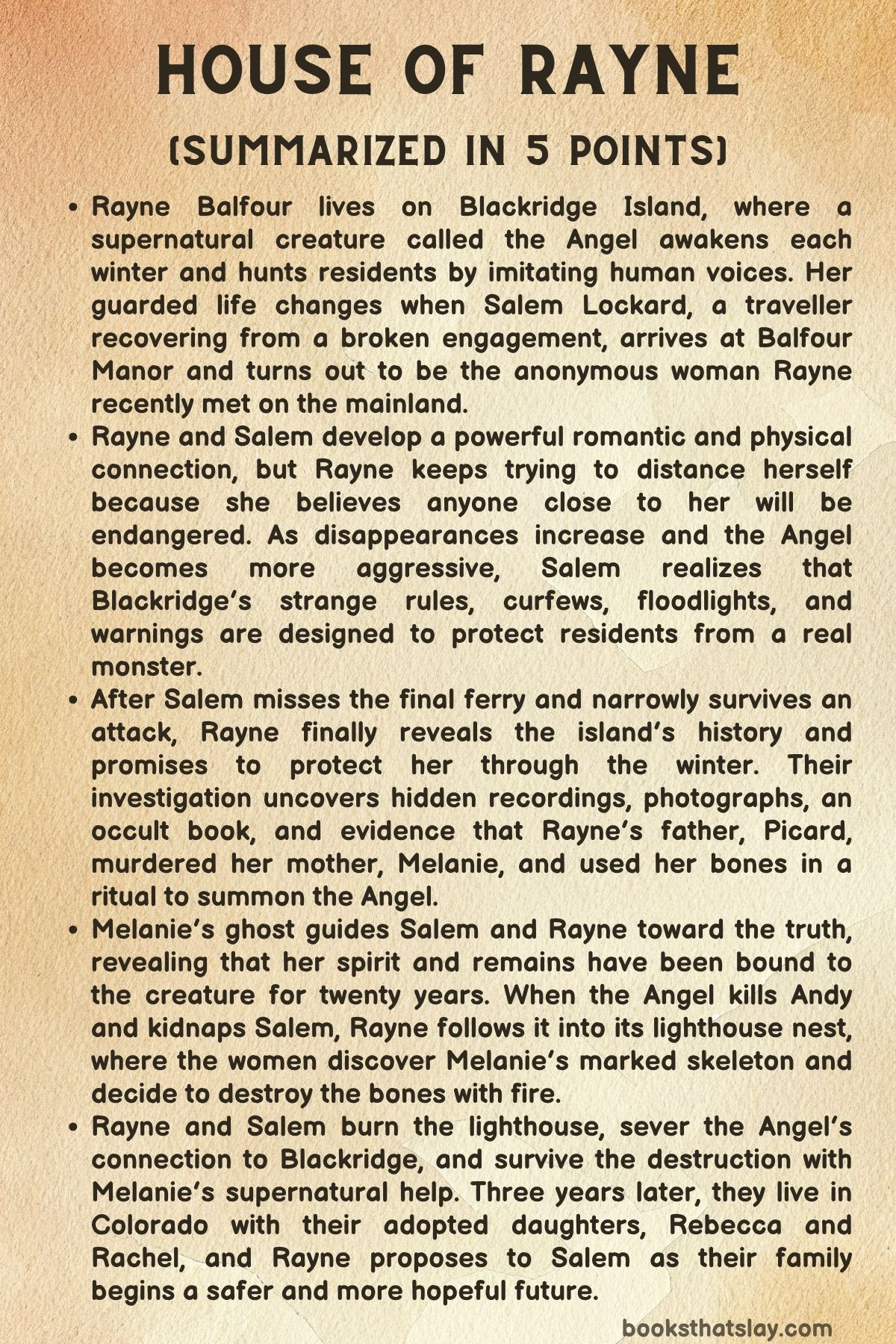
Rayne Balfour lives on Blackridge Island, where she manages Balfour Manor and prepares every year for a deadly winter season. While repairing a fence, she discovers a deer that has been violently torn apart without being eaten, convincing her that the creature known locally as the Angel has awakened earlier than expected.
Soon afterward, Rayne sees a pale, eyeless presence in the forest and hears emotionless voices repeating human greetings. The creature chases her through the fog, causing her to crash her ATV and dislocate her shoulder, but she reaches safety by refusing to look directly at it.
Elsewhere, Salem Lockard begins a solitary cycling trip along the Pacific coast on what should have been her wedding day. Her fiancé, Colin, ended their relationship shortly before the ceremony, and she later learned that he had been unfaithful.
At a coastal bar, Salem meets a mysterious woman who refuses to exchange names with her. They share an intense encounter and then part under the assumption that they will never meet again, although Salem feels unexpectedly affected by the stranger.
The following morning, Salem takes a ferry to Blackridge Island, where she has reserved two weeks at Balfour Manor. The island appears beautiful but oppressive, with strict religious messages, suspicious residents, severe weather, and an atmosphere of constant observation.
When Salem reaches the manor, she discovers that its owner is the woman from the bar. Rayne is equally shocked to see her, but she checks Salem in, explains the island’s dangerous trails and unreliable communication, and warns that Salem must leave on the final ferry before winter closes the island.
Their attraction remains powerful, yet Rayne attempts to maintain emotional distance. She believes that relationships are impossible on Blackridge and has made a habit of choosing anonymous encounters on the mainland rather than allowing anyone to become part of her life.
The manor quickly reveals signs of supernatural activity. Salem experiences unnatural cold, disappearing mold, footsteps on a forbidden staircase, and a corpse-like woman dressed in red who appears beside her bathtub.
When Salem panics and breaks the faucet, Rayne rescues her and moves her into a room beside her own. Rayne later investigates the damaged room and finds wet footprints, whispering presences, a second shadow, and a voice referring to blood and bones.
Rayne realizes that Salem has somehow become connected to the haunting. Although she does not yet understand whether the red woman intends to help or harm them, she becomes determined to protect Salem from both the apparition and the creature hunting outside.
Salem continues exploring the island and repeatedly feels watched. Rayne eventually admits that Blackridge makes lasting relationships impossible for her, while Salem challenges the emotional walls Rayne has constructed.
Their physical relationship develops through open discussions of consent, dominance, controlled fear, and Salem’s desire to surrender control in a safe environment. Rayne finds that caring for Salem afterward feels more frightening than the encounter itself because tenderness threatens the emotional isolation she has maintained for years.
Their connection grows through quieter moments as well. Rayne remembers Salem’s preferred drink, cooks for her, comforts her during panic attacks, introduces her to residents, and shows a protective affection toward Andy Moss’s daughters, Rebecca and Rachel.
Salem begins to see that Rayne’s severity is rooted in fear rather than cruelty. Rayne has lost people before, expects Blackridge to claim everyone she loves, and believes keeping Salem at a distance is the only way to prevent another devastating loss.
Meanwhile, people begin disappearing. A teenager named Andrea vanishes while walking home, and two hunters staying at the manor, Martin and George, disappear after entering the forest.
Rayne learns that the Angel is active earlier than ever. Trail-camera footage shows that it has killed and dismembered a black bear, while its decision to display human bodies in a tree suggests that it is becoming more intelligent and deliberately using terror against the community.
At a Halloween festival, Salem hears the local legend. According to the story, a preacher’s wife was murdered, and the grieving preacher prayed for divine punishment before the winter killings began.
The preacher was Rayne’s father, Reverend Picard Balfour, and the murdered woman was supposedly Rayne’s mother, Melanie. Rayne has spent most of her life believing that the Angel appeared after Melanie’s death and that Picard later died during another winter attack.
Rayne still refuses to tell Salem the full truth before Salem’s planned departure. She believes that allowing Salem to leave without understanding the danger is preferable to frightening her into staying.
Salem wakes alone on the morning of the final ferry and assumes Rayne’s absence is rejection. While travelling toward the dock, she hears Martin calling from the forest and follows the voice, only to discover an eyeless, six-limbed creature repeating words it has stolen from its victims.
The Angel pursues Salem through the woods. A red glow and a woman’s voice guide her toward temporary safety, but she loses consciousness, misses the final ferry, and awakens near the creature’s burrow by the abandoned lighthouse.
When Salem reaches Marihope, she finds Andrea, Martin, and George displayed in a tree. Rayne sees her among the crowd and realizes that the woman she tried to protect by sending away has become trapped on Blackridge.
Rayne finally confirms the truth about the Angel. It hunts mostly at night, imitates human voices, heals rapidly, fears intense light and fire, and has killed residents for approximately twenty years.
She also explains that people born on Blackridge rarely escape permanently. Those who leave begin hearing the red woman’s voice until they return or destroy themselves, causing Rayne to believe that the island itself has condemned her.
Salem refuses to let Rayne continue facing the danger alone. She chooses to stay beside her, not merely because the ferry is gone but because their relationship has become something neither woman wants to abandon.
Their partnership deepens as they search for information. Salem reveals that the red woman told her to stay, while Rayne begins to suspect that the apparition may be Melanie’s spirit.
A sealed stone building on the manor grounds provides the first major discovery. Rayne and Salem break inside and find Picard’s hidden office, religious materials, evidence of violent acts, and an underground cellar connected to the Angel’s burrow.
Salem falls through the floor and finds a box wrapped in fabric from Melanie’s red coat. Inside are an old camcorder and several tapes that Picard had attempted to conceal.
The recordings show Melanie planning to escape Blackridge with Rayne. She describes Picard as controlling, abusive, watchful, and increasingly involved with dangerous beliefs, proving that she never intended to abandon her daughter.
Additional photographs reveal animal mutilations, ritual objects, carved bones, and the body of a murdered woman who appears to be Melanie. The images suggest that Picard killed his wife and used her remains in a ritual.
During a severe storm, Rayne travels north to repair the island’s damaged communications tower. The protective lights fail, and the Angel attacks her while imitating Melanie’s voice with disturbing accuracy.
At the same time, Salem experiences Melanie’s death through a supernatural vision. She feels herself choking on blood and hears words about binding through blood, flesh, and bones.
When the Angel later attacks Salem and Loki outside Andy’s farmhouse, Rayne arrives and helps drive it away. Rayne is severely wounded, forcing Salem to guide them back to the manor and stitch her injuries.
Rayne struggles to accept care because she has spent her life believing that her suffering is unimportant. Salem directly challenges that belief, telling her that she deserved protection as a child and deserves to be saved now.
As Rayne recovers, they examine the photographs together. Rayne concludes that Melanie’s cut throat, missing body, and carved bones were all part of a ritual performed by Picard.
They secretly exhume Melanie’s grave and find an empty coffin containing an ancient occult book. Picard’s notes in the margins describe summoning and binding a supernatural being through blood, flesh, death, and a complete set of marked human bones.
The evidence proves that Picard was not a grieving husband who accidentally called forth divine judgment. He murdered Melanie, used her as the required innocent sacrifice, and created the Angel because he believed himself chosen by God.
The red woman was not attempting to torment Rayne. Melanie’s spirit had been trying to expose the truth and direct her daughter toward the bones that kept both her and the creature bound to Blackridge.
A final recording confirms Melanie’s story. She tells Rayne that Picard will kill her, warns that he is serving something evil, and begs her daughter never to believe that she left willingly.
Rayne finally understands that her childhood fear was not a failure and that Melanie had never stopped trying to reach her. Supported by Salem, she allows herself to grieve and openly declares her love.
The occult book reveals that destroying the symbols carved into Melanie’s bones will break the creature’s tether. Unfortunately, Picard hid the remains inside the Angel’s guarded nest.
Before Rayne can prepare a plan, Rebecca contacts her over the radio. The Angel has killed Andy and is using his voice to lure the children from hiding.
Rayne, Salem, and Loki rescue Rebecca and Rachel, but the creature attacks during their escape. Salem draws it away from Rayne and is seized by the leg before being dragged into the forest.
Rayne follows the blood trail to the burrow and crawls inside with only a knife, flashlight, and lighter. She is no longer risking herself because she considers her life worthless; she enters because Salem and their possible future have given her a reason to fight.
The Angel carries Salem into the abandoned lighthouse, which is filled with human remains and trophies taken from its victims. Salem discovers Melanie’s complete skeleton wrapped in a cocoon, with ritual symbols carved across every bone.
Rayne reaches the lighthouse and reunites with Salem. Together, they gather Melanie’s remains, prepare a barrel of kerosene, and begin smashing and burning the marked bones.
The Angel attacks as flames spread through the lighthouse. Rayne and Salem retreat upward, but the collapsing staircase leaves them trapped on the observation deck.
Believing there is only one way to save Salem, Rayne pushes her over the railing toward the ocean. She then ignites the remaining kerosene, surrounding herself, the Angel, and the lighthouse in fire.
Salem survives the fall and reaches a beach below. Melanie’s spirit appears in a peaceful form and directs her toward Rayne, who has also reached the shore but is unconscious and badly burned.
Salem revives her, and together they watch the lighthouse collapse. Melanie’s red light fades into the water, showing that the destruction of her bones has released her spirit and ended the curse.
Three years later, Rayne and Salem live in Colorado with Rebecca and Rachel, whom they have adopted following Andy’s death. Rayne runs a landscaping company, Salem has returned to cycling, and both women continue therapy while building a stable family life.
During a camping trip, Rayne arranges a surprise proposal with the help of the girls. She asks Salem to become her wife and remain beside her through every future challenge, and Salem immediately accepts.
The story ends with the family celebrating together. A faint crimson light appears beyond the trees, suggesting that Melanie is no longer imprisoned but may still be watching over the life her daughter fought to create.
Characters
Rayne Balfour
Rayne is the emotional center of House of Rayne, defined at first by competence, secrecy, physical courage, and an almost absolute refusal to depend on anyone. She runs Balfour Manor, repairs fences, protects residents, maintains survival equipment, and confronts supernatural danger with the practiced control of someone who has never expected help to arrive.
Her strength is inseparable from childhood trauma. Picard’s cruelty taught her that pain must be hidden, fear invites punishment, and love inevitably becomes another means of control or loss.
Rayne therefore limits her relationships to anonymous encounters away from the island. Her refusal to exchange names with Salem reflects her desire to experience connection without permitting another person to gain emotional power over her.
Her dominant sexuality initially appears to support this need for control, but the book gradually shows that her true strength lies in responsibility rather than force. She pays close attention to consent, watches Salem’s reactions, stops when anxiety appears, and treats vulnerability as something to protect rather than exploit.
Rayne’s central conflict is her belief that her life has less value than the lives of those she protects. Salem changes this by insisting that sacrifice cannot remain one-sided and that Rayne deserves rescue, tenderness, and a future.
By entering the Angel’s burrow, Rayne appears ready to die for Salem, but her motivation has changed. She is no longer moving toward death because she feels worthless; she is fighting because love has finally made survival meaningful.
Salem Lockard
Salem begins House of Rayne at a moment of personal collapse. Her planned marriage has ended, her former fiancé has betrayed her, and the future she carefully arranged has disappeared.
Her cycling journey is an attempt to reclaim independence, yet she remains burdened by anxiety, self-doubt, and the fear that other people will treat her emotional needs as inconvenient. Her attraction to Rayne is partly physical, but it also emerges from the contrast between Rayne’s attentiveness and Colin’s dismissiveness.
Salem’s willingness to surrender control during intimacy does not make her passive. She communicates what she wants, chooses her limits, uses a safeword, challenges Rayne’s emotional withdrawal, and repeatedly refuses to let Rayne make major decisions on her behalf.
Her courage is often impulsive, especially when she follows voices, enters dangerous spaces, or returns to save Rayne despite knowing that the Angel imitates human cries. Nevertheless, these decisions arise from empathy and loyalty rather than a desire to appear fearless.
Salem becomes Rayne’s emotional protector as much as Rayne becomes her physical protector. She treats Rayne’s injuries, remains beside her during nightmares, confronts her self-destructive beliefs, and insists that receiving care is not weakness.
By the conclusion, Salem has moved beyond the future Colin once defined for her. She creates a new life based on mutual trust, chosen family, emotional honesty, and a love that does not require either partner to disappear inside the other.
Melanie Balfour
Melanie initially exists through fragmented memories, frightening visions, old photographs, and Rayne’s uncertainty about the past. Because her spirit appears bloodied and decayed, Rayne understandably associates her with the violence surrounding the manor.
The tapes gradually restore Melanie’s identity. They reveal a loving mother who recognized Picard’s escalating cruelty, attempted to seek financial help, planned an escape, and refused to abandon Rayne even when leaving alone might have saved her.
Melanie’s tragedy extends beyond murder. Picard controls the story told about her, presents her as unstable, hides her recordings, stages an empty funeral, and uses her body in a ritual that keeps her trapped within the creature created through her death.
Her ghostly actions are sometimes terrifying because she struggles to communicate through trauma and supernatural confinement. Her repeated references to blood, flesh, bones, and staying are fragments of the truth she needs Rayne and Salem to understand.
Melanie protects Salem because Salem is capable of reaching Rayne in ways she cannot. By guiding Salem through the forest, directing her to the hidden tape, and helping her locate Rayne after the fire, Melanie becomes an active force in saving her daughter.
Her peaceful appearance after the bones burn shows that she has finally been restored to herself. She is no longer Picard’s victim, the island’s frightening legend, or the Angel’s unwilling tether.
Reverend Picard Balfour
In House of Rayne, Picard is the human source of the novel’s central horror. Although he is dead before the main events, his beliefs and crimes continue controlling Blackridge, Rayne, Melanie, and the creature he summoned.
He presents his ambition as religious devotion. Convinced that God has chosen him to punish sin, he studies an occult text, isolates his wife, controls her communications, and persuades others that she is mentally unstable.
His public identity as a preacher allows him to disguise domination as spiritual authority. The island’s later belief that the Angel is an instrument of divine judgment grows from the explanation Picard created to conceal his own responsibility.
Picard’s murder of Melanie is especially horrifying because he does not act in uncontrolled anger. The photographs, translations, carved bones, ritual table, and hidden office reveal preparation, patience, and a deliberate reduction of another human being to ritual material.
His abuse of Rayne continues after his death through the beliefs he leaves inside her. She assumes that she is sinful, doomed, unworthy of rescue, and responsible for protecting everyone because he taught her that suffering was her natural condition.
Destroying the Angel therefore means more than killing a monster. Rayne must expose Picard’s lies, reject his version of God, free Melanie’s body, and refuse the future of isolation and death that he attempted to impose on her.
The Angel
The Angel is a physical monster, a supernatural prisoner, and the continuing result of Picard’s violence. Its eyeless face, six limbs, hooves, claws, speed, regenerative ability, and talent for imitating voices make it nearly impossible to confront through ordinary methods.
Its mimicry is especially cruel because it turns love and concern into weapons. It uses the voices of missing people, frightened children, Andy, Salem, Rayne, and Melanie to lure survivors into darkness.
The creature changes during the story. It begins displaying bodies, setting psychological traps, attacking protected locations, and using emotionally precise imitations, suggesting an expanding intelligence or a weakening of the restraints that once controlled it.
Despite being called an angel, it has no connection to divine justice. Its creation depends on murder, occult ritual, desecrated bones, and Picard’s need to present personal hatred as sacred purpose.
The revelation that Melanie’s remains form its tether gives the monster a disturbing dual nature. Her body was used to bind it, and her spirit remains trapped beside it, but the creature is not simply Melanie transformed.
Its destruction requires the removal of the human violence sustaining it. Burning the bones and carved symbols ends its presence because the Angel survives through Picard’s treatment of Melanie as an object rather than a person.
Ruth Miller
Ruth represents the way destructive beliefs can spread beyond the individual who first created them. She repeatedly judges Rayne, Salem, and other residents through the severe religious framework inherited from Blackridge’s past.
Her hostility toward Rayne is complicated by their shared childhood. Gerard later reveals that Ruth was once Rayne’s closest friend and the first girl to kiss her, suggesting that fear, shame, and religious pressure transformed affection into condemnation.
Ruth uses faith to place herself above others rather than to offer compassion. She interprets disappearances as punishment, condemns desire as corruption, and assumes that obedience will protect her from the creature.
Her death exposes the emptiness of that belief. The Angel enters the church, ignores every symbol of religious authority, repeats Ruth’s declaration that God protects, and kills her without distinction.
Rayne’s grief for Ruth shows that she can recognize both the harm Ruth caused and the person she might have become under different circumstances. Ruth is therefore neither an innocent martyr nor a simple villain; she is another life damaged by fear, inherited fanaticism, and the island’s refusal to confront its history.
Andy Moss
In House of Rayne, Andy is one of Blackridge’s practical protectors. He operates the hardware store, maintains alarms and supplies, raises his daughters, and cooperates with Rayne in preparing the community for winter.
His relationship with Rayne reveals her capacity for family long before she openly imagines having one. After the death of his wife, Rayne helps care for Rebecca and Rachel, and Andy trusts her with their safety.
Unlike Picard, Andy attempts to shield his children without controlling or demeaning them. Rayne notices this difference and understands that he provides the protection she never received from her own father.
His death is especially devastating because it destroys one of the island’s few stable households. The Angel uses his voice to lure his daughters, turning the sound associated with safety into a threat.
Andy’s loss also changes Rayne and Salem’s future. Their adoption of Rebecca and Rachel continues the family structure he created and ensures that his daughters are raised by people who understand both their grief and their need for security.
Rebecca and Rachel Moss
Rebecca and Rachel bring warmth, humour, and vulnerability into a story dominated by adult secrecy. Their trust in Rayne shows that they recognize the kindness beneath her intimidating appearance.
Rebecca is curious, observant, and willing to discuss the Angel more openly than the adults. Her comments about the firewatch tower and the creature expose cracks in the community’s attempt to protect children through silence.
Rachel is less prominent during the early events, but the attack on the farmhouse places both girls at the center of the danger. They survive by hiding, following instructions, and trusting Rayne, Salem, and Loki.
Their rescue gives the final conflict a broader emotional purpose. Rayne and Salem are not only fighting for their own future but also attempting to end a cycle that would otherwise shape another generation through terror.
Three years later, the girls’ adoption demonstrates that chosen family can emerge after profound loss. Rachel calling Salem “Mama” confirms that the household is not a temporary arrangement built around tragedy but a secure family formed through love, responsibility, and daily care.
Loki
Loki functions as guardian, companion, guide, and emotional support. His immediate acceptance of Salem helps connect her to the manor and suggests that she belongs in Rayne’s life before Rayne is ready to acknowledge it.
The dog frequently senses danger before the humans do. He reacts to the sealed stone building, recognizes the threat behind imitated voices, follows trails through storms, and attacks the Angel despite the creature’s overwhelming strength.
His loyalty is not limited to physical defence. When Salem collapses in the snow, Loki keeps her warm, and when she awakens frightened or alone, his presence provides reassurance.
Loki also acts as a bridge between Rayne and Salem. Both women trust him, protect him, and follow his instincts, making him part of the partnership they are gradually building.
His survival and continued presence in Colorado complete the image of the family they create. He belongs to both the dangerous history they escaped and the peaceful home they establish afterward.
Gerard Balfour
Gerard in House of Rayne, serves as a connection between Rayne’s personal memories and the broader history of the Balfour family. His knowledge of the occult book explains how Picard obtained the object and how destructive beliefs passed through generations.
He reveals that their grandfather discovered the volume in France during the First World War. Trauma and religious obsession caused him to treat it as a sacred object, allowing Picard to inherit both the book and the belief that supernatural power could prove divine selection.
Gerard also remembers Picard’s resentment of family life and his campaign to portray Melanie as unstable. These memories help Rayne understand that her father’s abuse was visible in fragments even though no one recognized its full extent.
Although Gerard does not save Melanie or Rayne in the past, he accepts the evidence when confronted with it. His willingness to help barricade the house and discuss the family’s history makes him part of the community’s late attempt to face the truth.
His character shows how silence can preserve abuse even among people who do not consciously support the abuser.
James and Mark Balfour
James and Mark assist Rayne with trail cameras, firewatch equipment, community defence, and emergency preparations. Their presence shows that Rayne is not completely isolated, even though she behaves as though every responsibility belongs to her.
They understand the island’s survival systems and help document the Angel’s changing behaviour. The footage they examine with Rayne confirms that the creature has awakened early, killed a bear, and become more deliberate in its attacks.
Their relationship with Rayne appears practical rather than emotionally expressive. They cooperate during crises, but they do not reach the deeply wounded parts of her identity that Salem eventually confronts.
Even so, their assistance matters because the island’s survival depends on collective labour. Rayne may carry the strongest sense of duty, but the watchtowers, cameras, radios, lights, and searches require several residents working together.
They represent the Balfour relatives who inherited responsibility for Picard’s legacy without understanding its true origin.
Dr. Tasha Hale
Dr. Tasha Hale in House of Rayne, provides medical competence within a community where ordinary emergency services cannot easily operate. She treats Salem’s injured foot, travels through severe weather, repairs Rayne’s stitches, and supplies antibiotics.
Her praise of Salem’s emergency work validates Salem at a time when she fears that her efforts may have caused additional pain. This moment strengthens Salem’s growing confidence as Rayne’s caretaker.
Dr. Hale also treats supernatural danger as a practical reality rather than a subject for denial. Her warning to keep the house illuminated reflects the community’s understanding that medicine alone cannot guarantee survival.
Although she remains a supporting figure, she helps preserve Rayne’s life during a period when infection, blood loss, and reopened wounds could have killed her before the Angel did.
Her role supports the book’s repeated connection between survival and cooperation. Weapons and courage matter, but so do medical knowledge, supplies, rest, and the willingness to seek assistance.
Martin, George, and Andrea
Martin, George, and Andrea represent the human cost of the Angel’s return. Their disappearances transform rumours and private warnings into undeniable evidence that the winter killings have already begun.
Andrea’s death is especially disturbing because she is only fifteen and disappears while performing an ordinary act: walking home. Her loss proves that innocence offers no protection against a creature falsely described as an agent of moral judgment.
Martin and George initially appear as friendly hunters who believe they are prepared for the island’s natural dangers. Their weapons and experience become useless against a predator that does not follow natural rules.
The Angel uses Martin’s voice to lure Salem, demonstrating how victims continue to serve the creature after death. Their bodies are later displayed with Andrea’s in a tree, showing the monster’s growing desire to communicate terror.
Although they receive limited personal development, their deaths shift the story from unsettling mystery to an open struggle for survival.
Colin
Colin never appears directly during the events on Blackridge, yet his treatment of Salem shapes her emotional condition. He ends their engagement shortly before the wedding and has already been involved with someone else.
His betrayal destroys Salem’s confidence in the future she had planned. It also leaves her questioning whether her needs, desires, and emotional reactions are unreasonable.
Salem’s memories indicate that Colin treated intimacy as something organized around his comfort. When her needs challenged him, he responded with dismissal rather than curiosity or care.
Rayne provides a direct contrast. She may frighten Salem and struggle with emotional openness, but she listens, negotiates, stops immediately when necessary, and refuses to treat Salem’s anxiety as an inconvenience.
Colin therefore represents the apparently ordinary relationship that demanded Salem reduce herself. Losing him initially feels like failure, but the loss creates the space in which she discovers a more honest understanding of love, desire, and partnership.
Themes
Love as Protection and Mutual Rescue
Love in House of Rayne is measured less through declarations than through attention, responsibility, and the willingness to remain present when another person is frightened. Rayne protects Salem physically, but her most meaningful acts involve listening to her anxiety, respecting her boundaries, remembering small preferences, and refusing to use control without consent.
Salem gradually recognizes that Rayne’s protectiveness becomes unhealthy when it excludes Rayne from the category of people worth saving. Rayne repeatedly attempts to make decisions alone, send Salem away, conceal danger, and place herself between the community and death because she believes sacrifice is her only purpose.
The relationship becomes sustainable only when Salem rejects this imbalance. She treats Rayne’s wounds, challenges her self-hatred, enters danger to save her, and insists that love cannot mean accepting another person’s destruction in silence.
Their final rescue demonstrates this reciprocity. Rayne enters the burrow for Salem, Rayne pushes Salem from the burning lighthouse, Salem revives Rayne on the shore, and Melanie guides Salem toward the body.
Love does not remove fear or guarantee safety. It gives each woman a reason to face danger while also teaching them that survival is a shared responsibility rather than an individual burden.
Religious Fanaticism, Abuse, and Manufactured Evil
Picard’s violence grows from his decision to treat personal ambition as divine instruction. His conviction that he has been chosen by God allows him to reinterpret control, murder, and desecration as sacred duties.
Religion becomes dangerous when it removes accountability. Picard claims that Melanie is unstable, isolates her from support, monitors her communication, and later presents the creature he created as punishment for the island’s sins.
The Angel exposes the falsehood of his theology. It does not distinguish between believers and nonbelievers, adults and children, innocence and guilt, or sacred and ordinary spaces.
Ruth continues Picard’s pattern by assuming that devotion protects her and that suffering proves moral failure. Her death inside the religious setting she considers safe demonstrates that faith used as superiority cannot control the consequences of human cruelty.
The novel does not suggest that every form of belief is evil. Rayne’s desperate prayer outside the burrow shows the human need to reach beyond oneself during unbearable fear.
The greater danger comes from using God to excuse domination. Picard creates the monster, but the island sustains his lie for twenty years because accepting supernatural judgment feels easier than confronting abuse committed by a respected preacher.
Trauma, Fear, and the Work of Healing
In House of Rayne, Trauma affects both Rayne and Salem through the body as much as through memory. Rayne responds to danger by suppressing pain, controlling her surroundings, avoiding attachment, and assuming that she must remain functional regardless of injury.
Salem experiences panic, intrusive fear, physical disorientation, and uncertainty about whether others will believe her. Her anxiety is not erased by courage, and frightening events continue affecting her even after immediate danger passes.
Their relationship helps because neither woman demands instant recovery from the other. Rayne grounds Salem during panic attacks, stops intimate activity when anxiety rises, and builds a blanket fort where Salem can experience temporary safety without being asked to solve anything.
Salem returns that care by remaining beside Rayne during nightmares, cleaning and stitching her wounds, monitoring medication, and speaking calmly when Rayne becomes helpless. These scenes treat caregiving as active work rather than a sentimental gesture.
The conclusion refuses to suggest that killing the Angel automatically heals everything. Rayne retains burns, Salem avoids the woods for a period, the children grieve their father, and the survivors continue therapy and group conversations.
Healing becomes possible because they are no longer isolated. Their family gives fear a place to be spoken, witnessed, and carried collectively rather than hidden until it becomes another private prison.
Home, Imprisonment, and Chosen Family
In House of Rayne, Blackridge Island is both Rayne’s home and her prison. Its landscape, community, manor, history, and winter traditions form the only life she knows, yet the curse convinces her that she can never leave without being driven back.
Balfour Manor carries the same contradiction. It contains memories of abuse and supernatural terror, but it also holds Melanie’s greenhouse, Rayne’s work, Loki’s companionship, and the growing relationship between Rayne and Salem.
Salem initially arrives as a temporary guest. Her decision to stay changes the meaning of the manor because she begins participating in daily life rather than merely observing Rayne’s isolation.
The blanket fort is a small but important transformation of space. Rayne takes a haunted room and fills it with lights, pillows, music, food, and safety, creating a temporary home through deliberate care.
The destruction of the lighthouse ends the physical tether keeping Rayne bound to Blackridge. Leaving the island then becomes possible because she has exposed Picard’s lie rather than simply fleeing its consequences.
Colorado represents a home chosen rather than inherited. Rayne and Salem build a household with Rebecca, Rachel, Loki, a garden, work, therapy, and ordinary routines.
Their family does not erase the people they lost. It proves that belonging can be created without repeating the violence, secrecy, and obligation that defined the families into which they were born.