If Not You Summary, Characters and Themes
If Not You by Ellen O’Clover is a contemporary romantic novel about ambition, professional rivalry, emotional vulnerability, and the unexpected possibility of finding love in someone once considered an enemy.
Set primarily within Chicago’s competitive advertising industry, the story follows Mattie French, a determined copywriter whose career has long been defined by her rivalry with the successful Campbell Porter. When they compete for the same prestigious advertising account, years of resentment begin giving way to attraction and mutual understanding. Through their changing relationship, the novel examines how childhood experiences shape adult insecurities and why personal fulfillment sometimes requires accepting uncertainty rather than controlling every outcome.
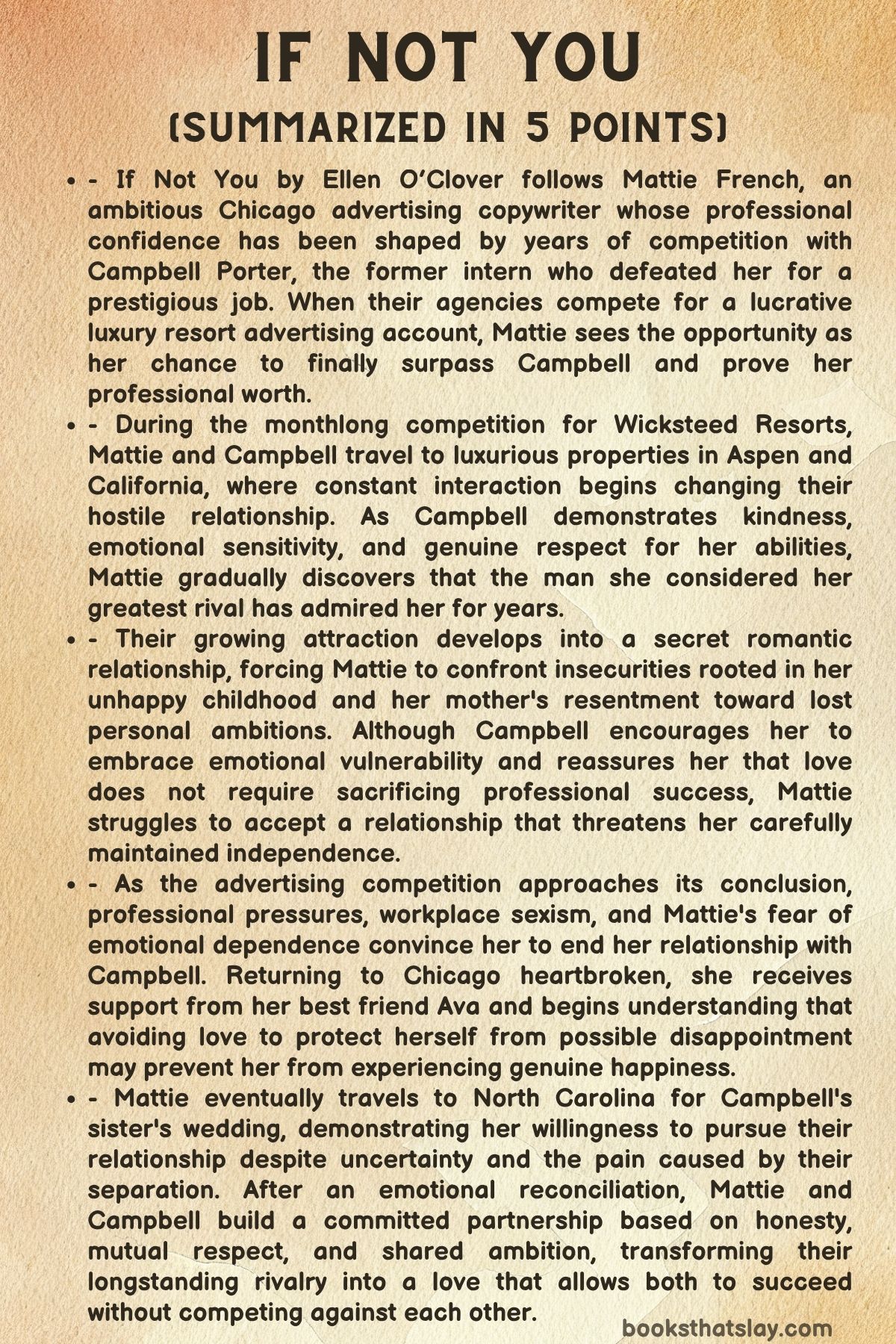
Summary
Mattie French has spent much of her adult life believing that professional success is the foundation of personal security. Growing up in an unhappy household, she learned to associate independence with safety and achievement with self-worth. Her parents’ troubled marriage, particularly her mother’s resentment over the opportunities she sacrificed after becoming a parent, left Mattie feeling responsible for disappointments that were never hers to carry.
Five years earlier, Mattie competed against Campbell Porter for a permanent junior copywriter position at Slater Faust, a prestigious Chicago advertising agency. Both were talented interns, but only one could receive the position. Campbell’s privileged education, expensive clothing, confident personality, and apparently effortless professional abilities irritated Mattie, who believed she had sacrificed considerably more to earn the same opportunity.
Their competition quickly developed into a personal rivalry characterized by sarcastic exchanges, creative challenges, and a shared determination to win. When Campbell received the permanent position, Mattie experienced the rejection as confirmation that hard work could never entirely overcome the advantages enjoyed by people like him.
Although she eventually established a career elsewhere, the disappointment remained deeply personal.
Five years later, Mattie works at the Art Room, a smaller Chicago advertising agency where she has developed a successful creative partnership with art director Dexter. She shares an apartment with her lifelong best friend, Ava Zimmerman, and Ava’s fiancé, Lev. Her professional life appears stable, but important changes are approaching.
Ava is preparing for marriage and will soon move out, leaving Mattie anxious about her future living arrangements and financial independence. Although she supports her friend’s happiness, she secretly fears that their relationship will become less important once Ava begins a new chapter with Lev.
At work, Mattie receives an opportunity that could transform her career. Wicksteed Resorts, a luxury hotel company, is considering replacing its longtime advertising agency and has invited several firms to compete for the account.
Winning could bring Mattie the promotion and financial security she desperately wants. However, her excitement disappears when she discovers that Slater Faust is competing and Campbell will be part of its presentation team.
Campbell has become an award-winning copywriter whose successful athletic advertising campaign, “If Not You,” earned him a prestigious Cannes Lion. Mattie witnessed his triumph at the awards ceremony, where his recognition intensified her insecurities about her own achievements.
The possibility of defeating him for the Wicksteed account therefore becomes more than a professional objective. Mattie sees the competition as an opportunity to correct the humiliation she experienced during their internship and finally establish herself as his equal.
The initial presentations bring the competing agencies together. Mattie and Dexter introduce a campaign encouraging Wicksteed guests to collect passport-style stamps while visiting different resorts. Campbell impresses the audience with his persuasive presentation skills and understanding of the emotional appeal of travel.
Despite Mattie’s determination to dislike him, she cannot deny his talent. She is also surprised when Campbell’s art director, Soraya, reveals that he has spoken highly of her professional abilities.
The longstanding agency is eliminated, leaving the Art Room and Slater Faust to compete in an extended final stage involving visits to several Wicksteed properties.
Before leaving, Campbell gives Mattie a note containing their familiar challenge, “Full send,” signaling that their competition is continuing.
The assignment begins at Wicksteed’s luxurious Aspen resort, where both teams must participate in outdoor activities and experience the properties as guests. Mattie approaches the unfamiliar activities with determination, although she frequently feels uncomfortable outside her usual routines.
Campbell’s apparently natural confidence continues to irritate her. Their disagreements revive old arguments about privilege, education, and the meaning of professional accomplishment.
Yet the more time they spend together, the more difficult it becomes for Mattie to maintain her negative assumptions. Campbell demonstrates genuine attentiveness, notices her discomfort, and occasionally shares her frustration with the advertising industry’s predictable demands.
Their professional similarities become increasingly apparent. Both understand creative pressure, enjoy verbal challenges, and possess the ability to recognize strong ideas.
When an unfamiliar man makes Mattie uncomfortable at a social gathering, Campbell intervenes discreetly and helps her leave the conversation. His considerate behavior surprises her, particularly because he avoids making the encounter about himself.
Mattie also discovers that his confidence conceals insecurities and disappointments she has never considered. Meanwhile, Campbell’s anger at Nolan’s dismissive treatment of her demonstrates that his personal rivalry with Mattie does not diminish his respect for her abilities.
Their growing attraction becomes more evident during ordinary interactions. When Mattie helps Campbell choose a navy shirt, the experience creates an unexpected sense of intimacy. Campbell subsequently wears the shirt to dinner, making her increasingly conscious of feelings she has spent years denying.
A crisis involving Mattie’s beloved cat, Pancake, marks an important turning point. Learning that Pancake is seriously ill leaves Mattie frightened and emotionally exposed. Campbell offers reassurance without mocking her vulnerability.
Recognizing that her hostility toward him has become unfair, Mattie apologizes and proposes a temporary truce. Campbell accepts, allowing their relationship to develop beyond its familiar antagonism.
Dexter nevertheless confronts Mattie about allowing her fixation on Campbell to interfere with their professional responsibilities. His criticism forces her to recognize that her behavior affects someone who has consistently supported her career.
The group subsequently travels to Wicksteed’s coastal resort in Bodega Bay, where the quieter atmosphere encourages more personal conversations.
Mattie admits that Ava’s marriage frightens her because she worries their friendship will change permanently. Campbell listens sympathetically and suggests that she is afraid of losing the security she has always associated with that relationship.
His understanding makes Mattie feel seen in ways she has rarely experienced. She begins recognizing that his attention matters to her for reasons unrelated to their professional rivalry.
The relationship changes dramatically after Mattie nearly reveals a private writing project that Campbell has concealed from his colleagues. Campbell urgently removes her from the gathering, and their confrontation in the resort’s business center develops into an unusually honest conversation.
Mattie discovers that Campbell’s advertising success has not eliminated his creative frustrations. He has personal writing ambitions that remain unfulfilled, and he fears failing at something deeply meaningful to him.
For the first time, Mattie understands that his professional confidence does not mean he has escaped disappointment or self-doubt.
Their emotional openness leads them to acknowledge their longstanding attraction. Campbell admits that he has wanted to kiss her for years, transforming Mattie’s understanding of their shared history.
They begin a secret romantic relationship, finding opportunities for intimacy while continuing to work for competing agencies.
Although their attraction is powerful, Mattie fears its consequences. She worries that becoming emotionally involved with Campbell could compromise her professional judgment and damage the career she has worked so hard to establish.
Campbell appears more willing to accept the relationship’s growing importance, while Mattie repeatedly insists that their involvement must remain temporary.
As their connection deepens, they discuss their families, ambitions, and insecurities. Campbell reveals more about his sisters, Josie and Vivian, and the emotional importance of their family relationships. Mattie encourages his writing aspirations, recognizing that his creative disappointments deserve compassion rather than judgment.
Their relationship also exposes Mattie’s unresolved childhood pain. She explains that her mother made her feel responsible for the opportunities she lost through motherhood.
Campbell rejects this interpretation, insisting that a child should never bear responsibility for a parent’s unfulfilled ambitions. His response helps Mattie question beliefs that have shaped her identity for years.
When Campbell suffers an injury during a beach activity, Mattie’s frightened reaction exposes their relationship to Dexter. Feeling betrayed by her secrecy, Dexter initially withdraws.
Mattie eventually admits that she genuinely cares for Campbell. Although Dexter worries that the relationship could end painfully, he encourages her not to reject happiness simply because it involves emotional risk.
Campbell subsequently invites Mattie to attend his sister Josie’s wedding in North Carolina. The invitation demonstrates that he wants her in his life beyond the Wicksteed assignment.
Mattie agrees, tentatively accepting the possibility of a future together.
However, the approaching final presentations revive her insecurities. Work pressures increase, campaign revisions become demanding, and Nolan’s dismissive comments reinforce her fear that others will judge her romantic involvement as evidence of professional weakness.
Mattie begins believing that she must choose between her career and Campbell. Rather than risk losing control, she ends their relationship.
Campbell is devastated by her reversal, particularly because she had recently agreed to meet his family. Mattie is equally miserable but convinces herself that sacrificing the relationship is necessary to protect her ambitions.
Both agencies complete their final presentations, but Mattie finds professional achievement less satisfying than she expected. Campbell remains composed despite his obvious unhappiness, and she continues admiring the honesty with which he evaluates his own work.
Returning to Chicago, Mattie finally admits to Ava that she has been frightened about their changing friendship.
Ava reassures her that marriage will not erase their bond. Their conversation helps Mattie understand that relationships can change without losing their meaning.
When Ava questions Mattie’s decision to reject Campbell, Mattie begins recognizing how strongly fear has influenced her choices. Discovering that her flights to North Carolina remain valid, she decides to attend Josie’s wedding.
At the Porter family home, Mattie encounters the affectionate family environment that helped shape Campbell. Her arrival demonstrates a willingness to pursue their relationship, although the pain caused by their separation cannot immediately disappear.
The experience forces Mattie to accept that loving Campbell was meaningful even if reconciliation remains uncertain.
Back in Chicago, she continues her professional responsibilities while reconsidering the belief that achievement must come before every emotional attachment.
Eventually, Mattie and Campbell confront their separation openly. She acknowledges that fear caused her to reject him, while he admits how deeply her decision hurt him.
Their reconciliation marks a decisive change in Mattie’s understanding of love. She tells Campbell that she loves him and wants a lasting relationship, and he reciprocates.
By December, their romance has become part of ordinary life. Campbell spends time with Mattie’s friends, accompanies her on errands, and supports her during difficult interactions with her parents.
Ava’s approaching marriage no longer represents an inevitable loss, and Mattie begins recognizing that accepting love does not require surrendering her independence.
The novel concludes with Mattie and Campbell playfully competing to describe the depth of their affection. When Campbell suggests declaring their contest a draw, their old rivalry becomes a symbol of equality rather than opposition.
For Mattie, happiness no longer depends on defeating someone else. She has learned that personal achievement and emotional connection can exist together, and that allowing another person into her life may strengthen rather than diminish her sense of self.
Characters
Mattie French
Mattie French is the central protagonist of If Not You, a talented and fiercely ambitious advertising copywriter whose determination to succeed is closely connected to her complicated childhood. She is intelligent, sarcastic, professionally capable, and reluctant to reveal emotions that might make her appear vulnerable.
Her strongest defining characteristic is the belief that achievement provides security. Having grown up with parents who remained unhappy in their marriage, Mattie learned to associate emotional dependence with disappointment and professional independence with personal survival.
Her mother’s resentment toward the opportunities she sacrificed after having children left Mattie carrying an undeserved sense of guilt. She consequently treats professional achievement as evidence that her life has value and that she has not wasted the possibilities her mother believes she lost.
This explains why her rivalry with Campbell becomes so consuming. His success challenges her belief that dedication and sacrifice should produce recognition, while his privileged background appears to represent advantages she never enjoyed.
Mattie’s guarded personality also influences her relationships with people she loves. Although she depends deeply on Ava’s friendship, she refuses to acknowledge how frightened she feels about Ava’s marriage and the changes it will bring.
Her relationship with Campbell exposes the limitations of this emotional independence. Initially, she interprets his attention as mockery, but his compassion gradually forces her to recognize that she has misunderstood both his intentions and her own feelings.
Her greatest struggle emerges when she believes that pursuing romance will undermine her career. Ending their relationship reveals how deeply she has internalized the idea that love necessarily involves sacrifice.
By the novel’s conclusion, Mattie begins separating her self-worth from professional recognition. Her reconciliation with Campbell represents not an abandonment of ambition but an acceptance that career success and emotional fulfillment need not compete.
Her character development is therefore centered on learning that vulnerability is not weakness and that independence does not require emotional isolation.
Campbell Porter
Campbell Porter serves as Mattie’s professional rival and eventual romantic partner, bringing charm, intelligence, confidence, and emotional complexity to If Not You. His outward appearance suggests effortless success, but his personal struggles reveal a man whose ambitions and insecurities are more complicated than Mattie initially understands.
Campbell’s prestigious education and early professional achievements make him appear privileged and self-assured. His Cannes Lion award reinforces Mattie’s belief that he possesses everything she has struggled to obtain.
However, the novel gradually establishes that Campbell’s talent comes from genuine dedication rather than background alone. He continually seeks opportunities to improve, challenges himself creatively, and takes his work seriously even when he appears relaxed.
His longstanding attraction to Mattie is concealed beneath years of teasing and competitive exchanges. While she interprets his behavior as antagonistic, his admiration for her intelligence and creative abilities has been present since their internship.
Campbell’s compassionate behavior becomes particularly significant when Mattie experiences distress. He helps her escape an uncomfortable social encounter, reassures her during Pancake’s illness, and listens carefully when she discusses her fear of losing Ava.
His private writing ambitions provide a second dimension to his character. Despite his professional accomplishments, he struggles with unfinished creative goals and fears that success in advertising may not translate into fulfillment elsewhere.
These vulnerabilities challenge the assumption that external achievement guarantees internal confidence. Campbell understands disappointment and uncertainty, even though his public persona rarely reveals them.
His strongest emotional conflict concerns Mattie’s reluctance to accept their relationship. He wants something lasting, but his willingness to express affection leaves him exposed to rejection.
When she ends their romance, his pain demonstrates that his confidence cannot protect him from emotional injury. Nevertheless, their eventual reconciliation shows his capacity to move beyond resentment when genuine honesty becomes possible.
Campbell ultimately represents a form of partnership grounded in admiration, patience, and shared ambition. His relationship with Mattie becomes healthier when both stop treating vulnerability as defeat.
Ava Zimmerman
Ava Zimmerman is Mattie’s lifelong best friend and one of the most important sources of emotional stability in her life. Her warmth, loyalty, and familiarity with Mattie’s personality make her an essential influence on the protagonist’s development.
Their friendship began during childhood, when Ava’s affectionate family environment provided Mattie with the security she rarely experienced at home. Ava’s mother welcomed Mattie, allowing her to experience a sense of belonging that shaped her understanding of friendship.
As adults, Ava and Mattie continue sharing everyday routines and living arrangements. Their closeness provides Mattie with a predictable emotional foundation, making Ava’s approaching marriage particularly difficult for her to accept.
Ava’s relationship with Lev represents a natural progression into a different stage of adulthood. However, Mattie interprets the coming changes as evidence that their friendship may eventually become less important.
Ava demonstrates patience toward these fears while refusing to allow Mattie to hide behind sarcasm indefinitely. She repeatedly encourages her friend to acknowledge feelings that she would rather suppress.
Her response to Mattie’s relationship with Campbell is particularly revealing. Although she knows how deeply Mattie has resented him, Ava recognizes that the intensity of their interactions may conceal emotions Mattie has never considered.
Following the breakup, Ava challenges Mattie’s belief that avoiding future pain justifies rejecting present happiness. Her perspective becomes instrumental in Mattie’s decision to reconsider the relationship.
Ava’s importance lies in showing that enduring friendships can survive changes in circumstances. She helps Mattie understand that emotional security does not depend on preserving every familiar routine.
Dexter
Dexter is Mattie’s art director partner at the Art Room and one of her closest professional friends. His creative abilities, practical judgment, and willingness to confront uncomfortable truths make him an important supporting character.
Their partnership is founded on mutual respect and a shared understanding of advertising’s demanding environment. They collaborate effectively because each recognizes the other’s talent and dedication.
Dexter also understands Mattie’s insecurities more clearly than many of her colleagues. He has witnessed her professional disappointments and recognizes how deeply Campbell’s achievements affect her confidence.
Unlike Mattie, Dexter is increasingly aware that professional commitment can create problems in personal relationships. His difficulties with his boyfriend, Krishna, demonstrate the strain caused by excessive workloads and competing priorities.
These experiences make him sensitive to the consequences of allowing work to dominate every aspect of life.
Dexter initially tolerates Mattie’s hostility toward Campbell, but eventually confronts her when the rivalry begins compromising their partnership. His criticism is significant because it comes from someone who respects her abilities and wants her to succeed.
When Dexter discovers Mattie’s secret romance, he feels betrayed by her dishonesty. However, his anger is rooted in concern rather than possessiveness or professional jealousy.
Their reconciliation reveals his emotional maturity. He acknowledges the risks of Mattie’s relationship while encouraging her to pursue happiness rather than retreat into fear.
Dexter represents friendship built on accountability. His loyalty does not prevent him from challenging Mattie when her behavior becomes harmful, and his continued support helps her develop greater emotional honesty.
Soraya
Soraya is Campbell’s art director partner at Slater Faust and an important figure in changing Mattie’s understanding of her rival. Her professionalism and familiarity with Campbell allow her to offer a perspective that Mattie has never seriously considered.
Unlike Nolan, Soraya does not approach the competition with unnecessary hostility. Although she remains committed to her agency, she demonstrates an ability to recognize talent in the opposing team.
Her revelation that Campbell has spoken positively about Mattie’s work creates an early crack in Mattie’s certainty that he considers her inferior. This information suggests that Campbell’s professional challenges have always been accompanied by genuine admiration.
Soraya also reveals aspects of Campbell’s personality that become important to Mattie’s emotional development. Her observations about his determination to improve demonstrate that his success is not simply the result of privilege.
Throughout the resort assignment, Soraya remains a capable and dependable colleague. Her willingness to accompany Campbell for medical treatment after his injury illustrates the trust within their professional partnership.
She also helps establish that respectful competition can exist without personal resentment. Her character provides a contrast to the hostility Mattie associates with Slater Faust and encourages a broader understanding of professional relationships.
Nolan
Nolan is a member of the Slater Faust team whose dismissive behavior exposes the sexism and professional inequality that Mattie has encountered throughout her career. He functions as an antagonistic supporting character whose conduct helps distinguish legitimate competition from disrespect.
Where Campbell challenges Mattie’s ideas and abilities, Nolan frequently appears unwilling to take her seriously. His attitude suggests that he evaluates her through assumptions about gender rather than professional competence.
His behavior brings Mattie’s earlier experiences at Slater Faust back into focus. She remembers feeling that female employees had to demonstrate greater competence than their male counterparts to receive similar recognition.
Nolan’s insinuations about her personal conduct become especially damaging when Mattie’s relationship with Campbell begins interfering with her confidence.
His criticism reinforces the belief that romantic involvement may cause colleagues to question her dedication and professional abilities.
The contrast between Nolan and Campbell is particularly important. Although Campbell enjoys competing with Mattie, he respects her talent and reacts negatively when Nolan treats her unfairly.
Nolan therefore represents the workplace attitudes that complicate Mattie’s effort to establish a secure professional identity. His presence demonstrates that her insecurities are not entirely imagined, even if she sometimes allows them to govern her decisions.
Lev
Lev is Ava’s fiancé and a supporting character whose relationship with Mattie’s closest friend contributes to her anxiety about change. Although he is not a central participant in the advertising competition, his presence influences Mattie’s emotional journey.
Lev and Ava share a committed relationship that is progressing toward marriage. Their upcoming wedding represents a natural development in their lives, but Mattie fears that it will disrupt the domestic closeness she has enjoyed with Ava.
As a member of their shared household, Lev participates in familiar routines that provide Mattie with comfort and stability. His presence demonstrates that the three have established a supportive domestic environment.
However, his impending marriage to Ava also forces Mattie to recognize that this arrangement cannot remain unchanged indefinitely.
Lev becomes involved in Mattie’s emotional difficulties when he communicates concerns about her feelings to Ava. Mattie initially resents the interference, interpreting it as another example of losing control over private matters.
Nevertheless, his actions contribute to the conversations Mattie has been avoiding. His character illustrates how people who care about someone may recognize distress that the individual refuses to acknowledge.
Iris
Iris is the creative director at the Art Room and an important professional influence on Mattie’s career. She occupies a position of authority while remaining involved in the creative development of the agency’s advertising campaigns.
Her recognition of Mattie and Dexter’s abilities helps establish the significance of their work. She participates in major professional opportunities, including the Cannes Lions festival and the Wicksteed competition.
Iris represents the professional recognition that Mattie values so highly. Her involvement in the Wicksteed pitch reinforces its importance to the agency and the possibility of advancement.
She also contributes to the team’s creative direction, selecting concepts and supporting their development as the competitive process continues.
Unlike Campbell, Iris is not an emotional rival or romantic influence. Her character belongs primarily to the professional environment in which Mattie struggles to establish herself.
Her presence demonstrates that career progress depends on collaboration, leadership, and the ability to respond constructively to creative challenges.
Greg
Greg is the executive creative director at the Art Room and an authority figure whose decisions shape Mattie’s professional opportunities. He introduces the Wicksteed account as a potentially transformative opportunity for the agency.
His emphasis on the importance of winning reflects the pressures that advertising professionals experience when competing for major clients.
For Mattie, Greg’s expectations carry particular weight because the account could influence her promotion prospects and financial security.
Although Greg does not participate in Mattie’s private emotional conflicts, his professional demands help create the circumstances that intensify them.
His role illustrates the connection between institutional expectations and personal ambition. Mattie’s determination to satisfy those expectations becomes increasingly difficult when her relationship with Campbell challenges her established priorities.
Lucia Perez
Lucia Perez is a marketing executive at Wicksteed Resorts who helps oversee the advertising competition. Her professional authority makes her an important figure in the circumstances that bring Mattie and Campbell together.
Lucia communicates the company’s expectations, evaluates competing concepts, and guides the agencies through an unconventional pitch process involving firsthand experiences at Wicksteed properties.
Her emphasis on distinctive advertising and emotional engagement challenges the participants to think beyond ordinary promotional strategies.
She also helps create situations in which the competing teams must spend extended periods together, allowing their personal dynamics to become more complicated.
Although Lucia remains primarily focused on the company’s advertising needs, her role illustrates the importance of understanding consumers’ emotional experiences.
The campaign’s demand for authentic emotional connection indirectly parallels Mattie’s growing realization that meaningful relationships cannot be reduced to professional calculations.
Joaquin
Joaquin is Mattie and Campbell’s former manager at Slater Faust and a significant figure in the history of their professional rivalry. His decision to award Campbell the permanent junior copywriter position becomes one of the defining disappointments of Mattie’s career.
For Mattie, Joaquin’s judgment carries a meaning far beyond an ordinary hiring decision. She interprets the rejection as evidence that her sacrifices and determination were insufficient to overcome Campbell’s advantages.
His later appearance at the Cannes Lions festival reminds her of that original defeat and reinforces her tendency to compare her achievements with Campbell’s.
Joaquin does not function as a personal antagonist, but his professional decisions acquire emotional significance because of Mattie’s insecurities.
His character demonstrates how a single competitive outcome can influence someone’s self-perception long after its immediate consequences have passed.
Keiko
Keiko is a strategist at the Art Room who participates in the development of the Wicksteed advertising proposal. Her presence establishes the importance of strategic planning alongside the creative abilities of Mattie and Dexter.
Advertising campaigns require more than persuasive language and attractive visual concepts. Keiko’s position reflects the research, positioning, and understanding of consumer behavior necessary to make creative ideas commercially effective.
Her role also emphasizes the collaborative nature of the Art Room’s work. Mattie’s professional achievements are supported by colleagues whose contributions may be less visible than those of the presenting creative team.
Keiko remains a supporting character rather than a major participant in the emotional storyline, but her involvement strengthens the portrayal of the advertising industry’s practical demands.
Josie Porter
Josie is one of Campbell’s sisters and an important connection between his professional persona and his private family life. Her approaching wedding becomes a significant turning point in Mattie’s relationship with Campbell.
When Campbell invites Mattie to attend Josie’s wedding, he demonstrates that their connection means more to him than a temporary romance during the Wicksteed assignment.
The invitation represents a willingness to introduce Mattie into the intimate environment of his family.
For Mattie, accepting the invitation is frightening because it requires acknowledging the possibility of a future together. Her subsequent decision to end the relationship makes the invitation an especially painful reminder of what she has rejected.
Josie’s wedding eventually gives Mattie an opportunity to act on her feelings. By traveling to North Carolina, she demonstrates that she is willing to pursue emotional connection despite uncertainty.
Josie therefore plays an important role in the novel’s exploration of commitment and the transition from temporary attraction to lasting partnership.
Genevieve
Genevieve is Josie’s partner and eventual spouse, whose wedding celebration provides an important setting for Mattie’s emotional development. Although Genevieve is not extensively developed as an independent character, her relationship with Josie represents a committed form of love.
Their wedding brings the Porter family together and exposes Mattie to an atmosphere of affection, celebration, and belonging.
For someone who grew up associating marriage with bitterness and regret, witnessing a joyful family occasion offers a different perspective on romantic commitment.
Genevieve’s role is therefore connected to the novel’s wider examination of relationships that can provide support rather than restrict personal freedom.
Her partnership with Josie also establishes a contrast with Mattie’s initial belief that romantic attachment inevitably requires painful sacrifice.
Vivian Porter
Vivian is Campbell’s sister and a supporting member of the Porter family. Her inclusion in Campbell’s conversations with Mattie helps establish the family relationships that have shaped his personality.
Campbell’s affection for his sisters reveals his capacity for loyalty, emotional concern, and long-term attachment.
Through these family connections, Mattie begins understanding that his confident professional identity is only one part of his character.
Vivian’s presence contributes to the portrait of a family whose relationships include both affection and personal difficulties.
Although the available narrative gives her a limited independent storyline, she helps demonstrate why Campbell values emotional connection and why introducing Mattie to his family represents a meaningful commitment.
Krishna
Krishna is Dexter’s boyfriend, whose relationship with him introduces the personal consequences of demanding professional schedules. His frustration with Dexter’s long working hours highlights the difficulty of maintaining romantic relationships within a competitive industry.
Krishna’s concerns demonstrate that professional dedication can become harmful when it consistently overrides personal commitments.
Although his relationship with Dexter remains secondary to the central romance, it creates an important parallel with Mattie’s struggle to balance ambition and emotional attachment.
His character helps establish that the tension between career and love is not unique to Mattie. It affects other professionals who must decide how much time and attention they are willing to devote to work.
Krishna’s presence therefore broadens the novel’s treatment of professional ambition and its influence on personal relationships.
Pancake
Pancake is Mattie’s beloved cat and an important source of comfort in her everyday life. Although an animal rather than a human character, Pancake carries considerable emotional significance within If Not You.
Mattie’s attachment to Pancake reflects her desire for dependable affection and a familiar domestic environment. Caring for the cat offers a form of emotional stability that does not require the difficult conversations she frequently avoids with other people.
When Pancake becomes ill during the Wicksteed assignment, Mattie’s fear exposes the vulnerability she usually conceals beneath sarcasm and professional determination.
Campbell’s compassionate response to her distress becomes instrumental in changing their relationship. His willingness to comfort her allows Mattie to recognize his kindness without interpreting it as another competitive gesture.
Pancake also symbolizes Mattie’s connection to home and the routines she fears losing. Her recovery offers reassurance during a period when many other aspects of Mattie’s life feel uncertain.
Jade
Jade is one of Ava’s friends and a participant in planning her bachelorette celebration. Her involvement in discussions about decorations and arrangements creates additional responsibilities for Mattie while she is preparing for the demanding Wicksteed assignment.
Although Jade’s role is limited, her interactions with Mattie reveal the protagonist’s tendency to assume responsibility for organizing other people’s happiness.
Mattie wants Ava’s celebration to be memorable, but she becomes frustrated when competing suggestions make the planning process more complicated.
Her response illustrates her preference for control and her difficulty accepting that collaborative activities rarely proceed exactly as anticipated.
Jade therefore contributes to the domestic storyline by demonstrating how Mattie’s perfectionism extends beyond her professional responsibilities.
Mattie’s Mother
Mattie’s mother is one of the most influential figures in the protagonist’s psychological development, despite remaining largely outside the central events of the novel.
Her disappointment with marriage and motherhood profoundly shaped Mattie’s understanding of personal responsibility. By suggesting that becoming a parent prevented her from fulfilling creative ambitions, she caused Mattie to associate her own existence with another person’s lost opportunities.
These comments encouraged Mattie to believe that she must achieve exceptional success to justify the sacrifices made on her behalf.
The emotional damage extends into adulthood, influencing Mattie’s professional perfectionism and reluctance to enter committed relationships.
Her mother’s experience also establishes Mattie’s fear that love and family inevitably require surrendering personal ambitions.
Campbell’s rejection of this reasoning becomes particularly important because it challenges a belief Mattie has accepted for years.
The character therefore represents the lasting effects of parental resentment and the difficulty of separating one’s identity from expectations inherited during childhood.
Mattie’s Father
Mattie’s father contributes to the unhappy family environment that shapes her childhood. His troubled marriage with Mattie’s mother establishes the emotional conditions from which Mattie develops her distrust of romantic attachment.
The absence of warmth between her parents creates a contrast with the affectionate household of Ava’s family, where Mattie experiences belonging and acceptance.
Although her father’s individual personality receives less attention than her mother’s resentment, his participation in the unhappy marriage remains significant.
His character helps explain why Mattie views committed relationships with suspicion and believes that emotional independence is necessary for personal security.
The lasting influence of her parents’ marriage demonstrates how children can carry assumptions about love into adulthood, even when those assumptions no longer reflect the relationships available to them.
Ava’s Mother
Ava’s mother provides a source of maternal warmth that Mattie does not consistently receive in her own household. Her willingness to welcome Mattie into the family offers the young protagonist an alternative understanding of affection and belonging.
Through this relationship, Mattie experiences kindness without the explicit resentment that characterizes her interactions with her own mother.
However, Mattie’s insecurity prevents her from accepting that welcome without reservation. She worries that her presence may create an additional burden, reflecting the guilt she has internalized at home.
Ava’s mother’s generosity therefore becomes both comforting and revealing. It shows that loving care can be offered freely, even though Mattie struggles to believe that she deserves it.
Her character provides an early example of the unconditional acceptance that Mattie gradually learns to recognize in her adult relationships.
Relationship Between Mattie and Campbell
The relationship between Mattie and Campbell forms the emotional center of If Not You, developing from competitive hostility into mutual admiration, attraction, and commitment.
Their rivalry begins because each recognizes the other’s talent while interpreting that recognition as a threat. Mattie’s resentment is intensified by economic inequality, professional disappointment, and the belief that Campbell’s advantages have made success easier for him.
Campbell’s teasing conceals attraction, while Mattie’s sarcasm protects her from acknowledging how much his attention matters.
Their professional reunion forces them to reconsider these assumptions. Extended time together reveals Campbell’s compassion and creative insecurity, while Mattie gradually becomes willing to share fears she has concealed from others.
Their romance is complicated by the possibility that emotional attachment may undermine professional ambition. Mattie repeatedly attempts to preserve control by defining the relationship as temporary.
The eventual breakup demonstrates how fear can cause someone to reject the very connection they desire. Their reconciliation becomes possible only when both acknowledge the pain created by secrecy, withdrawal, and misunderstanding.
The relationship ultimately transforms competition into cooperation. Rather than needing to defeat one another, Mattie and Campbell learn to admire each other’s abilities while accepting their individual vulnerabilities.
Their final playful declaration of a draw reflects a partnership based on equality, shared ambition, and the understanding that love need not produce a winner and a loser.
Themes
Professional Ambition and Personal Identity
Professional ambition becomes a defining force in Mattie’s life because she associates achievement with emotional security and personal worth. Her dedication to advertising is genuine, but the intensity of her ambition reflects deeper insecurities created by childhood experiences.
Her mother’s resentment toward lost creative opportunities leads Mattie to believe that success is necessary to justify her existence. Consequently, professional disappointment becomes inseparable from feelings of inadequacy.
Losing the Slater Faust position to Campbell therefore carries emotional consequences far beyond an ordinary hiring decision. Mattie interprets the outcome as proof that her efforts cannot overcome the advantages possessed by someone with a more privileged background.
Her subsequent rivalry with Campbell transforms professional competition into a struggle for validation. Even when she establishes a successful career at the Art Room, his accomplishments continue influencing her assessment of herself.
The Wicksteed assignment intensifies these pressures by offering the possibility of advancement and financial independence. However, her growing relationship with Campbell creates a conflict between personal fulfillment and the professional identity she has carefully constructed.
Mattie’s initial decision to end their romance demonstrates the danger of defining self-worth through achievement alone. She assumes that emotional attachment must threaten her dedication, overlooking the possibility that love can exist alongside ambition.
If Not You ultimately challenges the belief that career success provides a complete foundation for happiness. Mattie’s development does not require abandoning her professional goals but learning to distinguish meaningful ambition from the fear of being inadequate.
Campbell’s unfinished writing aspirations reinforce this message by demonstrating that public recognition does not guarantee creative satisfaction. Both characters must learn that achievement is valuable without allowing it to determine their entire identities.
Emotional Vulnerability and the Fear of Love
Emotional vulnerability is particularly difficult for Mattie because her earliest experiences taught her that affection could be accompanied by resentment, disappointment, and obligation. Her parents’ unhappy marriage makes romantic commitment appear dangerous rather than comforting.
She consequently develops a guarded personality that relies on sarcasm, independence, and professional achievement to avoid situations in which another person might hurt her.
Her fear is not limited to romance. Ava’s approaching marriage produces intense anxiety because Mattie worries that their friendship will become less important when their domestic circumstances change.
Rather than discussing these concerns openly, she initially conceals them, believing that acknowledging emotional dependence would make her appear selfish.
Campbell challenges this pattern through consistent acts of consideration. He notices when Mattie is uncomfortable, supports her during Pancake’s illness, and listens without judgment when she discusses her childhood and relationships.
These experiences gradually demonstrate that emotional openness can produce understanding rather than rejection.
However, their relationship also exposes how difficult it is to overcome deeply established fears. Mattie begins imagining a future with Campbell but retreats when professional pressures make the possibility of emotional loss seem overwhelming.
Her decision to end their romance illustrates how self-protection can become self-defeating. By attempting to avoid possible future pain, she creates immediate suffering for both herself and Campbell.
Their reconciliation requires Mattie to accept that no relationship can guarantee freedom from disappointment. Loving another person means acknowledging uncertainty without allowing fear to determine every decision.
The novel presents vulnerability as an essential component of intimacy rather than evidence of weakness. Mattie’s emotional growth emerges when she recognizes that independence and openness are compatible, and that accepting affection does not require surrendering control over her identity.
Competition, Privilege, and Mutual Respect
The rivalry between Mattie and Campbell exposes the complicated relationship between professional merit, socioeconomic privilege, and personal insecurity. Their initial competition at Slater Faust places two talented individuals in a situation where only one can achieve the desired outcome.
Mattie approaches the opportunity with the knowledge that her resources have been limited. Campbell’s prestigious education, additional professional training, and expensive appearance remind her of advantages she could not afford.
His eventual success appears to confirm her suspicion that privilege influences professional outcomes even when individuals possess comparable dedication.
However, the novel refuses to reduce Campbell’s accomplishments entirely to his background. His creativity, determination, and willingness to improve demonstrate that he possesses genuine professional ability.
Mattie’s gradual recognition of this complexity becomes essential to their changing relationship. She begins understanding that acknowledging his talent does not diminish her own achievements.
Campbell must also confront the assumptions and misunderstandings that have shaped their rivalry. His respect for Mattie’s professional abilities becomes increasingly apparent, particularly when he reacts negatively to Nolan’s dismissive behavior.
Nolan’s sexism introduces another dimension to the theme by demonstrating that workplace inequality extends beyond differences in wealth and education. Mattie’s experiences of being underestimated reflect genuine obstacles rather than simple jealousy.
The contrast between Campbell and Nolan distinguishes respectful competition from prejudice. Campbell challenges Mattie because he recognizes her competence, while Nolan’s behavior suggests an unwillingness to grant her equivalent professional standing.
Their evolving relationship demonstrates that competition becomes destructive when personal worth depends entirely on defeating someone else.
By the conclusion of If Not You, Mattie and Campbell no longer require professional superiority to validate their identities. Their ability to appreciate each other’s strengths transforms rivalry into partnership, showing that mutual respect can exist even between individuals pursuing similar ambitions.
Friendship, Change, and the Meaning of Belonging
Mattie’s anxiety about Ava’s marriage reveals how strongly she associates belonging with familiar relationships and predictable routines. Having grown up in an emotionally unstable household, she found affection and security through Ava’s family.
Their friendship became a foundation of her identity, providing reassurance that she had a place where she was wanted.
As adults, sharing an apartment reinforces that security. Their daily routines offer Mattie a sense of permanence that contrasts with the uncertainty she associates with romantic relationships.
Ava’s decision to marry Lev threatens this arrangement, even though Mattie genuinely supports her happiness. She fears that changes in their living circumstances will eventually weaken the friendship itself.
Her reaction demonstrates how past experiences can make ordinary transitions feel like abandonment. Because she has learned to expect affection to become conditional, she struggles to imagine relationships surviving significant change.
Ava’s response challenges that belief. Rather than dismissing Mattie’s concerns, she acknowledges that their lives are evolving while reaffirming the importance of their shared history.
Their honest conversation becomes instrumental in Mattie’s broader emotional development. She begins recognizing that relationships do not need to remain unchanged to retain their value.
Campbell’s family provides another example of belonging. When Mattie attends Josie’s wedding, she encounters an affectionate household where emotional connection appears supportive rather than restrictive.
This experience contrasts with the resentment that characterized her childhood and offers a more hopeful understanding of family life.
The theme extends into Mattie’s eventual reconciliation with Campbell. Their relationship becomes meaningful not only through romantic attraction but through his willingness to participate in her ordinary routines, friendships, and personal difficulties.
The novel ultimately suggests that belonging is not created by maintaining permanent control over circumstances. It develops through trust, honesty, adaptability, and the willingness to accept that relationships may change while remaining deeply important.