I Hope This Email Finds You in Hell Summary, Characters and Themes
I Hope This Email Finds You in Hell by Mackenzie Reed is a supernatural romantic comedy that combines workplace frustration, demonic danger, personal grief, and an unlikely love story.
The novel follows Brie Benson, an unhappy insurance company receptionist whose ordinary life changes when she discovers that her attractive but secretive boss, Luke D’Angelo, performs exorcisms. When her closest friend disappears, Brie follows Luke into a surprisingly bureaucratic version of hell to bring her home. What begins as a dangerous rescue becomes a journey of self-discovery, emotional recovery, and romance, as Brie confronts the painful memories that have prevented her from moving forward.
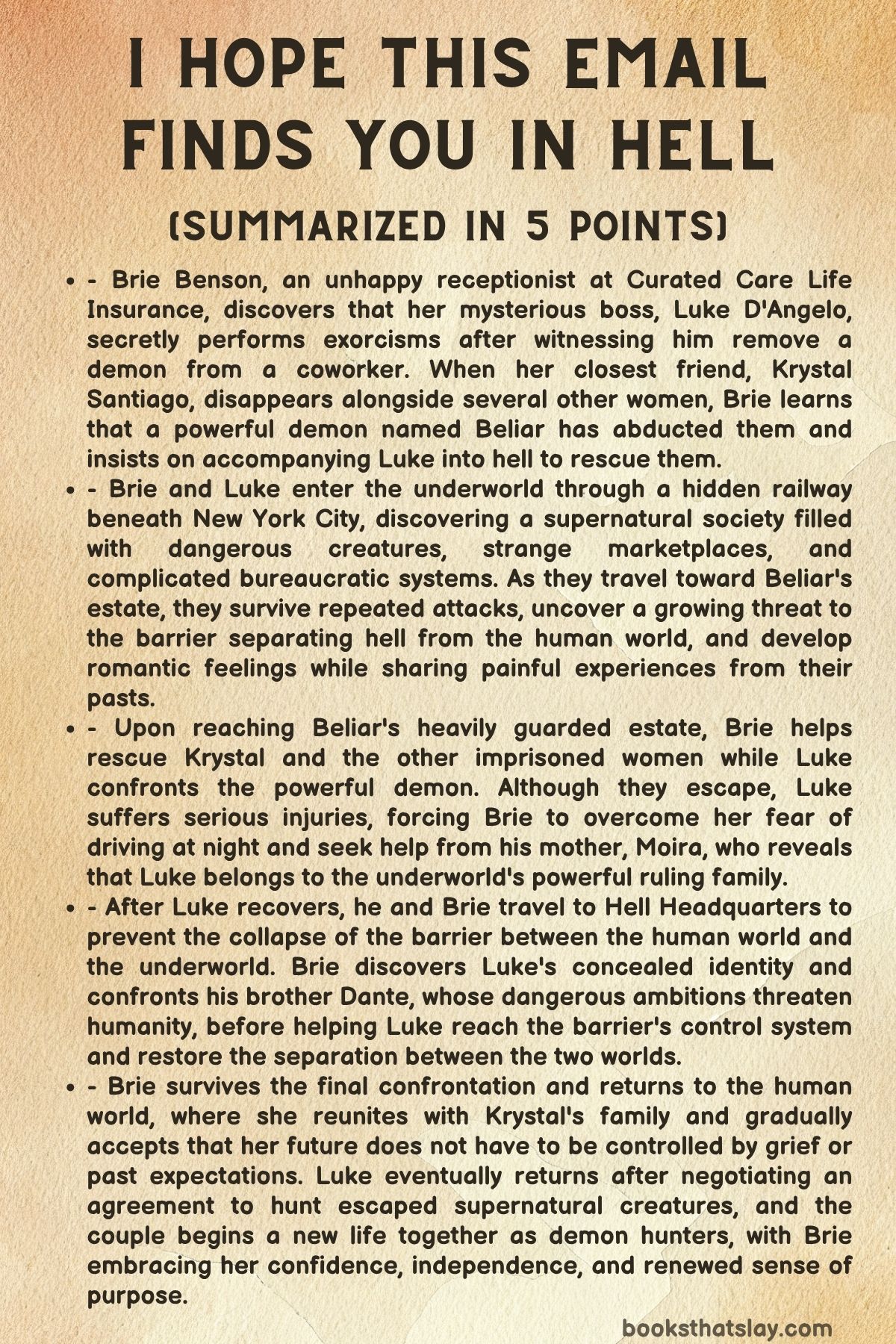
Summary
Brie Benson works as a receptionist at Curated Care Life Insurance in Tarrentown, Pennsylvania, where her days revolve around inconvenient coworkers, malfunctioning office equipment, and tasks that make her increasingly miserable. Although she presents herself as cheerful and professional, she feels disconnected from the future she once imagined.
Her closest friend at work is Krystal Santiago, a compassionate woman who repeatedly encourages Brie to become more involved in her family life. Brie appreciates Krystal’s friendship but struggles with invitations involving holidays and celebrations because they remind her of her parents’ deaths.
Brie also finds herself attracted to Luke D’Angelo, the company’s mysterious manager. His reserved personality makes him difficult to understand, although his appearance and occasional attention leave Brie wondering whether he feels anything for her.
Her ordinary routine changes when she returns to the office one evening to complete a forgotten task. Hearing strange noises from Luke’s office, she investigates and discovers him performing an exorcism on Debra, an elderly coworker whose body has been possessed by a demon.
The ritual becomes dangerous when Brie’s interruption allows the possessed woman to escape her protective enclosure. Debra attacks Brie with unnatural strength, forcing her to defend herself while Luke struggles to regain control.
Following Luke’s instructions, Brie restores a protective barrier using salt, allowing him to expel the supernatural entity. Although Debra survives, Luke invents a story about an accidental fall to explain her injuries and insists that Brie forget what she witnessed.
Unable to dismiss the experience, Brie begins researching demons and possession. Her fears intensify when she learns that several women have recently disappeared, including Poppi Parker and Madeline Valero.
The situation becomes personal when Krystal fails to return home. Her wife, Amelia, reveals that Krystal’s abandoned vehicle was discovered beneath a bridge, and Brie becomes convinced that the disappearances are connected to supernatural activity.
After learning that the missing women have experienced considerable grief, Brie suspects that someone is deliberately targeting emotionally vulnerable people. Luke’s mysterious behavior leads her to wonder whether he might be responsible.
Brie investigates Luke’s isolated home and confronts him, accusing him of being a powerful demon. Luke denies the accusations and reveals that he is hunting Beliar, a dangerous supernatural being who has abducted the missing women.
He believes Beliar is holding his victims at an estate in hell. Despite Luke’s insistence that the journey would be too dangerous, Brie refuses to abandon Krystal, whose wife and children are waiting desperately for her return.
Their situation becomes more urgent when a shapeshifting creature impersonates Luke and invades Brie’s apartment. A violent confrontation between the impostor and the real Luke confirms that Brie has attracted Beliar’s attention.
With her safety compromised, Brie accompanies Luke to New York City. Beneath the Forty-Second Street subway station, they discover a concealed passage leading to a supernatural railway that connects the human world with hell.
During the train journey, Brie learns that the underworld resembles an enormous administrative society rather than a landscape consisting entirely of fire and punishment. Human souls perform assigned labor, supernatural creatures hold positions of authority, and departments govern different territories.
The journey becomes dangerous when hostile creatures recognize Luke and attack them. After fighting their pursuers aboard the moving train, Luke and Brie escape into the underworld, where they must continue toward Beliar’s estate.
Their travels take them through strange territories, deserted settlements, dangerous marketplaces, and regions resembling distorted versions of American states. Brie discovers that hell operates through complicated rules, supernatural bargains, and deeply entrenched political hierarchies.
At a junkyard, they encounter hostile spirits and narrowly escape on a motorcycle. Their flight brings them to the Night Market, where supernatural merchants trade unusual goods and creatures from different parts of the underworld gather.
Brie learns about an approaching lunar eclipse that could weaken the barrier separating hell from the human world. A sacrifice involving human blood during this event could increase the danger, suggesting that Beliar’s abductions are connected to a much larger supernatural crisis.
Meanwhile, Brie and Luke grow emotionally closer. Their shared danger encourages them to discuss childhood memories, personal failures, and the expectations that once controlled their lives.
Brie gradually reveals that she previously attended medical school and was engaged to be married. Her parents’ deaths shattered her plans, leaving her overwhelmed by guilt and unable to continue the life she had constructed.
She also suffers from a fear of driving at night because of the circumstances surrounding their fatal accident. Instead of confronting her trauma, she abandoned her education, ended her former life in Florida, and moved away.
Luke listens without condemning her decisions. His willingness to acknowledge her suffering contrasts with the emotional pressure she experienced in her previous relationship.
Their connection strengthens further when Brie learns that Luke has endured his own struggles with family expectations and personal freedom. Although he remains reluctant to reveal his entire history, he gradually demonstrates affection through protection, encouragement, and unexpected moments of tenderness.
At a motel, they encounter Tatianna, a dangerous vampire with whom Luke previously had a complicated relationship. Her hostility makes Brie uncomfortable and reminds her that Luke continues to conceal important information about his past.
Despite the uncertainty, the two continue toward Death Valley, where Beliar’s heavily guarded estate is located. Brie develops an infiltration strategy involving an upper entrance and a servants’ staircase, earning Luke’s admiration for her intelligence.
Their plan becomes dangerous when supernatural stone guards detect them. One possesses distinctive golden eyes that remind Brie of an animal associated with her parents’ fatal accident, suggesting that the tragedy may contain unexplained supernatural elements.
Luke holds off the guards while Brie locates Krystal and the other abducted women. She finds them weak and frightened but alive, and she begins guiding them toward an escape route.
Their escape is interrupted by Beliar himself. The demon recognizes Brie as another emotionally vulnerable person and appears delighted that she has voluntarily entered his territory.
Luke confronts Beliar and prepares to sacrifice his own safety so Brie can lead the prisoners away. Before separating, he kisses her, revealing the romantic feelings that have developed between them.
Although the confrontation allows the captives to escape, Luke suffers serious injuries. Brie refuses to leave him behind and helps him into their vehicle alongside the rescued women.
With Luke losing consciousness, Brie must overcome her greatest fear and drive through the darkness. Her decision represents a personal breakthrough, demonstrating that her determination to protect others has become stronger than the trauma controlling her life.
Eventually, she reaches a remote cabin belonging to Moira, a knowledgeable woman who recognizes Luke immediately. Moira provides assistance and explains that the captives have been poisoned, leaving them in urgent need of treatment.
Because medicine is limited, Brie must consider how to give everyone a chance of survival. Moira arranges to guide the rescued women toward a passage near Santa Monica Pier, through which they may return to the human world.
Brie remains behind to care for Luke, using medical knowledge she believed she had abandoned permanently. The experience reconnects her with an important part of her former identity and allows her to recognize that her past ambitions have not become meaningless.
Moira also reveals that she is Luke’s mother and that his brother was responsible for banishing him from the underworld. Brie begins to understand that Luke belongs to a powerful supernatural family whose internal conflicts influence the fate of both worlds.
As Luke recovers, their relationship becomes openly romantic. He confesses that his behavior at Curated Care sometimes concealed his attraction to Brie, while she acknowledges that she has developed genuine feelings for him.
They share an intimate encounter and begin imagining an ordinary future together, including a promised movie date. For Brie, their growing relationship offers the possibility of happiness without denying the pain she has experienced.
However, their mission remains unfinished because the barrier between the worlds is still deteriorating. They travel to the underworld’s version of Silicon Valley, where Hell Headquarters controls the administrative systems maintaining the separation.
To infiltrate the building, they obtain enchanted masks from a merchant named Chryser. The masks provide disguises but carry a dangerous curse: if worn beyond midnight, they will become permanently attached.
Inside Hell Headquarters, Brie and Luke attend an extravagant masked gathering. While exploring the building, Brie notices a portrait depicting a powerful supernatural ruler who resembles Luke.
The discovery exposes the extent of his concealed identity and leaves Brie feeling betrayed. Before they can resolve their disagreement, she is pursued through the headquarters and eventually captured.
When Brie awakens imprisoned beside Luke, he explains more about his previous responsibilities within the underworld’s government. His duties involved administration, political obligations, dangerous assignments, and acts that challenged his conscience.
Their conversation is interrupted by Luke’s brother, Dante, one of hell’s powerful rulers. Dante reveals his fascination with the human world and explains that he has considered allowing the weakening barrier to collapse.
Rather than viewing the merger of both worlds as a disaster, Dante sees it as an opportunity for expansion and change. Luke recognizes that such an event would expose humanity to devastating supernatural violence.
Brie refuses to remain powerless during the confrontation. Using an obsidian dagger, she frees herself and challenges Dante, helping Luke gain an opportunity to reach the machinery controlling the barrier.
Their route leads through an apparently ordinary office filled with supernatural creatures determined to stop them. Brie and Luke fight through the defenders until they finally reach the control system.
The machinery reminds Brie of the unreliable fax machine at Curated Care. Applying her practical workplace experience, she suggests turning the system off and restarting it.
Although Luke initially fears the consequences, the approaching supernatural event leaves them with limited alternatives. Their efforts create an opportunity to restore the barrier, but Brie is critically injured during the struggle.
Desperate to save her, Luke negotiates with Dante. In exchange for permission to return to the human world, he agrees to hunt the dangerous supernatural creatures that have already escaped.
Brie survives and returns to a life that now feels entirely different. She reconnects with Krystal, Amelia, and their children, finding reassurance in the ordinary happiness she helped preserve.
Luke’s temporary absence leaves her uncertain about their relationship, although a letter he leaves behind expresses affection and regret for his deception. When he eventually returns, they acknowledge that neither wants to lose the other.
Brie chooses to accompany Luke on his new assignment rather than return to her former existence. She also insists on driving, demonstrating that she is no longer willing to let fear determine her choices.
Five months later, the couple is working together as supernatural hunters. During an assignment in Miami, Brie helps Luke confront a dangerous demon, using her intelligence, concealed weapons, and growing confidence to defeat their enemy.
Their successful partnership confirms how profoundly their lives have changed. Brie has discovered a new sense of purpose, while Luke has found someone who encourages him to build a future beyond the expectations of his supernatural family.
Characters
Brie Benson
Brie Benson is the central protagonist of I Hope This Email Finds You in Hell, and her transformation provides the emotional foundation of the novel. Initially introduced as an unhappy insurance company receptionist, she is intelligent, sarcastic, compassionate, and deeply dissatisfied with the direction her life has taken.
Her outward humor conceals substantial emotional suffering. Before the deaths of her parents, Brie was studying medicine and preparing for marriage, believing that following a carefully established plan would guarantee happiness.
The tragedy destroyed her sense of stability and left her burdened by guilt. Her fear of driving at night becomes a particularly significant manifestation of her trauma, reminding her that she has allowed one devastating experience to influence nearly every important decision afterward.
Brie’s relationship with Krystal demonstrates her capacity for loyalty and affection. Although she frequently withdraws from personal connections, she refuses to abandon her friend when Krystal disappears, even after discovering that rescuing her requires entering hell.
Her courage is particularly notable because she possesses none of Luke’s supernatural advantages. Instead, she survives through observation, determination, humor, practical knowledge, and an ability to remain resourceful under extreme pressure.
Brie’s growing relationship with Luke also encourages her to reconsider her understanding of love. Unlike her former fiancé, Luke eventually respects her intelligence, acknowledges his mistakes, and recognizes her independence.
However, she does not simply become confident because someone falls in love with her. Her development comes from repeated decisions to confront danger, protect others, and recognize that her former identity does not have to determine her future.
Her use of medical knowledge to save Luke represents a meaningful reconciliation with the life she abandoned. Similarly, her willingness to drive at night demonstrates that fear can remain present without controlling her actions.
By the conclusion, Brie has become a capable supernatural hunter who actively shapes her own future. Her development establishes her as a protagonist defined not by the tragedy she experienced but by the decisions she makes afterward.
Luke D’Angelo
Luke D’Angelo serves as the male romantic lead in I Hope This Email Finds You in Hell, initially appearing to be an attractive but emotionally distant insurance company manager. His mysterious behavior conceals an extraordinary history involving supernatural authority, political conflict, and exile from the underworld.
His first major revelation occurs when Brie discovers him performing an exorcism. Although his competence and composure suggest considerable experience, he refuses to explain his background, establishing secrecy as one of his defining characteristics.
Luke frequently attempts to protect others by keeping them uninformed or excluding them from danger. While these decisions originate partly from genuine concern, they also reveal his difficulty trusting people and sharing responsibility.
His behavior toward Brie gradually changes during their journey. What begins as frustration with her insistence on accompanying him develops into admiration for her courage, problem-solving abilities, and emotional honesty.
Luke’s family history adds substantial complexity to his character. Having grown up within a powerful supernatural hierarchy, he understands the brutality and rigid expectations that govern the underworld.
His banishment represents both punishment and liberation. Although he loses his former position, he gains an opportunity to explore the human world and reconsider the responsibilities imposed upon him.
His conflict with Dante demonstrates his moral independence. Despite participating in the underworld’s administrative and violent systems, Luke increasingly rejects the idea that power justifies cruelty.
Romantically, Luke must learn that affection requires honesty rather than constant protection. His concealment of his identity nearly destroys Brie’s trust, and their reconciliation depends on his willingness to acknowledge the harm caused by his secrecy.
By accepting Dante’s agreement to hunt escaped demons, Luke chooses a purpose consistent with his developing conscience. His relationship with Brie allows him to imagine a life in which responsibility and personal happiness can coexist.
Krystal Santiago
Krystal Santiago is one of the most emotionally significant supporting characters in I Hope This Email Finds You in Hell. As Brie’s closest workplace friend, she represents the compassion, belonging, and human connection that Brie has struggled to accept since her parents’ deaths.
Krystal’s kindness is demonstrated through ordinary gestures, particularly her invitation for Brie to spend Thanksgiving with her family. She understands that Brie is lonely and attempts to provide companionship without forcing her to explain every painful memory.
Her personal history contains considerable suffering. Krystal previously struggled with addiction, and the overdose death of her younger sister, Shania, became a turning point in her life.
After seeking treatment and achieving sobriety, Krystal built a family with Amelia. Her recovery demonstrates resilience and establishes her as someone who understands the difficulties of rebuilding a life after loss.
Her disappearance provides the primary motivation for Brie’s journey into the underworld. Although Krystal is physically absent during much of the adventure, her importance remains central because Brie repeatedly measures danger against the possibility of bringing her home.
The revelation that Beliar targets individuals carrying grief and guilt also connects Krystal’s personal history to the supernatural conflict. Her suffering makes her vulnerable to exploitation by a creature that recognizes emotional pain as a weakness.
Krystal’s eventual rescue restores more than an individual life. It preserves her family and demonstrates the importance of relationships built through love, patience, and mutual support.
Through Krystal, the novel presents friendship as a relationship capable of inspiring extraordinary sacrifice. She also represents the possibility that people who have experienced profound suffering can eventually create stable and fulfilling lives.
Amelia
Amelia is Krystal’s wife and an important representation of the ordinary human relationships endangered by supernatural violence. Her distress following Krystal’s disappearance gives immediate emotional significance to the central rescue mission.
As the person waiting for Krystal to come home, Amelia reveals the consequences of Beliar’s actions beyond the immediate suffering of his captives. The disappearance threatens the stability of an entire family, including the lives of their children.
Her conversations with Brie provide important information about Krystal’s history of addiction, recovery, and bereavement. These revelations deepen Brie’s understanding of her friend’s experiences and help establish a possible connection among the missing women.
Amelia also represents a kind of committed domestic love that contrasts with Brie’s uncertainty about her own future. Her relationship with Krystal demonstrates the possibility of building lasting happiness after difficult experiences.
Although Amelia does not participate in the journey through hell, her presence influences Brie’s decisions throughout the story. Every risk Brie accepts carries the possibility of restoring Amelia’s family.
Her reunion with Krystal reinforces the human value of the rescue. Through Amelia, the consequences of supernatural cruelty remain grounded in recognizable experiences of fear, love, and responsibility.
Beliar
Beliar is the principal antagonist behind the disappearances that initiate Brie’s journey. As a powerful supernatural being, he exploits grief, guilt, and emotional vulnerability to identify and abduct human victims.
His selection of women who have experienced profound personal suffering demonstrates his predatory understanding of human psychology. Rather than targeting people randomly, he seeks individuals whose pain makes them especially desirable for his purposes.
Beliar’s estate in Death Valley represents his power and authority within the underworld. Its supernatural guards, imprisoned captives, and elaborate defenses establish him as someone accustomed to operating without meaningful resistance.
His encounter with Brie is particularly revealing because he treats her voluntary arrival as an unexpected opportunity. He recognizes her emotional suffering and assumes that entering his territory places her under his control.
Beliar’s cruelty also connects individual disappearances to the larger crisis involving the barrier between worlds. The possibility of blood sacrifice during the approaching eclipse suggests that his activities threaten more than the women he abducts.
As an antagonist, he embodies exploitation rather than ordinary personal conflict. His power depends on treating the suffering of others as a resource to be collected and used.
His confrontation with Brie and Luke highlights their opposing values. Where Beliar treats vulnerability as an opportunity for domination, the protagonists increasingly understand it as a reason to offer protection and compassion.
Dante
Dante is one of the most consequential characters in I Hope This Email Finds You in Hell, serving as Luke’s brother and a powerful ruler within the underworld. His position gives him extraordinary authority over the supernatural administration and the systems regulating interactions between worlds.
His personality combines intelligence, arrogance, curiosity, and an unsettling willingness to embrace destruction. Unlike Beliar, whose actions are openly predatory, Dante presents dangerous ambitions through political authority and the language of possibility.
His fascination with the human world influences his attitude toward the weakening barrier. Rather than repairing the damage immediately, he considers merging the two realms, despite the widespread suffering such an event could cause.
Dante’s relationship with Luke exposes a fundamental disagreement about responsibility. Both brothers understand supernatural power, but they interpret its obligations differently.
Luke increasingly believes that authority should prevent unnecessary harm, while Dante appears willing to endanger others to satisfy his ambitions. Their disagreement also reflects the personal resentments and expectations that shaped their family history.
Dante’s reaction to compassion reveals another important dimension of his character. When asked to spare Brie and Luke, he worries that mercy will undermine his reputation among those he rules.
This fear suggests that his cruelty is partly sustained by political insecurity. Despite his extraordinary authority, he remains concerned about appearing weak.
His eventual agreement with Luke demonstrates that he can negotiate when circumstances demand it. Nevertheless, his decisions remain shaped by the need to preserve power and control.
Moira
Moira appears as a knowledgeable and compassionate figure when Brie is desperately searching for help after escaping Beliar’s estate. Her isolated cabin becomes a temporary sanctuary for the wounded Luke and the rescued women.
Her medical supplies and understanding of supernatural conditions make her essential to their survival. She recognizes the poisoning affecting Beliar’s captives and explains the difficult limitations of the available treatment.
Moira’s willingness to assist contrasts with the hostility and self-interest displayed by many supernatural inhabitants. She responds to suffering with practical care rather than attempting to exploit vulnerability.
Her significance increases when Brie discovers that she is Luke’s mother. This revelation connects Moira to the underworld’s ruling family and establishes her as someone familiar with its political conflicts.
Through Moira, Brie learns that Luke’s banishment resulted from a complicated family struggle. Her information helps transform his mysterious past into a more understandable conflict involving authority, responsibility, and personal freedom.
Moira also demonstrates maternal concern without completely controlling her son’s decisions. She supports the rescue effort while allowing Brie to remain responsible for Luke’s recovery.
Her character provides an important example of compassion existing within a world associated primarily with punishment and cruelty.
Tatianna
Tatianna is a dangerous vampire whose relationship with Luke introduces tension into the developing romance. Her confident manner, hostility, and familiarity with his past immediately unsettle Brie.
Her history with Luke is complicated by violence and political circumstances. The revelation that she previously attempted to kill him demonstrates that their relationship cannot be understood as an ordinary former romance.
Tatianna’s appearance also reveals how little Brie knows about Luke’s life before Curated Care. Her familiarity with his weapons and supernatural connections highlights the difference between the person Brie knows and the powerful figure he once was.
Her treatment of Brie is dismissive and provocative. By implying that Brie is merely another temporary romantic interest, she attempts to undermine her confidence and emotional security.
However, Tatianna’s comments inadvertently encourage Brie to examine her feelings more carefully. Brie’s discomfort reveals that she has developed expectations and hopes extending beyond professional friendship.
Tatianna also helps establish the dangerous political environment surrounding Luke. Her connections, hostility, and references to Beliar suggest that his past relationships remain entangled with powerful supernatural interests.
Although she eventually allows the couple to leave, her presence demonstrates that escaping a former life does not necessarily eliminate its consequences.
Hazaar
Hazaar is a mysterious supernatural merchant whom Brie encounters during her dangerous separation from Luke at the Night Market. His shop offers temporary protection and access to unusual knowledge that proves important to her survival.
Like many inhabitants of the underworld, Hazaar operates within a society where bargains carry significant consequences. His interactions with Brie therefore require her to exercise caution, intelligence, and an understanding of unfamiliar rules.
His recognition of something distinctive about Luke suggests that he knows more about the manager’s past than Brie does. This reaction contributes to the gradual revelation that Luke once possessed considerable status in hell.
Hazaar also provides an example of the underworld’s complicated moral landscape. Not every supernatural creature is immediately hostile, but apparent assistance does not necessarily guarantee complete safety.
Brie’s ability to negotiate with him demonstrates her increasing independence. Rather than relying entirely on Luke to explain or control every encounter, she begins using her own judgment.
Hazaar’s warnings about the approaching dawn also create urgency, reminding the characters that supernatural spaces operate according to dangerous conditions that humans may not instinctively understand.
Badulf
Badulf is one of the hostile supernatural creatures pursuing Brie and Luke during their journey through hell. Initially distinguished by his denim clothing, he becomes a recurring threat whose persistence reinforces the dangers awaiting the protagonists.
His survival after the violent train confrontation demonstrates that supernatural enemies cannot necessarily be defeated through ordinary physical means. Brie discovers this when she encounters him again at the Night Market.
Badulf’s pursuit forces Brie to act independently in an unfamiliar environment. Her attempts to distract him through sarcasm and escape through crowded passageways demonstrate both her personality and improving survival instincts.
His connection to Luke’s enemies also suggests that the manager’s concealed past has consequences extending beyond his immediate family. Various supernatural beings possess reasons to recognize or confront him.
Although Badulf receives less psychological exploration than the central antagonists, he contributes to the novel’s atmosphere of persistent danger. His repeated appearances prevent the journey from becoming a straightforward rescue operation.
Debra
Debra is an elderly Curated Care employee whose demonic possession initiates Brie’s involvement in the supernatural world. Before the incident, Brie primarily views her as an irritating coworker who repeatedly delays sending essential reports.
Her transformation into a violent possessed creature creates an unsettling contrast between familiar office life and supernatural horror. The same woman associated with frustrating administrative tasks suddenly becomes capable of extraordinary strength and cruelty.
Importantly, Debra herself is not presented as willingly responsible for the attack. She becomes the victim of an invading entity that uses her body to threaten others.
Luke’s decision to conceal the exorcism from her reinforces the secrecy surrounding supernatural activity. Brie also supports the invented explanation while remaining concerned about Debra’s physical condition.
Debra’s role is significant because she establishes how easily supernatural danger can enter apparently ordinary environments. Her experience reveals that the barrier protecting the human world is already vulnerable.
Poppi Parker and Madeline Valero
Poppi Parker and Madeline Valero are two of the missing women whose disappearances help Brie identify the pattern behind Beliar’s activities. Their personal histories establish that his victims are connected through experiences of grief, vulnerability, or serious emotional hardship.
Poppi’s history of substance addiction initially makes her disappearance appear explainable through ordinary assumptions. However, the larger pattern reveals the danger of dismissing vulnerable individuals because of their circumstances.
Madeline’s experience of personal loss further supports Brie’s suspicion that the disappearances are linked. Together, their cases demonstrate that Beliar deliberately chooses people carrying emotional suffering.
Both women eventually appear among the captives at his estate, confirming the supernatural explanation behind their disappearances. Their weakened condition demonstrates the physical and psychological consequences of his imprisonment.
Although they receive less individual attention than Krystal, they broaden the moral significance of the rescue mission. Brie is not simply saving someone she knows but helping several women whose suffering has been exploited.
Shonda
Shonda is a performer who provides assistance to Brie during dangerous encounters in the underworld. Her involvement becomes particularly important when Brie encounters her again while attempting to escape through Hell Headquarters.
As someone familiar with supernatural environments and performance spaces, Shonda possesses practical knowledge that Brie lacks. Her willingness to assist offers brief moments of cooperation amid widespread hostility.
The aerial silks and equipment associated with Shonda’s performance provide Brie with an opportunity to evade pursuing guards. This encounter demonstrates how unexpected relationships and ordinary-looking objects can become useful during a supernatural crisis.
Shonda’s character also helps establish that the underworld contains individuals with distinct occupations, personalities, and loyalties rather than a uniform population of enemies.
Chryser
Chryser is a supernatural merchant who supplies Brie and Luke with masks for their infiltration of Hell Headquarters. The disguises allow them to enter an exclusive gathering without immediately exposing their identities.
However, the masks carry a dangerous curse that makes them impossible to remove after midnight. Chryser’s warning establishes a strict deadline and creates an additional source of tension during the infiltration.
His role demonstrates the dangerous relationship between usefulness and risk in supernatural commerce. Objects that provide significant advantages may also impose consequences that are difficult or impossible to reverse.
Chryser contributes to the novel’s depiction of hell as a place governed by specialized businesses, magical transactions, and unusual contractual conditions.
Esmar
Esmar is the supernatural employee responsible for assisting travelers at the concealed railway entrance beneath New York City. Her initial refusal to provide tickets establishes the importance of authority and procedure in underworld transportation.
Luke’s use of an ancient language frightens her into cooperating, revealing that he possesses knowledge or status capable of influencing supernatural inhabitants.
Through Esmar, Brie first encounters the bureaucratic structure governing travel between worlds. The episode introduces the strange similarity between ordinary customer-service frustrations and the administrative systems of hell.
Although her appearance is brief, Esmar helps establish that supernatural society functions through rules, employees, hierarchy, and recognizable institutional procedures.
Brie’s Parents
Brie’s deceased parents remain central to the novel despite their absence from the present-day action. Their deaths explain much of her emotional withdrawal, abandoned education, and difficulty imagining a fulfilling future.
The fatal accident has become the defining event through which Brie evaluates her choices. Her recurring nightmares and fear of driving at night reveal how deeply the experience has affected her.
A ring they gave her for graduation serves as a tangible connection to the life she once shared with them. It also reminds her of the ambitions and personal identity she developed before their deaths.
Their influence becomes especially significant when supernatural details appear connected to the accident. The golden-eyed creature at Beliar’s estate and changes in Brie’s nightmares suggest that her understanding of the tragedy may be incomplete.
Throughout the story, Brie’s recovery does not depend on forgetting her parents. Instead, she gradually learns to preserve their importance while allowing herself to build a new life.
Brie’s Former Fiancé
Brie’s former fiancé represents the rigid expectations and unhealthy emotional patterns associated with her previous life. Although he is not directly involved in the underworld adventure, his continuing attempts to contact her demonstrate that the past remains difficult to escape.
Brie’s reflections suggest that she frequently prioritized his expectations and accepted an unequal approach to disagreements. She recalls that he rarely acknowledged mistakes or accepted responsibility for his behavior.
This history helps explain why Luke’s eventual apologies affect her so strongly. She is unaccustomed to receiving sincere recognition of her feelings from a romantic partner.
Her former relationship also reflects her earlier tendency to measure success through an externally approved future. Marriage, medical education, and an established life once appeared to offer security, even when her personal desires were not fully considered.
The contrast between her former fiancé and Luke reinforces her developing understanding that healthy relationships require mutual respect, honesty, and independent choice.
Themes
Grief, Guilt, and Emotional Recovery
Grief shapes the emotional experiences of several major characters, particularly Brie and Krystal. Their histories demonstrate how devastating losses can influence identity, relationships, and the ability to imagine happiness.
For Brie, her parents’ deaths represent more than a painful memory. The tragedy destroys her confidence in the future, interrupts her medical education, and leaves her unable to participate comfortably in ordinary activities that remind her of family life.
Her recurring nightmares reveal that she has never fully processed the accident. Her fear of driving at night becomes an especially significant expression of guilt because it transforms an ordinary activity into a reminder of helplessness and loss.
Krystal’s history provides a contrasting example of grief and recovery. After losing her sister Shania to an overdose, she seeks treatment for her own addiction and eventually builds a stable family with Amelia.
The parallel between the two women demonstrates that recovery does not occur according to a single pattern. Krystal has developed a supportive domestic life, while Brie remains emotionally isolated despite her professional routine.
Beliar’s decision to target grieving individuals adds a supernatural dimension to the theme. He exploits the emotional injuries that make people vulnerable, treating their suffering as something useful rather than deserving compassion.
In I Hope This Email Finds You in Hell, recovery emerges through action, connection, and the willingness to confront painful memories. Brie’s eventual decision to drive at night demonstrates that healing does not require the complete disappearance of fear.
Her return to medical work while caring for Luke also reconnects her with ambitions she believed were permanently lost. By the ending, she has not forgotten her parents or erased her grief, but she has developed a life in which their deaths no longer determine every possibility.
Freedom, Identity, and the Pressure of Expectations
Brie and Luke begin the story trapped by different forms of obligation. Although their circumstances are radically different, both have spent significant portions of their lives attempting to satisfy expectations established by other people.
Brie’s earlier ambitions were shaped by a conventional understanding of success. Medical school, marriage, and a carefully organized future appeared to offer certainty, but she eventually recognizes that she did not always distinguish her own desires from the approval she sought.
After losing her parents, she abandons these plans without replacing them with an independent sense of purpose. Her receptionist position provides routine and stability, but it does little to restore her confidence or personal fulfillment.
Luke faces a comparable problem within the underworld’s ruling hierarchy. His family background places him within a powerful administrative system where duty, political loyalty, and obedience restrict individual freedom.
His banishment allows him to experience the human world, but it does not immediately eliminate the habits developed through years of responsibility. He continues concealing information, controlling decisions, and treating emotional attachment as a potential weakness.
Their journey forces both characters to challenge these assumptions. Brie becomes increasingly capable of making independent decisions, while Luke learns that genuine partnership requires allowing another person to share responsibility.
The conflict with Dante provides a political expression of the same theme. Dante possesses enormous power but remains trapped by his concern for authority, reputation, and appearances.
Freedom in the novel therefore involves more than escaping external control. It requires identifying personal values and accepting responsibility for choices that may contradict expectations.
Brie’s decision to become a supernatural hunter illustrates this development. She no longer measures her future against the plans she once abandoned, instead choosing a life that reflects her abilities, relationships, and willingness to confront danger.
Love, Trust, and Emotional Vulnerability
The romance between Brie and Luke develops through a gradual movement from suspicion toward emotional openness. Their relationship begins under unusual circumstances, with Brie attracted to Luke while simultaneously wondering whether he might be a dangerous supernatural creature.
Luke’s secrecy initially prevents genuine trust. Even after he reveals the existence of demons and the underworld, he continues withholding information about his identity, family, and political history.
His guarded behavior reflects a belief that emotional distance provides protection. Having experienced dangerous relationships and family conflict, he struggles to understand how much honesty another person deserves.
Brie approaches romance with different but equally significant difficulties. Her former engagement left her accustomed to prioritizing another person’s expectations, making her uncertain about expressing disagreement or demanding emotional accountability.
As they travel together, physical danger creates opportunities for meaningful communication. Their conversations about grief, personal disappointments, and family expectations gradually reveal vulnerabilities that neither comfortably shares with others.
Luke’s willingness to apologize becomes a particularly important turning point. Brie recognizes that he can acknowledge wrongdoing without turning disagreement into an attempt to control her.
However, I Hope This Email Finds You in Hell does not present attraction as a substitute for trust. When Brie discovers Luke’s concealed identity, she experiences genuine betrayal despite the affection they have developed.
Their eventual reconciliation requires Luke to acknowledge the consequences of his dishonesty. It also requires Brie to decide whether trusting him again is consistent with her own emotional needs.
Their final partnership demonstrates a healthier balance between independence and intimacy. Neither character must surrender personal agency to maintain the relationship.
Love becomes meaningful because it encourages both individuals to behave more honestly, accept their vulnerabilities, and imagine a future based on mutual respect rather than obligation.
Bureaucracy, Power, and the Absurdity of Institutional Life
The underworld’s resemblance to a modern bureaucratic organization creates much of the novel’s humor while supporting its criticism of rigid institutions. Hell is not simply a place of supernatural punishment but a vast administrative society divided into departments, labor systems, and hierarchical responsibilities.
Brie’s experience at Curated Care prepares her unexpectedly well for this environment. Her familiarity with irritating procedures, difficult colleagues, and unreliable equipment gives her a practical understanding of institutional problems.
The similarity between the insurance office and the underworld suggests that frustrating bureaucracy can become a recognizable form of everyday suffering. Rather than constructing a completely unfamiliar supernatural landscape, the story exaggerates systems that readers may already recognize.
The Department of Mining, Customer Support Department, supernatural ticket counters, and Hell Headquarters demonstrate how administrative structures shape even extraordinary environments. These institutions maintain order but also reinforce inequality and concentrate authority.
Dante embodies the danger of leadership disconnected from accountability. His willingness to consider merging the human world with hell reveals how powerful individuals can treat catastrophic consequences as abstract political possibilities.
Luke provides an alternative perspective through his rejection of unquestioning obedience. His experience within the ruling hierarchy allows him to recognize that an established system does not automatically deserve loyalty.
The climax transforms this institutional criticism into comedy when the machinery controlling the barrier between worlds resembles ordinary malfunctioning office equipment. Brie’s suggestion to restart the system applies a familiar workplace solution to an apparently impossible supernatural problem.
This moment also challenges assumptions about expertise and authority. Luke possesses extraordinary knowledge, but Brie’s ordinary practical experience becomes essential to their success.
Ultimately, the novel suggests that institutions can become so complicated and self-important that they lose sight of their fundamental responsibilities. Brie’s success demonstrates the value of clear thinking, adaptability, and individual initiative in confronting systems maintained by fear, hierarchy, and habit.