If Only I Had Told Her Summary, Characters and Themes
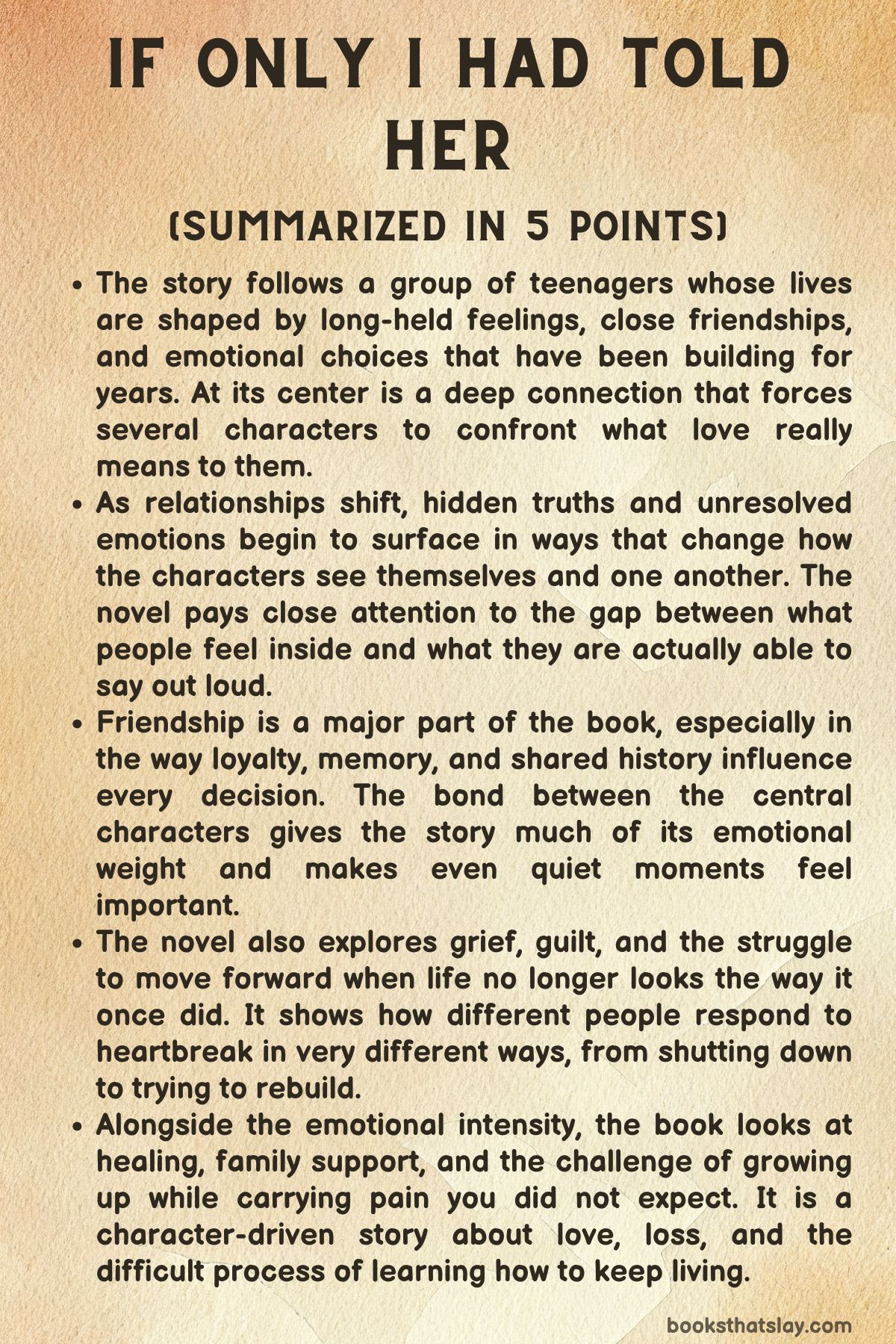
If Only I Had Told Her by Laura Nowlin is a contemporary young adult novel about love, regret, grief, and the lives that are changed by one irreversible night. The story follows three teenagers—Finn, Jack, and Autumn—whose friendship carries years of longing, missed chances, and emotional confusion.
What begins as a story of hidden feelings and finally spoken love becomes a story about loss and the hard work of surviving it. Through shifting points of view, the novel looks at how people carry guilt, remember the dead, and try to keep going when the future they imagined disappears.
Summary
Finn has loved Autumn for most of his life. Their families are close, they grew up side by side, and she has always occupied a central place in his thoughts.
Even while dating Sylvie, Finn never fully let go of what he felt for Autumn. At the start of the story, he wakes after a night spent with Autumn and Jack, feeling both desire and shame.
Sylvie is returning from Europe soon, and Finn knows he has reached a breaking point. He intends to end his relationship with Sylvie, not because he is certain Autumn will choose him, but because he can no longer live dishonestly.
As Finn spends time with Autumn, old memories return. When they were younger, he once kissed her without understanding how frightened and unprepared she was.
That moment damaged their closeness and left him convinced that she did not love him back. Even so, the connection between them never fully disappeared.
Now that they are close again, Finn reads the novel Autumn has written and begins to understand that she has seen his love all along. In the story she wrote, he recognizes versions of them both, and this gives him the courage to ask what really happened between them years ago.
Autumn explains that when he kissed her in middle school, she was overwhelmed and scared. She also admits that she became caught up in social status and the attention she received from others, and that she distanced herself from him partly because of that.
What Finn had seen as rejection was more complicated. As they talk honestly for perhaps the first time, the years of confusion between them begin to clear.
Finn asks if he can kiss her again. This time she says yes.
They sleep together, and afterward Autumn tells him she loves him. Finn feels that everything he has wanted for years has finally come true.
Their happiness is intense and immediate. They look back on moments from childhood and adolescence, seeing new meaning in things they once misunderstood.
Autumn admits that she has loved him too, and they decide they will finally be together. Yet there is a problem they cannot avoid: Finn is still with Sylvie.
Autumn worries about the timing and asks him to wait until the next day, but Finn insists he must end things right away. He believes that delaying would be unfair to Sylvie.
He leaves Autumn with promises about the future, certain that after one difficult conversation he will return to her and begin the life they have both wanted.
Before going to Sylvie’s house, Finn buys condoms and Autumn’s favorite candy. These small purchases reflect how fully he has already entered his imagined future with Autumn.
But when he arrives, the meeting with Sylvie goes badly from the start. Sylvie already knows far more than he expected.
Throughout the summer, people had seen Finn and Autumn together and passed information back to her. She has questions prepared, and the confrontation quickly turns raw.
Finn admits he slept with Autumn. The argument forces him to face truths he has avoided: he did love Sylvie in some way, but not in the same complete, consuming manner that he loves Autumn.
The fight becomes more heated as Sylvie tries to understand whether she was ever truly chosen. Finn says things that cut deeply, especially when he describes his bond with Autumn as something essential and soul-deep.
Sylvie wants to get out of the car. In the chaos, Finn loses control while driving in the rain.
The crash throws Sylvie from the vehicle. Finn tries to reach her, but he is electrocuted when he exits the car.
He dies almost instantly. In a single moment, the future he imagined with Autumn disappears, and everyone connected to him is left to make sense of what remains.
The second part of the novel shifts to Jack, Finn’s best friend. Jack initially cannot believe that Finn is dead.
Once the truth settles in, his grief is immediate and disorienting. He moves through the rituals that follow death—the gathering of friends, the memorial, the funeral—while feeling angry at the falseness around him.
Many people mourn Finn publicly, but Jack feels that few of them really knew him. He also knows the truth of Finn’s final day and chooses not to expose it.
In Jack’s mind, Finn made one terrible mistake, but he does not want that mistake to define him forever.
Jack becomes an observer of everyone else’s grief. He sees Autumn at the funeral home speaking to Finn’s casket and saying she loves him.
He sees that she is shattered in a way others do not fully understand. He also sees Sylvie, physically bruised but alive, struggling with memory loss around the accident.
Jack begins to question details of the crash, wondering how it happened and why Sylvie was not wearing a seatbelt. Yet even when these questions trouble him, he cannot bring himself to turn her into the villain of the story.
Grief makes blame tempting, but it does not provide peace.
As time passes, Jack goes to college, where every milestone is shadowed by Finn’s absence. They were supposed to share this next stage of life.
Jack keeps replaying memories, trying to hold on to pain because he fears that letting it fade would mean losing Finn again. Eventually he begins to understand that grief cannot stay frozen forever.
Through running, studying, and an unexpected friendship with his roommate Brett—who has also lost someone close—Jack starts to see that remembering Finn does not require constant suffering. Memory can survive even when the sharpest edge of grief softens.
Jack’s bond with Autumn becomes important after he returns home and sees how badly she is coping. She is living almost inside a fantasy where Finn is still near her.
Soon Sylvie tells Jack that Autumn has tried to die by suicide. When Jack visits her in the hospital, he brings the bag of candy Finn had bought the night he died.
There Autumn reveals that she is pregnant with Finn’s child. The news changes the shape of their grief.
The baby is now another living connection to Finn, and Jack realizes Autumn needs support rather than judgment. Although he has blamed her in some ways for what happened, he cannot ignore that she is carrying part of Finn’s future.
The final section follows Autumn as she faces pregnancy, depression, and the challenge of staying alive after losing the person she loved. She moves through doctor visits, shopping trips, therapy, and group counseling while feeling disconnected from her body and from the baby.
Her mother Claire and Finn’s mother Angelina surround her with practical care, hoping to give her reasons to keep going. Autumn often struggles to feel excited, but small moments begin to shift something in her.
She reads about pregnancy, thinks seriously about the kind of parent she wants to be, and starts to imagine a life that is not only defined by death.
Other people help widen her view of survival. Her friend Angie, already a young mother, speaks honestly about how difficult parenthood can be and tells Autumn she needs a reason to live beyond the baby alone.
In therapy, Autumn meets Brittaney, whose painful life story reminds her that suffering takes many forms and that fear is a constant part of loving a child. These conversations do not erase Autumn’s grief, but they help her see that endurance is possible.
She does not need to become cheerful or fully healed to continue.
Autumn also has to deal with Finn’s father, John, who was largely absent from Finn’s life. At first he represents another source of pain, but their meeting becomes more meaningful than she expects.
He gives her control of the trust fund he had set up for Finn and asks only to hear stories about his son. Together they begin gathering memories and photographs for the baby.
In this way, Autumn starts building a record of Finn that will outlast grief and guilt.
A major turning point comes during the ultrasound, when Autumn sees the baby moving and understands more fully that this child is not merely a reminder of loss. She is the continuation of something real between her and Finn.
Autumn learns she is having a girl, but she also finds out there is a problem with the baby’s heart. This news renews her fears, yet by now she is beginning to think like a mother.
She is frightened, but she is also attached, protective, and willing to face uncertainty.
By Thanksgiving, Autumn has not stopped grieving, but she has changed. She has forgiven some people from her past, accepted support from others, and decided to shape her life around those who truly loved Finn or who help her move toward something steadier.
Jack remains in her life, and even Sylvie has found a way to connect with them without bitterness taking over completely. The novel ends with Autumn still living inside loss, but no longer destroyed by it.
She carries Finn with her, not as a dream that can return, but as a love that has altered her forever and will continue through their daughter.
Characters
Finn
Finn is the emotional center of the first part of If Only I Had Told Her, and his character is built around longing, idealization, and inner conflict. He has loved Autumn for years, and that love has shaped the way he understands himself, his relationships, and even his future.
What makes Finn compelling is that his feelings are not casual or temporary; they have become part of his identity. He sees Autumn as the person who has always mattered most, and because of that, every other choice in his life is measured against what he feels for her.
His emotional intensity gives him sincerity, but it also gives him a dangerous lack of balance. He is capable of deep devotion, yet that same devotion makes him justify decisions that hurt other people.
One of Finn’s most important traits is that he confuses emotional truth with moral correctness. He believes that because his love for Autumn is real and longstanding, acting on it must also be right.
This is why he can admit guilt over Sylvie and still feel that he is being loyal to something “bigger.” He is not a cruel person, and that is what makes his mistakes more tragic. He does care about Sylvie, and he does understand that she deserves honesty, but he places the emotional power of his bond with Autumn above the responsibility he owes to the person he is currently with.
His tragedy comes from this split between sincerity and selfishness. He does not set out to destroy anyone, yet he causes great damage because he lets feeling override judgment.
Finn is also defined by memory. He carries the past with unusual force, especially the kiss from middle school and the years of distance that followed.
He has built an entire emotional history around what he believes Autumn felt and did not feel, and this history determines how he moves through the present. When he learns that he misunderstood her more than he realized, it feels to him like the world has finally opened.
That revelation explains his rush toward happiness. Once he believes Autumn loves him too, he gives himself over completely to the idea that life is at last becoming what it should have been all along.
This gives his final hours a painful brightness, because he is not simply hopeful; he is certain.
As a character, Finn also represents the fragility of imagined futures. He is young, intelligent, affectionate, and capable of tenderness.
He comforts Autumn, pays attention to small details about her, and dreams of a meaningful life. Yet he is also impulsive, emotionally absolute, and unable to pause when it matters most.
His death freezes him in the minds of others at the point where love, guilt, excitement, and disaster meet. After he is gone, everyone remembers a different version of him: loyal friend, beloved son, boyfriend, betrayer, first love, future father.
That complexity keeps him from becoming only a romantic figure. He is not simply the boy who loved deeply; he is the boy whose inability to manage the consequences of that love changes many lives.
Autumn
Autumn is one of the most layered characters in If Only I Had Told Her because her inner life is marked by sensitivity, hesitation, guilt, and gradual transformation. She is not emotionally loud, yet she feels everything intensely.
For much of the story, she is someone who has trouble expressing what she knows and what she wants. This is especially clear in her long history with Finn.
She loved him, but fear, immaturity, and social pressure kept her from answering that love openly. She is not written as someone who never cared; rather, she is written as someone who recognized what she felt but failed to act with courage at the right time.
That failure becomes one of the central emotional burdens she carries.
Autumn’s character is strongly tied to observation and imagination. She is a writer, and that matters because she processes life by turning feeling into story.
Her novel becomes the place where she expresses truths she cannot easily say aloud. Through writing, she reveals that she has understood Finn’s love more clearly than he believed.
This makes her a character who often communicates indirectly, not because her emotions are weak, but because direct emotional exposure is difficult for her. She is thoughtful and perceptive, yet she can be passive at crucial moments.
That passivity shapes her life. She lets popularity pull her away from Finn in adolescence, lets time deepen misunderstandings, and later tries to delay Finn’s breakup with Sylvie because she senses how fragile their happiness is.
She often sees trouble coming without fully stopping it.
After Finn’s death, Autumn becomes the novel’s clearest portrait of grief as dislocation. She does not simply mourn him; she loses her sense of reality, purpose, and self-preservation.
Her pain is so severe that life itself becomes difficult to continue. What makes her portrayal strong is that the grief is not romanticized.
She becomes detached from her body, frightened by the future, and uncertain whether she can survive what has happened. Her pregnancy does not instantly heal her.
Instead, it forces her into a harder kind of endurance. She must remain alive while carrying both love and devastation at once.
This makes her arc less about recovery in a neat sense and more about learning how to live without certainty, without the person she wanted, and without the version of herself that existed before the loss.
Autumn’s growth is quiet but substantial. Over time, she becomes more willing to accept support, more able to imagine motherhood, and more deliberate about the people she allows around her.
She does not stop being vulnerable, but she becomes steadier. She starts to understand that the baby is not merely evidence of what she lost, but also a continuing bond that asks something of her.
This shift gives her a new kind of strength. By the later part of the story, she is still grieving deeply, but she is no longer only collapsing inward.
She is making choices, setting boundaries, seeking treatment, and trying to build a future. Her character ends not in simple healing, but in hard-won endurance shaped by love, sorrow, and responsibility.
Jack
Jack begins as Finn’s closest friend, but he develops into something much larger: the witness who survives, remembers, judges, and gradually learns how to continue living. He is one of the most grounded characters in the novel because he is not driven by fantasy in the way Finn is, nor by emotional paralysis in the way Autumn often becomes.
Jack is practical, observant, and emotionally loyal. His love for Finn is expressed through presence rather than drama.
Because of this, his grief has a blunt, stripped-down quality. He is not interested in sentimental public mourning or performative sorrow.
He wants truth, and when he sees people mourning someone they barely understood, he feels both alienated and angry.
A major strength in Jack’s characterization is that grief does not make him saintly. It makes him harsh, suspicious, and sometimes unfair.
He resents the stories others tell about Finn, especially when they flatten him into something simpler than he was. He also directs anger toward Autumn and, at moments, toward Sylvie.
This matters because it shows how grief often searches for shape through blame. Jack wants someone to account for what happened, but he also knows that the truth is messier than accusation allows.
He understands that Finn made serious mistakes, and this complicates his mourning. He has to hold love for his friend alongside disappointment in him.
That emotional complexity gives Jack depth. He is not mourning a perfect boy; he is mourning the real one.
Jack’s journey is also about identity after loss. He and Finn had imagined their lives together in college, on campus, in friendship, in routine.
Once Finn is gone, Jack has to confront a future that no longer matches the one he expected. He resists moving forward because pain feels like proof of loyalty.
This is one of the most convincing things about him: he fears healing because healing feels like abandonment. His eventual growth comes not from forgetting, but from understanding that remembrance does not require permanent emotional ruin.
Running, studying, and forming a friendship with Brett all help him realize that grief can change form without disappearing. This shift makes him one of the novel’s most quietly resilient figures.
Jack also serves as a bridge character. He connects Finn’s past to Autumn’s future, especially once he learns about the pregnancy.
In her hospital room, when Autumn asks him to help preserve stories and photographs for the baby, he becomes part of the way Finn will continue to exist in memory. This role softens him.
His anger does not vanish, but it becomes less important than care. He starts by seeing Autumn partly as the person around whom disaster formed, but he ends by recognizing that she is carrying a living piece of the friend he lost.
That recognition transforms him from witness into participant in healing. His character shows that friendship can survive death by becoming memory, responsibility, and compassion.
Sylvie
Sylvie is one of the most emotionally complicated characters because she could easily have been reduced to the role of the girlfriend who gets betrayed, yet the novel gives her more pain, intelligence, and dignity than that. She is not merely an obstacle between two soulmates.
She is a young woman who enters a relationship already sensing she is competing with a history she cannot defeat. Her sharpness comes from perception.
She recognizes what Finn feels before he is willing to name it honestly, and much of her anger grows from living inside that uncertainty. She wants to be chosen fully, not tolerated, and her demands for reassurance come from a real wound rather than insecurity alone.
Sylvie’s relationship with Finn is marked by imbalance. He does love her, but not with the total emotional alignment he reserves for Autumn, and Sylvie knows this.
That knowledge leaves her in a position where she is always measuring signs, reading his tone, and asking questions whose answers she already partly fears. Her character gains additional depth through the details of her past, especially her experience of sexual harassment and the ways that experience shaped her vulnerability and need for safety.
These elements explain why emotional instability in her relationship matters so much. She is not simply dramatic or jealous.
She is trying to protect herself from being made to feel lesser, disposable, or manipulated.
After the crash, Sylvie becomes a survivor in every sense of the word. She lives through an event that kills Finn, and she has to carry both physical survival and the burden of memory loss around what happened.
The dissociative amnesia adds an important dimension to her character. She is not able to narrate the final moments cleanly, which means she must live with uncertainty inside her own trauma.
This prevents her from becoming either fully accused or fully absolved, and that ambiguity suits the novel’s emotional tone. She is wounded, grieving, and partly shut out from the very truth that others want from her.
What makes Sylvie especially effective as a character is that she does not remain trapped in bitterness. She could have become hardened against Autumn and Jack, yet she continues to show unexpected grace.
She expresses concern for Autumn’s well-being even after everything that happened, and later her connection with Jack suggests a movement toward a different kind of understanding. This does not erase the wrong done to her, but it reveals a capacity for generosity that makes her more than a figure of injury.
She ends as someone deeply marked by betrayal and loss, yet still capable of empathy. That combination gives her quiet strength.
Angelina
Angelina, Finn’s mother, represents maternal love in one of its most painful forms: love that survives the death of a child. She is warm, engaged, and emotionally open, and the story shows how central she is to Finn’s life.
She is not distant or ornamental; she is one of the people who truly knows him. That closeness makes her grief devastating, but it also gives her unusual generosity.
Even after losing her son, she does not retreat entirely into private sorrow. She continues to care for Autumn, supports practical needs surrounding the pregnancy, and remains willing to hold the emotional chaos around her without making everything only about herself.
Her character is especially moving because she understands that love does not stop with death. Instead of trying to control how Finn is remembered, she seems to want his presence to remain active in the lives of others.
She allows Jack into her grief, speaks honestly about losing Finn, and becomes part of the support system around Autumn. This is not a passive kindness.
It takes effort, maturity, and emotional courage to care for the girl carrying your dead son’s baby while also carrying your own grief. Angelina’s actions suggest that motherhood, for her, is not possession but devotion.
She wants what remains of Finn to be protected, including the child Autumn is carrying.
Angelina also gives the novel one of its clearest statements about love and mortality. Her reassurance that parenthood is still worth it even though children can die captures a hard-won wisdom that younger characters do not yet have.
She is not naive. She knows exactly what loss costs.
Because of that, when she speaks about love continuing to be worth the risk, the statement carries real emotional authority. She becomes a model of how grief can exist beside tenderness rather than destroying it.
At the same time, Angelina is not idealized into endless patience. Her grief is implied in practical details, in the empty spaces Finn once filled, and in the strain surrounding money and John’s absence.
She lives with the ordinary devastation of a mother whose son is gone. Her strength comes from continuing to show up anyway.
She helps create conditions under which others can survive, even when she herself is grieving. That makes her one of the novel’s quiet pillars.
Claire
Claire, Autumn’s mother, is a stabilizing force, but she is not a simple caretaker figure. She combines protectiveness, realism, and emotional adaptability.
As a single mother dealing with financial strain, her support for Autumn has a practical urgency. She is not only comforting her daughter emotionally; she is also trying to build a workable future under difficult circumstances.
This makes her care feel concrete. She drives Autumn to appointments, helps with therapy, navigates baby expenses, and keeps life functioning when emotional collapse would be easier.
One of Claire’s strongest qualities is that she does not force a single emotional script onto Autumn. She wants her daughter to live, to heal, and to care for the baby, but she still tries to leave space for Autumn’s agency.
This is especially visible in how she approaches the pregnancy. She offers support rather than command.
That matters because Autumn is surrounded by fear and grief, and Claire understands that control would only deepen the damage. Her parenting is active but not suffocating.
Claire also exists within adult tensions that complicate her role. Her handling of financial help connected to Finn’s father reveals that she is willing to make difficult, imperfect decisions if she thinks they may protect Autumn and the baby.
This creates conflict, especially with Angelina, and shows that Claire is not above secrecy or compromise. She is a caring mother, but she is also someone making choices under pressure, with limited resources and no easy options.
That complexity keeps her believable.
In emotional terms, Claire represents persistence. She does not always have the right words, and she cannot remove Autumn’s suffering, but she remains present through all of it.
She supports therapy, listens to fear, and continues creating a structure around her daughter’s life when Autumn herself cannot always imagine one. Her love is steady, practical, and deeply human.
John
John, Finn’s father, is a character shaped by absence, guilt, and late attempts at responsibility. For much of Finn’s life, he has existed more as a wound than as a parent.
His distance has already done its damage by the time he enters the emotional center of the story. Because of this, he arrives carrying moral failure that cannot be undone.
He cannot become the father Finn needed, and the novel does not pretend otherwise. What makes him interesting is that he understands this.
He does not come in expecting instant forgiveness or sentimental redemption.
When he finally speaks openly, John reveals that fear governed his choices. He stayed away partly because he was afraid of becoming like his own father.
That explanation does not excuse him, but it does make him legible. He is a man whose attempt to avoid one form of harm created another.
By withholding himself, he deprived Finn of presence, guidance, and connection. His guilt later takes financial shape through the trust fund, expensive gifts, and his attempts to provide materially where he failed emotionally.
This pattern makes him tragic in a restrained way. He has resources, but he cannot purchase back time.
John becomes more meaningful through his interaction with Autumn. He approaches her carefully, trying not to use money as leverage, and asks only for stories about his son.
This request is important because it shows that he is not merely trying to manage consequences; he is trying to know Finn after death in the way he should have known him in life. The idea of making a book of photographs and memories for the baby gives him a role rooted in listening rather than authority.
That is probably the only honest role left to him.
As a character, John represents belated love. He is evidence that remorse can be genuine and still insufficient.
He cannot repair the original loss of his absence, but he can choose not to repeat that absence with Finn’s child. His emotional value in the story comes from showing that regret does not always lead to transformation soon enough, but even so, late responsibility still matters.
Angie
Angie plays a smaller role than the central trio, but she is important because she gives Autumn a version of womanhood and motherhood that is direct, tired, imperfect, and real. Unlike characters who approach the pregnancy as an abstraction or symbol, Angie speaks from daily experience.
She understands loneliness, exhaustion, and the way motherhood can swallow a person’s previous identity. This honesty makes her presence useful to Autumn, who needs more than encouragement.
She needs someone who will tell the truth.
Angie’s role is not only to caution Autumn; she also reminds her that a self can survive motherhood. When Autumn notices how much Angie has lost touch with the parts of herself that existed before having a child, the friendship becomes mutually reflective.
Autumn encourages Angie to reconnect with her own interests, and this exchange prevents Angie from being reduced to a lesson-giving side character. She, too, is struggling.
She loves her child, but she misses parts of herself. That realism makes her scenes feel grounded.
What Angie offers most is emotional plainness. She does not dress life up in beautiful language or false certainty.
She tells Autumn that having the baby cannot be the only reason to stay alive. That statement is crucial because it pushes Autumn toward a deeper commitment to living.
Angie understands that motherhood alone cannot heal despair. In this way, she helps shift Autumn from passive endurance toward more conscious survival.
Brett
Brett appears later, but he plays an important role in Jack’s development. At first, Jack misreads him, assuming distance where there is actually private grief.
Once Brett reveals that he lost his twin brother years earlier, he becomes one of the few people who can speak to Jack without forcing easy comfort. Brett understands the fear that healing will erase the dead.
This shared emotional knowledge allows Jack to feel less isolated.
Brett’s significance lies in the way he expands Jack’s understanding of grief. He shows that loss can become part of a life without permanently destroying that life.
He is social, functional, and still marked by his brother’s absence. For Jack, this is evidence that survival does not have to mean betrayal.
Brett therefore helps move Jack from raw mourning toward a more sustainable relationship with memory.
He is also important structurally because he breaks Jack’s loneliness at college. Without him, Jack might remain trapped in isolation and self-punishment.
Brett brings companionship without forcing intimacy too fast. That makes him a subtle but necessary figure in the novel’s emotional architecture.
Alexis
Alexis helps reveal aspects of Jack more than she stands as a deeply independent emotional center, but she still matters as a portrait of immature grief and self-protective behavior. Her conflict with Jack after Finn’s death shows how loss can expose selfishness as well as pain.
She wants closeness from Jack, but she also avoids the harder emotional responsibilities around Sylvie and the immediate aftermath of the tragedy. This creates tension between what she says she feels and what she actually does.
Her role is useful because she represents a kind of social grief that can be loud without being especially intimate. Jack reacts strongly against this, and through that reaction the reader sees how fiercely he values authenticity.
Alexis is not heartless, but she is limited. She wants emotional recognition without fully offering emotional labor.
That limitation sharpens the novel’s contrast between those who truly carry the dead and those who mainly respond to the event.
Dr. Singh
Dr. Singh is important because he provides something many other characters cannot: structured, professional steadiness. He does not sentimentalize Autumn’s condition or treat her grief as something that should pass on its own.
Instead, he insists on treatment, accountability, and continued engagement. His presence gives the story a practical framework for mental health recovery.
He understands that pain alone is not insight and that suffering needs support, language, and routine.
His value as a character lies in the balance he offers. He is compassionate, but he is also firm.
When Autumn resists therapy arrangements, he does not simply let her withdraw. He pushes her toward group therapy and ongoing care because he sees that she cannot survive on private feeling alone.
In a story dominated by emotional intensity, Dr. Singh represents disciplined care.
Brittaney
Brittaney is one of the most striking secondary characters because she brings an entirely different scale of hardship into the story. Her life has been marked by exploitation, loss, instability, and judgment, yet she speaks with clarity and blunt wisdom.
She refuses to perform suffering in a polished way. Instead, she gives Autumn a rough, practical truth about fear, parenting, and survival.
Her perspective changes Autumn because it strips away some of the paralysis created by trying to control everything.
What makes Brittaney memorable is that her realism is not cold. She has suffered enormously, but she still offers comfort in a way that is simple and usable.
Her advice about loving a child and teaching that child basic self-worth is powerful because it reduces motherhood to what can actually be done rather than what can be perfectly guaranteed. In a novel full of overwhelming emotions, Brittaney offers a survival ethic: do what you can, love as well as you can, and keep going.
Jamie
Jamie matters less through presence than through what he represents in Autumn’s emotional life. His betrayal confirms for her the difference between superficial attachment and deeper love.
He belongs to the phase of her life in which social acceptance and outward belonging had influence over her choices. Through him, the story shows how she once settled for relationships that did not match her emotional truth.
By the time she reaches the later part of the novel, she has outgrown what Jamie represents. Her decision to forgive him while also asking for distance shows increased self-respect and clearer boundaries.
Themes
Love as Certainty, Misreading, and Moral Confusion
Love in If Only I Had Told Her is not presented as a simple force that makes people better or wiser. Instead, it is shown as something that can feel absolutely true while still leading to harmful choices.
Finn’s love for Autumn is central to this idea. He does not think of his feelings as a passing attraction or unfinished teenage crush.
He sees them as the deepest truth of his life, something constant enough to survive years of distance, other relationships, and emotional disappointment. That certainty gives his love intensity, but it also gives it danger.
Because he experiences his bond with Autumn as essential and unquestionable, he begins to treat it as its own justification. He can recognize that Sylvie deserves honesty and still believe he is acting in service of something larger than ordinary obligation.
The novel therefore raises an uncomfortable question: if a feeling is genuine, does that make the actions it produces acceptable? Its answer is clearly no.
Autumn’s side of this theme makes the idea even more complex. She has loved Finn too, but her love has long been mixed with fear, hesitation, and social self-consciousness.
She understands what he means to her without always being able to act on that understanding. This shows that love is not just about feeling; it is also about timing, courage, and the ability to make oneself vulnerable.
Their relationship is marked not only by devotion but by years of misunderstanding. Each assumes something incomplete about the other, and those assumptions shape the path of their lives.
When they finally speak honestly, the truth feels liberating, yet the release comes too late to prevent disaster. In that way, the novel suggests that love can be real and still be poorly handled.
The story also resists the comforting idea that true love exists outside ordinary ethics. Finn and Autumn’s connection may be profound, but it does not erase the fact that Sylvie is hurt, deceived, and forced into a confrontation she did not deserve.
Emotional authenticity does not cancel accountability. This is one of the novel’s strongest insights.
It refuses to flatten love into either romance or betrayal alone. Instead, it shows how love can be beautiful, selfish, transformative, and destructive at the same time.
That emotional contradiction gives the story much of its force.
Grief as Ongoing Life Rather Than a Single Emotional Event
Grief in this novel is not treated as a temporary state with a clear beginning, middle, and end. It becomes a condition of living, something that alters time, relationships, self-perception, and even physical routine.
Finn’s death is the event around which the later sections are organized, but the novel is less interested in the shock itself than in the many forms grief takes afterward. Jack’s grief is angry, skeptical, and resistant to public display.
He watches others mourn and feels separated from them because his pain is tied to intimacy and memory rather than social ritual. He does not want generalized sadness from people who barely knew Finn.
What he wants, even if he cannot fully say it, is for the world to recognize the specific person who has been lost. His response shows that grief is often possessive.
It wants accuracy, not performance.
Autumn’s grief takes a very different form. For her, loss is not only emotional pain but collapse of meaning.
Finn’s death tears apart the future she had only just allowed herself to imagine. Because their happiness arrived so suddenly, grief is intensified by the nearness of what might have been.
She is not mourning an old memory alone; she is mourning a life that had just begun to feel possible. This makes her grief physically and psychologically overwhelming.
She becomes detached from herself, uncertain she can continue, and unable to relate to ordinary life in a normal way. The novel does not tidy this into noble suffering.
It shows the mess, danger, and exhaustion of trying to remain alive after devastating loss.
What makes the treatment of grief especially effective is that it changes over time without ever disappearing. Jack moves toward a version of survival in which remembering Finn no longer depends on constant pain.
Autumn begins to build a future through pregnancy, therapy, and small acts of acceptance, yet none of this means she has “moved on” in a simplistic sense. The dead remain present in memory, habit, objects, and altered plans.
The novel argues that grief is not something one finishes. It is something one carries, and over time the carrying changes.
Some days it is weight, some days structure, some days tenderness, and some days fear. By presenting grief through multiple people rather than a single point of view, the story makes clear that loss is never one emotion.
It is a long process of learning how the dead continue to exist in the lives of those who remain.
Survival, Mental Health, and the Hard Work of Continuing
The novel gives serious attention to what survival actually requires when someone has been broken by loss. It does not frame survival as a beautiful awakening or a sudden decision to appreciate life more.
Instead, it shows survival as repetitive, difficult work that often depends on other people, professional support, and practical structures. Autumn’s arc is especially important here.
After Finn dies, she does not become stronger in an immediate or inspirational way. She becomes fragile, disconnected, and at risk.
Her suicide attempt is not used for shock alone; it marks the point at which grief is shown as a genuine threat to continued existence. From there, the story asks what recovery can look like when someone does not yet fully want the future she is being asked to live toward.
Therapy, medication, group sessions, and medical appointments all matter because they place emotional suffering inside systems of care rather than leaving it only in the language of romance. Dr. Singh’s role is especially important because he does not let Autumn disappear into passive sadness.
He insists on treatment, participation, and effort. This helps the novel avoid a familiar problem in love stories involving loss: the tendency to suggest that feeling deeply is itself enough.
Here, feeling deeply is precisely what creates danger. Survival requires more than sincerity.
It requires support, responsibility, and repeated engagement with life even when life feels unbearable.
Pregnancy complicates this theme in a meaningful way. The baby does not magically cure Autumn’s despair.
In fact, pregnancy introduces new forms of fear, bodily alienation, and uncertainty. She struggles to connect with her changing body and with the child growing inside her.
That hesitation is significant because it keeps the story honest. It shows that caring for life does not instantly make someone healed.
At the same time, the pregnancy gradually gives Autumn a new structure for living. She begins to read, prepare, imagine, and make decisions.
These are not dramatic gestures, but they matter because survival is often built from ordinary acts done consistently.
The novel also shows that survival is relational. Angie, Claire, Angelina, Jack, Brittaney, and Dr. Singh all contribute to Autumn’s continued life in different ways.
Some provide emotional steadiness, some practical help, some difficult truth. The story therefore resists the myth of solitary resilience.
People survive because others keep showing up, and because eventually they begin to show up for themselves as well. What emerges is a deeply human view of mental health: not a straight path toward wellness, but a day-by-day effort to remain present in a life that no longer looks the way it once did.
Memory, Legacy, and the Fear of Losing the Dead Twice
Much of the emotional power of the novel comes from the fear that death may not be the final loss. The characters are also afraid of forgetting, simplifying, or failing to carry the dead forward properly.
This concern appears most clearly in Jack, who worries that if his pain lessens, Finn will somehow recede with it. For him, grief initially feels like proof of loyalty.
To stop hurting seems dangerously close to not loving enough. That fear is deeply recognizable and gives the novel a rich understanding of mourning.
The dead do not vanish only through burial; they can also seem to vanish through time, routine, and the living person’s gradual adaptation. Jack’s struggle lies in learning that memory can remain powerful even when suffering changes form.
Autumn’s relationship to memory is shaped by both love and future responsibility. Once she learns she is pregnant, memory becomes more than private longing.
She now has to consider how Finn will be known by a child who will never meet him. This changes memory from an inward emotional act into something closer to inheritance.
Stories, photographs, habits, and objects begin to matter in a new way because they will help form the child’s understanding of her father. The idea that the baby is not only a remnant of the past but a continuation of their shared story deepens this theme considerably.
Legacy is no longer abstract. It becomes embodied.
John’s late involvement adds another layer. As Finn’s absent father, he cannot recover the relationship he failed to build in life.
But by asking for stories about Finn and helping gather materials for the baby, he participates in the making of posthumous memory. This is important because it suggests that legacy is collective.
No single person owns the dead. The loved one who is gone survives through different forms of recollection held by many people, each with partial knowledge and partial guilt.
The effort to assemble those fragments becomes an act of care.
The novel also pays close attention to physical tokens of memory. Candy, a keychain, a car, photographs, and everyday routines all become charged with emotional meaning.
These objects matter because grief often attaches itself to the concrete. People hold on to what the dead touched because material things seem to resist disappearance.
Yet the story does not let memory become museum-like or frozen. Instead, it shows memory becoming active through storytelling, parenting, friendship, and changed relationships.
In that sense, the dead are not preserved only by being remembered exactly as they were. They are also carried forward by what their absence asks the living to become.