Immortal Game Summary, Characters and Themes
Immortal Game by Allison Saft is a fantasy novel centered on chess, faerie magic, family guilt, rivalry, and the difficult process of learning what freedom actually means.
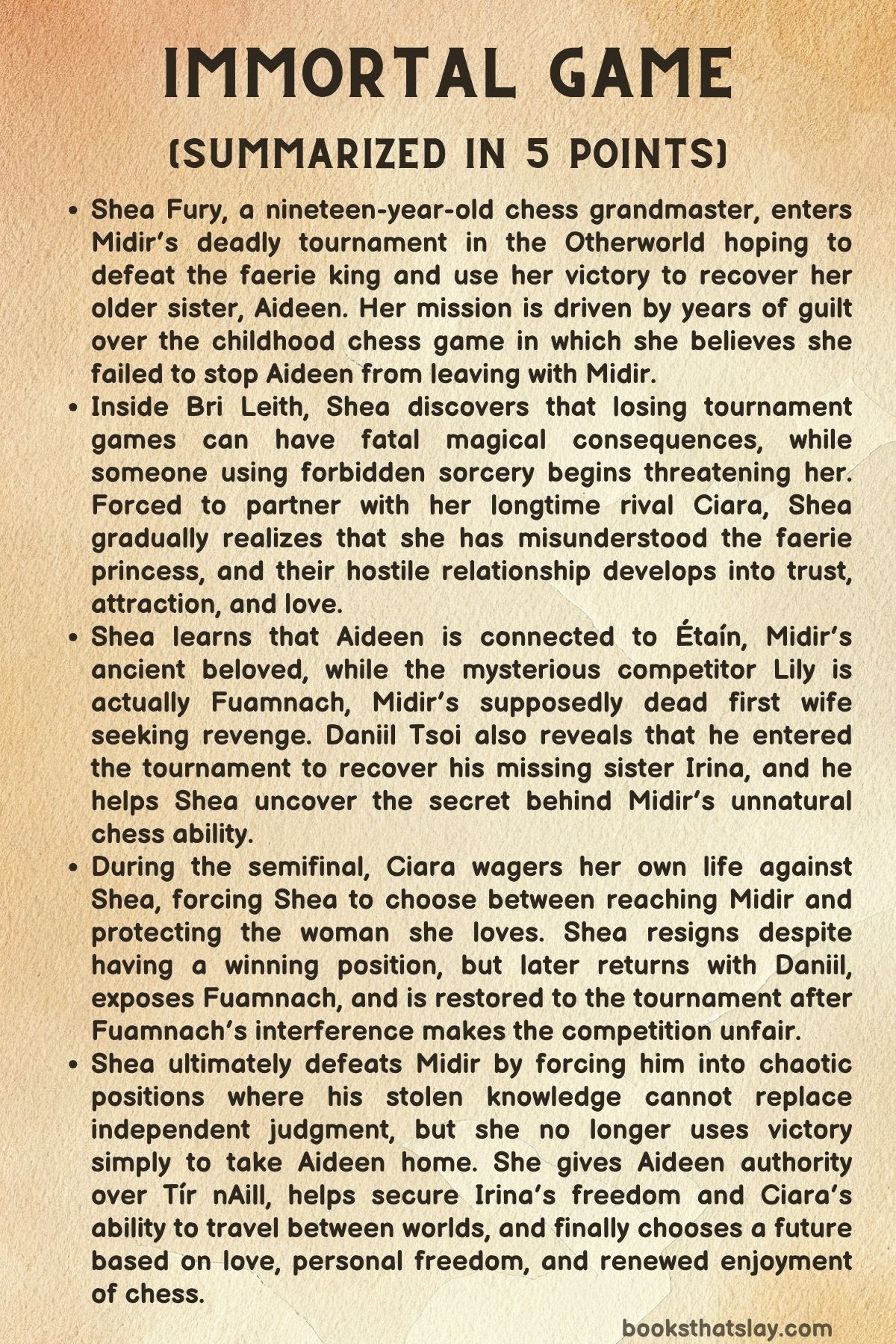
Nineteen-year-old grandmaster Shea Fury enters a lethal tournament in the Otherworld with one purpose: defeat the immortal king Midir and recover her older sister, Aideen. Yet the competition gradually challenges nearly everything Shea believes about responsibility, victory, love, and sacrifice. Her relationships with faerie princess Ciara and fellow competitor Daniil force her to reconsider the isolated life she has built around revenge, while long-buried secrets reveal that Aideen’s disappearance is part of a much older conflict.
Summary
Eight years after Midir first enters Shea Fury’s life, Shea has transformed herself into a nineteen-year-old chess grandmaster. Her entire career has been organized around one goal: earning an invitation to Midir’s legendary tournament in the Otherworld and defeating him.
Six years earlier, Shea’s older sister, Aideen, disappeared with Midir. Shea has never accepted the loss, believing that her own failure at chess allowed it to happen.
While traveling to a competition, Shea is surrounded by unnatural mist and confronted by Ciara of Bri Leith, Midir’s younger sister and one of Shea’s longtime chess rivals. Ciara announces that Shea has finally received the invitation she has spent years seeking.
The winner of the tournament will eventually play Midir and, if victorious, receive a wish. Shea immediately knows what she wants: Aideen returned to her.
Ciara gives Shea a golden apple and silver branch that will permit her to enter Tír nAill on Samhain. Before doing so, she extracts an oddly mundane promise that Shea must someday take her to a mortal convenience store.
More seriously, Ciara warns Shea not to enter the tournament at all. Shea assumes that the warning is another attempt to unsettle her and refuses to reconsider.
Back in Wayfolk, Shea discovers that her participation has become a public spectacle. Her hometown treats her as the American representative in a magical international competition, while Shea privately sees the tournament only as the final stage of her mission to rescue Aideen.
Her relationship with her mother, Kara, reveals how deeply Aideen’s disappearance has damaged their family. Kara fears that Shea’s obsession will cost her another daughter, while Shea continues to believe that defeating Midir will repair everything.
Shea’s coach, Yangmei, identifies a weakness that becomes essential later: Shea cannot emotionally tolerate losing positions. Whenever a game begins turning against her, she does not merely calculate badly; she starts experiencing defeat as catastrophe.
That reaction originates with the game she played against Midir when she was thirteen. Shea wagered that if she defeated him, he would leave Aideen alone forever, while Midir demanded Shea’s left eye if he won.
She believed modern chess preparation would give her an advantage. Instead, Midir overwhelmed her.
Before the game formally ended, Aideen intervened and announced that she wanted to leave with Midir. He accepted a draw and departed with her, but Shea interpreted the event as personal failure and spent the next six years analyzing the position and punishing herself.
Using Ciara’s gifts, Shea crosses the magical mist between worlds and reaches Tír nAill. The Otherworld is beautiful, unfamiliar, and dangerous, but Shea refuses to be distracted from Aideen.
At Bri Leith, she meets the mortal and faerie competitors and finally sees Midir again. He explains that the tournament carries supernatural consequences and places magical wooden fetters around the contestants’ wrists.
The stakes soon become horrifyingly clear. During the first round, Shea watches an opponent die after losing, with roots and flowers bursting from his body.
Midir’s tournament is not simply an elite chess event. Elimination can mean death.
Meanwhile, Shea’s memories reveal that Aideen possessed unusual powers long before leaving the mortal world. When a boy named Ryan became dangerously aggressive toward her, Aideen commanded him to stop, and supernatural force compelled him to obey.
The tournament soon requires players to form partnerships. Ciara expects Shea to consider joining her, but Shea rejects the possibility and accuses Ciara of years of selfishness, mockery, and manipulation.
Ciara insists that her strange behavior during their chess rivalry was often an attempt to provoke Shea into enjoying the game rather than treating every match like war. Shea dismisses this explanation and hurts her badly.
At the Fraughan Festival, Shea tries to find another partner. Daniil Tsoi, a brilliant and arrogant young grandmaster, refuses her proposal, while Lily Keenan becomes offended when Shea evaluates her primarily according to strategic usefulness.
Shea gradually realizes that she has spent years treating other people as components in her plans. With everyone else paired, she is forced to search for Ciara.
After Ciara rescues Shea from a bog, the two finally begin speaking more openly. Ciara admits that she deliberately played irritating chess against Shea because she wanted a response from someone who seemed incapable of playing simply for pleasure.
They become partners, magically bound together by living vines. Soon afterward, they discover a threatening message burned into Shea’s chessboard telling her to leave the tournament.
The threat proves that someone is actively targeting her.
As Shea and Ciara investigate, their forced proximity changes their relationship. They argue constantly, but Shea also begins seeing aspects of Ciara that do not fit the image of a spoiled and malicious faerie princess she has carried for years.
Ciara is deeply curious about the mortal world because Midir has kept her isolated from it. She also reveals a painful history of trying to earn her brother’s approval.
Midir taught Ciara chess when she was young, and she once believed becoming strong enough to defeat him would make him accept her. Instead, she grew up lonely and eventually discovered mortal chess partly because tournaments allowed her glimpses of a world from which she had been excluded.
Ciara also begins questioning Shea’s relationship with chess. Shea has spent so long treating her talent as a weapon against Midir that she can barely explain what she actually wants once the revenge is over.
When Shea admits that she might abandon chess after the tournament, the possibility shocks even her.
The partnership round magically links Shea and Ciara’s thoughts and emotions. For Shea, who has spent years concealing fear and guilt, this is unbearable.
During a difficult game against Daniil and his partner, Shea begins collapsing psychologically as her position worsens. Ciara directly experiences the terror Shea associates with losing and finally understands the emotional damage beneath her relentless discipline.
Shea eventually tells Ciara the truth about her childhood game against Midir and Aideen’s disappearance. Ciara responds with an extraordinary revelation.
Aideen appears to be connected to Étaín, Midir’s ancient lost beloved. Étaín suffered repeated transformations and reincarnations after being attacked through the sorcery of Fuamnach, Midir’s first wife.
The revelation suggests that Midir’s interest in Aideen began long before Shea was born.
As Shea and Ciara continue playing together, Shea experiences something she thought she had permanently lost: genuine enjoyment of chess. Instead of treating every move as a moral test, she begins appreciating competition again.
Her growing affection for Ciara becomes inseparable from that change.
During another tournament trial, Shea encounters what appears to be Aideen. The woman is actually an attacker using sorcery and has apparently been responsible for the earlier threats.
Daniil unexpectedly intervenes to protect Shea, followed by Ciara, who recognizes the attacker and fights her. Ciara is injured but survives.
Afterward, Ciara identifies the sorceress as Fuamnach, Midir’s supposedly dead first wife.
The discovery means an ancient conflict has entered the modern tournament.
At the same time, Daniil reveals his own reason for competing. His sister Irina, an accomplished ballerina, disappeared into the Otherworld after performing there.
Like Shea, Daniil has structured his life around recovering a missing sister.
He also shares a theory about Midir’s supernatural chess ability. Many great players who challenged Midir in the past never seriously played again afterward.
Shea connects this pattern to Midir’s silver artificial eye. She suspects that the artifact stores the skills of defeated players, allowing Midir to draw upon centuries of stolen chess knowledge.
Shea and Ciara’s emotional tension finally becomes romantic. After Shea demands to know why Ciara continues spending time with her even when they are no longer forced to remain together, Ciara admits that she simply likes her.
They kiss, allowing Shea to want something unrelated to guilt for perhaps the first time in years.
The final four competitors are Shea, Ciara, Daniil, and Lily. While searching Midir’s private rooms for information about Aideen, Shea discovers a portrait of Fuamnach.
Lily then appears and reveals that she herself is Fuamnach.
Fuamnach explains that she was once Midir’s wife and that his relationship with Étaín left her humiliated and abandoned. Shea recognizes that Fuamnach was genuinely wronged but rejects the idea that her pain justifies centuries of cruelty toward Étaín, Aideen, and others.
The semifinal pairings produce a painful result. Daniil must face Fuamnach, while Shea must play Ciara.
Their game becomes devastating when Midir revives a custom requiring both players to wager something valuable. Ciara wagers her own life.
Shea eventually gains a winning position. Victory would place her within one game of Midir and the goal she has pursued for six years.
But winning may also kill Ciara.
Shea repeatedly offers a draw, and Ciara refuses. Shea becomes furious, believing Ciara has deliberately made the choice impossible.
In the end, Shea knocks over her own king and resigns.
She returns to the mortal world convinced that everything has been wasted. Aideen remains behind, her opportunity to defeat Midir is gone, and she once again believes she has failed at the decisive moment.
Yet Shea slowly begins questioning the assumptions beneath her mission. Memories of Aideen reveal that her sister often felt as though her choices were being controlled by other people.
Shea finally wonders whether “saving” Aideen has ever been about what Aideen wants.
Daniil refuses to abandon the situation. Together, they travel to Ireland and attempt to force their way back into the Otherworld by physically disturbing the mortal counterpart of Bri Leith.
Their absurd plan succeeds. Midir appears, furious, and they warn him that Lily is actually Fuamnach.
Fuamnach’s semifinal against Ciara is interrupted. Once exposed, Fuamnach attacks and is eventually captured.
Daniil then argues that the tournament bracket has become invalid. Ciara threatens to resign rather than accept victory under compromised circumstances.
To preserve the legitimacy of his tournament, Midir allows Shea back into the competition and names her his final opponent.
Before the final, Shea finally reunites with Aideen.
Instead of gratitude, Aideen responds with anger. She never asked Shea to sacrifice six years trying to rescue her and does not want to be forcibly returned to the mortal world.
Their confrontation exposes mutual guilt. Shea believes she ruined Aideen’s future; Aideen believes her supernatural existence ruined Shea and Kara’s lives.
Aideen admits that she has real feelings for Midir and genuinely chose aspects of life in Tír nAill. Yet she has also come to understand that Midir’s protection is another kind of imprisonment.
She does not want Shea to rescue her. She wants the power to choose her own future.
Shea also repairs her relationship with Ciara. Ciara apologizes for wagering her life and explains that she was desperate to win because she viewed victory as her only path toward freedom.
The two agree that their relationship should not be based on permanent magical promises. They will remain together for as long as being together makes them happy.
Preparing for Midir, Shea realizes conventional chess preparation cannot overcome centuries of stolen knowledge. Ciara and Daniil therefore help her construct a strategy based on unusual, chaotic positions that will force Midir to think independently.
During the final, the theory about Midir’s eye proves correct. Its appearance changes as he draws upon the abilities of different players.
Rather than confronting that accumulated knowledge with perfect chess, Shea creates disorder.
She sacrifices material, creates tactical complications, and forces Midir to make decisions without relying entirely on stored expertise. Under time pressure, his weakness becomes clear: he has enormous borrowed knowledge but insufficient confidence in his own judgment.
Shea defeats him.
When Midir begs her not to use her wish to take Aideen away, Shea rejects the assumption that Aideen should belong to either of them.
Instead, she uses her victory to change the political order of Tír nAill. Aideen becomes its true queen, gaining authority over her own future and the realm itself.
She asks Midir to leave while she determines what she wants. He agrees to wait.
Aideen then confronts Fuamnach. Rather than continuing the cycle of revenge, she recognizes that Fuamnach was wronged by Midir but chose to attack other women rather than direct her anger toward the man responsible.
Aideen refuses to become another participant in that inherited conflict.
As queen, she begins reforming Tír nAill. Daniil’s sister Irina is freed, allowing the siblings to reunite.
Ciara is also given the possibility of traveling between worlds, finally receiving the freedom she has wanted for years.
Shea returns from the tournament transformed. She no longer sees herself as solely responsible for fixing everyone she loves, no longer treats defeat as proof of personal worthlessness, and no longer experiences chess only as punishment.
Her future with Ciara is uncertain, but uncertainty is no longer something Shea needs to defeat. She has recovered her love of chess and gained the ability to choose what comes next rather than living entirely in service of the past.
Characters
Shea Fury
Shea Fury is the central character of Immortal Game, and nearly every major conflict in her life grows from the belief that sufficient skill, discipline, and sacrifice can correct the past. At nineteen, she is already a grandmaster, but chess has stopped being a source of enjoyment and become an instrument through which she tries to repay an emotional debt.
Her defining wound is Aideen’s disappearance. Shea interprets the childhood game against Midir as the moment she failed her sister, even though Aideen voluntarily interrupted the match and chose to leave.
That belief turns Shea into an intensely controlling person. She studies relentlessly, supports her mother financially, evaluates potential allies according to usefulness, and treats losing positions as personal catastrophes because defeat has become associated with abandonment and guilt.
Her interactions with Lily at the partnership festival expose this habit especially clearly. Shea approaches people strategically because she has trained herself to see life as a series of positions that must be solved correctly.
Ciara challenges this worldview more effectively than anyone else. At first, Shea sees her only as an irritating rival whose unconventional chess insults everything Shea values.
Gradually, however, Ciara reminds Shea that playing can contain curiosity, pleasure, attraction, spontaneity, and companionship. Shea’s rediscovery of enjoyment becomes inseparable from her growing love for Ciara.
Shea’s most important growth occurs when she begins accepting that caring for someone does not entitle her to determine that person’s future. Her resignation against Ciara represents the first major moment when she chooses a person over the mission that has defined her.
Her confrontation with Aideen completes that lesson. Shea must admit that years of attempted rescue were built partly on assumptions about what Aideen should want.
By the end of the book, Shea still possesses her competitiveness and extraordinary intelligence, but those qualities are no longer controlled entirely by guilt. Her victory over Midir matters not simply because she finally defeats him, but because she uses that victory differently from the younger Shea who wanted to force a single outcome.
Ciara of Bri Leith
Ciara initially appears in Immortal Game as Shea’s unpredictable faerie rival, someone whose teasing, strange strategies, theatrical behavior, and apparent confidence make her almost impossible for Shea to trust. Her personality is energetic and provocative, but beneath that surface lies intense loneliness.
Much of Ciara’s emotional life has been shaped by Midir. His rare approval during her childhood made chess deeply important to her, while his later rejection convinced her that becoming stronger might eventually make her worthy of being welcomed home.
Her mortal chess career therefore carries several motives at once. It gives her contact with a world Midir keeps from her, allows her to challenge boundaries, and provides repeated opportunities to connect with Shea.
The tragedy of their early rivalry is that Ciara attempts connection through provocation while Shea interprets every provocation as hostility. Both are proud, emotionally defensive people, so the misunderstanding lasts for years.
Ciara differs from Shea most clearly in her relationship with chess. Although she also attaches emotional meaning to winning, she remains capable of treating the game as experimentation and pleasure.
That attitude becomes essential to Shea’s recovery. Ciara does not merely help Shea improve; she reminds her why someone might want to play at all.
Yet Ciara has serious flaws of her own. Her decision to wager her life during the semifinal is reckless and emotionally unfair because it forces Shea into an impossible position.
Ciara later recognizes the harm she caused and explains that desperation for freedom influenced her choice. Her apology matters because she does not excuse the action simply because her underlying fear was understandable.
Her romance with Shea ultimately becomes healthier when both reject absolute promises. Rather than converting love into another binding oath, they agree to remain together through continuing choice.
Ciara’s eventual freedom to travel between worlds represents the resolution of one of the novel’s central contradictions. Someone associated with immortality and magical privilege has spent much of her existence trapped, and real happiness only becomes possible when she can decide where to go.
Aideen Fury
Aideen occupies an unusual position in Immortal Game because she is both the apparent object of Shea’s quest and an independent person whose own desires undermine the assumptions supporting that quest. For much of the story, Shea imagines Aideen primarily as someone who was taken.
Later revelations complicate that interpretation. Aideen chose to leave with Midir, although that choice occurred when she was young, frightened, socially isolated, and burdened by supernatural circumstances she barely understood.
Her connection to Étaín places her inside an ancient history that other people repeatedly try to interpret for her. Midir sees her through the lens of a beloved woman lost across different lives, while Shea sees her as the sister who must be recovered.
Aideen’s anger when Shea finally reaches her is therefore crucial. She refuses gratitude because gratitude would validate the idea that Shea had the right to decide what her life should become.
At the same time, Aideen does not idealize her relationship with Midir. She acknowledges that she loves him and genuinely values aspects of Tír nAill, but she recognizes that his protectiveness has become restrictive.
Midir’s love does not automatically make his control acceptable. Aideen wants authority, mobility, responsibility, and the right to discover whether her current life is truly the one she wants.
Her eventual elevation as Queen of Tír nAill gives political form to that desire for agency. Instead of being transferred from Midir back to Shea, she becomes someone capable of determining conditions for herself.
Her confrontation with Fuamnach also demonstrates emotional maturity. Aideen recognizes the original injustice Fuamnach suffered without excusing the harm she later caused.
Rather than continuing an inherited revenge cycle, she chooses reform and self-determination. Aideen therefore evolves from someone others speak about into one of the clearest voices for personal freedom in the novel.
Midir
Midir functions as both antagonist and a more complicated representation of possessive love in Immortal Game. He is an immortal ruler, legendary chess player, political isolationist, and central figure in the ancient history connecting Étaín, Fuamnach, Aideen, and Ciara.
For Shea, Midir initially represents absolute evil because she believes he stole Aideen and destroyed her family. That interpretation becomes less simple without making his behavior harmless.
Midir repeatedly insists that Aideen came willingly, but his later treatment of her shows that voluntary beginnings do not guarantee continuing freedom. His tendency to protect people by limiting their choices appears in both his relationship with Aideen and his treatment of Ciara.
His chess ability mirrors his broader character. By drawing upon abilities stored through his magical eye, Midir possesses extraordinary knowledge without fully trusting his own judgment.
This dependence becomes critical when Shea forces him into unfamiliar positions. He has collected the expertise of others, yet accumulation has not necessarily produced confidence or adaptability.
Midir is also ruled by fear of loss. That fear helps explain why he attempts to preserve relationships through restriction, secrecy, and control.
The novel distinguishes explanation from justification. Midir may genuinely love Aideen and Ciara, but genuine affection does not erase the consequences of treating them as people whose choices must remain within boundaries he defines.
His defeat forces him to surrender both chess supremacy and political authority. When Aideen asks for distance, his willingness to wait suggests at least the possibility that he can begin learning a different relationship to love.
Daniil Tsoi
Daniil begins as an abrasive competitor whose arrogance makes him appear almost entirely self-interested. His sharp manner, refusal to flatter Shea, and obsession with deserving to face Midir create immediate friction.
Yet his behavior gradually reveals loyalty beneath hostility. He follows Shea during the dangerous nighttime challenge because he notices that someone is pursuing her, then risks himself against Fuamnach despite having no obligation to intervene.
His motivation also parallels Shea’s. Daniil entered the tournament because his sister, Irina, disappeared into the Otherworld, meaning that his competitive ambition is attached to personal loss just as Shea’s is.
That similarity helps them understand each other. Neither becomes conventionally affectionate, but their hostility develops into a friendship based on argument, honesty, and practical support.
Daniil becomes especially important after Shea resigns against Ciara. While Shea interprets the result as final failure, Daniil refuses to let the story end there.
He helps her return to Bri Leith, exposes Fuamnach, argues for the tournament’s fairness, and later helps prepare Shea for Midir. His persistence prevents Shea from retreating completely into the self-punishing isolation that characterized much of her earlier life.
As a chess partner and friend, Daniil offers something different from Ciara. Ciara restores Shea’s capacity for joy, while Daniil strengthens her ability to continue fighting from difficult positions.
By the end, Irina’s release confirms that Daniil’s loyalty and persistence mattered even though he did not personally defeat Midir.
Fuamnach
Fuamnach is one of the most morally complicated figures in Immortal Game because her violence originates in a genuine betrayal but eventually becomes far greater than the wrong committed against her. Once Midir’s wife and a powerful sorceress, she was displaced after his involvement with Étaín.
Her humiliation, anger, and jealousy are understandable emotional responses. The problem is what she chooses to do with them.
Instead of limiting her vengeance to Midir, Fuamnach targets Étaín and later Aideen, turning other women into substitutes for the person whose betrayal caused her pain. Over centuries, revenge becomes the organizing principle of her identity.
Her disguise as Lily allows her to enter Midir’s tournament and approach him from within his own system. She also targets Shea because Shea threatens the revenge Fuamnach believes belongs to her.
Fuamnach serves as a warning for Shea because both women have allowed past injustice to define the future. The difference is that Shea eventually learns to release the belief that revenge must determine every decision.
Aideen’s response to Fuamnach provides the clearest judgment on her character. She can acknowledge that Midir treated Fuamnach badly while still refusing to excuse what Fuamnach did afterward.
Fuamnach demonstrates how a person can begin as a victim of injustice and later become responsible for creating new victims.
Kara Fury
Kara is Shea and Aideen’s mother, and her comparatively limited presence carries substantial emotional importance. Her relationship with Shea has become strained through years of grief, fear, financial dependence, and unresolved blame.
Kara sometimes dismisses Shea’s devotion to chess, making it difficult for Shea to feel that her achievements are valued at home. Yet Kara’s hostility toward the tournament comes primarily from terror.
She has already lost one daughter to the Otherworld and cannot tolerate the possibility of losing another.
Her relationship with Aideen also contributes to Aideen’s guilt. Aideen grows up feeling that her unusual nature caused hardship for Kara and Shea, while Shea develops the opposite conviction that she should have protected everyone more effectively.
Kara therefore helps reveal how family trauma can generate different forms of self-blame in different people. No single family member possesses a complete or accurate explanation of what went wrong.
Yangmei
Yangmei, Shea’s coach, understands a truth about her student that technical chess analysis alone cannot solve. Shea has prepared obsessively, but Yangmei identifies her inability to function calmly in losing positions as the weakness most likely to destroy her.
That observation proves crucial throughout the tournament. Shea’s difficulty is psychological rather than intellectual: disadvantage triggers memories of Midir and transforms an ordinary chess problem into evidence that catastrophe is returning.
Yangmei’s role illustrates the limitations of pure preparation. Shea cannot defeat her past merely by memorizing more positions.
Her eventual ability to survive difficult games comes from emotional change, relationships, and accepting that losing control of a position does not mean losing control of her entire life.
Irina Tsoi
Irina appears largely through Daniil’s motivation, yet her absence shapes many of his choices. She was a successful ballerina before disappearing into the Otherworld after performing there.
For Daniil, recovering Irina justifies entering a tournament whose dangers might otherwise seem irrational. His determination mirrors Shea’s fixation on Aideen and helps the two rivals recognize their similarity.
Irina’s eventual release gives the story an important contrast with Aideen. Both women disappeared into the Otherworld, but the correct outcome is not automatically identical for both.
Irina is reunited with Daniil, while Aideen chooses to remain and reshape Tír nAill. Their different outcomes reinforce the idea that freedom depends on individual choice rather than a universal definition of rescue.
Themes
Freedom, Choice, and the Limits of Protection
Freedom in Immortal Game is repeatedly threatened not only by obvious imprisonment but by relationships that claim to act in someone’s best interest. Midir provides the clearest example: he sees himself as protecting Aideen and Ciara, yet his protection consistently restricts their ability to make meaningful decisions.
Aideen’s situation shows why good intentions cannot substitute for consent. She genuinely chose to leave the mortal world, but that earlier choice does not mean she surrendered the right to reconsider how she wishes to live.
Her conflict with Midir emerges because he treats safety as something he can define for her. Aideen, by contrast, wants authority, responsibility, movement, and even the ability to make mistakes.
Shea repeats a similar pattern in a different form. Her desire to rescue Aideen comes from love, guilt, and loyalty, yet she spends years assuming that returning Aideen to the mortal world must be the correct outcome.
When the sisters finally reunite, Shea discovers that rescue imposed without listening can become another form of control. Her growth therefore depends on separating love from ownership.
Ciara’s experience reinforces the same theme. Although she is immortal and powerful, she has spent much of her life confined by Midir’s decisions and forced to seek fragments of freedom through mortal chess competitions.
The conclusion resolves these conflicts by increasing choice rather than imposing one universal solution. Aideen remains in Tír nAill with real political authority, Ciara gains movement between realms, Irina is allowed to return, and Shea chooses chess again on new terms.
Freedom is therefore presented as the ability to participate in shaping one’s own future.
Guilt, Responsibility, and the Desire to Repair the Past
Shea’s identity is built around an exaggerated sense of responsibility. At thirteen, she loses control of her game against Midir and concludes that Aideen’s departure happened because she was not good enough.
That interpretation turns a complicated family event into a private sentence Shea carries for six years. Every tournament, training session, sacrifice, and financial responsibility becomes connected to the belief that she must eventually correct what happened.
The danger of this mentality is that responsibility becomes indistinguishable from control. Shea believes that if she studies hard enough, calculates correctly enough, and refuses weakness completely enough, she can produce the outcome everyone needs.
Chess reinforces that fantasy because positions appear to have solutions. Human relationships do not.
Aideen carries her own destructive guilt. While Shea believes she failed to protect Aideen, Aideen believes that her unusual existence harmed Kara and stole Shea’s childhood.
The sisters therefore spend years blaming themselves for different parts of the same history. Their eventual confrontation becomes liberating because neither can continue preserving the story in which one person’s failure explains everything.
Daniil, Ciara, and even Midir carry related burdens. Each tries to solve an emotional wound through victory, approval, recovery, or control.
Immortal Game gradually separates responsibility for one’s actions from responsibility for controlling every outcome. Shea remains accountable for the ways she hurts others, but she learns that caring for people does not make her responsible for preventing every painful possibility.
Chess as Control, Identity, and Joy
Chess changes meaning repeatedly throughout the story. For young Shea, it begins as talent and confidence, but after her game against Midir it becomes associated with failure, guilt, and obligation.
She studies not simply because she loves the game but because mastery seems like the only path back to Aideen. Her career therefore becomes simultaneously impressive and emotionally restrictive.
Shea’s inability to tolerate bad positions reveals how completely chess has merged with her trauma. A disadvantage on the board does not remain a temporary strategic problem.
Instead, it recreates the emotional logic of her childhood: one mistake means losing someone forever. Her coach understands this long before Shea does.
Ciara introduces another way of playing. Her strange openings, experimental decisions, and willingness to seek enjoyment initially infuriate Shea because they challenge the belief that serious chess must always be disciplined warfare.
Their partnership helps Shea remember that chess can create intimacy, curiosity, humor, and pleasure. That emotional rediscovery matters as much as any technical improvement.
Midir offers a darker version of mastery. His magical eye apparently gives him access to skills accumulated from defeated players.
He therefore possesses tremendous knowledge, but his dependence on borrowed expertise leaves him vulnerable when Shea creates a chaotic position requiring independent judgment. The final game contrasts stored knowledge with adaptive confidence.
By the conclusion, Shea does not abandon competition. She chooses to continue playing because chess has stopped being a punishment she owes the past.
The game becomes hers again.
Revenge, Inherited Conflict, and Breaking Cycles
Fuamnach’s history shows how suffering can become destructive when a person treats revenge as the only acceptable response. Midir genuinely wronged her, and the story does not erase that betrayal.
Yet Fuamnach directs much of her rage toward Étaín and later Aideen, creating new victims who did not cause the original injury. Her revenge survives across generations and reincarnations until people far removed from the initial betrayal are still paying for it.
Shea initially risks following a similar emotional pattern. Her life becomes defined by defeating Midir because she believes victory can undo what happened to Aideen.
Unlike Fuamnach, however, Shea gradually recognizes that revenge cannot restore lost years. Her most important choices occur when she acts against the logic of vengeance.
She resigns rather than sacrifice Ciara, listens when Aideen rejects rescue, and uses her victory over Midir to redistribute freedom rather than simply punish him.
Aideen’s confrontation with Fuamnach makes this theme explicit without requiring forgiveness. She can acknowledge Fuamnach’s original suffering while refusing to continue the same cycle.
That distinction matters because ending revenge does not mean pretending injustice never occurred. It means refusing to create additional victims in its name.
The story ultimately replaces inherited obligation with deliberate choice. Shea does not have to spend her life correcting thirteen-year-old Shea’s failure, Aideen does not have to become Étaín simply because history connects them, Ciara does not have to earn Midir’s approval, and Fuamnach’s pain does not need to govern another generation.
Breaking the cycle becomes possible when the characters stop asking how to recreate or reverse the past and begin deciding what kind of future they actually want.