In Your Dreams Summary, Characters and Themes
In Your Dreams by Sarah Adams follows Madison Walker, who has just graduated from culinary school in New York, but instead of feeling proud, she feels exposed. Her confidence is shot, her anxiety is loud, and the career she chased now feels like a place she can’t breathe inside.
When a late-night phone call to James Huxley—an older family friend she’s spent years trading sarcastic jabs with—turns into an unexpected job offer back home in Kentucky, Madison takes it as a lifeline. This book is a small-town romance about second chances, found steadiness, and two people realizing that the safest place to land might just be each other. It’s the 4th book in the When in Rome series by the author.
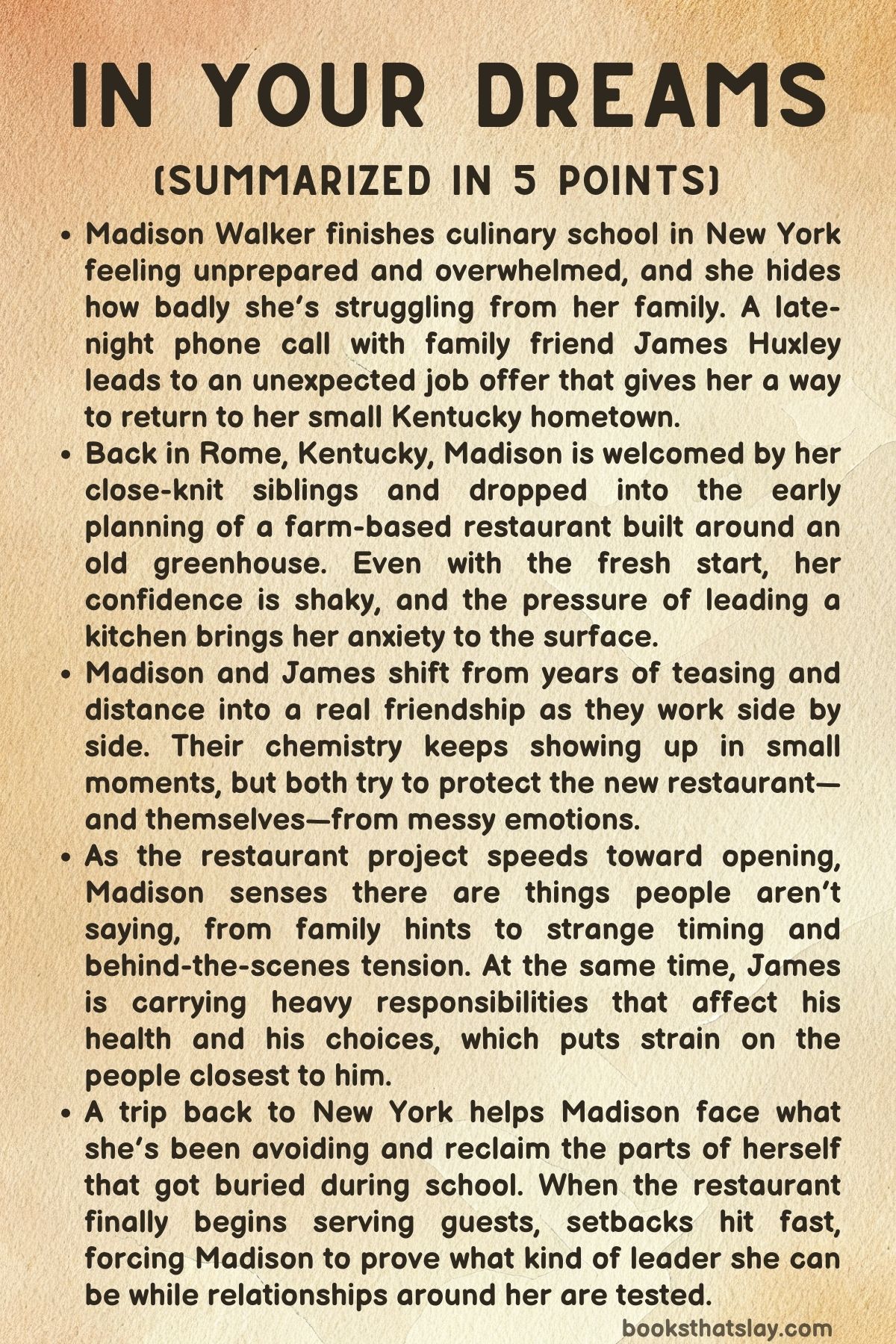
Summary
Madison Walker sits through her Culinary Institute of New York graduation feeling like an imposter. She’s scraped by, relied on extra-credit cleaning shifts, and clings to the memory of one excellent risotto as proof she belongs.
Even the ceremony feels wrong on her skin. When classmates talk about restaurant jobs and big plans, Madison dodges the questions because she doesn’t have answers.
She doesn’t even trust that she should be in a professional kitchen at all anymore. The pressure has been building for months—panic attacks, anxiety, exhaustion—and she believes one of her instructors, Chef Davis, wouldn’t recommend her if her future depended on it.
Madison keeps her family at a distance through a string of small lies. In a group chat with her sisters, she pretends she’s spending graduation night quietly at home.
She also claims there’s no ceremony, so they won’t travel to celebrate. When her name is called, she walks across the stage, accepts her chef’s hat, and then bolts before the usual post-graduation meal with loved ones.
Outside, she throws the hat away and heads back to Brooklyn with tears she refuses to fully let out.
Home is not a comfort. Her roommate Bryce has a date over—signaled by a scrunchie on the door—and Madison’s apartment life is a steady mix of noise, mess, and feeling trapped.
Her tortoise, Sammy, is recovering from a cracked shell with a bright pink bandage, and the shaking walls nearly send him tumbling. Madison realizes she can’t stay in New York.
She wants Rome, Kentucky. She wants space to breathe.
She wants her family. Desperate, she tries calling her sister Emily for help, but when she fumbles her phone, she accidentally calls Jack—Emily’s boyfriend—and reaches James Huxley instead.
James is a longtime family friend, close with Madison’s brother Noah, and older than Madison. Their relationship has always been more teasing than tender—annoying jokes, quick comebacks, a familiar friction.
Madison hangs up in embarrassment, but James calls back, immediately catching the strain in her voice. He offers her a choice: tell him what’s wrong, or he’ll get on a plane.
Madison tries to play it off, blaming her tears on Bryce’s loud hookups and introducing Sammy as a distraction. James doesn’t let her hide for long.
Eventually Madison admits the truth: she graduated, she hated it, she’s terrified, and she feels like she failed.
James surprises her with an offer that sounds impossible. He says he’s opening a restaurant on his farm and wants Madison to run the kitchen.
Full menu control. Real authority.
A job that would let her come home without begging for a couch to sleep on, without needing Chef Davis’s approval. Madison doesn’t believe she deserves it, especially after barely finishing school, but the alternative is staying in a city that makes her feel like she’s shrinking.
She accepts.
Four weeks later, Madison flies back to Kentucky with equal parts relief and fear. She admits privately that saying yes felt like grabbing a rope before she fell—but the rope might snap.
At the airport, she expects James, but his younger brother Tommy picks her up instead. Tommy is polished, charming, and openly flirty.
He remembers Madison’s old crush, pushes for a date, and acts like “co-worker” is a flexible label. Madison shuts it down.
After a messy relationship in New York with a classmate named Caden—who treated her like someone to hide—she’s done mixing work and romance. She even tells Tommy she’s not dating colleagues anymore, and when he keeps trying, she gets firmer.
Tommy drops her at Hank’s bar while he takes her bags to the farm. Inside, Madison finds James alone and has the sudden urge to hug him, which catches her off guard.
Instead, she falls back into their usual banter, stealing his beer and trading insults that feel safer than softness. James’s feelings, though, are not casual—he’s been in love with Madison for years.
The restaurant idea wasn’t a long-term plan until her accidental call. After she hung up, James called Tommy in a panic, begged him to help create a real concept fast, and set a renovation plan into motion using his grandmother’s old greenhouse.
At Hank’s, they talk about Tommy’s flirting and Madison makes it clear she isn’t interested. James tries to keep his emotions boxed up by insisting everything is professional, but there’s a shift between them.
Madison admits it would have been strange for them to suddenly start talking one-on-one after years of group friendship, yet her honesty shows she noticed his silence. James suggests they become real friends now that they’ll work together.
Madison agrees with dramatic flair, calling for a blood pact before settling for a pinky promise. Their moment is interrupted when Madison’s siblings arrive—Emily, Annie, Amelia, and Noah—stunned and thrilled that she’s home.
The sisters fall back into their patterns fast: teasing, warmth, and sharp instincts for each other’s secrets. Madison notices Annie behaving oddly with alcohol, and the sisters begin to suspect pregnancy.
They decide to wait until Annie is ready to say something, even as Madison’s curiosity itches. During their sleepover, Madison is asked about the restaurant and her menu ideas—and she freezes.
The creative spark that once felt natural is gone. To cover the panic, she jokes about serving boxed mac and cheese and dinosaur nuggets, while inside she’s terrified she can’t deliver what James believes she can.
At the farm, tensions simmer beneath the surface. Tommy pushes James about the restaurant timeline and the financial stakes.
James has been hiding how badly the farm needs this restaurant to succeed. He’s also refusing a contract offer from Anderson Food Distributions because he believes it would compromise the farm’s values.
The stress is affecting his health—dizziness, headaches, high blood pressure—and he’s haunted by the fear of ending up like his father, who had a heart attack.
When Madison arrives at the farmhouse, she accidentally sees James step out of the shower in a towel, and the moment hits her harder than she expects. A planning meeting follows where Tommy shows branding and design options.
Madison, anxious and distracted, lies through her opinions to avoid conflict—even though she hates the direction. Later James gives her a tour: the greenhouse dining room, full of light and possibility, and then her private living space, a small cottage with a bright yellow door.
Madison is overwhelmed when she realizes James and Emily moved her old furniture in, making it feel like home.
But stepping into the professional kitchen space triggers Madison badly. Her breathing collapses, her body shakes, and she spirals into a panic attack.
James catches her and holds her steady. The incident makes it clear this isn’t just nerves—something about kitchens now sets off a deep fear connected to her time in New York.
Despite the strain, Madison begins building her vision for the restaurant, The Greenhouse, with local details that reflect who she is. She plans pottery from a local maker, linens with personal charm, and a space that supports the community.
James quietly supports her, even when town gossip questions whether she’s the right choice. When a hardware store employee makes a rude comment about Madison being a risk, James shuts it down immediately and demands respect.
The emotional line between Madison and James keeps thinning. One night at Madison’s cottage, after a warm conversation and chamomile tea, Madison blurts out that she doesn’t understand James’s closeness lately.
The attraction between them turns impossible to ignore. James offers a simple test: a kiss to see if it clears her head.
Madison agrees, and the kiss lands with more truth than either of them can pretend away.
Soon after, Madison travels back to New York for a meeting arranged through an acquaintance, Josie, with famous Chef Zora Brookes. James insists on going with her.
In the city, Madison reconnects with Josie and learns Zora is Josie’s mother. James pushes Madison to see the city beyond her burnout memories and takes her on a night built around fun: walking, karaoke, a drag show, chaotic laughter, and a kind of freedom Madison forgot she could have.
Back at Madison’s old apartment building, the reality of her past life hits again—Bryce’s mess, loud hookups, and the cramped feeling of who she used to be there. On a rooftop under the night sky, Madison finally tells James about Caden: he refused to claim her publicly, saying she wasn’t the kind of person he could bring home.
James is furious for her, and Madison realizes how deeply safe she feels with him.
Back in Kentucky, the truth James has been hiding erupts. Tommy forces a confrontation by bringing their parents home, and the financial crisis becomes public: the farm is in serious trouble, and the restaurant must succeed quickly.
Madison overhears Tommy calling her a risky choice and feels betrayed. When James admits he built the restaurant plan around her after that desperate phone call, Madison is shaken.
She confesses her own secret: she barely graduated and feels unqualified. James refuses to let her shame define her.
He tells her he believes in her completely—and then finally admits he’s loved her for years. Madison admits she loves him too, and they choose each other openly.
James faces his father with honesty at last, admitting how scared he’s been and how alone he’s felt carrying the pressure. With support from his family, he decides to accept the Anderson Food Distributions contract for stability while the restaurant grows.
Then the soft opening arrives—and chaos hits hard. Equipment fails, staffing problems pile up, the system glitches, and a serious allergy mistake puts a guest at risk.
Madison races an EpiPen to the dining room, keeps the situation under control, and pushes through service even as panic tries to take over. Outside, James confronts Tommy, learning that Tommy’s flirting with Madison was never real—he did it to provoke James into admitting his feelings.
James snaps and punches him, and the brothers’ fight becomes a public scene outside the restaurant.
Madison, overwhelmed, orders both men to leave and runs home in tears. Mabel follows her and refuses to baby her, reminding Madison that the restaurant is still running and her team needs her leadership.
Madison returns, addresses the dining room with steady humor and gratitude, and wins the room back. Later James and Tommy talk honestly, apologize, and begin repairing their relationship.
When Madison gets home, James has cleaned her place and made her cinnamon sugar toast as a peace offering, along with two new turtles as a funny, affectionate gesture. They reconcile and acknowledge what the night proved: Madison can lead under pressure, and James’s faith in her isn’t fantasy.
Days later, the family gathers the night before the official opening. Amelia reveals she is pregnant after a long private struggle, and the family celebrates.
James shares that his blood pressure has improved, and the atmosphere settles into hope. Madison, once convinced she was a fraud, stands on the edge of a new chapter with a restaurant that feels like her, a town that’s learning to trust her, and a partner who chose her long before she chose herself.
Characters
Madison Walker
Madison is the emotional center of In Your Dreams—a young chef whose outward achievement (graduating culinary school) collides with an inner conviction that she doesn’t deserve it. Her impostor syndrome isn’t a passing insecurity; it shapes nearly every decision she makes, from fleeing her graduation to hiding the truth from her family to accepting James’s offer partly because it lets her escape New York without admitting defeat.
Anxiety and panic attacks don’t just “add stakes” to her arc—they define the specific way she experiences kitchens, evaluation, and belonging, turning professional spaces into triggers and turning success into something that feels dangerous. At the same time, Madison is highly adaptive and socially quick: she can joke, deflect, and “perform fine” even when she is unraveling, which is why lying becomes both her shield and her shame.
Her growth comes from slowly trading concealment for honesty—about her fears, her competence, and her desire—and from learning that leadership doesn’t require perfection, only steadiness and accountability, which she proves when the soft opening collapses into chaos and she chooses to return to the dining room and own the room anyway.
James Huxley
James is built from devotion and pressure: he is the kind of man who solves problems by carrying them alone, working harder, and refusing help until his body forces the issue. His love is not impulsive; it is longstanding, disciplined, and quietly self-denying, shaped by the history of knowing Madison as “Noah’s little sister” and by the fear that wanting her would ruin the balance of family and friendship.
His grand gesture—creating a restaurant that didn’t exist until her late-night call—reveals both his tenderness and his flaw: he uses action as a substitute for vulnerability. He tries to protect Madison by giving her a lifeline, but he also controls the narrative by not telling her the full financial reality, which turns love into risk when she learns how much is riding on her.
James’s health scare and fear of repeating his father’s fate add a second kind of ticking clock: not just the restaurant’s timeline, but his need to stop living like a martyr. His arc is the movement from self-sacrificing control to shared truth—accepting support, choosing stability (including the contract he resisted), and allowing his feelings to be visible rather than disguised as “professionalism” or “friendship.”
Tommy Huxley
Tommy is a catalyst disguised as a flirt. He brings polish, branding language, and big-city hospitality instincts, but his deeper role is to agitate the emotional status quo that James is desperate to preserve.
His flirting with Madison is performative and strategic, not primarily romantic, which makes him both useful and ethically messy: he understands what James won’t admit and tries to force the confession by pushing buttons. That manipulation reads as protective in his own mind—he believes he’s saving the farm and saving his brother from self-destruction—but it still treats Madison like a lever, and the story holds him accountable for that.
Tommy also embodies a different approach to family duty: he’s willing to modernize, borrow, and negotiate; he sees compromise as survival, whereas James sees compromise as betrayal of values. His eventual reconciliation with James matters because it reframes him from antagonist to wounded family member who wants to belong and be trusted, even if his methods are blunt and sometimes cruel.
Emily Walker
Emily functions as Madison’s closest “real-world” mirror —the sister who asks the unglamorous questions about staffing, bookkeeping, logistics, and sustainability. She can come off controlling or intrusive, but her insistence on details is driven by protective love and by an understanding that Madison’s creativity thrives only when the scaffolding is stable.
Emily also represents a particular kind of maturity: she apologizes when she pushes too hard, she refuses to violate Annie’s privacy even when the suspicion seems obvious, and she tries to keep the family from turning concern into surveillance. Importantly, Emily’s presence intensifies Madison’s self-doubt because Emily sees what Madison is hiding; yet Emily isn’t trying to shame her—she’s trying to keep her from being blindsided.
That tension makes Emily less of a “supportive side character” and more of a realistic sibling force: loving, exasperating, and right often enough to be irritating.
Annie Walker
Annie is the quiet storm of In Your Dreams. She appears steady and teasing, but small behavioral shifts—what she drinks, what she avoids, what she doesn’t say—become the story’s domestic mystery.
Her secrecy around pregnancy is not framed as betrayal; it’s framed as autonomy, and the sisters’ debate about whether to confront her highlights the book’s broader theme of control versus trust. Annie’s character also sharpens the family dynamic by becoming a point of projection: everyone reads meaning into her choices, which shows how deeply this family watches each other and how easily love can become entitlement to information.
Annie’s role isn’t to create melodrama so much as to underscore the book’s emotional rule: people disclose when they feel safe, not when others feel curious.
Amelia Walker
Amelia—also known publicly as Rae Rose—is the character who carries both glamour and vulnerability . Her fame could have made her feel untouchable, but the story uses her as a reminder that public success doesn’t prevent private pain.
Her pregnancy reveal lands not as a twist but as a release after long tension, and it reframes earlier clues and family speculation into something more compassionate: fertility and timing are complicated, and secrecy can be a form of self-protection rather than distance. Amelia also becomes materially important to Madison’s arc when Madison asks her to help generate publicity; Amelia’s willingness to use her visibility for Madison’s restaurant turns celebrity into practical support, and it shows that this family’s love language is not only emotional comfort but also tangible backing when it counts.
Noah Walker
Noah sits at the intersection of family and the Huxleys, acting as connective tissue between Madison’s sibling world and James’s farm world. He often supplies comedic friction—blurting suspicions, teasing, stirring the pot—but his role is also structural: he’s one of the people who has known James long enough to recognize when James is lying about his feelings and when he’s driving himself into the ground.
Noah’s marriage to Amelia places him close to public scrutiny and private sensitivity at the same time, which is why his impulsive comment about pregnancy searches lands as a genuine misstep rather than a villain moment. He is affectionate, loyal, and occasionally thoughtless in a way that feels like an authentic sibling-brother energy, and he helps keep the family scenes from becoming overly sentimental.
Jack
Jack is the steady partner energy, a character who doesn’t need dramatic arcs to be significant. He makes room—literally leaving so the sisters can have their sleepover—without making himself a martyr, and that small gesture signals the kind of household Emily has built: one where relationships expand to hold family rather than compete with it.
Jack also participates in the male friendship circle around James, which allows the story to show James’s emotional avoidance in a different light: with the guys, James can joke and deflect, but he can’t fully hide. Jack’s function is quiet normalization—he represents what secure support looks like when it isn’t tangled with secrets or pride.
Will
Will is the friend who sees too clearly., he serves as both comic relief and moral pressure, calling out what James is doing—overworking, denying obvious love, acting like a man who thinks endurance equals responsibility. By stepping into James’s attempt to manage stress through running, Will offers a form of care that James can accept because it’s practical and masculine-coded rather than emotionally intimate.
He also voices what the town already suspects, which matters because it shows James’s fear isn’t only internal; it’s social. Will’s presence keeps James honest by refusing to treat denial as noble.
Chef Davis
Chef Davis is less a full character than a haunting authority, but his impact on Madison is enormous. He embodies the institutional gatekeeping that turned Madison’s passion into dread: evaluation, recommendation, and the power to define who is “real” in a profession.
Whether he is harsh, unfair, or simply misaligned with how Madison learns, the result is the same—Madison internalizes his judgment as identity. His role in the story is to explain why Madison’s fear is so sticky and why her panic in the new kitchen isn’t irrational; it’s an embodied memory of being assessed and found lacking.
The arc doesn’t require Madison to “defeat” Chef Davis directly because the deeper victory is that she stops needing his approval to believe she belongs.
Bryce
Bryce represents the claustrophobic version of New York —not the city itself, but the lived reality that made Madison feel trapped. The loud hookups, the mess, the disrespect for shared space, and the way Sammy is physically endangered by the chaos all turn Bryce into a symbol of Madison’s lack of control and lack of sanctuary.
Bryce isn’t portrayed as nuanced because she doesn’t need to be; her narrative job is to show what it feels like when your home is not safe, not quiet, and not yours. That experience pushes Madison toward the decision that changes the story: leaving, asking for help, and choosing a different life even before she believes she deserves it.
Sammy
Sammy, the tortoise with the cracked shell and pink bandage, is Madison’s emotional anchor . He functions as a living measure of care: Madison’s tenderness toward him shows who she is beneath panic and sarcasm, and his vulnerability parallels her own—both are healing, both are carrying damage, and both need gentleness rather than pressure.
Sammy also forces other characters into intimacy with Madison; bringing him to Hank’s makes her visible in town, and James taking responsibility for him is a quiet way of saying, without romance, “I will protect what you love.” Even when he’s comic, Sammy’s deeper role is to externalize Madison’s need for safety and patience.
Josie
Josie is the bridge between Madison’s past shame and her future possibility . She arrives as an old school connection, but she becomes the person who cracks open the myth that Madison’s New York life was simply “failure.” By connecting Madison to Chef Zora Brookes, Josie also gives Madison a path to validation that isn’t tied to Chef Davis.
Her reveal that Zora is her mother complicates the mentor storyline in an interesting way: greatness comes from lineage and environment, but also from fracture, ambition, and reinvention. Josie is curious, perceptive, and a little nosy, and that nosiness matters because she says out loud what Madison and James are trying not to name.
Chef Zora Brookes
Chef Zora is the offstage force of aspiration—a figure whose reputation is big enough to reframe Madison’s self-image. Even without long page time, Zora represents a version of culinary success that aligns with Madison’s values: farm-to-table origins, rootedness, and credibility that doesn’t depend on elite cruelty.
The prospect of meeting her turns Madison from someone hiding into someone reaching, and it implies that Madison’s talent is not a fluke that must be apologized for. Zora’s importance is symbolic: she’s proof that a person can come from rural beginnings and become extraordinary, which is exactly the story Madison needs to believe about herself.
Caden
Caden is the emotional antagonist of Madison’s past . His harm isn’t dramatic abuse; it’s the quieter, cutting kind—treating Madison as privately desirable but publicly inconvenient, and then letting that judgment seep into her sense of worth.
By telling her she isn’t someone he could bring home, he weaponizes respectability and class-coded shame, turning romance into a referendum on her identity. The reason Caden matters is not because the story wants revenge; it’s because Madison’s fear of failing, of being unchosen, and of being “not enough” has a personal root as well as a professional one.
When James rejects Caden’s framing and insists Madison doesn’t need to change, it becomes a corrective experience: Madison is loved without being edited.
Mabel
Mabel is the town’s sharp-edged conscience, a character who refuses to romanticize collapse. When Madison runs from the soft opening in humiliation, Mabel doesn’t soothe her into staying small; she pushes her back toward responsibility and reminds her that leadership means returning even when you want to disappear.
That tough-love approach could read harsh, but the story uses Mabel to separate comfort from care: sometimes care is insisting you show up. Mabel also carries the community layer of the novel—competitions, rivalries, rituals—and by the end, her softened connection with Harriet hints at the book’s belief in companionship as a kind of healing, not only for couples but for everyone.
Harriet
Harriet begins as a rival figure, part of the town’s bickering tradition, but her role is to show that even long-standing oppositions can shift. The glimpse of her sitting with Mabel later isn’t just a cute detail; it’s the story quietly affirming that people don’t have to age into loneliness, and that pride can loosen over time.
Harriet’s character is less about plot and more about atmosphere: she helps make Rome feel like a living place where history persists, relationships calcify, and then—sometimes—unexpectedly thaw.
Phil
Phil is the voice of small-town skepticism —the person who says what others might think but keep polite. His snide comment about Madison being a risk exposes the social pressure Madison will face as a “returning” local with a big job and fragile confidence.
James’s response—shutting it down firmly and then diffusing it with unexpected warmth—shows a lot about James’s leadership style: he protects his people publicly and manages conflict without escalating it into permanent enemy-making. Phil’s presence matters because it tells us the restaurant isn’t only a business challenge; it’s also a community test of whether Madison will be treated as legitimate.
Themes
Fraud feelings and earned confidence
Madison walks out of graduation carrying a story in her head that she “got lucky,” and that story shapes almost every decision she makes afterward. She measures her value by narrow signals: a barely-passed evaluation, a single standout risotto, and the fact that extra-credit cleaning shifts kept her afloat.
The result is a constant sense that any praise or opportunity is a clerical error that will get corrected the moment someone looks closely. That mindset explains why she lies about the ceremony and avoids the final meal, because celebration would force her to be seen as successful when she doesn’t feel successful.
It also explains why she clings to the job offer from James: it gives her a respectable reason to go home without having to admit she feels broken in New York, and it protects her from needing validation from Chef Davis. What changes her isn’t a sudden pep talk or a single triumphant dish, but repeated exposure to responsibility paired with support that doesn’t treat her as fragile.
When the restaurant planning starts, she freezes, pretends to like branding she hates, and jokes about serving boxed food, because admitting she’s stuck feels like announcing she’s not qualified. Yet she keeps showing up, keeps making choices about menu details and local partnerships, and keeps taking ownership even when she’s scared.
The soft opening is the moment her confidence becomes real, because it’s not theoretical anymore: equipment fails, staffing collapses, systems break, and a severe allergy mistake hits the dining room. The crisis forces her to act as the leader she’s been afraid to claim she is.
She makes decisions, takes responsibility, and returns to the room after breaking down, not because she suddenly believes she’s perfect, but because she accepts that competence is proven by what you do under pressure and what you fix after something goes wrong. By the end, her confidence is no longer borrowed from a diploma or a famous sister-in-law’s publicity; it’s earned through accountability and follow-through.
Anxiety, panic, and the body keeping score
Madison’s struggle isn’t just “stress”; it shows up as panic attacks, avoidance, and a physical reaction to spaces that should feel familiar. She doesn’t simply dislike professional kitchens—her body treats them as dangerous, and she can’t talk herself out of it.
In New York, that turns into isolation and claustrophobia: the loud apartment, the lack of privacy, the constant pressure to perform, and the feeling that she’s failing in public. She tries to manage the fear by shrinking her life—lying, hiding, skipping rituals, refusing to ask for help directly—until the pressure forces its way out in tears during a phone call.
The story treats anxiety as something that can coexist with ambition rather than cancel it. Madison can want a dream job and still be terrified of the environment where that dream happens.
Her panic in the new kitchen at the farm is especially important because it happens in a place designed for her success; it shows that “better circumstances” don’t automatically erase the nervous system’s learned alarms. What helps her isn’t being told to calm down, but being met with steadiness and practical care.
James catches her, stays present, and doesn’t turn her fear into a reason to doubt her competence. Later, the book also mirrors this theme through James’s health anxiety—dizziness, high blood pressure, fear of repeating his father’s heart crisis—showing how stress can look different but still drive secrecy and overwork.
Both characters try to carry too much alone, and both pay for it physically. The turning point comes when they start sharing the truth sooner: Madison admitting how close she came to failing, James admitting the farm’s risk and his fear.
The message isn’t that anxiety disappears; it’s that honesty, support, and better boundaries reduce its control. Madison still shakes, still worries, still feels the urge to flee, but she learns she can lead while scared, and she can ask for help without turning it into a confession of weakness.
Home as safety, identity, and a place you can choose again
New York represents achievement on paper and misery in daily life. Madison arrives there for school, but ends up in an existence that feels airless: a cramped apartment, an unstable roommate situation, and relationships that make her feel disposable.
Rome, Kentucky, by contrast, is not presented as perfect, but it offers something Madison can’t get in the city—belonging that doesn’t depend on performance. When she drives her truck again, when she walks into Hank’s, when she sees familiar faces and hears town gossip, her body reacts with relief before her mind can argue with it.
Home also carries memory: Ruth’s cooking, family teasing, old furniture, and routines that remind Madison who she was before she started judging herself only as a chef. The greenhouse restaurant turns “home” into something more complex, though, because it isn’t just a return; it’s a responsibility that can fail in front of everyone she loves.
That raises the stakes: if she fails here, she can’t hide behind anonymity. Even the cottage with the yellow door—sweet, personal, thoughtfully prepared—creates an emotional conflict.
It feels like care, but it also triggers suspicion: is it a gift because people believe in her, or a cushion because they expect her to collapse? That tension shows how home can be both comfort and pressure, especially for someone who feels watched.
Over time, Madison’s relationship with home shifts from escape to chosen identity. She isn’t returning to be taken care of; she’s returning to build something, to hire locally, to design a space that reflects her roots, and to become visible on her own terms.
The final image of community—family gathered, rivals softening, locals praising the food—lands because Madison isn’t simply “back.” She has created a life in Rome that includes ambition, love, and public leadership, without needing to become someone else to deserve it.
Family intimacy, privacy, and the ethics of telling the truth
The sibling group chat, the sleepovers, the teasing at Hank’s, and the shared gossip establish a family culture built on closeness and constant contact. That closeness is comforting, but it also creates pressure to perform and to manage everyone’s feelings.
Madison lies to keep the family away from her graduation, partly to avoid questions and partly to avoid their disappointment. The sisters’ pregnancy suspicions show another side of intimacy: when people know each other well, they start thinking they’re entitled to answers.
Madison notices Annie’s drinking habits and immediately wants proof, even suggesting secret testing, while Emily argues for waiting until Annie is ready. That conflict highlights a real boundary question: does closeness mean full access, or does love include restraint?
The story keeps returning to that dilemma with different characters. Noah crosses a line by tracking Amelia’s searches, and Annie calls it out, making privacy a form of respect rather than secrecy.
James hides the farm’s financial situation and the restaurant timeline, believing he’s protecting everyone, but his secrecy removes other people’s ability to consent to risk—especially Madison, whose reputation and future are tied to the restaurant’s success. Madison, in turn, hides how shaky her graduation was, believing that honesty will make her unhireable and unlovable.
In this world, lying is often a survival tool, but it creates loneliness and misunderstandings. Madison even admits she’s “too good at lying,” and that line works like a warning: skill at self-protection can become habit, and habit becomes isolation.
The healthiest moments come when characters tell the truth with care. James finally admits the scope of the risk and his feelings.
Madison admits her fear and her academic struggles. Their families also learn to hold information without forcing it out, as seen in the pregnancy reveal arriving when Amelia chooses it.
By the end, the book argues for a particular kind of honesty: not confession as punishment, but truth as a way of sharing load, restoring consent, and letting love be based on what’s real.
Love built from friendship, restraint, and timing
Madison and James have years of banter and friction, but their connection becomes meaningful because it shifts from automatic teasing to deliberate presence. James’s feelings aren’t new; what changes is his choice to act in ways that put Madison’s needs first without demanding anything back.
He builds a job opportunity because she needs a way out, and he does it without asking her to return his feelings. That can look romantic, but it also raises an uncomfortable question: is he supporting her freedom, or shaping her life around his desire?
The story acknowledges that tension when Madison learns the restaurant became real after her call and that the farm’s future is tied to her success. Her devastation is not only about pressure; it’s about being made central to a plan she didn’t fully understand.
For love to be healthy here, it has to include honesty and choice, not surprise obligations. Their relationship advances only after both truths are on the table: the farm’s risk and Madison’s insecurity about her skills.
The kiss in the cottage works because it isn’t rushed into a full romance; it’s framed as a test of feeling, and it leaves Madison with clarity rather than instant resolution. Even in New York, the romance grows through shared experiences that correct old damage.
James helps Madison rewrite her relationship with the city by giving her a night of safety, laughter, and agency—doing things she wanted but couldn’t reach when she was burned out and alone. That shared night also contrasts with Caden’s treatment of her.
Caden’s rejection lands as social shame—she isn’t “presentable” to his parents—while James’s love lands as acceptance of her exact self: her messiness, her fear, her ambition, and her tenderness. The age gap theme shows up as a social barrier, not a power fantasy.
James has spent years thinking of her as Noah’s little sister, and his restraint comes partly from loyalty and partly from uncertainty about how to change the dynamic without making her uncomfortable. When they finally confess love, it feels like a decision made by equals who know each other’s worst moments, not a rescue story.
Their romance becomes sustainable only when it stops being a secret weight and becomes a shared, spoken commitment.
Integrity, money pressure, and what it costs to keep values
The restaurant isn’t just a dream project; it’s a response to financial strain on the farm, and that strain forces characters to decide what they are willing to trade for stability. James refuses the Anderson Food Distributions contract at first because he believes it compromises the farm’s values, yet his refusal also keeps the family in danger and pushes him into overwork, secrecy, and health risk.
The theme here isn’t “money is bad” or “values are expensive” in a simplistic way. It’s about the way financial pressure narrows choices and makes people defensive, especially in families where pride and legacy matter.
James wants to be the one who holds everything together, partly because he’s terrified of stressing his father and partly because he doesn’t want to be seen as failing the farm. Tommy’s approach is blunt and modern: accept change, build revenue, be realistic.
But Tommy’s methods—forcing conversations, manipulating emotions, using flirtation as a trigger—show how “practical” people can still cause harm when they treat relationships like levers. The book doesn’t excuse James’s secrecy, but it also doesn’t turn Tommy into a simple villain.
Tommy invests because no one else will, and he wants the family to survive; he just confuses pressure with leadership. When James finally accepts the contract after reconciling with his father, it feels like a mature compromise rather than surrender.
He isn’t abandoning his values; he’s choosing a stability plan that reduces panic decisions and gives the restaurant room to grow. Madison’s leadership is also part of this theme.
She wants the restaurant to reflect Southern roots and support local community partners like the potter Beatrice, even if that means more coordination and risk. Her commitment to local identity becomes a business decision as much as an aesthetic one.
By the end, integrity is shown as something you practice under constraint: you make hard trade-offs, you stop pretending you can do everything alone, and you build systems—contracts, staffing, honest communication—that keep your values possible over time.