Ink Blood Sister Scribe Summary, Characters and Themes
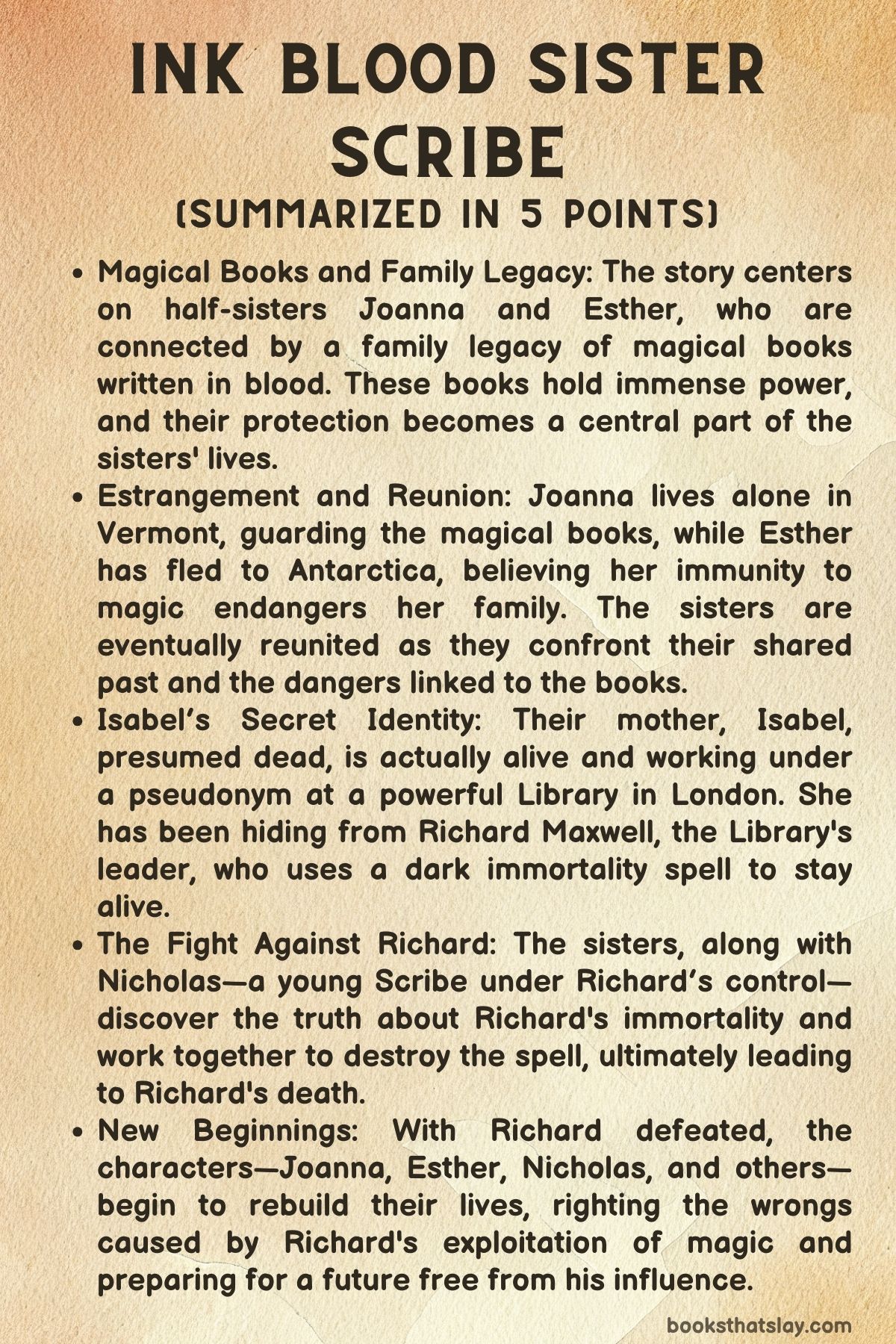
Ink Blood Sister Scribe by Emma Torzs is a dark and inventive fantasy about family, magic, and survival. It follows two estranged sisters bound by an inheritance of dangerous books written in blood.
Joanna lives in isolation in Vermont, guarding her late father’s library of magical volumes and performing nightly rituals to keep their home hidden. Her sister Esther, immune to magic, hides at an Antarctic station, ignoring their father’s warning to keep moving or risk death. Their lives collide with Nicholas, a young man trapped in the grip of a secretive Library, leading them into a conflict that reveals long-buried family secrets and forces them to choose between loyalty, freedom, and power.
Summary
The story begins in Vermont, where Joanna Kalotay finds her father Abe dead outside their home. Beside him lies a strange book that has drained his blood.
Abe leaves a warning to keep her mother Cecily out and to protect the library of magical manuscripts he had spent his life guarding. Unlike the other books, this one is unreadable, indestructible, and bound with human hair, written in blood.
Abe had failed to destroy it despite years of attempts. Now the responsibility of preserving the magical collection and maintaining nightly protective wards falls solely on Joanna.
Her life is marked by solitude, sharpened by the absence of her sister Esther, who left years ago and communicates only through postcards.
Far away in Antarctica, Esther has built a life at a South Pole station, working as an electrician and sharing a relationship with Pearl, a carpenter. For the first time, she breaks her father’s rule to leave every November 2, a precaution he had tied to the murder of their mother years ago.
Days later, unsettling signs appear: the scent of yarrow, an herb linked to magic, and dried blood marks on mirrors in ritual patterns. Realizing that someone has brought a dangerous book to the station, Esther recalls her father’s warnings and fears she may have doomed herself and Pearl by staying too long.
Meanwhile, Joanna struggles under the weight of her inherited duty. She experiments with writing her own magical books but fails.
She even sends samples to labs, learning that human blood has always been a key ingredient. Haunted by her father’s warnings and her mother’s attempts to burn the books, she maintains the nightly wards using a codex written by her mother Isabel, which makes the house invisible.
Her isolation is absolute; only Esther could bypass the protections, but she remains distant. Joanna’s relationship with Cecily is fraught, complicated by Abe’s dying command not to trust her.
Cecily pushes Joanna to see the books as a prison, intensifying the family rift.
The narrative also follows Nicholas, a young man in London bound to the Library, a secretive institution controlling magical books. His uncle Richard, the head of the Library, exploits Nicholas’s blood to create spells.
At a party, Nicholas watches his illusions used for profit while his health deteriorates. Soon after, he survives a violent attack targeting the Library.
Within its walls, he is forced to destroy cursed books and questioned about potential traitors. His loyalty to Richard wavers, especially after learning disturbing truths, including the preservation of his severed eye as a magical artifact.
Maram, the Library’s chief librarian, secretly arranges his escape, believing Richard cannot be trusted. With the help of his bodyguard Collins, Nicholas flees, carrying false passports, money, and his dog, Sir Kiwi.
In Vermont, Joanna faces betrayal when Cecily traps her with a blood spell, preventing her from tending the wards. The house is left vulnerable, forcing Joanna to confront her mother’s choices and their fractured history.
At the same time, Esther experiments with the mirror spells at the Antarctic base. She communicates through a mirror and receives a letter warning her she is in danger, along with travel documents and blood.
Though hesitant, she finally leaves, abandoning Pearl. On her journey, she narrowly survives an attempted attack by a glamoured imposter at Auckland airport, saved by a mysterious ally who guides her onward.
On the flight to the United States, she meets Nicholas and Collins, who recognize her immunity to magic and reveal they have been sent to find her. They believe Esther is a Scribe, someone uniquely tied to the creation of magical books.
The unlikely trio—Esther, Nicholas, and Collins—travel together, hiding from Richard’s reach. They visit allies of Collins who live modestly with practical magical tools.
Esther reaches out to Pearl, who feels betrayed, but she presses on with her companions toward Vermont. Their paths converge with Joanna’s, who continues her solitary struggle until Esther finally returns.
Together, they begin uncovering their family’s deeper secrets: Isabel, the mother they knew as gone, is in fact Maram, the Library’s chief librarian. Once Abe’s lover, she abandoned the family and betrayed them for power.
Cecily, originally Esther’s nanny, raised the sisters after Isabel’s departure.
In England, Nicholas and Esther infiltrate the Library through hidden passages with Maram’s covert assistance. They confront Richard in his study, where he threatens Esther’s life to force Nicholas into surrender.
Maram appears to support Richard but subtly manipulates the situation. In the chaos, Esther tackles Richard, and Nicholas destroys the artifacts binding his uncle’s life.
Richard ages rapidly and dies, leaving Nicholas overwhelmed by grief despite his uncle’s cruelty. Maram reveals her true identity as Esther and Joanna’s mother but avoids openly embracing the role.
She disappears afterward, taking powerful books and leaving Nicholas with control of the Library.
Back in Vermont, Cecily reveals the tangled history of Isabel’s betrayal, Abe’s obsession, and the role of silencing spells that kept them from telling the full truth. Joanna, shattered by revelations, begins to see the larger picture.
Eventually, she joins Esther, Nicholas, and Collins in England. For Joanna, it is her first time stepping beyond her father’s cloistered world.
Esther reconnects with Pearl through magical communication, suggesting a fragile hope for their future. Collins and Joanna grow closer, while Cecily reunites with Esther with guilt but affection.
The story concludes with Nicholas, now the reluctant head of the Library, proposing to reshape it into something open rather than controlling. Joanna and Esther push for new ways to share magic with the wider world.
Together, they prepare to use Joanna’s skills to read a newly written book—a spell designed to break the centuries-old inheritance rules that restricted magic to certain bloodlines. Their decision carries risk, as it could undo magic entirely, but they face it as a united front, ready to redefine the legacy of books, blood, and family.
Characters
Joanna Kalotay
Joanna stands at the center of the legacy her father left behind, both burdened and defined by the magical books she inherits after his death. Her life is one of isolation, enforced by the responsibility of maintaining the protective wards that conceal her family home.
She is deeply conflicted: though she resents the solitude and the immense weight of expectation, she also clings to the books as her only connection to her father and to a fractured sense of family. Joanna’s relationship with magic is one of both mastery and desperation.
She is capable of identifying and using the books with skill, yet she becomes obsessed with trying to create her own through experimentation with blood ink. This pursuit reflects her hunger for control and belonging, as she feels abandoned by her sister Esther and mistrustful of her mother Cecily.
Her character embodies the tension between duty and desire—she yearns for companionship and freedom, but remains tied to her father’s warnings and the dangerous inheritance of blood-bound magic.
Esther Kalotay
Esther is defined by her resistance to magic—both in her immunity to it and in her refusal to be bound by it. While her sister Joanna is locked in their father’s world, Esther spends years running, moving from place to place under Abe’s cryptic rule to leave every November 2.
This wandering life marks her as someone who seeks escape and self-determination, even at the cost of family ties. Her work as an electrician at the Antarctic base, far removed from the magical legacy of her family, highlights her desire for a grounded, practical life.
Yet she cannot entirely escape her past: the scent of yarrow, blood-marked mirrors, and the resurfacing of magical threats pull her back into the world she tried to flee. Her relationship with Pearl provides her with a fleeting sense of stability and love, but her inability to explain her history causes cracks in that bond.
Esther’s immunity to magic, once a source of alienation, later becomes a defining strength, positioning her as a crucial figure in breaking the cycle of secrecy and inherited danger. Her journey is one of reluctant acceptance—embracing that even without magical power, she has a pivotal role to play in reshaping its future.
Abraham (Abe) Kalotay
Abe’s presence lingers over the entire narrative, even after his death. His obsession with magical books, his strict rules, and his inability to destroy the cursed volume he guarded form the framework within which his daughters live.
Abe is portrayed as both protector and jailer: he sheltered Joanna in their magically hidden home, teaching her to safeguard their collection, while at the same time driving Esther away with cryptic warnings and controlling rules. His legacy is one of silence and secrecy, leaving his daughters to piece together the truths he withheld.
Abe’s contradictory nature—loving yet authoritarian, protective yet complicit in perpetuating the dangers of magic—makes him a complex figure whose influence is felt long after his death. He embodies the weight of tradition and the cost of devotion to power, ultimately leaving his daughters with both tools and traumas to navigate.
Cecily
Cecily is a deeply conflicted character, torn between love for her daughters and resentment of the magical prison that shaped their lives. Once their caregiver after Isabel’s abandonment, she struggles against the walls Abe built, both literal and metaphorical.
Her decision to trap Joanna with a blood spell, preventing her from maintaining the wards, reveals both her desperation and her sense of betrayal. She insists that Joanna has become a prisoner to the books, echoing her own feelings of being trapped in a life dictated by others’ choices.
Cecily represents rebellion against the system of secrecy and control, but her methods—deception, manipulation, and emotional pressure—undermine her intentions. Her complicated relationship with Joanna is marked by distance and mistrust, yet beneath it lies an enduring bond that resurfaces as the truth about Isabel comes to light.
Cecily’s character reflects the emotional fallout of generations shaped by blood-bound magic.
Isabel (Maram)
Isabel, who reinvents herself as Maram, is the enigmatic and morally ambiguous figure at the heart of the story’s revelations. Once Abe’s lover and the mother of Joanna and Esther, she abandons her family to pursue power within the Library.
Her choices fracture her daughters’ lives, leaving Cecily to raise them while she consolidates her influence in Richard’s world. Isabel is a woman driven by ambition, cunning, and a restless desire to define her own role in the magical order.
While she initially appears as an ally to Nicholas, her motives are layered with self-preservation and opportunism. Yet she is not a purely villainous figure; her eventual intervention against Richard, and her strained attempt to reconnect with Esther, suggest a complicated mix of maternal instinct and pragmatic calculation.
Isabel represents the dangerous allure of the Library’s power, as well as the painful reality of a woman who sacrifices family for ambition but cannot fully sever those bonds.
Nicholas
Nicholas is a tragic yet resilient figure, raised under the manipulative grip of his uncle Richard within the confines of the Library. His entire existence has been shaped by exploitation, as his rare ability as a Scribe comes at the cost of his health and autonomy.
Nicholas’s bitterness stems from years of using his blood to produce magical creations for others’ gain, leaving him disillusioned and hollow. Yet beneath his weariness lies a yearning for freedom and self-definition, which grows stronger through his unlikely alliances with Collins and Esther.
His relationship with Richard is deeply conflicted—marked by dependency, loyalty, and betrayal—culminating in a devastating recognition of Richard’s cruelty. Nicholas’s decision to risk rewriting the foundations of magic reflects both his courage and his desire to dismantle the oppressive structures that shaped his life.
He embodies the theme of reclaiming agency, turning suffering into resolve to change the future.
Richard
Richard, head of the Library and Nicholas’s uncle, is the embodiment of generational control and the corrupting hunger for power. He is both patriarch and tyrant, using manipulation, silencing spells, and psychological games to maintain his dominance.
Richard’s relationship with Nicholas reveals his cruelty masked as protection, fostering dependency while exploiting his nephew’s gift. His binding to the Library through bone and blood symbolizes his complete surrender to the institution’s legacy, elevating him to near-immortality at the cost of humanity.
Richard’s downfall comes from the very structures he upheld, as the fragile balance of secrecy and loyalty crumbles. He represents the dangers of inherited power left unchecked, a figure clinging to control even as it rots him from within.
Collins
Collins provides a grounding presence in the narrative, balancing blunt pragmatism with surprising loyalty. Initially introduced as Nicholas’s bodyguard, he evolves into a protector and guide, offering Nicholas the courage to escape Richard’s oppressive world.
His no-nonsense demeanor conceals a deep compassion, as seen in his commitment to both Nicholas and later to Esther. Collins’s connection to Lisa and Tansy shows that he is not merely an enforcer but part of a broader resistance, someone who values community and survival over hierarchy and secrecy.
His role highlights the power of chosen loyalty and found family, standing in contrast to the blood-bound ties that ensnare so many other characters. Through his steady support, Collins helps Nicholas and Esther envision the possibility of a future not dictated by the past.
Themes
Family and Estrangement
The relationship between family members is at the heart of Ink Blood Sister Scribe, and it is a fractured, painful bond riddled with betrayals, silences, and secrets. Joanna and Esther embody two drastically different responses to their father’s obsession with magical books—Joanna inherits the responsibility of protecting them, while Esther runs as far as she can from their burden.
Their estrangement is not simply geographical but emotional, each sister carrying unspoken resentments and guilt. Joanna clings to duty, bound to her father’s house and rules, resenting Esther’s freedom yet yearning for her presence.
Esther, on the other hand, feels excluded from the magical world because of her immunity, an exclusion that festers into distance and avoidance. Their mother figures, Cecily and Maram, add layers of abandonment and betrayal, both by choice and through secrets that alter the sisters’ understanding of their own lives.
Family becomes a prison as much as a source of identity, with Joanna trapped in her father’s rituals and Esther haunted by his warnings. Yet even within the brokenness, the possibility of reunion remains, and the novel suggests that reconciliation is not about erasing wounds but learning to live alongside them.
The family dynamic here emphasizes how love and loyalty are tested when histories are shaped by secrecy and grief, and how estrangement does not sever the pull of blood ties.
Power, Control, and Exploitation
The magical books themselves are embodiments of power, written in blood and infused with sacrifice. The Library, where Nicholas suffers under his uncle Richard’s rule, is the clearest example of this theme, as it monopolizes magic and binds its members through silencing spells and coercion.
Richard thrives on control, exploiting Nicholas’s body and blood for the creation of magical texts while keeping him under surveillance and manipulation. This system mirrors broader structures of exploitation, where power is concentrated in the hands of a few who weaponize knowledge to secure dominance.
Joanna’s strict adherence to Abe’s rules reflects another form of control, one that imprisons her within isolation and duty rather than overt violence. Esther’s immunity is also a kind of power, but one that destabilizes control, as she disrupts magical systems rather than sustaining them.
The tension between freedom and domination runs through the novel, and the characters’ journeys revolve around resisting those who would hoard or abuse power. Nicholas’s decision to remake the Library as something more open and Esther’s insistence on sharing magic with the wider world mark the breaking of this cycle, yet the narrative makes clear how hard-fought and fragile that liberation remains.
Isolation and Connection
Isolation pervades every character’s storyline. Joanna is literally walled into her Vermont home, hidden by magical wards and estranged from her sister, mother, and broader community.
Her rituals of protection become both her safety and her curse, leaving her physically and emotionally cut off. Esther chooses isolation by moving from place to place, never staying long enough to build a life, until her relationship with Pearl offers her a fragile sense of belonging.
Nicholas, trapped within the Library, experiences another kind of loneliness—his body used for others’ gain, his voice silenced, and his agency stripped. In each case, isolation is not only external but internalized, shaping how these characters see themselves.
Yet the novel also charts the tentative movements toward connection. Joanna’s longing for Esther’s postcards, Esther’s bond with Pearl, Nicholas’s alliance with Collins, and ultimately the joining of all three threads suggest that connection is possible when individuals risk vulnerability despite fear.
The story underscores that isolation, though sometimes a form of survival, cannot endure as a permanent state. The arc toward reunion—between sisters, between allies, between survivors of exploitation—becomes the most hopeful movement in the novel.
Knowledge, Secrecy, and Legacy
Knowledge in Ink Blood Sister Scribe is never neutral; it is hidden, hoarded, and passed on through blood. Abe’s obsessive guardianship of magical books is an inheritance Joanna cannot refuse, and one that estranges her from both her mother and her sister.
The Library represents an institutionalized form of secrecy, where knowledge is tightly controlled, enforced by silencing spells, and leveraged for personal gain. Secrets saturate the characters’ lives—Esther grows up not knowing the full truth of her mother’s murder, Nicholas learns too late the extent of Richard’s manipulations, and Joanna lives under warnings that only half-explain her father’s choices.
The inheritance of these secrets becomes a legacy of fear and control. Yet the novel also questions whether secrecy can ever protect, or whether it only perpetuates harm.
Nicholas’s decision to undo the bloodline restriction on magic, opening it beyond families like his own, becomes a radical act of transparency. By envisioning magic as a resource meant to be shared rather than locked away, the story reframes legacy not as inherited secrecy but as deliberate transformation.
This theme challenges the notion that knowledge must always be preserved by gatekeepers, suggesting instead that liberation lies in dismantling the walls around it.
Identity, Difference, and Belonging
The contrast between Joanna’s gift for magic and Esther’s immunity shapes both sisters’ sense of identity. Joanna’s role as caretaker and wielder of magical texts is not one she chooses but one she inherits, tying her worth to ability and obligation.
Esther, immune and excluded, grows up in the shadow of that difference, both protected from and estranged by it. Her life becomes defined by displacement, as if her lack of magical sensitivity means she cannot belong fully to her family or to the dangerous world surrounding them.
Nicholas mirrors this struggle, defined by his role as a Scribe but also used and diminished by those who should have nurtured him. Belonging, then, becomes not about shared blood or ability but about chosen bonds—Esther’s love for Pearl, Nicholas’s trust in Collins, Joanna’s eventual connection with allies outside her home.
The novel portrays identity as a negotiation between what is inherited and what is chosen, suggesting that difference, whether immunity or ability, does not determine worth. Belonging emerges as a fragile but vital pursuit, created through love, trust, and shared struggle rather than enforced lineage or magical talent.