Innocence Road Summary, Characters and Themes
Innocence Road by Laura Griffin is a taut and suspenseful crime thriller set against the desolate landscapes of West Texas. The story follows Detective Leanne Everhart, a determined small-town investigator haunted by her family’s complicated legacy in law enforcement.
When a mutilated young woman’s body is discovered near a remote railroad track, Leanne finds herself unraveling a chilling web of corruption, cover-ups, and serial murders that span years. As she battles her superiors’ interference and her own demons, Leanne uncovers disturbing truths linking her father’s past case to a present-day killer, forcing her to confront betrayal within the very system she serves.
Summary
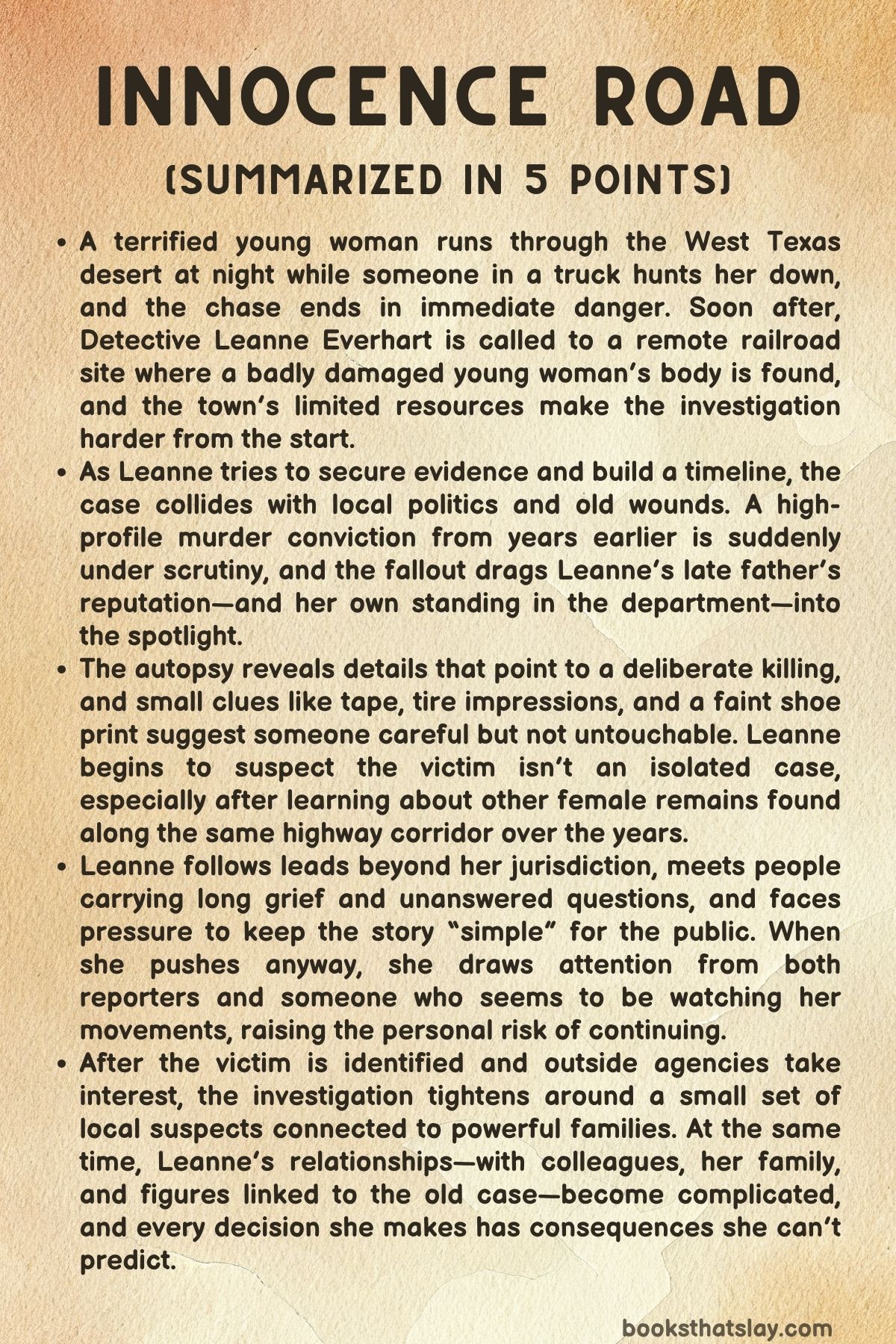
The novel begins with a harrowing scene of a young woman fleeing through the desert at night, pursued by a man in a truck. Exhausted and terrified, she’s caught, confronted at gunpoint, and executed.
The next morning, Detective Leanne Everhart is called to the scene near Madrone, a dusty Texas town. The victim’s decomposed body lies beside railroad tracks—her skull crushed and her identity unknown.
Leanne, facing limited forensic support, carefully gathers evidence: tire marks, duct tape, and traces of animal activity. Her superior, Chief Jim McBride, officially assigns her the case.
Soon, the discovery draws public attention, and Leanne finds herself juggling town gossip, an intrusive press, and political pressure. Matters grow worse when District Attorney Trey Novak informs the department that Sean Moriarty—once convicted of murdering local teenager Hannah Rawls—has been exonerated.
His confession, ruled coerced, tarnishes the department’s credibility. For Leanne, the news hits close to home: her late father worked the Rawls case, and her family’s name is now under scrutiny.
McBride orders her to visit the Rawls family to manage the fallout. The visit turns volatile as the victim’s mother, Trish Rawls, vents years of anger and vows revenge if Moriarty returns to town.
Meanwhile, Leanne’s personal life is fraying. Struggling with alcoholism and strained family ties, she finds herself isolated.
When she encounters Liam Moriarty, Sean’s bitter brother, their confrontation turns violent, only diffused by Justin Carr, an old acquaintance whose involvement soon proves far darker. Unbeknownst to Leanne, a man named Max secretly watches her home that night, reporting her movements to an unknown handler.
As Leanne digs deeper, the autopsy reveals the victim was strangled before being bludgeoned, with a butterfly tattoo on her wrist providing a slim lead. Evidence suggests she was dragged to the site, not dumped from a train as Leanne first suspected.
Her superiors’ obstruction frustrates her: McBride excludes her from the autopsy and withholds resources. Undeterred, Leanne investigates on her own, visiting her late father’s notes from the Hannah Rawls case.
She discovers references to a gallery in Marfa, suggesting he once followed a lead connected to that investigation.
Visiting the Dark Sky Gallery, Leanne questions owner Zach Olmstead, who denies knowing her father. A nearby woman, Alma, then reveals her daughter Marisol disappeared years ago, one of several missing girls from the region.
These stories echo Leanne’s current case, suggesting a pattern of young women vanishing along the same desert corridor. With the help of Deputy Duncan Harper, she consults forensic anthropologist Jen Sayers, who confirms the “animal bone” from the crime scene is human—part of a femur belonging to another teenage girl.
Jen’s records show multiple similar cases along Highway 67, all marked by violence and duct tape. Leanne suspects a serial killer operating across county lines.
When she presents this theory to McBride, he dismisses her, forbidding her to use the term “serial killer” publicly. Furious, Leanne turns to Duncan for quiet support.
Together, they pursue leads despite bureaucratic resistance. In El Paso, Leanne meets FBI agent Sam Carver, an old friend, and shares her data on the highway corridor victims, hoping federal support might expose the link.
Sam warns her that internal corruption tied to the Moriarty case may reach high into law enforcement ranks.
Soon, the latest victim is identified as Valeria Reyes, a nineteen-year-old from Albuquerque with a history of sex work. This discovery cements Leanne’s belief that the killer targets vulnerable women.
Izzy Huerta, the young crime scene photographer, helps uncover a partial shoe print—men’s size thirteen—suggesting a tall, physically strong suspect. Leanne’s investigation intensifies just as tragedy strikes her family: her stepfather’s ranch garage burns down under suspicious circumstances.
Evidence of arson emerges, and suspicion falls on her brother Ben, who is struggling with addiction. The crisis reignites long-buried family tensions, and her mother confesses a shocking truth—that Leanne’s father coerced Sean Moriarty’s confession at gunpoint, a secret she tried to destroy by burning the tape.
The revelation shatters Leanne’s belief in her father’s integrity.
Emotionally unraveling, Leanne nearly relapses into drinking but clings to her purpose: solving the murders. Meanwhile, Duncan learns that the FBI’s genealogical DNA search has produced a hit—linking the unknown killer’s DNA to the Carr family, including Justin Carr, the same man who once defended the Moriartys at the bar.
Leanne realizes with horror that Justin is the killer and likely responsible for both Valeria Reyes’s death and others. Acting alone, she drives to his farm but finds Izzy’s abandoned car nearby.
Realizing Izzy has been abducted, Leanne rushes toward the desert.
Izzy, meanwhile, is trapped in Justin’s truck. He accuses her of photographing his tires—evidence from the scene—and forces her at gunpoint into a remote area, pushing her into an abandoned mine shaft.
As Leanne arrives, she encounters Sean Moriarty, who insists he knows where Justin took Izzy. Reluctantly, she teams up with him, racing through the desert night to the old mercury mine where Justin once spent time as a teen.
Inside, they find Justin holding Izzy hostage. Leanne tries to negotiate while Sean distracts him long enough to strike.
A violent struggle ensues; Leanne subdues Justin and arrests him. Izzy survives, though traumatized.
The investigation that follows confirms Justin’s guilt—not only in Valeria’s murder but in multiple cold cases, including Hannah Rawls’s. Hidden in his trailer, police find trophies from his victims, including Hannah’s bracelet, proving Sean Moriarty’s innocence once and for all.
Yet the truth brings little comfort. McBride and the district attorney scramble to control the scandal, but Leanne, armed with a recording of McBride admitting to past coercion, turns the tables.
Working secretly with the FBI, she exposes the corruption behind the wrongful conviction and the years-long cover-up. McBride flees but is captured after a tense pursuit.
In the aftermath, justice ripples through the community. McBride and the former DA are indicted, and the department faces public reckoning.
Leanne’s mother admits that her late husband tried to come clean before dying, but others silenced him. Though weary and ostracized, Leanne accepts the deputy chief position, determined to rebuild integrity in the force.
As the story closes, she hikes into the vast desert, reflecting on truth, loss, and the cost of justice as storm clouds gather on the horizon—a reminder that healing, like justice, takes time.
Characters
Leanne Everhart
Leanne Everhart is the central character of Innocence Road and the story’s protagonist. A determined and tenacious detective, Leanne is driven by a complex mix of personal and professional motivations.
As the daughter of a respected police officer who was involved in a controversial case, she feels the weight of her family legacy while trying to uphold justice in a town where the lines between right and wrong are often blurred. Leanne’s work is hampered by her struggles with sobriety, as she battles the urge to return to drinking amidst the stresses of her job and personal life.
Despite these challenges, she is methodical and fiercely dedicated to solving the murder cases she’s assigned, particularly the case of an unidentified woman found near the railroad tracks, which she suspects is part of a larger serial killing pattern. Leanne’s personal journey is as much about confronting her demons—such as her strained relationship with her mother and the trauma of her father’s death—as it is about solving crimes.
Her character evolves significantly throughout the novel, as she uncovers dark secrets, faces the painful truths about her family’s role in past injustices, and confronts corruption within her own department. Leanne is ultimately defined by her resilience, her pursuit of truth, and her willingness to make difficult choices, even when they jeopardize her career and personal relationships.
Sean Moriarty
Sean Moriarty is a key character whose past is shrouded in controversy. Once wrongfully convicted of the murder of a local teen, Sean’s release from prison after new evidence surfaces sets the stage for much of the novel’s conflict.
Although initially viewed with suspicion by Leanne and others, Sean’s role in the story is more complex than it first appears. As the brother of the actual killer, Justin Carr, Sean is burdened by the legacy of his coerced confession and the trauma of being a scapegoat.
His interactions with Leanne are tense and fraught with mistrust, particularly because of their shared history tied to the death of Hannah Rawls. Over time, however, Sean proves to be a reluctant ally to Leanne.
His knowledge of the region and his involvement in the investigation ultimately help uncover critical details about the murders. Despite his past, Sean’s character is one of redemption and reconciliation, offering a stark contrast to the corruption within the police force and the town.
His arc is about seeking justice for himself and for others who have been wronged, culminating in a pivotal moment where he helps Leanne confront the true killer.
Justin Carr
Justin Carr is initially presented as an unassuming figure, but his role in Innocence Road evolves into that of a villain with dark secrets. He is one of the three men linked to a series of murders in the region, with his connections to the other victims being slowly uncovered throughout the story.
Justin’s connection to Leanne is particularly complicated, as they share a history, and he is revealed to be both manipulative and violent. As the true killer of several women, including Hannah Rawls, Justin’s character represents the darker side of small-town life—where secrets fester and the truth is often concealed under a facade of normalcy.
His interactions with Leanne and others are marked by a disturbing sense of entitlement, and he uses his charm to mask his cruelty. Justin’s final confrontation with Leanne and his subsequent arrest serve as the culmination of the tension between them, showcasing his escalating violence and the devastating impact of his actions.
Justin’s character is a study in the psyche of a killer who hides in plain sight, using his charm and position to manipulate those around him.
Izzy Huerta
Izzy Huerta is a young crime scene photographer who plays a critical role in helping Leanne unravel the mystery surrounding the murders. Though she initially appears as a secondary character, Izzy’s growth throughout the story is substantial.
She is intelligent, observant, and unafraid to question the events around her, which makes her an invaluable ally to Leanne. Izzy’s emotional connection to the case becomes personal, especially after she uncovers key pieces of evidence that Leanne had overlooked.
Her discovery of a faint shoe impression and her documentation of the crime scenes help drive the investigation forward. However, Izzy’s involvement in the case takes a dangerous turn when she becomes a target of Justin Carr, leading to a harrowing and traumatic experience for her.
Izzy’s character is one of vulnerability mixed with strength—she is deeply affected by the violence she witnesses, yet she continues to pursue the truth, even when it puts her own life in danger. Her relationship with Leanne is one of mentorship and friendship, and her actions prove essential in bringing the killer to justice.
McBride
Chief Jim McBride is a deeply flawed and morally ambiguous character who serves as a major antagonist in Innocence Road. As the head of the Madrone Police Department, McBride is initially portrayed as a competent, no-nonsense leader, but as the story progresses, his darker traits emerge.
McBride is part of the web of corruption that runs through the town, including his role in the coerced confession of Sean Moriarty. He is driven by self-preservation and a desire to maintain control over the department, even if it means covering up past mistakes and injustices.
His relationship with Leanne is strained due to their differing approaches to justice, and his manipulation of the investigation leads to many of the roadblocks Leanne faces. McBride’s character is a study in authority gone awry—his need to protect his own interests and his reluctance to confront the truth about his role in past events create a sense of moral decay.
By the end of the novel, McBride’s actions lead to his downfall, as his past misdeeds are exposed, and he is held accountable for his role in the corruption and wrongful convictions that have plagued the town for years.
Boone Sullivan
Boone Sullivan, Leanne’s stepfather, is a peripheral yet significant character in Innocence Road. He represents the more stable, traditional elements of Leanne’s life, yet his relationship with her is complicated by the circumstances surrounding her family.
Boone’s ranch serves as both a retreat and a point of contention for Leanne, as it’s tied to her father’s legacy and the tensions in her family. His presence in the story is mainly to provide emotional support for Leanne, but he is also involved in the investigation when his property becomes a focal point due to a fire that is suspected to be arson.
Boone’s character is defined by his protective nature and his desire to keep the peace, but his role in the investigation is ultimately overshadowed by the deeper, darker events unfolding in Madrone. His relationship with Leanne highlights the fractured nature of their family dynamics, particularly regarding the unresolved issues surrounding her late father’s actions and their impact on the present.
Alma
Alma is a minor but poignant character in the story, whose grief and sense of loss highlight the broader theme of missing and murdered women that runs through the narrative. Alma’s daughter, Marisol, went missing six years ago, and Alma’s pain is palpable when she recounts the loss to Leanne.
Alma’s character serves as a reminder of the many unsolved cases and the heartbreak families face when they are left without answers. Her personal connection to the broader theme of violence against women adds depth to the story, illustrating how the victims are not just faceless bodies but real people with families and loved ones who continue to suffer in the wake of their disappearance.
Alma’s story becomes part of the larger puzzle Leanne is trying to solve, reinforcing the urgency of her investigation and the emotional toll it takes on everyone involved.
Themes
Justice versus institutional self-protection
From the moment Leanne is blocked from basic investigative steps on the unidentified victim, Innocence Road shows how justice can be treated as optional when it threatens an institution’s reputation. The obstruction isn’t subtle: the autopsy is moved up without her knowledge, evidence submissions are denied under the excuse of budget limits, and her authority is quietly undercut by sending another detective in her place.
This creates a system where solving the crime is less important than controlling the story. The department’s leadership is not simply overwhelmed; it is actively choosing public relations over truth, especially once the Moriarty release triggers statewide attention and the fear of lawsuits.
The pressure isn’t just about embarrassment. Careers, pensions, old alliances, and a legacy built on a conviction are all on the line, and that encourages officials to treat new victims as an inconvenience rather than human beings.
Leanne’s insistence on following patterns—duct tape, similar injuries, recovery sites along a corridor—collides with a leadership culture that prefers neat, isolated cases that can be “cleared” fast. When McBride labels victims as people no one reports missing, he is not making an investigative point; he is announcing which lives the system is willing to deprioritize.
The theme reaches a breaking point when proof of coercion and corruption surfaces: the machinery that once claimed certainty about guilt is revealed as capable of manufacturing it. Justice in this world is not only about catching a killer; it is about confronting the apparatus that decides what counts as acceptable truth, and who is allowed to demand it.
Vulnerability, gendered violence, and whose disappearance counts
The repeated discovery of young women harmed along the same regional corridor makes the violence feel both personal and structural. The victims are not framed as random tragedies; they are connected by how easily they can be dismissed.
Valeria Reyes is identified through a prostitution-related arrest, and that fact becomes a social permission slip for officials to treat her as less urgent. The same logic hovers over the older remains, the missing daughter Alma mourns, and the suggestion that some victims were “transients” who got involved with criminals.
The narrative exposes how status determines urgency: a respected local teen’s murder becomes a defining case for a town, while other women can vanish for years with only a mother’s altar preserving their name. This theme is intensified by the setting and logistics—remote stretches of highway, desert distances, sparse resources—which create conditions where predators can act repeatedly and where even well-intentioned investigators can be outmatched by scale.
But the core is not geography; it is social triage. The story forces attention to what happens when violence targets those with fewer advocates and when institutions assume that silence equals consent to forget.
Leanne’s anger is partly moral and partly diagnostic: she recognizes that the pattern exists because the region has trained itself not to look too closely. When the killer is revealed as someone embedded in the community, the message sharpens—danger is not always an outsider threat, and the veneer of respectability can be the most effective camouflage.
The theme ultimately argues that vulnerability is amplified not only by predators but by a public system that measures grief and urgency by reputation.
Truth, memory, and the instability of personal legacy
Leanne’s relationship with her father’s legacy is not a simple devotion or rejection; it is a conflict between what she needs to believe and what the evidence demands. She inherits a story about a respected officer who helped put away a murderer, and that story has shaped her identity inside the department and in the town’s social landscape.
But as she searches his old notes and sees gaps, odd references, and clues pointing to hidden contacts, she begins to understand that memory can be curated. The past is not simply “there” to be discovered; it has been edited by people with motives, shame, and fear.
Her mother’s revelations—especially the claim that a confession was forced at gunpoint and then the tape was destroyed—turn family history into contested terrain. That destabilization is emotionally expensive because it doesn’t just change what happened; it changes who Leanne is allowed to be.
If her father participated in wrongdoing, then the professional pride she has carried becomes complicated, and the moral authority she thought she inherited becomes uncertain. The theme is also reflected in the town’s broader reaction.
Public belief is not anchored to facts but to familiar narratives: a “monster” was caught, a family received closure, a department protected its own. When that narrative collapses, people scramble to preserve something stable, even if it means resisting new truths.
Leanne’s arc shows the cost of choosing truth anyway. She accepts that honoring a person’s memory cannot mean defending their worst choices, and that loyalty to the dead cannot come at the price of abandoning the living.
The story treats legacy as something tested under pressure, not something automatically earned, and it suggests that real respect is shown through honesty rather than mythmaking.
Addiction, self-control, and the private battles beneath public competence
Leanne’s sobriety is not presented as a background detail; it is a constant pressure line running beneath every decision she makes. She is trying to stay steady while facing professional sabotage, public hostility, family conflict, and personal humiliation, and each stressor is the kind that historically would have pushed her toward escape.
The narrative shows how addiction is not only about substances but about patterns of coping—impulsive late-night messages, self-isolation, taking reckless risks when feeling cornered, and using intensity as a substitute for stability. Her work demands control and clarity, yet she operates in an environment that repeatedly undermines her, which creates a dangerous emotional feedback loop: the more powerless she feels institutionally, the more tempted she is to regain control through risky personal choices.
The relapse moment is particularly telling because it is not driven by celebration or boredom; it is driven by exhaustion and loneliness. Her sobriety is portrayed as an act of daily endurance rather than a single turning point.
The theme also connects to how others perceive her. In a small town, personal struggles become reputational vulnerabilities, and the people who want her silenced can use any misstep as justification to discredit her.
That threat makes self-control not only a health issue but a survival strategy. Yet the story doesn’t romanticize willpower.
Leanne’s drinking returns when her emotional world collapses, and the aftermath shows the shame and damage it can cause in relationships, especially with Duncan. What makes the theme powerful is that sobriety and integrity mirror each other: both require telling the truth to yourself when it would be easier to numb out, deflect blame, or accept comfortable lies.
Her eventual ability to keep going—continuing the work, facing consequences, refusing to leave—suggests that recovery is not about becoming unbreakable; it is about rebuilding after breaking without surrendering your values.
Trust, betrayal, and the uneasy necessity of alliances
Trust in Innocence Road is never a simple moral choice; it is a tactical and emotional gamble shaped by limited options. Leanne can’t fully trust her chief, can’t trust the media tailing her, can’t even trust that her own department will process evidence properly.
That atmosphere makes every alliance feel provisional. Duncan is one of the few people who supports her work, yet even that relationship strains because help becomes entangled with favors, secrecy, and emotional need.
Their dynamic shows how trust can erode when communication is uneven—when one person reaches out only in crisis, or when professional boundaries blur into personal reliance. The most challenging version of this theme arrives with Sean Moriarty.
For years, he has represented guilt in the town’s collective mind and in Leanne’s professional identity, and the idea that he might be innocent forces her to confront how thoroughly trust can be engineered by authority and repetition. When she accepts Sean’s help to find Izzy, she is not making a sentimental gesture; she is making a decision under extreme stakes, based on the immediate logic of saving a life.
The uneasy partnership highlights how truth can require collaboration with someone you once considered an enemy, and how moral certainty can be more fragile than urgency. Betrayal operates at multiple levels: institutional betrayal of victims, personal betrayal within family history, and public betrayal through media narratives that simplify complex harm into talking points.
Yet the story also insists that trust is still necessary—someone has to believe Izzy, someone has to believe Alma, someone has to believe that the pattern matters. By the end, Leanne’s leadership role is meaningful because it isn’t built on naive faith in the system.
It is built on a hard-earned understanding that trust must be supported by accountability, and that alliances are safest when they are paired with proof, transparency, and consequences for those who abuse power.
Power, reputation, and the cost of speaking when silence is rewarded
The book repeatedly shows that power is less about rank than about controlling consequences. McBride and the former district attorney hold power not only through their positions but through their ability to shape which facts become “official” and which are treated as inconvenient noise.
Leanne, despite being competent and driven, is placed under deadlines and threatened with losing her case—mechanisms designed to force obedience. Reputation becomes a kind of currency: the department wants a human-interest segment to soften public perception, not because it serves the murdered woman, but because it serves the brand of authority.
In that context, speaking up carries concrete penalties. Leanne risks her job, her standing in the community, and even her family’s safety when attention turns toward her brother after the arson.
The narrative treats retaliation as an expected response to disruption, not an exception. The presence of surveillance and targeting—Max watching her home and reporting she is alone—adds another layer: power can extend into intimidation that is deniable, carried out through intermediaries, rumors, and pressure rather than direct orders.
The cost of truth is also social. Small-town life magnifies conflict, turning professional disagreements into personal feuds, and making it easy for gossip to become an enforcement tool.
Leanne is isolated not because she is unpopular in a generic sense but because challenging powerful people breaks the community’s preferred peace. Yet the story refuses to frame silence as wisdom.
Silence preserves careers and reputations, but it also preserves predators and corrupt practices. When Leanne chooses to expose the coercion and participates in the sting that brings down McBride, the theme reaches its conclusion: power that depends on silence is fragile, and reputation that requires burying victims is not worth saving.
Her decision to stay and accept leadership shows the book’s belief that reform is not achieved by leaving a broken system behind; it is achieved by taking responsibility for what the system becomes next.