Intermezzo by Sally Rooney Summary, Characters and Themes
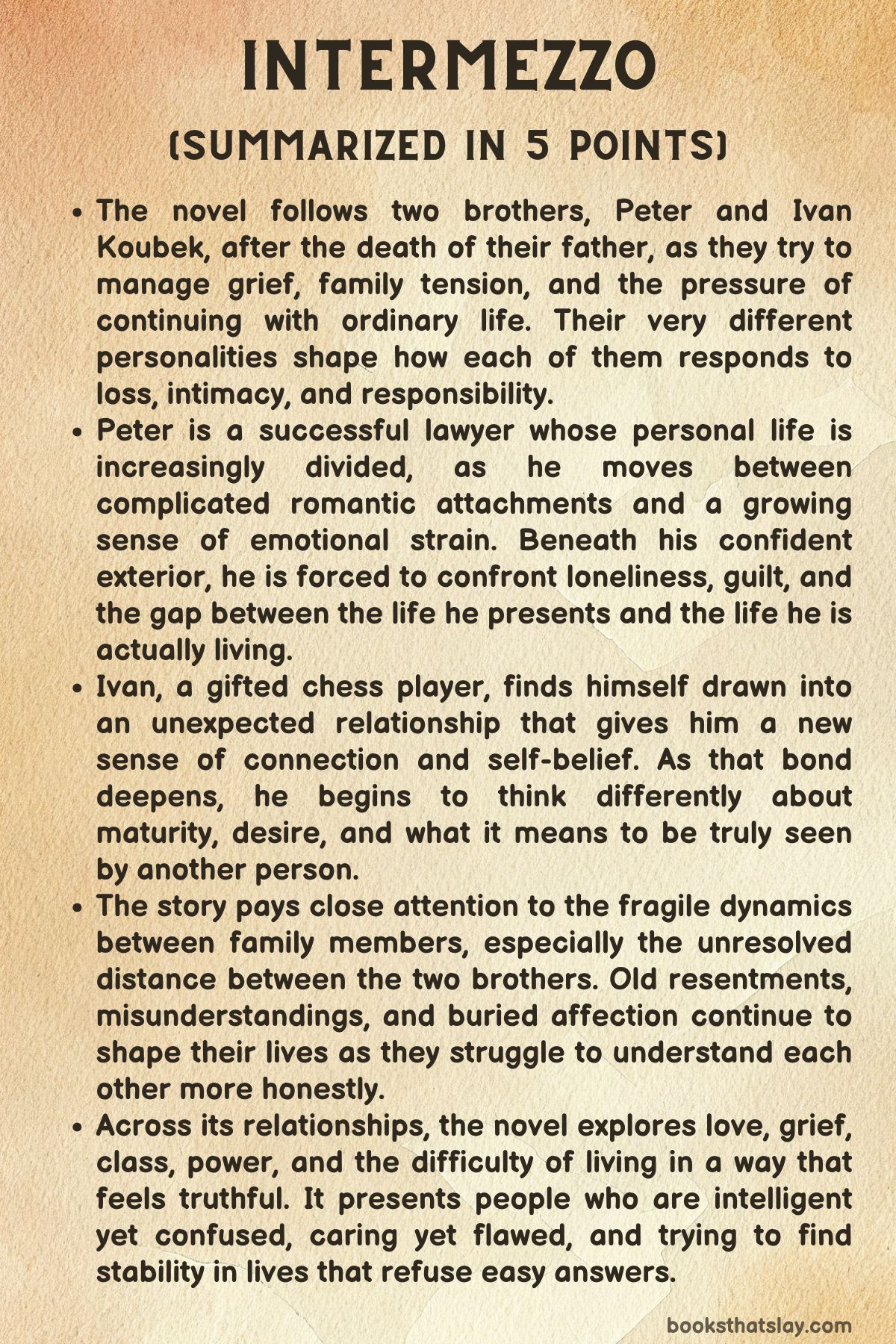
Intermezzo by Sally Rooney is a novel about grief, desire, class, power, and the uneasy ways people try to care for one another. It follows two brothers, Peter and Ivan Koubek, after their father’s death, as each moves through love, guilt, memory, and resentment in very different ways.
Peter, outwardly successful and socially fluent, is emotionally divided between two women and close to collapse. Ivan, younger and more inward, finds an unexpected relationship that changes how he sees himself. The novel studies intimacy with unusual precision, showing how people can be selfish, tender, cruel, needy, and sincere at the same time.
Summary
After the death of their father, the Koubek brothers are left facing not only grief but also the unresolved tensions that have shaped their lives for years. Peter, the older brother, is a lawyer in Dublin.
He appears capable and self-possessed, but inwardly he is fraying. He moves between two women: Naomi, a much younger college student in a precarious housing situation, and Sylvia, the former partner he still deeply loves.
Naomi’s life is unstable, and Peter supports her financially as well as sexually, though both know the relationship is uneven and compromised. With Sylvia, the bond is older and more serious.
She lives with chronic pain after a car accident, and their connection carries history, intellectual intimacy, and longing, but also sadness and limits.
Peter is also estranged from Ivan, his much younger brother. At their father’s funeral, the distance between them is unmistakable.
Peter feels burdened by responsibility and by old family roles. Ivan, quieter and socially awkward, seems to Peter cut off and difficult to reach.
Yet Ivan is dealing with the same loss in his own way. A gifted chess player, he travels to County Leitrim for a chess event, where he meets Margaret, a 36-year-old arts center worker.
Their attraction is immediate but cautious. Margaret is older, separated from her husband Ricky, and conscious of how others may judge her involvement with a younger man.
Ivan, for his part, is shy but direct, and finds in Margaret a form of attention and care he has rarely known.
Their relationship quickly becomes meaningful. Margaret is drawn to Ivan’s seriousness and openness, while Ivan is relieved by her curiosity about him.
He speaks to her about chess, work, and his father’s death, and she responds with genuine interest. For Ivan, who often feels apart from other people, this attention matters deeply.
For Margaret, whose life has narrowed into routine, local judgment, and the lingering effects of a troubled marriage, Ivan feels like a sudden reopening of possibility. Their age gap and different life stages trouble her, but she cannot deny the force of what she feels.
Meanwhile Peter becomes more unstable. He continues seeing Sylvia, and in her company he can briefly imagine a better, more coherent life.
Their conversations bring back their college years, shared ideas, and lost hopes. Yet Sylvia’s pain shapes everything.
Physical intimacy is difficult, and she is unsure whether resuming a full romantic relationship would be fair to either of them. Peter remains devoted to her, but he also returns to Naomi, whose dependence on him and whose emotional directness keep pulling him back.
Naomi’s vulnerability is real: she is evicted, arrested, and left without secure housing. Peter helps her, first at the police station and then by letting her stay in his apartment.
Their sexual bond intensifies, but so do the questions of power, need, and obligation between them.
Peter’s inner life darkens as he moves between work, grief, Sylvia, and Naomi. He experiences intrusive thoughts and imagines that others might be better off without him.
He is ashamed of how split his life has become. With Naomi he feels both protective and exploitative.
With Sylvia he feels love, admiration, and a desperate wish to recover what they once had. He tells himself that one relationship must eventually give way to the other, yet he cannot fully release either woman because each answers something different in him.
Ivan, by contrast, enters a period of emotional awakening through Margaret. Their meetings become more intimate and more serious.
He talks to her about freelance work, money worries, and the pressure he feels about chess. Margaret shares parts of her own history, including the strain of her separation from Ricky, whose alcoholism and abusive conduct made her life painful and unstable.
Ivan listens without patronizing her, and he rejects the idea that their relationship is automatically corrupt because of the age difference. He sees Margaret not as someone using him but as a person whose life has been difficult and who deserves love.
Gradually, he begins to feel that being with her changes him: it sharpens his moral sense, strengthens his confidence, and brings warmth back into a life hollowed out by grief.
The brothers briefly move toward reconnection when Peter calls Ivan and arranges to meet him. At dinner, they manage a fragile closeness, speaking honestly about work, ambition, and fear.
Peter even offers Ivan financial help when he learns about his rent worries. But the moment collapses when Ivan mentions Margaret’s age.
Peter reacts with anger and contempt, accusing Margaret of taking advantage of Ivan. He cannot see the relationship clearly, partly because of his own hypocrisy and partly because he still thinks of Ivan as someone who must be protected or corrected.
Ivan is humiliated and furious. To him, Peter’s reaction confirms a long history of disrespect and condescension.
After this, the rift deepens. Peter apologizes by text, but Ivan does not respond.
Margaret, hearing more about Peter, senses that Ivan’s account of their relationship is incomplete, though she also understands why he resents him. Peter broods over the silence and becomes increasingly unable to manage his emotional life.
Naomi challenges him more openly, seeing that he keeps her at a distance from the deeper parts of his world. Sylvia, too, confronts him about his contradictions.
When Peter finally tries to choose Sylvia and end things with Naomi, it does not bring relief. Sylvia is alarmed rather than pleased, sensing that Peter is using the idea of her to escape the mess of his life instead of honestly facing it.
At the same time, Ivan’s relationship with Margaret grows more serious. They tell each other they love one another.
Yet outside pressures do not disappear. Margaret worries about being judged by her town, by her friend Anna, by her mother Bridget, and by Ricky.
Bridget is openly hostile, blaming Margaret for family troubles and treating her choices as selfish or shameful. Margaret cannot stop imagining a future in which Ivan eventually leaves her for someone younger.
Ivan, however, keeps insisting on the reality of his commitment. For him, loving Margaret is not a mistake or phase but a truth he wants to live by.
A turning point comes when Naomi, now staying at the Kildare family house Peter has offered her, meets Ivan. Their conversation lets Ivan see more clearly how Peter lives and how lonely he has become.
Naomi tells him that Peter has called him a genius, something Ivan is startled to hear. She also suggests that Peter’s cruelty and confusion are tied to grief.
This does not excuse Peter, but it complicates Ivan’s anger. Ivan begins remembering moments from the past, including one night after Sylvia’s accident when Peter, distressed and frightened, asked him to stay with him and talk.
Ivan had refused. That memory now returns with force, and for the first time he truly worries that Peter may be in danger.
Soon after, Peter and Ivan meet at the Kildare house and their conflict explodes into a physical fight. Old grievances come spilling out: Peter’s habit of belittling Ivan, Ivan’s sense that Peter stole the center of their father’s funeral, Peter’s resentment that no one sees how much responsibility he has carried, and both brothers’ tangled feelings about their father.
The fight leaves them shaken. Peter, horrified by what he has done, calls their mother Christine and breaks down.
Ivan, bruised and angry, turns to Margaret and finally allows himself to grieve more openly, speaking of his fear that forgetting his father would mean losing him entirely.
The final movement of the novel brings a fragile but genuine repair. Peter’s collapse continues until Naomi and Sylvia, both worried by his behavior, find him together and force a kind of honesty.
Naomi tells him that his death would have mattered to her. Sylvia admits that she helped create an impossible emotional situation.
Instead of demanding a clean resolution, the three arrive at an unconventional arrangement that reflects the truth of their attachments more than any moral script would. It is awkward, unstable, and hard to name, but it gives Peter a way to live without lying quite so completely to himself.
Ivan, meanwhile, throws himself into chess and competes in an event that could bring him closer to the rank he wants. Peter comes to watch, staying outside so as not to distract him.
There he meets Margaret. Speaking with her, he realizes how wrong he was about her.
She is not predatory or ridiculous; she is thoughtful, serious, and clearly important to Ivan. After Ivan wins, Margaret brings Peter to him.
The brothers finally face each other without performance or defensiveness. Peter apologizes.
Ivan apologizes too, acknowledging Peter’s care for both him and their father. They say what neither has been able to say plainly for much of the novel: that they love each other, that their father loved them, and that they have both been trying, badly but sincerely, to survive.
By the end, nothing is perfectly settled. The relationships remain unusual, the grief remains real, and the future is uncertain.
But the brothers recover a sense of mutual recognition, and that changes everything. Christmas, once another source of tension, becomes something they can imagine sharing.
The novel closes not with final answers but with a hard-won openness to love, forgiveness, and the possibility of living honestly within imperfection.
Characters
Peter Koubek
Peter is one of the most psychologically complex figures in Intermezzo. On the surface, he appears accomplished, articulate, and socially fluent.
He is a lawyer, intellectually confident, and capable of moving through the world with polish. Yet this outer competence hides deep instability.
He is grieving his father, burdened by responsibility, and trapped inside a life that no longer feels coherent to him. He wants to think of himself as rational and morally serious, but much of his behavior reveals confusion, vanity, fear, and emotional dependency.
He is constantly trying to control how others see him, which is one reason he keeps different parts of his life separate. He does not know how to integrate love, desire, grief, duty, and self-respect into a single honest identity.
A defining trait in Peter is contradiction. He is capable of tenderness, but he is also evasive and condescending.
He cares for Naomi, helps her financially, and later gives her a place to stay, yet he also benefits from the imbalance between them and often treats her feelings as secondary to his own turmoil. He truly loves Sylvia, but even that love is mixed with nostalgia, possessiveness, and a longing for the version of himself he was when they were together.
He wants to be needed, admired, and forgiven, yet he resists being fully known. This makes him emotionally unreliable.
He is not simply selfish in an ordinary sense; he is a man whose grief and old disappointments have made him desperate for affirmation, and that desperation distorts every relationship he enters.
His bond with Sylvia reveals his hunger for seriousness, stability, and intellectual companionship. Around her, he feels restored to a more meaningful version of himself.
She represents history, culture, memory, and emotional depth. But Peter also struggles to accept the reality of her pain and the limits it places on what their relationship can be.
He wants their love to redeem him, to prove that his life still has direction. This gives his attachment to her a tragic intensity.
At the same time, his relationship with Naomi exposes another side of him: his attraction to youth, improvisation, erotic immediacy, and need. Naomi offers attention, volatility, and a kind of emotional dependency that both flatters and unsettles him.
Rather than choosing honestly, he tries to keep both worlds open, which pushes him further into confusion.
Peter’s relationship with his younger brother is central to understanding him. He has long seen himself as the more capable, worldly sibling, and this has encouraged habits of superiority and interference.
He thinks he is protecting Ivan, but often he is really refusing to recognize Ivan as an autonomous adult. Even his outrage about Margaret is shaped by hypocrisy.
He condemns the age gap in Ivan’s relationship while failing to confront the imbalance in his own relationship with Naomi. Still, Peter’s flaws do not erase his care.
He has taken on practical burdens in the family and has carried private anxieties for years. Beneath his arrogance is exhaustion, loneliness, and a genuine wish to love well, even if he repeatedly fails.
His grief sharpens everything unstable in him. The death of his father strips away some of the structures that once held him together, and suicidal thoughts begin to surface with disturbing regularity.
He feels shame, self-disgust, and a sense that his life is breaking apart. What makes him compelling is that he is not presented as either villain or victim.
He is intelligent enough to recognize his hypocrisy, but not strong enough to immediately change. His eventual movement toward honesty, apology, and reconciliation does not make him suddenly pure or solved.
Instead, it makes him human in a fuller way. By the end, he emerges as someone still conflicted, still anxious, but more willing to live inside truth rather than performance.
Ivan Koubek
Ivan is quieter than Peter, but no less richly drawn. He begins as someone defined by reserve, awkwardness, and inwardness.
A gifted chess player, he is used to living inside systems of thought that feel safer than ordinary social interaction. He is highly intelligent, observant, and serious, yet he often seems younger than his years in emotional and social life.
Others tend to underestimate him or speak about him as if he is fragile, but his inner life is much stronger and more disciplined than people assume. His grief for his father is direct and profound, and unlike Peter, he does not try to disguise it behind polish or social ease.
He carries sorrow in a more naked form.
What makes Ivan especially interesting is the tension between his apparent passivity and his real moral force. He often seems hesitant, but he is not empty or weak.
He thinks deeply about beauty, ethics, work, desire, and human behavior. His relationship to chess reflects this.
Chess is not only a talent for him; it is also a way of ordering experience, a structure through which the world becomes legible. Yet he also worries that too much of his youth has been given over to it, as though mastery in one domain may have cost him life in another.
This anxiety makes his relationship with Margaret especially important, because it opens a new emotional register for him. Through her, he begins to experience intimacy not as something abstract or embarrassing, but as something sustaining and real.
Ivan’s love for Margaret becomes a major source of confidence and growth. With her, he is earnest, attentive, and surprisingly direct.
He does not treat their bond as a game or an indulgence. He believes in it with unusual sincerity.
This matters because Ivan is often surrounded by people who either misread him or flatten him into a type: the chess prodigy, the awkward younger brother, the socially uncertain son. Margaret sees his seriousness and enjoys his mind.
In turn, he gives her a form of recognition that is free of condescension. His defense of their relationship is not naïve idealism.
It comes from his conviction that people should not surrender living truths merely because others find them improper or inconvenient.
At the same time, Ivan is not entirely free of immaturity. He can be rigid, wounded, and quick to retreat into grievance.
His anger toward Peter is justified in many ways, especially because Peter has patronized and mocked him, but Ivan also nurses old injuries in ways that keep him emotionally fixed. He idealizes his father and measures Peter harshly against that ideal.
He is sensitive to disrespect and deeply affected by the thought that others may see him as foolish or lesser. These insecurities make him vulnerable to shame, particularly when Peter criticizes Margaret.
Yet even here, Ivan is more perceptive than he first appears. He gradually comes to understand that people can hurt one another without ceasing to love one another, and this recognition helps prepare him for reconciliation.
His relationship to grief is among the most moving elements in the novel. He fears that if he lets go of his father too much, memory itself will collapse and erase him.
This gives his sorrow a nearly sacred quality. The father is not just a lost parent but an organizing emotional presence whose absence has changed the moral atmosphere of the brothers’ lives.
Ivan’s eventual reconciliation with Peter matters because it does not require him to abandon that grief. Instead, he begins to see that loving his father and loving his brother do not have to compete.
By the end, Ivan stands as a figure of emotional awakening: still uncertain, still vulnerable, but more capable of holding love, ambition, anger, and mourning together.
Margaret
Margaret is one of the most quietly powerful characters in Intermezzo. She enters the story as a woman whose life has narrowed under the pressure of routine, judgment, and disappointment.
She works at an arts center, carries the residue of a damaged marriage, and lives in a social environment where everyone seems connected through gossip, family expectation, and local memory. At first, she sees herself almost through the eyes of others: as too old, too exposed, too compromised, too settled into a life that failed to become what it should have been.
This makes her relationship with Ivan both exciting and frightening. He does not come to her through old scripts.
He sees her freshly, and that creates both joy and panic.
Margaret’s central tension lies between desire and self-surveillance. She wants Ivan, enjoys him, and is emotionally revived by him, yet she cannot stop measuring the relationship against public judgment and moral anxiety.
She is acutely aware of their age difference and of how easily others might assign her the role of manipulative older woman. But the novel gives her much more depth than that stereotype allows.
She is not predatory, nor is she simply fragile. She is thoughtful, self-questioning, lonely, and capable of real emotional openness.
Her caution comes partly from social fear, but also from conscience. She does not want to harm Ivan, even indirectly.
That concern is genuine, which is why his insistence on the validity of their relationship affects her so strongly.
Her past with Ricky is crucial to her characterization. She has lived through the chaos of alcoholism, harassment, and emotional strain.
That history has trained her to expect trouble, to anticipate shame, and to distrust the possibility of uncomplicated happiness. Even after separation, Ricky still exerts pressure on her life, and her mother’s sympathy toward him deepens her isolation.
Margaret has often been the person who helps others while receiving little help herself. This creates in her a weariness that Ivan temporarily interrupts.
With him, she is allowed to be desired, listened to, and emotionally centered rather than burdened with care for everyone else.
Margaret is also a character shaped by class, place, and social enclosure. Her life in Leitrim is not neutral background; it is an active force in her psychology.
The town’s networks of observation make privacy difficult, and her fear of being discussed is never mere vanity. Reputation can shape a whole life in such a setting.
That is why her love for Ivan carries social risk as well as personal hope. She must imagine not only what she feels, but what her mother, her friends, her former husband, and the town itself may say about those feelings.
In that sense, her love story is also a struggle over whether she can claim freedom within a life already heavily interpreted by others.
What makes Margaret especially affecting is her combination of self-doubt and receptivity. She is able to recognize beauty, tenderness, and possibility even while fearing their loss.
She knows that Ivan may one day leave her, and she never fully escapes that thought. But she still allows herself to love him.
This is not presented as blindness. It is a form of courage.
By the end, she becomes a figure of conditional hope: not someone freed from fear, but someone willing to imagine a future larger than fear.
Naomi
Naomi is initially easy to misread because so much of how she is seen comes through Peter’s troubled perspective. He often reduces her to youth, beauty, need, or sexual energy, but she is much more perceptive and emotionally intelligent than he allows.
She is young and economically precarious, moving through unstable housing and relying at times on exploitative arrangements to survive. She has sold explicit images for money, been evicted, and carries the aftereffects of previous abusive experiences.
Yet none of this makes her passive. Naomi is alert, ironic, emotionally literate, and often quicker than Peter to name the truth of what is happening between them.
Her relationship with Peter is marked by mutual use, but not by emotional emptiness. She understands that he is drawn to her in part because she represents something outside the world of seriousness, failure, and grief that surrounds him.
At the same time, she does care for him. She notices his evasions, his class shame, his need for control, and his emotional dependence on Sylvia.
Naomi repeatedly forces Peter to confront his own behavior, especially his habit of withholding recognition while still demanding intimacy. She refuses to remain merely an arrangement.
Even when she is materially dependent on him, she continues to assert her emotional agency.
Naomi’s youth is important, but the novel does not treat it simply as innocence. She belongs to a different sexual and social generation than Peter, and their conversations sometimes expose those differences in assumptions about intimacy, desire, and attachment.
She is frank about sex in a way Peter finds both attractive and destabilizing. Her openness can make her seem carefree, but it actually reflects a tough realism about bodies, power, and survival.
She knows what it means to negotiate with the world from a vulnerable position. That realism makes her less sentimental than Peter, and often more honest.
Another important aspect of Naomi is her refusal to disappear into shame. She has reasons to feel excluded from Peter’s life: he does not bring her into family spaces, does not define her properly, and often makes her feel like an embarrassment.
But she keeps pushing back against that invisibility. Her meeting with Ivan is especially important because it reveals how much Peter has concealed and how much Naomi has endured without full acknowledgment.
Even then, she does not collapse into self-pity. She is wounded, but she remains lucid.
She can criticize Peter without denying his pain.
By the end, Naomi emerges as one of the most emotionally grounded figures in the story. She is capable of love without illusion.
When Peter’s mental state worsens, she acts. She does not retreat into injured pride; she reaches out, helps bring Sylvia into the situation, and directly tells Peter that his death would have mattered.
That moment shows her moral seriousness. She may begin in material instability, but she becomes a force of emotional reality, refusing false hierarchies between herself and the more culturally prestigious figures in Peter’s life.
Sylvia
Sylvia is the character most associated with memory, intellect, and loss. She shares a long history with Peter, and much of his emotional life is organized around what she represents to him.
Before her accident, she seems to have embodied a future of shared seriousness and love. After the accident, chronic pain reshapes her life and changes the terms on which intimacy is possible.
She becomes someone living with bodily constraint, humiliation, and isolation, yet she retains intellectual sharpness, humor, and emotional insight. She is not reduced to suffering, though suffering has changed her.
What distinguishes Sylvia is her clarity. She often sees Peter more accurately than he sees himself.
She knows that he is divided, nostalgic, and prone to self-dramatization. She also understands the danger of becoming for him a symbol rather than a person.
Peter wants her to restore order to his life, but Sylvia knows that love cannot simply erase history, pain, or contradiction. That is why she resists easy reunion even while continuing to love him.
Her refusal is not coldness. It is a painful kind of honesty.
She knows that desire and care alone are not enough to make a life sustainable.
Her chronic pain gives her character a particular dignity and sorrow. She has lost forms of ease, sensuality, and freedom that once shaped her identity.
There are moments when she grieves not only the future she cannot have, but also the self she used to be. This grief affects her sense of desirability and of what she can offer another person.
She fears becoming a burden and resists being loved out of pity. At the same time, she still wants contact, pleasure, thought, companionship, and tenderness.
The novel gives her the full complexity of a person whose body has changed but whose inner life remains active and demanding.
Sylvia also plays a major ethical role in the narrative. She repeatedly pushes Peter toward greater honesty, especially regarding Naomi and Ivan.
She sees his hypocrisy around age, power, and emotional responsibility more clearly than he does. Yet she is not morally superior in a simple sense.
She too contributes to ambiguity. By remaining emotionally close to Peter while resisting the formal resumption of their relationship, she creates a space in which hope and frustration coexist.
She knows this, and later admits that she has placed him in an impossible position. That admission deepens her characterization because it shows self-awareness rather than righteousness.
In the end, Sylvia becomes part of an arrangement that defies conventional naming. This is significant because she is often associated with principle, discipline, and restraint, yet she proves more flexible than Peter expects.
Her willingness to imagine a structure outside ordinary monogamous language suggests that she values truth of feeling over social script. She remains a figure of intelligence and pain, but also of adaptation.
She is not the lost ideal Peter first treats her as. She is a living person, still changing.
Christine
Christine, the brothers’ mother, is a complicated maternal figure whose importance lies partly in what she fails to give. She is not monstrous, but she is often inattentive, defensive, and unable to grasp the emotional reality of her sons’ lives.
Both Peter and Ivan feel some distance from her, though in different ways. Peter sees her as overbearing and lacking insight, while Ivan experiences her as someone who favors others and does not properly value him.
The emotional atmosphere around her is one of partial neglect, misunderstanding, and mismatch rather than dramatic villainy.
Her significance is heightened by contrast with the father. The brothers remember their father as gentler, steadier, and more emotionally affirming, especially for Ivan.
Christine therefore becomes associated with the fragmented family structure that shaped their insecurity, including the presence of stepfamily, competing loyalties, and the feeling of not fully belonging. Even her practical decisions, such as the treatment of Alexei, reinforce the sense that she does not fully understand what matters most to her sons.
Yet Christine is not without care. She reaches out, asks about plans, and, when the crisis between the brothers comes to a head, responds with real concern.
When Peter breaks down after hitting Ivan, she does not reject him. She reassures him, checks on Ivan, and offers a kind of emotional holding that he clearly still needs despite all his resentment.
This moment shows that even flawed maternal figures can remain emotionally central. Christine may not be the mother either son wanted, but she is still part of the fragile network that keeps them from total collapse.
The Father
Though absent in life, the father shapes almost every emotional movement in the novel. His death is the event that opens the story, but his importance extends far beyond that.
He exists in memory as a figure of decency, gentleness, and emotional significance, especially for Ivan, who feels most directly loved by him. For Peter too, the father is central, though in a more conflicted way.
Peter took on responsibilities during his illness and funeral, and this fed both his resentment and his need to be recognized. The father therefore becomes a site of both devotion and competition between the brothers.
He functions less as a fully independent character than as a moral presence whose absence exposes the weaknesses of everyone left behind. While he was alive, he seems to have served as a stabilizing force between the brothers.
Without him, cruelty, rivalry, and loneliness rise more openly to the surface. Both sons fear failing him, misrepresenting him, or losing him through memory.
Ivan especially experiences this fear in almost existential terms, as though forgetting would amount to erasure.
The father’s power in the novel comes from the fact that he is remembered differently but loved deeply by both sons. He is not idealized into perfection; even Peter eventually admits that he was not perfect.
But he was trying to be good, and that effort matters. In the final reconciliation, the brothers are able to move toward one another partly because they recover a shared understanding of him.
He remains dead, but no longer functions only as a source of pain. He becomes a bridge between them.
Ricky
Ricky is not present as often as the central characters, but his influence on Margaret’s life is major. He represents the lingering power of a damaging marriage, especially one shaped by alcoholism, volatility, and harassment.
Even in separation, he continues to occupy psychological and social space. Margaret’s caution, guilt, and fear of judgment are all partly connected to what she has lived through with him.
He is a reminder that relationships can trap, diminish, and exhaust a person long after formal bonds weaken.
What matters most about Ricky is that he helps explain why Margaret struggles to trust happiness. Her connection with Ivan is shadowed by the life she had with Ricky, a life in which intimacy was entangled with instability and threat.
His presence also reveals the social pressures surrounding her, because others, including her mother, remain more sympathetic to him than to her. In that sense, Ricky is not just an ex-husband but part of a larger structure that keeps Margaret feeling accused.
Bridget
Bridget is one of the clearest embodiments of judgment in the novel. As Margaret’s mother, she does not offer warmth, protection, or imaginative sympathy.
Instead, she criticizes, blames, and reinforces Margaret’s sense of being the least favored among her siblings. Bridget’s treatment of her daughter helps explain the deep roots of Margaret’s insecurity.
The fear that love may always be conditional, that happiness may always be suspect, has not begun with Ivan or Ricky. It has older foundations.
Her importance lies in how she turns social pressure into something intimate and familial. Margaret does not only fear what the town might say; she fears the condemning voice she already knows at home.
Bridget’s hostility toward Margaret’s relationship with Ivan is therefore not surprising, but it is still damaging. She treats Margaret’s desire as selfishness and her suffering as self-inflicted.
This makes Bridget a powerful secondary figure, because she represents the kind of family cruelty that does not always look dramatic from the outside but can shape a whole personality from within.
Alexei
Alexei, Ivan’s dog, may not be a human character, but he carries real symbolic and emotional weight. He is tied to memory, care, and continuity after the father’s death.
Ivan’s concern for him reveals tenderness, loyalty, and a need to preserve something living from the world he shared with his father. The poor conditions in which Ivan finds him deepen the sense that grief has material consequences: even care for the vulnerable has broken down.
Alexei also functions as a quiet measure of character. Ivan’s attachment to him shows the seriousness of his affections.
Peter’s and Christine’s treatment of practical responsibilities can be contrasted with Ivan’s emotional investment in the dog. Bringing Alexei into new spaces, including the prospect of Leitrim, suggests Ivan’s attempt to carry love and memory forward into a changed future.
In a novel full of argument, shame, and uncertainty, Alexei represents uncomplicated attachment.
Anna
Anna, Margaret’s friend, is important not because she is deeply developed, but because she reflects a life path Margaret did not take. Through Anna, the story presents a contrast between conventional adulthood and Margaret’s sense of estrangement from it.
Anna has family structures and recognizably settled social roles, while Margaret feels outside those forms. Even small exchanges with Anna can leave Margaret feeling lonelier, older, or more aware of what her life lacks.
Anna also helps show why Margaret’s relationship with Ivan feels disruptive in more than a romantic sense. It opens a break from monotony and from the identities her social world has assigned to her.
Margaret’s awareness of how Anna might judge her is part of the larger pressure of being seen. Anna therefore matters less as an individual force than as a representative of ordinary social expectation.
Darren
Darren plays a small but revealing role in the family structure around the brothers. His failure to properly care for Alexei intensifies Ivan’s resentment and underlines the emotional distance within the blended family setting.
He comes across as careless and passive, which fits Ivan’s broader frustration with people he sees as contributing little while still benefiting from comfort and stability.
More importantly, Darren’s presence reminds the reader that Peter and Ivan grew up in a complicated domestic arrangement in which belonging was uneven. The stepfamily context helped shape their alienation, and Darren’s casual negligence becomes another example of how little their deeper attachments are understood by others around them.
Themes
Grief, Memory, and the Fear of Emotional Erasure
Grief in Intermezzo is not treated as a single emotion that can be processed in a clean or orderly way. It appears instead as a force that changes perception, damages communication, and exposes the hidden structures of family life.
After their father’s death, both Peter and Ivan are left in states of emotional disturbance, but their responses are strikingly different. Peter becomes restless, divided, impulsive, and self-destructive.
Ivan turns inward, carrying sorrow with a quieter but no less consuming intensity. What makes the treatment of grief especially strong is that loss is never isolated from the rest of life.
It does not pause desire, work, conflict, or moral failure. Rather, it enters those areas and alters them from within.
The brothers do not simply miss their father; they become different versions of themselves in the absence of the person who once gave emotional shape to their world.
Memory plays a central role in this process because the dead father survives through recollection, interpretation, and shared language. But memory is unstable.
Each brother carries his own image of the father, and those images are bound up with guilt, resentment, longing, and self-judgment. Ivan fears that forgetting details about his father would amount to losing him a second time.
This fear gives grief an almost metaphysical dimension. The dead are not gone in a simple sense; they remain vulnerable to being diminished by the failures of memory.
Peter’s grief is equally powerful, though more concealed. He has taken on practical burdens and social roles connected to the death, but he also feels unseen in that labor.
His pain becomes tangled with the need to be acknowledged, which makes mourning inseparable from old sibling tensions.
The novel also suggests that grief can distort moral proportion. Peter lashes out, makes poor decisions, and moves closer to collapse.
Ivan idealizes the father and measures the living against that ideal, especially Peter. The dead man becomes at once a source of comfort and a source of pressure.
Because he can no longer speak, the living speak for him, defend him, and use him in their arguments. This is one reason the brothers’ conflict becomes so intense.
They are not only fighting about the present. They are fighting about who loved the father better, who failed him more, and who has the right to interpret what he meant.
What gives this theme its force is the refusal to sentimentalize mourning. Grief here is not ennobling by default.
It can make people cruel, selfish, confused, and desperate. Yet it can also lead them toward honesty.
By the end, mourning has not disappeared, but it has changed form. The brothers begin to understand that remembering their father does not require them to remain trapped inside blame and rivalry.
Memory becomes less a weapon and more a shared inheritance. That shift allows grief to move from pure wound toward something closer to love.
Love, Desire, and the Problem of Unequal Relationships
Romantic and sexual relationships in Intermezzo are shaped by unequal power, but the novel refuses simple moral formulas. Instead of dividing relationships into clean categories of healthy and unhealthy, it studies the unstable territory where desire, care, dependence, guilt, and social judgment meet.
Peter’s involvement with Naomi is a clear example. He is older, financially secure, professionally established, and able to offer practical help that she urgently needs.
Naomi is younger, economically vulnerable, and living with severe instability. The imbalance is obvious, and the novel does not soften it.
Yet the relationship cannot be reduced to exploitation alone. Naomi is not passive, and Peter is not emotionally untouched.
They use each other in some ways, but they also develop feeling, attachment, and genuine concern. This complexity makes the relationship morally uneasy in a productive way.
It asks how love can exist inside conditions that are structurally unfair, and whether sincerity is enough to redeem imbalance.
A related but distinct version of this question appears in Ivan’s relationship with Margaret. Here the age gap works differently.
Margaret is older and fears that others will see her as predatory or inappropriate. Ivan, however, experiences the relationship as affirming, serious, and freely chosen.
He is younger, but he does not see himself as manipulated. What matters is not only the fact of the age difference, but how each person understands agency.
Margaret worries that she may be limiting Ivan’s future or taking something from him. Ivan insists that this way of thinking erases his own will and treats him like a child.
The novel gives weight to both positions. Margaret’s concern is not hypocrisy or cowardice; it comes from conscience and from a lifetime of being judged.
Ivan’s insistence is not naïve rebellion; it comes from his desire to be recognized as fully capable of choosing love.
By placing these two relationships side by side, the novel raises difficult questions about consent, power, and social perception. Peter condemns Ivan’s relationship while ignoring the contradictions in his own.
This does not mean the two situations are identical. Rather, it shows how quickly moral judgment becomes entangled with vanity, projection, and fear.
People often recognize exploitation more easily in others than in themselves. The novel is especially sharp in showing that social disapproval can be both justified and distorted.
Some inequalities matter deeply, but the language used to condemn them can itself become dehumanizing, especially when it denies the inner life of those involved.
Desire in the novel is also shown as something that resists neat social labels. Peter’s eventual arrangement with Naomi and Sylvia pushes beyond conventional expectations of monogamy and emotional hierarchy.
Instead of resolving desire into a respectable form, the story allows it to remain messy, negotiated, and difficult to name. This does not romanticize confusion.
Rather, it suggests that adult intimacy often exceeds the moral vocabulary people inherit. Love is not shown as pure or orderly.
It is shown as compromised, embodied, morally risky, and yet still capable of truth.
Family, Sibling Rivalry, and the Need for Recognition
The relationship between Peter and Ivan gives the novel much of its emotional pressure. Their conflict is not based only on different personalities.
It grows out of years of hierarchy, misunderstanding, resentment, and unmet need. Peter has long occupied the role of older brother who knows more, manages more, and judges more.
Ivan has long been seen as awkward, overly serious, or lacking social ease. These roles harden over time, until each brother begins to encounter the other not as a changing person but as a fixed type.
Peter looks at Ivan and sees someone he must protect, correct, or interpret. Ivan looks at Peter and sees arrogance, condescension, and emotional dishonesty.
The tragedy is that neither view is entirely wrong, yet neither is sufficient.
Recognition is the central issue beneath their conflict. Each brother wants to be seen accurately by the other, and each fails in that task for most of the novel.
Peter cannot accept Ivan as a full adult with his own judgments, desires, and seriousness. Even when he feels affection, he often expresses it through superiority.
Ivan, meanwhile, cannot easily see the extent of Peter’s loneliness, guilt, and burden. He reads Peter’s polish as confidence and his criticism as malice, missing how fragile he actually is.
This mutual failure creates a painful asymmetry. Both brothers are starving for acknowledgment, yet both protect themselves by withholding it.
Their father’s death intensifies this dynamic because he seems to have been a stabilizing emotional presence between them. Without him, old grievances become more visible and more volatile.
The funeral, the eulogy, and the practical responsibilities surrounding death all become symbols in a larger battle over love and legitimacy. Who was closer to the father?
Who understood him better? Who failed him?
These questions are not asked directly in a formal way, but they structure much of the brothers’ anger. The father becomes both a memory and a contested moral inheritance.
The physical fight between Peter and Ivan is therefore more than a moment of temper. It is the collapse of years of suppressed feeling.
Violence arrives when language fails and when both men feel that their inner dignity has been denied. Yet the scene matters not only because it is shocking, but because it reveals how much love still survives beneath hostility.
The fight horrifies them precisely because the bond matters. If there were no attachment left, the injury would not cut so deeply.
The eventual reconciliation is powerful because it does not depend on either brother becoming entirely right. Instead, it depends on recognition.
Peter acknowledges his disrespect. Ivan acknowledges Peter’s care.
Each begins to see the other not as a caricature formed by years of resentment, but as a wounded person shaped by grief and imperfect love. Family here is neither sanctuary nor prison in a simple sense.
It is the place where people are first misrecognized and, if they are fortunate, later recognized again with greater truth.
Class, Status, and the Distance Between Public Identity and Private Need
Social status is a constant pressure in the novel, not as a background detail but as something that shapes how characters see themselves and one another. Peter is especially sensitive to class, polish, and cultural legitimacy.
He moves comfortably in professional and intellectual spaces, yet that comfort is unstable because it rests partly on anxiety. He wants not simply money or success, but validation.
He is intensely aware of the social codes that determine who appears respectable, serious, or embarrassing. This sensitivity helps explain why he compartmentalizes his life.
Naomi’s precariousness, youth, and social position do not fit the image of the world he inhabits publicly. His shame about introducing her to others reveals how class and status continue to organize intimacy, even when he might prefer to think of himself as morally progressive.
Naomi’s situation shows the material side of this theme with particular clarity. Housing insecurity, financial dependence, and informal survival strategies place her in a vulnerable position that affects every relationship she enters.
The novel never allows the reader to forget that emotional choices are shaped by economic conditions. Naomi cannot engage Peter from a position of full independence.
That fact matters, even when she is emotionally perceptive and sexually confident. Her dependence does not erase her agency, but it does complicate it.
The same is true for Ivan, though in a different register. His freelance work, rent anxiety, and uncertain professional life exist alongside his talent at chess, a field that brings prestige without guaranteeing stability.
He has gifts, but gifts do not protect him from economic precarity.
Margaret’s life in Leitrim adds another dimension. Her work at the arts center has real value, but it does not confer social freedom.
She remains exposed to local judgment, family pressure, and the narrow forms of recognition available in her setting. Her relationship with Ivan is partly threatening because it risks public scrutiny, and scrutiny itself functions like a form of social control.
Reputation matters, especially for women, and the novel shows how class and place combine to police behavior. Margaret’s fear of gossip is not trivial self-consciousness.
It reflects a world in which private life can be quickly turned into communal narrative.
The contrast between public identity and private need is especially sharp in Peter. He is professionally successful and intellectually assured, yet privately he is fragmented, dependent, and close to emotional collapse.
He defends the marginalized in court, but struggles to understand his own involvement in relationships marked by inequality. He presents himself as rational, but is driven by loneliness, jealousy, and panic.
This gap between the public self and the private self is not unique to him, but he embodies it most visibly. The novel suggests that status often functions as a cover story that hides vulnerability rather than eliminating it.
Taken together, these elements create a strong account of how social structures enter the most intimate parts of life. Love is shaped by money.
Shame is shaped by class. Respectability determines what kinds of desire can be shown openly and what kinds must remain hidden or defended.
The novel does not argue that private feeling is false because it is socially conditioned. Instead, it shows that feeling is always lived inside structures of value and inequality.
People love sincerely, but they do so from within worlds that rank, expose, and constrain them.