Is This a Cry for Help Summary, Characters and Themes
Is This a Cry for Help? by Emily Austin is a contemporary novel told through the sharp, anxious, often funny perspective of Darcy, a librarian returning to work after a severe mental-health crisis. Back on the reference desk, she’s hit by a string of public confrontations, online harassment, and a culture-war storm aimed at her library.
At home, she tries to stay steady while her wife, Joy, supports her sister through a complicated new-baby situation, and while an unexpected orange cat complicates everything. Underneath the daily chaos, Darcy is also trying to make sense of grief, guilt, and the long shadow of her late ex, Ben.
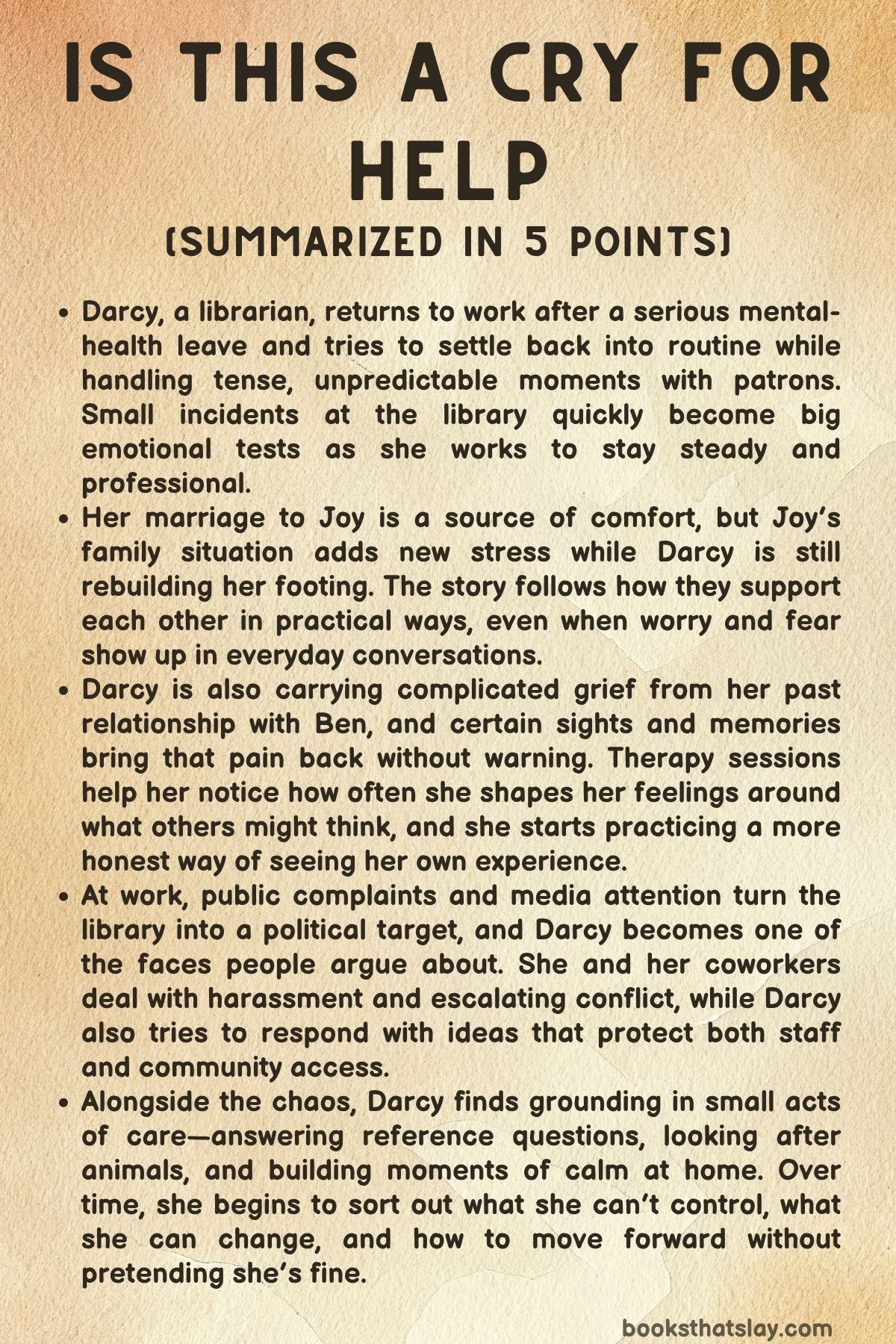
Summary
Darcy returns to her library job after two months away, following a breakdown that landed her in emergency care and a psychiatric ward. She wants her first day back to be ordinary, but it immediately becomes strange and tense: a patron is watching pornography at full volume on a public computer.
Darcy follows policy, verifies it isn’t illegal, and makes a calm announcement to the room about using headphones or muting sound. A furious patron confronts her anyway, demanding the man be stopped.
Darcy explains that adult content isn’t automatically banned and offers the complaint process, but the interaction leaves her shaky—especially because she’s newly fragile and trying not to look fragile.
At the desk, Darcy finds an old email she sent during her crisis, turning down a second interview for a branch manager role. She doesn’t remember writing it.
The message is full of typos, and the realization hits her hard: there are gaps in her memory from the period when she was unwell. Her thoughts slip into comparisons between past and present.
Once, she lived with her boyfriend Ben, performed the role of a timid girlfriend, and tried to be the kind of woman she thought she should be. Now she is thirty-two, married to Joy, and living with their cats.
The contrast should be comforting, but the missing pieces in her mind make everything feel unreliable.
Darcy calls Joy during a break to debrief. Joy listens, jokes with her, and checks in about how she’s feeling.
Darcy admits she’s embarrassed about the old email and afraid her leave will mark her as untrustworthy. Joy reminds her that she was sick and that it doesn’t make her less capable.
Their call briefly swerves into Darcy’s intrusive fears about death and blame, and Joy gently steers her back to the present, mentioning that her sister Sophie is near the end of pregnancy and will be going on leave.
Back in the staff area, Darcy’s coworker Mordecai corners her with nosy questions about her absence. During the awkward conversation, Darcy spills hot soup on her shirt.
The mess triggers another cascade of memories: Ben doing laundry in their old apartment, Darcy’s old routines, and the unsettling fuzziness of recollection around that time in her life. She can’t tell what she truly remembers and what she has stitched together afterward.
Later, a man in a suit arrives at the reference desk and asks to record Darcy’s answers. He introduces himself as a correspondent for a sensationalist outlet and frames the pornography complaint as proof that the library has become a moral threat.
He needles her with loaded questions, mocks her blue hair, calls the building a “godless sex hole,” and pushes her to confirm whether she’s religious. Darcy tries to stay professional and explains the library’s role: access to information, consistent rules, and limits based on legality rather than personal beliefs.
The man escalates anyway, twists her words, calls her a deviant, and leaves after implying she should “pray.” Darcy reports the encounter to her director, Brenda, because it feels less like journalism and more like intimidation.
Trying to reset her nervous system, Darcy sinks into what she knows best: reference work. She carefully answers an email about grouse diets, checking multiple credible sources before replying.
The steadiness of the task helps. She thinks about Joy and their early relationship, remembering how safe Joy made her feel from the start.
At home, Darcy does small, tender things to keep herself grounded—like catching a spider and releasing it outside. Then Joy gets a call: Sophie is in labor.
Soon they learn Sophie has delivered a baby girl through an emergency C-section, and the baby is missing two fingers on one hand due to a congenital malformation. Sophie insists she’s okay, but the news rattles everyone.
Joy panics into action, packing to travel and worrying Sophie might fall into postpartum depression, especially since Sophie’s husband, Kearney, doesn’t seem dependable.
Joy hesitates because Darcy has only recently stabilized. Darcy remembers, with shame and fear, the winter incident when Joy found her naked outside during a panic episode—an image that still feels like evidence that her mind can betray her.
Darcy insists she can handle time alone. She drives Joy to the station, reassures her when Joy spirals over forgetting a toothbrush, and watches her leave, aware that the goodbye contains a quiet worry neither of them wants to name.
At work, Brenda supports Darcy and asks for the reporter’s name. Darcy looks him up and finds the article already published, full of inflammatory language attacking the library and “blue-haired” staff.
The comments are hostile. The story turns her workplace into a target, and Darcy feels exposed.
On another shift, Darcy sees a man who resembles Ben and breaks down in a bathroom stall. Mordecai interrupts with news of an emergency that turns out to be an orange cat wandering inside the library.
Darcy is relieved by the simplicity of it. She pets the cat, decides to take it to a shelter, and returns to work with her breathing a little steadier.
A patron named Sammy keeps emailing Darcy increasingly heavy bird questions—first curiosity, then bigger, existential hypotheticals. Darcy researches the ecological consequences of bird decline, but the workday is constantly interrupted by patrons who are angry and rude.
When Darcy listens to a voicemail from her mother scolding her for missing a relative’s birthday, Darcy crumples. Her mother’s priorities—manners, obligation, appearances—leave no room for the truth: Darcy was barely surviving, hospitalized, adjusting to antipsychotic medication, and trying to rebuild a life that had temporarily collapsed.
Darcy deletes the voicemail and cries in her car, telling herself crying isn’t the same as falling apart.
She takes the orange cat to a shelter and learns there’s no microchip and no space. The staff member’s evasiveness makes the outcome feel grim if Darcy leaves him.
She brings him home instead and sets him up in Joy’s workshop. She tells herself it’s temporary.
The cat becomes both comfort and complication, especially with two resident cats already in the house.
In therapy with Dr. Jeong, Darcy tries hard to be a “good” patient. Dr. Jeong emphasizes sleep and grounding techniques and introduces a method that involves revisiting memories.
Darcy talks about how she met Ben when she was eighteen at a call center job, how he helped her, walked her safely to transit at night, and made her feel protected when she’d just separated from her mother’s control. Yet even in therapy, Darcy notices she frames everything around how she might be judged—by Dr. Jeong, by Joy, by the world—rather than what she feels.
Dr. Jeong points this out: Darcy has a habit of prioritizing other people’s perspectives over her own.
While Joy is away, Darcy makes a small mistake that turns into a nightmare. She posts a photo of a glittery bath bomb on Instagram and doesn’t notice her nude reflection in a faucet.
Hundreds of people see it before she realizes. Messages flood in.
Shame detonates in her chest, and she immediately imagines the worst: exposure, ridicule, threats.
The library’s problems intensify. Brenda warns Darcy they’re now in the local news again, with public outrage over the pornography incident and the library’s policies.
Soon a children’s story-time event is disrupted by an enraged man yelling about a “drag queen,” tying it to pornography and accusing staff of harming children. The outburst sends parents scrambling and toddlers crying.
Brenda tells Darcy the complaints are coordinated and widening beyond one incident into challenges to books and programming.
Darcy begins to receive threatening emails, including one with her nude photo attached. She tries to reason through who could be behind it.
As the harassment spreads, it becomes clear she’s not alone: Mordecai later receives an email containing pre-transition photos and a threat. Brenda instructs them to preserve everything and involves police.
Outside the library, protests appear, led by the same correspondent, Declan Turner. Protesters shout accusations about “the gay agenda,” pornography, and grooming.
Inside, staff try to keep serving patrons while feeling watched and unsafe. Darcy nearly panics, then regains control over something concrete—like forcing a patron to remove a Crock-Pot of meatballs someone has bizarrely set up near the baby-changing station.
Small acts of competence keep her upright.
As Darcy investigates, a call with Douglas—an acquaintance connected to Ben—changes everything. Douglas tells her Ben didn’t die by suicide; he died suddenly from a brain aneurysm.
The news hits Darcy like a physical wave. For months she has been blaming herself, convinced her breakup caused a downward spiral that ended in Ben’s death.
Learning it was sudden doesn’t erase grief, but it loosens the grip of self-blame that has been strangling her.
The harassment source becomes clearer in an unexpected way. Darcy searches her mother’s Facebook and discovers her mother’s profile is public and has been reposting screenshots of Darcy’s Instagram, including the bath image with the accidental nude reflection.
Her mother didn’t understand what she was sharing, but it made the image easy to find, screenshot, and weaponize by strangers. Darcy confronts her mother and guides her step-by-step through deleting the post.
The conversation is maddening—her mother blames Darcy for posting it at all—but Darcy pushes through and decides she’ll visit soon to fix the privacy settings so it can’t happen again.
Joy returns home, and their routines—coffee, the dock, the lake, the loons—help Darcy settle. Together they attend a packed municipal community consultation about library policies.
Declan speaks first, accusing the library of attracting predators and attacking books and programs about race and gender. Others echo him with demands that “traditional values” dominate public services.
But many community members speak strongly against censorship, insisting the library must serve everyone and that parents can make choices for their own kids without controlling others. Joy speaks too, describing harassment she’s experienced and arguing for the importance of diverse books.
On Darcy’s birthday, Joy plans a full day of gentle joy: breakfast in bed, small adventures, dinner with friends. Darcy admits, out loud, that she had a breakdown this year.
Her friends respond with support instead of judgment. The honesty helps.
At the library, Darcy and Brenda follow through on Darcy’s idea for a Human Library event, where people volunteer to be “books” and share lived experiences in one-on-one conversations. Declan shows up hoping to participate.
Everything is booked, so Darcy offers herself as a “book” and sits with him. He demands the removal of books he dislikes and insists the library is biased unless it conforms to his worldview.
Darcy explains that the library carries materials she personally dislikes too, because the point is access, not agreement. They end the conversation without resolution, and Darcy later regrets not confronting him about harassment.
Home life brings its own stress: Joy wants to keep the orange cat, now nicknamed Kyle, while Darcy insists they can’t. The tension escalates until another truth spills out—Darcy admits she once cheated on Ben during their relationship.
Joy is furious, not only about the act but about Darcy hiding it. After space, anger, and a hard conversation, Joy forgives her, making it clear the secrecy hurt more than the past mistake.
The next morning Joy reorganizes their books in a new, playful system as a peace offering, a compromise between Darcy’s need for order and Joy’s comfort with mess.
In therapy, Darcy processes Joy, Ben, grief, and guilt. Dr. Jeong suggests writing Ben a letter.
Darcy does, facing the version of herself who once believed she was a monster for leaving him and for taking so long to understand her sexuality. She writes about love and harm, remorse and distance, and the ways she has punished herself.
Finally, Darcy confronts Declan in a grocery store parking lot about the threatening emails. Declan admits he sent the photo emails, apologizes for crossing a line, but insists he didn’t send the bird questions.
As he walks away, Darcy hears him call to his child—Sammy—and the pieces click. The relentless bird emails came from a kid, not a sinister stalker, and the harassment came from Declan exploiting what he found online.
Sammy’s emails shift into something more urgent: questions about abortion—age requirements, parental notification, where to go. Darcy’s fear spikes, but she answers carefully, professionally, and with compassion, providing information and emphasizing confidentiality.
Then good news lands: Brenda offers Darcy the branch manager job she once declined. It feels like proof that her crisis didn’t erase her competence or her future.
Joy celebrates with her—and also reveals she found a safe home for Kyle with their friends, solving the argument with kindness rather than victory.
Darcy brings Ben’s letter to therapy and hands it over. The act doesn’t “fix” grief, but it changes its shape.
The story ends with Darcy and Joy on the dock again, listening to the lake and the birds, in a life that is still messy and loud and political and uncertain—but also real, shared, and worth staying for.
Characters
Darcy
Darcy is the emotional center of Is This a Cry for Help: a public-facing professional who is privately rebuilding herself after a severe mental-health crisis. At the library she is diligent, policy-minded, and ethically steady—she verifies what the patron is watching, defuses conflict without escalating it, documents incidents for leadership, and takes pride in careful reference work, triple-checking sources before replying.
At the same time, her inner life is volatile and associative, with memory gaps, intrusive thoughts, shame spirals, and sudden grief surges that show how fragile her stability still feels. A defining trait is her reflex to manage other people’s comfort before her own—she “performs” versions of herself, from timid girlfriend in the past to competent supervisor now to “good patient” in therapy, and often narrates experiences as she thinks others will judge them.
Her arc is a slow shift from self-erasure toward self-ownership: she begins by minimizing her needs and fearing she will be seen as unreliable, and ends by advocating publicly for intellectual freedom, proposing a bold community program, taking on leadership, and writing a candid letter that reframes her guilt and grief into something survivable. She is also tender and conscientious in small ways—freeing a spider, caring for a stray cat, staying calm for Joy in emergencies—which grounds her humanity and shows that even at her most unsteady, she is oriented toward care rather than harm.
Joy
Joy functions as Darcy’s anchor and counterweight: steady where Darcy is spiraling, practical where Darcy is abstracting, and emotionally warm without being sentimental. She checks in directly on Darcy’s feelings, reassures her without dismissing the seriousness of her illness, and handles crises with a mix of competence and visible anxiety—especially around Sophie and baby January, where her protective instincts surge into fear.
Joy’s love is shown through actions: traveling to support her sister, calling Darcy often, celebrating Darcy’s birthday intentionally, speaking up in a hostile public forum, and later helping resolve the cat situation in a way that protects both Darcy’s boundaries and the animal’s welfare. Yet Joy isn’t written as a flawless caretaker; she has her own limits and pressures, and her relationship with Darcy includes conflict, especially when Darcy reveals the cheating history and when stress makes them misread each other’s intentions.
What makes Joy compelling is that her support is not a blank check—she can demand honesty and space, name Darcy’s partner flaws without condemning her as a person, and then choose repair. She represents a love that is both compassionate and adult: not rescue, but partnership.
Ben
Ben is present mostly through memory, grief, and Darcy’s self-blame, which makes him feel both intimate and unstable—almost like a shifting mirror for Darcy’s evolving understanding of herself. In Darcy’s recollections he is older, protective, and at times gently shepherding: he helps her at work, walks her to the bus in a rough area, does domestic tasks, shows affection, loves animals, and offers a kind of safety she badly needed after conflict at home.
But the narrative also allows for Darcy’s later clarity that the relationship wasn’t built on true compatibility; she increasingly recognizes that what she wanted was validation and containment more than partnership, and she admits that the younger version of herself was “performing” a role she thought she should want. Ben’s death detonates Darcy’s stability—partly because of unresolved questions, partly because grief reopens old identity wounds, and partly because she treats the breakup as a moral crime that must have caused his end.
As Darcy heals, Ben becomes less of a courtroom exhibit she must defend to others and more of a complicated human she can mourn without building her entire identity around guilt. The letter she writes is the clearest synthesis: it holds tenderness and remorse alongside the truth that she was hiding herself, that the age gap mattered, and that forgiveness—mutual or internal—is necessary if she’s going to live.
Brenda
Brenda is the managerial presence who quietly models what ethical leadership looks like under public pressure. She believes Darcy, supports her documentation of threats, asks practical follow-up questions, and treats conflict as an institutional problem to solve rather than a personal failing to shame.
When controversy escalates—news coverage, coordinated complaints, protests, policy review—Brenda remains procedural and steady, coordinating with legal and police while also making room for proactive strategies. Her importance to Darcy is partly symbolic: Brenda’s trust functions like a corrective to the shame narrative Darcy carries about her sick leave and competence.
By approving Darcy’s proposed “Human Library” initiative and then offering her the branch manager role, Brenda validates Darcy’s professional value at the exact moment Darcy fears she’s becoming a liability. She represents stability without coldness: a boundary-setting advocate for staff safety and intellectual freedom.
Dr. Jeong
Dr. Jeong is a structured, gently challenging therapeutic figure who helps reveal Darcy’s patterns rather than simply soothe them. She emphasizes fundamentals like sleep and grounding, uses concrete techniques like the peppermint exercise, and introduces trauma-processing strategies such as imaginal revisiting, but her most incisive work is relational: she notices how Darcy keeps narrating through someone else’s eyes.
By pointing out Darcy’s habit of prioritizing the therapist’s presumed interpretation, Dr. Jeong highlights the deeper survival strategy Darcy uses everywhere—anticipating judgment and trying to preempt it by self-editing. Dr. Jeong’s presence also clarifies Darcy’s need to be “good” at recovery, to perform wellness the way she once performed relationships.
Over time, therapy becomes the place where Darcy practices a new skill: telling the truth without packaging it, letting messy feelings exist without immediately prosecuting herself. The suggested letter to Ben is pivotal because it reframes healing as communication and integration rather than punishment.
Declan Turner
Declan is the story’s main external antagonist, embodying the escalation from everyday public friction into targeted ideological harassment. He approaches as a “correspondent” but behaves like a provocateur, twisting language, baiting Darcy into personal disclosure, and framing the library as a moral battleground rather than a civic service.
His fixation on Darcy’s blue hair, atheism, and “deviance” is less about facts than about constructing an enemy image that will mobilize outrage; later, his protests and rhetoric—pornography, “gay agenda,” grooming accusations—show how he uses moral panic as a tool for attention and control. At the same time, the narrative gives him a disturbing ordinariness—he has a family, he can apologize, he can claim he “crossed a line”—which makes him more realistic and therefore more chilling.
His eventual admission that he sent the photo harassment confirms that his public crusade is paired with private intimidation. The twist that he calls his daughter “Sammy” complicates the threat: it suggests his household is entangled with the anonymous questions, blurring the line between orchestrated harassment and a child’s possible cry for help.
Sammy
Sammy initially appears as a remote patron asking oddly specific bird questions, which Darcy treats as normal reference work until the pattern becomes uncanny and linked to harassment. Over time, Sammy becomes a symbol of why libraries matter: behind the “weird” questions is a person searching for knowledge, privacy, and maybe safety.
The emails shift from ecology and animal behavior to reproductive healthcare and confidentiality, triggering Darcy’s fear that the questioner could be a pregnant minor who cannot safely ask an adult. The revelation that Declan calls his daughter “Sammy” reframes the entire thread: the bird questions may be a mask, a coping mechanism, or a way to test whether the librarian is trustworthy before asking something terrifyingly personal.
Sammy’s role is therefore double-edged—part potential suspect, part potential vulnerable child—and that ambiguity forces Darcy to choose values over paranoia. Her response becomes more humane and protective, showing Darcy growing into the kind of librarian who can hold both skepticism and care at once.
Mordecai
Mordecai is a coworker who oscillates between comic nuisance and fellow target, making him an unexpectedly important mirror for Darcy’s experience. At first he’s intrusive and socially clumsy, prying into Darcy’s absence and filling silence with unhelpful chatter, which amplifies Darcy’s vulnerability and sense of being watched.
Yet as threats escalate, he becomes part of Darcy’s survival network: he is harassed too, his trans history is weaponized against him, and that shared danger transforms him from irritant to ally. Mordecai’s presence also broadens the book’s view of public hostility; Darcy’s harassment is tied to sexuality, “deviance,” and morality policing, while Mordecai’s includes explicit transphobic intimidation.
Their decision to investigate together shows a shift from isolated shame to collective resistance. He ultimately gains depth because he’s not reduced to either a joke or a victim; he’s a messy colleague who still deserves safety and solidarity.
Sophie
Sophie, Joy’s sister, is primarily a catalyst for urgency, family responsibility, and Joy’s anxiety, but she also represents the raw reality of postpartum vulnerability. Her labor, emergency C-section, and the discovery that baby January is missing fingers create a cluster of fear, grief, and adaptation that ripples outward—Joy drops everything, Darcy worries about being left alone, and the family’s emotional bandwidth is stretched.
Sophie’s situation is not sensationalized as tragedy; instead it’s portrayed as a new normal requiring support, information, and time. Her struggle is intensified by Kearney’s unreliability, making her depend more heavily on Joy and indirectly highlighting the theme of who shows up when life is hard.
Sophie’s role helps contrast two kinds of crisis—Darcy’s internal psychiatric emergency and Sophie’s external medical one—showing how both demand compassion without judgment.
January
January is an infant, so she isn’t characterized through choices or dialogue, but she is still a major presence because she concentrates the book’s themes of fragility, fear, and love into a single tiny person. Her missing fingers and later respiratory infection become focal points for adult anxiety, especially Joy’s protective instinct and Darcy’s brief, guilty zooming-in worry about what January’s life will be like.
Importantly, January’s existence forces the characters to practice accepting uncertainty: genetic testing can reassure some things but not promise ease; care can stabilize today but not erase worry. January also functions symbolically as time made literal—named “January,” arriving right after Darcy’s January panic episode—linking birth, recovery, and the uneasy hope of a new beginning.
Kearney
Kearney appears mainly through absence and unreliability, and that is precisely his function: he is the missing support in a moment that requires constant support. While Joy and Darcy scramble emotionally and logistically to help Sophie, Kearney is described as barely around, which heightens Joy’s stress and makes Sophie’s postpartum fear feel lonelier.
He isn’t painted with elaborate villainy; instead he represents a quieter, more common harm—failure to show up—whose impact is cumulative and heavy. His presence in the story sharpens the contrast between chosen family that acts and obligated family roles that sometimes collapse under pressure.
Judy
Judy, Darcy’s mother, is one of the most psychologically influential characters because she embodies the lifelong pressure system Darcy has internalized. She values manners, social obligation, and conventional life scripts, and she interprets Darcy’s choices—distance, queerness, marriage, childlessness—not as identity but as defiance.
Judy’s criticism operates less like one argument and more like an atmosphere that Darcy has breathed for years, producing guilt even when Darcy is objectively unwell. Yet Judy is not written as pure cruelty; there are rare gentler memories—cross-stitch, acceptance of mistakes, the surprising compliment about Darcy’s childhood beauty—that make the relationship confusing in the way real parental bonds often are.
The Facebook incident is devastating because it shows how Judy’s ignorance and boundarylessness can become dangerous: by reposting Darcy’s content publicly, she unintentionally exposes Darcy to harassment. Judy’s reaction—blaming Darcy for posting rather than owning her part—captures the central wound: Judy can be involved in Darcy’s life without actually seeing Darcy.
Still, the scene where Darcy guides her step-by-step to delete the post shows Darcy’s reluctant competence and the exhausting reality of loving someone who keeps hurting you.
Darcy’s father
Darcy’s father is quieter but meaningful as a voice of moderation and denial. He insists Judy loves Darcy, offering a soothing narrative that may be partially true but also functions as a way to avoid confronting harm directly.
His presence underscores how family systems maintain themselves: one parent wounds, the other smooths, and the child learns to doubt her perception. Even in small moments—watching baseball, existing at the edges—he represents a kind of stability that doesn’t necessarily protect.
He isn’t portrayed as malicious; rather, he shows how passivity can enable dysfunction while still feeling like “peacekeeping.”
Rhonda Wheeler
Rhonda, the library CEO, represents institutional articulation under political attack. In the public consultation she provides the framework—policy context, selection criteria, equitable access, inclusion, intellectual freedom—that transforms chaos and accusation into civic language.
Her role matters because she gives shape to what Darcy instinctively defends: the idea that a library is not a moral gate but a democratic service. Rhonda also symbolizes the burden leaders carry during culture-war flashpoints: she must be calm, procedural, and persuasive while being shouted at by people who are not arguing in good faith.
Through Rhonda, Is This a Cry for Help shows that protecting public institutions requires not only personal courage but also policy literacy and strategic communication.
Patty
Patty is a coworker who often operates as Darcy’s immediate workplace ally and witness. She shares reactions with Darcy when the inflammatory article appears, helping confirm that Darcy isn’t overreacting to how threatening and dehumanizing the rhetoric is.
Patty’s presence also shows the social texture of the library—coworkers who notice, who talk, who sometimes step in during conflict—contrasting with Darcy’s fear that everyone will quietly judge her leave. During the story-time confrontation, Patty is part of the staff response, reinforcing that Darcy is not alone on the front line even when it feels that way.
Hodan
Hodan appears as part of Darcy’s friend circle and as a practical extension of community support. In conversations about censorship and library policy, Hodan helps create a space where Darcy can process the external conflict among people who broadly share her values, which is crucial when the public narrative is hostile.
Hodan’s later role in taking in Kyle is especially telling: it’s a form of care that solves a problem without humiliating Darcy or forcing a false choice. Hodan represents friendship that is concrete—showing up not only with opinions but with help.
Ada
Ada complements Hodan as another friend who reinforces Darcy’s sense of belonging outside work and family stress. Their presence during discussions of policy and free expression underscores that Darcy’s fight is not only professional but communal; she is part of a network that values the library as a shared good.
Ada also becomes part of the practical resolution when Kyle is rehomed, which positions her as someone who participates in repair rather than merely observing it. Through Ada, the story emphasizes that recovery and resilience are often collective projects.
Douglas
Douglas functions as a hinge character who converts Darcy’s tormenting uncertainty into painful clarity. Darcy suspects him because of his online activity, but when she contacts him, the conversation shifts to Ben’s death, and Douglas provides the factual explanation—brain aneurysm—that Darcy has been missing.
That information matters not only as plot resolution but as psychological intervention: it undercuts Darcy’s belief that she caused Ben’s death and destabilizes the self-punishing narrative that helped trigger her collapse. Douglas’s role also shows how grief can become self-contained when information is withheld or unavailable; one phone call can change the shape of a trauma that has been eating someone alive.
Declan’s daughter
Declan’s daughter is mostly glimpsed through the reveal of her name, but that single detail has enormous thematic weight. By connecting “Sammy” to Declan’s family, the story suggests that the abstract battles adults wage in public—the speeches, the slogans, the harassment—spill into the private lives of children who may be confused, curious, afraid, or in need.
Her implied presence forces a more uncomfortable reading of the “enemy”: it is possible for a child to be seeking help while her parent is generating harm. This complicates Darcy’s role as librarian into something closer to guardian of anonymous safety, where the right response is not exposure but protection.
Themes
Living with mental illness while trying to appear “functional”
Darcy’s return to work in Is This a Cry for Help happens in a space that demands composure, neutrality, and competence, even when her inner life is anything but stable. The library’s routines—answering emails, managing disruptions, following policy—become a kind of test: not just whether she can do the job, but whether she can pass as “back to normal” in a world that treats mental health crises as suspicious gaps in a résumé.
What keeps resurfacing is how much energy goes into managing perception. She worries about a typo-filled email she doesn’t remember writing, fears coworkers will treat her leave as illegitimate, and even jokes about inventing a stigmatized illness to stop questions, which shows how shame can push a person toward absurd strategies of self-protection.
The book also captures how recovery is rarely neat; Darcy can handle a reference question with careful sourcing and then spiral in seconds when a thought about death appears. Small stresses—nosy conversation, a spilled soup, a rude patron—hit harder because they stack on top of sleep disruption, medication adjustment, and the aftershock of hospitalization.
Therapy adds another layer: Darcy tries to be a “good” patient, monitoring what Dr. Jeong might think, which mirrors how she performs competence at work. The repeated pattern is not simply anxiety, but an ongoing negotiation between safety and exposure.
She learns grounding techniques, attempts to regulate sleep, and searches for steadier footing, yet she also keeps discovering how quickly the body remembers fear. The most revealing moments are when she tells herself that crying is normal and not a relapse—because it shows recovery as an everyday argument with panic: a continuous effort to claim ordinary emotions without treating them as proof of collapse.
Intellectual freedom versus community outrage
The library is not just Darcy’s workplace; it becomes a public stage where conflicting ideas of morality, citizenship, and “common good” collide. A patron watching pornography is handled as a policy matter—legal content, noise rules, respectful shared space—until outsiders transform it into a symbolic crisis.
Declan Turner’s framing turns the library into a target: a taxpayer-funded institution supposedly corrupting the community, staffed by people presented as ideological threats. What makes this theme powerful is how the book shows the mechanics of escalation.
A single complaint becomes a hostile interview, then a sensational article, then coordinated outrage about children’s programming, culminating in protests and a municipal forum where titles and story hours are treated like evidence in a moral trial. The language thrown at staff—“communist,” “groomers,” “deviants”—is not meant to persuade; it is meant to intimidate and to shrink the space of public life until only one set of values is safe to express.
Darcy’s responses highlight a competing vision: the library as a democratic institution that offers information access without requiring ideological agreement. Her refusal to answer personal religious questions is not evasiveness; it is a boundary that protects the idea that public service should not depend on private confession.
The book also doesn’t pretend policy is a magic shield. Even when staff follow rules, they face harassment, doxxing-like behavior, and threats that push them into survival mode.
Against that pressure, the “Human Library” proposal matters because it offers a proactive answer that doesn’t surrender principles. Instead of treating conflict as something to hide from, the institution creates structured ways for people to meet across difference, emphasizing conversation over removal.
The tension remains unresolved in a tidy way, but that is the point: intellectual freedom is shown as daily labor, maintained by ordinary workers who must uphold access while protecting themselves from a public that can become cruel when fear is converted into righteousness.
Grief, guilt, and rewriting the past
Darcy’s grief is complicated not only because Ben is dead, but because the relationship itself sits in an unstable category in her memory: comfort and harm, safety and imbalance, affection and dependency. After Ben’s death, she experiences intrusive recollections, emotional whiplash, and a constant self-interrogation about what she owes him now.
The uncertainty around his death intensifies that torment because ambiguity invites blame; when a story has missing pieces, Darcy supplies them with the harshest version of herself. She believes she may have contributed to his decline, and that belief becomes a kind of private sentencing that follows her through work shifts, errands, and sleepless nights.
Therapy presses on a central problem: Darcy keeps narrating Ben in ways she thinks others will judge correctly. She worries about making him sound predatory because of the age gap, then overcorrects by emphasizing his kindness, as if she must protect his reputation to justify her own past choices.
This reveals a deeper pattern: Darcy is accustomed to organizing reality around other people’s perspectives—her mother’s values, her therapist’s imagined evaluation, her coworkers’ opinions—so her grief becomes another arena where she tries to earn a verdict that will let her breathe. The book also shows how sexuality and identity complicate mourning.
Darcy’s life with Joy is loving and real, yet Ben still occupies a psychological place tied to being seen, being chosen, and being rescued at a vulnerable age. As she revisits those memories, she recognizes that validation was often the central currency, not compatibility.
That recognition is painful because it reframes what she once called love, and it forces her to confront how dependency can feel like safety when a person has just escaped a punishing home environment. The letter Darcy writes to Ben becomes a turning point because it allows grief to include contradiction: affection without romance, gratitude without obligation, remorse without self-erasure.
It also becomes a method of reclaiming authorship over her own story, rather than living as a character trapped in someone else’s narrative of what she “should” have done.
Exposure, privacy, and the cost of being visible
Darcy’s accidental nude reflection and the chain reaction that follows turns a minor mistake into a lesson about how fragile privacy is when other people control the settings, the sharing, and the interpretation. The incident is humiliating on the surface, but the deeper threat comes from how quickly strangers can weaponize vulnerability, especially when the surrounding environment is already hostile.
Darcy is not simply embarrassed; she feels hunted, because the photo becomes a tool that can be attached to a moral narrative about her job, her appearance, and her right to exist comfortably in public. The harassment emails and the targeting of Mordecai show how exposure works as coercion: it tries to force silence by making personal life dangerous.
What sharpens this theme is that the breach isn’t only caused by political antagonists—it is enabled by family. Darcy’s mother reposting Instagram content onto a public Facebook profile is presented as careless rather than malicious, yet the effect is the same: Darcy’s boundaries are treated as optional, and her autonomy is undermined by someone who insists she is the authority on what “should be fine.” That dynamic matches earlier family patterns where Judy values manners and social obligation over Darcy’s internal reality, interpreting Darcy’s life choices as defiance rather than self-knowledge.
The privacy crisis therefore becomes both technological and relational: Darcy must manage not just settings but the pain of realizing that a parent can expose her while believing she is being supportive or harmless. The book connects visibility to safety in a way that feels contemporary and intimate.
Darcy’s blue hair, her marriage to Joy, her trans-flag pin, and her role as a librarian become surfaces onto which others project fantasies of corruption. Yet the story also shows that visibility can be reclaimed.
Darcy refuses to collapse into secrecy; she continues working, proposes community-building programs, supports patrons who ask sensitive questions, and confronts her mother directly while still choosing a practical path to fix the problem. The theme ultimately argues that privacy is not only a personal preference; it is a condition for dignity.
When it is taken, the harm is not merely social embarrassment—it is a reshaping of the world into a place where ordinary life requires constant defensive calculation.