Just Between Us Summary, Characters and Themes
Just Between Us by Lena Hendrix is a contemporary romance that combines an opposites-attract relationship with a long-buried family mystery, small-town loyalties, and questions about trust, power, identity, and belonging.
At its center are Royal King, a tattoo artist whose humor hides old wounds, and Veda Bauer, an ambitious consultant who has built her life around competence and control. Their anonymous online connection becomes unexpectedly real when Veda arrives in Royal’s Michigan hometown, while her professional investigation into his father’s business gradually uncovers disturbing truths about the King family and the disappearance of Royal’s mother. It’s the 3rd book of The Kings series.
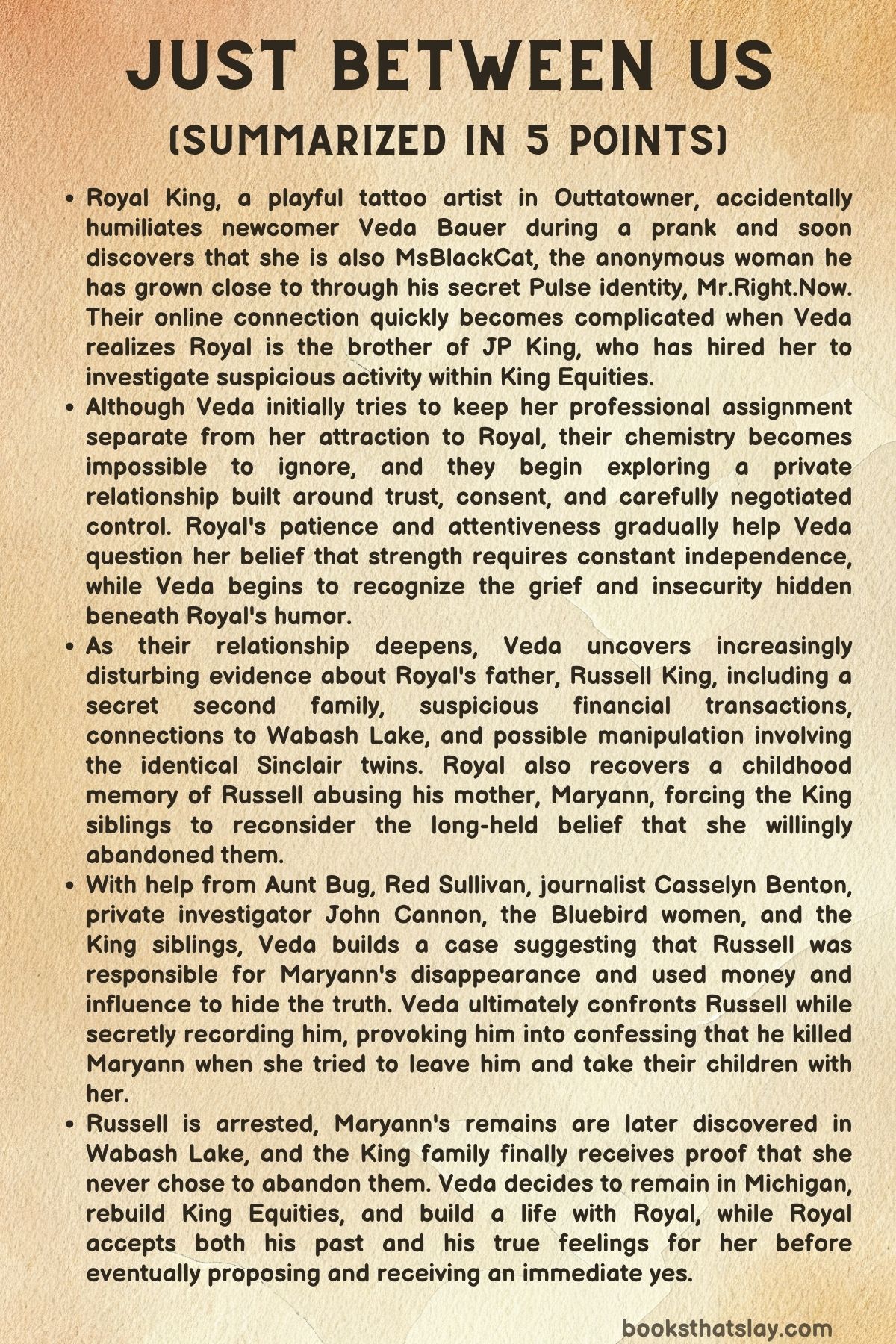
Summary
Royal King owns King Tattoo in the small Michigan town of Outtatowner and has a reputation for jokes, pranks, tattoos, and impulsive decisions. One of those pranks goes badly wrong when he arranges for two boys to egg and splash milk over a Range Rover he believes belongs to someone involved in the long-running King-Sullivan rivalry, only to discover that the vehicle belongs to an elegant stranger from Illinois named Veda Bauer.
Royal feels genuinely guilty about humiliating Veda, although she initially knows nothing about his responsibility. Beneath his playful public personality, Royal carries emotional scars from the disappearance of his mother, Maryann, who vanished when he was a child and was believed to have abandoned her six children.
Royal also keeps a secret life online. Using the name Mr.Right.Now on a subscription platform called Pulse, he produces anonymous intimate content that combines reassurance, encouragement, desire, and emotional attention, and the account has become highly successful.
Among his subscribers, one woman stands apart. MsBlackCat has spent months exchanging sarcastic, increasingly personal messages with him, and Royal has developed a fascination with the intelligence and vulnerability behind her guarded personality.
The mysterious MsBlackCat is Veda herself. She has come to Outtatowner because Royal’s brother JP King has secretly hired her to investigate King Equities, the massive family business controlled by their father, Russell King.
JP believes serious wrongdoing may be hidden inside the company and fears that Russell’s actions could eventually destroy the family. Veda accepts the assignment because her own corporate career in Chicago was damaged after she exposed wrongdoing at a previous employer and was punished professionally for refusing to stay silent.
Pulse has been Veda’s private escape from a life dominated by ambition, order, and self-discipline. She therefore panics when she enters King Tattoo, recognizes Royal’s distinctive tattoos and voice, and realizes that the man standing before her is Mr.Right.Now.
Veda tries to separate her online world from reality by deleting the app, but Outtatowner keeps drawing her into Royal’s social circle. She develops an unexpected friendship with MJ King, attends the Bluebird Book Club, and begins spending time with members of both the King and Sullivan families.
At Abel and Sloane’s wedding, Royal becomes suspicious of Veda after she reacts strongly when he jokingly calls her a black cat and uses language associated with his private conversations with MsBlackCat. During a dance, they finally admit that they know each other’s secret identities.
The discovery changes their relationship completely. Royal wants to explore the attraction that already existed between them, while Veda fears that allowing their anonymous connection into her real life will threaten both her professional objectivity and the emotional control she depends upon.
Their disagreement becomes a competition when Royal proposes a paintball wager. If Veda wins, he will stop pursuing her; if Royal wins, she will allow him to show her how giving up control to someone trustworthy can feel liberating rather than diminishing.
Veda wins decisively, proving herself tactical, competitive, and far less predictable than Royal expected. Instead of feeling relieved that Royal must leave her alone, however, she realizes that she is disappointed.
She soon approaches him again and proposes changing the wager. Eventually they agree to explore the power dynamic they had previously discussed online, but Veda establishes strict boundaries involving secrecy, consent, emotional distance, and her freedom to end the arrangement.
Royal makes it clear that trust is more important to him than control. Rather than treating Veda’s willingness to surrender authority as weakness, he repeatedly emphasizes that real submission depends upon choice, communication, safety, and the certainty that he will care for her.
Their private arrangement gradually becomes much more personal. Royal makes sure Veda eats, carries things for her despite knowing she is capable, plans experiences around her preferences, protects her from people who expect her to appear softer or friendlier, and accepts aspects of her personality that others have criticized.
Veda, in turn, begins relaxing the rigid habits that have governed her life. She forms friendships, joins spontaneous adventures, laughs more freely, and realizes that independence does not require rejecting every form of care.
Their growing closeness also reveals Royal’s hidden vulnerability. Veda learns that his birth name is Dwayne James King and that the confident Royal persona developed partly in response to childhood insecurity, bullying, and the devastation caused by Maryann’s disappearance.
Veda admits that her own identity was shaped by a different pressure. As an only child, she learned to associate achievement with approval, eventually building an adult life in which competence became both her strength and her emotional armor.
While their romance develops, Veda’s investigation produces disturbing evidence. She discovers Russell’s hidden second family, suspicious business dealings around Wabash Lake, unusual financial transactions, and evidence suggesting that Russell’s attempt to acquire the lake began almost immediately after Maryann disappeared.
Aunt Bug possesses additional information. For years she quietly recorded Russell’s suspicious meetings and transactions, and after Royal confronts Russell during a frightening encounter at the family estate, she gives Royal the notebook containing those records.
The confrontation also unlocks one of Royal’s suppressed childhood memories. He remembers witnessing Russell physically attacking Maryann and finally understands that the family story about his mother peacefully walking away may have concealed years of fear and abuse.
Royal shares the memory with his siblings. Abel, JP, Whip, Sylvie, and MJ are devastated, but they agree that learning what happened to their mother matters more than protecting Russell or even preserving King Equities.
Veda combines Bug’s notebook with property records, payments and local history. She begins to suspect that the Sinclair twins, Bootsy and Terrance “Bowlegs” Sinclair, have been using their identical appearances to help Russell create alibis and conceal activities that could otherwise be traced back to him.
The supposed death of Bowlegs becomes especially suspicious because Russell made an unusually large funeral payment. Veda eventually tests her theory by calling the man known as Bootsy by Bowlegs’s real name, Terrance, and he instinctively responds.
Further evidence comes from Red Sullivan, whose memories reveal that Maryann had once approached him and his wife June in fear. Maryann appeared deeply worried about protecting her children, while June became convinced after the disappearance that Russell was responsible.
June had even asked authorities to search Wabash Lake, believing Maryann’s body might be there. Her concerns were ignored, and later evidence suggests that officials may have received money connected to King Equities.
These revelations transform Royal’s understanding of his childhood. The belief that Maryann willingly abandoned him had shaped his insecurity, rebellion, humor, and fear that people he loved would eventually leave.
As Veda investigates further, Royal also acknowledges that his attachment to her has become love. When she casually refers to eventually returning to her normal life, his abandonment fears erupt and he reacts badly by drinking instead of discussing what he feels.
Veda takes care of him, and the following morning they confront the problem directly. They agree that a relationship cannot function if either person insists on managing fear alone, establishing emotional honesty as another form of mutual care.
The investigation becomes increasingly public when journalist Casselyn Benton begins looking into Maryann’s disappearance. The Bluebird Book Club also joins the effort, gathering memories and information, while a large billboard displaying Maryann’s face forces the town to confront a case Russell would prefer forgotten.
Veda eventually receives decisive information from private investigator John Cannon. A historical deposition and police report indicate that June formally accused Russell and requested a lake search, strengthening the possibility that Russell used money and influence to suppress scrutiny.
Instead of simply preserving the evidence, Veda decides to provoke Russell into exposing himself. Working with John and law enforcement, she enters the King estate while carrying concealed surveillance equipment and confronts Russell about the suspicious payments.
Russell’s controlled public personality breaks down. He physically threatens Veda, summons both Sinclair twins and orders one twin to appear publicly in town while the other helps take Veda away, confirming that the brothers have indeed been used to create false appearances and alibis.
Veda wakes near Wabash Lake with Russell and Bowlegs holding her captive. Although frightened and injured, she deliberately attacks Russell’s ego and reconstructs what she believes happened to Maryann, pushing him to correct her and prove his superiority.
The strategy succeeds. Russell admits that Maryann had intended to leave him with the children and confesses that he strangled her because he could not tolerate losing control over his family.
Russell destroys Veda’s phone, believing he has eliminated the recording. Veda then reveals that a hidden camera in her brooch has been transmitting the confrontation, and police arrive before Russell can escape.
Royal, who has been desperately searching for Veda, reaches the lake and finds her alive. Once she tells him that Russell confessed to killing Maryann, relief and grief collide as Royal finally receives proof that his mother never chose to abandon him.
Royal and Veda openly declare their love. The King siblings begin reclaiming their family identity from Russell, accepting that the truth may destroy much of the business empire he created but deciding that protecting his reputation is no longer worth preserving a lie.
Veda chooses to remain in Michigan rather than return to her former life in Chicago. She sees a future rebuilding King Equities, accepts Royal’s invitation to live with him, and recognizes that staying does not mean sacrificing ambition but choosing a life in which career, friendship, love, and belonging can coexist.
Royal also stops dividing himself into separate identities. With Veda’s support, he continues Pulse but changes his content toward helping couples communicate about intimacy and desire, and he eventually tells his family about the account without treating it as a source of shame.
Russell’s arrest causes King Equities to begin collapsing under revelations about his corruption, while authorities secure permission to search Wabash Lake. Maryann’s remains are eventually found, finally confirming what happened and allowing her children to bury her with dignity on Sullivan land.
On Maryann’s birthday, family, friends and much of the town gather to celebrate her life rather than remember her only through the violence of her death. Later, Royal takes Veda away from the crowd to a quiet pond and tells her that she has given him a sense of home and stability he never realized he was missing.
Royal proposes with a dark diamond chosen to represent his black cat, and Veda immediately accepts. Their future rests not on either of them becoming a different person, but on finally allowing every side of themselves to exist openly within a relationship built on acceptance, trust, humor, choice, and love.
Characters
Royal King
Royal is the emotional center of Just Between Us, a man whose outward cheerfulness initially makes him appear much simpler than he actually is. His pranks, jokes, tattoos, reckless decisions, and golden-retriever energy create the impression of someone who refuses to take life seriously, yet much of that behavior functions as protection against feelings he has carried since childhood.
Maryann’s disappearance leaves Royal with an abandonment wound that affects almost every part of his adult identity. As a child he first tries to become perfect enough to make his mother return, then eventually replaces obedience with rebellion when perfection fails to restore what he has lost.
Even the name Royal represents a constructed identity. Born Dwayne James King, he grows from an insecure, bullied child into the colorful personality that everyone recognizes, suggesting that reinvention has been one of his primary methods of survival.
His Pulse persona reveals another dimension. Mr.Right.Now appears confident and sexually assured, but the purpose of the account is not simply attention; Royal likes making lonely or insecure people feel valued, wanted, and understood.
His relationship with Veda exposes the strongest part of his character: his instinct to care. He recognizes that her surrender of control has meaning only if he accepts responsibility for her trust, making consent, communication, attention, and aftercare central to the relationship rather than treating power as a privilege.
Royal nevertheless remains flawed. His impulsiveness causes the opening prank, his dune-diving injury, moments of recklessness, and his decision to get drunk when fear of losing Veda overwhelms him.
His development comes through learning that humor cannot solve every form of pain. Confronting Russell, recovering the memory of Maryann’s abuse, mourning his mother, admitting his love for Veda and telling his family about Pulse all require him to stop performing confidence and allow himself to be fully known.
Veda Bauer
Veda is the other central force in Just Between Us, defined initially by precision, ambition, intelligence, self-discipline and emotional reserve. Her intimidating professional manner is not presented as a defect that needs to disappear; instead, the story examines why she has come to believe that constant competence is the only safe way to live.
Her career history explains part of that defensiveness. She exposes labor abuses at Franklin & Mirth and is professionally punished rather than rewarded, leaving her with the experience of being correct but unsupported.
Veda therefore arrives in Outtatowner determined to rebuild her career through the King Equities investigation. She observes people analytically, maintains strict boundaries and treats emotional complications as risks that can be controlled through planning.
Her anonymous identity as MsBlackCat exposes desires she rarely permits herself to acknowledge openly. The anonymity appeals to her precisely because it separates vulnerability from real-world consequences, which explains why recognizing Royal as Mr.Right.Now feels so threatening.
Her relationship with Royal gradually changes her definition of strength. She discovers that accepting care does not erase independence and that voluntarily surrendering control can itself be an expression of agency when the decision remains hers.
That change does not make Veda passive. She remains competitive, professionally ambitious and intellectually aggressive, and these same qualities allow her to uncover the conspiracy surrounding Russell and ultimately design the operation that secures his confession.
Her greatest weakness is closely connected to her greatest strength: she believes she can manage danger by thinking faster than everyone else. The confrontation with Russell succeeds, but it also places her in genuine physical danger and shows that calculated courage can become recklessness.
By the end, Veda’s development lies in expansion rather than transformation. She keeps her ambition and formidable intelligence while making room for friendship, intimacy, spontaneity, dependence, humor and a permanent home with Royal.
Russell King
Russell is the primary antagonist and the embodiment of coercive power hidden beneath respectability. He has built a successful business empire and a persuasive public persona, enabling him to appear accomplished and controlled while concealing cruelty, manipulation and corruption.
His defining need is not simply wealth but dominance. He tries to control his children, his businesses, Veda’s investigation, local narratives, Maryann and even the consequences of his own crimes.
The existence of his second family shows how extensively he has compartmentalized his life. He expects different people to occupy assigned roles while he alone retains the freedom to violate those boundaries.
Maryann’s decision to leave with the children becomes intolerable because it represents a rejection of his authority. His eventual confession reveals that murder grows from the same entitlement visible throughout his other behavior: he considers another person’s independence an attack against him.
Russell is particularly dangerous because he understands institutions as instruments. Money, business connections, public reputation, local officials and the Sinclair twins all appear to have been used to distance him from accountability.
His downfall therefore occurs when control of the narrative is taken away from him. Veda provokes his ego, his children refuse to protect the company, the town remembers Maryann publicly, and his own words finally provide the evidence he spent decades suppressing.
Maryann King
Maryann is absent physically for most of the story but remains one of its most important characters. For decades, her children understand her through an explanation created after her disappearance: that she chose to leave them.
That belief produces lasting emotional damage, particularly in Royal. As new evidence emerges, however, Maryann is gradually restored from the role of absent mother into the image of a frightened woman attempting to protect six children from an abusive husband.
Red and June’s memories are especially significant because they show that Maryann sought help while fearing that involving other people could place them in danger. Her final intention to leave with her children completely reverses the story Russell allowed them to believe.
Maryann also continues to exist through the qualities her children inherited. Veda’s observation that Royal carries his mother’s humor, kindness and gentleness allows him to understand that Russell did not erase her influence even after taking her life.
The discovery and burial of her remains provide physical closure, but the larger restoration is about memory. The billboard, newspaper tribute, town gathering and birthday celebration ensure that Maryann is remembered as a person who loved her children rather than as an unexplained absence.
JP King
JP begins as the King sibling most visibly connected to Russell’s professional world. Having been raised as a likely successor within King Equities, he carries responsibilities that make his decision to investigate his own father especially important.
Hiring Veda demonstrates that JP is willing to question the system from which he benefits. He recognizes that something is wrong before he understands the full scale of Russell’s actions and accepts that uncovering the truth may have consequences for the entire family.
JP’s treatment of Veda also contrasts with her previous professional experiences. When she develops a seemingly strange theory about the Sinclair twins, he evaluates the evidence rather than dismissing her, giving her something she was denied in Chicago: professional trust.
His strongest moment comes when he accepts that King Equities may need to be sacrificed. For someone shaped to inherit the empire, placing his mother’s truth above the company represents a rejection of Russell’s values.
By the end, JP faces the difficult task of separating whatever deserves to survive within the business from the corruption attached to his father. His interest in employing Veda permanently suggests that he wants the next version of the company to be built around competence and accountability rather than obedience.
Abel King
Abel is less central to the immediate romance, but he contributes significantly to the family’s movement toward the truth. His marriage to Sloane demonstrates that the old hostility between the Kings and Sullivans is already giving way to a different form of family connection.
He also proves willing to consider possibilities that others initially struggle to accept. Before Russell’s confession, Abel has already wondered whether their father could have killed Maryann, showing a readiness to confront the most painful interpretation of the evidence.
Abel’s decision to hire private investigator John Cannon becomes important later because John’s research uncovers records that help Veda establish the connection between Russell, local corruption and the suppressed investigation into Maryann’s disappearance.
Through these actions, Abel represents practical support rather than dramatic leadership. He contributes resources, accepts difficult evidence and participates in the collective decision to prioritize truth over family reputation.
Whip King
Whip’s importance is especially visible through Royal’s personal history. He is the brother who helps the insecure young Dwayne develop the nickname and identity that eventually become Royal, giving him an imaginative route away from the frightened child he once was.
That act can be understood as both loving and psychologically important. Whip helps his brother construct confidence at a moment when their family life has been destabilized by Maryann’s disappearance.
As an adult, Whip remains part of the sibling network that supports Royal when his emotions become difficult to manage. Bringing an intoxicated Royal home after his fear about Veda surfaces shows his willingness to step in without abandoning or humiliating him.
Whip therefore functions as one of the quiet supports beneath Royal’s larger-than-life personality. His presence reinforces the idea that the King siblings survived their father’s household partly by creating their own forms of protection for one another.
Sylvie King
Sylvie combines emotional intelligence with strategic thinking. From the opening incident, when she helps Veda after the milk prank, she shows an instinct for responsibility that contrasts sharply with Royal’s impulsiveness.
She later contributes significantly to the family’s campaign against Russell. Rather than confronting him too early, Sylvie suggests allowing him to believe that his children remain manageable while they quietly gather evidence.
Her decision to wear Maryann’s denim jacket in Russell’s presence is another example of psychological strategy. She understands that memory itself can destabilize a man who has spent years controlling what others believe.
Sylvie also occupies an important social position through the Sugar Bowl and the town’s network of relationships. Her connections help turn what begins as a private King family investigation into something the wider community can no longer ignore.
MJ King
MJ brings openness, enthusiasm and social energy into a story containing many guarded people. Her determination to include Veda is one of the first forces that disrupts the consultant’s isolation.
By pulling Veda toward the Bluebird Book Club and regularly messaging her, MJ offers friendship without demanding that Veda first become warmer or easier to approach. That acceptance helps Veda begin imagining a form of belonging that is not based on professional usefulness.
MJ also contributes actively to the family investigation. She participates in the siblings’ discussions, gathers information and helps connect family members with people who possess useful memories.
Her ability to balance serious loyalty with humor makes her particularly valuable within a family carrying heavy trauma. Even her apparent awareness of Royal’s Pulse activities shows how observant she is beneath her cheerful exterior.
Aunt Bug
Bug is one of the more morally complicated members of the older generation. She loves the King children and ultimately helps expose Russell, but she also admits that she spent years choosing not to recognize the full extent of her brother’s cruelty.
Her confession matters because the book does not allow passive ignorance to appear entirely innocent. Bug understands that truly acknowledging Russell’s behavior would have created an obligation to act, and fear helped her avoid that responsibility.
At the same time, she was not completely inactive. Her secret notebook recording Russell’s meetings, transactions and suspicious instructions becomes one of the investigation’s most valuable pieces of evidence.
Bug therefore represents both guilt and attempted repair. She cannot reverse the years in which Maryann was unprotected, but she can stop protecting Russell’s secrets and place what she knows in the hands of people willing to act.
Her willingness to involve the Bluebirds also shows growth. Rather than keeping family wrongdoing private out of shame, she chooses collective action and allows the community to help uncover what silence protected.
Luna
Luna works with Royal at King Tattoo and serves as one of the people who knows his everyday personality most closely. She witnesses the disastrous prank at the beginning and immediately helps manage its consequences.
Her willingness to support the shop while Royal’s personal and family life becomes increasingly chaotic suggests reliability and loyalty. Royal’s eventual decision to thank her and expand the staff acknowledges that her work has helped keep the business stable.
Luna also helps establish that Royal’s life is not defined solely by romance or family conflict. He has created a workplace and a circle of people who trust him, showing that his caring nature existed before Veda arrived.
Sketch
Sketch is Royal’s new apprentice and represents Royal’s development as a mentor and business owner. His interactions with the younger artist show a responsible side that contrasts with the impulsive reputation attached to him.
Sketch also participates indirectly in Royal’s care for Veda, delivering food and helping with her heavy work bag. These small actions demonstrate how naturally Royal’s instinct to look after people extends into his daily life.
The apprenticeship suggests that Royal has built something sustainable through King Tattoo. Although Russell dismisses him as reckless, Royal has become capable of teaching another person, managing employees and creating professional independence outside the King Equities empire.
Sloane
Sloane’s marriage to Abel helps symbolize the changing relationship between the King and Sullivan families. What was once defined by inherited rivalry is gradually becoming a network of marriages, friendships and shared loyalties.
Her wedding is also a turning point for Royal and Veda. The celebration creates the setting in which their anonymous identities are finally acknowledged and their relationship begins moving from fantasy into reality.
Sloane’s significance is therefore partly structural. Through her relationship with Abel, she demonstrates that old family divisions do not have to determine the choices of the next generation.
Lee Sullivan
Lee represents the modern, mostly playful version of the King-Sullivan rivalry. Royal’s original involvement with Pulse begins because of a prank connected to Lee, making him indirectly responsible for the circumstances that eventually bring Royal and Veda together anonymously.
He is also part of Royal’s social circle and joins the late-night dune-diving adventure. His presence helps show that the supposed rivalry has changed from serious hostility into something closer to competitive family tradition.
As the investigation into Maryann progresses, the broader Sullivan connection becomes increasingly important. Characters such as Lee exist within the younger generation that is willing to cooperate with the Kings rather than inherit the grudges of their elders.
Annie
Annie is another member of the wider King-Sullivan social group and participates in the spontaneous dune-diving night with Royal, Veda, MJ and Lee. Her presence reinforces the sense of community gradually forming around Veda.
Although she does not drive the major conflict, characters such as Annie matter because they show what Veda is gaining outside her relationship with Royal. She is becoming part of a social life she never previously prioritized.
Red Sullivan
Red becomes one of the most important witnesses to the past. His memories provide information unavailable through corporate records and help correct the false story that Maryann willingly abandoned her children.
He remembers Maryann approaching him and June in fear and understands that she was primarily concerned about protecting her children. His testimony therefore gives Royal emotional evidence that his mother’s disappearance was not rejection.
Red also reveals June’s suspicion about Wabash Lake. His improving memory becomes a bridge between the unresolved past and the investigation occurring in the present.
His role demonstrates that truth can survive imperfectly through people even when official systems fail. Records can be altered or ignored, but memories retained by members of the community eventually help expose what wealth and influence concealed.
June Sullivan
June is deceased during the main events, but her earlier actions make her one of the story’s most important moral figures. She recognizes danger in Russell long before most people are willing to challenge him.
After Maryann disappears, June refuses to accept the convenient explanation that a loving mother simply left six children. She reports her suspicions, asks authorities to search Wabash Lake and later resists Russell’s attempt to acquire the property.
Her resistance becomes crucial because government protection prevents Russell from gaining full control of the area where Maryann’s remains are eventually found. Even without possessing enough power to expose him at the time, June creates obstacles that limit his ability to erase the past completely.
June represents the value of refusing to accept a powerful person’s version of events simply because challenging it is difficult. Her suspicions are dismissed initially, but the evidence eventually proves how clearly she understood the situation.
Bootsy Sinclair
Bootsy initially appears to be an eccentric local man who seems unusually informed about what happens around town. His odd behavior allows other characters to underestimate how closely he is connected to Russell’s activities.
The later discovery that he and his twin have been exchanging identities changes the meaning of his earlier appearances. What looks like harmless local eccentricity becomes part of a long-running strategy involving surveillance, deception and alibis.
Bootsy is not portrayed as possessing Russell’s level of authority, which makes his fear when Royal confronts him significant. Once pressure reaches him directly, his loyalty begins to collapse.
His confession gives Royal crucial information about Veda’s disappearance. In that moment, the carefully maintained illusion surrounding the twins finally starts working against Russell instead of protecting him.
Terrance “Bowlegs” Sinclair
Bowlegs is believed to be dead for years, and that supposed death is central to the scheme protecting Russell. The excessive funeral payment connected to him first gives Veda reason to suspect that the official story may be false.
His continued existence allows the twins to create public and private versions of the same person. One brother can be seen in town while the other performs work elsewhere, giving Russell distance from activities he does not want traced directly back to him.
Bowlegs becomes part of Veda’s kidnapping and is present at Wabash Lake, but his refusal to follow Russell’s final order to dispose of her shows the limit of his obedience. He has participated in serious wrongdoing, yet even he eventually stops short of carrying out Russell’s escalating demand.
John Cannon
John Cannon provides professional investigative support that strengthens Veda’s work. Hired by Abel, he uncovers historical legal and police records that the family’s private business investigation alone might never have located.
His discovery of the former mayor’s suspicious payment and June’s police report helps establish that Russell’s influence may have reached local authorities. Those records transform long-standing suspicion into a more traceable pattern of corruption.
John also assists Veda’s final plan by helping arrange surveillance equipment and police involvement. His participation is essential because Veda’s confrontation with Russell is not merely an impulsive private stunt; it is part of an attempt to capture evidence law enforcement can use.
Casselyn Benton
Casselyn is the journalist whom Royal and Sylvie approach when they realize that Russell’s carefully controlled public image is one of his greatest defenses. Her involvement introduces public scrutiny into a mystery that has remained largely private for decades.
Royal and Sylvie ask her not to reduce Maryann to sensational material, and Casselyn respects that concern. Her eventual article becomes not only an investigation into Russell but also a tribute to Maryann’s life and the memories people still hold of her.
That choice matters deeply to Royal. Journalism becomes a means of restoring a person’s identity rather than merely exposing another person’s wrongdoing.
Elizabeth Peake
Elizabeth Peake represents one of Russell’s largest hidden truths. The discovery that he has maintained another wife and family changes the King siblings’ understanding of their father’s life and proves how extensively he has deceived the people closest to him.
Her existence also becomes relevant to the mystery surrounding Maryann because it provides another possible source of conflict within Russell’s marriage. More importantly, it demonstrates that Russell has long believed himself entitled to construct separate realities and force other people to live inside them.
Elizabeth remains largely outside the central action, which prevents the story from treating Russell’s second family as equivalent to Russell himself. The wrongdoing originates in his deception rather than in the mere existence of the people he deceived.
Huck
Huck plays a small but meaningful role in Veda’s adjustment to Outtatowner. At the Sugar Bowl, he encourages her to sit, eat and simply observe the town instead of treating every moment as something that must be used efficiently.
That ordinary invitation reflects the larger challenge Veda encounters throughout the story. Outtatowner repeatedly asks her to participate in life rather than manage it entirely from a professional distance.
Characters like Huck make the town feel like a functioning community rather than simply a background for the central romance. Their casual acceptance contributes to Veda’s gradual decision that Michigan can become home.
Dan
Dan appears briefly during Royal and Veda’s date in Star Harbor, but his behavior serves an important purpose in revealing how Royal understands Veda. His suggestion that she would be more attractive if she smiled represents the social pressure she has repeatedly experienced to make her strength more comfortable for other people.
Royal’s response is immediate. Rather than encouraging Veda to soften herself, he rejects the assumption that she owes strangers friendliness, sweetness or accessibility.
The encounter therefore clarifies why Royal’s acceptance matters to her. He does not love an imagined gentler version of Veda; he values the woman other people sometimes describe as intimidating.
The Bluebird Women
The women of the Bluebird Book Club operate almost like a collective character. At first they represent the kind of friendship and informal community Veda has largely excluded from her achievement-focused life.
Their teasing, openness and willingness to include her begin weakening her assumption that belonging must be earned. Later, that same social network becomes a practical investigative resource when Bug asks them to share memories, rumors and information.
Their importance becomes especially clear once Maryann’s disappearance stops being treated as private King family business. The Bluebirds demonstrate the power of community memory, particularly when formal institutions have failed or been corrupted.
Themes
Control, Trust and the Meaning of Surrender
Control functions as both protection and imprisonment throughout Just Between Us. Veda has built an identity around managing outcomes because professional betrayal and years of achievement-based approval have taught her that competence is safer than dependence.
Her relationship with Royal challenges the assumption that control and strength are identical. When she voluntarily allows him to lead, the experience matters because she retains the ability to consent, establish limits, communicate discomfort and withdraw permission.
Royal’s approach is equally important. He understands that receiving authority from another person creates responsibility rather than entitlement, so his role depends upon attentiveness, safety, patience and care.
The contrast with Russell is deliberate. Russell seeks power by removing other people’s choices, while Royal accepts power only when Veda actively chooses to give it.
That distinction turns the romantic relationship into a broader argument about power itself. Control becomes abusive when it exists to erase another person’s independence, but surrender can be empowering when it is voluntary, informed and grounded in trust.
Veda’s development therefore does not require becoming less powerful. She discovers that strength can include allowing another person to carry responsibility temporarily, because trusting someone does not mean losing ownership of herself.
Identity, Performance and Self-Acceptance
Nearly every central character is living behind some form of constructed identity. Royal presents himself as the carefree prankster, hides behind the anonymous confidence of Mr.Right.Now and rarely allows other people to see the frightened child shaped by Maryann’s disappearance.
Veda creates a different performance. Her professional identity depends on control, efficiency and emotional distance, allowing her to appear untouchable even when she is lonely or uncertain.
Their anonymous online relationship initially feels safe because both can reveal hidden desires without exposing their complete selves. The real challenge begins when those separate identities collide and they must decide whether the private and public versions of themselves can coexist.
Neither character ultimately abandons the persona they created. Royal remains playful, tattooed, sexual and impulsive, while Veda remains ambitious, competitive, intimidating and highly analytical.
Growth instead comes from integration. Royal can be humorous without using humor to escape grief, and Veda can be independent without treating affection as a threat to independence.
The same principle shapes Royal’s decision to tell his family about Pulse. Shame loses some of its power once he stops dividing his life into acceptable and unacceptable versions of himself.
Family Trauma, Memory and the Recovery of Truth
The King family’s trauma begins with a false explanation. The children are allowed to believe that Maryann abandoned them, and because they lack another story, they build their identities around that perceived rejection.
Royal provides the clearest example of how childhood narratives continue influencing adulthood. His need to entertain people, fear of abandonment and early attempts to transform himself all grow partly from believing that he was not enough to make his mother stay.
Recovering the truth therefore becomes more than solving a crime. Each piece of evidence forces the siblings to reinterpret their childhood, their father and themselves.
Memory is unreliable but essential within that process. Royal’s suppressed recollection of Russell abusing Maryann, Red’s remembered conversations, June’s suspicions and Bug’s notebook all preserve pieces of a reality that official institutions failed to protect.
The eventual discovery of Maryann’s remains is devastating because certainty confirms her death. Yet certainty also ends Russell’s ability to define her absence.
Her burial and birthday celebration restore her to the family as a loved person with humor, gentleness and history. Healing does not erase loss; it begins when the family can finally grieve what actually happened rather than continue living inside a lie.
Power, Accountability and Community Resistance
Russell’s influence survives for decades because his authority extends beyond his immediate family. Money, corporate structures, social respectability, private operatives and possible influence over local officials create layers of protection between his actions and their consequences.
The investigation succeeds only when those layers are attacked from several directions at once. Veda follows financial records, Bug provides private documentation, Red supplies memory, John uncovers official records, Casselyn creates public scrutiny and the Bluebirds activate the town’s informal network of knowledge.
The King siblings must also decide whether family loyalty means protecting the empire or confronting the person who built it. Their willingness to risk King Equities is crucial because Russell has always assumed that financial dependence will keep his children obedient.
Community resistance becomes especially powerful through acts that appear simple. Sylvie wears Maryann’s jacket, the Bluebirds collect memories, a billboard displays Maryann’s face and Casselyn publishes a story that refuses to let Russell control how his wife is remembered.
These actions strip away the isolation that allowed abuse and corruption to remain hidden. Accountability becomes possible when private fear turns into shared knowledge.
The story ultimately suggests that entrenched power is strongest when people believe they must face it alone. Russell’s control collapses once family members, professionals, friends, journalists and townspeople begin comparing what each of them knows.