Our Ex’s Wedding Summary, Characters and Themes
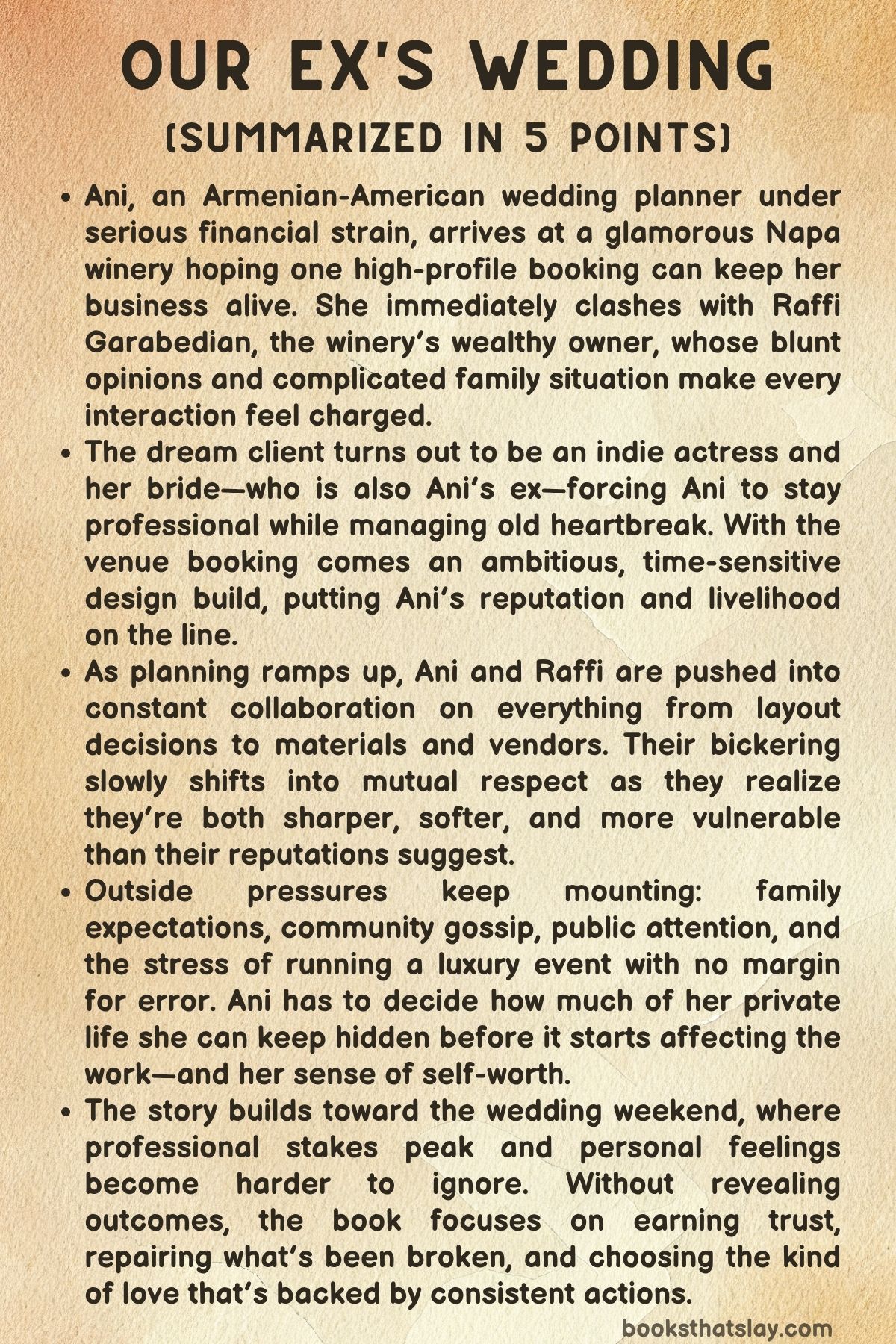
Our Ex’s Wedding by Taleen Voskuni is a contemporary romance set between San Francisco and Napa’s wine country, centered on Ani, an Armenian-American wedding planner who is one bad month away from losing everything. When she’s offered a lucrative celebrity wedding at a new luxury winery, she expects difficult clients and tight deadlines—not the shock of discovering one of the brides is Kami, the ex she never truly got over.
The job could rescue Ani’s business, but it also forces her to face old grief, family expectations, and the kind of love that asks for honesty instead of perfection—especially once the winery’s owner, Raffi Garabedian, becomes impossible to ignore.
Summary
Ani Arslanian shows up early to a meeting at Ô, a Tuscan-style winery in Napa, because she needs this job more than she wants to admit. Her wedding planning business is sinking under debt, and a six-figure venue wedding could stabilize everything.
While she waits, her parents call with excited gossip: the winery now belongs to Raffi Garabedian, a rich Armenian former doctor with a reputation for being reckless with women and backed by a family name people whisper about. Ani tries to brush it off, but she can’t ignore the overdraft notification that hits her phone right after.
Her assistant, Sanan, texts encouragement and reminds her that the potential client is an indie actress with a new movie.
At the winery entrance, Ani meets Raffi in the most humiliating way possible. She loses her footing on the gravel in her heels, he reaches out to steady her, and her oversized matcha latte spills all over his crisp white shirt.
Raffi reacts with sharp annoyance and mentions the shirt’s designer label, while Ani fires back that the gravel is a hazard. An older man—Raffi’s father—calls down from a balcony in Armenian, scolding Raffi and questioning his maturity.
Ani is already irritated, and it gets worse when Raffi looks over her portfolio and dismisses her work as too small-time for the winery’s image.
His comment hits a nerve because Ani’s money troubles started with a past disaster: a wealthy couple once hired her for an extravagant wedding, promised reimbursement for vendor costs, and then disappeared after giving her a check that bounced. Ani covered the expenses on credit to protect her reputation and her staff, and she’s been paying for that mistake ever since.
She refuses to let Raffi see how desperate she is, so she snaps back, calling him arrogant and leaning into the warnings she’s heard about him.
The client arrives in a Range Rover. Grace, the actress, steps out first, warm and friendly.
Then the second bride emerges from the car, still on a phone call—and Ani’s stomach drops. It’s Kami, Ani’s ex, the person Ani has been unable to fully move past since their breakup two years earlier.
Ani freezes, trying to keep her face neutral. Raffi is also visibly rattled when Kami greets him with a kiss on the cheek, revealing that she and Raffi once dated too.
Kami treats the overlapping history like a fun fact, casually telling Grace that Ani is her ex as well. Grace checks whether everyone is comfortable.
Ani forces herself to say yes, even though her body is screaming no.
They tour the property with Raffi attempting to play host, while Ani grills him on the details he hasn’t considered—power, catering, sound, liquor, capacity, parking, and timing. Kami and Grace want a wedding that includes Armenian traditions, and Grace specifically wants an Armenian venue.
Raffi notices his father watching from above with visible disapproval. When the tour ends, the brides return with a set of demands that sounds impossible: they want Raffi to build a neoclassical dome and add custom water features—fountains and pools—on the grounds for the ceremony.
Raffi balks until they offer to pay. Then they add a second incentive: they’ll give Ani an additional $20,000 to oversee the landscaping and build, on top of her planning fee.
Ani agrees because she has to. The money could keep her business alive.
But agreeing also means she has just signed up to plan her ex’s wedding while working closely with her ex’s other ex.
After the meeting, Ani spirals. She’s furious with Raffi, wrecked by Kami’s presence, and terrified of the construction timeline.
Raffi tries to lighten the mood with jokes, and the tension between them shifts into something sharper than pure dislike. He admits he left medicine during residency, has an MBA from Stanford, and intends to be hands-on at the winery.
Ani leaves shaken, already realizing she’s trapped: pride won’t pay her bills. At home, she does the math and decides she can’t walk away.
She avoids telling her family the real stakes, but her sister warns her that Raffi has a reputation for charming women and then disappearing.
Raffi soon texts Ani a Pinterest board full of dome and fountain inspirations. She expects half-hearted effort, but the references are good, and she grudgingly respects how seriously he’s taking it.
They set a plan to start immediately. On Monday morning, Ani arrives with Sanan and finds the gravel hazard sign she placed still up, which feels like a small victory.
Raffi meets them with his contractor friend, Chris. Ani argues for a dome placement that will work better for guest comfort and photos, and Sanan backs her up with a lighting mock-up.
Raffi accepts their reasoning. In the middle of work, Ani and Raffi end up positioned like a couple at an altar for a quick reference photo, and the image looks unexpectedly intimate—enough to make Ani’s pulse jump.
While measuring, Ani heads into a shed for supplies, insisting she doesn’t need help. Raffi follows anyway.
A mouse startles them, they both scream, and the heavy door slams shut and locks. With no phones and no one hearing them, they’re stuck.
In the cramped space, Ani and Raffi fall into awkward conversation that turns revealing. Raffi jokes, but Ani catches glimpses of something guarded beneath his confidence.
He admits suits make him feel protected, and when Ani presses him on what he’s protecting himself from, they’re rescued before he has to answer.
Days later, Raffi worries the winery lacks recognition and decides to throw a party to attract attention. He ropes Ani into choosing materials and insists on coming with her.
On their errands, strangers assume they’re a couple, and Raffi leans into the misunderstanding with humor. Ani finds herself playing along more easily than she expects.
But when she confronts him about how he treated a woman he once pursued and then ignored, Raffi admits he behaved badly and claims he’s tried to change.
At a nursery, Ani identifies a rare flower that would bloom perfectly for the wedding. Raffi tries to buy everything, but the owner resists.
Ani steps in with real expertise and wins the deal. On the drive back, Raffi has a severe allergic reaction to the flowers and struggles to breathe.
Ani pulls over, uses an EpiPen she carries for emergencies, and injects him. Raffi recovers, shaken and grateful, and something between them softens into trust.
Then Ani attends Kami’s dress try-on. Kami’s family welcomes Ani warmly, asking her opinions as if nothing has changed.
The kindness makes it worse, not better. When Kami mentions flowers that used to be special to their relationship, Ani breaks.
She escapes outside and cries, feeling foolish for still being hurt. Raffi unexpectedly finds her, listens, and tells her bluntly that she doesn’t owe Kami more pain.
He hints at his own complicated history with Kami and admits his father is only allowing the wedding because the bride’s family matters to their business. Raffi invites Ani to his winery party, emphasizing it isn’t a date, but the invitation lands like one anyway.
Ani tries to steady herself with family dinner, but when she admits the luxury wedding is Kami’s, her sister is furious. Ani explains the job could change her career.
Later, pulled by curiosity and attraction, Ani ends up at Raffi’s home after a chaotic afternoon. His house is luxurious but impersonal, like a space designed to impress rather than comfort.
Raffi offers her a shower, food, and privacy. Ani is overwhelmed by wanting him while fearing what wanting him could cost.
They spend the night eating, drinking wine, and watching a rom-com together. The domestic ease unsettles Ani more than flirting would.
When the conversation turns serious, Ani admits she used to believe in lasting love, but Kami’s behavior broke that belief. She describes the pattern: attention, neglect, apologies, affection—enough to keep Ani hoping, never enough to make her feel chosen.
Raffi tells Ani she deserves someone whose actions match their words. The air shifts toward a kiss, but Ani pulls back and redirects into work.
They update marketing materials for the winery, sitting close enough that every small movement feels loaded.
At Kami and Grace’s engagement party, Raffi escorts Ani like a partner, and the chemistry between them finally crosses the line. He asks her to dance, and Ani agrees despite old embarrassment about dancing.
Raffi reveals he once danced competitively but stopped after his brother Sevan died because joy felt wrong without him. Dancing with Ani brings that joy back.
He admits he likes her. Ani admits she feels the same.
They kiss—intense enough to scare Ani. She stops it immediately, insisting they can’t risk mixing work and desire.
She challenges his reputation directly, asking if he’ll lose interest once things turn physical. Raffi says he wants to date her seriously.
Ani doesn’t believe herself strong enough to survive being left again, so she pulls away.
Months pass. The dome and gardens take shape, the winery’s business improves, and Ani’s marketing brings more bookings.
Raffi, meanwhile, is miserable and obsessed, sending updates that Ani answers with careful professionalism. Ani buries herself in work and also tries to track down the couple who ruined her financially, using a fake account to locate them.
She learns they’re in Bali, unreachable, and the injustice makes her feel trapped in her mistake all over again.
When Ani finally returns to the winery, the tension between her and Raffi is immediate. Kami arrives to inspect the build and complains the stone isn’t white enough.
Raffi takes responsibility and defends Ani’s choice, explaining that bright white would reflect sunlight and harm guest comfort and photos. Alone after Sanan leaves due to a family emergency, Ani and Raffi fall back into their old rhythm—banter, competence, and heat under the surface.
Raffi takes Ani to eat, and over wine they laugh about Kami’s habits and tantrums with the relief of people who survived the same storm.
Raffi admits he has been making excuses just to spend time with Ani. He tells her he can’t keep pretending it’s nothing, and that he wants her—not only physically, but in his life.
He asks for honesty: if Ani is still tied to someone else, she has to say so. Ani is overwhelmed, but the feeling is mutual.
They finally give in, and their relationship turns physical, leaving Ani thrilled and terrified by how quickly she can picture a future with him.
Right before the wedding, Grace warns Ani about the tabloids and how interested they are in Ani’s connection to Kami. On the wedding morning, Ani runs everything with discipline despite exhaustion, until whispers spread through the bridal suite.
A tabloid story has been published claiming Ani is on the brink of financial ruin. Worse, it’s true.
Ani has around $50,000 in debt, and the article mocks her and questions her professionalism. Ani feels exposed and ashamed, and she panics that Raffi will see her differently now that her secret is public.
She calls Sanan, offering to separate if the scandal harms the business. Sanan refuses, reminding Ani that she’s always been paid and that Ani’s work is the reason clients trust them.
Raffi calls next, furious at the article, but hurt that Ani didn’t tell him the truth. Ani explains the scam wedding that buried her, and Raffi realizes he’s been buying her expensive gifts while she struggled.
Ani refuses the idea of being rescued with his money. Overwhelmed, she ends the call abruptly, and Raffi panics that he’s losing her again.
At the winery, Raffi faces paparazzi and reporters and pushes them off the property with police support. He throws himself into making the day flawless, determined to protect Ani’s work and dignity.
The wedding itself is beautiful—exactly the elegant Armenian celebration Grace and Kami wanted, shaped by Ani’s design and planning. During the toasts, Raffi takes the microphone and publicly praises Ani as the reason everything is perfect, asking everyone to raise a glass to her.
Ani tears up. Later, Raffi and Kami finally address lingering resentment about his brother’s death and her distant response at the time.
Kami apologizes, admitting fear and uncertainty, and they forgive each other.
Raffi finds Ani again and tries to talk privately. Ani admits she’s scared she isn’t good enough for him, and that people will assume she’s with him for money.
She says guests offered to help her financially, which only deepened her humiliation. Raffi insists she’s worthy, but in his desperation he blurts that he won’t recover if she leaves.
Ani becomes angry because she doesn’t want love built on fear. A camera flash goes off nearby, and Ani panics, believing she’s been caught in a scandal photo.
She bolts and avoids Raffi.
The next day, Raffi is wrecked. Even his father, Moushegh, notices and calls him out for mishandling things with Ani.
In an unexpected moment of honesty, Moushegh advises him to apologize fully, admitting he regrets not doing that in his own marriage. The conversation gives Raffi hope that he can still fix what he broke.
After the wedding, Ani’s career explodes. Grace posts about her, inquiries flood in, and the winery becomes a top venue with Ani at the center of its success.
The tabloid attention fades, and the feared photo never appears. Ani finally tells her sister the truth about the debt.
Her sister insists on helping with a real loan so Ani can escape the high-interest payments. They confront years of insecurity between them and end in a raw, honest reconciliation.
Kami also reaches out to apologize for how she treated Ani after the breakup, admitting she didn’t understand the damage she caused. Then Kami sends Ani a black-and-white photo of Ani and Raffi dancing under a single bulb—the flash Ani feared was likely the photographer capturing a tender moment, not paparazzi.
Ani realizes she ran away for nothing. She calls Raffi, but the calls go to voicemail and her text appears undelivered, convincing her he blocked her.
She breaks down.
Days later, Ani receives a text from Raffi asking her to call. He explains he didn’t block her—he was on a plane.
They meet at Marin Headlands, and Ani runs into his arms. They apologize, confess love, and finally choose each other without retreating.
Raffi then reveals why he was unreachable: he flew to Bali and confronted the couple who stole from Ani. He hands her a cashier’s check for $60,000—the debt repaid with interest.
He admits his father’s intimidation played a role in forcing them to pay. Ani is stunned, relieved, and furious in equal measure, but the relief wins.
Her burden is finally gone.
They talk about the future. Ani’s work is now centered in Napa and Sonoma, so she considers moving closer.
She also admits she can’t move in with him without a formal commitment, both because of her family expectations and her own promise to herself. Raffi laughs and tells her he has a plan.
In the epilogue, Ani’s career is booming, Ô is fully booked, and Ani and Raffi are publicly together. They attend a movie premiere in a limo, teasing each other in the kind of easy intimacy Ani once thought she’d lost forever.
Outside the theater, Raffi drops to one knee and proposes, telling Ani she changed his life and he wants to keep choosing her every day. Ani says yes, laughing through her joy as they step forward toward their new life, engaged and finally on the same side.
Characters
Ani Avakian
Ani is the emotional and structural center of Our Ex’s Wedding: a talented Armenian-American wedding planner whose competence is constantly undercut by financial precarity and the lingering emotional injury of her breakup with Kami. Her sharpness reads as prickly at first, but it is fundamentally defensive—she has been burned professionally by clients who exploited her trust and personally by a partner who trained her to accept inconsistency as love.
That combination makes her hyper-alert to red flags, quick to challenge power, and almost allergic to pity, which is why she repeatedly refuses the “easy” solution of letting Raffi rescue her financially. What makes Ani compelling is how she can be both extremely capable and deeply insecure at the same time: she can run a complex luxury wedding, negotiate with vendors, and outthink a billionaire venue owner in logistics and design, yet still see herself as the “less successful” sister and the family disappointment.
Her arc is not about becoming competent—she already is—but about allowing her competence to count as worth, allowing herself to be loved without bribing the world with perfection, and learning that being chosen consistently is not something she has to earn through suffering.
Raffi Garabedian
Raffi begins as the polished, intimidating archetype—wealthy, handsome, rumored to be a playboy, with a father whose shadow suggests danger—but the story steadily reframes him into someone using control as armor. His suits, his fixation on brand image, and his insistence on being involved in details all read as status performances until it becomes clear they are coping mechanisms: he is trying to contain a life shaped by grief, parental conflict, and a sense that love is unreliable.
The death of his brother Sevan sits underneath his choices like a fault line, altering how he trusts, how he attaches, and how easily he interprets distance as abandonment. What differentiates Raffi from the reputation other characters attach to him is that he actually changes in observable ways: he apologizes for past behavior, backs Ani in professional moments, defends hosting a queer wedding despite his father’s rage, and—most importantly—does not push Ani when intimacy is possible but emotionally unsafe for her.
His devotion is intense, sometimes frightening in its absolutism, and the narrative treats that intensity as something that needs maturity rather than being automatically romantic. By the end, Raffi’s grand gesture is not simply about money; it is about restoring justice to the wound that destabilized Ani’s life, while also proving that he can show up decisively without demanding she surrender her autonomy.
Kami Mardian
Kami functions as the story’s catalyst and its most complicated antagonist: not villainous in a moustache-twirling sense, but devastating in the way charming, self-involved people can be. She moves through the world expecting emotional labor to be provided on demand, and she treats relational fallout as an inconvenience rather than a responsibility, which is exactly why Ani is still haunted by her.
The narrative makes clear that Kami’s harm was not only the breakup—it was the pattern of inconsistency, the loop of neglect followed by affection, which keeps Ani psychologically tethered long after the relationship ends. Kami also mirrors a different kind of privilege than Raffi’s: she is socially confident, protected by family status, and able to recast uncomfortable truths as no big deal, including the fact that she is bringing two exes into the same wedding ecosystem and expecting everyone to perform comfort for her.
Yet she is not purely static; the wedding forces a reckoning, and her eventual apology to Ani and her conversation with Raffi about Sevan reveal a person who avoided emotional difficulty out of immaturity and fear rather than pure cruelty. Even so, her growth does not erase impact, and the story is firm about that: Ani’s healing requires stepping out of Kami’s gravitational field, not waiting for Kami to become the person Ani needed two years earlier.
Grace
Grace is a steadying presence and a quiet rebuttal to the glamor of celebrity: she is warm, enthusiastic, and surprisingly grounded, especially given the tabloid ecosystem circling her wedding. She represents the possibility of being famous without being entitled, and the story uses her to contrast Kami’s performative ease—Grace checks in about comfort, shows gratitude, and later takes concrete action when the tabloid narrative harms Ani.
Her role is also thematically important because she chooses an Armenian venue and rituals with genuine respect, framing the wedding as a bridge rather than appropriation, and that choice elevates the event beyond mere spectacle into something that matters culturally and emotionally. Grace’s kindness is not naïve; she understands the media machine and warns Ani precisely because she recognizes that Ani, unlike her, does not have a protective publicist shell.
In many ways, Grace becomes the unexpected ally who helps Ani’s career pivot from survival to momentum, validating Ani’s talent publicly when Ani herself is still struggling to believe she deserves success.
Sanan
Sanan is more than the supportive assistant archetype; she is the practical backbone of Ani’s business and a mirror reflecting Ani’s leadership back to her. The overdraft notification and Sanan’s calm competence establish early that Ani’s crisis is not theoretical—it is daily—and that Sanan’s job stability is part of what Ani is fighting for.
Sanan’s presence also highlights Ani’s integrity: Ani pays her assistant even when it harms her own survival, and that choice speaks louder than Ani’s inner monologue ever could about who she is. Later, when the tabloid debt story breaks, Sanan’s reaction becomes one of the most emotionally clarifying moments for Ani: instead of judging, she recognizes the scam that happened and chooses loyalty, which punctures Ani’s belief that being imperfect makes her unworthy of commitment.
Sanan also contributes meaningfully to the work itself—her lighting mock-up persuades Raffi—so she is written as a collaborator, not a prop, reinforcing the story’s idea that competence is communal and that Ani does not have to carry everything alone to be “good.”
Talar
Talar embodies the complicated intimacy of sibling dynamics: protective, blunt, occasionally harsh, but ultimately deeply invested in Ani’s survival. Her warnings about Raffi and her anger about Ani planning her ex’s wedding come from a place that mixes care with frustration, and that mixture matters because it explains why Ani hides so much from her—Ani anticipates judgment even when love is present.
The later reconciliation reframes Talar’s sharpness as its own kind of insecurity, rooted in competing for parental attention and fearing invisibility in the family story. When Talar insists on wiring money as a real loan rather than charity, she offers Ani a version of help that preserves dignity, directly addressing Ani’s biggest terror: being pitied.
In that way, Talar is part of the healing infrastructure of the ending; she represents family evolving from a pressure system into a support system, not by becoming sentimental, but by learning how to show up in the language Ani can actually receive.
Moushegh Garabedian
Moushegh is the main pressure source—patriarchal, status-obsessed, and emotionally punishing—yet he is also written with enough dimensionality to feel like a real father rather than a cartoon tyrant. His disapproval of Raffi is not just about business competence; it is about manhood, control, and obedience, and his outrage at hosting a gay wedding reveals how deeply he equates family reputation with dominance.
The hints of mafia ties create an aura of menace that later becomes functional in the plot, but his real power in the story is psychological: he is the voice that tells Raffi he is never enough, which helps explain why Raffi performs competence so relentlessly. What makes Moushegh interesting is that he is capable of a begrudging pivot when results force his hand; he recognizes the wedding’s business success and, in advising Raffi to grovel with Ani, indirectly admits his own regret about not fighting for his marriage.
That does not redeem him, but it complicates him: he is a man who only understands certain forms of repair late, and whose love is filtered through harshness until he is confronted with the cost.
Sevan Garabedian
Sevan is absent in the present-tense action, but he is emotionally present as the event that reorganized Raffi’s life. His sudden death is the rupture that turns love into something risky for Raffi and transforms family conflict from ordinary dysfunction into something “unforgivable,” splitting his parents and leaving Raffi with a grief that he manages through control.
Sevan’s impact is shown through what disappears from Raffi’s life—competitive dancing, unguarded joy, belief in romance—and through what becomes hypersensitive: abandonment, loyalty, and the need to be chosen when it matters. Even Kami’s brief condolence text gains narrative weight because it becomes symbolic of the kind of minimal effort that can feel like betrayal when someone is grieving.
Sevan, in this sense, is not only a backstory tragedy; he is the emotional logic behind Raffi’s intensity and the reason the story treats commitment as something that must be proven through sustained action, not declared.
Nareh Bedrossian
Nareh operates as both social memory and moral barometer: she remembers the version of Raffi who was arrogant and entitled, and she is unimpressed by wealth or charm. Her warning call with Ani keeps the story honest about reputations, forcing Ani—and the reader—to hold multiple truths at once: Raffi may be changing, but past behavior still happened, and women have reasons to be cautious.
Later, when Raffi apologizes and Nareh acknowledges the change while still testing him with a pointed question, she becomes the narrative’s quiet checkpoint for growth, the person who won’t be seduced by romantic momentum alone. As a reporter, she also symbolizes the thin line between public narrative and private truth, which ties into the tabloid storyline: people will write stories about you whether or not they understand you, and what matters is how you respond and who you choose to trust.
Galia
Galia is a smaller but telling presence who reinforces the social ecosystem around Kami: family members who participate in the wedding performance and amplify Kami’s standards. Her role is mostly to reflect and reinforce Kami’s emotional weather—showing up alongside her, witnessing tantrums, moving through the luxury context as if it is normal—which heightens Ani’s sense of being outmatched and outclassed.
In a story where Ani often feels like she does not belong in high-end spaces, characters like Galia contribute to the ambient pressure that makes Ani’s professionalism feel like a tightrope walk.
Ani’s Parents
Ani’s parents represent a loving but intrusive form of family culture: they are affectionate and proud, but also deeply invested in Ani’s romantic trajectory and in the communal habit of commentary. Their early “keep your heart open” push sets the tone for how family can unintentionally minimize heartbreak by treating it as a phase to be corrected rather than an injury to be processed.
At the same time, they are part of what Ani longs for—stability, devotion, a love that lasts—and that longing shapes her fear of repeating her own story with Raffi. They matter most through contrast: Ani believes she must be perfect to maintain belonging, and the family reconciliation suggests that the real path forward is not perfection, but honesty that allows the family system to adapt.
Knar and Giro
Knar and Giro are not central in terms of page time, but they are central to the story’s engine because they are the origin of Ani’s financial trauma. Their bounced check and disappearance do more than create debt; they teach Ani that trust is dangerous, that generosity can be weaponized against her, and that one mistake can define her identity as “the screwup.” The fact that Ani resorts to catfishing to locate them underscores how cornered and humiliated she feels, and how justice becomes psychologically necessary for her to move on.
When repayment finally happens, it is not just a financial reset—it symbolically closes the chapter of exploitation that has been bleeding into every decision Ani makes, including her inability to believe Raffi’s care can be real without a trap.
Chris
Chris, Raffi’s contractor friend, plays the practical role of turning impossible wedding demands into an actionable plan, but he also serves as a stabilizing witness to Ani and Raffi’s dynamic. In scenes like the shed incident, his eventual rescue punctures intimacy at the exact moment it becomes too revealing, which keeps the slow-burn tension alive while reminding the reader that this relationship is unfolding inside a professional project with real deadlines.
Chris’s presence grounds the construction storyline in reality and reinforces that Raffi, despite his wealth, is relying on competent collaborators—mirroring how Ani relies on Sanan—so Our Ex’s Wedding repeatedly frames success as something built by teams, not lone saviors.
Lala
Lala never becomes a full on-page character, but she is narratively significant as the human consequence of Raffi’s earlier reputation. She functions as Ani’s evidence that charming men can cause real harm while still considering themselves decent, and bringing her up forces Raffi into accountability rather than flirting his way past discomfort.
The apology text he sent Lala is important less for what it fixes—because it cannot undo being ignored—and more for what it signals: Raffi is capable of looking back without self-justification. Lala’s role, therefore, is to keep the romantic arc from becoming weightless; she anchors the idea that past patterns matter and that change must be demonstrated, not promised.
Themes
Love after heartbreak and the fear of repeating old patterns
Ani’s emotional world is shaped by what happened with Kami: not only the breakup, but the exhausting rhythm of being made to feel special and then disposable. That history explains why Ani can feel a powerful pull toward Raffi and still clamp down on it the moment it becomes real.
When she stops the kiss after the dance, it isn’t because she lacks desire; it’s because she recognizes how quickly desire can turn into dependency when someone has been starved of consistent care. Her caution becomes a kind of self-protection built from lived evidence: she once invested fully in someone whose affection was not reliably matched by follow-through, and she refuses to gamble her stability again.
That fear shows up in the way she frames her questions to Raffi—she doesn’t ask whether he likes her, she asks whether he will get bored after sleeping with her. The anxiety is specific, and it’s tied to his reputation, which functions like a warning label she can’t ignore.
What makes the romance compelling is that Raffi is not written as a simple cure for heartbreak; he becomes a test of whether Ani can rebuild trust without surrendering her agency. He repeatedly offers care in practical ways—food ordered with her preferences in mind, not pushing physical boundaries, publicly crediting her work, and showing up during humiliation rather than disappearing.
Those choices matter because Ani’s wound is not just “lost love,” but the sense of being treated as optional. At the same time, Raffi has his own fear of abandonment that can leak into desperation, especially when he blurts that he won’t recover if she leaves.
Ani’s reaction is sharp because she knows what it’s like to be trapped by someone else’s emotional need. The theme becomes less about finding love and more about learning a healthier emotional contract: affection that doesn’t demand self-erasure, commitment that doesn’t require proof through suffering, and intimacy that can coexist with boundaries.
By the end, their reunion works because both have to correct their reflexes—Ani has to stop assuming she’ll be punished for needing support, and Raffi has to stop speaking like love is something that must be held onto through fear.
Money, shame, and the cost of trying to look “fine”
Ani’s financial trouble isn’t a side obstacle; it controls her choices, her sense of dignity, and even her willingness to be honest with people who care about her. The debt originates in a professional betrayal—fronting costs to protect vendors and deliver a wedding, then being left holding the damage when the promised payment collapses.
That experience teaches Ani a harsh lesson: doing the “right” thing can still get you crushed if you don’t have power or leverage. So when the Ô opportunity appears, the decision isn’t simply career ambition; it is survival.
She accepts work that emotionally devastates her—planning Kami’s wedding—because the money represents a way to keep her business alive and avoid cutting Sanan loose. In that sense, the theme is not greed; it’s what financial instability does to self-respect and to the ability to choose freely.
The shame is equally important. Ani hides the debt from her family, from Raffi, and even from herself in the way she tries to outrun it with relentless competence.
She’s not just worried about being broke; she’s terrified of being seen as the family disappointment and the “quaint” wedding planner who doesn’t belong in luxury spaces. That’s why the tabloid story is so violating: it doesn’t merely reveal a number, it weaponizes it to question her legitimacy and imply she is a pity hire.
The humiliation lands in the middle of the wedding day, when she must perform flawless control while feeling exposed. Her call with Sanan shows how shame can distort reality: Ani offers to part ways as if her debt makes her unworthy of loyalty, and Sanan’s response pushes back against that internal narrative.
Raffi’s reaction also highlights how money complicates intimacy. He feels embarrassed that he has been buying her expensive things without knowing she’s drowning, while Ani refuses a rescue that would reinforce fears about being valued only through charity or dependency.
The eventual repayment from the Avedissians adds another layer: the system didn’t fix Ani’s problem; power did. Raffi can do what Ani couldn’t because his family name and resources create consequences the scammers actually fear.
That resolution is emotionally satisfying, but it also underlines the theme’s bite: in many worlds, integrity is not enough—access is what changes outcomes. Ani’s final step toward healing is not simply becoming solvent; it is allowing herself to be helped in a way that still preserves her pride, especially through Talar offering a structured loan and through Ani’s booming career proving she earned her success.
Armenian identity, tradition, and the push-and-pull of community expectations
The story places Armenian identity at the center of both warmth and pressure. Family calls, Armenian phrases, gossip networks, and communal reputation all operate like an ecosystem that can nurture or suffocate depending on the moment.
Ani’s parents’ excitement about Raffi, their nudging about her romantic life, and the way friends trade warnings about his behavior all show a community that is deeply involved in personal decisions. That involvement creates a constant feeling of being watched and assessed.
Ani’s choices are never only her own; they are interpreted through family optics, community talk, and what a “good” future should look like. Even her reluctance about moving in before engagement connects to this cultural framework—she isn’t only negotiating personal comfort, she is navigating expectations that carry real emotional weight.
The queer wedding intensifies these dynamics because it forces tradition to adapt in public. Raffi’s father’s anger about hosting a gay wedding and his insistence that Kami should be marrying Raffi reveal a worldview where family legacy and social image outrank individual truth.
Raffi’s refusal matters because it is a direct rejection of that hierarchy: he supports the wedding not just as business, but as a statement that the community can be both Armenian and openly queer. Meanwhile, Kami and Grace wanting an Armenian venue and certain Armenian rituals shows another aspect of identity: not a restrictive set of rules, but a belonging they actively choose.
The wedding becomes a site where heritage is celebrated while also contested—who gets to represent the community, what is considered acceptable, and whether inclusion is conditional.
Ani, caught between these forces, experiences identity as both grounding and exhausting. She takes pride in cultural fluency, in how she can speak to families, understand rituals, and design an event that feels authentic.
Yet she also feels the sting of comparison and judgment within the same circle. When guests offer her financial help, her panic isn’t only about money; it is about being pitied in a community where reputation travels fast.
The theme culminates in the way relationships shift when honesty enters the family space: Ani’s conversation with Talar shows that the pressure to appear perfect was not a personal flaw but a family pattern. Healing comes through naming it, admitting that both sisters were competing for visibility and approval, and choosing solidarity over performance.
In that sense, Armenian identity functions not as decoration but as a living structure shaping love, work, and self-worth.
Reinvention through work, competence, and earned respect
Ani’s professional skill is not portrayed as generic “hardworking” virtue; it is specific, technical, and tested under stress. Her competence shows up in the way she interrogates logistics at Ô, how she anticipates guest comfort and photo lighting, and how she uses quick visual mock-ups to settle design disputes.
These details matter because they frame work as a craft that can restore confidence when emotions are chaotic. Planning Kami’s wedding is painful, but the work also becomes the arena where Ani proves to herself that she is not trapped by her past failures.
The earlier scam by the Avedissians could have defined her as naive or “small-time,” especially after Raffi calls her portfolio “quaint.” Instead, Our Ex’s Wedding treats that moment as a bruise that fuels growth: Ani learns sharper boundaries, becomes more strategic, and stops letting other people’s status dictate her value.
Raffi’s own reinvention mirrors this theme from a different direction. He’s a wealthy former doctor who quit residency, carries a strained relationship with his father, and is trying to build legitimacy for Ô.
His interest in being hands-on—Pinterest boards, vendor trips, learning the details—signals a desire to be respected for what he builds rather than what he inherits. The winery project becomes a shared transformation: Ô gains bookings and brand recognition, and Ani gains visibility, credibility, and financial recovery.
What is crucial is that Ani’s rise is not handed to her as a favor. Even when Raffi supports her, he does it in ways that spotlight her competence rather than replacing it—crediting her decisions, praising her publicly, and treating her input as decisive.
That dynamic is why the toast at the wedding lands so strongly: it is public acknowledgment that the event’s success comes from Ani’s leadership, not from the venue’s wealth or the brides’ celebrity.
This theme also explores the emotional cost of being “the reliable one.” Ani keeps functioning under pressure even when she is breaking inside, especially after the tabloid story. She manages the wedding with controlled precision because she has learned that professionalism is safer than vulnerability.
The story challenges that coping strategy by forcing her to face the gap between how capable she looks and how alone she feels. Her eventual breakthrough comes when she allows different kinds of support: Sanan’s loyalty, Talar’s financial help structured with dignity, and Raffi’s insistence that she is worthy beyond productivity.
By the end, her career momentum is not just a plot reward; it is evidence of a deeper shift. Ani starts believing that excellence can be recognized without her having to suffer quietly for it, and that respect can be earned while still letting people see the parts of her that need care.