Only on Gameday Summary, Characters and Themes
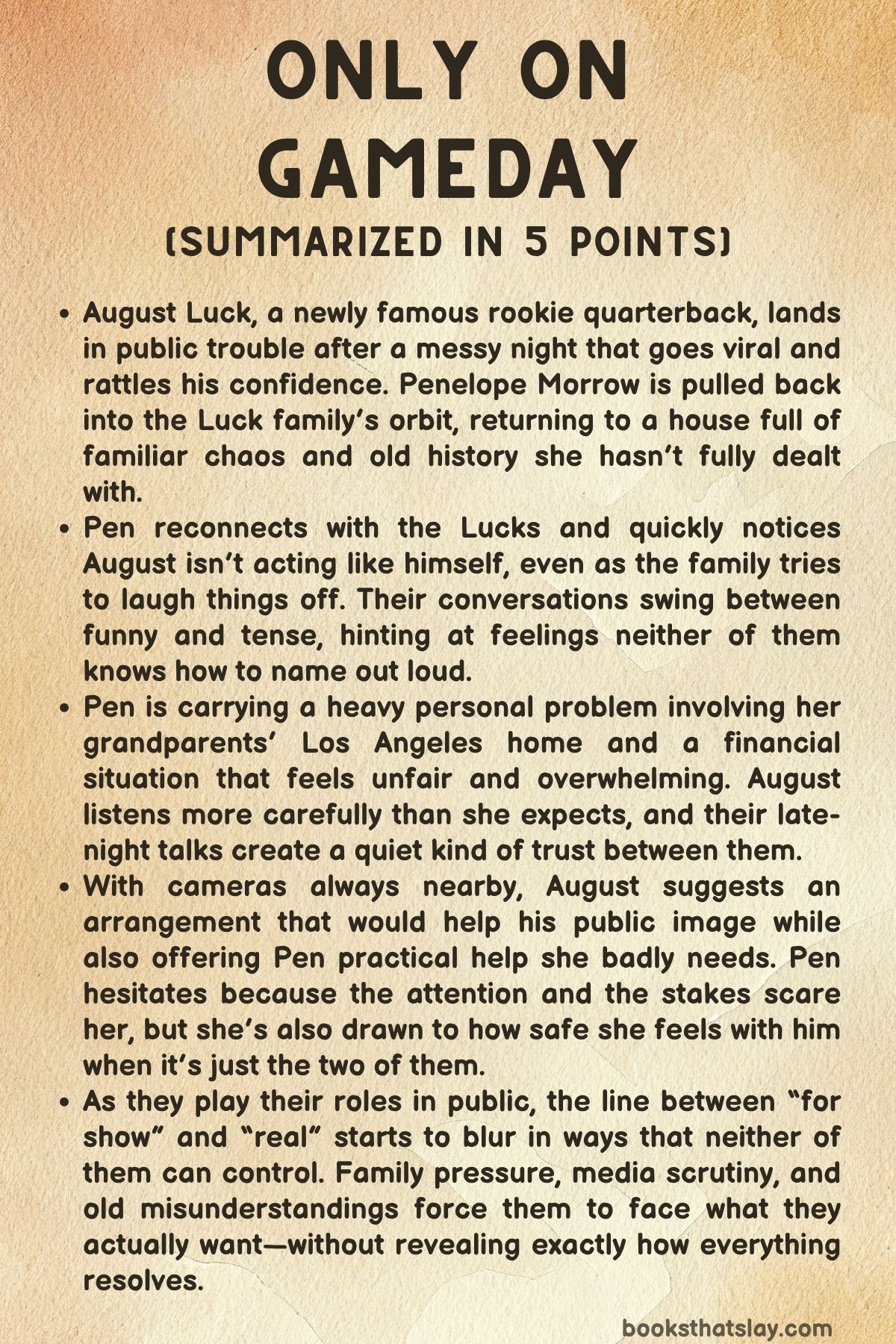
Only on Gameday by Kristen Callihan is a contemporary romance set in the high-gloss, high-pressure world of pro football and Hollywood-adjacent Los Angeles. August Luck is a new NFL star whose public image starts to wobble after one humiliating night goes viral.
Penelope Morrow is smart, guarded, and quietly drowning in a financial problem tied to the one place that still feels like home. When August offers a deal—public engagement in exchange for help—Pen has to decide what she can risk: privacy, pride, and the feelings she’s spent years keeping under control. It’s the 5th book in the Game On series.
Summary
August Luck should be enjoying his dream season. He’s the number-one draft pick, the new starting quarterback, and the face of a franchise that expects immediate results.
Instead, he spirals after a team win and makes a spectacle of himself at a black-tie fundraiser. Drunk and reckless, he climbs onto a table in tuxedo pants and a purple faux-fur coat, shouts for the crowd’s approval, and does a ridiculous dance while phones record every second.
When he falls, he panics most about his throwing arm—and about the sense that he might be ruining everything he worked for.
On the other side of the country, Penelope Morrow drives through heavy rain outside Boston, tense and trying to keep her emotions locked down. Her mother calls mid-drive and brings up August, calling him “little Augie” and saying she’s worried because he’s acting unlike himself.
Pen shuts the conversation down fast, insisting she doesn’t care, but the mention of him hits a nerve she doesn’t want touched. She’s headed to the Luck family home, a place she knows well, full of warmth that also reminds her of what she’s lost.
When Pen arrives at the large colonial house, she hesitates before knocking, caught between comfort and loneliness. August opens the door himself, and they freeze in an awkward loop of saying each other’s names, like neither knows what comes next.
Pen is thrown by how grown and intimidating he looks now, and August looks equally rattled by her presence. She asks to come in, and he lets her inside with a stiffness that makes her wonder if he’s hurt.
The Luck household quickly wraps Pen up in its familiar chaos. Margo Luck hugs her like she never left.
March, August’s brother, teases and flirts with life the way he always has. Pen reunites with June and May, and the sisters talk freely about how August has been “a disaster lately.” During dinner, Pen ends up across from August, trying not to look at him too long.
Conversation swings from football to family teasing, and Margo casually suggests that since Pen and August both live in Los Angeles, they should meet up there. The idea makes Pen uneasy, partly because it’s true and partly because she doesn’t want to examine why that matters.
A family game about attractiveness spins out of control, and Pen, pushed into answering, blurts out that August is the most attractive. August nearly chokes on his water.
Trying to respond, he says Pen is the most attractive person there too—but because she’s the only non-relative, it lands weirdly in the room and leaves Pen feeling exposed. Later, May calls August out for how his words hurt Pen, and he insists he meant it, but he’s so off-balance that even his own family notices.
He has a sudden panic episode, struggling to breathe and to explain what’s happening inside him. Margo quietly pulls him close, steadies him, and gets him to stay the night.
That evening, everyone ends up in pajamas arguing over what to watch. August joins them and chooses a movie that reminds them of being younger together, and for a few hours the house feels like it used to.
Pen falls asleep on the couch. Afterward, August wakes her gently, teasing her for how she sleeps, and apologizes for his earlier awkward compliment.
Their banter softens into something warm and private. He makes them sandwiches in the quiet kitchen, calling her “Sweets,” and they trade nicknames that feel too intimate for people who keep insisting they’re only family friends.
Pen finally admits what’s weighing on her: she inherited her grandparents’ house in Los Angeles, the only real home she’s ever felt anchored to, but the property taxes are crushing—around $125,000 a year. Her mother refused to help because she wants Pen to sell.
Her estranged father is angry he didn’t inherit the property and may try to contest it. Pen is ashamed that she can’t “fix it” on her own, and terrified of losing the house.
August listens, validates her attachment, and tells her she doesn’t have to feel guilty for wanting to keep something that mattered to her.
Pen asks about his public meltdown. August dodges at first, then briefly cracks open, asking what she would do if he wasn’t okay.
Pen promises she’d listen. For a moment, it feels like he might finally tell her the truth about what’s wrong, but he snaps back into a polished smile, says he’s fine, and ends the moment with humor.
Soon after, Pen finds herself at the airport—and August appears beside her like he planned it. Their talk turns playful and flirtatious, charged with the kind of physical awareness that makes Pen feel both brave and foolish.
August upgrades her to first class and sits next to her on the plane. They talk about random interests and settle into an ease that surprises them both.
Then, right before landing, August drops a bomb: he asks Pen to marry him.
Pen is furious, convinced it’s a cruel joke. In the airport, she demands answers.
August insists it’s real—then admits what he actually means. He wants a fake fiancée.
His image has taken a hit since the viral fundraiser disaster, and being publicly engaged would make him look stable and focused. He needs someone who feels “real,” someone who won’t create drama, and—most importantly—someone who won’t fall in love with him or expect forever.
He assumes Pen has never been romantically interested in him, so she’s “safe.”
August drives Pen to her grandparents’ Brentwood estate instead of her apartment, and seeing him in her grandfather’s old Jeep Wagoneer overwhelms her with memories. August reveals that her grandparents once welcomed him and March during a summer football camp, that her grandfather taught him to drive in that Jeep, and that the house holds a kind of family for him too.
Inside the estate, August makes his offer clear: if Pen agrees to the fake engagement and makes it convincing, he will cover the property taxes so she can keep the house. Pen refuses at first—she can’t accept that kind of money—but she can’t deny the temptation of saving the home she loves.
She doesn’t agree, but she promises to think about it.
Back in Los Angeles, Pen wrestles with what the deal would mean. Her roommate Sarah, loud and fearless, adds a strange comedy to Pen’s anxious life—especially with her pet frog, Edward, who wears tiny hats.
When August shows up at Pen’s apartment, Sarah is unimpressed by his fame, and August is visibly terrified of the frog. Alone together, August and Pen slip into easy jokes again, and he asks her to take a walk and talk somewhere that isn’t guarded by amphibians.
On a drive to Santa Monica, Pen makes a sudden decision: she’ll do it. She’ll be his fake fiancée.
August is so relieved he lifts her up and spins her in the parking lot. On the beach, they talk through rules and timelines.
The plan will run through the football season, potentially into February, and then end with a planned breakup announcement in spring. Pen will attend home games, be seen with him, and help sell the story.
August has already lined up help for the tax payments. Pen insists she wants to try solving it herself, but accepts his support as a backup.
As a sneak photo gets taken, Pen feels the first sting of the attention she has invited into her life, and August’s body tenses with the constant threat of being watched.
Pen’s introduction to August’s public world happens fast. She’s brought to a luxury stadium suite filled with celebrities, wealth, and people who treat football like a gala.
An Oscar-winning actress, Monica Reyes, is there, immediately clocking Pen as August’s fiancée. Pen is starstruck and embarrassed, but Monica is kind and funny, turning the moment into friendly banter.
As guests arrive, Pen tries not to shrink. A member of the Luck family quietly reminds her that beneath the glitter, they’re just people.
Still, Pen feels like she’s wearing someone else’s life.
Pen’s own support system shows up in unexpected ways—Sarah arrives with Edward the frog wearing a tiny signed team hat, and the absurdity breaks the tension. Pen watches the game and finds herself hoping August wins for reasons that have nothing to do with the contract.
On the field, August uses the steadiness he feels with Pen as a mental anchor, repeating the confidence she offered him and pushing himself toward “no fear.”
Public pressure lands on Pen from home, too. When she tells her mother about the engagement, her mother dismisses it, insisting Pen and August live in different worlds.
The call leaves Pen shaken. May and June decide Pen needs help dealing with paparazzi and public scrutiny, especially after unflattering photos circulate.
They drag her into a makeover, half loving, half relentless, trying to prepare her for the way the world will judge her.
Weeks pass, and what started as a business arrangement becomes emotionally messy. Pen shows up to games and events, but August grows busier and more cautious.
She feels lonely even while she’s constantly “seen.” Wanting company, she invites Monica over. Monica’s confidence and practical advice cut through Pen’s self-denial: Pen is not powerless; the house itself is wealth, and she should think strategically instead of treating money as shameful.
Pen starts to consider a future that isn’t built around fear.
August, meanwhile, realizes Pen has become his first choice for comfort. He calls her after games, flirts, tries to talk seriously, and fails.
He vents to March, who tells him Pen won’t assume anything is real unless August is blunt and clear. August can’t pretend he’s unaffected anymore, but he also can’t figure out how to undo the premise he created.
Pen reaches the same breaking point from the other side. She admits to May and June that the act is starting to feel real, and the realness is what hurts.
She decides she has to end it before she gets crushed. When August comes over for dinner, Pen blurts out that she can’t pretend anymore.
August immediately offers to stop if she’s unhappy, assuming she wants him gone. Pen stops him and confesses the truth: she likes being with him too much.
The public affection plus private closeness is making it impossible to keep her heart out of it. August admits he’s been trying to talk too.
He tells her he wants her, that being near her makes him feel wrecked in the best and worst ways. Pen challenges him to ask for what he wants instead of hiding behind rules.
He asks to touch her. She says yes.
And they kiss for real, stepping out of the deal and into something they can’t control.
Their relationship turns physical and tender quickly, but the “fake” label still hangs over them when they arrive at January Luck’s lake house. Their parents show up unexpectedly and catch them mid-mess after a playful fight, and the families react with shock, teasing, and disbelief.
Years of assuming Pen and August didn’t like each other collapse in real time. As the house fills with food, noise, and holiday energy, the truth presses in: what they have is no longer pretend, no matter what they call it.
That weekend also forces the Luck men into hard conversations. Around a fire by the lake, January admits he might sell the lake place and move to Los Angeles, chasing a fresh start after his career-ending accident.
Their father and brothers talk about the pressure football has put on their family, and January admits losing the sport also gave him a strange relief. Then he reveals another painful truth: a tell-all article about his accident is coming out, written by his ex-fiancée’s boyfriend.
He exposes that she was cheating on him and that the night of the crash was full of betrayal and argument. January spirals into guilt, blaming himself for what happened, but their father shuts it down, insisting it wasn’t his fault.
Inside, Pen has a quiet moment with March, who admits he always saw her as “August’s girl” and never crossed that line. When August walks in and hears Pen jokingly say she loves March, he gets jealous for a second—proof of how real this has become.
The next morning, everything explodes in a different way. The family turns on the TV to find Pen’s estranged father giving an interview.
He paints Pen as fame-hungry, suggests her engagement is a money grab, and publicly identifies the Los Angeles property—effectively exposing where she lives. Pen feels humiliated and unsafe.
Panic takes over, and in front of everyone, she demands space and pushes August away, telling him to leave so she can breathe.
August goes out on a boat with March, sick with guilt and fear. He admits there’s a major truth he’s been hiding from Pen and that he has to confess it.
Back at the house, Pen’s mother refuses to let Pen collapse into avoidance. She pulls her into the kitchen with Margo, and they calm Pen by cooking together, giving her hands something to do while her heart catches up.
Pen admits she’s terrified of how much she wants this to last, and her mother and Margo make it clear: she’s loved, she’s allowed to choose happiness, and fear doesn’t get to run her life forever.
When August returns, subdued and uncertain, Pen gives him a signal and leads him to their room. She apologizes, then breaks down.
August holds her and finally tells the truth: the team never demanded he get engaged. The fake-fiancée plan wasn’t a PR order; it was his choice.
He used it as an excuse to be close to her because he’s wanted her for a long time and was afraid she’d reject him if he asked honestly. He admits he’s been in love with her since childhood.
Pen is stunned—and then admits she’s loved him since she was nine. They say “I love you” out loud, both shaken by how long they got it wrong, and finally accept that they’re together for real.
A year later, they live in Pen’s renovated Los Angeles house. Pen shows August a hidden archive she kept for years—proof she watched every game he ever played and saved pieces of him long before she ever let herself hope.
August reveals he has kept his grandmother’s ring for Pen since he was a boy, claiming it for her after she got hurt as a child. This time, there’s nothing fake about it.
He asks her to marry him for real. Pen says yes, promising she won’t take the ring off, and they celebrate the life they finally chose without hiding.
Characters
August Luck
August is introduced as a prodigy under a spotlight that has become a cage: the number-one draft pick and starting quarterback whose public “Funky Chicken” meltdown isn’t just comic humiliation, but a symptom of pressure, anxiety, and a fractured sense of self. In Only on Gameday, he reads as a man performing stability for cameras while privately unraveling—his panic episode, his hyper-awareness of optics, and his instinct to “smile like an interview” show how deeply he’s trained himself to manage perception rather than emotion.
What makes him compelling is the split between the controlled leader on the field and the tender, awkward person off it: he’s strangely gentle with Pen, protective when March jokes crudely, and almost disarmed by ordinary intimacy like making sandwiches or choosing a familiar movie. His fake-fiancée plan is both manipulative and heartbreakingly human—an attempt to manufacture safety for his image and closeness to Pen without risking outright rejection.
Over time, August’s arc becomes less about salvaging a reputation and more about choosing authenticity: he stops chasing January’s shadow, admits he orchestrated the engagement because he wanted Pen, and finally speaks the truth he’s been swallowing since childhood—love, fear, and need—without turning it into a performance.
Penelope Morrow
Penelope moves through the story as someone who has learned to survive by minimizing herself: avoiding emotional conversations, swallowing reactions, and staying “small” even when her life contains large things—fame-adjacent family ties, an inheritance worth millions, and a grief-laden house that represents the only real home she’s known. Her tension is less about whether she can love August and more about whether she can allow herself to be seen—by him, by his world, and by the public.
The Brentwood estate and its crushing property taxes become a concrete symbol of her emotional bind: holding on means pain and responsibility, letting go means losing the last tether to her grandparents and a sense of belonging. Pen’s warmth shows in how she slips back into the Luck family’s chaos and how naturally she comforts March, but she constantly undercuts her own place in that warmth, insisting she doesn’t fit.
The fake engagement forces her to confront the very thing she avoids—visibility—and that pressure reveals her quiet bravery: she steadies August when the camera threat stiffens him, agrees to the role despite dread, and later draws the hard boundary that she cannot keep pretending when it starts breaking her. Her emotional turning point is not a makeover or a public debut, but the moment she admits desire and fear in the same breath—she wants him, she wants it to last, and that terrifies her—because it means she’s finally choosing her own happiness without asking permission.
Margo Luck
Margo functions as the emotional anchor of the Luck family: warm, teasing, and observant in a way that makes her both comforting and quietly authoritative. She’s the kind of mother who runs a loud, affectionate home yet doesn’t miss what’s unsaid—she notices August’s panic, sends others away without drama, and holds him in a way that gives him permission to fall apart safely.
Her humor isn’t cruelty; it’s part of the family’s language of closeness, a way to keep the atmosphere light while still making room for seriousness when it’s needed. Margo also acts as a bridge for Pen, welcoming her back like she never left and reaffirming that Pen belongs in their orbit, which matters because Pen’s core wound is feeling unclaimed and out of place.
Later, when Pen is spiraling after Neil’s interview, Margo joins Pen’s mother in offering steadiness and care, reinforcing the theme that real family is built through presence and protection, not just blood.
March Luck
March is the story’s catalyst-disrupter: funny, blunt, and constantly pushing at people’s weak spots, but usually in service of truth rather than harm. He reads as the brother who keeps the emotional thermostat from freezing—he jokes to diffuse tension, teases August because he can sense what August won’t admit, and needles situations until someone reacts honestly.
His cruder comments early on show he’s not perfectly sensitive, but his immediate backtracking when August draws a line reveals a deeper loyalty and respect, especially regarding Pen. March’s role evolves from comic relief to emotional witness: he’s present for the family’s big shifts, he hears and carries the weight of January’s revelations, and he becomes a quiet support for Pen when she’s overwhelmed, telling her what she needs to hear about August’s long-standing feelings.
Under the humor is a young man grappling with disillusionment—learning that the football dream and the heroic narrative around January aren’t as clean as he believed—and that shakeup makes him more human than his wisecracks suggest.
May Luck
May is sharp-edged care in motion: protective, outspoken, and unwilling to let emotional harm slide just because everyone is joking. She’s the first to confront August about how his compliment lands, translating social subtext for someone who is sincere but socially clumsy and already fragile.
That moment shows May’s strength: she can be blunt without being cruel, and she understands Pen well enough to defend her even when Pen doesn’t ask for it. May also acts as a guide into the public-facing version of the relationship, pushing Pen toward a makeover not as shallow transformation, but as armor—an acknowledgment that public scrutiny can be brutal and that women often pay a harsher cost for visibility.
Her dynamic with Pen is sisterly in the truest sense: she teases, pressures, supports, and ultimately wants Pen to feel powerful rather than exposed.
June Luck
June brings steadiness and warmth to the Luck sibling chaos, often functioning as the calmer current beneath May’s intensity and March’s noise. She participates in the teasing and bickering, but her presence reads as reassuring—another voice affirming that Pen is welcomed, another pair of hands pulling Pen into the family’s orbit so she can’t retreat into isolation.
June also supports the “public survival” side of the plot by participating in Pen’s preparation for the role and by being part of the social scaffolding around the engagement. She may not dominate scenes, but she helps create the environment where Pen can believe, little by little, that she has a place and that love doesn’t have to be earned through perfection.
January Luck
January is both legacy and cautionary tale: the former football star whose career-ending accident haunts the family system and shapes August’s identity even when January isn’t in the room. His most striking trait is the unexpected relief he feels after losing football—he articulates a freedom that complicates the family’s worship of the sport and forces August to question what he’s been chasing.
His confession about Laura and the coming tell-all article adds layers of grief, betrayal, and survivor guilt, showing how public narratives flatten real pain into marketable storylines. January’s honesty becomes a turning point for August because it reframes “success” away from comparison and toward self-definition; January isn’t just the shadow over August, he’s the person who finally names that shadow as unfair.
Even his desire to sell the lake house and move suggests a man trying to reclaim agency, to stop living inside the story everyone else keeps repeating about him.
Mr. Luck
Mr. Luck represents a quieter, older masculinity that has learned—sometimes the hard way—that achievement cannot substitute for peace. He’s not loud, but when he speaks, he stabilizes: he shuts down January’s spiraling guilt with physical reassurance and a firm refusal to let blame rewrite reality.
His conversation with August about not being January, and about love being something you stop searching for once it’s real, positions him as someone who understands both the seduction and the cost of ambition. He carries the theme of legacy differently than his sons do: less as a trophy and more as a burden that should not be inherited.
When the family confronts public intrusion through Neil’s interview, his presence also underscores what the story keeps returning to—privacy, protection, and the right to define one’s own life away from spectacle.
Anne Morrow
Anne, Pen’s mother, is a complicated blend of glamour and maternal force—someone with her own public identity who nevertheless understands the private stakes of pain. She initially triggers Pen’s defenses by bringing up August and pressing emotional buttons Pen would rather avoid, suggesting a history of conversations where Anne tries to steer Pen toward what she thinks is “best,” even if it feels invalidating.
Her refusal to loan money for the house can read as practicality or control depending on perspective, but the later kitchen scene reveals her deeper function: she knows how to interrupt a spiral with something embodied and soothing, like cooking, and she uses that to pull Pen back from fear. Anne’s strength is that she doesn’t let Pen disappear inside humiliation or panic; she insists Pen is loved, insists happiness is allowed, and stands beside Margo as a united front of maternal support when Pen’s world feels unsafe.
Neil
Neil operates as the story’s most overt antagonist because he weaponizes visibility and narrative against Pen. His interview is not just betrayal; it’s a targeted attempt to control how the world sees his daughter—painting her as fame-hungry and opportunistic while exposing her home and escalating real safety risks.
He embodies entitlement and resentment, particularly tied to the inheritance he didn’t receive, and his public comments suggest a man more invested in reclaiming status than in his child’s wellbeing. Importantly, Neil’s presence intensifies the book’s central conflict between private life and public consumption: he proves that the danger isn’t only paparazzi or fans, but family members willing to sell intimacy for leverage.
His actions force Pen to confront not just embarrassment, but fear—and in doing so, they catalyze her realization that pushing August away won’t actually protect her, it will only isolate her.
Sarah
Sarah is comedic texture with a meaningful purpose: she represents ordinary life, blunt honesty, and a refusal to be impressed by fame. Her loud music, strong personality, and the absurd delight of a frog named Edward in tiny hats create a home environment that is weirdly grounding for Pen, even if Pen sometimes seems overwhelmed by it.
Sarah’s immediate unimpressed reaction to August punctures the celebrity bubble and gives Pen a reminder that she can be connected to a world where people are just people. Sarah also indirectly tests August: his fear of the frog is funny, but it shows he’s still capable of being unguarded and silly, which matters for a man trapped in image-management mode.
She’s a side character, but she helps define Pen as someone who has chosen a small, manageable life as a shield—and the engagement threatens to tear that shield open.
Edward
Edward is a running gag, but he also functions like a tiny symbol of boundary-breaking chaos. The frog’s presence creates immediate discomfort for August and amusement for everyone else, which flips the usual power dynamic—August the famous quarterback is suddenly just a guy trying not to freak out.
That reversal helps establish that Pen’s circle has its own norms and that August can’t control every environment with charisma or status. Edward’s little hats, including the signed team hat, also mirror the book’s theme of performance and costume—except here it’s playful, harmless, and chosen, not demanded by PR or media narratives.
Monica Reyes
Monica is a celebrity who behaves like a person first, which makes her a useful mirror for Pen’s anxieties about status and belonging. She enters as an Oscar-winning presence that could heighten Pen’s insecurity, but instead she meets Pen with humor and warmth, teasing her gently until the tension dissolves.
Monica’s insight about equity and wealth is pivotal because it reframes Pen’s inheritance not as shameful “rich girl” privilege but as a tool Pen can wield responsibly; she nudges Pen toward agency instead of martyrdom. She also demystifies August’s world by pointing out how the luxury suite actually works and how teams monetize relationships around players, highlighting the transactional ecosystem that surrounds fame.
Monica’s role is part fairy godmother, part reality-check—helping Pen navigate public life without surrendering her self-respect.
Trent “Jelly” Gellis
Trent is the voice of the locker-room reality and institutional expectation, pressing on August at exactly the spot that hurts. His confrontation by the pool is not subtle comfort; it’s a reminder that performance is demanded and that the team expects not just competence but greatness and championships.
He represents the external pressure system that turns August into a product, where a single viral moment can threaten stability and where “getting it together” is framed as obligation rather than human recovery. Even if Trent isn’t malicious, his bluntness underscores why August is so desperate for something “real” and private—because the professional world offers him no soft landing.
Penelope’s Grandparents
Though absent in the present timeline, Pen’s grandparents function as emotional architecture: their house is not just property but memory, safety, and identity. In Only on Gameday, the estate’s warmth is described through sensory nostalgia—cooking, familiar rooms, a sense of being held—and that makes the threat of selling it feel like a second bereavement.
Their influence also connects Pen and August in a way neither fully claims at first: they hosted him during football camp, taught him to drive, and anchored him in a version of home that wasn’t about the Luck legacy or public expectation. They are a reminder that love can be quiet and formative, and their legacy becomes one of the primary reasons the fake engagement turns into something true—because both Pen and August are, in different ways, chasing the feeling that house once represented.
Laura
Laura is mostly offstage, but her impact detonates inside the Luck family’s mythos. She’s tied to betrayal, media exploitation, and the painful revelation that the story everyone believed about January’s past wasn’t complete or fair.
The fact that an unauthorized tell-all is coming, and that her boyfriend is implicated, shows how easily private trauma becomes content—and how quickly blame gets reassigned to the injured party when the public demands a neat narrative. Laura’s role is less about personal characterization in-scene and more about what she triggers: January’s guilt spiral, March’s disillusionment, and August’s determination to stop living by someone else’s storyline.
Themes
Public Image, Private Anxiety, and the Cost of Being Watched
August’s fundraiser humiliation is not just a one-off mistake; it’s a public collapse captured by dozens of phones, turning a personal low point into permanent content. The incident makes his first fear intensely practical—his throwing arm—because his body is his career, but the deeper fear is that he has become a headline instead of a person.
That fear keeps showing up in smaller moments: his sudden panic episode at home, his stiffness when someone takes a sneaky photo at the pier, and his habit of switching into a smooth “interview” version of himself when conversations get too real. The pressure around him is constant and normalized.
Teammates and management expect greatness as if it’s a basic requirement rather than a human burden, and the stadium suite world introduces another layer of performance where even seating, food, and proximity become part of the business of football. Pen enters that world as someone who is not trained for it.
Her discomfort in the suite and her sense that she doesn’t belong are not vanity; they are a rational reaction to being placed in an environment where attention is currency and people assess each other as brands. The theme becomes sharper when Pen’s father weaponizes publicity, going on television to shape a story about her motives and exposing details about her home.
That moment shows how public narratives can become a form of control, especially when someone has the confidence or platform to speak first and loudly. In Only on Gameday, being watched creates distortions: August becomes trapped in a loop of proving stability, while Pen becomes trapped in defending her authenticity.
The story keeps returning to the same question without stating it outright: how do you keep a private self intact when the world insists on turning you into a symbol?
Home, Inheritance, and the Difference Between Wealth and Security
Pen’s inherited Los Angeles house is worth extraordinary money, but it functions like a weight around her neck because the property taxes make it unlivable on a normal income. That contrast exposes a harsh reality: an asset can look like privilege to outsiders while feeling like a threat to the person responsible for it.
Pen’s attachment is not about status; it is about memory, identity, and grief. The house is the only real home she associates with stability, and she avoids staying there because being close to what she loves increases the pain of losing it.
Her mother’s refusal to loan her money intensifies the conflict by framing the house as a problem to solve pragmatically rather than a bond to protect emotionally. At the same time, Pen’s estranged father’s anger about the trust reveals another side of inheritance: it can turn family into competitors, with love replaced by entitlement and resentment.
August’s response matters because he recognizes that Pen’s desire to keep the house is not shameful or greedy. He validates that wanting to protect a place can be a form of loyalty, not refusal to “move on.” Yet his offer to pay the taxes introduces the uncomfortable power imbalance that comes with financial rescue.
Pen resists because accepting money would feel like surrendering agency and inviting judgment. Later, Monica reframes the situation by pointing out that equity can be used strategically, encouraging Pen to see options rather than only guilt.
That shift is important because it separates moral worth from financial struggle: needing help does not make Pen lesser. The theme lands hardest when Pen’s father publicly labels her engagement as a money grab.
He tries to define her motives for the world, reducing her complicated reality—taxes, grief, fear, pride—into a crude accusation. Here, “home” is not a backdrop; it is a battlefield where the characters fight over what belonging costs, who gets to claim it, and whether love can exist without becoming another kind of transaction.
Chosen Family, Belonging, and Healing Through Everyday Care
The Luck household is chaotic, loud, teasing, and emotionally direct in a way that makes Pen feel both warmed and exposed. Their dinner table arguments, the pajama movie night, the casual nicknames, and the communal routines create a kind of belonging that doesn’t require Pen to perform perfection.
That matters because Pen’s own family system feels tense and conditional; she avoids emotional topics with her mother, she carries unresolved pain, and her father operates like an external threat rather than a protective figure. When Pen returns to the Luck home, she steps back into a space where affection is expressed through contact, jokes, and persistence.
Even when the teasing embarrasses her, it’s also proof that she is included. The story repeatedly uses ordinary care as a form of repair.
August making sandwiches late at night is not romantic because of the food; it is romantic because he pays attention, calls her “Sweets,” and creates a calm pocket where she can finally speak about her fears. Later, when Pen unravels after her father’s TV appearance, the response is not to debate her emotions but to ground her physically and socially: her mother and Margo pull her into cooking, giving her hands a task and her nervous system a rhythm.
That scene shows a model of comfort that isn’t about clever advice; it’s about presence, warmth, and nonjudgmental steadiness. Even side characters contribute to the theme—Sarah’s frog in a tiny hat becomes a ridiculous but effective reminder that Pen’s life is not only about crisis, and Jan’s calm guidance in the suite reframes celebrities as people, lowering the intimidation factor.
The Luck family also provides a corrective experience for August. When his panic hits, Margo doesn’t scold or demand explanations; she holds him and asks what’s wrong with genuine softness.
The men’s late-night firepit talk adds another layer: vulnerability between fathers and sons, permission to stop living under comparison, and reassurance that blame isn’t always deserved. Healing is shown as something built in kitchens, living rooms, and small rituals, where people are allowed to be messy and still loved.
Consent, Honesty, and the Shift from Performance to Real Commitment
The fake engagement begins as a controlled story designed to influence perception, but it quickly exposes how unstable it is to build intimacy on a contract of pretending. August’s pitch is carefully engineered: Pen is “real,” she won’t fall in love, she won’t demand a future, and the relationship has an expiration date.
Those conditions are not neutral; they are protective walls built from fear—fear of rejection, fear of being wanted for fame, fear of failing at football, fear that he is too fractured to be loved without consequences. Pen’s initial resistance is also fear-based, but in a different direction: she worries she cannot survive scrutiny, cannot accept money cleanly, cannot trust that she belongs in his world.
Once they agree to the arrangement, performance starts to leak into private life. Public kisses begin to carry private meaning, and private joking begins to feel like betrayal when it’s framed as temporary.
Pen’s loneliness during late October shows the cost of that limbo. She wants friendship and clarity, but the structure of the deal trains both of them to pull back at the exact moments closeness forms.
The story makes a meaningful distinction between being “nice” and being truthful. August’s awkward compliments early on and his later insistence that he meant them are still not the same as telling Pen what he actually wants.
That gap becomes impossible to sustain, and Pen reaches the breaking point: she cannot pretend because the pretending is making her want more and then punishing her for wanting it. The turning point is not simply a passionate scene; it’s the moment where August asks to touch her and she says yes.
That explicit request transforms intimacy from assumption and momentum into chosen, mutual participation. It signals that they are done using performance as a substitute for communication.
The largest rupture, though, is August’s confession that the team never demanded an engagement. He chose the plan because it gave him access to Pen without risking an honest ask.
That admission reframes the entire “PR” rationale as a shield for longing. When Pen answers with her own truth—that she loved him since childhood—the story resolves its central emotional conflict: both believed the other was unreachable, and both tried to manage that pain through controlled roles.
The final proposal, with the saved ring and Pen’s hidden archive of his games, is commitment without strategy. Love becomes real when they stop treating feelings like liabilities to manage and start treating them like facts to speak out loud.