Keeping Score Summary, Characters and Themes
Keeping Score by Rebecca Jenshak is a contemporary sports romance set in Moonshot, where pro hockey meets elite gymnastics and two stubborn, driven people collide in the worst possible way. Travis Bennett is the team’s star with a loud public life and a private streak of loneliness.
Hannah Walsh is a talented gymnast fighting for a coaching spot, a stable career, and the money to keep training. When a late-night misunderstanding ends up costing Hannah her sponsorship, she decides Travis is the last person she should trust. Then one impulsive weekend turns their enemies-to-neighbors tension into a very public, very legal problem neither of them can ignore. It’s the 2nd book in the Moonshot Hockey series.
Summary
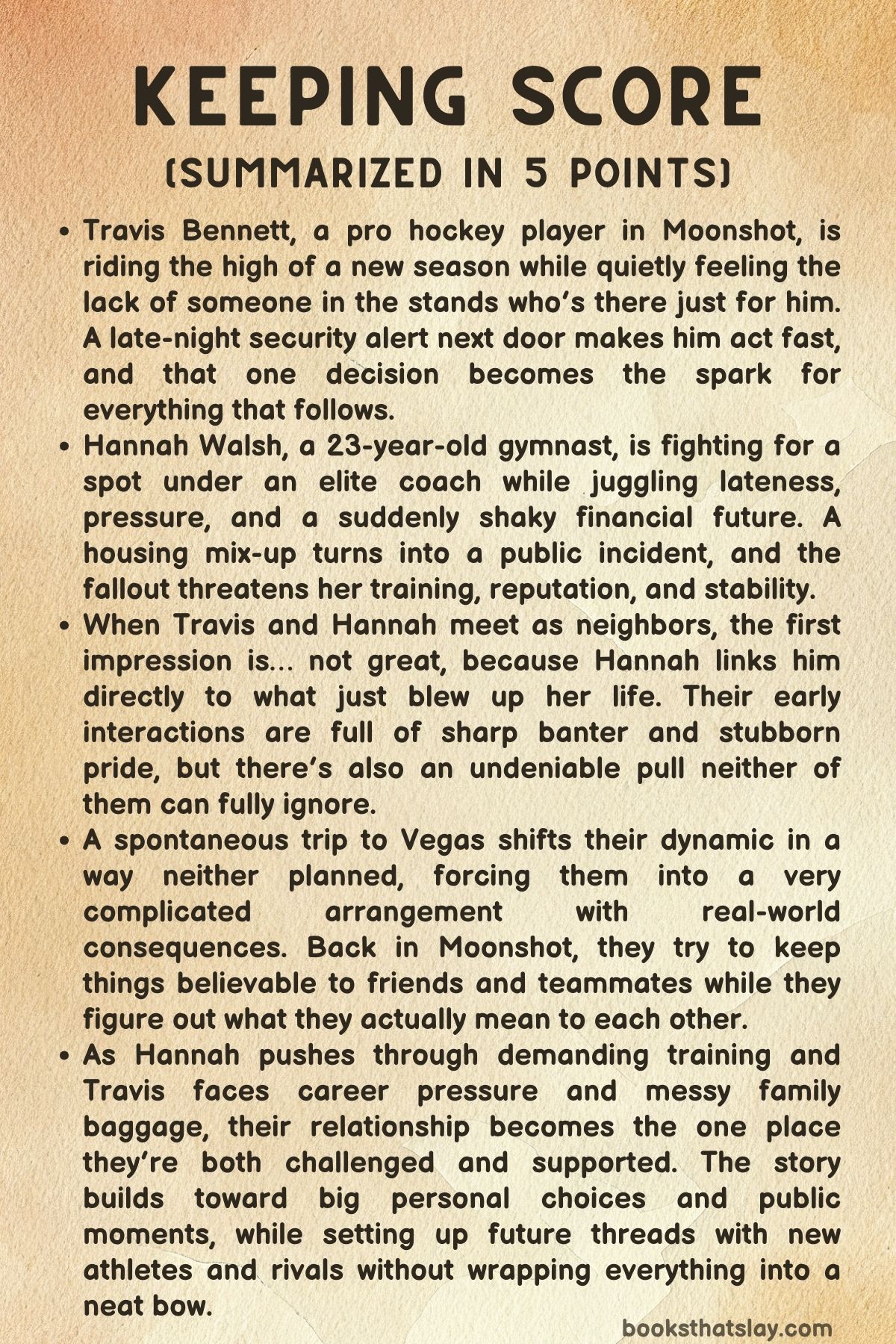
Travis Bennett finishes Moonshot’s first home game of the season and joins his teammates at their usual post-game bar, MVP. He jokes around, drinks with the guys, and tries not to think about the familiar emptiness that follows him after the noise fades—no family support, no partner in the stands, and a life that feels strangely quiet once the arena lights go dark.
Later that night, a motion alert from his home security feed shows someone sneaking onto the neighbor’s property. Travis watches a hooded figure climb a tree, reach a second-floor window, and slip inside the house next door.
Knowing his elderly neighbor is away, he reports it, asking for help to be sent. The incident sticks with him, leaving him uneasy and alert.
A day later, Hannah Walsh arrives late to her gymnastics training again, already running on stress and little sleep. She’s in Moonshot on a trial period, hoping elite coach Rodier will decide she’s worth coaching.
Her friend Kinsley pushes for the truth, and Hannah admits she spent the night at the police station. Hannah had arranged a short-term rental, but when the promised key wasn’t where it was supposed to be and the leasing agent wouldn’t answer, she checked a window, found it unlocked, and climbed in.
A neighbor called the police. With no one to verify her story late at night, Hannah was treated like a trespasser, held until morning, and released embarrassed and furious.
The fallout hits immediately. Hannah’s agent, Everly, calls to warn her that the incident has been logged and tied to Hannah’s name, and her sponsor, Meyer, may use a morality clause to cut her loose.
Almost as soon as Everly speaks, Hannah gets the email: sponsorship terminated, effective immediately. Hannah panics.
Without sponsorship money, her training and coaching fees are suddenly on a cliff edge.
While Hannah stands outside her rental simmering, her neighbor approaches. It’s Travis—friendly, confident, and distractingly handsome in an effortless athlete way.
He introduces himself, offers help, and asks her out to dinner. For a moment, Hannah almost forgets everything else.
Then Travis mentions the break-in he saw on camera and admits he called the authorities. Hannah realizes he’s the reason the police showed up at the exact moment she was inside the house.
The connection is instant and brutal: his “helpful” call spiraled into her night at the station and the report that cost her sponsorship. Hannah explodes, telling him he ruined her life, and slams the door on him, rejecting dinner and anything else he might offer.
Travis can’t let it go. He’s shocked by the damage his call caused, but also shaken by how strongly he’s drawn to her.
He tries to apologize and make peace—first with a hopeful breakfast offering, then with stubborn persistence. Hannah refuses him at every turn, but their bickering develops a sharp rhythm.
At the bar one night, Hannah runs into Ruby (Nick Galaxy’s girlfriend) and then Travis, who shows up with the hockey crew. Hannah’s irritation spikes, but so does the tension between them.
Travis teases her, Hannah snaps back, and their friends quickly notice the chemistry under the arguing. When Hannah leaves, Travis makes sure she gets home safely, which only annoys her more.
Hannah’s life stays tense. Training is relentless, and she’s desperate to earn Rodier’s approval while also worrying about money.
A small moment of unexpected kindness comes when Travis flirts with her at the grocery store, then leaves her a favorite muffin the next morning like a peace offering she didn’t ask for. Hannah tries to stay angry, but the constant pressure makes it harder to ignore small gestures that feel steady and personal.
Then Hannah gets the news she’s been chasing: Coach Rodier will take her on. She’s thrilled, proud, and suddenly willing to celebrate.
Kinsley convinces her to join a weekend trip to Vegas. At the same time, Travis is in Vegas with teammates for his birthday, distracted by a call from his estranged father and by the fact that he can’t stop thinking about Hannah.
He hears her voice in the hotel and finds her with Kinsley and Skylar. He offers to get them into a sold-out club, and the night becomes a chaotic mash-up of champagne, dancing, and the kind of thrill that makes choices feel easy.
As the night goes on, Travis and Hannah keep circling each other—flirting, talking, laughing in a way that surprises them both. Travis admits he’s watched her gymnastics videos and followed her online.
Hannah, caught between attraction and fear, swings from bold to overwhelmed. They nearly kiss, she panics, then she kisses him anyway.
The next thing Hannah knows, she wakes up in a luxury hotel room with Travis beside her and a sinking feeling that she can’t remember how the night ended.
Travis tries to slow her down. He offers breakfast and conversation.
Hannah bolts, embarrassed, and then he drops the bomb: they got married. Hannah thinks it’s a joke until the proof appears—marriage certificate, signatures, evidence she can’t explain away.
Back home, Hannah tells Kinsley and insists she’ll get an annulment. Travis, however, doesn’t treat it like a mistake he wants to undo.
He suggests they stay married for now, presenting it as a practical solution while their friends and public lives make a clean split complicated. Hannah agrees reluctantly, setting rules and boundaries, certain she can keep her feelings out of it.
They begin living in the strange in-between of being married on paper while insisting it isn’t real. To make the situation believable, Travis gives Hannah a ring.
He brings her meals, supports her training schedule, and quietly becomes part of her daily routine. Meanwhile, Hannah’s gymnastics training hits a wall.
Rodier orders her into a month of conditioning, ballet, visualization, and rebuilding fundamentals—no apparatus. Hannah feels like she’s being punished, but she follows the plan, trying to trust the process even when it’s frustrating.
As they spend more time together, the edges soften. They share pieces of their histories: Hannah’s parents died when she was young, leaving her and her sister Wren to be raised by their grandmother.
Hannah learned early that stability can vanish without warning, and she hates depending on anyone. Travis admits his family is alive but absent in the ways that count—emotionally distant parents, an estranged father, and a life where he learned to handle things alone.
Their physical attraction grows, but so does something harder to manage: the comfort of being seen.
Hannah injures her ankle during beam practice, and despite trying to keep it quiet, she ends up at Travis’s game. Travis spots her in the stands and lights up in a way that makes her feel both exposed and wanted.
He plays an explosive game, takes the “player of the game” belt, and then carries her out when he sees her limp. At home, they trade care—ice for her ankle, massage for his bruised shoulder—building intimacy in small, practical moments.
Trouble returns when Hannah learns her gym and coaching fees for the coming year have been paid in full. The payer is Travis.
Hannah confronts him at MVP, furious not because she doubts his kindness, but because it feels like he decided her life for her. She’s terrified of owing anyone, terrified of being bought, and terrified of letting love become a debt she can’t repay.
Travis tries to explain that he wasn’t trying to control her—he just couldn’t stand watching her struggle.
The argument opens a deeper truth Travis has hidden: his grandfather left him ten million dollars, but he couldn’t access it until he was twenty-seven, employed, and married. Hannah is stunned, and her anger spikes again.
She wonders if the Vegas wedding was about money. Travis insists it wasn’t—he wanted her, not the inheritance—but the secrecy makes everything feel unstable.
Hannah walks away, and Travis spirals, convinced he’s proven he can’t keep relationships intact.
Kinsley helps Hannah name what’s really happening. Hannah isn’t only angry; she’s scared.
She’s spent years surviving by refusing to need anyone. Depending on Travis feels like handing him the power to hurt her, even accidentally.
Realizing that doesn’t fix everything, but it cracks the wall enough for her to go looking for him.
Hannah finds Travis at Whisky Roots in a tense dinner with his father, Gene Bennett. Gene is smooth and sharp, and it quickly becomes clear he’s there to get access to Travis’s money.
He belittles Travis, insults Hannah, and suggests she’s only around for luxury. Hannah snaps back, defending Travis and refusing to let Gene rewrite the story.
Travis admits he met Gene because he thought fixing his family might help prove he can be a steady husband. Hannah tells him he doesn’t owe his parents anything and that she’s not leaving.
Soon after, Hannah attends another hockey game and hears the announcer introduce “Travis Bennett-Walsh.” Travis has put her name on his jersey, legally hyphenating his last name so her name is always said with his. The gesture overwhelms Hannah.
She rushes to see him after he’s cut above the eyebrow, and emotion spills into a private, urgent moment that confirms they’ve crossed past “fake” into something real.
At the Winter Classic gymnastics competition in Kentucky, Travis watches Hannah compete alongside Wren. Hannah delivers under pressure—strong floor, steady beam, a difficult vault with only a small error, and a solid bars routine.
Her scores hold, and she wins the meet. She runs to Travis, and they celebrate with the kind of joy that comes from hard-earned trust.
A year later, their friends celebrate Travis’s birthday and their anniversary back in Vegas. Hannah gives Travis a matching wedding band, and they laugh at the strange route that brought them here.
Hannah suggests they get married again—this time fully present and remembering everything—choosing each other on purpose, not by accident.
Characters
Travis Bennett
In Keeping Score, Travis Bennett is introduced as a star pro hockey player who looks like he has everything—status, money, teammates who feel like family—yet he moves through life with a persistent loneliness that’s hard to shake, especially when he notices there’s no one in the stands who is “his.” That emotional emptiness is what makes his fixation on Hannah feel less like a casual crush and more like a hungry hope for connection, something stable that belongs to him outside the rink. Travis’s defining trait is how intensely he commits once he decides someone matters: he keeps showing up after Hannah rejects him, learns her world by watching her routines online, feeds her literally and emotionally, and tries to prove through actions what he struggles to say cleanly.
At the same time, his protectiveness and impulse to “fix” things becomes a flaw when it crosses into secrecy and control, most notably when he pays her training costs without consent and withholds the inheritance conditions that complicate his motives. Underneath the confidence and teasing charm is a man shaped by emotional neglect, someone who equates love with staying, doing, and giving—sometimes too much, too fast—because he is terrified of being left again.
Hannah Walsh
Hannah Walsh is a disciplined, high-stakes athlete whose entire identity is tied to earning her place, and that drive becomes both her power and her cage. She starts the story already under pressure—late to training, desperate to impress an elite coach, financially precarious—and then she gets punished socially and professionally for a mistake that sits in a gray area, leaving her humiliated and suddenly unsupported.
That early incident crystallizes Hannah’s core wound: she cannot afford to be misunderstood, and she cannot afford to be dependent, because loss has taught her that stability can vanish overnight. Her anger at Travis is real and justified, but it also becomes a shield that keeps her from acknowledging how much she wants the safety he offers; even when she’s drawn to him, she tries to keep emotional distance by reframing everything as logistics, image management, or temporary necessity.
What makes Hannah compelling is that her strength isn’t performative—she grinds, she visualizes, she returns to basics, she endures the ego bruises of rebuilding—yet she still has soft edges, like the way she quietly lights up when she’s cared for or when someone shows up for her without demanding anything in return. Her arc isn’t about becoming less strong; it’s about learning that accepting love and help does not erase her agency or the fact that she earned everything she’s fought for.
Nick Galaxy
Nick Galaxy functions as Travis’s emotional anchor and social mirror, the best friend who knows Travis well enough to tease him, call him out, and still take him seriously when something real finally shows up. Nick represents what Travis thinks he’s missing: a life that includes a partner and a steady affection that exists beyond the sport, and that contrast makes Travis’s loneliness sharper early on.
He also helps normalize the chaos once the Vegas marriage happens because his presence keeps the friend group grounded, turning potentially explosive drama into something survivable through humor, perspective, and loyalty. Nick’s role is less about personal transformation and more about being proof that commitment can be real and sustaining, which is exactly what Travis needs to believe is possible for him.
Ruby
Ruby is the warm connective tissue of the group, someone who moves easily between worlds and uses empathy as her default setting. She is positioned as both friend and informal adviser, the person Travis can call when he’s spiraling about instant attraction and the person who welcomes Hannah without making her “earn” a place socially.
Ruby’s energy softens scenes that could otherwise tilt into bitterness because she models emotional security—she listens, she reacts honestly, and she keeps people from feeling alone in a crowded room. While she enjoys the entertainment of the situation like everyone else, she never treats Hannah’s discomfort as a joke, which makes her an important counterbalance in a story where public perception and private fear collide so often.
Kinsley
Kinsley is Hannah’s loud, relentless, ride-or-die friend, and her personality is built on momentum: she pushes people into motion when they get stuck inside their own heads. On the surface she’s the comedic instigator—dragging Hannah out, teasing her, making choices that force social collisions—but underneath that is a friend who notices what Hannah won’t say out loud, especially the way grief and financial stress have made her rigid about control.
Kinsley’s value isn’t that she always makes perfect calls; it’s that she refuses to let Hannah disappear into isolation, and she tells her the kind of truth that only lands because it comes from devotion rather than judgment. She becomes the voice that names Hannah’s deeper fear—needing someone and then losing them—helping Hannah recognize that her anger at Travis isn’t only about money or secrecy, but about terror.
Skylar
Skylar serves as part of Hannah’s social safety net, offering a calmer presence within the friend dynamic and functioning as reinforcement for the idea that Hannah is allowed to have joy alongside ambition. She helps widen Hannah’s world beyond training stress by being present in celebratory moments, particularly the Vegas trip, where Hannah temporarily stops performing competence and lets herself be swept into something impulsive.
Skylar’s role is subtle but important because she contributes to the sense that Hannah has community—people who will keep her steady when her life veers suddenly off plan.
Coach Rodier
Coach Rodier is the embodiment of uncompromising excellence, the kind of elite coach who doesn’t traffic in reassurance or comforting words because he believes precision and discipline are the most respectful forms of support. He initially reads as intimidating—blunt corrections, high expectations, little patience for excuses—but the story reveals his investment through action: he chooses Hannah, monitors her improvement, and makes the bold decision to pull her away from apparatus work and force a rebuild when she’s teetering on the edge of collapse.
Rodier represents the idea that progress is not always forward motion; sometimes it is stripping everything down until the athlete’s foundation can hold the weight of their ambition. His coaching style also parallels Hannah’s emotional journey because he is essentially demanding that she learn trust—trust in process, trust in repetition, trust in hope—rather than trying to brute-force outcomes through sheer anxiety.
Coach Liz
Coach Liz operates as the pragmatic system around Hannah’s elite training, translating Rodier’s philosophy into a structured plan and enforcing the reality that excellence costs money, time, and compliance. She is not written as cruel, but she is firm, which makes her feel like the adult voice of the institution: invoices exist, training cycles exist, and sometimes what the athlete wants is not what the athlete needs.
Liz’s role becomes especially sharp when the payment appears, because she is the delivery mechanism for the reveal that Hannah’s financial crisis has been quietly solved, triggering Hannah’s conflict about autonomy. In that way, Liz isn’t just staff—she’s a narrative hinge that turns private help into a public fact Hannah must emotionally confront.
Everly
Everly is Hannah’s agent and crisis manager, representing the professional world that treats athletes as both talent and brand. Her primary function is to show how fast reputational risk can turn into financial catastrophe, and how little room Hannah has for mistakes when she’s dependent on sponsorship.
Everly’s warnings are not melodramatic; they are procedural, and that procedural tone makes the sponsorship termination feel colder and more destabilizing. She reinforces the theme that Hannah’s life is governed by contracts and clauses as much as it is by performance, which heightens the stakes of every decision Hannah makes.
Meyer
Meyer is less a person and more a force, the sponsor who wields morality language as a weapon and demonstrates how transactional support can be. By terminating Hannah “effective immediately,” Meyer turns a confusing misunderstanding into a life-altering threat, exposing the fragility of Hannah’s career stability and the vulnerability of athletes whose resources are tied to public perception.
Meyer’s presence matters because it sets Hannah’s survival instincts on fire, making it emotionally logical that she later panics when Travis tries to solve money problems for her—she has learned that whoever controls the funding controls the future.
Wren Walsh
Wren is Hannah’s younger sister and emotional history, the person who most clearly explains why Hannah’s independence is non-negotiable. Their shared past—the loss of their parents and being raised by their grandmother—creates a relationship where Hannah has long been the protector, the planner, and the one who absorbs stress so Wren doesn’t have to.
Wren’s arrival also tests Travis, because she is naturally skeptical and curious, asking questions that force him to show who he is without the mask of flirtation. Her presence pulls the story into a domestic, intimate space—movie nights, shared food, casual closeness—where Hannah can’t pretend this is only a convenient arrangement.
Wren’s role is to remind Hannah that love is not just romance; it is also caretaking, chosen family, and the courage to let someone else share the burden Hannah has carried for years.
Conrad “Shep”
Shep is one of Travis’s close teammates and part of the friend-group chorus, but he also offers a surprisingly tender mirror to the main couple’s dynamic. His awkwardness with women makes him an easy target for teasing, yet the story treats it as something human rather than pathetic, and Hannah’s decision to help him approach Diane shows her natural empathy and competence in social problem-solving.
Shep’s friendship with Travis is important because it gives Travis a place to be vulnerable when he’s spiraling, and it also highlights what Travis is afraid of: that he might be fundamentally bad at relationships. In Shep’s small success and earnestness, the story reinforces the idea that people can learn connection, even if it doesn’t come naturally.
Danny “D-Low”
Danny, called D-Low, contributes energy and loyalty to Travis’s circle, functioning as part of the social environment that both supports and pressures the relationship into visibility. He is present in celebratory spaces—Vegas, group nights, teasing conversations—where the couple’s boundaries are tested by jokes, attention, and the expectation that they play along.
D-Low’s importance is less about his individual backstory and more about how he helps build the sense that Travis isn’t alone, that he has a steady network, and that Hannah is slowly being folded into a larger community.
Penn
Penn appears as another teammate in Travis’s orbit, helping establish the locker-room and bar culture that defines Travis’s public life. Characters like Penn reinforce the contrast between Travis’s outward world—noise, confidence, camaraderie—and his private emotional hunger.
Even with limited focus, Penn’s presence matters as part of the social ecosystem that normalizes Travis’s routines and makes Hannah’s entrance into that world feel like a meaningful disruption rather than a simple meet-cute.
Victor Aven
Victor Aven is positioned as the external antagonist, a rival player who provokes Travis and tries to humiliate him by targeting what matters most—his pride and, later, his wife. Aven’s trash talk is not just sports hostility; it is a psychological attempt to destabilize Travis, and the fact that Travis has to be physically restrained shows how easily Travis’s protectiveness and anger can flare when he feels threatened.
Aven’s role also sharpens Hannah’s perception of Travis because it forces her to see the edges of his intensity, not only the sweetness, and it frames the hockey world as a place where conflict is constant and public.
Gene Bennett
Gene Bennett, Travis’s estranged father, is the clearest portrait of emotional exploitation, arriving not with warmth but with agenda. He treats relationships like transactions, probing for access to money and power, and his contempt exposes the wound Travis has been living with for years: being valued for what he can provide rather than for who he is.
Gene’s presence forces Travis into a confrontation with the part of himself that still wants parental approval, even when it costs him dignity, and it also gives Hannah a chance to demonstrate love as protection rather than dependence. The dinner scene with Gene is crucial because it reveals that Travis’s fear isn’t only losing Hannah; it’s the belief that people will always leave or use him, and that he is only safe when he is useful.
Martha
Martha, the elderly neighbor whose house is entered while she is away, operates as a plot catalyst rather than a developed character. Her absence creates the conditions for Travis’s protective instincts to kick in and for Hannah’s housing situation to become a public incident.
Martha’s importance is symbolic: she represents how small misunderstandings and assumptions—about who belongs where, about what danger looks like—can spiral into consequences that land hardest on the most vulnerable person in the situation.
Diane
Diane is briefly featured as the woman Shep approaches, and her openness functions as a gentle contrast to the guardedness in the main romance. She is receptive, talkative, and easy to engage, which allows Shep to relax and lets the scene carry a note of warmth rather than humiliation.
Even with limited page time, Diane’s role supports the theme that connection can be simple when fear doesn’t run the show.
Knox Holland
Knox appears at the end as the lead-in to a new storyline within the same broader world, and his brief introduction frames him as intensity and grief in motion. He is driven by a need to honor his late mother, pushing his body to extremes, and the crash caused by his teammate’s aggression positions him immediately in a conflict shaped by risk, betrayal, and physical consequence.
Even with only a glimpse, Knox reads as a character whose identity is welded to competition and loss, setting up a more volatile emotional arc than the comparatively playful beginning of Travis and Hannah.
Link
Link is introduced through action rather than interiority, defined in a single moment as the aggressive teammate whose interference causes Knox’s crash. That framing makes him an instant source of resentment and suspicion, raising questions about whether his move was reckless, competitive, or personal.
Link’s narrative function is to ignite stakes and establish a social environment where rivalry can turn dangerous quickly.
Avery Oliver
Avery is introduced as a gymnast dealing with lingering injury and pressure, and she represents the quieter misery of not being able to trust your own body. Her frustration at practice and the weight of expectations suggest a character who is mentally tough but emotionally exhausted, someone caught between ambition and limitation.
The moment she locks eyes with a tattooed rider at an event hints at a future storyline built around destabilization—desire, distraction, and the threat of wanting something that complicates recovery and focus. Even in a short intro, Avery reads as someone who is used to control and is unsettled by what she cannot control: pain, performance, and attraction.
Quinn
Quinn appears as Avery’s roommate and social engine, the friend who drags her out of the loop of injury obsession and into a louder world. She functions as a catalyst, pushing Avery into an environment where she meets riders and feels something unexpected, which implies Quinn will continue to be the bridge between Avery’s structured training life and the messier emotional world waiting outside the gym.
Themes
Public image, private vulnerability, and the price of being watched
In Keeping Score, reputation isn’t an abstract concern; it functions like a force that can rearrange a person’s life overnight. Hannah’s sponsorship collapse shows how quickly institutions reduce a complex human situation into a neat violation of a clause, and how little room there is for context once something is documented.
The incident is humiliating not only because she feels wrongly judged, but because the system treats a confusing housing situation as evidence of flawed character. That creates a constant pressure to appear controlled, respectable, and safe for brands—especially in a sport where funding can disappear without warning.
Travis lives under a different kind of exposure: fans, teammates, and the constant idea that people are watching him perform. The loneliness he feels after games isn’t solved by celebrity; it’s sharpened by it, because the applause doesn’t translate into personal support.
The book keeps returning to surveillance in literal and emotional forms—cameras catching the break-in, public speculation about the sudden marriage, and the performative expectations of a believable relationship. Even when Travis offers help, Hannah experiences it through the lens of visibility: if she accepts, she fears she’ll look dependent, purchased, or like someone who traded dignity for security.
The tension between how they are perceived and what they actually feel becomes a central pressure point. Their marriage begins as a public-facing problem to manage, but the story shows how image-management can slowly reveal truths people have been avoiding—how lonely Travis is, how precarious Hannah’s career is, and how easily both are harmed when others control the narrative.
Independence, control, and the fear of owing someone
Hannah’s sense of self is built around survival and competence, not because she enjoys refusing help, but because relying on others has historically been unsafe. Losing her parents young forces her into a mindset where stability must be earned, guarded, and never assumed.
That background makes her extremely sensitive to anything that resembles rescue, even when it comes from care rather than pity. When Travis pays her training fees, the action lands like an emotional trespass: he removes a problem she is trying to solve through her own effort, and that threatens the identity she has built around earning every inch of progress.
The conflict isn’t about money alone; it’s about agency. Hannah hears an unspoken message—“you can’t handle this without me”—even if Travis doesn’t intend it.
Travis, on the other hand, expresses devotion through practical solutions: food, rides, repairs, a ring, payments. He’s good at action because action feels measurable, safer than asking for emotional permission.
The result is a relationship where generosity can accidentally become control, and gratitude can feel like a debt. Hannah’s panic around “repaying” him reveals how support, when mismatched to someone’s needs, can create shame instead of relief.
The story pushes both characters to redefine what partnership looks like: not a scoreboard of who provided more, but a negotiated space where help is offered with honesty and received without humiliation. Their progress depends on learning that independence and intimacy aren’t opposites, and that accepting care can be an act of strength when it’s chosen rather than imposed.
Performance pressure and returning to fundamentals
Both sports in Keeping Score demand perfection under observation, but the story emphasizes how progress often requires stepping backward. Hannah’s training plan shifting away from apparatus work toward conditioning, ballet, visualization, and meditation is frustrating because it feels like losing ground.
Yet it also reflects an important truth about elite performance: breakthroughs are frequently built on unglamorous repetition and mental stability. Hannah’s fear that she doesn’t belong at Premier isn’t only about skill; it’s about the fragile economics of her career and the anxiety that one mistake will erase her opportunity.
Travis experiences a parallel pressure in hockey—trash talk, rivalry, public expectation, and the emotional swing of wins and losses. The narrative shows how performance isn’t simply physical talent; it’s emotional regulation, routine, and identity management.
When Hannah is told to visualize with “hope,” it signals that mindset is part of technique, not a separate motivational accessory. Travis’s need for someone in the stands reveals how performance can feel empty without relational grounding.
Their marriage, oddly, becomes part of that grounding: Hannah showing up at his game changes his experience of playing; Travis supporting her competition changes her ability to withstand stress. The theme also highlights how athletes are often trained to push harder rather than listen inward.
The story challenges that reflex. Hannah’s injury and the slow rebuild, Travis’s bruises and emotional setbacks, and the discipline required to return to basics all argue that durability matters as much as peak moments.
Winning the Winter Classic is satisfying not just because she places first, but because it validates a process that demanded patience, humility, and trust in work that didn’t immediately look like progress.
Love shaped by consent, boundaries, and earned intimacy
The relationship begins with a collision of misunderstandings and resentment, which makes boundaries central from the start. Hannah needs space, control, and clear choices; Travis needs closeness and reassurance.
That mismatch creates comic tension at first—breakfast offerings, flirting, relentless banter—but it becomes serious when actions carry emotional weight. Travis’s support repeatedly tests the line between care and overreach, and Hannah’s reactions test the line between self-protection and withdrawal.
What makes their intimacy feel earned is the gradual shift from forcing proximity to choosing it. Their “exposure therapy” idea is playful, but it also functions as a negotiation: affection isn’t demanded to perform credibility; it’s explored because both want it.
Travis saying he won’t kiss her to prove anything draws a clear boundary against turning her body into evidence for others. Hannah initiating kisses at key moments shows her moving from reactive defensiveness to active desire.
The story also treats intimacy as more than sex: shared meals, watching movies with Wren, the comfort of falling asleep together, and the quiet routines of living side by side become emotional anchors. This theme is sharpened by the fact that their marriage starts impulsively and under the haze of alcohol, creating a lingering discomfort about memory and consent.
The narrative addresses that discomfort by making later choices explicit and mutual: conversations about what they are, whether they will date others, how they will act in public, and what they actually want. By the time Travis changes his name to include hers, it lands as devotion rather than spectacle because it follows many smaller moments where he respected her fears and she chose to stay anyway.
The romance becomes less about grand gestures and more about boundaries that are communicated, honored, and sometimes renegotiated when they get it wrong.
Money, power, and the difference between security and dependence
Financial pressure shapes nearly every decision Hannah makes, and the story portrays money as both practical necessity and emotional trigger. Sponsorship loss threatens not only her training but her identity as an athlete with a future.
The precariousness of her situation highlights how elite sports can be accessible only when someone else funds the dream, which creates constant vulnerability to contracts, clauses, and reputation. Travis’s wealth operates differently: he has earnings from hockey, but the inheritance adds another layer—money tied to conditions, family history, and manipulation.
The marriage requirement exposes how money can attempt to control life choices even after a person dies, and Gene’s reappearance proves how wealth attracts opportunists. Hannah’s fear of being “bought” is not paranoia; it’s a response to real social dynamics where financial imbalance can shift power in a relationship.
Travis paying her fees is compassionate, but it also risks making Hannah feel like a dependent rather than a partner. The conflict forces the book to ask: when does help become leverage, even unintentionally?
Travis’s insistence that he married for love is complicated by timing and secrecy, and the story doesn’t treat Hannah’s suspicion as irrational. Instead, it frames trust as something that must be protected from the distortions money can introduce.
At the same time, the book refuses to romanticize struggle for its own sake. Hannah’s desire to earn her success is admirable, but the narrative also suggests that refusing all support can be another form of fear-based control.
The resolution comes when money is repositioned as a tool rather than a claim: security is valuable when it expands choice, but it becomes toxic when it replaces consent. By confronting Gene and rejecting his attempts to access Travis’s resources, Hannah aligns herself with Travis’s dignity, not his wallet, and that distinction becomes the moral center of how the couple learns to handle wealth without letting it define their worth.