Kissed by the Gods Summary, Characters and Themes
Kissed by the Gods by Caty Rogan is a fantasy tale about a young serf whose life shatters when the ruling kingdom destroys her family and exposes a power she never knew she possessed. The story follows Leina, a woman raised in the oppressed land of Selencia, as she is dragged into the world of the Altor—god-touched warriors believed to exist only among her enemies.
As she confronts injustice, divine forces, and forbidden love, Leina must decide who she is, whom she trusts, and what she is willing to fight for in a world spiraling toward war.
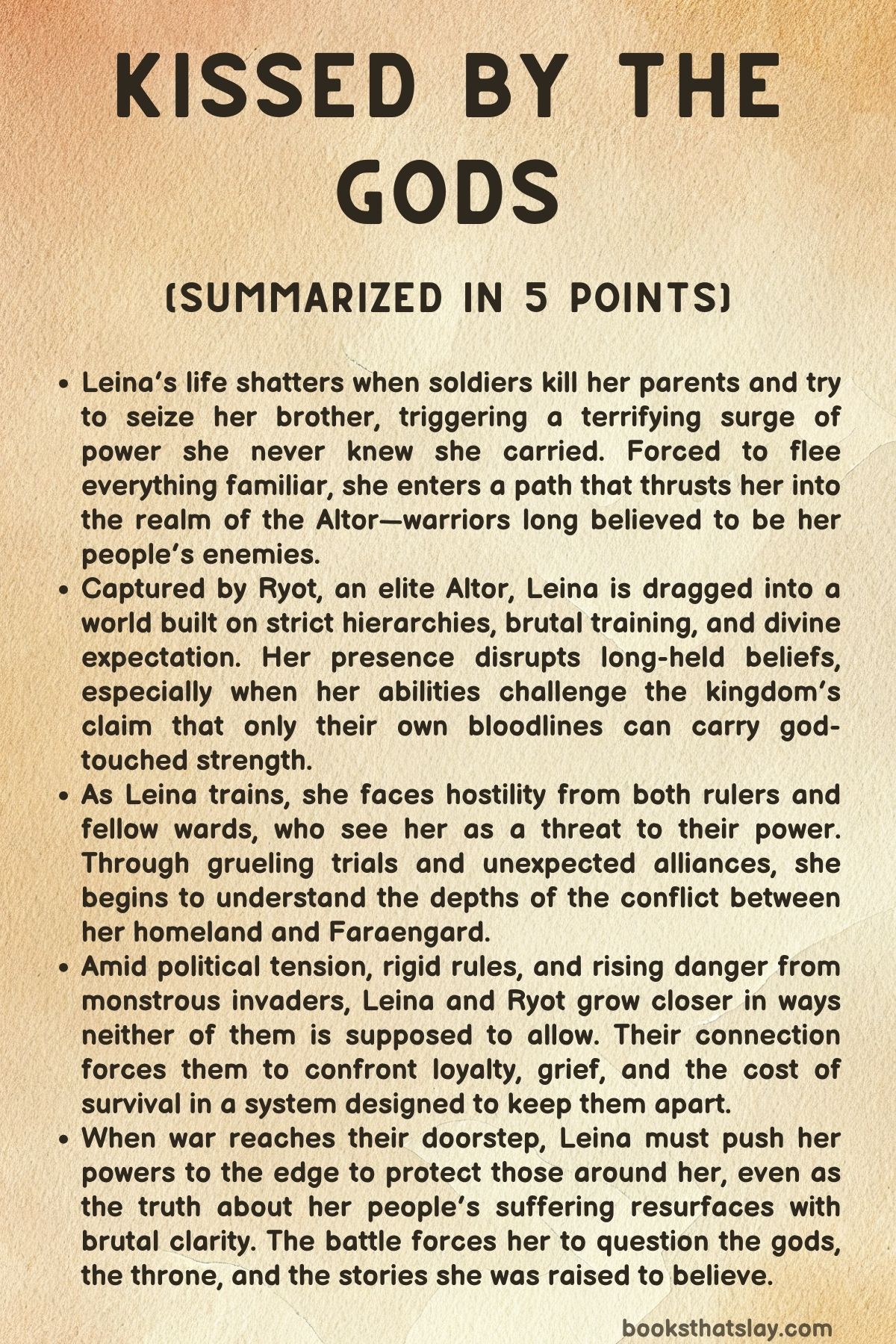
Summary
Leina’s life changes forever on the day her parents are killed and her hidden power explodes outward. When Faraengardian soldiers arrive to take her brother Seb for the annual Collection, an archer murders her mother in front of her.
The horror unleashes a force inside Leina that she has struggled to control since the day her sister-in-law burned to death. In a single devastating burst of instinct and strength, she kills the entire squad of soldiers.
One survivor names her “Altor,” a title reserved for the god-gifted warriors of Faraengard, before he dies in a disturbing eruption of insects. With the kingdom sure to retaliate, Seb pulls Leina and their little brother Leo into flight.
They hide in the Weeping Forest, scavenging what is left of their home, grief following their every step.
Their temporary refuge ends when an Altor named Ryot finds them. A hunter of rebels, he has been sent to track down the Selencian responsible for the soldiers’ deaths.
Leina attempts to fight him, but his skill far exceeds hers, and he subdues her with ease. To save her brothers, she offers herself on the condition that he never reveals their location.
She is taken from them in chains, carried through the forest until Ryot summons his faravar: Einarr, a colossal winged beast with an unsettling intelligence. Though terrified of flying, she is forced into the sky, leaving her life behind to face a place she has only ever heard of through warnings and rumors.
As they travel, Leina sees the stark contrast between conquered Selencia and Faraengard. The capital, Edessa, brims with wealth built from Selencian labor.
Her resentment grows as Ryot takes her to the Synod, a fortress carved into the mountainside and home to the Altors. There, her arrival sparks immediate hostility.
Many refuse to believe a woman—especially a Selencian—could share their sacred power. When she instinctively summons her scythe from Ryot’s back, the Synod is forced to acknowledge something strange about her.
Their doubts deepen when the fortress is ambushed by monstrous beings called Kher’zenn. During the attack, Leina touches one and survives, something no mortal should be able to do.
An Elder confirms the truth: she is an Altor.
Leina becomes a ward, training under the Synod while living in constant suspicion. Some warriors bully her.
Others quietly show her kindness. She learns the culture, rules, and politics of the Altor, including the strict prohibition against emotional attachment.
Her strained but growing bond with Ryot becomes harder to ignore. He is often cold and controlled in public, but in private his concern, pain, and loyalty show through the cracks.
Their trust deepens as he oversees her training and teaches her to anchor her mind during meditation. Both share memories of the families they lost, and the grief they carry becomes a fragile bridge between them.
As winter arrives, Leina’s training intensifies. She must prepare for the perilous climb of Elandors Veil and for the Trial of Last Blood—a divine judgment that could guarantee her place among the Altor or condemn her soul.
During these months, tensions in the Synod rise. The king views her as a threat.
Tyrston, a powerful ward, takes every chance to undermine or intimidate her. Yet Leina also gains moments of strength and confidence, forming friendships with other wards like Leif and earning quiet respect from a few seasoned warriors.
Her relationship with Ryot reaches a breaking point during a dangerous practice climb. When Leina forgets essential gear and risks both their lives, they are forced to share body heat in a cramped tent.
Desire and fear collide, leading to an intimate moment that neither expected. Ryot, bound by duty and rank, pulls away despite wanting more.
Their connection becomes a silent storm neither can escape.
The fragile balance collapses when Tyrston attacks her with lethal intent. During the brutal fight, Leina’s goddess-marked power erupts, saving her life.
Ryot arrives in time to kill Tyrston, cradling her in a protective shield strong enough to block out the world. Though weakened, she hears Princess Rissa warn Ryot that his feelings for Leina could destroy them both.
Soon after, Leina learns devastating news—her twin brother Levvi and her friend Alden were not merely taken in the Collection; they were murdered. Rage and heartbreak drive a confrontation with Ryot, who finally reveals the depth of his loyalty and love.
Their emotional walls fall completely, and they decide to overthrow the king together. But before they can act, alarms sound across the sea.
A massive Kher’zenn swarm approaches the city of Amarune.
The ensuing battle is catastrophic. Ryot orders Leina to stay in the rear with Princess Rissa, but she refuses to abandon him or the slaughtered families around her.
As the Kher’zenn overwhelm the front lines, Leina reaches through the Veil—a strange space she has glimpsed before—and begins turning the tide. She and Vaeloria, a faravar bonded to her, slip between worlds, striking the enemy from impossible angles.
At the Elder’s command, she lures the swarm toward a charged storm above the sea. The Elder unleashes a final stormburst that annihilates the Kher’zenn but kills him in the process.
Leina and Vaeloria are dragged through the Veil again, returning only after the city lies in ruins. With thousands dead and another swarm approaching, the survivors flee into the adamas mines beneath the Valespire Peaks.
In the tunnels, Leina follows a strange pull toward an abandoned chamber where she encounters King Agis. She tries to kill him, but Ryot intervenes.
Forced into a corner, Ryot confesses a truth he has never spoken: the king is his father, making him a royal prince. The revelation cuts Leina deeply, shaking her sense of trust and belonging.
When she attacks again through the Veil, a hooded Altor blocks her strike. At the king’s command, he is ordered to kill her.
But instead, he removes his hood. Scarred, changed, and long believed dead, he is Alden—her brother.
His presence reveals that the nightmares she suffered for years were real echoes through the Veil of his torment. The world Leina thought she understood collapses again, and the path ahead grows darker and more uncertain than ever.
Characters
Leina
Leina is the emotional and moral center of Kissed by the Gods, a young Selencian serf whose life unravels in a single, catastrophic morning. Her arc begins in trauma—first with the death of Irielle, then the seizure of Levvi and Alden, and finally the murder of her parents by royal soldiers.
These compounded losses carve a heroine driven by grief, guilt, and the desperate instinct to protect whoever remains. Her transformation from a frightened serf into a god-marked warrior is marked by overwhelming sensory surges, bursts of impossible strength, and an internal conflict between who she was raised to be and who she is becoming.
Leina’s power is both a curse and a calling; each instinctive act of violence terrifies her even as it saves her life. She constantly measures herself against the injustice inflicted on Selencia, embodying the fury of an oppressed people who were told their suffering was destiny.
Her relationship with Ryot forces her to confront hope in the midst of despair, while her bond with Vaeloria and her terrifying encounters with the Kher’zenn underline the cosmic scale of her fate. Despite the gods’ hand in her life, Leina fights for her family, living and dead, and evolves into a warrior who refuses to bow to divine or royal decree.
Ryot
Ryot is a study in contradiction: a weapon forged by the Synod, a prince unaware to most of the world, and a man deeply marked by grief beneath his rigid discipline. As an Altor of the Stormriven Vanguard, he is brutal, precise, and unwaveringly loyal—until loyalty collides with love.
His initial treatment of Leina is cold, efficient, and governed by duty, but even early on, his choices betray a quiet protectiveness he refuses to name. Ryot’s past—six sisters lost, a childhood shaped by war, and a father who rules through fear—has hollowed out much of him, leaving only discipline and devotion to the order that gave him purpose.
Leina reawakens the human parts he buried, the pieces ruled by tenderness, longing, and defiance. His struggles revolve around the tension between personal desire and institutional expectation; the moment he chooses Leina over the Synod and even his own father marks a profound reclamation of identity.
Underneath the hardened exterior lies a man desperate to belong to someone after losing everything, and Leina becomes the axis around which his fractured loyalties begin to realign.
Seb
Seb represents the grounded, familial resilience of Selencian life. As Leina’s older brother, he is pragmatic, protective, and hardened by years of quiet suffering under Faraengard’s rule.
He becomes the anchor in the chaos following their parents’ deaths, instinctively taking charge when Leina collapses under the weight of her emerging powers. Seb is not superhuman, yet he embodies a courage that rivals any Altor’s.
His refusal to let Leina sacrifice herself, his determination to keep Leo alive, and his willingness to join the rebellion all show a man who has accepted that survival now requires impossible choices. Though his presence fades when Ryot captures Leina, his emotional imprint remains, shaping her motivations and reminding her what she’s fighting for.
Seb’s importance lies not in supernatural gifts but in the quiet strength that keeps a broken family from falling apart completely.
Leo
Young Leo stands as a fragile symbol of innocence in a world soaked in blood. His vulnerability heightens the stakes of the early narrative, reminding both the reader and Leina what is truly at risk as Selencia suffers under Faraengard’s oppression.
While he does not feature prominently in the later portions of the story, his role is foundational—he is the last piece of Leina’s immediate family, the child she wants desperately to protect, and the reason Seb refuses to let her surrender. Leo represents the future that oppression seeks to stamp out and the future Leina fights to preserve.
Alden
Alden’s character weaves through the narrative in layers: first as Leina’s lost love, then as a ghost haunting her trauma, and finally as a living, breathing warrior shaped by the Veil and suffering. His early disappearance in the Collection establishes him as one of the many casualties of Faraengard’s cruelty.
Yet his reemergence—scarred, conflicted, and bound by forces beyond his control—reframes his entire presence in Kissed by the Gods. Alden is not merely a memory but a man reshaped by torment, and his survival introduces a web of emotional and political complexity for Leina.
His final revelation detonates years of guilt for her, proving that the nightmares she endured were not just visions but shared suffering. Alden embodies the tragedy of stolen youth and the living cost of tyranny.
Irielle
Irielle’s death is the spark that ignites the entire story. Though her time is brief in the plot, the horror of her burning and the cruelty of the Collection ritual establish the brutality of Faraengard.
Irielle’s role is that of a quiet martyr, representing every Selencian woman sacrificed to a kingdom that sees its subjects as resources. For Leina, Irielle’s death becomes a wound that never fully closes, shaping her fear, her guilt, and her distrust of the world beyond their fields.
Leif
Leif is an example of kindness flourishing even within harsh institutions. A fellow ward recovering within the Synod, he offers Leina camaraderie at a time she believes herself surrounded by enemies.
His gentleness highlights the humanity that still exists within Faraengard’s ranks, and his loyalty—both in small acts and in crisis—helps Leina realize that not all Altors are defined by cruelty or arrogance. He is a quiet but steady thread of hope and solidarity within her otherwise hostile environment.
Nyrica
Nyrica is a medic, mentor, and friend who consistently bridges the gap between duty and compassion. Her medical skill saves Leina more than once, and her bold, unfiltered personality provides emotional grounding as well as comic contrast.
Her relationship with Thalric reveals the complexity of Altor life, especially the balance between desire and forbidden attachment. Nyrica’s courage is emphasized not through battlefield triumphs but through her unwavering loyalty—she is one of the first to fully accept Leina as an equal rather than a threat or anomaly.
Thalric
Thalric is a disciplined, steadfast presence who reveals his depth gradually. As a warrior, he is protective and deadly; as a man, he carries deep emotional ties, especially to Nyrica.
His moments of vulnerability—especially during the battles at Amarune—expose the heavy cost of leadership and loyalty among the Altors. Thalric stands as a foil to Ryot: dependable where Ryot is volatile, steady where Ryot is haunted.
His respect for Leina emerges not from fear of her powers but from witnessing her courage firsthand.
Princess Rissa
Princess Rissa embodies both privilege and pressure. At first cold, disdainful, and dismissive of Leina, she reflects the elitism of Faraengard’s ruling class.
However, her role becomes more layered as she is thrust into danger and forced to rely on Leina and Leif for survival. Rissa is a woman raised in luxury but forged by expectation—her disdain is both a shield and a symptom of a life spent under political scrutiny.
Her complicated bond with Ryot and her conflicting loyalties create a sharp tension with Leina, blending jealousy, duty, and wary respect.
King Agis
King Agis is the embodiment of ruthless, calculated power. He rules with the philosophy that suffering is necessary for national strength, justifying atrocities in the name of war.
His tenderness toward his youngest daughter contrasts disturbingly with his political brutality, revealing a man who compartmentalizes humanity to maintain control. His interest in Leina is not merely political but paranoid; he sees her as a threat that must be extinguished before it grows.
His revelation as Ryot’s father adds another layer of cruelty—Agis is both the destroyer of Leina’s world and the creator of the man she loves. His presence drives the central conflict between tyranny and justice.
Archon Lyathin
Lyathin represents institutional rigidity and the dogmatic belief that the gods’ order must remain unchallenged. He is dismissive of Leina from the outset, clinging to tradition so tightly that he is blind to the truth unfolding before him.
His leadership feeds the culture that has oppressed Selencia and molded generations of Altors into unquestioning soldiers. Lyathin functions not just as a political antagonist but as the embodiment of a system built on hierarchy, fear, and divine justification.
The Elder
The Elder is a figure of ancient wisdom, enigmatic presence, and tremendous power. He bridges the world of mortals and gods more intimately than any other character.
His connection to the Veil and to Sigurd reveals a bond between Altor and faravar that transcends mere partnership. He sees in Leina what others cannot—something beyond mortality—and his recognition of her as an Altor redefines her entire future.
His final sacrifice during the storm marks him as a guardian of his people, willing to give everything to protect the remnants of Aesgroth from annihilation.
Tyrston
Tyrston embodies the internal corruption rotting Faraengard from within. A cruel and arrogant ward, he views Leina as an affront to the established order and reacts with violence born of insecurity and entitlement.
His inherited gifts amplify his brutality, and his obsession with undermining or destroying Leina escalates until it ends in fatal confrontation. Tyrston’s death is both a personal victory for Leina and a symbolic moment when the institution’s own darkness begins to devour itself.
Einarr
Einarr is more than a mount; he is an extension of Ryot’s soul and a silent yet expressive presence throughout the story. Intelligent, perceptive, and fiercely protective, Einarr treats Leina first with suspicion and later with reluctant acceptance.
Through him, the depth of the Altor-faravar bond becomes clearer—it is a relationship of mutual respect, trust, and shared danger. Einarr’s reactions often reveal what Ryot refuses to say, and his actions in crisis reinforce that Leina’s place among the Altors is no longer deniable.
Vaeloria
Vaeloria emerges later in the story as the faravar bonded to Leina, a magnificent affirmation of her identity as an Altor. Their bond is instinctive and profound, allowing Leina to step through the Veil, navigate battles with supernatural precision, and lure an entire swarm of Kher’zenn into destruction.
Vaeloria’s presence transforms Leina’s understanding of herself, offering companionship and strength at a time when her human connections are strained by grief and betrayal. The pair move through the world with a shared ferocity, hinting at a destiny far larger than any mortal role.
Aruveth
Aruveth serves as the voice of grim pragmatism during Amarune’s darkest hour. As the Aishan steward, he commands with clarity and purpose, acknowledging the hopelessness of their situation while rallying his people to protect fleeing families.
His leadership is rooted in sacrifice rather than glory, and his choices reflect a man who understands that victory is sometimes measured only in who survives to fight another day.
Sigurd
Sigurd, the Elder’s faravar, mirrors the Elder’s ancient power and solemn presence. Their partnership is marked by synchronicity and deep spiritual resonance, and together they wield the storm itself as a weapon against the Kher’zenn.
Sigurd’s death alongside the Elder symbolizes an entire era ending in fire and lightning, leaving behind a world on the brink of further devastation.
Caius
Caius represents the loyal warrior who gives everything and dies in service to a cause greater than himself. His death during the Amarune battle is a stark reminder of the lethal cost of defending Aesgroth.
The grief that follows, especially among those close to him, underscores how profoundly interconnected the Altor ranks are and how each loss diminishes the whole.
Themes
Trauma, Memory, and the Burden of Survival
Trauma follows Leina through every stage of Kissed by the Gods, shaping her identity long before she understands the truth of her nature. Her memories don’t sit quietly in the background; they flare into sensory distortions, intrusive recollections, and physical reactions that influence every choice she makes.
The loss of Irielle, the seizure of Levvi and Alden, and the violent deaths of her parents create a layered grief that lives in her body as much as in her mind. Instead of reducing trauma to a symbolic wound, the story shows how it reshapes perception, heightens instincts, and isolates her from the world she once belonged to.
Each time she attempts connection—whether with Seb, Leo, Ryot, or the other wards—she carries the invisible weight of violence she’s witnessed and enacted. Her power emerges in tandem with that trauma, leaving her uncertain whether her abilities are a blessing or a curse and whether they free her or trap her further inside a cycle of fear.
As she travels from the farm to the Synod, and later through the Veil into realms beyond mortal understanding, her memories accompany her, shifting from something she hides to something she confronts. The narrative reveals how survival is not a finish line but an ongoing negotiation with the past, one that requires courage not only in battle but in allowing herself to grieve, to trust, and eventually to reclaim agency over the stories that once held her captive.
Oppression, Empire, and the Machinery of Power
The world of Kissed by the Gods is dominated by a stark imbalance of power between Faraengard and Selencia, presenting a complex examination of what empire looks like from the perspective of the oppressed. The Collection, the exploitation of Selencian labor, and the casual brutality of the soldiers are not isolated injustices but parts of an integrated system built to maintain dominance.
Through Leina’s eyes, the reader sees how normalized cruelty becomes when it is sanctioned by the state. Her encounter with King Agis sharpens this theme further: the same man who shows affection to his daughters enforces a regime that steals children from other families and rationalizes suffering as necessary for war.
The hypocrisy of empire is laid bare, not through grand political speeches but through everyday contrasts—Selencian hunger versus Edessa’s overflowing markets, conscripted sons versus well-fed noble heirs, and the claim that only Faraengardians can be Altors even as Leina’s existence disproves it. Oppression is also psychological; Leina internalizes beliefs about her worth, her place, and the supposed supremacy of her enemies until evidence forces her to confront how these narratives were designed to manipulate and control.
The rebellion she eventually aligns with is not merely a political stance but a reclaiming of truth from the distortions imposed by those who benefit from Selencia’s suffering.
Identity, Transformation, and the God-Marked Self
Leina’s journey is anchored in the question of identity—who she is, who she has been told she is, and who she might become. Her transformation into an Altor is not a linear awakening but a disorienting confrontation with a self she never expected to inhabit.
She doesn’t grow into her power with confidence; she fears it, mistrusts it, and worries it distances her from her family and her humanity. Her moments of violence trouble her as much as they astonish the Synod, because each eruption of power reminds her of the line between control and chaos she struggles to walk.
The Trial of Last Blood, the meditation sessions, and her encounters with the Elder all push her toward an unavoidable realization: identity is not solely what one inherits but what one chooses to claim. Her time within the Veil deepens this theme by showing that connection to divine or supernatural forces does not erase the self but magnifies its deepest truths.
When she learns Alden is alive, her identity fractures and reforms again; the person she has become must face the pieces of the person she was. The novel treats transformation as layered and painful, demanding introspection as much as courage.
Leina’s god-mark does not give her clarity—it gives her conflict, and through that conflict she begins to understand the full breadth of who she is.
Grief, Love, and the Possibility of Intimacy After Loss
Grief threads through Leina’s every interaction, shaping how she loves and fears connection. Her relationships—especially with Seb, Leo, and later Ryot—show the difficult balance between holding onto lost loved ones and allowing herself to form new bonds.
Instead of moving past grief, Leina learns to live alongside it, carrying her family’s memory into each new stage of her life. Ryot complicates this journey; his own grief mirrors hers yet manifests in hardened discipline and devotion to duty.
Their moments of connection are raw, often uncomfortable, because both resist the vulnerability required to trust another person after losing so much. The tent scene, the shared memories, and the later fracturing moment when Ryot’s royal blood is revealed all show how intimacy can be both healing and destabilizing.
Love is portrayed as dangerous in a world where attachment can become a weakness—but the story argues it can also be an anchor. Leina’s growing bond with Ryot, her loyalty to her brothers, and her protective instincts toward others in the Synod reinforce the idea that connection is not something trauma destroys but something trauma makes more valuable.
Even her dream of Ryot reveals her longing for tenderness in a world shaped by violence. Grief becomes not solely a source of pain but a testament to the depth of the relationships she’s survived for.
Destiny, Choice, and Moral Ambiguity
Throughout Kissed by the Gods, characters grapple with the tension between destiny and free will. The gods loom over every action—deciding fates, granting powers, and demanding sacrifices—but the narrative repeatedly questions whether divine intention is worthy of obedience.
Ryot’s resentment toward the gods and Leina’s hesitation to surrender to divine judgment expose cracks in the religious order that governs Aesgroth. The Trial of Last Blood is positioned as a divine test, yet it is constructed and enforced by mortals who manipulate belief to maintain control.
Leina’s journey through the Veil further challenges the notion that destiny is fixed. Each decision she makes in battle—protecting the Aishan Altor, choosing to lure the Kher’zenn into the storm, defying Ryot’s orders—reveals that her will, not the gods’ design, drives the outcome.
Even the revelation about Alden’s survival complicates the idea of fate; she believed his loss was inevitable, only to learn her visions were glimpses into a truth she was never meant to uncover through divine channels. The story ultimately presents destiny as something fluid, shaped as much by defiance as by acceptance.
Characters who blindly follow divine or royal mandates often perpetuate harm, while those who question or resist those mandates push the world toward transformation. Leina embodies this conflict, standing at the crossroads between god-gifted power and self-determined purpose, forcing the narrative to confront the possibility that the gods’ will might not align with what is just.