Last One Out Summary, Characters and Themes
Last One Out by Jane Harper is a mystery about loss, guilt, and the slow death of a town shaped by mining and abandonment. Set around the fading community of Carralon Ridge, the novel follows Ro Crowley as she returns five years after her son Sam vanished without a trace.
What begins as a painful family memorial becomes a search through old houses, hidden loyalties, and buried truths. The story examines how people cling to places, secrets, and versions of the past, even when those things have already begun to destroy them.
Summary
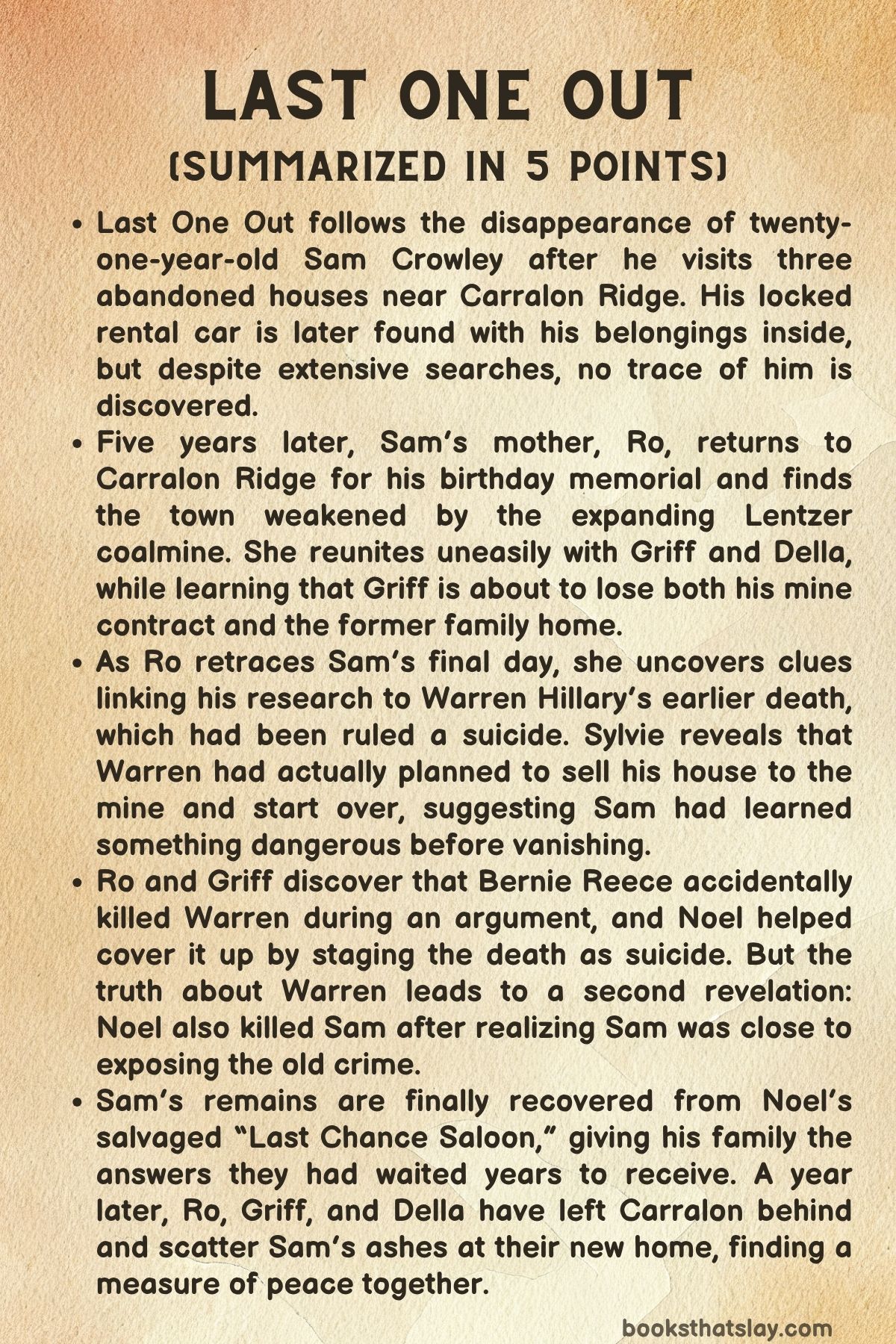
Twenty-one-year-old Sam Crowley vanishes after visiting three abandoned houses near Carralon Ridge. On the day he disappears, he drives a red rental car along the track leading to Warren Hillary’s old farmhouse, Ann-Marie Birstock’s overgrown cottage, and Bernie Reece’s boarded-up bungalow.
He enters each house alone, leaving visible boot prints behind, but after that trail, there is nothing. His parents, Ro and Griff, later find his locked car near a fork in the track.
His laptop, notebook, and water bottle are still inside. The sight suggests he meant to return, yet Sam is gone.
The search that follows covers the houses, the surrounding bushland, the mine site, and the town itself. No body is found.
No clear sign of a struggle appears. No answer comes.
For Ro, Griff, and their daughter Della, the disappearance becomes an open wound. Over time, uncertainty reshapes the family.
Ro leaves Carralon Ridge, unable to remain in a place defined by Sam’s absence. Griff stays behind, tied to the town, the mine, and the home they once shared.
Della grows up with her brother’s disappearance as a central fact of family life, even though no one can tell her exactly what happened.
Five years later, Ro returns to Carralon Ridge for Sam’s birthday memorial. The town she comes back to feels diminished.
The Lentzer coalmine has expanded, and its presence has hollowed out the community. Families have left, shops have closed, services have disappeared, and the remaining residents seem caught between memory and defeat.
Griff now works for Lentzer as a fire-safety officer. He is living in the former Crowley family home, but the mine owns it, and his right to stay depends on his job.
Ro learns that his contract is ending, which means he will soon have to leave the house for good.
Ro’s reunion with Griff is strained but filled with shared pain. Their daughter Della is also there, caught between both parents and the grief that still defines them.
Ro and Griff begin revisiting the places connected to Sam’s final known movements. The three empty houses become more than abandoned buildings.
They are physical reminders of the town’s collapse and of the mystery that has ruled the family for years.
At Ann-Marie Birstock’s ivy-covered cottage, Ro and Griff discover that Ann-Marie has still been sneaking inside to look after the place. Though the house no longer properly belongs to her in any meaningful sense, Ann-Marie cannot fully let it go.
Her quiet attachment reflects the way many people in Carralon Ridge remain bound to homes and histories that the mine has already claimed. While Ro retraces Sam’s route through the cottage, Ann-Marie accidentally reveals that Griff’s contract has not been renewed.
The news confirms that even Griff’s hold on the old family house is nearly over.
Ro and Griff also visit Warren Hillary’s farmhouse. Warren was Griff’s cousin, and his death eight years earlier still carries its own shadow.
At the time, Warren was believed to have killed himself by jumping into the mine quarry. He had left distressed messages for Sylvie, his former partner, and the official explanation seemed to fit the despair that had settled over Carralon Ridge.
Yet while Ro and Griff are at the farmhouse, they find a small key lodged between the boards of Warren’s porch. The object seems insignificant at first, but it becomes one of the first signs that the accepted story may be wrong.
As Ro begins thinking through Sam’s old research, she sees that her son had been asking difficult questions before he vanished. Sam had been working on a university thesis about Carralon Ridge and the damage caused by the mine.
He had interviewed residents about losing their homes, their businesses, and their sense of future. His notebook includes questions about the town and a mysterious note about Sylvie.
Ro realizes Sam may not simply have been recording the town’s decline. He may have uncovered something dangerous.
Sylvie eventually tells Ro a truth that changes the meaning of Warren’s death. Warren had not been planning to kill himself.
On the night he died, he had told Sylvie that he intended to sell his house to the mine so they could start over together. This matters because many locals saw selling to the mine as betrayal.
For residents who had resisted Lentzer’s expansion, each sale weakened the community and made the town’s survival less likely. If Warren had truly planned to sell, then his death may have involved more than despair.
Sam had somehow learned about Warren’s plan and had questioned Sylvie before he disappeared.
Ro also spends time with Heather, Noel, and their sons, including Darcy, who had been one of Sam’s closest childhood friends. Noel owns a rough cabin known as the Last Chance Saloon, built from salvaged pieces of old Carralon homes.
The structure is part shelter, part monument, and part act of refusal. It preserves fragments of houses that the town has lost, but it also hides the damage beneath nostalgia.
Ro begins to suspect that the small key found at Warren’s farmhouse may belong to one of the salvaged doors in Noel’s cabin.
During Sam’s memorial, Darcy gives a raw speech that forces the adults to face uncomfortable questions. He asks why so many of them stayed in Carralon Ridge when it was obvious the town was dying.
His words strike Ro because they shift the focus from loyalty to responsibility. The older generation had treated staying as a sign of strength, but Darcy sees it differently.
To him, their attachment trapped their children in a place with no future. Ro begins to understand that grief in Carralon Ridge is not only about Sam.
It is also about the damage caused by choices people made while believing they were preserving something valuable.
Ro and Griff test the key and discover that it opens the blue front door from Bernie Reece’s old bungalow, now installed on Noel’s Last Chance Saloon. This discovery leads to Bernie’s confession.
Bernie admits that he confronted Warren on the night Warren died. He had learned Warren planned to sell his house to the mine, and anger drove him to Warren’s farmhouse.
During the argument, Bernie shoved Warren. Warren fell, hit his head, and died.
Instead of reporting the accident, Bernie accepted Noel’s help in covering it up. Noel cleaned the porch, moved Warren’s body to the mine, cut the fence, and staged the scene to make Warren’s death look like suicide.
The distressed messages Warren had left for Sylvie helped support that false version of events. For years, the town accepted Warren’s death as one more tragedy linked to Carralon Ridge’s decline.
This confession explains Warren, but it does not explain Sam. Griff recognizes that Sam’s disappearance still has a missing piece.
Attention turns to Noel. Five years earlier, Noel had picked Sam up after Sam visited the three houses.
He had taken him to the Last Chance Saloon, supposedly to give him old maps for his research. While they were there, Sam mentioned that Bernie had told him Warren planned to sell, and that he had already checked this with Sylvie.
Noel understood at once that Sam was close to exposing the truth about Warren’s death.
To protect Bernie and preserve the secret, Noel attacked Sam inside the saloon. Sam’s body had been hidden there ever since.
The place built from the remains of lost homes had also become the hiding place for the town’s most devastating secret. The police are called, and Sam’s remains are finally recovered.
After five years of uncertainty, Ro, Griff, and Della learn what happened to him. The truth does not restore what they lost, but it ends the cruel emptiness of not knowing.
One year later, the abandoned houses have been demolished, and Carralon Ridge continues to empty. The town that so many people tried to defend is still disappearing.
Ro and Griff have moved elsewhere together, choosing a life beyond the place that held their grief for so long. When they receive Sam’s ashes, they scatter them in the back paddock of their new home with Della beside them.
In that final act, Sam is no longer lost among abandoned houses, old secrets, and the ruins of Carralon Ridge. He is back with his family, in a place where they can begin to live with the truth.
Characters
Sam Crowley
Sam Crowley stands at the emotional center of Last One Out, even though he is absent for most of the book. His disappearance shapes the lives of nearly every major character, turning him into both a lost son and a symbol of buried truth.
At twenty-one, Sam is curious, thoughtful, and determined to understand what happened to Carralon Ridge after the mine’s expansion. His university research is not just academic; it becomes a way of examining the town’s decline, the pain of those who stayed, and the damage caused by silence.
His visits to the abandoned houses show that he is methodical and brave, but also unaware of how dangerous old secrets can be. Sam’s greatest strength is his moral persistence.
He asks questions others have avoided, especially about Warren’s death and the mine’s impact on the town. This curiosity ultimately places him in danger because he comes too close to exposing the truth.
In the book, Sam represents the younger generation’s need for honesty, accountability, and escape from the emotional traps created by the adults before them.
Ro Crowley
Ro Crowley is one of the most emotionally layered characters in the novel. As Sam’s mother, she is defined by grief, but she is not portrayed as passive or broken.
Her return to Carralon Ridge shows that she is still searching, not only for answers about Sam but also for a way to understand the choices that fractured her family. Ro carries guilt, anger, and exhaustion, especially because Sam disappeared in a place connected to her past and family life.
Her investigation is deeply personal, and her grief sharpens her attention to details that others have overlooked. She revisits conversations, memories, and physical spaces with a painful determination.
Ro’s character is also important because she gradually changes the way she understands Carralon Ridge. At first, the town is tied to loss and failure, but over time she begins to see how attachment to place, fear of change, and adult denial helped create the conditions that destroyed lives.
Her journey is not simply about solving Sam’s disappearance; it is about accepting painful truths and finding the strength to live after them.
Griff Crowley
Griff Crowley is a character shaped by loyalty, regret, and emotional restraint. As Sam’s father, he has suffered deeply, but his grief is expressed differently from Ro’s.
He stays closer to Carralon Ridge, continues working for Lentzer, and remains tied to the former family home even after it is no longer truly his. This makes him a complicated figure because his survival depends on the same mine that helped ruin the town and indirectly destroyed his family’s life.
Griff’s connection to Warren also gives him a personal stake in the older mystery. He remembers Warren’s supposed suicide through the lens of family pain, but he has also accepted the official version for years.
As the truth emerges, Griff is forced to confront how much was hidden in plain sight. His character shows how grief can become routine and how people sometimes cling to damaged places because leaving would mean admitting that the past cannot be restored.
By the end of the story, Griff’s movement away from Carralon with Ro suggests a quiet but meaningful step toward healing.
Della Crowley
Della Crowley represents the surviving child in a family consumed by loss. Her role is quieter than Ro’s or Griff’s, but it is emotionally important because Sam’s disappearance has shaped her life too.
She has had to exist in the shadow of a missing brother, carrying grief that is both personal and inherited from her parents. Della’s presence reminds the reader that tragedy does not affect only the person who vanishes or dies; it changes the emotional structure of an entire family.
She also becomes part of the family’s final movement toward closure when Sam’s remains are found and his ashes are scattered. Della’s character gives the ending a broader emotional weight because the recovery of Sam is not only a resolution for Ro and Griff, but also for the sister who had to grow up with absence as part of her family identity.
Warren Hillary
Warren Hillary is one of the most tragic figures in the book because his death is misunderstood for years. At first, he appears to be a man who died by suicide after emotional distress, but the truth reveals a very different character.
Warren had been planning to sell his house to the mine and begin again with Sylvie, which makes his death even more painful. He was not moving toward despair in the way others believed; he was trying to choose a future.
His decision to sell makes him controversial because, in a town damaged by the mine, selling land can be seen as betrayal. Yet Warren’s choice also reflects desperation and the human need to survive.
His character exposes how moral judgment becomes complicated in dying communities. Warren is not simply selfish or weak; he is a man trapped between loyalty to place and the hope of a new life.
His death becomes the first buried secret that later leads to Sam’s murder, linking the town’s past violence to its present grief.
Ann-Marie Birstock
Ann-Marie Birstock is a deeply symbolic character because she continues to care for her abandoned cottage even after it no longer functions as a proper home. Her secret visits to maintain the ivy-covered house reveal how strongly people can remain attached to places that have already been taken from them.
Ann-Marie’s character reflects the emotional cost of displacement. She is not central to the crimes, but she helps show what Carralon Ridge has become: a town full of people living around loss, memory, and unfinished goodbyes.
Her accidental revelation about Griff’s contract also adds pressure to the story, showing that even ordinary conversations can expose hidden instability. Ann-Marie’s quiet devotion to her old home makes her a poignant figure.
She represents those who cannot fully leave the past, even when the physical world around them has already moved on.
Bernie Reece
Bernie Reece is one of the most morally guilty characters in the story, but he is also written as a man shaped by fear, anger, and attachment to a dying town. His confrontation with Warren begins with resentment over Warren’s plan to sell to the mine.
To Bernie, Warren’s decision likely feels like surrender or betrayal. However, Bernie’s anger turns fatal when he shoves Warren, causing his death.
His later confession reveals a man who has lived for years under the weight of a terrible secret. Bernie’s character shows how loyalty to a place can become destructive when it hardens into bitterness.
He does not plan a murder in a calculated way, but his violence and cowardice afterward cause enormous damage. By allowing Warren’s death to be staged as suicide, Bernie helps create the lie that eventually leads to Sam’s death.
His guilt is therefore not limited to one moment of violence; it extends through years of silence.
Noel
Noel is one of the darkest and most important characters in Last One Out because his actions connect both central mysteries. At first, he appears connected to the town through his family, his sons, and the strange “Last Chance Saloon” made from pieces of old Carralon homes.
That structure itself reflects Noel’s character: he gathers remnants of the dying town and turns them into something that seems nostalgic but hides something horrific. Noel helps Bernie cover up Warren’s death by cleaning the porch, moving the body, cutting the fence, and staging the scene as suicide.
This already makes him morally compromised, but his later murder of Sam reveals a far more frightening side. When Sam gets close to the truth, Noel chooses protection of family and secrecy over an innocent young man’s life.
His violence is deliberate, and the hiding of Sam’s body in the saloon turns a place of memory into a tomb. Noel represents the most extreme form of defensive loyalty, where preserving a secret becomes more important than justice, humanity, or the life of someone he once knew.
Heather
Heather is a supporting character whose role helps ground the Reece family and the wider community around Ro. As Noel’s partner and Darcy’s mother, she is connected to one of the families most closely tied to Sam’s childhood.
Her presence gives the story a sense of ordinary domestic life existing alongside hidden violence. Heather is not presented as the main keeper of the central secrets, but her family’s involvement in the truth makes her position painful and complicated.
She belongs to the social world that Ro re-enters, a world where old friendships and shared history are mixed with suspicion and grief. Heather’s character helps show how secrets do not remain isolated within the people who commit crimes.
They spread into families, friendships, and community relationships, changing the meaning of every past interaction once the truth is known.
Darcy
Darcy is one of the most emotionally revealing younger characters in the story. As one of Sam’s closest childhood friends, he represents the generation that grew up watching Carralon Ridge decline.
His speech at Sam’s memorial is especially important because it challenges the adults’ choices. Darcy asks why so many people stayed in a place that was clearly dying, and this question forces Ro to reconsider the meaning of guilt, loyalty, and responsibility.
Darcy’s character gives voice to the frustration of young people who inherited the consequences of older decisions. He is not only grieving Sam; he is also questioning the emotional logic that kept families tied to a collapsing town.
In this way, Darcy becomes a moral commentator within the story. His words help shift the focus from individual grief to a broader examination of why people remain attached to places that hurt them.
Sylvie
Sylvie is crucial because she holds the truth about Warren’s state of mind before his death. For years, Warren’s death is understood as suicide, but Sylvie reveals that he had actually planned to sell his house and restart his life with her.
This information changes the meaning of everything that happened to Warren and gives Sam a path toward uncovering the truth. Sylvie’s character is marked by memory, loss, and delayed honesty.
She does not function as a detective, but her knowledge becomes essential because it contradicts the story everyone accepted. Her relationship with Warren also humanizes him.
Through Sylvie, Warren is seen not as a hopeless man but as someone who wanted a future. Sylvie therefore represents the power of personal truth in a community built on public lies.
Her eventual admission helps expose the gap between what people believed and what really happened.
Themes
Grief and the Need for Answers
Grief in Last One Out is shown as something that does not end simply because time has passed. Sam’s disappearance leaves his family trapped in a painful state between hope and loss, because they cannot mourn fully without knowing what happened to him.
Ro’s return to Carralon Ridge shows how unresolved grief keeps pulling a person back to the place of trauma. She is not only searching for facts; she is trying to understand the final movements of her son and make sense of the silence that followed.
Griff and Della also carry the loss differently, showing how the same tragedy can divide a family rather than unite it. The locked car, the abandoned belongings, and the unanswered questions become emotional burdens that prevent healing.
When the truth is finally uncovered, it does not remove the pain, but it gives the family something solid to hold. Sam’s remains and ashes allow them to grieve with certainty, and that certainty becomes the first real step toward peace.
The Destruction of Community
Carralon Ridge represents a community slowly being emptied of life, memory, and purpose. The expanding mine does not only damage the land; it changes the relationships, choices, and futures of the people who remain.
Families leave, businesses close, homes are abandoned, and the town becomes a place defined more by absence than belonging. The three deserted houses show how private lives are swallowed by larger economic forces.
Each house carries traces of the people who once lived there, but those traces are fading. Griff’s work for Lentzer also shows the uncomfortable compromises people make when survival depends on the very force destroying their home.
The decline of Carralon Ridge creates anger, guilt, and desperation among the residents, especially those who feel powerless to stop the town’s collapse. Darcy’s speech makes this theme sharper by questioning why adults stayed attached to a dying place.
The novel suggests that communities can be destroyed not only by outside pressure, but also by fear, silence, and the inability to let go.
Secrets, Guilt, and Moral Compromise
The truth about Warren and Sam shows how one hidden act can grow into years of damage. Bernie’s shove may begin as a moment of anger, but the decision to hide Warren’s death turns that moment into a long-lasting moral failure.
Noel’s involvement deepens the theme because his loyalty to his father leads him to protect a lie at any cost. Once the first cover-up succeeds, silence becomes easier to justify, and truth becomes more dangerous.
Sam’s investigation threatens the secret because he asks questions others have avoided for years. His death shows how guilt can turn violent when people believe exposure will destroy them.
The novel presents moral compromise as a chain: one lie demands another, and each person involved loses more of their humanity. Ro’s search challenges this silence because she refuses to accept the surface explanation.
The final revelation shows that guilt does not disappear with time. It remains hidden in places, objects, and memories until someone has the courage to face it.
Home, Attachment, and Letting Go
Home is shown as both a source of comfort and a trap. Carralon Ridge holds memories of family, friendship, and belonging, but it also holds grief, guilt, and decay.
Ro, Griff, and many townspeople are tied to places that have already changed beyond repair. The abandoned houses are especially important because they show how homes can remain physically present even after the lives inside them have ended.
Ann-Marie’s secret visits to her old cottage reveal a deep emotional need to preserve what has been lost. Griff’s situation is also painful because the former family home no longer truly belongs to him; it is owned by the mine, turning home into something temporary and controlled.
By the end, Ro and Griff’s move elsewhere suggests that healing requires more than uncovering the truth. They must also release their attachment to a place that has caused too much pain.
Scattering Sam’s ashes in the back paddock of their new home shows that belonging can be rebuilt, not by forgetting the past, but by carrying love forward into a different future.