Last Night in Brooklyn Summary, Characters and Themes
Last Night in Brooklyn by Xochitl Gonzalez is a novel about memory, ambition, class, desire, and the cost of reinvention in a changing Brooklyn. Through Alicia Forten’s recollection of one decisive summer, the book explores how a city can remake itself while erasing the people who gave it meaning.
At the center is La Garza, a brilliant fashion designer whose fame rises alongside Brooklyn’s transformation and whose downfall exposes the greed, betrayal, and violence hidden beneath glamour. The story is both a personal confession and a portrait of a neighborhood losing its soul.
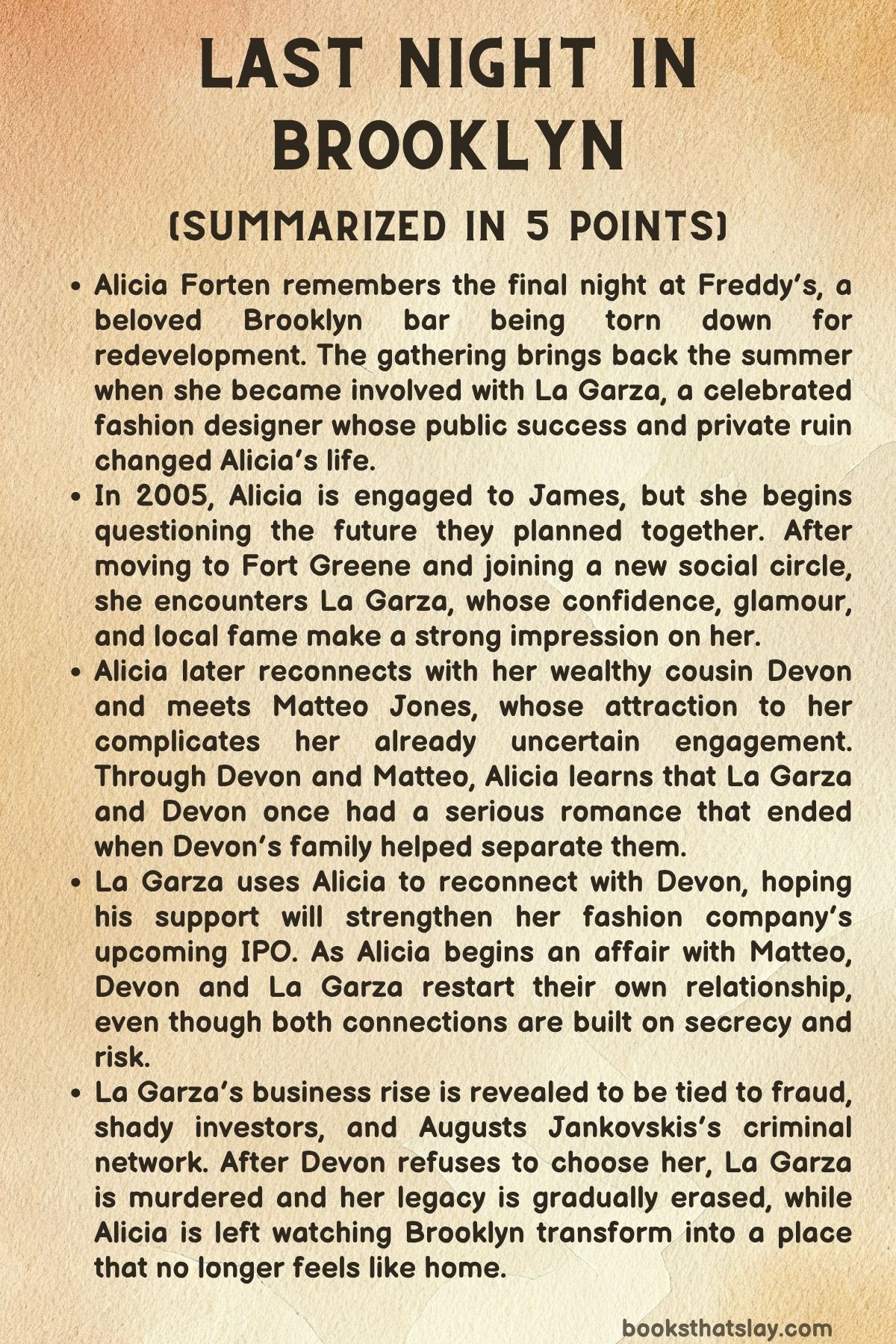
Summary
Last Night in Brooklyn begins with Alicia Forten looking back on the final night at Freddy’s, a bar that once stood as part of an older Brooklyn community. The bar is about to be destroyed for redevelopment, and the gathering feels less like a party than a farewell to a way of life.
As Alicia watches people come together to mourn what is being lost, her mind returns to the summer when her own life became tied to La Garza, a famous Brooklyn fashion designer whose rise and death left a mark Alicia has never fully escaped.
In 2005, Alicia is engaged to James, a reliable and decent man who is training to become a doctor. Their future appears sensible and secure, but Alicia begins to feel trapped by the life waiting for her.
James expects them to move to Syracuse, where he will continue his medical career, but Alicia has just begun building a career of her own in advertising. She does not want to leave New York or give up the freedom she is starting to taste.
Instead of moving forward with the wedding, she delays it, though she cannot yet admit the full truth: she is not ready to become the woman James expects her to be.
Alicia moves out of her grandmother’s house and into Fort Greene, where a different version of adulthood begins to open around her. Through her coworker Lorraine, she enters a circle of young, ambitious, creative Brooklyn residents who are trying to make names for themselves.
Among them are Marcus, Leti, Aaron Francis, Chuck, and others who treat the neighborhood as both home and stage. They are witty, hungry, image-conscious, and eager to be close to whatever feels exciting or new.
During one wild night out, Alicia first sees La Garza, already a local legend, racing in a shopping cart while wearing high heels. La Garza is bold, theatrical, and impossible to ignore.
To Alicia, she represents a kind of power that is unlike anything in the life she has been preparing to live.
By 2007, Alicia’s connection to this world deepens. She runs into her wealthy cousin Devon, who has recently moved to Fort Greene with his wife, Marla.
Devon comes from privilege, and his presence in the neighborhood shows how Brooklyn is beginning to attract people with money, access, and the ability to reshape places without fully belonging to them. At dinner with Devon and Marla, Alicia meets Matteo Jones, Devon’s friend, a financier and DJ whose charm unsettles her.
Matteo kisses Alicia unexpectedly, and the attraction between them quickly becomes difficult to ignore. Alicia is still technically engaged to James, but the distance between her old life and her new desires is growing.
Marla is also trying to find a place in Brooklyn’s creative scene. Alicia goes with her to a chaotic loft party hosted by Felix, an artist Marla admires.
The party is messy, performative, and full of people trying to appear daring. Marla drinks too much, takes drugs, and pushes herself into a world that does not quite accept her.
Through Marla, Devon, and Matteo, Alicia begins to see how wealth and art move around each other in Brooklyn, sometimes feeding each other and sometimes using each other.
La Garza soon invites Alicia to one of her grand parties. The event is full of spectacle, confidence, and carefully staged glamour.
There, La Garza announces that her fashion company is going public. She is no longer just a neighborhood figure; she is becoming a brand, a symbol, and a business opportunity.
Alicia spends time with Matteo, who reveals that La Garza and Devon once had a romantic past. Years earlier, La Garza had made custom shirts and suits for Wall Street men through Matteo’s connections.
Devon became one of her customers, and the two fell in love. But when Devon left for business school, he cut her off without explanation.
His family helped remove her from his life, treating La Garza as someone unsuitable for the future they wanted for him.
La Garza has never forgotten Devon, and she draws Alicia closer by asking for help reconnecting with him. She frames the request as business.
She wants to make Devon a suit and gain his support for her upcoming IPO. Alicia agrees and arranges the meeting.
Once Devon and La Garza are in the same room again, the old feelings between them return almost immediately. Devon agrees to help her company, but the reunion quickly becomes more than professional.
While Alicia begins an affair with Matteo after taking a “break” from James, Devon and La Garza begin a secret affair of their own.
With Devon’s assistance, La Garza’s public image grows rapidly. Her company becomes a media favorite, and the IPO is promoted as a major success story.
She is presented as the face of Brooklyn style: talented, original, and tied to the energy of a changing borough. Alicia watches as La Garza is transformed from a local legend into a marketable icon.
Yet beneath the attention, the business is unstable. Alicia learns more about La Garza’s past and the compromises that helped her survive.
After family tragedy and financial hardship, La Garza accepted help from Augusts Jankovskis, a shady old connection whose money and influence kept her company alive. That help came with danger.
The company’s financial records are false, and Augusts’s network is connected to a pump-and-dump scheme meant to profit from the IPO before everything collapses.
As La Garza’s fame grows, the personal risks around her increase. Marla begins to suspect Devon’s affair after a Page Six blind item suggests that something is happening.
Her suspicions sharpen when Felix creates a revealing painting that hints at the truth. The secrets that Alicia, Devon, La Garza, and Matteo have been keeping begin to close in on everyone.
The conflict reaches a breaking point in the Hamptons. La Garza has a pop-up opening there, and the event places her in the same wealthy world that once rejected her.
Later, at a family lunch, old resentments erupt. La Garza confronts Devon’s mother for helping erase her from Devon’s life years earlier.
The confrontation exposes the class prejudice and family control that shaped Devon’s choices. La Garza asks Devon to leave with her, offering him a chance to choose love and freedom over duty.
For a moment, it seems possible. But when Devon’s father orders him to sit down and remember his responsibilities, Devon obeys.
His failure is public and devastating. La Garza walks away humiliated, realizing that Devon still does not have the courage to choose her.
The next morning, Alicia finds La Garza frightened and unstable. La Garza says that Augusts’s associates have been following her and that Omar has been arrested.
She seems to understand that the danger around the IPO is becoming more immediate. Alicia is worried, but when La Garza says she is going to bathe, Alicia leaves.
Later, after passing out at Soul Summit, Alicia rushes back to check on her. She finds La Garza dead in the bathtub.
At first, the death appears staged as an accident or suicide, but it is later revealed that La Garza was murdered by strangulation and placed in the bath afterward. Augusts is clearly connected to what happened, but he is never punished.
La Garza’s death becomes another story shaped by wealth, power, and public appetite. The truth is pushed aside while gossip takes over.
After La Garza dies, the world she built is slowly dismantled. Her business falls apart, her home and studio are erased, and her memory is reduced to scandal.
A fire destroys what remains of her creative space. The media turns her life into a cautionary tale instead of honoring her talent or the forces that trapped her.
Brooklyn continues to change, absorbing the tragedy and moving on. The people who once made the neighborhood vibrant are displaced, forgotten, or turned into symbols for others to profit from.
Years later, after Freddy’s final party, Alicia walks through the redeveloped neighborhood and sees how much has been replaced. Condos stand where old homes and gathering places once held meaning.
The city has not simply changed; it has buried parts of itself. Alicia’s grief, guilt, and anger rise as she confronts what has been lost.
In a sudden act of rage, she throws a brick through a window, then runs home. The gesture cannot restore La Garza, Freddy’s, or the Brooklyn that disappeared, but it expresses the pain Alicia has carried for years.
Her memory of La Garza becomes a record of a woman, a neighborhood, and a moment that powerful people tried to erase.
Characters
Last Night in Brooklyn by Xochitl Gonzalez presents its characters through memory, ambition, love, betrayal, class tension, and the painful transformation of Brooklyn. Each character is connected not only to Alicia’s personal coming-of-age, but also to the larger story of a neighborhood being reshaped by money, art, fashion, and redevelopment.
Alicia Forten
Alicia Forten is the narrator and emotional center of the book. She looks back on the final night at Freddy’s with a mixture of nostalgia, guilt, grief, and anger, using that moment to revisit the summer when her life became entangled with La Garza.
Alicia begins as someone standing between two futures. On one side is James, stability, family expectations, and a conventional path toward marriage.
On the other side is Brooklyn’s exciting creative world, where ambition, desire, and freedom seem possible. Her decision to delay her wedding shows that she is not simply rebelling, but trying to understand what kind of life she actually wants.
Alicia is also a character shaped by observation. She is drawn to people who seem larger, freer, and more daring than she feels herself to be, especially La Garza and Matteo.
Her attraction to Matteo reveals her hunger for intensity and escape, while her fascination with La Garza reveals her desire to be close to power, glamour, and reinvention. Yet Alicia is not only a passive witness.
Her choices matter. By helping La Garza reconnect with Devon, she becomes part of the chain of events that leads to emotional destruction and business disaster.
This gives her narration a strong sense of regret. She understands that she did not cause everything, but she also cannot fully excuse herself.
Alicia’s complexity comes from the fact that she is both sympathetic and flawed. She wants independence, but she is often unsure how to claim it honestly.
She wants to be loyal, but she becomes involved in secrets. She wants to belong to the new Brooklyn, yet she later recognizes how that world consumes people and places.
By the end of the story, Alicia’s rage at redevelopment and erasure shows how deeply she has been affected by what happened. Her act of throwing a brick through a window is not just vandalism; it is an expression of grief for La Garza, Freddy’s, old Brooklyn, and the version of herself that once believed change would only bring freedom.
La Garza
La Garza is one of the most vivid, tragic, and morally complex figures in the book. She is introduced as a local legend, someone who can win a reckless shopping-cart race in high heels and immediately become unforgettable.
Her public image is glamorous, fearless, stylish, and almost mythic. As a fashion designer, she represents Brooklyn creativity before it is fully absorbed by corporate branding and redevelopment.
She has talent, charisma, and vision, and she understands how to turn herself into a symbol.
At the same time, La Garza is deeply vulnerable. Her success is built on brilliance, but also on instability, financial desperation, and dangerous compromises.
Her connection to Augusts Jankovskis shows how trapped she has become by the very machinery that keeps her business alive. Her IPO offers the promise of legitimacy and triumph, but it is also tied to fraud, manipulation, and criminal networks.
This makes her rise feel both dazzling and doomed. She is celebrated as the face of Brooklyn cool, but that celebration depends on people using her image for profit.
La Garza’s relationship with Devon reveals her emotional wound. Years earlier, she loved him and was discarded without explanation because his family and class expectations mattered more than her humanity.
When she reconnects with him, she is not only pursuing romance; she is trying to recover dignity, recognition, and the future that was taken from her. Her humiliation in the Hamptons is devastating because it confirms that Devon is still unable to choose her when his family’s power is present.
La Garza’s death completes the book’s harshest pattern: a woman who creates beauty and identity for others is ultimately erased by greed, class violence, and male cowardice. Her memory survives most powerfully through Alicia, even as the city tries to bury her story.
James
James represents stability, respectability, and the future Alicia is expected to want. As a future doctor and Alicia’s fiancé, he offers security and social approval.
He is not presented as cruel or unworthy, which makes Alicia’s conflict more meaningful. Her hesitation about marrying him is not simply about escaping a bad relationship; it is about realizing that even a good and steady future can feel wrong if it requires her to abandon her own desires.
James’s role in the story is important because he shows the cost of Alicia’s transformation. He belongs to the life she is outgrowing, but that does not make him a villain.
Instead, he becomes a measure of Alicia’s uncertainty and dishonesty. Her “break” from him allows her to pursue Matteo, but it also exposes her reluctance to fully confront the consequences of her choices.
James functions as the moral and emotional contrast to the seductive disorder of Brooklyn’s creative scene. Through him, the book shows that maturity is not only about choosing excitement over safety, but about being honest with oneself and others.
Lorraine
Lorraine is the coworker who helps pull Alicia into a new social world. Her role may seem casual at first, but she is important because she opens the door to Fort Greene, nightlife, and the circle of ambitious young Brooklyn friends.
Through Lorraine, Alicia begins to move away from her grandmother’s house and from the life that had been planned for her.
Lorraine represents the social energy of young Brooklyn at that moment: spontaneous, curious, connected, and eager to be near whatever feels new or exciting. She helps create the conditions for Alicia’s transformation, even if she does not control what happens afterward.
In this way, Lorraine functions as a gateway character. She does not carry the main tragedy, but without her Alicia might never have entered the world where La Garza, Matteo, Devon, Marla, and the others reshape her life.
Marcus
Marcus belongs to the circle of ambitious young Brooklyn friends Alicia encounters after moving into a more independent life. He represents the social ecosystem around Alicia: people who are building identities, careers, relationships, and reputations in a neighborhood that is itself being remade.
His presence helps establish Brooklyn as a living community rather than just a setting.
As part of this group, Marcus contributes to the feeling of possibility that attracts Alicia. He is one of the people who make the new world seem vibrant and full of movement.
At the same time, characters like Marcus also show how easily personal ambition can become entangled with gentrification and cultural change. The friends are not necessarily malicious, but they are part of a moment when creativity, class mobility, and neighborhood displacement begin to overlap.
Leti
Leti is another member of Alicia’s Brooklyn circle, and her presence helps create the sense of a community formed through youth, ambition, nightlife, and cultural energy. She reflects the world Alicia wants to enter: socially alive, creative, and less confined than the future Alicia had imagined with James.
Leti’s importance lies in how she helps define the atmosphere around Alicia. She is part of the group that makes Brooklyn feel like a place where reinvention is possible.
At the same time, her presence also helps show that Alicia is entering a world full of performances. Everyone seems to be making themselves into someone, whether through art, fashion, work, money, or social connections.
Leti belongs to that larger pattern of self-creation.
Aaron Francis
Aaron Francis is part of the ambitious Brooklyn network that surrounds Alicia during her period of change. He helps build the social texture of the story, representing the kind of young, striving figure who belongs to a neighborhood in transition.
His presence suggests a world where everyone is trying to attach themselves to culture, opportunity, and identity.
Aaron’s role also helps emphasize that Alicia’s transformation is not private. She is not changing in isolation; she is being shaped by a whole group of people who make risk and reinvention seem normal.
Through Aaron and the wider circle, the book captures the excitement of a social scene that feels alive while also hinting at the instability underneath it.
Chuck
Chuck belongs to the same young Brooklyn social world as Marcus, Leti, and Aaron Francis. His character helps fill out the community Alicia enters after moving away from the more traditional expectations of her earlier life.
Like the others, he contributes to the atmosphere of restless possibility that defines Alicia’s new surroundings.
Chuck’s role is less central than Alicia’s, La Garza’s, or Devon’s, but he remains important because the story is partly about social environments and how they influence choices. Characters like Chuck make Brooklyn feel crowded with personalities, ambitions, and shifting loyalties.
He helps create the sense that Alicia has entered not just a neighborhood, but a scene with its own values and temptations.
Devon
Devon is one of the most damaging characters in the story because his weakness hides behind privilege. As Alicia’s wealthy cousin, he occupies a world of money, family pressure, and social protection.
He is charming enough to inspire affection and desire, but he repeatedly fails to act with courage. His past relationship with La Garza reveals that he once loved her, but when his family’s expectations intervened, he allowed her to be erased from his life.
Devon’s renewed affair with La Garza shows that his feelings never fully disappeared, but it also proves that feeling is not the same as commitment. He wants the emotional intensity of La Garza without truly risking his position, marriage, or family approval.
His assistance with her IPO appears generous, but it is tangled with guilt, attraction, and self-interest. He helps make her a sensation, yet he cannot protect her from the forces surrounding her.
The Hamptons confrontation exposes Devon most clearly. When La Garza asks him to leave with her, he is forced to choose between love and inherited duty.
His father’s command reduces him to the obedient son he has always been, and he chooses his family’s world over La Garza once again. Devon’s tragedy is his cowardice, but the greater tragedy is what his cowardice costs others.
He survives because privilege protects him, while La Garza is left exposed.
Marla
Marla is Devon’s wife, and her character reflects insecurity, longing, and the awkward desire to belong to a creative world that does not naturally belong to her. She is wealthy and socially positioned, but she is also restless.
Her visit to Felix’s chaotic artists’ loft party shows her hunger to enter Brooklyn’s artistic scene, even if she does so clumsily and destructively. Her drunkenness and drug use suggest both recklessness and emptiness.
Marla is not simply an obstacle between Devon and La Garza. She is also a woman trapped inside a marriage where she senses betrayal before she can fully prove it.
Her suspicion after the blind item and Felix’s revealing painting shows that she is more perceptive than others may assume. However, her pain is filtered through class privilege.
Unlike La Garza, Marla has social protection and a secure place in Devon’s world. This contrast makes her both pitiable and protected.
Marla’s character also complicates the affair plot. Devon’s betrayal hurts her, but her presence also reminds the reader that Devon has built a socially acceptable life while leaving unresolved damage behind him.
Marla becomes part of the structure that keeps Devon respectable. She suffers because of his dishonesty, but she also benefits from the same system that excludes La Garza.
Matteo Jones
Matteo Jones is a financier and DJ whose character blends money, culture, charm, and emotional danger. He attracts Alicia because he seems to belong to multiple worlds at once.
He has access to finance, nightlife, music, and the fashionable Brooklyn scene. His unexpected kiss begins Alicia’s movement away from James and toward a more risky version of herself.
Matteo is seductive because he seems confident and worldly, but he is also connected to the financial machinery behind La Garza’s rise. His history with La Garza’s business, including his role in introducing her work to Wall Street men, shows how art and commerce are intertwined in the story.
He understands how style can circulate among the wealthy, and he becomes part of the bridge between Brooklyn creativity and financial exploitation.
In his relationship with Alicia, Matteo represents temptation and self-discovery, but not necessarily safety or truth. Their affair gives Alicia passion and escape, yet it also places her deeper inside a world of secrecy.
Matteo’s character shows how desire can feel liberating while still being morally complicated. He is not as openly destructive as Augusts or as cowardly as Devon, but he is part of the system that turns people, style, and neighborhoods into opportunities.
Felix
Felix is Marla’s artist friend and the host of the chaotic loft party that introduces Marla to a rougher, more performative version of Brooklyn’s creative life. He represents the art-world side of the story, where creativity, provocation, and self-display mix with insecurity and social climbing.
His loft party is not just a party; it is a stage where people try to prove they belong.
Felix becomes especially important through his painting, which helps expose Devon’s affair. Art in his hands becomes a form of revelation.
What is hidden socially becomes visible visually. His work contributes to Marla’s suspicion and helps move private betrayal into public awareness.
Felix’s character therefore shows that art in the story is not only decorative or fashionable. It can reveal truth, embarrass the powerful, and turn private lives into objects of interpretation.
Augusts Jankovskis
Augusts Jankovskis is one of the darkest forces in the book. He is a shady old friend whose money and connections help keep La Garza’s business alive after tragedy and financial trouble.
On the surface, he may appear to be a rescuer or investor, but his help comes with danger. He represents the criminal and corrupt underside of La Garza’s public success.
Augusts’s role in the IPO scheme reveals how vulnerable La Garza has become. Her company is not only a creative enterprise; it is being used in a pump-and-dump operation involving cooked books and manipulation.
Augusts embodies exploitation disguised as support. He benefits from La Garza’s talent and image while trapping her inside a system she cannot easily escape.
His connection to La Garza’s death makes him terrifying because he remains beyond punishment. The murder is staged, her life is reduced to gossip, and the people responsible are never truly held accountable.
Augusts therefore represents a world where money and criminal power can erase both evidence and memory. He is not only a villain to La Garza personally, but also a symbol of the forces that consume artists once their image becomes profitable.
Omar
Omar is important because his arrest signals the tightening danger around La Garza near the end of her life. Although he is not as fully developed as Alicia or La Garza, his situation helps reveal the criminal pressure surrounding the IPO and Augusts’s network.
When La Garza tells Alicia that Omar has been arrested, it becomes clear that the threat is no longer abstract.
Omar’s role also deepens the sense that La Garza is trapped. The people around her are being watched, followed, arrested, or silenced.
His arrest contributes to the atmosphere of fear that surrounds her final hours. Through Omar, the story shows that La Garza’s death is not sudden in an emotional sense; it is preceded by signs of danger that Alicia only fully understands afterward.
Devon’s Mother
Devon’s mother represents class control, social exclusion, and the quiet violence of respectable families. Her role in helping erase La Garza from Devon’s life years earlier is crucial.
She does not need to be physically violent to cause harm; her power lies in influence, pressure, and the ability to decide who is acceptable.
La Garza’s confrontation with her in the Hamptons is one of the most emotionally revealing moments in the story. La Garza is not only confronting an individual woman, but the entire social system that judged her unworthy of Devon.
Devon’s mother embodies the kind of privilege that protects itself by removing inconvenient people. Her actions help explain why La Garza’s old wound never healed.
As a character, Devon’s mother is coldly effective. She understands the rules of class preservation and enforces them.
Her presence shows that La Garza’s tragedy is not caused only by romance gone wrong, but by a family structure that chooses reputation over love and control over compassion.
Devon’s Father
Devon’s father represents patriarchal authority and inherited responsibility. His most important moment comes when he orders Devon to sit down and remember his obligations.
That command reveals the power he holds over Devon. It also shows why Devon, despite his age and wealth, remains emotionally dependent on his family’s approval.
Devon’s father does not need a long speech to change the course of events. His authority is so established that Devon obeys almost immediately.
This makes him a powerful symbol of the old structures behind the glamorous surface of wealth. He represents family legacy, duty, and social order, all of which crush Devon’s chance to choose La Garza.
His role in the story is brief but decisive. Through him, the book shows that privilege is maintained not only through money, but through obedience.
Devon’s failure in the Hamptons is his own, but his father’s command reveals the system that trained him to fail.
Alicia’s Grandmother
Alicia’s grandmother represents Alicia’s earlier life, family roots, and the more traditional world she begins to leave behind. Alicia’s move from her grandmother’s house to Fort Greene marks a major emotional shift.
It is not only a change of address; it is a movement away from protection, familiarity, and family expectations.
Even though Alicia’s grandmother is not at the center of the main scandal, her presence matters because she helps define what Alicia is moving from. Alicia’s desire for independence is partly shaped by the need to step outside a home where her future may feel already imagined for her.
The grandmother’s house stands in contrast to the unstable freedom of Alicia’s new Brooklyn life.
Through this character, Last Night in Brooklyn connects personal change to place. Alicia’s movement away from her grandmother’s home mirrors the larger transformation of the neighborhood.
Old forms of belonging are replaced by new forms of ambition, but the cost of that replacement becomes clearer only later.
Freddy
Freddy is significant because Freddy’s bar carries the emotional weight of old Brooklyn. Even if Freddy is less individually developed than Alicia or La Garza, the name attached to the bar represents community, memory, and local history.
The final night at Freddy’s gathers people together not only for a party, but for a farewell to a world being destroyed for redevelopment.
Freddy’s importance is symbolic. The bar stands for the kind of place that gives a neighborhood character before outside money decides it is valuable.
Its destruction reflects the same pattern that shapes La Garza’s fate: something beloved and distinctive is consumed, renamed, or erased once it becomes profitable to replace it. Freddy therefore belongs to the story’s larger meditation on memory and loss.
Themes
Gentrification and the Loss of Community
Last Night in Brooklyn presents redevelopment as more than a change in buildings; it becomes a force that removes memory, belonging, and shared history. Freddy’s final night represents the closing of a world where people knew one another, gathered freely, and built identity through neighborhood spaces.
As bars, homes, studios, and familiar streets are replaced by condos and wealthier newcomers, Brooklyn’s transformation feels both physical and emotional. Alicia’s memories show that the old neighborhood was imperfect, but it carried stories, relationships, and cultural meaning that cannot be recreated once erased.
La Garza’s disappearance from public memory mirrors the neighborhood’s disappearance: both are consumed, repackaged, and then forgotten when they no longer serve profit. The final image of Alicia walking through the redeveloped streets shows her grief turning into anger.
Her act of throwing a brick is not simply vandalism; it is a desperate response to a city that has taken away the places and people that shaped her.
Ambition, Reinvention, and the Cost of Success
La Garza’s rise shows how ambition can create power while also exposing a person to exploitation. She builds herself into a symbol of Brooklyn style through talent, confidence, and performance, but her success depends on dangerous financial backing and public image-making.
The IPO turns her creativity into a product for investors, media, and wealthy outsiders who want to profit from her identity. Alicia also struggles with ambition, though in a quieter way.
She postpones marriage, leaves the security of her grandmother’s home, and chooses work and independence over the life expected of her. Both women want more than the roles assigned to them, but the world around them does not reward ambition equally.
La Garza’s brilliance makes her desirable, yet also makes her vulnerable to men who use her business, her past, and her image. The novel suggests that reinvention is powerful, but when success depends on systems built around money and control, the cost can become devastating.
Love, Desire, and Betrayal
The relationships in the story are shaped by longing, secrecy, and unequal power. Alicia’s engagement to James represents safety and stability, but her attraction to Matteo reveals her fear of settling into a life that no longer fits her.
Her affair is not only romantic; it becomes a way of testing who she wants to become. Devon and La Garza’s relationship carries even greater emotional weight because it is built on an old wound.
Devon once abandoned her under family pressure, and when they reconnect, their passion is mixed with resentment, pride, and the hope that the past can be repaired. Yet Devon again chooses wealth, status, and family duty over love.
His failure is a betrayal not only of La Garza, but of the possibility of an honest life. The novel treats desire as powerful but unreliable.
Love can awaken courage, but it can also become another space where people are used, abandoned, or forced to face painful truths.
Memory, Erasure, and Storytelling
Alicia’s narration becomes an act of resistance against forgetting. Years after La Garza’s death, the public version of events has been reduced to gossip, scandal, and rumor, while the truth remains hidden or ignored.
Alicia remembers the details that others erase: the parties, the friendships, the betrayals, the fear, and the slow destruction of a woman’s legacy. This matters because erasure happens on many levels.
La Garza’s company collapses, her studio burns, her home disappears, and her death is treated as spectacle rather than injustice. Brooklyn changes in a similar way, with old spaces removed and replaced so completely that their histories seem to vanish.
By looking back, Alicia gives meaning to what was lost and challenges the version of history created by money, media, and silence. Her memory is imperfect and painful, but it preserves what redevelopment and scandal try to destroy.
The theme shows that telling the story is a way of honoring the dead and confronting the living.