King of Gluttony Summary, Characters and Themes
King of Gluttony by Ana Huang is a contemporary romance about rivalry, ambition, family duty, and the messy courage it takes to choose love without losing yourself.
The book follows Maya Singh, a sharp, pressure-tested executive in her family’s food empire, and Sebastian Laurent, the polished heir to a restaurant dynasty who secretly longs to cook instead of manage from a boardroom. Forced into a business partnership after a food-safety scandal, the two longtime rivals slowly confront old wounds, buried attraction, professional fear, and family expectations. Their story blends corporate drama, emotional misunderstandings, sabotage, and a romance built on years of unfinished history. It’s the 6th book in the Kings of Sin series.
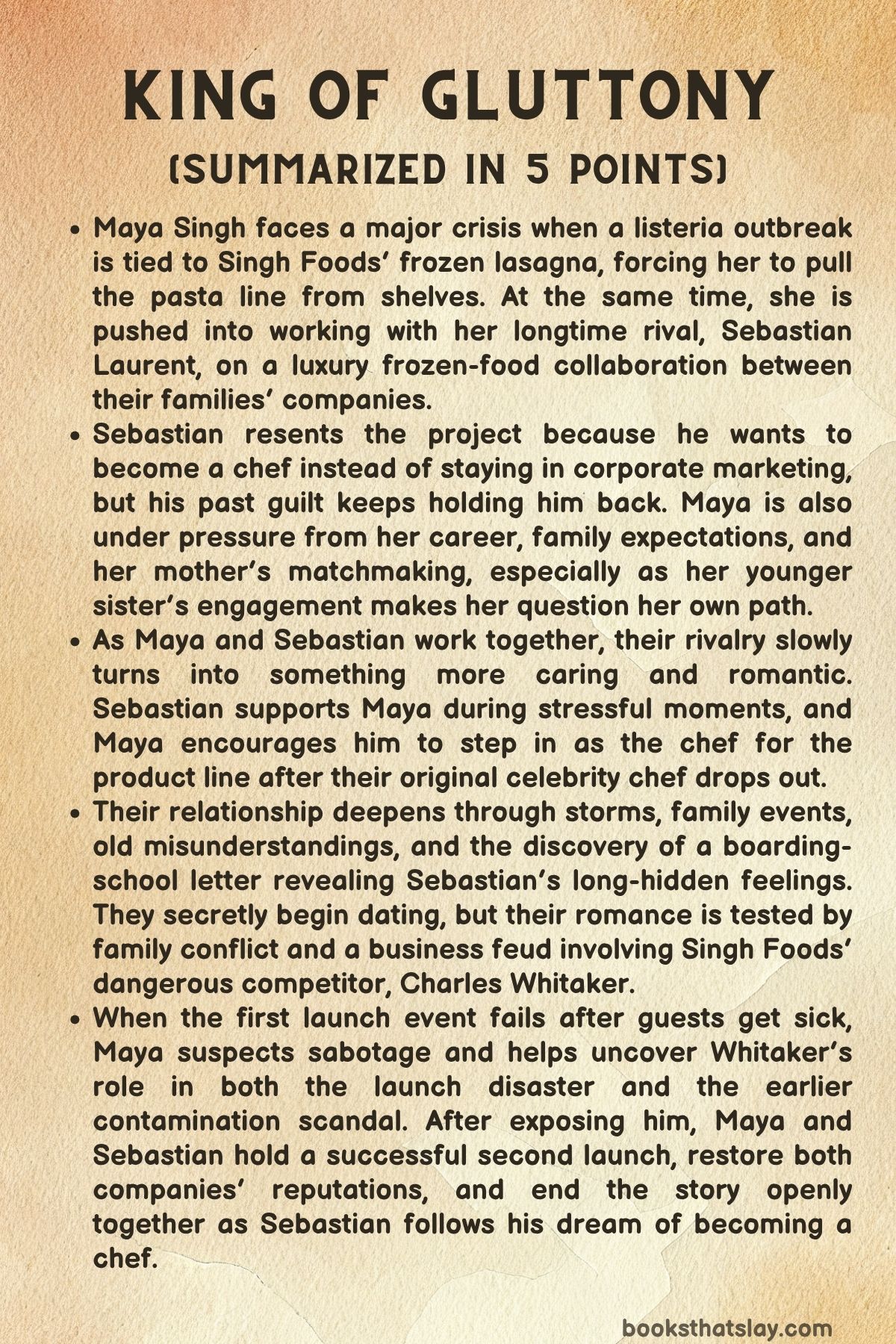
Summary
Maya Singh is already under enormous pressure when the story begins. As chief brand officer of Singh Foods, she must deal with a listeria outbreak tied to the company’s frozen lasagna.
Rather than choosing the safest financial option, Maya orders a recall of the entire frozen pasta line because every product came from the same factory. It is a costly decision, but to her, consumer trust matters more than protecting short-term numbers.
The crisis lands heavily on her because Singh Foods is not just her workplace. It is her family legacy, and every public mistake feels personal.
At her parents’ estate, Maya tries to distract herself from the stress with a childish prank aimed at Sebastian Laurent, her lifelong rival. Sebastian is the heir to the Laurent Restaurant Group, and he has spent years irritating her with his charm, polish, and ability to look perfect in every situation.
Their families are close, but Maya and Sebastian’s relationship has always been built on competition, insults, and a strange awareness neither of them wants to name. When Sebastian appears in the conservatory, Maya’s safe place, their usual banter begins at once.
During a family dinner, Maya and Sebastian learn that their fathers have arranged a major joint venture between Singh Foods and the Laurent Restaurant Group. The plan is to create a luxury-inspired frozen food line, combining Singh Foods’ mass-market reach with the Laurents’ restaurant prestige.
Both Maya and Sebastian object. The timing is terrible, the brands do not naturally match, and the work required is massive.
Their objections are ignored. Worse, they are chosen to lead the project together, forcing two rivals into months of close professional contact.
Sebastian is just as unsettled as Maya, though for different reasons. Beneath his golden public image, he is deeply frustrated with his father, Michel, who wants him to remain in corporate leadership rather than pursue cooking.
Sebastian has culinary talent and training, but he is haunted by a past restaurant tragedy in which a guest died during a soft opening he oversaw. Even though the situation was more complicated than he allows himself to believe, he has carried the guilt for years.
Maya and Sebastian begin the collaboration with suspicion, sarcasm, and constant friction. Yet they soon discover that they work unusually well together.
Maya understands branding, crisis management, and public perception. Sebastian understands restaurants, food, taste, and the emotional power of dining.
Their arguments sharpen their ideas instead of destroying them. The more time they spend together, the harder it becomes to pretend their connection is only hatred.
At first, they plan to front the project with celebrated chef Derek Gardiner. His name gives the collaboration credibility, and the public response is mostly positive.
But Derek unexpectedly leaves the project after another DUI and a decision to enter rehab. With no celebrity chef available, the entire launch is in danger.
Maya realizes that Sebastian should replace him. He knows the food, understands the project, and has the skill to create the recipes himself.
Sebastian resists because stepping into the kitchen means facing his deepest fear: that he might fail publicly, hurt someone again, or prove his father right. Maya sees through his excuses and pushes him to stop hiding behind comfort.
Sebastian eventually accepts the role. He also negotiates with his father: if the launch succeeds, he can leave his corporate position and become a full-time chef.
That agreement gives him a future to fight for. It also makes the collaboration feel more dangerous because failure would cost him more than business reputation.
As they develop the launch concept, Maya and Sebastian’s emotional walls begin to crack. They brainstorm late into the night, share food, argue over details, and slowly reveal the parts of themselves they usually hide.
Sebastian notices Maya’s stress habits and repeatedly sends or brings her the foods that comfort her. Maya notices how alive Sebastian becomes when he cooks and how trapped he seems in the life chosen for him.
Their forced partnership takes a dramatic turn when they travel to Vermont to scout a possible launch venue. A storm strands them in the woods, and they are forced to spend the night together in a stuck SUV and later outdoors.
Cold, frightened, and cut off from help, they rely on each other in ways they never expected. Sebastian protects Maya from danger, carries her when her feet are injured, and shows a steadier tenderness than she is prepared to accept.
The experience brings them close to admitting the truth, but when they return to normal life, Sebastian pulls back. Maya is left unsure whether she imagined the emotional shift between them.
Outside work, Maya is also under pressure from her family to marry. Her mother, Shilpa, is anxious about Maya’s future and reputation, especially after Maya rejects one unsuitable man after another.
After a disastrous date with a sexist suitor, Maya’s parents issue an ultimatum: if she is not engaged within a year, they will choose a husband for her. Maya is furious and frightened because the deadline turns dating into another performance she must manage.
Sebastian watches Maya date other men with growing jealousy. He tries to stay away, but he keeps appearing at the edges of her romantic life, sending desserts, interrupting conversations, and pretending he does not care.
His feelings are complicated by a wound from their teenage years. Sebastian once wrote Maya a letter confessing his love, but he received a cruel reply that made him believe she had rejected and mocked him.
Maya never knew about the letter. The misunderstanding shaped years of distance between them.
Their attraction finally breaks through during Maya’s cousin’s lavish wedding in India. Surrounded by family celebration, music, and memory, Sebastian and Maya stop hiding behind insults.
They dance, argue, confess half-truths, and eventually kiss in the gardens. The kiss confirms that their rivalry has always carried something deeper.
The next night, they give in to their desire and sleep together. But the emotional weight of it terrifies Maya.
She panics afterward and runs, unable to handle how much Sebastian has come to matter to her. Her fear hurts him deeply because he believes she is rejecting him again.
When Sebastian tells her about the old letter, Maya is confused. She realizes there is a missing piece in their past and becomes determined to find it.
She searches through old school materials until she finds the envelope Sebastian wrote years before. The discovery proves that he did send it and that she never read it.
Maya goes to Sebastian with the letter, wearing his sweatshirt and ready to tell the truth. Sebastian is guarded and angry at first because the old wound is still raw.
Maya explains that she never received the letter and never wrote the cruel response. She also admits that she ran from him not because she did not care, but because she was terrified by how real her feelings had become.
Sebastian finally allows himself to believe her. They reconcile, physically and emotionally, and the love that has been buried under years of misunderstanding becomes clear.
Afterward, they begin dating in secret. Their relationship is affectionate, passionate, and surprisingly natural.
Sebastian takes Maya on a food-centered tour of New York, showing her the side of himself that belongs to kitchens, vendors, flavor, and creativity. Maya sees how deeply food connects him to life outside corporate expectation.
He cooks for her privately and reveals more about the deal he made with Michel. Maya supports his dream of becoming a chef, not by pretending the risk is small, but by reminding him that fear does not have to decide his future.
As their relationship deepens, they eventually admit they love each other. Still, secrecy becomes harder to manage.
Maya’s friends accept the relationship, but her sister Neha warns her that hiding it from their families could cause serious damage. Maya plans to tell her parents during a dinner with the Laurents, but the dinner collapses for another reason.
Neal Singh confronts Michel Laurent over rumors that Michel met with Charles Whitaker, Singh Foods’ biggest competitor. Neal sees the meeting as a betrayal of both friendship and business trust.
The argument fractures the fathers’ relationship and throws both families into a cold war. Maya and Sebastian are forced to keep their romance hidden while continuing to work together on the launch.
The launch finally takes place at the Vermont lodge. The concept is clever and ambitious: guests taste gourmet dishes alongside their frozen-food versions and try to identify which is which.
At first, the event appears to be a success. Critics, journalists, and tastemakers are impressed by the food and presentation.
Then guests begin falling ill. The event collapses into chaos, and early signs point to food poisoning.
Sebastian is devastated. The disaster reopens his old trauma, making him believe he has once again harmed people through his food.
Maya refuses to let him sink into guilt. She notices details that do not fit ordinary food poisoning, including evidence that suggests the food may have been dosed with laxatives.
Her earlier suspicions about sabotage return. She believes the original listeria outbreak and the launch disaster may both be connected to an outside attack.
Maya brings in Christian Harper, a dangerous but highly effective investigator. His work uncovers proof that Charles Whitaker’s company paid a junior cook to sabotage the launch and was tied to broader food-industry crimes.
The evidence clears Singh Foods and the Laurent Restaurant Group. Charles is forced to confess, resign, and leave the industry.
With the truth exposed, Neal and Michel’s friendship begins to recover because they now recognize that Whitaker was the real enemy. Sebastian also gains clarity about his father.
Michel is not the invincible figure Sebastian once feared. He is flawed, proud, and human.
The companies stage a second launch, this time smaller and centered on the food itself. It succeeds.
Afterward, Maya and Sebastian finally tell their families they have been dating. The reaction is far less disastrous than Maya feared.
Shilpa is relieved and happy, Sebastian’s parents are calm, and Maya’s grandmother reveals she suspected the truth long before anyone else. Neha and Maya also reach a cautious understanding.
The business partnership ends successfully, and the frozen-food line becomes a hit. Michel honors his agreement, allowing Sebastian to leave his corporate role and pursue cooking professionally.
Maya and Sebastian pack up their shared office, aware that one phase of their lives is ending. They speak openly about marriage, ambition, and the future.
Later, Sebastian opens his own restaurant, Nouvelle Époque. The soft opening is a triumph, and it represents the life he fought to claim.
Maya supports him through the fear and pressure, and afterward he proposes. Their wedding in India becomes a celebration not only of love, but of everything they survived to reach it.
The mystery of the forged letter is eventually solved: Neville Grafton, an old classmate, intercepted Sebastian’s confession and created the cruel reply that kept them apart for years.
By the end, Sebastian has earned professional recognition as a chef, and Maya feels present in a life she no longer needs to measure by external milestones. Their love story closes with two former rivals choosing partnership, honesty, food, family, and a future built on the truth.
Characters
Maya Singh
Maya Singh is the emotional and professional center of King of Gluttony, and her character is shaped by pressure from nearly every direction. She is the chief brand officer of Singh Foods, which means she has to protect a family company while also proving that she deserves her authority beyond her surname. Her decision to recall the full frozen pasta line after the listeria scare shows her sense of responsibility. She is willing to absorb criticism and financial risk if it means doing the right thing for consumers.
Maya’s confidence is real, but it is also armored. She is sharp, funny, competitive, and often theatrical in the way she handles conflict, especially with Sebastian. Underneath that boldness, she is anxious about failure, marriage, reputation, and whether she is falling behind the milestones expected of her. Her family’s engagement ultimatum affects her deeply because it turns love into another test she feels she must pass.
Her relationship with Sebastian exposes the parts of her she cannot control. She is used to managing crises, brands, dates, and family expectations, but she cannot easily manage the way Sebastian sees her. He remembers her victories, her comfort foods, and her old hurts. Maya’s arc is about learning that control is not the same as safety. By choosing Sebastian, confronting sabotage, and standing by her own decisions, she becomes less ruled by fear and more able to live inside the happiness she once treated as something to chase.
Sebastian Laurent
Sebastian Laurent is one of the most layered figures in King of Gluttony because his public image and private self are so different. To outsiders, he is polished, charming, wealthy, and effortlessly successful. To Maya, he is infuriatingly smug, always ready with a perfect insult or a better comeback. Yet behind that golden surface is a man trapped between family duty, personal ambition, and unresolved guilt.
Sebastian’s deepest desire is to cook. Food is not a hobby for him; it is the language through which he understands creativity, care, and identity. His father wants him in the boardroom, but Sebastian comes alive in the kitchen. The tragedy from his past makes that dream painful because he believes he failed someone under his care. This fear keeps him from fully claiming the life he wants until Maya forces him to admit that hiding is not the same as being safe.
His love for Maya is long-standing and complicated by the forged letter that made him believe she had rejected him cruelly. That old wound explains much of his defensive behavior. He would rather spar with her than risk being vulnerable again. Once the truth comes out, Sebastian’s tenderness becomes more visible. He is possessive, protective, intensely observant, and deeply loyal. His growth lies in separating his worth from his father’s approval and understanding that love does not make him weak; it gives him the courage to become himself.
Neal Singh
Neal Singh represents pride, loyalty, and the burdens of family business. As Maya’s father and the head of Singh Foods, he carries the weight of a company that is tied to family reputation. He respects strength and discipline, and although he is not always emotionally expressive, he clearly sees Maya’s talent. His quiet amusement during some of her sharper moments suggests that he understands her fire even when he does not openly defend her.
Neal’s friendship with Michel Laurent is central to the business collaboration, which makes the later conflict between them especially painful. When Neal hears that Michel may have met with Charles Whitaker, he reacts not only as a businessman but as a betrayed friend. His anger comes from a place of loyalty. To him, trust is not a decorative value; it is the foundation of family, friendship, and partnership.
As a father, Neal is less controlling than Shilpa, but his expectations still matter greatly to Maya. His approval carries emotional weight, and the possibility of disappointing him scares her. By the end of the story, Neal’s willingness to move past the Whitaker betrayal and accept Maya’s relationship with Sebastian shows that he can adapt when truth replaces suspicion.
Shilpa Singh
Shilpa Singh is a mother whose love often comes through as pressure. Her concern for Maya’s marriage prospects is intense, and at times it feels unfairly controlling. She worries about gossip, reputation, and the possibility that Maya will remain unmarried, using family examples as warnings rather than allowing Maya to move at her own pace.
However, Shilpa is not written as simply harsh. Her fear is shaped by culture, family history, and a genuine desire for her daughter to be secure. The problem is that she confuses security with social approval. When she gives Maya the ultimatum about marriage, she does real emotional damage because she turns partnership into a deadline and dating into an obligation.
Her reaction to Maya and Sebastian’s relationship reveals the softer truth beneath her pressure. She is happy because Sebastian is familiar, trusted, and already part of the family’s world. Shilpa wants Maya loved and settled, even if her methods are often flawed. Her character shows how parental concern can become suffocating when fear speaks louder than trust.
Maya’s Grandmother
Maya’s grandmother acts as one of the wisest and most mischievous characters in the book. She understands Maya better than many people around her because she sees beyond Maya’s polished adult identity into the girl who once hid in conservatories, built rivalries, and felt everything too strongly.
Her role is not passive. She repeatedly nudges Maya and Sebastian into each other’s orbit, often through comic excuses involving lost jewelry or convenient timing. These schemes are funny, but they also show her emotional intelligence. She recognizes that Maya’s bond with Sebastian is not new; it has simply been misread for years as hatred.
She also gives Maya important guidance about dating and marriage. Rather than treating romance as a race or a family duty, she encourages Maya to date for herself and to look more carefully at what is already familiar. Her presence balances Shilpa’s anxiety with warmth and patience. She represents the kind of family wisdom that does not command but gently redirects.
Diya
Diya is a grounding maternal figure in Maya’s life. As the household manager who helped raise her, she has a place in the Singh home that goes beyond employment. She sees Maya at her most unguarded and is comfortable enough to catch her in ridiculous moments, including her attempted prank against Sebastian.
Her importance lies in the stability she provides. Maya’s world is full of public image, business crisis, family expectation, and romantic confusion. Diya offers a quieter form of care. She helps Maya search through old belongings when the missing letter becomes important, which makes her part of the emotional repair between Maya and Sebastian.
Diya’s character also expands the sense of home in the story. She is connected to memory, routine, and the version of Maya that exists outside boardrooms and press statements. Through her, the book shows that family can include the people who raise, protect, and understand you, even when they do not share your blood.
Michel Laurent
Michel Laurent is a complicated father because his authority is mixed with pride, fear, and emotional distance. He wants Sebastian to remain in the corporate world and refuses for a long time to take his culinary ambitions seriously. His resistance is cruelest when he uses Sebastian’s past trauma as a reason to keep him away from the kitchen.
Michel’s flaw is not that he lacks love for his son, but that his love is filtered through control. He believes he knows what is safest and most respectable for Sebastian. In doing so, he ignores the part of Sebastian that feels most alive. His skepticism forces Sebastian to fight for his dream, but it also deepens Sebastian’s fear that he will never be enough.
The confrontation around Charles Whitaker and the second launch changes Michel’s position. He does not transform into a perfect father, but he honors the agreement that allows Sebastian to become a chef. That matters because Sebastian no longer needs full emotional validation from him. Michel’s acceptance becomes useful, but Sebastian’s freedom comes from within.
Margaux
Margaux serves as a mentor figure for Sebastian in the culinary world. She sees his talent clearly and recognizes that his distraction, hesitation, and frustration are connected to more than ordinary work stress. Her conversations with him help reveal how much he is suppressing.
As a respected chef, Margaux represents the professional life Sebastian wants but fears claiming. She challenges the idea that Michel’s vision for him must define his future. Her presence matters because she validates Sebastian’s culinary identity at a time when his father repeatedly dismisses it.
Margaux is not central to the romance, but she is important to Sebastian’s growth. She functions as someone outside family politics who can speak honestly about his ability and his avoidance. Through her, the story gives Sebastian a professional mirror: she sees not the corporate heir, but the chef he could become if he stopped letting fear make his choices.
Xavier Castillo
Xavier brings humor, social energy, and perceptive friendship into the story. He often teases Sebastian, but his teasing carries insight. From early on, Xavier senses that Maya is not just an irritation in Sebastian’s life. He recognizes the spark, frustration, and emotional charge that Sebastian tries to deny.
His role as a friend is important because Sebastian is not naturally open about vulnerability. Xavier pushes without becoming cruel. He gives Sebastian room to brood, joke, and deflect, but he also notices when the deflection is failing. After Sebastian’s pain over Maya becomes too obvious to ignore, Xavier helps him through moments of drinking and emotional collapse.
Xavier also contributes to the broader social world surrounding Maya and Sebastian. He is part of the chosen-family circle that accepts their relationship more easily than their biological families. His presence keeps the story from becoming only about pressure and crisis by adding comedy, warmth, and friendship.
Ayana
Ayana is one of Maya’s closest friends and a key part of her support system. She gives Maya a space outside the Singh family where she can be teased, challenged, and understood without being judged by marriage prospects or corporate performance. Her friendship helps Maya remain connected to herself when work and family expectations become overwhelming.
Ayana also interacts with Sebastian in ways that show she sees more than he says. She gently prods him about Maya and recognizes the emotional charge beneath his denial. Her role is not to force answers but to notice what the main characters are not ready to say.
In the larger friend group, Ayana helps create a world where love is discussed openly, sometimes mockingly, but always with care. She represents the kind of friendship that can laugh at chaos while still offering support when the stakes become serious.
Sloane
Sloane is another part of Maya’s close circle, and her presence helps show Maya in a relaxed, less guarded environment. With her friends, Maya can vent about work, dating, and family expectations without needing to perform competence every second. Sloane contributes to that emotional safety.
Her role is also tied to the social commentary around Maya and Sebastian’s relationship. Like the rest of Maya’s friends, she is not completely shocked when the truth comes out. Their lifelong obsession with each other has always looked, from the outside, like a romance in disguise.
Sloane’s character adds to the book’s chosen-family structure. While she may not drive the central plot, she helps reveal who Maya is when she is away from her parents and Sebastian. That contrast matters because Maya’s journey depends on learning which voices help her and which ones trap her.
Priya Singh
Priya Singh, Maya’s younger sister, plays an important role in exposing Maya’s insecurity about life milestones. Priya’s engagement makes Maya genuinely happy, but it also stings because it reminds her that she feels behind. That emotional contradiction is very human: Maya can love her sister and still feel unsettled by what Priya’s happiness reflects back at her.
Priya often brings lighter energy into family scenes. She romanticizes Maya and Sebastian’s Vermont ordeal and adds humor during wedding chaos. Yet her engagement and wedding events also intensify the pressure on Maya, especially in a family environment where marriage is treated as both personal joy and public achievement.
Priya’s interruptions during key romantic moments can be funny, but they also underline how hard it is for Maya and Sebastian to exist privately within families that are always present. Through Priya, the book shows how sibling love can be warm and sincere while still sharpening comparison and pressure.
Neha Singh
Neha Singh is more serious and direct than Priya, and she often serves as a reality check for Maya. She notices the practical consequences of secrecy and does not allow Maya to romanticize the danger of hiding her relationship with Sebastian.
Neha’s concern is rooted in loyalty to their family, especially their father. She understands Neal’s values and warns Maya that he will feel betrayed if he learns the truth from someone else. Her ultimatum may feel harsh, but it comes from a belief that Maya is avoiding a problem that will only become worse.
Her character is important because she challenges Maya in ways her friends do not. The friend group accepts the romance with teasing ease, but Neha sees the family and business consequences. By the end, her guarded understanding with Maya suggests that sisterhood does not require constant agreement. It requires honesty, even when honesty creates conflict.
Christian Harper
Christian Harper enters the story as a morally gray problem-solver whose skills become necessary when ordinary methods are not enough. Maya turns to him after the launch disaster because she knows the truth must be found quickly and quietly. His reputation suggests danger, but also efficiency.
Christian’s role is plot-critical because he uncovers the evidence linking Charles Whitaker to the sabotage. Without his investigation, Maya and Sebastian might never clear their companies or prove that the launch disaster was not Sebastian’s fault. He turns suspicion into proof.
At the same time, Christian’s presence raises questions about methods and ethics. Sebastian is hesitant to involve him because Christian operates in a world of secrets. Maya’s willingness to call him shows how far she will go when reputation, truth, and the people she loves are at stake. He is not a comforting figure, but he is an effective one.
Charles Whitaker
Charles Whitaker is the clearest antagonist in the business plot. As the head of Whitaker Farms and Singh Foods’ major competitor, he represents corporate greed without loyalty, conscience, or regard for public safety. His actions are not limited to ordinary competition; he uses sabotage as a weapon.
His crimes are especially disturbing because they exploit food, which should be tied to trust and care. The listeria contamination and launch sabotage endanger people while attacking Maya and Sebastian’s reputations. Charles understands that in the food industry, fear spreads fast, and he uses that fear for profit.
His public confrontation and forced confession restore the truth, but they also expose how fragile trust can be in business. Charles’s downfall allows the Singhs and Laurents to reunite because they finally see the real source of the betrayal. He functions as the external enemy whose exposure clears the way for personal and professional healing.
Derek Gardiner
Derek Gardiner begins as the celebrity chef chosen to give the Singh-Laurent collaboration instant credibility. His name matters because the project is risky, and Maya and Sebastian need public trust after the food-safety crisis. Derek’s involvement appears to solve a major branding problem.
His sudden departure for rehab after another DUI changes the direction of the story. On a plot level, his exit creates the crisis that forces Sebastian into the chef role. Without Derek’s absence, Sebastian might have continued hiding behind strategy, branding, and corporate responsibilities instead of stepping into the kitchen himself.
Derek is not treated simply as a failed professional. His need for rehab suggests personal struggle, and the story uses his departure less to condemn him than to shift Sebastian’s path. He becomes the missing piece that forces the right person to take the role.
Hollis Miller
Hollis Miller represents the power of public opinion in the modern food and lifestyle world. As an influencer who criticizes the collaboration, Hollis adds pressure to Maya’s already fragile sense of professional security. Maya cannot simply build a good product; she must also manage perception.
Hollis’s presence at the launch heightens the stakes because her reaction could shape public response. When the launch disaster happens and she speaks out, the damage becomes even worse. Her platform turns private failure into public scandal almost instantly.
Yet Hollis is not the true villain. She functions more as a symbol of scrutiny. Her criticism forces Maya to confront the reality that brand trust is never fully under one person’s control. In a world of reviews, posts, and instant judgment, even careful planning can be undone by one visible disaster.
Zack
Zack is one of Maya’s dating prospects during the period when she tries to take control of her romantic life outside her parents’ matchmaking. He is pleasant, easy to talk to, and far better suited to her than some of the men chosen through family networks.
His importance lies in what he reveals rather than who he becomes. Maya’s date with Zack should feel promising, but she cannot stop thinking about Sebastian. That contrast helps her understand that compatibility on paper is not the same as emotional truth.
Zack is not cruel or ridiculous, which makes his role more meaningful. Maya does not reject him because he is obviously terrible. She pulls away because her heart is already elsewhere. He becomes proof that the problem is not simply that Maya cannot find a decent man; it is that she has not yet admitted whom she really wants.
Brady Sinclair
Brady Sinclair is a disastrous date who exposes the uglier side of the marriage market surrounding Maya. His sexist assumptions about women, careers, and family make him completely unsuitable for her. Maya’s public takedown of him is both satisfying and revealing.
The fallout from the date shows the unfair standards placed on Maya. Rather than focusing on Brady’s behavior, her mother worries about embarrassment and reputation. This turns a bad date into a family conflict and pushes Shilpa toward the engagement ultimatum.
Brady’s role is brief but important. He represents the kind of future Maya fears: a marriage chosen for status, convenience, or family approval rather than respect. Her rejection of him is not pickiness. It is self-preservation.
Neville Grafton
Neville Grafton is the hidden cause of one of the central emotional wounds between Maya and Sebastian. By intercepting Sebastian’s old confession letter and forging a cruel response, he steals years of possible happiness from them. His action is cowardly and deeply damaging because it manipulates both of them at a vulnerable age.
Even though Neville is not present through most of the story, the effect of what he did is everywhere. Sebastian’s belief that Maya mocked his love shapes his defensiveness, while Maya’s ignorance keeps her from understanding why Sebastian sometimes reacts with such hurt.
The final revelation about Neville gives closure to the old misunderstanding. It does not erase the years lost, but it removes the false story Sebastian and Maya had been living under. His character shows how one malicious act can distort lives long after the person responsible has left the scene.
Themes
Love Hidden Behind Rivalry
In King of Gluttony, rivalry becomes a disguise for feelings that are too risky to admit. Maya and Sebastian spend years treating each other as enemies because competition is easier than vulnerability. Their insults, pranks, and constant challenges give them a safe way to remain close without naming the emotional charge between them.
That rivalry is not fake; they genuinely irritate each other, challenge each other, and know exactly how to strike a nerve. But the story shows that anger and attraction can sometimes share the same space when two people are deeply invested in each other’s attention. Maya and Sebastian are never indifferent. Their problem is not lack of feeling, but too much feeling handled badly.
The old letter gives this theme its emotional weight. Sebastian tried to cross the line from rivalry to honesty as a teenager, but the forged response convinced him that openness would only humiliate him. Maya never knew any of it, so both of them kept performing hostility while carrying unfinished longing. Their romance becomes powerful because it is not sudden. It is the result of years of attention, misunderstanding, and desire finally being translated into truth.
Ambition, Fear, and the Right to Choose Yourself
Sebastian’s journey is built around the painful gap between the life expected of him and the life he wants. He is good at corporate leadership, but competence is not the same as fulfillment. His father sees the boardroom as the proper place for him, while Sebastian’s real sense of identity lives in the kitchen.
The tragedy from his past turns ambition into something frightening. Sebastian does not simply fear failure; he fears that pursuing his dream could hurt other people. That guilt makes him vulnerable to Michel’s control because part of him already believes he does not deserve the career he wants. Cooking becomes both his calling and his test.
Maya’s role in this theme is crucial because she refuses to let Sebastian hide behind polished excuses. She sees that he is afraid and challenges him to act anyway. The story does not present ambition as easy confidence. It presents it as a choice made while fear is still present.
Sebastian’s eventual restaurant is meaningful because it is not handed to him as a fantasy reward. It is earned through risk, work, public failure, recovery, and self-belief. His success matters because he finally chooses a life that belongs to him.
Family Loyalty and Family Pressure
Family in the story is both shelter and weight. Maya and Sebastian come from powerful families whose businesses, friendships, and reputations shape nearly every major decision they make. Their parents’ approval matters not only emotionally but professionally, which makes independence harder.
Maya’s family pressure is most visible through marriage expectations. Shilpa’s ultimatum turns love into a deadline, making Maya feel as if her worth is connected to whether she can secure the right partner in time. Even when the concern comes from love, it limits Maya’s ability to understand her own desires without panic.
Sebastian’s family pressure works differently. Michel tries to define his career, insisting that he belongs in corporate leadership rather than the kitchen. Sebastian’s struggle is not about marriage but identity. He must decide whether being a good son means obeying his father or becoming honest about who he is.
The conflict between Neal and Michel shows how family loyalty can expand into business loyalty, and how quickly betrayal can poison both. Yet the story also allows family to heal. Acceptance does not come from perfect understanding at every moment. It comes when truth finally replaces fear, pride, and secrecy.
Trust, Reputation, and the Fragility of Public Success
The food-safety crises in the story show how fragile public trust can be. Maya’s first major decision is to recall products because she understands that reputation is not only about image; it is about whether people believe a company will protect them. For a food business, trust is survival.
This theme returns with greater force during the launch disaster. Maya and Sebastian spend months building a concept meant to prove that luxury-level care can exist in frozen food. In one night, illness, panic, and public criticism threaten to destroy everything. The speed of the collapse shows how success can be undone before the truth has time to catch up.
The sabotage plot adds another layer because Maya and Sebastian are not careless; they are attacked. Still, the damage feels real before proof arrives. That is what makes the theme effective. Public reputation often moves faster than justice, and perception can punish the innocent before facts are known.
Maya’s growth is tied to this realization. She cannot control every outcome, but she can control her response. By pursuing the truth, standing beside Sebastian, and rebuilding after failure, she learns that trust is not preserved by avoiding disaster. It is rebuilt through courage, accountability, and persistence.