Joyful Anyway Summary and Analysis
Joyful Anyway by Kate Bowler is a reflective nonfiction book about living with pain, uncertainty, longing, and ordinary love after a life-altering diagnosis. Bowler writes from the experience of surviving Stage IV cancer while still carrying fear, physical limits, family responsibilities, and unfinished grief.
Rather than offering a simple cure for sadness or a formula for happiness, the book asks how people can keep making room for joy when life remains fragile and unresolved. With humor, honesty, memory, and spiritual insight, Bowler considers the ache at the center of human life and the surprising ways joy can still appear.
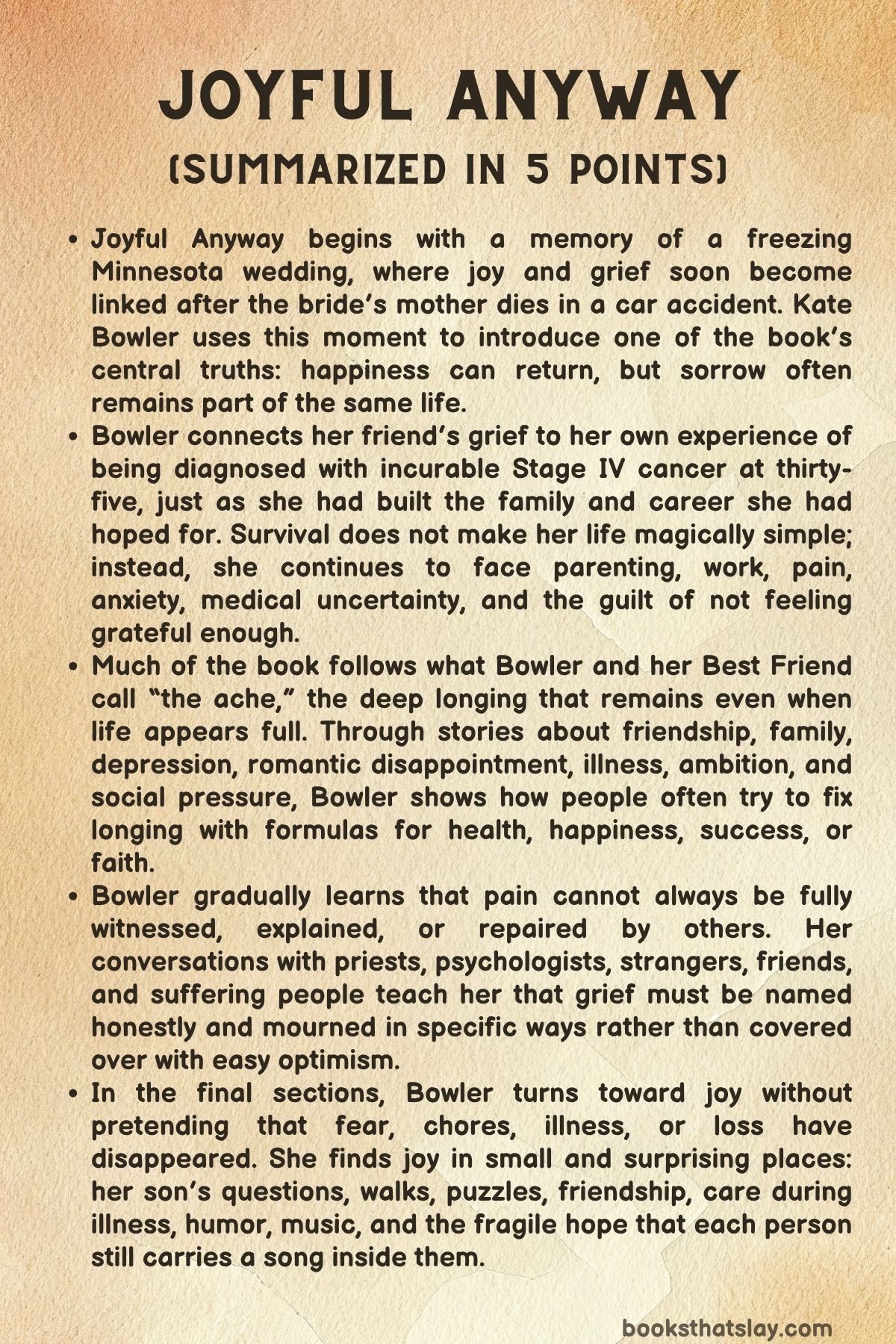
Summary
Joyful Anyway begins with a memory of a wedding in Minnesota. The narrator is standing in the freezing cold, watching her college roommate get married.
The weather is harsh, but the scene is full of life: celebration, laughter, family, and the nervous glow of a young bride beginning a new life. One figure stays with the narrator most clearly: the bride’s mother, who is crying with an overflowing kind of happiness.
Her tears seem to come from the deep knowledge that this moment matters. She is watching her daughter step into a future she has prayed for, worried over, and loved into being.
Soon after the wedding, everything changes. The bride’s mother dies suddenly in a car accident.
A day that had seemed to promise continuity and blessing is followed by loss. The newly married daughter is left grieving, and the narrator tries to comfort her.
She wants to say that joy will come back. She wants to believe that life will not always feel this broken.
But she also knows that grief does not simply disappear. It does not end because a friend says the right thing.
It becomes part of a person’s life, changing shape over time but never fully vanishing.
This opening memory sets the emotional direction of the book. The narrator is interested in joy, but not the easy kind that ignores suffering.
She is trying to understand how joy can return after something terrible has happened, and how people keep living when happiness can never again be innocent.
Her own life has taught her this lesson sharply. At thirty-five, she has reached many of the milestones she once hoped for.
She is married, has struggled through infertility, become a mother, and secured work that feels meaningful. Then she is diagnosed with incurable Stage IV cancer.
The future that once seemed open suddenly shrinks. Her life becomes organized around scans, treatments, pain, medical uncertainty, and the constant possibility of death.
She survives longer than expected, but survival does not turn her life into a simple miracle story.
Instead, ordinary life returns with all its demands. Her son Zach climbs into bed wrapped like a burrito in his blanket.
He asks strange, funny questions and fills the morning with noise and urgency. There are schedules to manage, work to do, appointments to attend, and bodies that do not always cooperate.
The narrator deals with chronic pain, anxiety, guilt, parenting pressures, and the strange pressure to feel grateful all the time because she is alive. She discovers that surviving cancer does not make her endlessly peaceful.
It does not make the dishes sparkle with divine meaning. It does not cancel frustration, boredom, fear, or exhaustion.
Much of the book explores this gap between what people expect survival to feel like and what it actually feels like. The narrator is grateful to be alive, but she is also tired.
She loves her family, but she is still overwhelmed. She has been spared, in some sense, but not returned to a life without limits.
She is still human.
Her Best Friend becomes one of the central companions in this search for meaning. During a weekend trip together, they talk about the Best Friend’s attachment to a man who cannot fully choose her.
He sends mixed signals, gives enough attention to keep hope alive, and then withdraws. The Best Friend is intelligent and self-aware, but longing does not obey logic.
Together, the women name the feeling that keeps pressing through their lives: “the ache.” It is the desire for what is missing, the pain of what has not happened, and the hunger for a life that feels whole.
The narrator recognizes this ache in many places. She remembers her childhood home and her father’s depression.
The atmosphere of silence and sadness shaped her early understanding of emotional pain. Yet she also remembers the small song her father would sing, almost as if he were trying to pull himself back toward life.
That song becomes an important image in the book: a fragile sign that even in dark seasons, something inside a person may still reach toward hope.
The ache follows the narrator into public life as well. At a fundraiser in California, she meets the historian Tom Holland and impulsively takes him to see Jack London’s former home and grave.
Thinking about London, she reflects on the hunger to live fully, to chase adventure, to want more than ordinary life seems able to hold. But she also thinks about the cost of that hunger.
A person’s pursuit of everything can leave others waiting, hurt, or abandoned. Desire is not simple.
It can lead people outward toward courage, but it can also pull them away from responsibility and love.
The narrator also considers the structure of ordinary adult life. She describes it as a house full of duties: children, parents, money, friendships, marriage, health, work, and the constant need to choose one thing over another.
Every choice includes a loss. To live one life means not living countless others.
To be faithful to one person, place, or task means giving up other possibilities. This is not only tragic; it is the basic shape of being finite.
At Duke, where she teaches, the narrator talks with students about toxic positivity. She sees how American culture often pressures people to appear cheerful, productive, and healed.
Pain is tolerated only if it comes with an inspiring lesson. Illness is acceptable if it produces wisdom.
Failure is allowed if it becomes a success story. But real life often refuses that pattern.
Some losses do not make people better. Some wounds remain confusing.
Some prayers are not answered in the way people hoped.
At a dinner with strangers, a wealthy man asks whether the group would follow a formula if it guaranteed complete health and happiness. At first, everyone resists the idea.
They seem to know that such a promise is suspicious. Yet slowly, they admit that they would probably try it.
The conversation reveals something honest: people may criticize easy answers, but they still long for them. They want to be safe.
They want to be well. They want to be free of fear.
The narrator then turns her attention to people and systems that claim to solve the ache. She looks at wellness culture, longevity plans, positivity programs, religious certainties, and algorithmic approaches to better living.
Many of them promise control. If a person eats correctly, thinks correctly, believes correctly, works correctly, or tracks the right data, then perhaps suffering can be avoided.
But the narrator knows that life cannot be mastered so neatly.
A conversation with Father Ron Rolheiser, an elderly priest with advanced cancer, gives her a different way to understand longing. He does not treat the ache as a defect.
He suggests that longing is part of being human and even part of being spiritually alive. People do not reach the end of life with every hope fulfilled.
They die with unfinished dreams, broken plans, and loves that could not become what they wanted. The work is not to pretend these losses do not matter.
The work is to mourn them.
This idea changes the narrator’s attention. She and the Best Friend sit on a rooftop watching chimney swifts, and the Best Friend continues to suffer over the man who keeps hurting her with uncertainty.
Together they decide to write “The List,” a record of major grievances. The list is not neat or noble.
It is a way of admitting what has wounded them. It lets them stop pretending that disappointment is smaller than it is.
The narrator writes her own list and begins to understand that other people cannot fully witness or repair her pain. Even those who love her cannot enter every part of it.
There is a loneliness in grief that cannot be solved by explanation. This does not mean love fails.
It means that some forms of pain must be carried honestly rather than handed off to someone else to fix.
She visits a wellness retreat and observes a retired couple arguing over tofu and beans. Their unhappiness undercuts the promise that the right lifestyle will create peace.
She joins a Zoom group for “highly sensitive” leaders, where participants reveal different kinds of emotional strain, overload, detachment, and need. These scenes are often funny, but they also show how hard people are trying to manage themselves into wholeness.
The narrator also reflects on the emotional labor expected of women. Women are often trained to monitor everyone else’s moods, soften conflict, anticipate needs, and make pain easier for others to bear.
This creates a particular kind of exhaustion. The Best Friend’s situation with the unavailable man becomes another example of how longing can trap a person in hope even when the facts are painful.
When he finally tells her she is not special, the wound is both humiliating and clarifying.
The narrator continues learning how to grieve in more concrete ways. She travels to the Netherlands, prunes trees, and receives guidance from her psychologist Henry.
Grief, she learns, cannot remain vague forever. It has to be named.
People must admit not only that life is hard, but what exactly has been lost: the child not born, the future not lived, the body not restored, the love not returned, the version of oneself that no longer exists.
In the final movement of the book, the narrator turns toward joy, but she does not treat it as a cure that cancels sorrow. Joy arrives in flashes.
It appears in puzzles at Duke, in trash walks with Zach, in children’s unexpected definitions of joy, in odd conversations with strangers, in jokes, in friendship, and in moments when the body is vulnerable but still alive. These joys are not grand solutions.
They are small openings.
After a snakebite and a hospital stay, the narrator feels the tenderness of being cared for by a nurse and by the Best Friend. Dependence, which can feel frightening or humiliating, also becomes a place where love is visible.
She begins to want brave and ridiculous things again. This desire does not mean she has forgotten death.
It means life is still calling to her.
She speaks with a dying professor about small changes. She watches Henry perform as Scrooge in A Christmas Carol.
She gives a commencement address and visits a cemetery. These scenes keep placing life and death near each other.
The narrator is not trying to escape mortality. She is trying to live truthfully beside it.
The book closes by returning to the image of the song inside each person. The song is not loud triumph.
It is the small inner music that helps people continue. The Best Friend starts dating again.
The narrator returns to chores, family, fear, work, love, and ordinary days. Nothing is perfectly resolved.
The ache remains. But so does laughter, friendship, care, and the possibility that joy may arrive even in a life that is still unfinished.
In the end, Joyful Anyway argues that joy is not the opposite of sorrow. Joy is what can still visit a person who has stopped pretending life is whole, fair, or safe.
It is not a reward for perfect faith or perfect thinking. It is a gift that can appear in the middle of pain, in the company of people who stay, and in the fragile song that keeps rising inside the human heart.
Key Figures
The Narrator / Kate Bowler
The narrator is the emotional center of Joyful Anyway, and her character is shaped by the tension between survival and ordinary life. She is not presented as someone who has overcome suffering in a neat or inspirational way; instead, she is someone who has lived through cancer, fear, chronic pain, motherhood, ambition, grief, and love, and still finds herself confused by the demands of daily life.
Her Stage IV cancer diagnosis changes the way she understands time, the body, relationships, and joy, but it does not magically make her life simple or constantly meaningful. This makes her deeply human because she resists the false idea that suffering automatically produces wisdom or permanent gratitude.
She is honest about anxiety, guilt, exhaustion, and disappointment, while also remaining open to beauty and tenderness.
As a character in the book, the narrator is especially thoughtful because she is always examining her own reactions. She notices the ache inside herself and others, and she tries to understand why human beings long for lives that are fuller, safer, healthier, happier, and more complete than the ones they actually have.
Her reflections are not detached or purely intellectual; they come from her own experience of having wanted a future that illness threatened to take away. She is also emotionally generous, often trying to comfort others even when she knows that comfort can be limited.
Her promise to her grieving friend that joy will return shows both her compassion and her uncertainty, because she understands that grief does not simply disappear.
The narrator’s strength lies in her willingness to live without easy answers. She questions toxic positivity, wellness formulas, and religious or cultural promises that claim to solve pain.
At the same time, she is not cynical. She still searches for joy in small, strange, ordinary places: her son’s questions, a walk with trash bags, a puzzle at Duke, a nurse’s care, a friend’s loyalty, and the memory of a song.
Her character grows not by escaping sorrow, but by learning to grieve more concretely and receive joy more humbly. By the end of the story, she becomes someone who accepts that joy and ache can exist together, and that a meaningful life may still be unfinished, fragile, funny, and beloved.
Zach
Zach, the narrator’s son, represents ordinary joy, chaos, dependence, and the future the narrator once feared she might not live to see. His presence in the story brings a lively domestic energy that contrasts with the narrator’s medical fears and emotional heaviness.
When he crawls into bed wrapped in a burrito-like blanket or asks strange questions, he reminds the narrator that life continues in small, messy, demanding ways. He is not simply a symbol of happiness; he is also part of the daily work of survival.
Parenting him requires patience, energy, and attention, even when the narrator is tired, anxious, or physically unwell.
As a character, Zach helps reveal the narrator’s deepest tenderness and vulnerability. Her love for him is bound up with fear because she knows what it means to live under the shadow of death.
He embodies what she most wants to protect and what she cannot fully control. Through him, the book shows that love does not remove fear; often, love makes fear sharper because it gives a person so much to lose.
Yet Zach also gives the narrator access to a kind of joy that is not polished or profound in the usual sense. His childlike curiosity and unpredictable presence draw her back into the present moment.
Zach’s role becomes especially important in the later movement toward joy. The narrator’s trash walks with him show how joy can appear in humble, unglamorous routines.
He does not offer philosophical answers, but his presence teaches through immediacy. Children in the story, including Zach, understand joy in ways that adults often forget: as something physical, spontaneous, funny, and close at hand.
Through Zach, the narrator is reminded that joy does not always arrive as a grand revelation. Sometimes it arrives as a child in a blanket, a strange question, or a shared walk through an ordinary neighborhood.
The Best Friend
The Best Friend is one of the most emotionally significant characters in the book because she carries a different but equally powerful form of longing. While the narrator’s ache is shaped by illness, mortality, motherhood, and survival, the Best Friend’s ache is centered on love, rejection, attachment, and the desire to feel chosen.
Her painful relationship with an unavailable man exposes how deeply people can long for recognition from someone who cannot or will not fully give it. She is intelligent and self-aware enough to see the pattern, but still emotionally caught inside it, which makes her character both sympathetic and realistic.
Her relationship with the narrator is one of the strongest sources of intimacy in the story. The two women speak honestly with each other, name their longing, and eventually create “The List” as a way to acknowledge grievances that cannot be easily healed.
The Best Friend does not exist only to support the narrator; she has her own wounds, hopes, humiliations, and turning points. When the unavailable man tells her she is not special, the moment is devastating because it strikes directly at the heart of her desire to be seen and valued.
Her pain shows that grief is not limited to death or illness. People also grieve imagined futures, emotional investments, and the selves they hoped they might become through love.
The Best Friend also represents loyal companionship. She is present during moments of vulnerability, including the narrator’s snakebite and hospital stay, and her care helps the narrator feel held by another person.
Their friendship is honest rather than sentimental. They do not fix each other, but they witness each other’s ache.
By the end, when the Best Friend starts dating again, her character shows a cautious return to possibility. She has not been magically healed, but she remains willing to risk hope.
Her story supports one of the central emotional truths of Joyful Anyway: people can carry disappointment and still move toward joy.
The College Roommate
The college roommate appears briefly but plays an important emotional role because her wedding becomes the opening image of joy before grief. As a bride, she is surrounded by celebration, family, and the promise of a new beginning.
Her mother’s joyful weeping at the freezing outdoor wedding makes the scene memorable because it captures happiness in a visible, overflowing form. However, the later death of her mother in a car accident transforms the wedding memory into something more complicated.
What was once pure celebration becomes tied to loss.
As a character, the college roommate represents the shock of grief entering ordinary life without warning. Her story shows how quickly joy can be interrupted and how people are forced to continue living after a devastating absence.
She also reveals the narrator’s early desire to offer comfort. The narrator wants to promise her that joy will return, but the situation also teaches that grief does not vanish just because joy becomes possible again.
The roommate’s sorrow becomes one of the first examples of the book’s larger emotional pattern: joy and grief are not opposites that cancel each other out. They often remain tangled together.
Although the college roommate is not developed through many scenes, her presence matters because she helps frame the narrator’s lifelong concern with suffering and consolation. Through her, the story asks what can honestly be said to someone whose life has been permanently changed by loss.
The roommate’s grief is not treated as a problem to be solved, but as a reality to be honored. She becomes a reminder that even the happiest moments may later be remembered through the lens of absence, and yet those moments still mattered.
The College Roommate’s Mother
The college roommate’s mother is a brief but powerful figure because she embodies joy before she becomes associated with loss. At the wedding, her tears are not sad; they are the tears of a mother watching her daughter step into a new life.
Her joyful weeping gives emotional weight to the opening scene because it shows love expressed through vulnerability. She is a character whose presence is felt most strongly through the intensity of her love and through the suddenness of her absence.
Her death in a car accident changes the meaning of the wedding memory. She becomes an example of how fragile human happiness can be.
One moment she is alive, present, and overcome with joy; soon afterward, she is gone. This contrast gives the story its first major meditation on grief.
Her character reminds readers that joy is precious partly because it is not guaranteed to last. The narrator’s memory of her also suggests that love leaves an imprint even after death.
As part of the book’s emotional structure, the roommate’s mother represents the impossibility of separating joy from mortality. She is not analyzed through long conversations or actions, but through the effect she has on those who survive her.
Her joyful tears remain meaningful precisely because they occurred before tragedy. She helps establish the idea that joy does not need to be permanent in order to be real.
The Narrator’s Father
The narrator’s father is a quiet but deeply affecting figure whose depression shapes the narrator’s understanding of sadness, silence, and survival. His emotional struggle creates an atmosphere in the narrator’s childhood home where darkness is present but not always openly discussed.
He represents a kind of suffering that is intimate and domestic, the kind that children sense even when adults do not fully explain it. Through him, the narrator learns that pain can live inside ordinary family life.
The small song he used to sing to pull himself out of darkness becomes one of the most important images connected to his character. The song suggests that he had some fragile method of returning to himself, even if only briefly.
This makes him a complex figure rather than simply a symbol of depression. He is someone who suffers, but also someone who reaches for light in a small, personal way.
His character shows that resilience is not always dramatic. Sometimes it is as modest as singing a little song to survive the next moment.
His influence on the narrator is emotional and spiritual. The memory of his sadness helps her recognize the ache as something that has existed in her life long before cancer.
It also prepares the ending image of the song inside each person. Through her father, the book suggests that every person carries some private method of enduring pain.
His character deepens the narrator’s compassion because she understands that suffering is often hidden inside people who appear to be simply moving through daily life.
Tom Holland
Tom Holland appears as a figure connected to intellect, history, curiosity, and the narrator’s spontaneous desire for adventure. Their meeting at a California fundraiser leads to the unexpected trip to Jack London’s former home and grave, which becomes less about Tom himself and more about what his presence allows the narrator to explore.
He brings with him the energy of historical imagination, and the narrator responds by turning the encounter into an excursion filled with reflection.
As a character in the story, Tom helps draw out the narrator’s interest in people who hunger for meaning, greatness, adventure, and intensity. His presence leads her toward Jack London’s life and legacy, and through that experience she thinks about the cost of wanting everything.
Tom functions as a companion in a scene of intellectual and emotional wandering. He helps create a moment where the narrator can step outside ordinary duties and enter a wider imaginative landscape.
Tom’s importance lies in the way he helps contrast adventure with responsibility. The narrator is fascinated by the lives of people who chase the world with appetite, but she is also aware of the people and obligations left behind.
Through the episode with Tom, the book explores the ache as a longing for more: more life, more experience, more freedom, more significance. His character does not need a large emotional arc because his role is to open a door into the narrator’s reflection on ambition and renunciation.
Jack London
Jack London appears through memory, place, and legacy rather than direct action. He represents hunger for adventure, intensity, achievement, and the desire to consume as much of life as possible.
The narrator’s visit to his former home and grave invites reflection on what it means to chase everything and what such chasing costs. London becomes a figure of restless appetite, someone whose life suggests both vitality and danger.
As a character within the narrator’s reflections, Jack London embodies one possible response to the ache: pursuing experience with force and urgency. He seems to stand for the belief that life should be seized, expanded, and filled with extraordinary action.
Yet the narrator does not romanticize him completely. She also thinks about the people left behind by his pursuit of everything.
This makes him a morally complicated figure, because his hunger for life may have created both greatness and harm.
London’s role helps the narrator examine the limits of freedom. Every life requires choices, and every choice involves renunciation.
His character becomes a mirror for the narrator’s own questions about wanting more while being bound by family, illness, work, money, friendship, and the body. Through him, the story asks whether a life devoted to intensity can ever escape loss, and whether chasing everything might still leave a person unsatisfied.
The Wealthy “Puma”-Like Man
The wealthy “puma”-like man is a sharp and memorable character because he gives voice to the fantasy of a guaranteed formula for health and happiness. At dinner, he asks whether people would follow a formula if it promised complete well-being.
His question exposes the vulnerability beneath social confidence. Even people who appear successful, polished, or powerful are tempted by the idea that life’s pain can be solved through the right system.
He represents the seductive logic of control. His wealth and predatory confidence make him seem like someone who should already possess the good life, yet his question reveals that he too is drawn to the possibility of certainty.
The hesitation of the dinner guests, followed by their admission that they would follow such a formula, shows how widespread the longing is. He becomes a catalyst for one of the book’s central critiques: modern people often want not only happiness, but guaranteed happiness.
As a character, he is important because he dramatizes the ache in a social setting. The desire for health, happiness, and protection from suffering is not limited to the sick or grieving.
It belongs to everyone. His question also connects to the narrator’s later investigation of algorithms, longevity regimens, wellness programs, positivity, and religion.
He stands at the doorway of that investigation, giving the narrator a scene in which the human hunger for a perfect formula becomes impossible to ignore.
Father Ron Rolheiser
Father Ron Rolheiser is one of the wisest and most spiritually grounded figures in the book. As an elderly priest with advanced cancer, he speaks from a place of lived vulnerability rather than abstract theory.
His conversation with the narrator is important because he does not treat longing as a defect to be cured. Instead, he frames longing as a holy and deeply human part of existence.
This gives the narrator a different way to understand the ache.
His character is marked by gentleness, realism, and spiritual depth. He does not promise that all desires will be fulfilled or that faith will remove disappointment.
In fact, he tells the narrator that people die with many hopes still unmet. This is a sobering idea, but it is also strangely freeing because it allows people to stop pretending that a complete life is one in which every longing is satisfied.
Father Ron teaches that unfulfilled hopes must be mourned rather than denied.
Father Ron’s importance lies in the way he redirects the narrator from solving pain to grieving it truthfully. His wisdom helps move the story into a deeper engagement with loss.
He does not offer a shortcut to joy, but he gives the narrator permission to acknowledge what cannot be repaired. In a culture obsessed with optimization and happiness, he represents a countercultural voice of acceptance, mourning, and sacred incompleteness.
Henry
Henry, the narrator’s psychologist, is a steady figure of insight, patience, and emotional guidance. He helps the narrator move from abstract awareness of pain toward concrete grieving.
His advice is important because the narrator often thinks broadly and intelligently about suffering, but Henry encourages her to name and mourn specific losses. He helps her understand that grief becomes more bearable when it is allowed to take a particular shape.
As a character, Henry represents therapeutic wisdom without becoming cold or clinical. He appears as someone who understands the narrator’s patterns and gently challenges her.
His presence suggests that healing requires help from others, especially from those who can listen carefully and ask the right questions. He does not erase the narrator’s ache, but he helps her develop a more honest relationship with it.
Henry’s performance as Scrooge in A Christmas Carol adds warmth and complexity to his character. It shows him not only as a psychologist but as a full person with humor, theatricality, and emotional range.
This moment also connects him to the book’s broader interest in transformation. Scrooge is a character associated with awakening, memory, regret, and renewed generosity, and Henry’s performance subtly echoes the narrator’s own movement toward a more open relationship with joy.
The Retired Couple at the Wellness Retreat
The retired couple at the wellness retreat offers a quietly comic but painful picture of dissatisfaction. They are surrounded by the language and practices of wellness, yet they are unhappy and argumentative.
Their conflict over tofu and beans reveals the gap between external programs for well-being and the unresolved emotional realities people bring with them. They show that being in a place designed for health does not automatically make people whole.
As characters, they represent the limits of lifestyle solutions. Their unhappiness interrupts the fantasy that the right retreat, diet, or routine can solve the ache.
The wellness setting promises peace, but their behavior reveals irritation, disappointment, and relational weariness. They are important because they make the narrator’s critique of wellness culture concrete rather than theoretical.
Their role is also gently humorous. The argument over food is ordinary and almost absurd, but that is what makes it revealing.
Human beings can carry deep dissatisfaction into even the most carefully curated spaces. Through this couple, the book suggests that pain cannot be completely managed by environment, discipline, or health practices.
The ache follows people because it is part of being human.
The Highly Sensitive Leaders
The highly sensitive leaders in the Zoom group appear as a collective character, representing different forms of emotional overload, detachment, and vulnerability. Their meeting exposes the many ways people struggle to manage feeling in a demanding world.
Some are overwhelmed by the emotions of others, while others have learned to detach or protect themselves. Together, they broaden the book’s exploration of sensitivity and emotional labor.
This group is especially important because it helps the narrator think about how women are often trained to manage everyone else’s feelings. The participants reveal how exhausting it can be to remain constantly aware of other people’s needs, moods, and wounds.
Their vulnerability shows that sensitivity can be both a gift and a burden. It allows connection, but it can also produce fatigue and confusion.
As a collective presence, the highly sensitive leaders show that the ache is not only private. It is social and relational.
People suffer not just because they have desires, but because they are entangled in the emotions, expectations, and needs of others. The group helps the narrator recognize that many people are trying to survive the emotional weight of being responsible, perceptive, and available.
The Unavailable Man
The unavailable man is central to the Best Friend’s emotional arc. He represents mixed signals, emotional withholding, and the painful hope that someone distant might eventually choose intimacy.
His behavior keeps the Best Friend attached because he gives enough attention to sustain longing but not enough commitment to satisfy it. This makes him a frustrating and damaging figure in the story.
As a character, he embodies one of the cruelest forms of the ache: the desire to be special to someone who refuses to offer full recognition. When he tells the Best Friend that she is not special, the statement wounds her because it strips away the hope she has been carrying.
He becomes the person through whom her longing is clarified. What she wants is not merely romance, but the assurance that she matters uniquely and deeply.
The unavailable man also helps the book explore how people can become trapped by imagined futures. The Best Friend’s attachment is not only to the man himself, but to the possibility of what life might feel like if he finally chose her.
His character shows how painful it is to grieve something that never fully existed. He is important not because he is admirable, but because his emotional absence reveals the depth of another character’s desire.
The Nurse
The nurse who cares for the narrator after the snakebite is a brief but tender figure of practical compassion. In a moment of bodily vulnerability, the nurse offers care that makes the narrator feel seen and protected.
This is important because the narrator’s body has often been a site of fear, illness, uncertainty, and pain. The nurse’s presence helps transform a frightening medical moment into an experience of being held by another person’s competence and kindness.
As a character, the nurse represents the quiet grace of caregiving. She does not need to solve the narrator’s entire life to matter.
Her care is specific, immediate, and embodied. She attends to the narrator in a moment when the narrator cannot fully care for herself.
This makes her part of the book’s larger movement toward recognizing joy in small acts of human goodness.
The nurse also helps awaken the narrator’s desire to live more bravely and playfully after the hospital stay. Being cared for reminds the narrator that vulnerability can lead not only to fear but also to connection.
Through the nurse, the story shows that joy can come through dependence, and that being helped by another person can restore a sense of possibility.
The Dying Professor
The dying professor is a reflective figure who helps the narrator think about change, finitude, and the smallness of what may still be possible near the end of life. Like Father Ron, the professor speaks from proximity to death, but the emphasis here is on modest transformation rather than grand resolution.
The conversation with the professor suggests that even when life is limited, small changes still matter.
As a character, the dying professor deepens the book’s resistance to dramatic narratives of redemption. There is no suggestion that a person must completely reinvent themselves before death in order for life to be meaningful.
Instead, the professor points toward smaller movements: slight shifts, honest recognitions, and limited but real forms of growth. This makes the character quietly powerful.
The dying professor also mirrors the narrator’s own awareness of mortality. Having lived with incurable cancer, the narrator understands that time can feel both precious and frightening.
The professor’s presence helps her consider what it means to keep changing even when the future is uncertain. Through this character, the story honors small acts of becoming as meaningful in themselves.
Duke Students
The Duke students function as a collective character through whom the narrator explores cultural pressure, ambition, and toxic positivity. In the classroom, she teaches them about the ways American culture often pressures people to appear happy, successful, and resilient.
Their presence allows the book to examine how young adults inherit systems that tell them to optimize themselves and hide their pain.
As characters, the students represent a generation being trained to perform happiness while carrying private anxieties. They are not individually developed, but their role matters because they create a setting where the narrator can challenge popular ideas about positivity.
Through teaching them, she also clarifies her own thinking. The classroom becomes a place where cultural myths are questioned and where pain is allowed to be discussed more honestly.
The students also show another side of the narrator. She is not only a patient, mother, friend, or survivor; she is also a teacher.
Her work with them reveals her desire to make suffering speakable. In their presence, she becomes someone trying to give others better language than the language she herself once received from a culture obsessed with cheerful certainty.
The Children Who Define Joy
The children who offer definitions of joy appear as a collective source of clarity, humor, and wonder. Their understanding of joy is direct and unpretentious.
Unlike adults, they do not overcomplicate joy with theories of success, productivity, wellness, or achievement. Their answers help the narrator notice that joy often lives in the body, in play, in surprise, and in small pleasures.
As characters, the children help shift the emotional direction of the story. After long attention to ache, grief, illness, and disappointment, their voices bring freshness.
They remind the narrator that joy does not always need to be earned or explained. It can simply be noticed.
Their presence challenges adult habits of making joy conditional on life becoming perfect.
The children’s role is important because they help the narrator recover a less defended way of seeing. They do not erase the seriousness of suffering, but they offer another register of truth.
Through them, the book suggests that joy may be easier to recognize when people stop demanding that it justify itself. Their small definitions become part of the narrator’s larger return to the song inside each person.
The Funny Strangers
The funny strangers who appear in the later section contribute to the story’s growing awareness of ordinary joy. They are minor figures, but they matter because they show how unexpected human encounters can interrupt heaviness.
Their humor offers relief without denying pain. In a book concerned with grief and longing, such figures help widen the emotional range of daily life.
As characters, the funny strangers represent the accidental generosity of the world. They are not central companions or major guides, but their presence shows that joy can arrive through surprise.
A joke, a strange comment, or an odd interaction can become a small opening in an otherwise burdened day. Their importance lies in their ability to make life feel less closed.
These strangers also help the narrator notice that joy is not always private or planned. It can be communal, brief, and unrepeatable.
Their role supports the idea that life remains alive with small invitations to delight, even when larger problems remain unresolved.
The People Searching for a Solution to the Ache
The people who pursue algorithms, longevity regimens, wellness practices, positivity, and religious formulas form an important collective presence in the book. They represent the human desire to solve longing through systems.
Some seek longer life, others seek perfect health, emotional control, spiritual certainty, or guaranteed happiness. Their efforts are understandable because the ache is painful, but the narrator sees that these solutions often promise more control than human life can actually provide.
As a collective character group, they reveal the cultural landscape surrounding the narrator. She is not suffering in isolation; she is living in a world filled with industries and ideologies that claim suffering can be optimized away.
These people are not mocked as foolish. Instead, they are shown as deeply human.
Their search for answers comes from fear, hope, and the desire not to be undone by grief or mortality.
Their role helps sharpen the book’s central argument. The ache cannot be fully solved by formulas, even when those formulas contain partial truths or useful practices.
Human beings still age, lose, desire, grieve, and die with unfinished hopes. This group of characters helps the narrator move toward a more honest understanding of joy: not as the result of perfect control, but as something that can still appear within an incomplete life.
Themes
Joy Beside Grief
In Joyful Anyway, joy is not presented as a cure for grief or a reward that arrives after pain has been fully processed. The opening memory of the wedding and the sudden death that follows creates a pattern for the entire narrative: happiness and sorrow can stand very close to each other, and one does not cancel the other.
The narrator’s promise to her grieving friend that joy will return is not a simple comfort, because she knows that the loss will remain. This makes joy feel more honest.
It is not permanent cheerfulness, denial, or emotional victory. It appears in fragments, often when life is still hard: a child’s strange morning questions, a friend’s presence, a nurse’s care, a walk, a joke, a small song.
The text suggests that joy survives because it does not demand perfect conditions. It can arrive while the body hurts, while fear remains, and while old sadness still has a place in the heart.
Living With Unfulfilled Longing
The ache becomes a central way of describing human desire that cannot be fully answered. The narrator and the Best Friend give a name to the feeling of wanting something deeply while also knowing that life may not provide it.
For the Best Friend, the ache is tied to romantic longing and the pain of hoping for love from someone who remains unavailable. For the narrator, it is connected to illness, fear, family history, survival, and the life she imagined before cancer changed everything.
The text does not treat longing as weakness or immaturity. Through the conversation with Father Ron Rolheiser, longing becomes part of being human, even part of spiritual life.
People die with hopes unmet, and the task is not to pretend this is fine but to mourn honestly. The ache shows that people are made of desire, memory, regret, and hope.
Learning to live with it means accepting that some losses cannot be solved, only carried with more truth.
The Failure of Easy Answers
The narrative strongly questions systems that promise complete happiness, perfect health, or emotional control. Algorithms, wellness retreats, positivity formulas, longevity practices, and religious certainty all appear as attempts to master the pain of being human.
The wealthy man’s question about whether people would accept a guaranteed formula for health and happiness exposes how tempting such promises are. Even those who resist simple answers still want relief.
Yet the narrator repeatedly sees that these solutions cannot fully address grief, illness, disappointment, or love. Toxic positivity is especially criticized because it pressures people to perform happiness instead of telling the truth.
The wellness retreat, the unhappy couple, and the group of sensitive leaders all reveal that suffering remains even in spaces designed for healing. The text does not reject care, therapy, faith, or healthy habits, but it rejects the idea that life can be controlled into painless success.
Real wisdom begins when people stop pretending there is a method that can remove all ache.
Ordinary Life as Sacred and Difficult
Survival does not transform ordinary life into constant gratitude. After cancer, the narrator still faces parenting stress, chronic pain, medical anxiety, work, guilt, chores, and emotional exhaustion.
This is important because it challenges the expectation that surviving a crisis should make every normal day feel miraculous. Ordinary life remains demanding.
Children need care, bodies fail, friends suffer, parents carry sorrow, money matters, and every choice involves giving something up. Yet the same ordinary world also becomes the place where meaning appears.
Zach’s questions, trash walks, puzzles, funny strangers, hospital kindness, friendship, and family routines become small forms of grace. The sacred is not separated from daily inconvenience; it is found inside it.
The narrator’s final return to the image of the song suggests that each person carries a private source of life that can still be heard through fear, duty, and loss. Ordinary life is not easy, but it is still worth receiving.