Finding Me Summary and Analysis
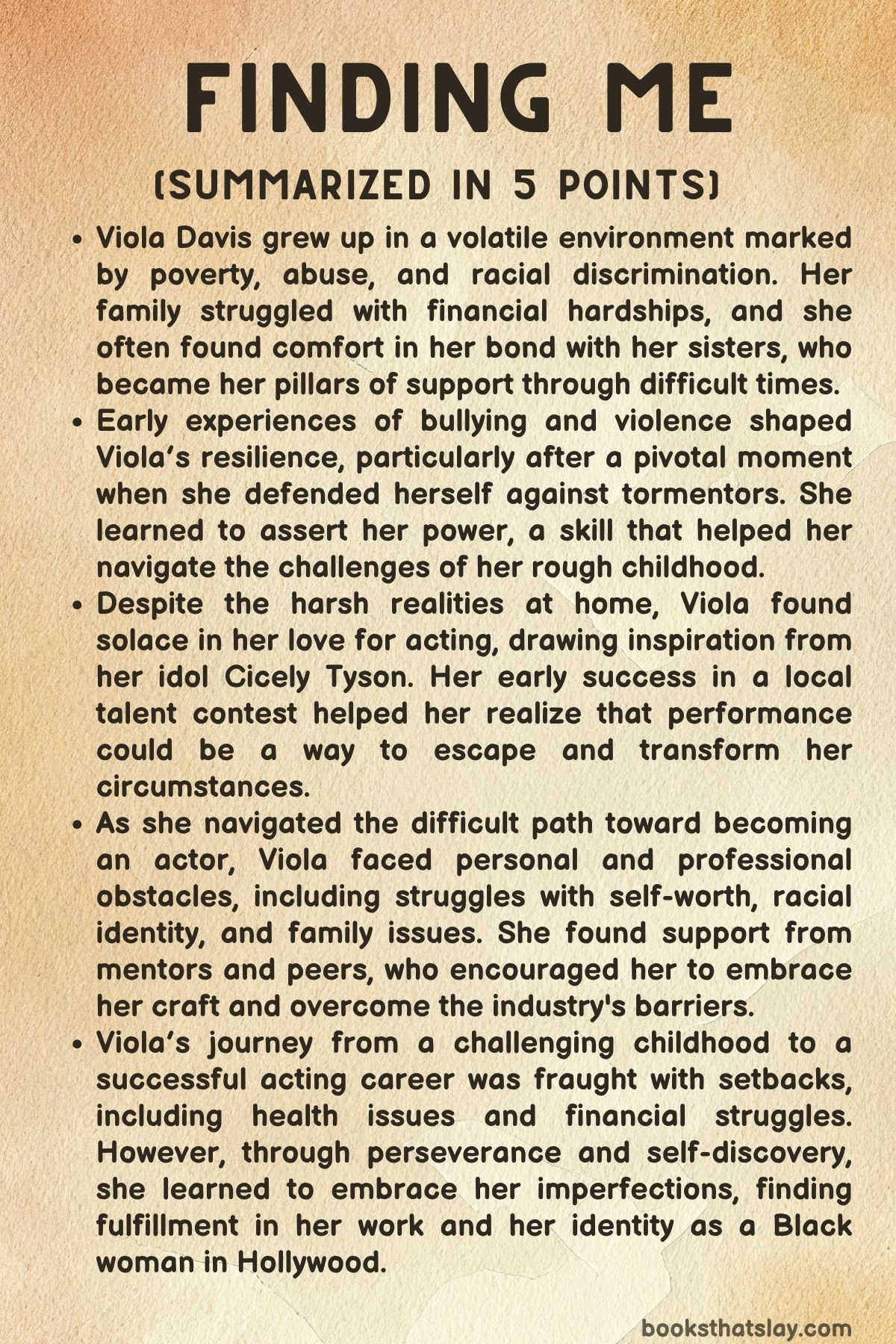
Finding Me by Viola Davis is a powerful memoir that chronicles the life of one of Hollywood’s most celebrated actresses. Born into a life of poverty, violence, and hardship, Davis reflects on her early years growing up in a troubled household in South Carolina and Rhode Island.
Despite the challenges, including family trauma, abuse, and bullying, Davis rises to prominence through sheer resilience, determination, and a love for acting. The book traces her journey from a young girl trying to survive in a harsh world to becoming an acclaimed actress who breaks barriers in an industry that often marginalizes women of color. With raw honesty, Davis opens up about her struggles with self-worth, identity, and the difficult balance between personal and professional life. Finding Me is not only a recount of Davis’s rise to fame but also a celebration of overcoming adversity and reclaiming one’s narrative.
Summary
Finding Me begins with Viola Davis reflecting on her turbulent childhood. Growing up in St. Matthews, South Carolina, and later in Central Falls, Rhode Island, she faced extreme poverty and abuse.
Her family, led by her strong but deeply traumatized mother and a father plagued by alcoholism and rage, was constantly on the brink of survival. Davis’s mother, MaMama, who worked tirelessly in factories to support six children, shared the pain of her own childhood trauma, including an accidental death that haunted her throughout her life.
Meanwhile, Davis’s father, Dan, though talented, was frequently the source of violence and instability, a trait that would shape Viola’s formative years.
As a young girl, Davis often felt like an outsider. At school, she was constantly bullied, with classmates taunting her using racial slurs and even throwing things at her.
Her mother, tired of hearing about the bullying, gave her a crochet needle for protection, marking a pivotal moment in Davis’s life where she began standing up for herself. Despite the difficult environment at home, Davis found solace in her passion for performance, inspired by the actress Cicely Tyson, who symbolized a potential escape from the chaos of her reality.
Viola’s family lived in poor conditions. Their apartment, referred to as “128,” was often without basic utilities and plagued by rats.
However, it was here that Davis began to explore her love for acting. She and her sisters performed in a local talent contest, an event that offered them a rare moment of achievement and joy.
However, Davis also had to confront the harshness of her reality, including the violence and trauma at home, which made her long for validation and recognition from the outside world.
As the years passed, Davis’s personal and academic struggles continued. Her family celebrated small holidays with joy, despite the dire circumstances, yet their environment was marked by violence, addiction, and insecurity.
The narrator, struggling with deep emotional scars, found comfort in escapism, often retreating into her imagination. At school, she faced intense food insecurity and public humiliation due to her poverty, which led her to feel invisible and alienated from her peers.
Her sense of identity was shaped by both her racial background and the poverty she endured, making her feel as if she didn’t belong anywhere.
Viola’s life was further complicated by her family’s challenges, especially after the birth of her youngest sister, Danielle. Viola felt an overwhelming responsibility to protect her, and this sense of protection extended to her siblings.
Despite the ongoing emotional and physical abuse from her father, Davis found solace in her academic success, using education as a tool to escape her circumstances. However, it was the support of her sisters, especially in times of crisis, that helped her push through the hardest moments.
The pivotal moment for Davis came when she participated in a program called Upward Bound, which introduced her to theater. Through acting, she found a therapeutic outlet to channel her pain.
A mentor named Ron encouraged her to embrace the difficulties of acting and helped her understand her own worth. This, along with her scholarship to attend a prestigious arts competition in Miami, marked a turning point in her journey toward self-discovery.
After winning the scholarship, Davis moved to New York to attend Juilliard. Here, she faced new challenges, particularly the overwhelmingly white environment and the demanding nature of the classical training.
The program’s focus on European techniques made her feel like an outsider, and the intense physical and emotional demands of the program took a toll on her. However, Juilliard also gave her an opportunity to explore her racial identity, particularly through a Martin Luther King celebration where she could express herself and find solidarity with her roots.
During her time in New York, Davis also navigated a tumultuous relationship with David, a man who would be an important part of her life for several years. Though their relationship was foundational, it was marked by emotional insecurity and a desperate need for love, which led to significant personal growth as Davis began to confront her own fears and doubts.
Around this time, she also took a life-changing trip to The Gambia, where African culture and spirituality helped her find a deeper sense of self.
As her acting career continued to evolve, Davis faced the harsh realities of the entertainment industry, which often limited her opportunities because of her race and gender. Despite landing significant roles, such as in the Broadway production of Seven Guitars, and receiving recognition for her work, including an Independent Spirit Award nomination, Davis continued to struggle with self-doubt and insecurities.
She also faced personal challenges, including health issues and the emotional toll of being unable to have children for some time.
Davis’s breakthrough came with her role in How to Get Away with Murder, where she portrayed the complex and powerful character of Annalise Keating. This role, breaking boundaries for dark-skinned women in Hollywood, marked a turning point in her career.
She also began to confront the trauma of her past, particularly in her portrayal of Rose in Fences, which led to an Oscar nomination. Alongside her professional success, Davis grappled with the ongoing challenges of being a Black woman in Hollywood, often facing typecasting and limited roles.
Throughout the ups and downs of her career, Davis’s personal life also evolved. She married Julius, and together they adopted a daughter, Genesis, marking a moment of personal fulfillment.
Meanwhile, her career continued to soar, with major roles in films and TV shows that established her as one of Hollywood’s most respected actresses. However, Davis never lost sight of the struggles that shaped her journey, and she continued to advocate for greater representation and opportunities for people of color in the entertainment industry.
Ultimately, Finding Me is a story of resilience and triumph. It is a testament to the power of self-expression, the importance of finding one’s voice, and the healing that comes from embracing both the good and the painful aspects of one’s past.
Davis’s journey, marked by numerous challenges, is a reminder that even in the face of adversity, it is possible to carve out a place for oneself in the world.
Key People
Viola Davis
Viola Davis, the central figure of Finding Me, is an incredibly resilient woman whose character evolves through her challenging life experiences. From a young age, Viola’s environment shaped her into a fighter, particularly due to the poverty, violence, and emotional turmoil she faced.
Growing up in a tough, working-class neighborhood in Central Falls, Rhode Island, she was confronted with racial bullying and an unstable home life. Her defiant behavior and use of profanity were coping mechanisms in response to the hostile surroundings she navigated.
However, it was not just her tough exterior that defined her; there was a quiet, competitive side to her that contrasted with her older sister, Anita, who was the more assertive figure in their family.
Viola’s journey from a frightened young girl running home to escape tormentors to a young woman determined to make her mark in acting is a testament to her inner strength. Despite being surrounded by a family marked by violence and poverty, she finds solace in her love for performance, especially when inspired by Cicely Tyson.
Her growing love for acting becomes both a form of escapism and a way to redefine herself beyond the limitations imposed by her environment. Her self-assertion begins after she stands up to the bullies at school, using a crochet needle to threaten them, signaling her transformation from a victim of circumstance to someone who takes control of her own narrative.
Her life becomes a balance of striving for external validation through moments of success, like the talent contest, and coping with deep-rooted emotional scars.
Viola’s resilience continues as she navigates the ups and downs of her personal and professional life. From her challenges with poverty and the trauma of her family dynamics to her struggles with her identity in predominantly white spaces, she confronts every challenge head-on.
Her journey toward self-acceptance, both in her career and in her personal life, is long and complex, but through her acting and the support of her mentors, she ultimately learns to heal and embrace her true self.
Mae Alice (MaMama)
Mae Alice, Viola’s mother, is a figure of both strength and trauma in this memoir. Viola affectionately calls her MaMama.
A woman who experienced immense hardship growing up, MaMama had to cope with the loss of her sister in a tragic fire that she inadvertently caused, as well as the abuse she suffered at the hands of her own parents.
Despite these traumatic experiences, MaMama remained a pillar of strength for her children. Her work in factories to support her family, despite the abuse and hardships, paints a portrait of a woman who refused to let the circumstances define her or her children.
Her complex relationship with Viola is shaped by the dual roles she plays as both a nurturing mother and a strict disciplinarian. While MaMama worked hard to support her children, her presence in the home was often a source of both comfort and tension.
Viola’s recollections of MaMama reflect her deep love and also the pain of growing up in a chaotic environment where violence and instability were ever-present. Despite these struggles, MaMama’s insistence on survival and her resolve to push through each day significantly influenced Viola’s journey to becoming a resilient woman.
Dan
Dan, Viola’s father, plays a complicated role in this memoir. His history of abuse and alcoholism, compounded by his difficult upbringing, creates a volatile environment at home.
His abuse, particularly towards MaMama, contributed to the fear and chaos Viola lived with during her childhood. However, as the story progresses, Dan undergoes a transformation.
Although his violent tendencies never fully disappeared, his role in the family shifts. Eventually, he becomes a more loving figure, especially in his later years when his grandchildren remember him fondly.
Despite his troubled past, he embodies the complexity of human relationships, showing that even those who cause harm can seek redemption and change. Dan’s character arc is reflective of the broader themes of healing and forgiveness that pervade Finding Me.
Anita
Anita, Viola’s older sister, is a fierce and protective figure in Viola’s life. Her role was significant, as she often acted as a shield against the bullying and violence they faced in their tough neighborhood.
While Anita may have been more overtly confident and assertive than Viola, she served as a source of protection and strength. Though not always present, Anita’s influence looms large, providing both a model of resilience and a reminder of the complexities of sibling relationships.
Through her, Viola learns about loyalty, protection, and the power of sisterhood, which remains a central theme throughout the narrative.
Danielle
Danielle, Viola’s younger sister, plays an important role in the latter part of the story, particularly as Viola navigates her early adulthood. The bond between Viola and Danielle grows stronger as they both enter the world of acting.
Danielle’s involvement in acting provides a parallel journey to Viola’s, and the two sisters’ shared experiences in the industry help them bond. Danielle’s journey through the challenges of life and the arts shows the ongoing struggles of Viola’s family, but it also serves as a testament to the importance of familial support and love.
Despite the difficulties they faced, the two sisters supported one another in their pursuit of artistic success.
David
David, who enters Viola’s life during her journey into professional acting, plays a significant role in her emotional development. Their relationship, however, is marked by emotional insecurity and her deep need for love and validation.
Although David is an important figure in Viola’s early adult life, the relationship ultimately proves to be emotionally draining, as Viola realizes that he had been emotionally unavailable throughout their time together. His character serves as a reminder of Viola’s internal struggles with self-worth and the need to find love within herself rather than relying on others for validation.
Ron
Ron, Viola’s acting teacher in the Upward Bound program, emerges as a pivotal figure in her growth as both an artist and a person. His encouragement to embrace the challenges of acting and his support in helping her understand the importance of self-worth offer Viola the opportunity to express herself in ways she had never before considered.
His mentorship marks the beginning of a transformative period in Viola’s life, one in which she begins to use acting not just as a career, but as a therapeutic tool for healing. Ron’s guidance helps Viola realize that her emotions, though painful, are valuable and can be channeled into her art, giving her the strength to move forward in her journey.
Julius
Julius, Viola’s eventual husband, plays a crucial role in the later stages of her life. His relationship with Viola is one of both love and support, though not without challenges.
Their marriage, which begins quietly and intimately, eventually grows into a more public and celebrated union. Julius becomes a stabilizing force in Viola’s life, particularly as she navigates the pressures of fame and family responsibilities.
His love and commitment to Viola serve as a counterbalance to the emotional turmoil she often experiences, offering her a sense of security and partnership as she continues her personal and professional journey.
Meryl Streep
Meryl Streep, while not a central character, has a significant impact on Viola’s growth, particularly in their shared work on the play Doubt. Streep’s legendary status as an actress presents a challenge for Viola, as she struggles with feelings of inadequacy in the shadow of such a revered figure.
Yet, through their collaboration, Viola learns to confront her insecurities and gain confidence in her own abilities. Streep represents the pinnacle of success in Viola’s field, and working alongside her helps Viola realize that she, too, belongs in the world of professional acting.
Genesis
Genesis, Viola and Julius’ adopted daughter, represents the culmination of Viola’s personal growth and healing. As Viola embraces motherhood, her relationship with Genesis signifies a new chapter in her life, one in which she can break the cycle of trauma and provide a loving, stable environment for her child.
Genesis becomes a symbol of hope, change, and the possibility of creating a family that is grounded in love and support. Through Genesis, Viola learns the importance of passing on the lessons of resilience and love to the next generation, ensuring that her own children will have a different experience than she did growing up.
Themes
Resilience in the Face of Adversity
Finding Me is a powerful exploration of the narrator’s resilience in the face of extreme adversity. From a childhood marred by poverty, abuse, and neglect, to a career in the highly competitive and often prejudiced world of Hollywood, Viola Davis’s story is one of tenacity and perseverance.
Growing up in an environment where survival was the daily focus, Viola developed a deep sense of inner strength. Her early experiences with bullying, the chaos of her family life, and witnessing violence at home could have easily defined her life.
Instead, she found ways to fight back against her circumstances, whether by physically defending herself or escaping through imaginative play and theater. This resilience is continually tested throughout her journey, particularly as she navigates the harsh realities of her adult life, from grappling with racial identity in a predominantly white industry to facing personal health issues.
Yet, despite these challenges, she continues to evolve, showing that resilience is not just about surviving, but also about growing and learning to thrive despite the odds.
The Impact of Family and Relationships
Family is a central theme in the memoir, with the narrator’s relationships serving as a foundation for both her struggles and her triumphs. While her upbringing was shaped by her family’s volatile dynamics, including her father’s abuse and her mother’s struggles with poverty, Viola’s family, particularly her sisters, played a crucial role in her survival.
The bond between the sisters is depicted as one of mutual support, where they shield each other from the harshness of their environment and provide emotional sustenance. This tight-knit family unit allowed Viola to endure many of life’s challenges, from the violence at home to the humiliation she faced at school.
Later in life, her family’s dependence on her for financial support continued to weigh heavily on her. The theme of family is not just about the support she received, but also the weight of responsibility she felt for them.
Her complex relationship with her father, in particular, highlights how family dynamics can both harm and heal. Viola’s father, once an abusive figure, transforms in her eyes into a more loving, albeit imperfect, patriarch as the story progresses.
The transformation of her father symbolizes the potential for healing and redemption, even within the most dysfunctional of relationships.
Racial Identity and Self-Discovery
Racial identity is an ongoing theme in the memoir, particularly as Viola navigates her career in the acting world. Raised in a predominantly Black community but constantly faced with the challenges of being a Black woman in a white-dominated society, Viola’s journey is a continuous process of understanding and embracing her racial identity.
Her time at Juilliard is especially formative in this regard, where she is forced to reconcile her Blackness with the overwhelmingly white and Eurocentric norms of classical theater. Her struggles with racial identity are not just about navigating external racism but also confronting internalized doubts about her worth and place in the world.
In Hollywood, she faces typecasting and racial bias, often feeling like an outsider in an industry that marginalizes people like her. However, through her acting, she eventually learns to embrace her Blackness, drawing strength from it as she becomes a trailblazer for dark-skinned women in Hollywood.
Her experience highlights how the journey of self-discovery and acceptance is long and often fraught with internal and external battles, but it ultimately leads to a more authentic and empowered sense of self.
Escapism and the Power of Imagination
Escapism is a vital coping mechanism for the narrator, providing temporary relief from her grim realities. As a child, Viola often retreated into her imagination, using play to create an alternate world where she could escape the harshness of her daily life.
Whether it was through pretending to be a wealthy woman or engaging in fantasy games with her sisters, imagination provided a necessary outlet for emotional survival. Later, this theme is reflected in her love for acting, where she is able to channel her emotions and experiences into her performances, giving her an avenue for expression and self-healing.
Theater, in particular, becomes both an escape and a means of confronting her painful past, allowing her to transform her personal trauma into art. Acting offers her not just a professional outlet, but a therapeutic one, where she can work through the emotional baggage of her early life.
Her escape through performance ultimately becomes a source of strength, a way to redefine her narrative and create a future beyond her past.
The Struggles of Gender and Identity in Hollywood
The memoir also examines the challenges faced by women, particularly Black women, in Hollywood. As Viola embarks on her acting career, she is confronted with the industry’s deeply ingrained sexism and racism.
Despite her immense talent, she faces significant barriers, including being typecast and dealing with a lack of opportunities for women of color. The industry’s preference for lighter-skinned actresses and the stereotypical roles often assigned to Black women are recurring obstacles she must overcome.
These gender and racial biases lead to feelings of inadequacy and self-doubt, especially as Viola struggles with her identity in a world that often marginalizes her. The book addresses how these struggles impact her mental health, self-worth, and the way she navigates her career.
Through roles such as Annalise Keating in How to Get Away with Murder, Viola is able to challenge these stereotypes and portray complex, multifaceted characters. In doing so, she not only breaks barriers for herself but also for future generations of Black actresses.
This theme sheds light on the broader issues of gender and racial inequality in the entertainment industry and underscores the resilience required to persist in such a challenging environment.
Healing Through Art and Self-Expression
Art and self-expression serve as powerful tools for healing. From her early interest in theater to her later career as an actress, Viola uses performance as a way to confront and process her personal trauma.
Theater provides her with a space to channel her anger, sadness, and confusion, transforming these emotions into something productive. This process is not just about professional success but about personal growth.
Through acting, Viola learns to embrace her vulnerability, allowing her to find healing and strength in her craft. Her participation in the Upward Bound program and her eventual training at Juilliard further solidify the idea that art, particularly acting, can be both a form of escape and a therapeutic tool.
As she matures, Viola realizes that her success as an actress is not only about achieving fame but also about reclaiming her narrative and using her platform to express her authentic self. Her journey highlights the transformative power of art as a means of healing and self-discovery, offering a way to cope with the emotional scars of the past and to create a future built on self-empowerment.