Law Maker Summary, Characters and Themes | Susie Tate
Law Maker by Susie Tate is a contemporary romance with a strong suspense thread, built around a woman trying to escape a violent criminal family and a powerful barrister whose orderly life changes when he sees the truth behind her fear. Clara is a skilled teaching assistant at an elite London school, but she hides her past, her pain, and even her identity to survive.
Rafe Sterling first enters her world as a protective father worried about his son, Ozzie, but Clara’s care for the boy reveals her courage and intelligence. The story follows love, trust, danger, and the difficult process of becoming safe after years of control. It’s the 1st book of the Aristocrats of London series.
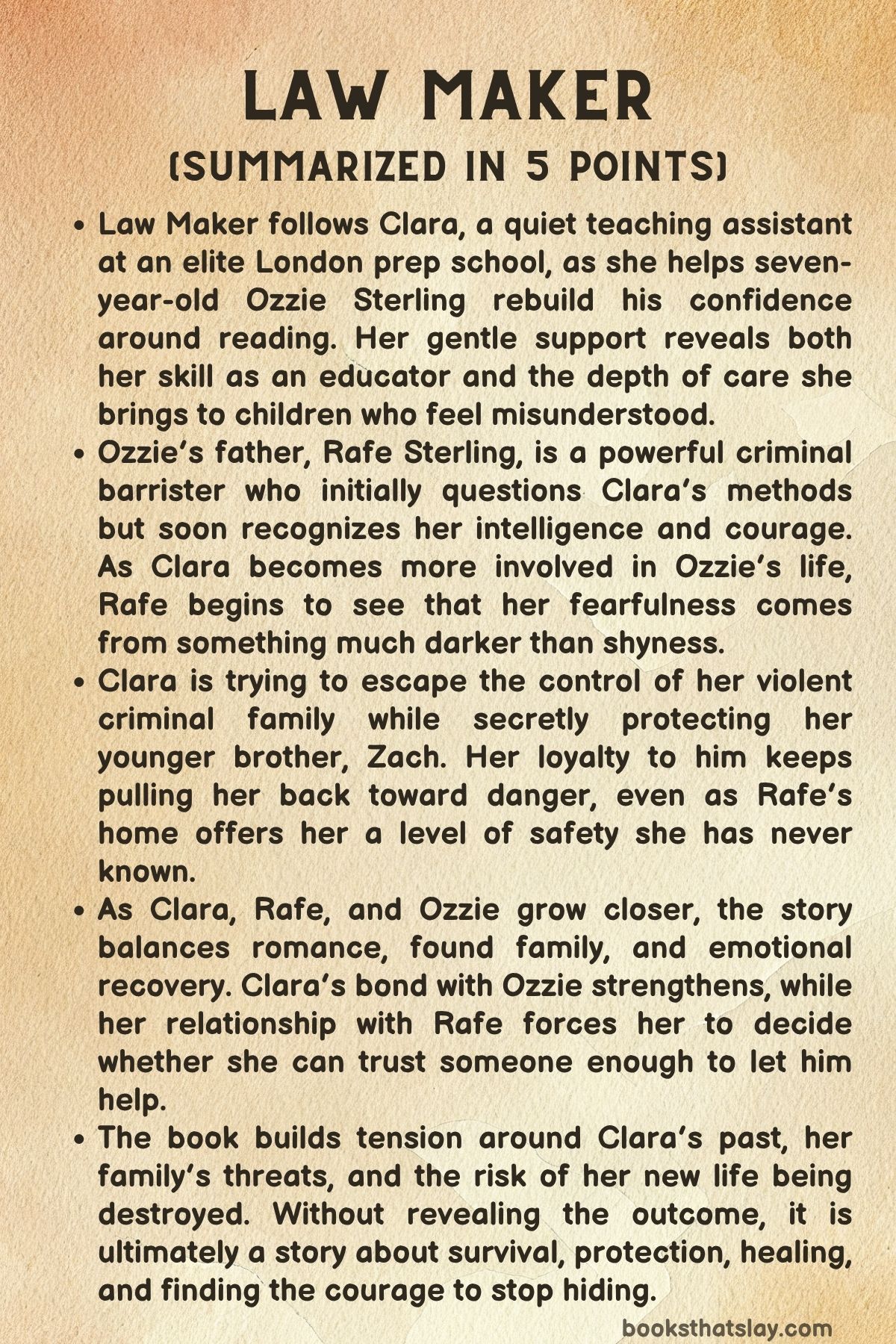
Summary
Clara works as a teaching assistant at Molton Prep, a prestigious London school where many of the pupils come from wealthy and influential families. She is quiet, careful, and almost invisible by choice.
She avoids drawing attention to herself, especially from parents, because her own background is dangerous. Clara comes from the Mason family, a feared criminal family ruled by her violent father, Frank Mason.
She has escaped the family home, but her younger brother Zach remains trapped there, and Clara’s fear for him controls much of what she does.
At school, Clara is especially close to seven-year-old Ozzie Sterling, the son of Lord Rafe Sterling, a successful criminal barrister. Ozzie has been misbehaving, and his behaviour worries the adults around him.
When he throws a book at another child, Margot Harding, Clara handles the situation calmly. Instead of shaming him, she gently gets him to admit the real reason behind his anger: he struggles to read and believes that makes him stupid.
Clara recognizes signs of dyslexia and reassures Ozzie that he is not unintelligent. She helps him apologize to Margot and begins using games, patience, and suitable learning materials to rebuild his confidence.
Ozzie talks about “Miss Clara” so often that Rafe demands to meet her. Clara is terrified of him at first because powerful men remind her of the world she has been trying to escape.
Rafe questions her qualifications and challenges her judgment about Ozzie. Clara, usually timid around men like him, finds the courage to defend herself and Ozzie.
She explains that she is experienced, that Ozzie needs help, and that ignoring his dyslexia could harm him deeply. Rafe is startled by both her fear and her competence.
He also learns that Ozzie’s nanny has been calling him stupid, and he fires her.
Outside school, Clara’s life is far more dangerous than anyone fully understands. She secretly visits Zach and helps him study because he dreams of doing well in school and becoming a vet.
During one visit to the Mason home, the violence escalates. Clara is badly beaten and returns to school with bruises, a broken wrist, and weak explanations about falling down stairs.
Lily and Mrs Clayton suspect the truth, but Clara refuses to go to the police. She knows Frank Mason’s reach, and she believes involving the authorities could put Zach in even worse danger.
Rafe notices Clara’s injuries and becomes increasingly concerned. When she flinches at a sudden movement, he understands that her fear is not ordinary nervousness.
He offers her a well-paid job tutoring Ozzie at his house. Clara refuses at first, not wanting to be dependent on him, but when she sees one of her father’s men watching her, she accepts the protection his car and home provide.
Rafe’s chauffeur and security man, Dave, along with the secure Sterling household, give Clara a sense of safety she has not felt in years.
As Clara begins tutoring Ozzie after school, he makes real progress. He starts reading more confidently, and his relationship with Rafe improves.
Clara also challenges Rafe to think about Ozzie’s emotional needs, not just his academic performance. Rafe explains that it was the nanny, not him, who damaged Ozzie’s self-esteem.
Clara sees that Rafe, though intense and sometimes demanding, loves his son deeply.
Rafe soon realizes Clara is not eating properly and is living in unsafe conditions. When he sees her flat, he insists she move into his house.
Clara resists the idea, but the Sterling home becomes a refuge. She settles into a spare room, grows comfortable with the staff, and becomes an important part of Ozzie’s life.
Ozzie eventually reads aloud to Rafe, creating a moving breakthrough between father and son.
Clara and Rafe grow closer. Their attraction turns into a kiss, then into a secret relationship.
Clara is afraid of several things at once: that she is Rafe’s employee, that Ozzie might be hurt if he learns too soon, and that her family will ruin anything good she finds. Rafe is certain about wanting her and begins drawing her into his family life.
Clara bonds with his sister Poppy, who also has dyslexia, and offers to help her. Rafe introduces Clara to his wider family during Sunday lunch, where his parents, Poppy, Ozzie, his ex-wife Sophia, and Clara’s friend Lily are present.
Most of the family welcomes her warmly, though Sophia is cold and suspicious.
For a short time, Clara feels almost happy. She and Rafe share a quiet routine, and Ozzie thrives with her support.
But her fear becomes reality when Skinny Pete, one of Frank Mason’s men, corners her and tells her Frank wants to see her. Clara tries to refuse, but Pete reminds her that Zach is still in Frank’s house.
Clara goes back to the family home, where she sees her frightened mother and faces Frank in the kitchen.
Frank reveals that he knows Clara is involved with Rafe. He also reveals that Rafe is prosecuting Freddie Mason, Clara’s brother.
The family deliberately arranged for Rafe to handle the case, hoping Clara could influence him. Clara insists Rafe never discusses work with her, but Frank orders her to stay close to him until the family decides how to use her.
When she refuses, Frank threatens Zach, making clear he can destroy the boy’s future or make him disappear. Clara feels trapped again.
After this, Clara begins pulling away from Rafe. She stops eating, avoids sleeping beside him, and acts as though their relationship is ending.
Rafe senses that something is badly wrong, but Clara will not tell him the truth. In frustration, he takes Ophelia to a charity gala to provoke a response.
Clara is devastated. She later tells Rafe she loves him, but the words sound like goodbye.
They spend one last night together, while Clara still hides the danger surrounding them.
The next day, Rafe arrives in court to prosecute Freddie Mason and sees Clara sitting with the Mason family. He realizes she is Clarabelle Mason, the defendant’s sister.
Feeling betrayed, he believes she may have manipulated him and put Ozzie at risk. Because of the conflict of interest, he steps away from the case.
Clara tries to ask him for help, finally understanding that he may be able to protect both her and Zach, but Rafe rejects her in anger. Frank drags her away.
Rafe later goes to Clara’s school, demanding answers from Lily and Mrs Clayton. Instead of confirming his suspicion, they panic when they realize Clara is with her family.
Their fear forces Rafe to reconsider. He contacts Detective Grant Mitchell and learns that Clara was a confidential informant who helped police access the Mason family’s encrypted network.
Then Zach arrives at Rafe’s house, terrified and furious, and confirms that Clara informed on the family to save them both. He warns that Frank will kill her if he finds out.
At the Mason house, Frank discovers proof of Clara’s betrayal. He attacks her mother and then Clara.
For the first time, Clara fights back fiercely. She strikes him, injures him, and escapes, begging her mother to come with her.
Her mother chooses Frank, leaving Clara to run alone. Injured and exhausted, Clara collapses on the lawn as Rafe arrives with help nearby.
Frank and his men try to stop him, but Rafe protects Clara, and Ruben orders the men to stand down. Rafe takes Clara to hospital.
In hospital, Clara receives treatment for her injuries and breaks down under the weight of what has happened. Rafe apologizes for not believing her and brings Zach to safety.
Working with Grant, he supports police action against the Masons. Frank is arrested, and Rafe makes it clear to him that Clara is no longer alone.
In the aftermath, Clara and Zach move into Rafe’s home. Zach begins counselling and starts to imagine a future beyond the Mason family.
Clara also begins to heal. She attends counselling, wears brighter clothes, accepts care from the people around her, and slowly learns to trust Rafe again.
She meets Ruben in prison and learns that, in his flawed way, he tried to protect her and Zach. She also confronts Frank, gaining a measure of closure.
By the end, Clara is no longer hiding in the same way. At a Sterling Foundation gala supporting domestic violence charities, she appears publicly with Rafe.
Her presence there shows how far she has come: from a frightened woman living under her family’s shadow to someone beginning to claim safety, love, and a future of her own.
Characters
Clara Mason
Clara Mason is the emotional centre of Law Maker, and her character is defined by the contrast between her quiet outward manner and her extraordinary inner strength. At Molton Prep, she presents herself as timid, careful, and almost invisible, but this is not because she lacks personality or intelligence.
It is a survival strategy shaped by years of violence, control, and fear within the Mason family. Clara has learned that being noticed can be dangerous, so she keeps her head down, avoids parents, and tries to live in a way that does not attract attention.
However, her work with children reveals who she truly is. With Ozzie, she is patient, observant, emotionally intelligent, and deeply compassionate.
She recognizes his dyslexia not as a weakness but as a learning difference, and she protects his confidence when the adults around him have failed to understand him.
Clara’s courage is quiet but powerful. She is terrified of Rafe at first because his authority, confidence, and physical presence remind her of the kind of men who have controlled her life.
Yet when Ozzie’s wellbeing is at stake, she challenges him directly. This moment shows that Clara may be frightened for herself, but she is fierce when defending someone vulnerable.
Her love for Zach also reveals the depth of her selflessness. She risks her safety to help him study, to keep his future alive, and to shield him from the Mason family’s violence.
Much of Clara’s tragedy comes from the fact that she is forced to make impossible choices: protect Zach by staying silent, or tell the truth and risk his life. Her secrecy around Rafe is not manipulative; it is the behaviour of someone trapped by fear and coercion.
Her development across the story is one of gradual recovery. At first, Clara cannot imagine being safe, loved, or protected without consequences.
She expects kindness to disappear and happiness to be punished. Rafe’s home, Ozzie’s affection, Lily’s friendship, and Zach’s eventual escape all help her begin to believe in a different life.
Even then, healing is not instant. Clara breaks down, withdraws, and struggles with guilt because abuse has taught her to blame herself for other people’s cruelty.
By the end of the book, her brighter clothing, public appearance beside Rafe, counselling, and willingness to confront Frank all show a woman slowly reclaiming herself. Clara is not portrayed as suddenly “fixed”; instead, she becomes stronger because she finally has space to be safe, loved, and believed.
Lord Rafe Sterling
Rafe Sterling is a powerful and complex romantic hero whose greatest flaw is also connected to his greatest strength: his certainty. As a criminal barrister, he is used to judging situations quickly, controlling rooms, and relying on his authority.
When he first meets Clara, he questions her qualifications and assumes she may be overstepping with Ozzie. This makes him appear arrogant, but his defensiveness comes partly from guilt and protectiveness as a father.
Once Clara stands up to him and proves that she understands Ozzie’s needs, Rafe begins to reassess her. His ability to change his opinion is important, because it shows he is not merely dominant; he can learn when confronted with truth.
Rafe’s relationship with Clara reveals both tenderness and possessiveness. He notices small signs of neglect and fear: her injuries, her lack of food, her unsafe flat, and the way she flinches when he moves too quickly.
Unlike many people around Clara, he does not accept her excuses at face value. He pushes, investigates, and eventually creates a safe place for her in his home.
At his best, Rafe is protective, attentive, and emotionally committed. He cares for Clara practically as well as romantically, making sure she eats, has shelter, and is not left alone with danger.
His love is shown through action, not just words.
However, Rafe’s lowest point comes when he feels betrayed after discovering Clara’s connection to the Mason family. His anger blinds him to the fear and desperation behind her silence.
In that moment, he judges her like a barrister assessing evidence rather than like a man who knows her heart. His rejection of her plea for help is deeply painful because Clara finally reaches for him, only to be turned away.
What redeems Rafe is that he does not remain trapped in pride. Once he learns the truth from Lily, Mrs Clayton, Grant, and Zach, he recognizes the harm his reaction caused and acts decisively to save her.
His later apology and efforts to rebuild trust show emotional growth. In the book, Rafe becomes not just Clara’s protector, but someone who must learn that protection without trust and patience is incomplete.
Ozzie Sterling
Ozzie Sterling is one of the most important emotional figures in the story because his struggles mirror Clara’s in a gentler but still painful way. He is a seven-year-old child who acts out not because he is cruel or badly behaved at heart, but because he is ashamed and frightened.
His difficulty with reading has made him believe something is wrong with him, especially after the nanny calls him stupid. Throwing the book at Margot is not simply misbehavior; it is the reaction of a child who feels exposed, humiliated, and unable to explain his pain.
Clara’s understanding transforms Ozzie’s arc. She gives him language for what he is experiencing and reassures him that dyslexia does not mean he lacks intelligence.
This is crucial because Ozzie’s confidence has been damaged by adults who should have protected him. Through Clara’s games, special reading materials, and calm encouragement, he begins to experience learning as something possible rather than shameful.
His apology to Margot also shows that he is capable of accountability when he is treated with compassion instead of humiliation.
Ozzie also functions as a bridge between Clara and Rafe. His love for “Miss Clara” brings Rafe into her orbit, and his progress helps Rafe see Clara’s competence and emotional wisdom.
The moment when Ozzie reads aloud to Rafe is a major breakthrough for father and son. It allows Rafe to see not only Ozzie’s progress, but also the damage caused by neglecting his emotional needs.
Ozzie’s innocence raises the stakes of the story because Clara fears bringing danger near him, while Rafe fears that Clara’s family connection might have endangered him. Ultimately, Ozzie represents trust, healing, and the possibility of a family built through care rather than blood alone.
Zach Mason
Zach Mason is Clara’s younger brother and one of the strongest reasons she keeps enduring impossible circumstances. He is trapped in the Mason household, but unlike many members of that world, he wants a future outside violence and crime.
His dream of becoming a vet reveals his gentleness and his desire to care for living things rather than harm them. Clara’s secret tutoring of him is more than academic help; it is her way of keeping hope alive for both of them.
Zach represents the life Clara is trying to save, even when she cannot fully save herself.
Zach is also more perceptive and courageous than his age might suggest. When he arrives at Rafe’s house furious and terrified, he becomes a truth-teller.
He forces Rafe to understand that Clara did not betray him for the Mason family; she betrayed the Mason family to protect others. His anger comes from fear, love, and frustration at adults who have failed to see the danger clearly.
Zach’s explanation helps shift Rafe from wounded pride into action, making him essential to Clara’s rescue.
His later healing is important because the story does not treat escape as the end of trauma. Zach begins counselling and starts building a future from the safety of Rafe’s home.
His presence also allows Clara to heal without the constant terror that he is still being used as leverage against her. Zach’s arc shows that abuse affects entire families, especially children who grow up inside violent systems.
Yet he also embodies possibility. He is proof that the Mason legacy does not have to define everyone born into it.
Frank Mason
Frank Mason is the main embodiment of violence, control, and patriarchal cruelty in Law Maker. As Clara’s father and the head of the Mason family, he treats his children not as people but as tools to be used.
His power is built on fear, and he maintains control through physical violence, threats, intimidation, and emotional manipulation. Clara’s terror of him is completely justified, because Frank understands exactly where she is most vulnerable: Zach.
By threatening her brother, he forces Clara back into obedience even when she desperately wants to resist.
Frank’s cruelty is not impulsive alone; it is strategic. He arranges for Rafe to be involved in Freddie’s case and expects Clara to be useful because of her relationship with him.
This reveals the coldness of his thinking. He does not care that Clara has built a safer life or found someone who loves her.
To him, her emotional life is just another weakness to exploit. His discovery that Clara acted as an informant intensifies his brutality because it threatens both his authority and his criminal empire.
The attack that follows exposes the full horror of his character.
Yet Frank is not just a physical villain; he is also a symbol of the abusive family system Clara must escape. His control has distorted everyone around him, including Clara’s mother and the men who serve him.
When Clara finally fights back, the moment is powerful because it breaks the pattern of helplessness he has forced on her. Her resistance does not erase the damage he caused, but it proves he is not invincible.
Frank’s arrest and Clara’s later confrontation with him provide a form of closure, showing that his power depended on silence, fear, and isolation. Once those are broken, he can no longer control her life.
Freddie Mason
Freddie Mason is important even though much of his role is connected to the criminal case rather than direct emotional intimacy with Clara. As Clara’s brother and the defendant Rafe is prosecuting, Freddie becomes the link between Clara’s hidden family identity and Rafe’s professional world.
His case is the trap Frank uses to pull Clara into a dangerous position. Through Freddie, the story shows how deeply the Mason family’s criminal life reaches into Clara’s attempt at normality.
Freddie also represents the part of the Mason family that Clara is trying not to become. Unlike Zach, who wants education and a peaceful future, Freddie is tied to the family’s criminal operations.
His situation makes Clara’s conflict more complicated because her blood connection to him can be used to make her look guilty, deceptive, or compromised even when she is actually a victim. Rafe’s discovery that Clara is Freddie’s sister creates the major rupture between them because it seems, from the outside, as if Clara has hidden something unforgivable.
Freddie’s character therefore functions as a source of moral and emotional pressure. He does not need to be as personally present as Frank to affect Clara’s life, because his case becomes the mechanism through which her two worlds collide.
He highlights the unfair burden Clara carries: being judged by the crimes of her family while secretly risking herself to stop them.
Skinny Pete
Skinny Pete is one of Frank Mason’s enforcers and serves as a reminder that Clara’s past can reach her anywhere. His public confrontation with her is frightening because it destroys the fragile safety she has begun to feel with Rafe.
Pete does not need to attack her physically in that moment; his power comes from the threat behind his words. When he tells Clara that Frank wants to speak to her and reminds her that Zach is still trapped, he uses fear with precision.
Pete’s role in the story is to show how abuse and criminal control operate through networks, not just through one villain. Frank’s influence extends through men like Pete, who monitor, intimidate, and retrieve people who try to escape.
Pete represents the surveillance Clara lives under. Even when she is away from the Mason house, she cannot assume she is free.
His presence also triggers one of Clara’s most painful choices. She does not go back because she wants to; she goes because Zach can be hurt.
Pete therefore functions as the messenger of coercion. He is not as central as Frank, but he is essential in showing why Clara’s fear remains so intense even after she moves into Rafe’s home.
Ruben
Ruben is a morally complicated figure because he belongs to the Mason world but is not presented as identical to Frank. His authority among Frank’s men is clear when he orders them to stand down, allowing Rafe to get Clara to safety.
This moment suggests that Ruben has influence and that his relationship to the family’s violence is more layered than simple loyalty to Frank.
His later prison meeting with Clara adds complexity to his character. Clara learns that, in his own flawed way, he had tried to protect her and Zach.
This does not make him innocent or erase his involvement in a dangerous criminal environment, but it complicates the idea that everyone around Frank is motivated by the same cruelty. Ruben seems to understand the brutality of the family system and, within limited or morally compromised means, attempts to reduce harm.
Ruben’s role is important because he shows that the Mason world contains shades of loyalty, guilt, fear, and protection. He is not Clara’s rescuer in the full sense, but his actions matter at critical points.
He also gives Clara a broader understanding of her past, helping her see that while Frank’s violence dominated the family, not every person connected to that world saw her as disposable.
Clara’s Mother
Clara’s mother is one of the most tragic characters in the story because she is both a victim and someone who fails to protect her children. When Clara sees her, she appears broken and frightened, showing the long-term effects of living under Frank’s control.
Her fear is not abstract; it is the fear of someone who has been emotionally and physically crushed over time. In this sense, she reflects one possible future Clara might have had if she never escaped.
However, her tragedy is sharpened by her choices. When Clara begs her to escape, she chooses Frank.
This does not mean she is happy or safe with him, but it does show how deeply abuse can distort a person’s sense of possibility. She may be too conditioned, terrified, dependent, or emotionally trapped to imagine freedom.
Her decision devastates Clara because it confirms that love alone cannot save someone who will not or cannot leave.
As a character, Clara’s mother deepens the book’s treatment of domestic abuse. She shows that survival can sometimes look like submission, and that victims may make choices that hurt other victims.
Her inability to protect Clara and Zach is painful, but it also helps explain why Clara becomes so determined to protect Zach herself. Clara has seen what happens when fear wins for too long, and she fights desperately not to let the same thing happen to her brother.
Lily
Lily is Clara’s friend and one of the few people at school who senses the truth beneath Clara’s excuses. She is warm, loyal, and protective, but she is also limited by Clara’s refusal to involve the police or fully explain what is happening.
Lily’s importance lies in her emotional steadiness. She does not treat Clara as a problem to be solved or a scandal to be avoided; she cares about her as a person.
When Rafe comes to the school in anger and threatens Clara’s job, Lily’s reaction helps shift the direction of the story. Instead of confirming his suspicion that Clara is deceitful, she panics for Clara’s safety.
This response reveals that Clara’s fear has been visible to those close enough to notice. Lily becomes one of the voices that forces Rafe to reconsider his interpretation of events.
Lily also represents healthy friendship in contrast to Clara’s abusive family ties. She cannot rescue Clara alone, but she believes in her.
Her presence at key moments, including the crisis around the Mason house, shows her loyalty. In a story where Clara has been isolated by fear, Lily’s friendship matters because it proves Clara is not as alone as Frank wants her to believe.
Mrs Clayton
Mrs Clayton is another important protective figure at Molton Prep. She understands enough about Clara’s situation to be worried, even when Clara hides the full truth.
Her concern is practical and grounded. She does not push Clara recklessly, but she also does not ignore the signs of abuse.
This makes her part of the quiet support system that surrounds Clara before Clara is ready to accept full help.
Like Lily, Mrs Clayton becomes crucial when Rafe misjudges Clara. Her fear for Clara’s safety helps reveal that the situation is much more serious than Rafe initially understands.
Mrs Clayton’s response gives credibility to Clara’s suffering because she has witnessed enough to know Clara is not simply unreliable or dishonest.
Her role also shows the importance of attentive adults in institutional settings. Clara works in a school, a place where she gives children care and safety, but she herself also needs protection.
Mrs Clayton’s concern reminds the reader that Clara’s pain is visible if people choose to look closely. She is not a central romantic or family figure, but she is morally significant because she cares, notices, and acts when it matters.
Dave
Dave, Rafe’s chauffeur and protection officer, contributes to Clara’s growing sense of safety in the Sterling household. His role is quiet but meaningful because he represents controlled, dependable protection rather than threatening male power.
For someone like Clara, who has learned to fear men connected to authority or violence, Dave’s calm presence helps redefine what protection can look like.
He also strengthens the atmosphere of security around Rafe’s home. The house is heavily secured, and Dave’s presence makes Clara feel safer than she has in years.
This matters because Clara’s healing begins not through dramatic declarations alone, but through repeated experiences of safety. Dave is part of that environment.
Although he is a supporting character, Dave helps show the difference between Rafe’s world and Frank’s world. Both worlds contain powerful men and security, but the purpose is different.
Frank uses men to intimidate and control; Rafe’s household uses protection to shelter and defend. Dave embodies that difference in a steady, understated way.
Poppy Sterling
Poppy Sterling, Rafe’s sister, adds warmth to the Sterling family and also connects personally with the theme of dyslexia. Because she has dyslexia too, her bond with Clara is not only social but meaningful.
Clara’s offer to help her shows Clara’s instinctive generosity; even while dealing with her own fear and trauma, she still notices other people’s struggles and wants to support them.
Poppy also helps bring Clara into Rafe’s family life. Her acceptance makes the Sterling world feel less intimidating and less formal.
Through Poppy, Clara experiences a kind of family connection that is affectionate rather than dangerous. This is especially important because Clara’s own family has taught her to associate family with fear, obligation, and violence.
Her character also reinforces one of the story’s central ideas: people thrive when they are understood rather than shamed. Just as Clara helps Ozzie view dyslexia differently, her connection with Poppy shows that learning differences do not define a person’s worth.
Poppy’s presence broadens this theme beyond Ozzie and makes it part of the emotional fabric of Law Maker.
Sophia
Sophia, Rafe’s ex-wife and Ozzie’s mother, is presented as cold and suspicious when Clara enters the Sterling family’s world. Her reaction creates tension because Clara is already insecure about her place in Rafe’s life.
Sophia’s suspicion may come from protectiveness, jealousy, class awareness, or discomfort with Clara’s sudden closeness to Rafe and Ozzie. Whatever the cause, she functions as an obstacle to Clara’s sense of belonging.
Sophia’s importance lies in the way she tests Clara’s position within the Sterling family. Clara is not only entering Rafe’s romantic life; she is also becoming emotionally important to Ozzie.
That naturally creates complexity with Ozzie’s mother. Sophia’s coldness makes Clara more aware of the social and emotional risks of being with Rafe, especially because Clara already fears that she is not suitable for his world.
However, Sophia is not the central antagonist. Her suspicion is uncomfortable, but it is not comparable to Frank’s violence.
Instead, she represents a more ordinary form of conflict: family boundaries, blended relationships, and the difficulty of accepting someone new. Her presence helps keep the romantic relationship grounded in real social complications rather than making Rafe’s world seem unrealistically easy for Clara to enter.
Margot Harding
Margot Harding is a minor but important child character because her interaction with Ozzie reveals the truth behind his behaviour. When Ozzie throws a book at her, the incident could easily be seen as simple aggression.
Clara’s response, however, uncovers the shame and fear beneath his action. Margot’s acceptance of Ozzie’s apology helps resolve the immediate conflict and shows that children can respond with kindness when guided properly.
Margot’s role also highlights Clara’s skill as an educator. Clara does not excuse Ozzie’s behaviour, but she does not reduce him to it either.
She helps him take responsibility while also addressing the cause of his distress. Margot’s presence therefore allows the story to demonstrate Clara’s balanced approach: compassion without ignoring harm.
Though Margot is not a major figure, she contributes to one of the earliest signs of Clara’s gift with children. Through the incident with Margot and Ozzie, the reader sees Clara’s patience, insight, and ability to protect the dignity of more than one child at once.
Grant Mitchell
Grant Mitchell, the detective involved in the Mason cases, plays a crucial role in revealing the truth about Clara’s actions. Through him, Rafe learns that Clara was not working for the Mason family but acting as a confidential informant against them.
This discovery changes the moral meaning of everything Rafe thought he knew. Clara’s secrecy, which seemed like betrayal, is revealed as sacrifice.
Grant’s role is partly investigative, but he also represents lawful authority outside Rafe’s personal emotions. While Rafe is caught in hurt and anger, Grant provides facts.
His involvement helps move the story from misunderstanding into action, allowing the police response against Frank and the Mason family to gather force.
As a character, Grant reinforces the danger Clara has been facing. If she had access to the family’s encrypted network and passed information to the police, then her fear of being killed is not exaggerated.
Grant’s knowledge confirms the seriousness of her risk. He helps validate Clara’s courage and makes clear that she has been fighting Frank long before others fully understood her situation.
Ophelia
Ophelia’s role is brief but emotionally significant because Rafe uses her to provoke Clara when he senses Clara pulling away. She functions less as a developed independent figure and more as a catalyst for Clara and Rafe’s emotional crisis.
Rafe taking her to the charity gala is a deliberate attempt to force Clara to react, and it succeeds in hurting Clara deeply.
Ophelia’s presence exposes one of Rafe’s flaws. Instead of responding to Clara’s withdrawal with patience and deeper concern, he briefly chooses jealousy as a tactic.
This is painful because Clara is not withdrawing out of indifference; she is being threatened by Frank and trying to protect Zach. The incident shows how misunderstandings can become cruel when people act from insecurity.
Even though Ophelia is not central to the plot, her presence matters because it reveals the fragility of Clara and Rafe’s relationship at that point. Clara believes happiness is already slipping away, and seeing Rafe with another woman confirms her worst fears.
Ophelia therefore intensifies the sense that Clara is saying goodbye before Rafe understands why.
Themes
Fear, Secrecy, and the Cost of Survival
Clara’s life is shaped by the constant need to hide: from parents at school, from her family’s reach, from Rafe’s questions, and even from her own desire for safety. Her secrecy is not dishonesty in the simple sense; it is a survival method learned in a violent home where truth can bring punishment.
She lies about injuries, avoids help, and keeps her relationship with Rafe hidden because every personal attachment can become a weapon against Zach. This makes her fear practical rather than weak.
Law Maker shows how abuse narrows a person’s choices until silence feels safer than rescue. Clara’s withdrawal from Rafe after Frank’s threat is especially painful because it looks like rejection, but it is really protection.
Her silence damages trust, yet the story makes clear that trauma often forces victims to choose between emotional honesty and physical safety. The theme becomes most powerful when Clara finally asks for help, proving that survival begins in secrecy but healing requires being seen.
Healing Through Safety, Care, and Trust
Clara’s recovery begins not with a grand romantic gesture but with small, repeated acts of safety. Rafe’s secure home, Dave’s protective presence, regular meals, a clean room, and the kindness of the household slowly give her body and mind permission to rest.
This matters because Clara has spent years living as if danger could enter at any moment. Trust is not immediate for her; it has to be built through consistency.
Rafe’s care is sometimes forceful, but its deeper purpose is to show Clara that she no longer has to manage hunger, fear, injury, and responsibility alone. Ozzie’s affection also helps her heal because it gives her a place where she is valued without suspicion.
Later, counselling, Zach’s safety, and public support at the gala show that healing is not simply escaping Frank. It is learning to live without expecting punishment for every choice.
The theme presents recovery as slow, uneven, and deeply dependent on people who keep showing up.
Family, Loyalty, and Chosen Belonging
Family in the novel is divided between blood ties that imprison and chosen bonds that protect. Clara’s loyalty to Zach is the emotional center of many of her decisions; she risks injury, fear, and heartbreak because she cannot abandon him to Frank’s control.
Yet her birth family also represents betrayal, manipulation, and violence. Frank uses kinship as ownership, treating Clara not as a daughter but as a tool against Rafe.
Even Clara’s mother’s refusal to leave shows how abuse can twist family loyalty into surrender. Against this, the Sterling household offers another model of belonging.
Rafe, Ozzie, Lily, Mrs Clayton, Poppy, and others gradually form a network where care is given freely rather than demanded through fear. Zach’s move into Rafe’s home confirms that family can be rebuilt around safety and respect.
Law Maker suggests that real family is not defined only by blood, but by who protects your future, honors your pain, and refuses to use love as control.
Confidence, Education, and Being Truly Seen
Ozzie’s dyslexia storyline reflects Clara’s own emotional struggle in a gentler form. Ozzie acts out because he feels ashamed and misunderstood, not because he is cruel or unintelligent.
Clara recognizes this because she understands what it means to be judged by outward behavior while the real pain remains hidden. Her teaching gives Ozzie more than reading support; it restores his confidence and changes how he sees himself.
The same pattern applies to Clara. Rafe initially misreads her fear, her secrecy, and later her connection to the Mason family.
When he finally learns the truth, he must look beyond appearances and understand the damage beneath her choices. Education in the novel is therefore not limited to schoolwork.
It is about learning to read people with patience, accuracy, and compassion. Clara helps Ozzie name his difficulty without shame, while Rafe slowly learns to see Clara not as a mystery or betrayal, but as someone who has been surviving under impossible pressure.