Learning Curves by Rachel Lacey Summary, Characters and Themes
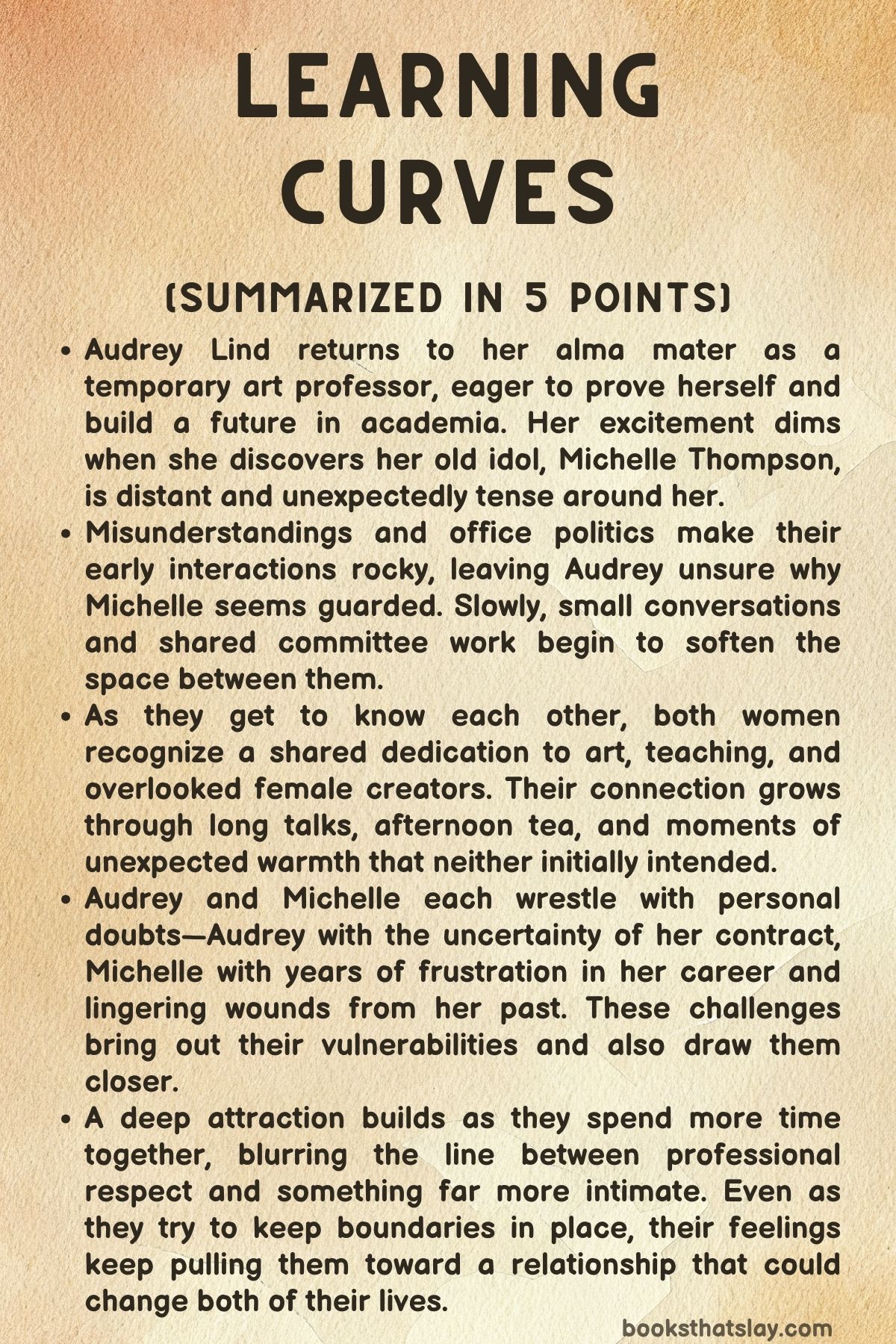
Learning Curves by Rachel Lacey follows Audrey Lind, a young ceramics and art history professor returning to her Vermont alma mater, where she crosses paths with Michelle Thompson, the brilliant art historian who once inspired her. Audrey hopes for a fresh academic start, while Michelle is worn down by a stalled career and lingering heartbreak.
What begins as awkward tension grows into a complicated, tender, and deeply personal connection. The novel explores ambition, academic politics, rediscovering passion, and falling in love at unexpected moments. At its core, the story traces two women learning to trust themselves—and each other—while fighting for the lives they want.
Summary
Audrey Lind arrives at Northshire University ready for her one-year teaching contract, believing it could be the start of something permanent. She is thrilled to have her own office and even more thrilled to discover it sits across from Michelle Thompson, the senior professor whose class once changed her life.
But their reunion is far from warm. Michelle, stressed and disillusioned with her career, has just learned that Audrey will be teaching a Women in Art seminar she had been proposing unsuccessfully for years.
Feeling replaced and dismissed, she reacts coldly, leaving Audrey confused and hurt.
As Audrey settles in, she begins building her courses, improving accessibility for her students, and navigating the subtle condescension she faces as the department’s new and youngest hire. She is also placed on the Sustainability Committee, where her ideas are routinely brushed aside.
Michelle, meanwhile, begins the semester teaching disengaged students and questioning the path that once excited her. Though she tries to ignore Audrey, seeing her only intensifies her sense of professional stagnation.
Their interactions shift after a difficult committee meeting in which Michelle becomes visibly uncomfortable because the restroom is out of order. Audrey creates an excuse to help her step out, allowing Michelle to find another restroom.
Michelle is mortified, reacts sharply, then later realizes she owes Audrey an apology. The conversation that follows becomes their first genuine moment of connection.
Michelle, usually private and proper, acknowledges her behavior and opens the door to a tentative friendship.
At a department gathering, they talk away from the crowd, easing into a more personal conversation for the first time. Audrey learns about Michelle’s recent divorce and lingering loneliness, while Michelle learns about Audrey’s hopes for a stable academic career.
Their shared love of art sparks a natural closeness that surprises them both. Michelle goes home that night with a revived spark she hasn’t felt in years.
Over the following weeks, they orbit each other more closely. Audrey observes Michelle’s class and sees a woman worn down, far from the vibrant professor she once knew.
Michelle visits Audrey’s office, admiring her ceramics and rediscovering the joy of connecting with a passionate younger academic. They drink tea together, exchange stories, and form a friendship that grows deeper than either intended.
Michelle becomes increasingly aware that her attraction to Audrey has resurfaced—and grown stronger. Audrey feels the same but worries about risking her fragile career.
Their bond pushes past friendship when Michelle visits Audrey’s home studio. Watching Audrey work on the pottery wheel is unexpectedly intimate, and after sharing wine and laughter, Michelle agrees to try throwing clay herself.
Audrey guides her closely, hands over hands, and the moment turns electric. Audrey draws tiny clay hearts on Michelle’s arms, and Michelle finally kisses her, leading to a heated exchange that leaves them breathless—and terrified.
Michelle pulls away, overwhelmed by their age difference and their professional history. Audrey steadies them by cooking dinner, and they talk honestly about the risks.
They decide, with difficulty, to step back and protect their careers.
Despite this decision, their connection keeps growing. They share tea, text throughout Thanksgiving break, and seek each other’s company in ways neither can disguise.
When Michelle secretly slips into Audrey’s Women in Art lecture, she is both proud and emotional. Audrey finds her afterward, and the attraction they’ve been suppressing rushes forward again.
Audrey kisses her this time, and neither of them wants to stop. They go to Michelle’s home, where their desire finally takes over—until Michelle’s unresolved fears interrupt the moment.
Their relationship is rekindled at Christmas. Michelle endures a painful holiday with her homophobic family in the UK, escaping their judgment by texting Audrey.
Their phone call keeps her grounded. When she returns to Vermont, Audrey surprises her with a warm celebration, complete with decorations and homemade gifts.
They confess they want to be girlfriends, discuss their pasts, exchange meaningful presents, and deepen their relationship physically and emotionally.
They spend winter break building a life together—skiing, working, sharing space, and imagining a future. Michelle admits she loves Audrey and doesn’t want to return to the UK; Audrey confesses the same.
Their happiness fractures when Audrey is told her contract will not be renewed due to budget cuts. Devastated, Audrey tries to cope while Michelle discovers the department plans to give her Audrey’s popular course.
Furious, Michelle refuses and then quits her tenured position entirely, realizing she no longer wants the career that has been draining her for years—and that she would rather ensure Audrey gets the chance she deserves.
Audrey is overwhelmed and initially lashes out, but they quickly reconcile. They decide to job-hunt together, even considering moving to London.
Michelle soon secures remote work writing history textbooks, allowing her to continue the novel she has been researching. Audrey continues applying widely.
A week later, the department chair informs Audrey that a new tenure-track position has opened—Michelle’s former job combined with the Women in Art course. The role is hers if she wants it.
Audrey happily accepts, checking first that Michelle truly wants to remain in Vermont. Michelle does, and she asks Audrey to move in with her.
Months pass, filled with stability, shared work, and growing joy. Michelle lands a three-book publishing deal, rushes to Audrey’s office to celebrate, and the two embrace their future with certainty.
They decide to get married, ready to build the life they once thought they couldn’t have.
Characters
Audrey Lind
Audrey is introduced as a newly hired assistant professor returning to Learning Curves’ Northshire University with a mix of excitement, idealism, and insecurity. Her character is shaped by her passion for ceramics and women’s art, her eagerness to prove herself in a precarious one-year contract, and a warm, earnest personality that makes her both easily likable and occasionally vulnerable to being underestimated.
Audrey’s deep care for her students shows immediately, especially in how she adapts her teaching for Laya, her deaf student, and later in the emotional investment she brings to her Women in Art course. The more time she spends at Northshire, the more her growth becomes evident—she learns to navigate academia’s politics, recognize subtle biases, and maintain her integrity without losing her kindness.
Her relationship with Michelle becomes a significant axis of her development. What begins as admiration for a former professor evolves into a slow-burn emotional and intellectual connection that pushes Audrey to examine her own desires, boundaries, and ambitions.
She experiences moments of hurt, jealousy, longing, and courage—each shaping her into someone more assertive and secure. A major element of her character is her sincerity: she cooks when conversations need calming, offers handmade gifts to communicate affection, and uses her art to show love.
Even when overwhelmed by fear after losing her job, Audrey regains her footing through resilience and an underlying belief that she deserves a fulfilling career and relationship. By the end, she transforms from a young academic hoping for a place in the institution into someone who recognizes her worth, claims her space, and embraces a future built on mutual support and love.
Dr. Michelle
Michelle begins the story as an elegant, somewhat aloof senior art historian whose reputation has cooled into “difficult,” but this façade masks years of disappointment, isolation, and suppressed longing. In Learning Curves, she is a woman caught between worlds—between the UK she still misses and the American life she built with a marriage that ended painfully; between the vibrant scholar she once was and the exhausted academic she has been pushed into becoming; between propriety instilled since childhood and her own buried desires.
When Audrey reappears in her life, Michelle’s carefully managed emotional distance begins to crack. Her prickle of resentment toward Audrey’s new course exposes deeper wounds: unfulfilled ambitions, gatekeeping she has endured, and a fear that her work is losing relevance.
As she spends more time with Audrey, the softness beneath her sharp edges emerges. Michelle apologizes when she behaves unfairly, opens up about her past, and slowly allows herself to feel attraction again after years of numbness.
This vulnerability becomes central to her arc. Michelle is meticulous, sometimes anxious, and often self-critical; she battles insecurities about age, desirability, and professional stagnation.
Yet she also possesses an enormous capacity for devotion and tenderness when she finally lets herself love freely. Her decision to resign—giving up her tenure not as a sacrifice but as an act of reclaiming her own life—is the culmination of long-standing disillusionment and newfound clarity.
By the end, she embraces a future defined not by institutional approval but by happiness, meaningful work, and a committed partnership.
Mercy Juma
Mercy serves as both friend and grounding force in Audrey’s life. Her character represents the academic colleague who has managed to survive the system long enough to understand its unwritten rules, but who remains keenly aware of its flaws.
She is perceptive, opinionated, sometimes exasperated by the “old guard,” and deeply protective of Audrey. Mercy provides a counterpoint to Michelle’s initial aloofness—she is frank where Michelle is restrained, warm where Michelle is guarded, and outspoken about the institutional dynamics Audrey hasn’t yet learned to navigate.
She is also one of the first to notice Audrey’s developing feelings for Michelle, acting as both a mirror and a reality check. Mercy’s presence highlights themes of mentorship, female camaraderie, and the importance of having allies in academia.
Stuart Hollinger
Stuart embodies the entrenched, mildly patronizing academic chair who is not malicious but is deeply shaped by institutional inertia. His character, while not villainous, represents the systemic barriers faced by women in academia—especially younger women and faculty of color.
He praises recycling while dismissing meaningful sustainability reforms; he compliments Audrey while simultaneously undermining her proposals; he repeatedly denies Michelle’s long-fought Women in Art course only to hand it easily to Audrey. Stuart’s decisions have consequences: they contribute to Michelle’s bitterness, Audrey’s frustrations, and ultimately the upheaval that reshapes both women’s careers.
He is a reflection of the quiet complacency that can be just as harmful as overt discrimination.
Brad Folchuk
Brad is another representative of institutional sexism, though in a more casually dismissive form. His request that Audrey bring snacks to committee meetings reveals how he unconsciously assigns domestic labor to young women, reinforcing gendered expectations.
Brad’s character deepens the contrast between Audrey’s desire to contribute intellectually and the department’s tendency to minimize her role. He functions less as a full character and more as a symbolic obstacle—an example of the everyday biases that female academics must continually navigate.
Laya LaRue
Laya, Audrey’s deaf student, appears briefly but meaningfully. Her presence reveals Audrey’s compassion and adaptability as a teacher.
Audrey’s eagerness to ensure accessibility for Laya not only underscores her commitment to inclusive pedagogy but also highlights her growth as a confident and innovative instructor. Laya’s engagement in class serves as a quiet affirmation of Audrey’s effectiveness and humanity.
Colin (Mercy’s Husband)
Colin serves primarily as support for Mercy and, by extension, Audrey. His role is subtle but grounding: he represents stability, domesticity, and the kind of warm, welcoming adult life Audrey herself longs to create.
His presence in social settings makes the academic world feel less isolating and provides contrast to the tension Audrey experiences at work.
Kelly (Michelle’s Ex-Wife)
Kelly’s character is revealed mostly through Michelle’s memories and reflections. She symbolizes a relationship where Michelle constantly felt inadequate, judged, or unable to express her full self.
Kelly’s expectations reinforced Michelle’s need for propriety and emotional restraint, contributing to years of repressed desire. Kelly is not portrayed as monstrous, but as someone whose relationship with Michelle ultimately suffocated rather than supported her.
Understanding Kelly helps illuminate Michelle’s insecurities and explains her initial hesitancy with Audrey.
Kate
Kate, Michelle’s best friend, brings humor, honesty, and emotional grounding to Michelle’s life. She is the friend who sees through Michelle’s walls, understands her patterns, and offers enthusiastic support when Michelle finally falls in love again.
Her presence emphasizes the importance of chosen family, especially for queer women who have faced rejection elsewhere. Kate also helps Michelle contextualize her feelings, serving both as confidant and cheerleader.
Muse
Muse, Michelle’s temperamental cat, functions symbolically as well as literally. She mirrors Michelle’s emotional guardedness—aloof, particular, slow to trust.
When Audrey teaches Michelle how to pet Muse properly and Muse finally responds with affection, it parallels Michelle learning how to let herself be loved again. Muse’s gradual acceptance of Audrey symbolizes the growth of intimacy and partnership between the two women.
Daniel
Daniel, the great-grandson of the artist Michelle is researching, plays a small but pivotal role. His acceptance of Eliza and Ada’s queer history not only validates Michelle’s scholarly work but also gives her a sense of purpose and excitement she has not felt in years.
Daniel represents genuine support—something Michelle has rarely experienced in academia—and his approval becomes a catalyst in her decision to break free from an institution that continually minimized her voice.
Additional Students and Colleagues
The general student body and colleagues—phone-absorbed undergraduates, older committee members, and skeptical faculty—collectively represent the broader academic environment. They contribute to the pressure, disillusionment, and shifting power dynamics that shape the experiences of both Audrey and Michelle.
Their presence forms the backdrop against which personal growth, ambition, frustration, and love unfold.
Themes
Ambition, Career Pressure, and the Cost of Academia
In Learning Curves, ambition is not portrayed as a simple upward arc but as a force that shapes identity, self-worth, and emotional vulnerability. Audrey arrives at Northshire full of hope, carrying the weight of a one-year contract and the dream of building a permanent academic life.
The unpredictability of contingent labor defines her mindset: every lecture, every committee meeting, every interaction might determine her future. Her eagerness to contribute, combined with the subtle pressure of needing to appear competent and indispensable, turns daily tasks into tests of professional survival.
Michelle’s trajectory reveals the opposite end of the academic spectrum. She once entered the field with passion and promise, yet years of institutional stagnation, unacknowledged proposals, and dismissive colleagues wear her down.
Her dream course is handed to someone else; her scholarship is undervalued; her teaching is ignored by distracted students. The book shows how academia can chip away at once-vibrant teachers until they question their belonging.
Ambition becomes bittersweet when Michelle realizes her accomplishments no longer bring her fulfillment. Their contrasting positions—Audrey aspiring upward, Michelle questioning the value of having “made it”—create a rich exploration of how the academy shapes people differently depending on where they stand.
Both women also confront how institutional decisions can destabilize their emotional lives: Audrey’s job insecurity influences her romantic restraint, while Michelle’s disenchantment intensifies her loneliness and longing. The book suggests that ambition must be balanced with a sense of humanity, as professional validation alone cannot nourish a life.
Ultimately, both characters discover that career success is meaningful only when paired with supportive relationships, personal growth, and the courage to leave structures that no longer serve them.
Power Dynamics, Age Difference, and Ethical Boundaries
The relationship between Audrey and Michelle is shaped from the beginning by uneven power structures—former professor and student, seasoned academic and newcomer, established scholar and contract employee. The book examines how these imbalances generate hesitation, fear, and a need for constant ethical negotiation.
Michelle, older and more professionally secure, feels the burden of responsibility more acutely; she fears becoming another colleague who abuses authority or crosses boundaries for selfish desire. Her internalized rules about propriety and her past experiences witnessing inappropriate academic relationships color every interaction with Audrey.
Even when attraction builds naturally through shared interests and mutual respect, Michelle instinctively restrains herself, believing that desire must yield to professionalism. Audrey, though younger, is not powerless, yet her precarious employment intensifies the stakes of any romantic step.
If their relationship becomes public or if conflict emerges, she stands to lose far more. This unequal risk shapes her decision to prioritize career safety even when her feelings deepen.
Their first kiss, set off by genuine chemistry rather than predatory intent, still triggers panic because both recognize the societal lens through which age-gap relationships, especially in academia, are scrutinized. The story shows that power dynamics are not only structural but emotional—Michelle worries about being perceived as taking advantage, while Audrey worries about being underestimated or infantilized.
Their eventual relationship succeeds only because they commit to transparency, mutual consent, and vigilant self-awareness. By portraying their love as something that grows through communication and shared vulnerability rather than impulse, the book challenges simplistic narratives about age-gap romances, revealing how two people with unequal standing can still create a partnership grounded in equity and respect.
Feminism, Gender Bias, and the Institutional Old Guard
The novel highlights the subtle yet persistent ways institutions uphold gendered expectations. Audrey enters the Sustainability Committee eager to contribute ideas, only to be dismissed by older male colleagues who treat environmental issues as minor inconveniences rather than opportunities for meaningful change.
Their quickness to assign her snack duty exposes how gendered labor continues to surface in academic spaces: women are expected to soothe, accommodate, and fill domestic roles even in professional settings. Michelle, though more senior, faces a different kind of bias.
Her Women in Art course—a scholarly project rooted in real academic need—is repeatedly denied without justification, only to be approved the moment a younger woman proposes it. The decision suggests the institution prefers novelty and marketable enthusiasm over long-term intellectual dedication, and it implicitly punishes Michelle for aging in a field that often valorizes fresh faces.
Her frustration is not jealousy alone but the pain of watching gender-focused scholarship treated as optional or trendy rather than essential. The book also addresses queer women’s representation in art and academia through their shared research on neglected female artists.
By centering figures like Eliza St. Claire and Ada, the narrative critiques how queer women’s histories are erased, sanitized, or rendered invisible.
Audrey’s choice to design her syllabus around overlooked female artists becomes a political act, while Michelle’s research gains new personal resonance as she rediscovers her own desire and authenticity. The institutional old guard—exemplified by dismissive administrators, resistant colleagues, and stagnant structures—serves as a reminder that progress for women often requires pushing against traditions that have long normalized exclusion.
Through both protagonists, the story shows how women persist, innovate, and challenge systems even when support is inconsistent.
Rediscovery of Desire, Intimacy, and Emotional Healing
Michelle’s emotional journey is one of reawakening after years of emotional drought and marital dissatisfaction. Her early scenes reveal a woman who has suppressed longing for so long that she barely recognizes attraction when it resurfaces.
The book allows her desire to emerge gradually: a lingering conversation, a shared walk, the tenderness of being seen again. For Michelle, intimacy is not merely physical but a reclaiming of self after a stifling past relationship marked by withdrawal, disappointment, and unspoken hurts.
Audrey, in contrast, approaches desire with the fresh intensity of someone still learning to balance romance with professional survival. Her attraction is immediate, but she tempers it with caution, aware that acting on feeling could jeopardize her future.
Their connection becomes a mutual healing process. In Audrey, Michelle finds someone who values her mind, her scholarship, and her vulnerability; in Michelle, Audrey finds someone who takes her ambition seriously and nurtures her confidence.
Their early intimate moments are charged not only with chemistry but with emotional risk, as both fear ruining something precious. Even their conflicts deepen their bond by forcing them to confront insecurities—Michelle’s fear of repeating past mistakes, Audrey’s fear of being seen as unprofessional or naïve.
The novel treats queer intimacy with care, showing that desire between women can be powerful, tender, and transformative. It emphasizes that healing often requires the courage to be known by another person, and that love can rekindle parts of the self long thought dormant.
Their physical and emotional closeness ultimately becomes a sanctuary, one that helps both women imagine futures shaped by joy rather than compromise.
Identity, Belonging, and the Search for Home
Both protagonists grapple with questions of belonging—professionally, geographically, and emotionally. Audrey is far from home, building a life in Vermont on temporary circumstances.
Everything she owns, teaches, or dreams about feels contingent, dependent on the university’s decisions. This instability leaves her feeling unanchored despite loving her work.
Her pottery becomes a literal act of grounding herself, each piece forming a claim to place and purpose. Michelle faces a different displacement.
Though she has lived in Vermont for years, she remains emotionally tied to the UK, yet unable to return because it no longer feels like a welcoming home. Her strained family relationships and the homophobic environment she grew up in push her into a perpetual in-between state.
She belongs everywhere and nowhere, caught between nostalgia and alienation. The university had once offered a safe haven, but as her career stalls and her passion wanes, even that space begins to feel foreign.
Their relationship becomes the catalyst for both to redefine home not as a fixed location but as a place created through connection. With Audrey, Michelle feels grounded enough to stop chasing external validation, and with Michelle, Audrey finds stability despite career uncertainty.
Their shared routines—tea, afternoons in each other’s offices, winter break together—shape an emotional home long before they decide to live together. When facing job loss and career upheaval, they choose to navigate change side by side.
The idea of home ultimately evolves into something reciprocal, a mutual choice rooted in love and shared dreams rather than geography or institutional belonging. Their final decision to marry affirms that belonging is built through commitment, vulnerability, and the willingness to build a future together.