Leave Me Behind Summary, Characters and Themes
Leave Me Behind by K M Moronova is a dark military romance built around trauma, survival, betrayal, and obsession. It follows Nell, a deadly operative who has already lost almost everyone she trusted, as she is forced into a brutal new squad led by men as damaged and dangerous as she is.
At the center of the story is her connection with Bradshaw, a soldier marked by grief, violence, and a past he cannot escape. The book mixes squad missions, captivity, psychological scars, and a fierce love story that grows out of pain, mistrust, and repeated battles to stay alive.
Summary
The story opens with a devastating memory from two years earlier in Patagonia, where Bradshaw is trapped in the middle of a failed mission with his dying teammate Abrahm, known as Bones. Abrahm has been fatally wounded, and as the firefight continues around them, Bradshaw realizes there is nothing he can do to save him.
In Abrahm’s final moments, Bradshaw removes the mask that has hidden his identity and tells him his real name, offering a last act of honesty before Abrahm dies. That loss brands Bradshaw permanently, leaving him driven by grief and revenge.
In the present, Nell is introduced as the only survivor of Riøt Squad, the team destroyed in that same Patagonia disaster. Instead of being treated like someone who endured the impossible, she is transferred to Malum Squad, a feared and notoriously vicious unit.
On her way to California, she meets two brothers on the flight, Eren and Bradshaw, though she does not immediately realize they are twins. Eren is charismatic and open, while Bradshaw is silent, scarred, and intimidating.
Nell is drawn first into Eren’s easy charm, but Bradshaw’s darker presence lingers in her mind.
That night, Eren invites Nell out for drinks. At the club, however, the attention between Nell and Bradshaw takes over.
He watches her dance from a distance, then steps in when another man gets too close. Their chemistry quickly turns consuming, and when Eren returns, he openly admits that he had hoped Nell and Bradshaw might connect.
Nell and Bradshaw leave together and return to her hotel, where they sleep together in an encounter charged with intensity, restraint, and emotional danger. Afterward, their connection continues in quieter ways as they talk in a diner, sharing hints of the darkness inside them.
Bradshaw calls himself a devil, Nell calls herself a reaper, and both reveal pieces of their pain without telling the whole truth.
Everything changes when Bradshaw reveals he knows Nell’s real name, Penelope Gallows. Nell realizes he belongs to the same secret dark forces world she does, and the shock deepens when she arrives at base the next day and discovers the truth.
Eren is Malum’s sergeant, and Bradshaw is the very operative she feared most. Worse, he is now her superior and assigned partner.
The squad immediately turns hostile, blaming Nell’s former team for old losses and mocking her survival. They give her the humiliating codename Bunny and make it clear she is not wanted.
Bradshaw is among the cruelest, accusing her of failing her former partner the same way he believes people failed his dead teammate.
Nell refuses to quit, partly out of pride and partly because she suspects her transfer is tied to what really happened in Patagonia. Soon she joins Malum on a grueling training deployment in the Rocky Mountains.
From the beginning, she is isolated. Bradshaw rejects any attempt at peace, though Nell proves quickly that she is skilled and dangerous.
During the mission, she helps detect hidden enemies, performs well under pressure, and shows she can match the team’s standards. Even so, the resentment around her does not fade.
During the days that follow, Nell and Bradshaw cycle between hostility and fragile understanding. They briefly apologize to each other for cruel words about the dead people they loved, but that moment of honesty never lasts.
When Eren pairs them together for field exercises, Bradshaw deliberately abandons Nell during a brutal climb, hoping she will fail and quit. Instead she fights her way forward alone, catches up to him, and attacks him in fury.
Their conflict turns physical, violent, and deeply personal. Eren later explains that Bradshaw’s cruelty may come from fear, because losing another teammate feels unbearable to him.
That fear twists into something even uglier. While on watch duty, Bradshaw lures Nell away from camp and, with help from two others, tries to terrorize her into quitting.
The assault goes too far, leaving Nell injured and shaken. Even the others are horrified once they understand the damage done.
Bradshaw remains consumed by guilt and rage, yet he cannot stop trying to drive her away. Nell, however, refuses to report everything because she is determined to survive Malum and uncover the truth behind Patagonia on her own.
As training continues, Nell keeps proving herself. She fights hard, outperforms expectations, and refuses to break.
Bradshaw and Nell spar again and again, their violence tangled with attraction neither of them can control. During a final mock raid, Nell excels as overwatch, protecting the squad and completing her role flawlessly.
Still Bradshaw cannot let go of his resentment. After the mission, he attacks her again near a cliff, and they both fall.
Injured but alive, they are forced into brief closeness as Bradshaw tends to her wound. His behavior keeps shifting between hatred, care, and desire.
Later, after Nell speaks openly with some of the others about Patagonia and the day her own squad died, Bradshaw overhears and suffers a severe breakdown tied to Abrahm’s death. Nell stays with him when he becomes unstable, and in that fragile state the barrier between them weakens.
Comfort turns intimate, and Bradshaw admits how obsessed he is with her, how deeply she disturbs him, and how impossible it has become to separate his rage from his need for her. Nell gives in to the pull between them even while recognizing how dangerous it is.
Their relationship becomes even more complicated when Eren catches them together. He is frustrated by the chaos they create, aware that they hurt each other constantly yet cannot stay apart.
He warns Nell not to become too entangled in things she does not understand. Around the same time, flashbacks deepen Nell’s history with her former superior Jenkins, showing how he shaped her into a ruthless operative and tied her loyalty to him through violence and manipulation.
Soon Malum is assigned to a new Level Black mission in Labrador. By then, Eren has discovered that Bradshaw was the real target in past attacks and that someone may be betraying them from within.
Nell is ordered to act as Bradshaw’s double to confuse the enemy. The arrangement forces them even closer and stirs Bradshaw’s fear that she will die because of him.
The mission quickly collapses when they are captured and taken to a remote fortified compound.
Inside the compound, Nell is separated from Bradshaw and imprisoned. She keeps control of herself, trying to survive long enough to understand what is happening.
Eventually she is taken upstairs and confronted by a masked commander who humiliates her and uses terror as a weapon. She is led to believe Bradshaw is badly hurt, only to discover the injured man is actually Eren.
The situation becomes even worse when Bradshaw is brought in and all three are exposed to the cruelty of the people holding them.
Then the truth is revealed: Jenkins, whom Nell believed dead, is alive and leading the Ghosts. He kills his own subordinate for touching Nell and calmly explains that he has manipulated her for years, using her to kill on his behalf and shaping her life through lies.
He admits that he spared her long ago because of his attachment to her. Nell is devastated by the realization that the man she once trusted most had turned her into an instrument for his own plans.
To save Bradshaw and Eren, Nell makes a terrible choice. She offers to stay with Jenkins if he releases the brothers.
Bradshaw confesses that he loves her, but Nell cannot give him what he needs, because pushing him away is the only way she can keep him alive. Jenkins honors the bargain, and Bradshaw is forced to leave without her.
Three years pass. Nell lives under Jenkins’s control in a life that looks comfortable on the surface but is still a prison.
She never stops thinking about Bradshaw, and Jenkins knows her heart is not truly his. At last, when Jenkins is away, Bradshaw returns for her.
Their reunion is emotional and immediate, full of love, relief, and the weight of everything they lost. Bradshaw reveals he has been searching for a way to get her back for years.
They attempt an escape with the help of the remaining members of Malum. For a brief moment it seems possible that they might get out alive, but the retreat turns brutal.
Harrison is shot. Eren sacrifices himself when he steps on an explosive and orders the others to keep moving.
Pete and Jefferson are later killed in the fighting. Jenkins himself arrives, leading to a final confrontation in which Bradshaw nearly beats him to death.
Nell asks to end it herself. She kneels beside Jenkins, tells him she loves him, sings to him, and then shoots him in the head, closing the darkest chapter of her life with both mercy and judgment.
In the aftermath, Paul unexpectedly rescues Eren, who survives despite catastrophic injuries. The survivors reach extraction and escape Labrador.
Later, after recovery in the hospital and years of pain behind them, Nell and Bradshaw finally build a life together. Five years later, they are living quietly in Scotland with their son Nathan and Eren nearby.
Their losses remain with them, but after years of violence, betrayal, and survival, they have made something peaceful out of what was left.
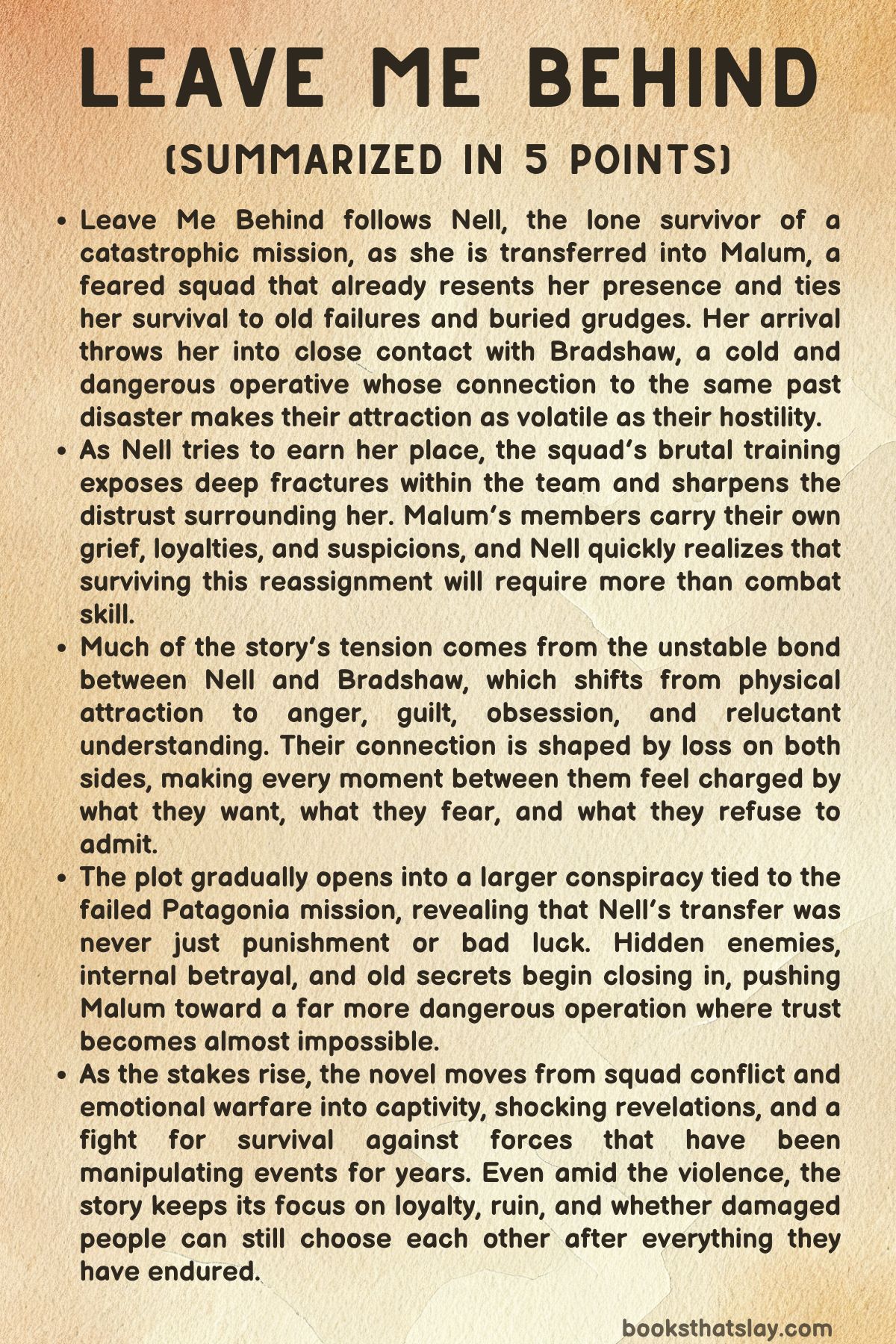
Characters
Nell / Penelope Gallows
Nell stands at the center of the story as a survivor shaped by violence, betrayal, and endurance. She begins as the lone remaining member of Riøt Squad, carrying the emotional ruin of Patagonia and the heavy burden of outliving everyone she once fought beside.
That survival does not bring respect or comfort. Instead, it isolates her further, because other people see her survival as suspicious, shameful, or undeserved.
This gives her character a constant defensive edge. She is always assessing danger, always expecting hostility, and always trying to stay one step ahead of people who may want to use or break her.
Her strength is not presented as simple toughness. It is tied to pain, discipline, and a deep willingness to keep functioning even when she is physically hurt or emotionally cornered.
What makes Nell especially compelling is the contrast between her sharp competence and her internal damage. She is a skilled sniper, observant, adaptable, and relentless under pressure, but beneath that control is someone starved for trust and stability.
Her connection to Jenkins explains much of this contradiction. He trained her, shaped her, and emotionally marked her in ways that left her with a warped understanding of loyalty, love, and violence.
Because of that history, Nell often responds to intimacy and cruelty as if they are tangled together. Her bond with Bradshaw grows from that same unstable ground.
She resists him, wants revenge on him, fears him, and still feels drawn toward him. That conflict is not weakness in her characterization.
It reveals how thoroughly her past has distorted her emotional instincts. Over the course of the story, Nell becomes more than a victim, more than a soldier, and more than a survivor.
She becomes someone forced to examine what parts of herself were created by others and what parts still belong to her. Her final arc carries real weight because her peaceful future does not erase what happened to her; it shows that she has fought hard enough to claim a life beyond it.
Bradshaw / Bones
Bradshaw is built as a figure of danger long before his deeper emotional life becomes visible. At first he appears cold, scarred, threatening, and almost impossible to read.
His silence gives him an intimidating presence, and his violence makes him seem nearly inhuman to those around him. Yet the story gradually reveals that this brutal exterior is the shell around a man shattered by grief.
The death of Abrahm, whom he calls Bones in a deeply personal way, is the defining wound of his life. That loss does not remain in the past.
It invades every decision he makes, especially in the way he treats Nell. He projects fear, blame, longing, and unresolved trauma onto her, because she arrives as both a reminder of catastrophic loss and an unexpected object of desire.
His hostility is therefore never just cruelty for its own sake, even when his actions become inexcusable. It is the behavior of someone who has been emotionally deformed by survival and no longer knows how to separate protection from destruction.
Bradshaw’s character is effective because he is always divided against himself. He is capable of tenderness, guilt, possessiveness, tenderness again, and then renewed violence.
He wants Nell gone, yet cannot stop watching her. He harms her, then checks on her in secret.
He tries to reject his own humanity, speaking of himself as an animal or devil, but his attachment to others proves that he is not beyond feeling. That contradiction makes him both disturbing and tragic.
He is not a clean redemption figure. The story allows him to remain damaged, obsessive, and morally compromised while still exposing the depth of his suffering.
His relationship with Eren also adds texture to his character, because it shows that beneath his savage reputation is someone who has always depended on his brother to stabilize him. By the end, Bradshaw’s evolution matters because he is not cured of darkness; rather, he becomes capable of choosing love, loyalty, and care without fully losing the hard edges that experience carved into him.
That complexity gives him force as both romantic lead and wounded antihero.
Eren
Eren is one of the most layered characters because he initially appears to be the easier, warmer counterpart to Bradshaw, but he gradually reveals himself as far more complicated than the charming brother Nell first meets on the plane. He is socially skilled, playful, and emotionally perceptive, which allows him to move through tense situations with a calm Bradshaw never possesses.
This warmth makes him immediately likable, yet it also hides a strategic mind. Eren sees people clearly, often before they understand themselves, and he uses that insight to manage both his squad and the emotional instability around him.
He recognizes the attraction between Nell and Bradshaw almost at once, and instead of being surprised by it, he tries to control its fallout. That makes him feel like a mediator, but also like someone who is always calculating outcomes.
His importance goes beyond being a brother or sergeant. Eren often functions as the fragile barrier between order and collapse.
He leads Malum, carries operational secrets, and bears the burden of making decisions that may sacrifice people for a larger objective. At the same time, he is emotionally entangled in everything he is supposed to control.
He cares for Bradshaw deeply, fears what vulnerability might do to him, and views Nell as both a threat and a possible source of salvation. His own intimacy with Nell adds another layer, because it complicates the emotional geometry of the story without reducing him to a simple rival.
Instead, it shows his loneliness, curiosity, and need for closeness in a world where most bonds are shaped by violence. Eren’s eventual suffering and sacrifice deepen his role further.
He is not simply the steadier twin. He is someone who spends much of the story holding together people and structures that are already breaking.
That makes his survival meaningful, because it feels earned through pain rather than guaranteed by narrative function.
Jenkins
Jenkins is one of the most unsettling figures in Leave Me Behind, because he occupies multiple roles at once: mentor, protector, manipulator, abuser, and eventual architect of enormous destruction. In Nell’s memories, he initially appears as the one person she could trust in a brutal world.
He teaches her how to survive, how to kill, and how to interpret danger. His influence over her is so complete because he mixes practical protection with emotional possession.
He gives her purpose, shapes her instincts, and becomes the center of her understanding of loyalty. That history makes his later return devastating.
He is not merely a villain reappearing after presumed death. He is the source of Nell’s worldview, the person who helped construct the version of her that exists in the present.
What makes Jenkins especially powerful as a character is his calmness. He is not chaotic or theatrical in the usual sense.
His cruelty is intimate, deliberate, and controlled. When he reveals that he survived and used Nell as his instrument for years, the horror lies not only in what he did but in how naturally he integrated domination into care.
He genuinely feels attached to her, which makes him more disturbing rather than less. His affection does not humanize him into innocence; it exposes how thoroughly he confuses love with ownership.
Even his treatment of Bradshaw and Eren is driven by power, revenge, and emotional calculation. He understands exactly how to break people by turning their attachments against them.
Yet the story also avoids making him feel hollow. His bond with Nell, however poisoned, is real enough to carry emotional force in his final scenes.
When she kills him, the moment lands because the relationship cannot be dismissed as fake from her side or from his. Jenkins is a portrait of corrupted intimacy, and his presence casts a shadow over nearly every major emotional decision Nell makes.
Abrahm / Bones
Abrahm has limited page presence compared to the central trio, but his emotional significance is immense. His death in Patagonia is the event that defines Bradshaw’s pain and shapes much of the hostility that follows.
In his final moments, Abrahm is shown as more than a fallen comrade. The scene between him and Bradshaw is intimate, vulnerable, and stripped of the emotional armor soldiers usually maintain.
Bradshaw reveals his real name to him, which immediately signals that Abrahm held a uniquely important place in his life. Because of that, Abrahm’s death becomes more than battlefield tragedy.
It becomes the breaking point that leaves Bradshaw psychologically trapped between grief and rage.
As a character, Abrahm represents loyalty, closeness, and the unbearable cost of attachment in this violent world. Even in absence, he remains present through memory, comparison, and emotional projection.
Bradshaw’s inability to move beyond him affects how he sees Nell and how he responds to the possibility of caring for another partner. Malum’s collective grief over him also shows that Abrahm was not only significant to Bradshaw but respected by the wider squad.
That helps explain why Nell’s arrival is received with such resentment. She enters a space still organized around mourning him.
In this sense, Abrahm functions almost like a ghost inside the story. He is gone, but he continues shaping relationships, fear, blame, and desire.
Characters speak around him, react because of him, and measure each other against the loss he left behind.
Jefferson
In Leave Me Behind, Jefferson begins as part of the hostile machinery of Malum, one of the men who helps make Nell’s early time with the squad miserable. He is complicit in the cruelty directed toward her, and that includes one of the darkest moments in the story when intimidation turns into serious assault.
This makes him morally compromised in a way that cannot be softened. At the same time, the book presents him as someone whose conscience is not completely dead.
Once the situation goes too far, he is horrified, and he becomes one of the first to react with urgency rather than continued brutality. That does not erase his role in what happened, but it does show that he is not as emotionally sealed off as Bradshaw tries to be.
Jefferson’s later scenes help expand him beyond mere squad hostility. He becomes one of the people who eventually shares information, speaks more openly, and participates in the group’s shift away from treating Nell as an enemy.
His presence reflects one of the story’s recurring ideas: that people shaped by violent systems often become cruel by habit, group loyalty, and grief before they fully reckon with what they are doing. Jefferson is not presented as pure-hearted underneath it all.
Instead, he feels like a damaged soldier whose better instincts are inconsistent and late. That gives him realism.
His death during the escape has impact because by then he has become part of the fragile collective effort to save Nell and survive together. He ends up representing the possibility of partial moral return in a world where redemption is never neat.
Pete
Pete occupies a role similar to Jefferson in the early squad dynamic, contributing to the atmosphere of contempt and aggression that defines Nell’s initiation into Malum. He is another example of how group grief hardens into cruelty, especially when the squad chooses Nell as the target for emotions they cannot properly process.
In the assault sequence, Pete’s participation marks him as deeply culpable, even though he too recoils when things cross an undeniable line. Like Jefferson, he is never cleansed of that wrongdoing.
The story instead treats him as someone trapped in a culture where brutality becomes normalized until individual conscience suddenly reasserts itself.
As the narrative progresses, Pete becomes less of a faceless enforcer and more of a member of the larger team struggle. That transition matters because it shows how Nell’s competence and endurance gradually force Malum to confront her as a person rather than a symbol of everything they hate.
Pete’s later role in the rescue effort and escape gives him a degree of hard-earned solidarity, even if it does not absolve his past actions. His death carries emotional weight for the same reason Jefferson’s does: not because he becomes innocent, but because he becomes part of the human cost of trying to undo a larger machinery of betrayal and violence.
He stands as one more reminder that nearly everyone in this story is morally damaged, and that loss falls on the compromised as well as the noble.
Ian
Ian is one of the steadier presences within Malum and helps ground the team dynamic with a more professional and observant energy. He is less driven by explosive emotion than Bradshaw and less outwardly dominant than Eren, which makes his role quieter but still important.
His reconnaissance work with Nell highlights his practical respect for skill. He sees what she can do in the field, and this helps create a subtle counterweight to the squad’s more irrational resentment.
Ian’s conversations with Nell later in the story also matter because they help connect personal grief to the larger operational mystery surrounding Patagonia and Abrahm’s death.
What defines Ian most is competence without theatricality. He feels like the kind of soldier who measures people by usefulness and truth rather than by loud declarations of loyalty.
In a story crowded with obsession, jealousy, and emotional extremes, that restraint makes him valuable. He contributes to the gradual transition of the squad from hostile unit to damaged alliance.
Even when he is not the focus of major emotional scenes, he helps the story breathe by representing a more stable military realism. His presence gives credibility to the team structure and helps show that Malum is not composed only of unstable personalities.
Some members are simply trying to do the work, understand the threat, and survive it.
Harrison
Harrison is another secondary squad member whose role helps flesh out Malum as a functioning but wounded unit. He does not dominate the emotional center of the story, yet his inclusion is important because he contributes to the sense that this squad has a history, hierarchy, and shared grief extending beyond the main romance.
He is part of the atmosphere Nell enters when she joins the team, and his reactions help reinforce how deeply Abrahm’s death still affects everyone around Bradshaw. Harrison’s involvement in later operations and his injury during the escape emphasize the physical cost of their attempt to break free from Jenkins and the Ghosts.
Character-wise, Harrison represents the broader fraternity of soldiers who live inside the consequences of leadership decisions and hidden betrayals. He is neither sentimentalized nor exaggerated.
Instead, he helps make the team feel like a real collective body where every person can be injured, lost, or forced into impossible situations. His suffering during the escape sequence reinforces the book’s refusal to make rescue easy or clean.
Even successful escape comes with blood, injury, and permanent damage.
Paul
Paul begins as one of the guards within the Labrador compound, which positions him on the side of Nell’s captors, but he is not drawn as a one-note monster. In Leave Me Behind, his interactions with Nell reveal someone shaped by the fortress’s power structure but not entirely consumed by sadism.
He is observant, somewhat more human than the worst men around him, and capable of responding to Nell as something other than prey. This matters later when the narrative returns to him during the escape and aftermath.
His survival and eventual rescue of Eren suggest that even within enemy structures, there are figures whose loyalties are unstable or whose humanity survives in compromised form.
Paul functions as a reminder that the world of the novel is not divided neatly between pure monsters and pure victims. He exists in an in-between space, where moral choice is constrained but not erased.
By helping Eren survive, he becomes part of one of the story’s most significant reversals, since Eren’s apparent loss is followed by partial recovery rather than total death. Paul’s role may not be central, but it is meaningful because it introduces ambiguity into the enemy space and shows that even small acts of intervention can alter the fate of major characters.
Lee
Lee appears during Nell’s captivity and serves as one of the guards escorting her through the compound. His role is smaller, but he helps establish the atmosphere of control, surveillance, and threat that defines the fortress.
Nell’s ability to read him, flirt strategically, and manipulate his assumptions reveals more about her than about him, yet that is part of his narrative function. Through Lee, the story shows Nell reverting to survival tactics that rely not only on force but on performance, patience, and psychological improvisation.
As a character, Lee represents the ordinary face of complicity. He is not the mastermind, not the primary sadist, and not emotionally central, but he is part of the system that cages and endangers Nell.
That makes him useful in a thematic sense, because it shows how violent power is sustained not only by singular villains like Jenkins but by a network of people who accept their place inside that structure.
Greg
Greg serves as the immediate face of cruelty before Jenkins reveals himself. Masked, theatrical, and sexually threatening, he embodies the overt brutality of the Ghosts’ power.
His purpose is to generate dread and demonstrate the kind of humiliation and violence Nell and Bradshaw are facing in captivity. Yet his role changes sharply once Jenkins enters and kills him.
In that moment, Greg is reduced from apparent master to subordinate, which instantly reorders the reader’s understanding of power inside the compound.
Even though Greg is not deeply developed, he is effective because he acts as a narrative decoy. He seems like the main villain of the captivity sequence, only for the story to reveal that the true horror lies in a more intimate figure from Nell’s past.
Greg’s death also tells us something important about Jenkins: that he will tolerate many things, but not another man violating what he considers his. This makes Greg useful not only as an antagonist in his own right but as a device that exposes the possessive psychology of the greater villain.
Nathan
Jenkins and Nell’s Son, Nathan appears only in the later future section, but his presence has strong symbolic importance. He represents the possibility of life after destruction, the proof that Nell and Bradshaw’s story does not end in endless war, captivity, or grief.
Because so much of the novel is defined by death, trauma, and corrupted intimacy, Nathan changes the emotional register of the ending simply by existing. He is a sign that his parents were able to build something gentle in a world that taught them only hardness.
Nathan is not a deeply explored character in the same way as the central adults, but he matters because he completes the emotional arc. He is the living evidence that Nell and Bradshaw have not only survived but transformed survival into family.
His presence also makes the ending feel more fragile and precious, because the peace around him exists only after extraordinary suffering. That gives the conclusion warmth without pretending the past is gone.
Themes
Trauma as a Living Force
Pain in this story is not treated as something that happened and ended. It stays active inside the characters, shaping decisions, relationships, and even their sense of identity.
Bradshaw’s grief over Abrahm is not a private wound he quietly carries; it becomes a force that alters the way he reacts to danger, loyalty, and intimacy. His cruelty toward Nell grows out of that unresolved loss, because every new attachment threatens to reopen the terror of watching someone die in front of him.
He keeps trying to turn himself into something hard enough to survive grief, but the harder he becomes, the more unstable he is. Nell is equally marked by what she has lived through.
She carries the destruction of Riøt Squad, the death of Jenkins as she understood it then, and the brutal conditioning of her past. Instead of allowing herself softness, she often turns hurt into discipline, silence, or retaliation.
What makes this theme especially powerful is that trauma is shown as both isolating and connective. It separates these people from ordinary life, but it also creates the strange recognition that pulls Nell and Bradshaw toward each other.
They understand darkness in one another because both have been shaped by violence so thoroughly that they no longer know where survival ends and self-destruction begins. Even moments that should offer comfort become charged with fear, because tenderness means exposure.
The training exercises, the captivity, and the later reunion all show that the past is never fully behind them. Trauma keeps resurfacing in memory, in instinct, and in the body itself.
The story suggests that survival is not the same as healing. A person can live through disaster and still remain ruled by it for years.
That is why the emotional stakes feel so severe throughout: every choice is filtered through old damage that neither character fully knows how to escape.
Love Entangled with Violence
Affection in this story is never simple, clean, or separate from danger. Attraction begins in an atmosphere of secrecy, threat, and emotional exhaustion, and it grows under conditions that should destroy trust rather than create it.
Nell and Bradshaw are drawn to each other almost immediately, but what develops between them is not a comforting refuge from the brutal world around them. Instead, their bond becomes another battleground where desire, fear, guilt, obsession, and protectiveness constantly collide.
The intensity between them is fueled by recognition. Each sees in the other a person already marked by death, secrecy, and inner ruin.
That recognition produces closeness, but it also makes their connection volatile because neither of them knows how to love without expecting loss, betrayal, or damage.
This theme becomes even richer because the story does not pretend that strong feeling automatically redeems bad behavior. Bradshaw’s attraction to Nell exists alongside acts of cruelty and violation, and the narrative does not erase that darkness.
Instead, it shows how damaged people can confuse longing with possession, protection with control, and emotional need with the right to wound. Nell, for her part, is not simply a passive victim of this emotional storm.
She is pulled toward him while also resisting him, resenting him, and sometimes seeking her own forms of revenge. Their relationship becomes a site where both characters reveal their worst instincts as well as their deepest vulnerability.
The later parts of the story push this theme further by showing how love can survive separation, captivity, and moral compromise without ever becoming innocent. Nell’s sacrifice under Jenkins is shaped by love, but it requires deception that devastates Bradshaw.
Bradshaw’s return for her years later is an act of devotion, yet it occurs in a world still governed by bloodshed and loss. The result is a vision of love that is not gentle by default.
It is powerful, damaged, and often frightening, yet still capable of becoming the reason these characters keep choosing life when everything around them has taught them to expect death.
Manipulation, Control, and the Theft of Self
Many of the most devastating events in Leave Me Behind grow from systems of control that strip people of autonomy and remake them according to someone else’s purposes. Nell’s past with Jenkins reveals this most clearly.
What she believed was loyalty, mentorship, and shared survival is eventually exposed as manipulation on a terrifying scale. He did not merely train her or influence her choices; he shaped her understanding of violence, trust, and morality so thoroughly that she became a weapon in his hands without fully realizing it.
The emotional damage of this revelation is immense because it forces her to confront the possibility that some of the identity she built for herself was constructed under false pretenses. Her guilt is therefore not only about what she has done, but about how completely her sense of self was engineered by someone who claimed to care for her.
This theme also appears inside the military structure and squad dynamics. Nell is reassigned, renamed, demeaned, and tested in ways that make clear how institutions can reduce a person to a function or a target.
The codename Bunny is not harmless teasing; it is an act of humiliation meant to shrink her place in the group. Malum’s treatment of her, especially in the early training period, shows how power can be used to isolate, punish, and force compliance.
Bradshaw himself is also caught inside forms of control. He is targeted by enemies, used as a strategic decoy, and treated by others as a necessary monster whose humanity is inconvenient.
Eren’s warning that Bradshaw cannot afford to be human reveals how thoroughly duty has overtaken personhood.
What makes this theme compelling is that control does not always appear as open domination. Sometimes it takes the form of affection, command, mentorship, or protection.
Jenkins is especially horrifying because he mixes tenderness with ownership. He knows how to make care feel inseparable from obedience.
The story repeatedly asks what remains of a person after years of being shaped by fear, hierarchy, and emotional coercion. In that sense, reclaiming the self becomes one of the deepest struggles in the narrative.
Escape is not only about leaving a fortress or surviving a mission. It is also about breaking the internal hold of those who taught these characters to see themselves as tools, liabilities, or monsters.
Redemption Through Choice and Endurance
For much of the story, the central figures see themselves in harsh, condemning terms. Bradshaw calls himself a devil and an animal.
Nell describes herself as a reaper and carries profound guilt over the deaths and betrayals tied to her past. These are not casual labels; they reveal how deeply each character believes they have been shaped into something irreparably dark.
Because of that, redemption in this narrative is not presented as innocence recovered. No one is restored to purity, and nothing erases what has happened.
Instead, redemption emerges through choices made after corruption, grief, and moral damage have already taken hold. It is built slowly through endurance, sacrifice, and the refusal to let the worst acts of the past define the only possible future.
Nell’s arc embodies this especially well. She survives loss, humiliation, assault, manipulation, captivity, and years of emotional imprisonment, yet she continues making choices aimed at protecting others.
Even when her methods are harsh or morally complicated, she keeps moving toward truth and toward the preservation of those she loves. Her decision to stay with Jenkins to save the brothers is one of the clearest examples of redemption through suffering rather than through moral simplicity.
It is tragic and painful, but it is also selfless. Bradshaw undergoes a related transformation.
He begins as someone ruled by grief, rage, and a need to push Nell away through cruelty. Over time, however, his actions start to reveal a capacity for care that he cannot entirely suppress.
He does not become gentle in any complete sense, but he does begin choosing protection over destruction.
The closing movement of the story gives this theme its fullest expression. The final peace in Scotland matters because it has been earned through enormous loss rather than granted by fantasy.
The survivors are not untouched; they carry scars, dead friends, damaged bodies, and memories that will never disappear. Yet they manage to create family, stability, and tenderness anyway.
That outcome suggests that redemption is not about becoming new people who were never broken. It is about broken people insisting on building something decent after everything that tried to reduce them to pain.
The quiet life at the end becomes meaningful precisely because it stands as proof that endurance, love, and deliberate choice can carve out hope even after years of brutality.