Love Unwritten by Lauren Asher Summary, Characters and Themes
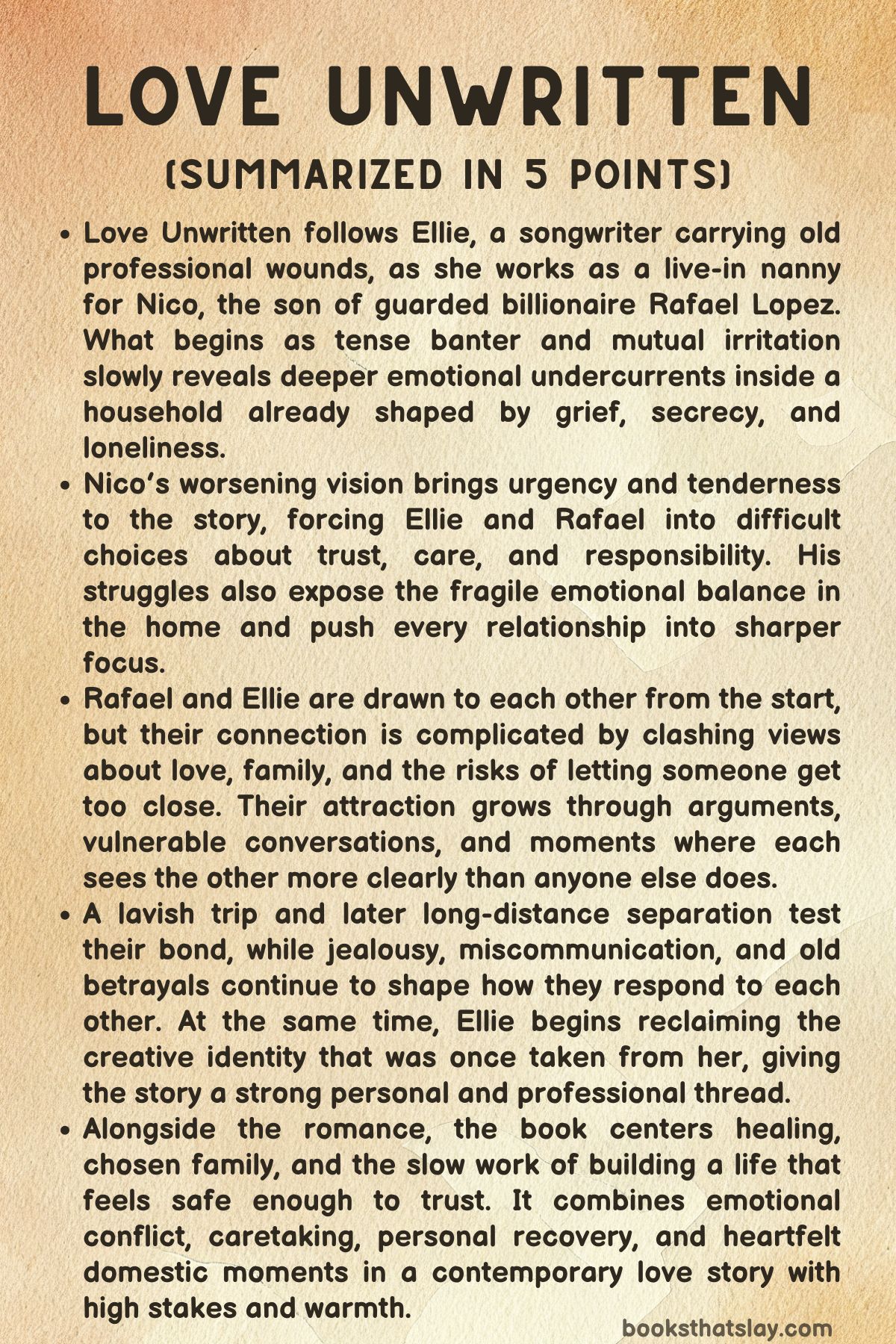
Love Unwritten by Lauren Asher is a contemporary romance built around grief, trust, second chances, and the slow creation of a family. At its center is Ellie, a warm and emotionally intuitive nanny, and Rafael Lopez, a guarded billionaire father trying to hold himself together for his son, Nico.
The story balances sharp banter, romantic tension, family pain, and personal healing, while also giving Ellie an important professional journey as she fights to reclaim credit for songs that were taken from her. It is both a love story and a story about choosing openness after years of disappointment, fear, and loss. It’s the 2nd book in the Lakefront Billionaires series.
Summary
The story begins with Ellie working as the live-in nanny for Rafael Lopez’s son, Nico. She is upset after reading an article about pop star Ava Rhodes, whose success was built in part on songs Ellie helped write without receiving recognition.
The article reopens old wounds and reminds Ellie of the betrayal she still carries. Rafael notices her mood, which surprises her because he usually keeps his distance and presents himself as cold and unapproachable.
Their conversation quickly turns into the teasing, argumentative rhythm they have developed. Ellie denies anything is wrong, Rafael calls her out, and she jokes about murdering him.
When he briefly smiles, Ellie is delighted, because she and Nico keep track of how often Rafael smiles. That small moment shows how rare lightness has become in him.
Their teasing takes on a more physical tension when Ellie drops her phone and catches Rafael looking at her body. The spark between them is immediate, but Rafael shuts it down just as quickly and returns to his usual reserve.
Ellie later joins Nico, who lives in a large, beautiful house that feels warm on the inside even though its isolated setting suggests Rafael is hiding from the world. Nico is happy to hear that his father smiled, but Ellie notices he is not himself during music practice.
Later, when she puts him to bed, he chooses a braille book instead of his usual comics. Ellie gently gets him to open up, and Nico confesses that his vision is getting worse.
He has been hiding it because he overheard Rafael crying after a doctor’s appointment and does not want to hurt him more. Ellie is devastated, but when Nico begs her not to tell his father yet, she makes a compromise and gives him until after his birthday to speak up.
The perspective then shifts to Rafael, who admits he never wanted a nanny in his private space but knows Nico needs Ellie’s warmth. He sees that Ellie can reach Nico in ways he cannot, and although that makes him uneasy, he cannot deny the good she has done.
Ellie later encourages Rafael to join Nico during story time, but he refuses. She tells him bluntly that he pushes people away after being hurt, and her honesty unsettles him because it is true.
Rafael tries to reconnect with Nico on his own, but Nico rejects him and asks for Ellie instead. Hurt and frustrated, Rafael later meets his cousin Julian, who points out that something deeper is going on and suggests Rafael ask Ellie for insight.
That night Rafael returns home, hears Ellie playing guitar, and secretly listens. Her music affects him deeply, and when he finally approaches her, he awkwardly asks for help with Nico.
Their conversation becomes emotionally raw when Rafael admits that seeing Nico prefer Ellie makes him resent her. Ellie points out that if he truly hated her, he would have fired her already.
She comforts him, rubs his back, and reassures him that he is not a bad father.
Before the moment can go further, Nico falls in his room and badly splits his chin. Ellie and Rafael rush him to the hospital.
During the examination, the doctor asks about Nico’s vision changes, and Nico admits they have gotten worse. Rafael is shocked and immediately realizes Ellie already knew.
Once they return home, his fear turns to anger. Refusing to hear her full explanation, he blames her for keeping such a serious secret, accuses her of failing Nico, and fires her.
He will not even let her say goodbye.
Ellie leaves and stays first with her friend Willow and then with her mother and stepfather Burt. Although they comfort her, she is heartbroken.
Rafael, meanwhile, feels her absence immediately. Nico is devastated when he realizes she is gone and angrily tells Rafael that he was the one who asked Ellie to keep quiet.
Rafael begins to understand the situation differently, especially after Nico keeps blaming himself. He reaches out to Ellie, apologizes, and offers her job back, but she refuses to return simply because he asks.
Though she regrets keeping the secret, she does not regret protecting Nico’s trust.
As Ellie and Rafael continue circling each other, the emotional tension between them grows. During one confrontation, Rafael tells Ellie that they are fundamentally wrong for each other.
He says she wants marriage and children and admits that he does not want those things again. He reveals that after learning Nico’s condition could be inherited, he got a vasectomy because he could not bear the idea of another child suffering the same way.
He also makes clear that his failed marriage left him unwilling to try again. Though he admits wanting her feels right, he insists their future goals do not match and leaves Ellie heartbroken.
Soon after, they leave for Hawaii with Nico. Rafael changes their travel plans and charters a massive yacht to take them between islands because Ellie is afraid of flying.
His thoughtfulness only confuses her more after his rejection. On the yacht, their attraction becomes harder to deny.
Ellie tries to provoke him by mentioning Cole, a supportive friend helping her with her music career and legal situation. Rafael reacts with obvious jealousy, but the exchange turns painful when he says he only trusts people who have never betrayed him.
Ellie realizes he is still holding the secret against her and walks away humiliated.
Rafael quickly regrets hurting her. After talking with Nico, he begins to face the damage his fear has done to both of them.
That night he goes to Ellie, apologizes, and finally tells her the truth about his past. He explains how childhood insecurity made him into a people pleaser and how his marriage to Hillary was built on pressure, instability, and later betrayal.
Hillary’s long affair deeply damaged his ability to trust. Ellie listens, comforts him, and holds him as he speaks.
Rafael tells her he wants to forgive her. Their emotional closeness finally turns physical, and they share a powerful first kiss.
Though Ellie suggests they try being friends afterward, both know that will not be enough.
Once they reach Kauai, they attempt that friendship while spending time with Nico. Ellie sees more clearly how devoted Rafael is as a father.
During a serious conversation, she tells him that by hiding his feelings he may be teaching Nico to do the same. The truth of that breaks something open in Rafael, and for the first time he cries in front of her.
The moment leads to a tender group hug with Nico and deepens Ellie’s sense that she could belong with them.
Their relationship is tested again when paparazzi photos make it look as though Ellie and Cole are romantically involved. Rafael withdraws, leaving Ellie hurt and frightened, especially because Ava has also resurfaced and triggered painful emotions.
When they finally talk, Rafael admits his silence came from jealousy and shame, not suspicion. Ellie explains how abandoned his distance made her feel.
Rafael apologizes sincerely and promises to do better. This time, he follows through.
While Ellie continues traveling with Cole’s tour through Europe, Rafael stays emotionally present. He begins sending her thoughtful gifts under the playful title of “Rafael’s Relationship Rule Book,” including a 3D-printed flower, intimate surprises, and eventually a custom white guitar.
When she becomes homesick, he arrives at her hotel with Nico, Willow, her mother, and Burt, bringing a piece of home directly to her.
At the same time, Ellie’s professional life begins to heal. Cole publicly credits her as a co-writer for a song, giving her long-denied recognition.
Later, Ava’s legal team offers Ellie a settlement in exchange for silence, but Ellie chooses court instead. With support from Rafael, Willow, and her lawyer, she faces the public battle.
Over time, Rafael and Ellie also begin speaking more openly about the future, including marriage, children, and adoption, showing how much he has changed.
Ellie is gradually embraced by Rafael’s family, and Rafael is equally drawn into hers. He learns that she had a crush on him back in high school, something that delights him.
Six months later, the court rules in Ellie’s favor. She receives a major financial award, but it does not bring the emotional closure she expected.
Instead, she donates the money to a nonprofit that helped her access therapy as a child, finding peace in that act. She tells Rafael she wants to come home, meaning the life they now share.
The ending shows their future together in full. Ellie, Rafael, and Nico build a joyful family life.
Rafael eventually proposes, promising her a life filled with love, commitment, and shared dreams. They marry surrounded by family and friends.
Later, on Mother’s Day, Nico tells Ellie he wants her to be his mother in every way that matters. The story ends with Rafael knowing with complete certainty that Ellie and Nico are the center of his world.
Characters
Ellie
Ellie comes across as the emotional center of the story because so much of the human warmth, honesty, and resilience in the plot flows through her. She begins in a place of old hurt, still carrying the damage caused by Ava Rhodes and the loss of recognition for songs she helped create.
That betrayal is not presented as a closed chapter in her life but as something that continues to shape her confidence, her sadness, and the way she understands trust. At the same time, she is not defined only by pain.
She is witty, emotionally perceptive, nurturing, and capable of creating comfort even inside a home burdened by silence and strain. Her banter with Rafael shows that she does not simply submit to his coldness.
She pushes back, teases him, reads him accurately, and forces life into spaces he has allowed to become emotionally rigid.
Her relationship with Nico reveals another side of her character. With him, Ellie is patient, safe, and instinctively compassionate.
She pays attention to small changes in his mood and behavior, which allows her to notice when something deeper is wrong. The trust Nico places in her is one of the clearest signs of who she is.
He chooses her not just because she is kind, but because she listens without judgment and makes him feel less alone in his fear. The difficult choice she makes about keeping his secret shows both her strength and her flaw.
She honors Nico’s emotional vulnerability, but in doing so she crosses a line that has real consequences. That tension makes her feel fully human.
She is not unrealistically perfect; she acts from love, but love does not protect her from making mistakes.
Ellie is also written as someone who deeply values emotional openness. She wants honesty, commitment, and a future that feels whole.
That is why Rafael’s mixed signals wound her so badly. She is not merely attracted to him; she sees what he could become if he stopped hiding behind fear.
Her heartbreak after his rejection matters because she knows her own desires clearly and refuses to pretend otherwise. She wants lasting love, marriage, and family, and she does not apologize for that.
This gives her a quiet strength. She is romantic, but not naive.
She feels deeply, yet she does not surrender her self-respect. Even when Rafael apologizes and asks her to return, she does not instantly fold.
She insists that protecting Nico’s trust was meaningful, and that her actions cannot be judged in a shallow way.
Another major part of Ellie’s character is her creative identity. Songwriting is not a decorative trait attached to her; it is tied to her emotional survival.
She turns sorrow into music, processes betrayal through art, and slowly rebuilds her sense of self by reclaiming authorship and voice. Her eventual legal fight is important because it proves that she is no longer willing to stay silent about what was stolen from her.
Yet even her victory is not treated as simple triumph. She realizes money is not the same as healing, which shows maturity and emotional depth.
In the end, Ellie is compelling because she combines tenderness with inner steel. She heals others, but she also learns to insist on her own worth, making her one of the most complete and convincing characters in Love Unwritten.
Rafael Lopez
Rafael is introduced as guarded, intimidating, and emotionally remote, but his characterization gradually reveals that this hardness is a defense structure built over years of fear, abandonment, and betrayal. His coldness is not simple cruelty, though he can certainly be harsh.
It is the result of a life spent believing that emotional exposure leads to pain. He has trained himself to survive by staying controlled, useful, and needed, first in childhood and later in adulthood.
This makes him successful and powerful on the surface, but deeply isolated underneath. One of the strongest aspects of his characterization is that his distance is shown not as mystery for its own sake, but as something costly.
His emotional habits hurt his son, damage his connection with Ellie, and trap him in reactions that he himself does not seem proud of.
As a father, Rafael is one of the most layered figures in the story. He loves Nico intensely, but that love is entangled with fear.
Nico’s diagnosis devastates him, and his reaction is not to lean into vulnerability but to bury it. He wants to protect his son, yet he often ends up communicating anxiety, helplessness, and emotional absence instead.
This makes his parenting painful to watch at times, because his love is obvious but his methods are limited. He cannot reach Nico in the way Ellie can, and that creates jealousy, shame, and resentment.
His confession that he hates seeing Nico prefer Ellie is one of the most revealing moments in the story because it exposes how insecure and emotionally raw he really is. He is not angry because Ellie is unkind or manipulative; he is angry because she succeeds where he feels he is failing.
Rafael’s romance with Ellie is shaped by contradiction. He is drawn to her warmth, humor, and emotional courage, yet these are the exact qualities that threaten the boundaries he depends on.
He wants closeness while also fearing what closeness will demand of him. This is why he vacillates between tenderness and retreat, thoughtful gestures and wounding rejection.
His decision to reject the possibility of a future with her is especially revealing. He frames it as realism, but it is clearly also an act of self-protection.
His vasectomy, his refusal to imagine remarriage, and his insistence that they are wrong for each other all come from a worldview shaped by grief, betrayal, and inherited pain. He convinces himself that denying happiness is safer than risking another emotional collapse.
What makes Rafael ultimately effective as a character is that he does change, but not suddenly and not without struggle. His growth comes when he begins to recognize that his self-protective habits are also harming Nico and costing him Ellie.
He starts to understand that suppressing emotion is not strength and that trust must be chosen even when certainty is impossible. His confession about his marriage, childhood, and emotional patterns marks a turning point because he stops using silence as a shield.
From there, his actions become more generous and more emotionally accountable. He apologizes, makes room for Ellie’s hurt, supports her through public and legal battles, and imagines a future he once rejected.
By the end, Rafael becomes more than the brooding, damaged hero he first appears to be. He grows into someone capable of love that is not merely possessive or reactive, but steady, expressive, and deeply committed.
Nico
Nico is essential to the emotional structure of the story because he is not simply a child placed between the adult leads. He has his own fears, desires, perceptions, and agency, and the plot gives real weight to his emotional life.
His worsening vision is the central source of vulnerability around which many of the family tensions revolve, but he is never reduced to his diagnosis. He is musically curious, affectionate, observant, and deeply sensitive to the moods of the adults around him.
The smile tracker he shares with Ellie is a small but telling detail because it shows how much he notices and how much he longs for joy inside his home. He is painfully aware of sadness, especially his father’s, and tries to manage it in the only way a child in his position can.
One of the most affecting things about Nico is the way he internalizes responsibility for other people’s feelings. He hides the progression of his condition not because he is careless, but because he cannot bear the thought of causing his father more pain.
After overhearing Rafael cry, he starts treating his own suffering as something dangerous to reveal. That is a heartbreaking position for a child to occupy, and it shows how deeply he has absorbed the emotional climate around him.
His request that Ellie keep the secret is therefore not just a plot complication. It reveals a boy who feels he must protect the adults caring for him, even when he himself is frightened.
His actions are misguided, but they come from love and guilt rather than defiance.
Nico’s bond with Ellie is one of the clearest emotional truths in the story. She offers him steadiness, fun, and acceptance, and he responds by trusting her with the parts of himself he hides from Rafael.
Their connection is convincing because it is built on daily care, shared creativity, and emotional safety. At the same time, Nico’s relationship with Rafael is equally important because it is full of love complicated by silence.
He wants his father, needs his father, and is hurt by his father, often all at once. His anger after Ellie is fired is one of his strongest moments because he finally speaks aloud a truth Rafael needs to hear: that people keep leaving, and Rafael’s way of handling pain contributes to that pattern.
Nico’s emotional honesty becomes a catalyst for change.
As the story moves forward, Nico also becomes a mirror through which Rafael sees himself more clearly. Their conversations about fear, abandonment, and trust reveal how closely their emotional wounds echo one another.
This gives Nico unusual narrative importance. He is not only someone to be protected but someone whose perspective matters morally and emotionally.
By the end, his acceptance of Ellie as his mother in every meaningful sense is especially powerful because it is not presented as a sentimental shortcut. It feels earned through shared pain, healing, and chosen family.
Nico’s character adds tenderness and gravity to the story, making the emotional stakes feel larger than romance alone.
Ava Rhodes
Ava functions primarily as a source of betrayal, unresolved anger, and public theft, but her importance should not be underestimated simply because she is not given the same intimate interiority as the central trio. She represents a wound that predates the main romance and helps explain why Ellie’s emotional life is so fragile in certain areas.
Ava’s success is built in part on work that was not truly hers, and that fact gives her role a particularly corrosive quality. She is not just someone who wronged Ellie in private.
She became publicly celebrated while Ellie remained unseen, which turns personal betrayal into something larger and more humiliating. Every article, every achievement, and every public mention becomes a reminder of what was stolen.
Her presence in the story also matters because she embodies the kind of power imbalance that leaves lasting psychological damage. Ellie is not merely bitter or envious; she is trying to live with the knowledge that someone else built fame on her contributions while she received none of the recognition.
That history affects her self-worth, her confidence in relationships, and her ability to feel secure when abandoned or ignored. When Ava contacts her again and contributes to Ellie’s mental spiral, it becomes clear that the damage is ongoing.
Ava is therefore less a distant villain than an active symbol of emotional and professional erasure.
At the same time, Ava’s role helps define Ellie’s eventual growth. The legal case becomes a way for Ellie to stop accepting silence as the price of survival.
Ava’s existence in the narrative forces Ellie to confront whether she will continue carrying private pain or publicly reclaim the truth. In this sense, Ava’s character is important not because she is richly sympathetic, but because she sharpens the story’s concern with voice, ownership, and dignity.
She is the personification of a theft that can no longer be ignored.
Cole
Cole serves as an important contrast to Rafael and as one of the healthier supporting presences in Ellie’s life. He is supportive, emotionally available, and professionally generous in ways that stand out strongly against the betrayals Ellie has previously endured.
His willingness to collaborate with her, credit her publicly, and help her reconnect with her talent makes him significant far beyond the role of jealousy trigger. He becomes part of Ellie’s rebuilding process.
Through him, she experiences what it looks like to be respected rather than used in a creative partnership.
His relationship with Ellie is also useful for revealing Rafael’s insecurity. Cole does not need to do much to provoke Rafael because his mere presence exposes what Rafael fears: that another man might offer Ellie the steadiness and trust he himself has failed to provide.
Yet Cole is not written as a shallow romantic obstacle. Instead, he remains a largely decent figure whose support is genuine.
This makes the jealousy around him more revealing, because Rafael’s reactions stem from his own internal instability rather than from any real wrongdoing on Cole’s part.
Cole’s role in Ellie’s public recovery is especially meaningful. When he acknowledges her work before an audience, he gives her something Ava denied her: visible recognition.
That moment is not only career progress but emotional repair. It allows Ellie to stand in front of people as herself and begin loosening the hold of an old wound.
Cole therefore helps restore not just opportunity, but self-belief.
Willow
Willow is the kind of best friend character who adds force and clarity without feeling disposable. She is fiercely loyal to Ellie and immediately offers practical and emotional support when everything with Rafael collapses.
What makes her effective is that her loyalty does not erase her honesty. She can be angry on Ellie’s behalf while still admitting that Ellie made a mistake by keeping Nico’s secret.
This balance gives her credibility. She is not there simply to flatter the heroine or attack the hero without nuance.
Instead, she grounds Ellie in moments when Ellie is hurt, confused, or tempted to doubt herself.
Willow also represents the value of chosen support systems. In a story centered on trust and family, she shows that emotional survival does not come only from romance.
Friendship matters, and her presence reminds the reader that Ellie has people who see her clearly and stand beside her even when events become messy. During the legal and media turmoil, Willow continues to help Ellie endure pressure, which strengthens the sense that healing is communal rather than solitary.
She is warm, funny, protective, and emotionally intelligent, making her one of the most valuable supporting characters in the narrative.
Julian
Julian plays a quiet but significant role as one of the few people capable of challenging Rafael without being shut out completely. He functions as a sounding board, but not a passive one.
When Rafael talks to him about Nico and Ellie, Julian does not simply sympathize; he identifies patterns Rafael is resisting and pushes him toward honesty. His observations help move Rafael from self-protective denial toward action.
That matters because Rafael is a character who can remain frozen unless someone forces him to see beyond his own defensive logic.
Julian’s value lies in the fact that he understands Rafael well enough to speak hard truths in ways that can still be heard. He represents family connection at its healthiest: direct, affectionate, and unwilling to let avoidance masquerade as strength.
Though he is not central to the romance, he helps create conditions in which emotional change becomes possible.
Hillary
Hillary is important because her past relationship with Rafael explains much of his emotional damage, though the story presents her largely through his perspective. She is connected to one of the deepest betrayals in his life: a marriage shaped by pressure, instability, financial strain, and eventual infidelity.
Through her, the narrative shows how Rafael came to associate intimacy with entrapment and trust with humiliation. She becomes part of the reason he fears repeating old pain with Ellie.
Her role also affects Nico, especially through absence and inconsistency. The cancellation of visits and the instability of maternal presence contribute to the emotional insecurity that shapes Nico’s behavior.
In this way, Hillary matters not just as Rafael’s ex-wife but as part of the broader emotional landscape in which both father and son learn to expect disappointment. Even without extensive direct characterization, she leaves a deep imprint on the story’s central relationships.
Josefina
Josefina represents a calmer, wiser family voice. When Rafael brings Nico to her, she offers care without escalating the conflict.
She does not erase Ellie’s mistake, but she encourages Rafael to consider the emotional reasoning behind it. This makes her an important moderating presence.
She helps prevent Rafael’s anger from becoming the only framework through which the situation is interpreted. In a story where many characters are acting from fear or hurt, Josefina contributes perspective and emotional maturity.
Her presence also reinforces the theme that family can help correct distorted thinking. Rafael often isolates himself inside his own reactions, and characters like Josefina gently widen his view.
Though her role is not extensive, it is stabilizing and meaningful.
Themes
Trust as a Choice Rather Than a Feeling
Trust shapes nearly every important relationship in Love Unwritten, not as something simple or automatic, but as something fragile that must be chosen again and again after pain. Ellie and Rafael are both deeply affected by betrayal long before their romance has any real chance to grow.
Ellie carries the wound of having her songwriting contributions stolen and watching someone else build fame from work that mattered to her. That history makes her sensitive to being overlooked, used, or dismissed.
Rafael’s damage comes from a different place, rooted in childhood instability and a marriage poisoned by dishonesty and infidelity. Because of that, both of them read situations through old injuries, and even moments of care become tangled in suspicion, defensiveness, or fear.
This theme becomes especially powerful through the conflict over Nico’s worsening vision. Ellie keeps his secret because she wants to protect the trust he placed in her, while Rafael sees that same choice as a devastating violation of his role as a father.
Neither reaction is shallow. Ellie is honoring a child’s emotional safety, while Rafael is reacting to the horror of being shut out of something vital involving his son.
The novel refuses to make trust easy or clean. Instead, it shows how two people can act from love and still hurt one another badly.
What gives this theme its depth is that forgiveness does not arrive through one apology or one emotional confession. Rafael has to decide whether he wants to remain ruled by fear, and Ellie has to decide whether she can believe his change is real.
Trust here is not treated as blind faith. It is shown as emotional risk, honesty under pressure, and the willingness to remain open even when experience suggests that openness could lead to pain.
The relationship only moves forward once both of them stop asking whether trust feels safe and begin asking whether love without trust can ever be enough.
Love After Damage
Romance in this story is not presented as something that appears in ideal circumstances. It develops between two people already marked by disappointment, grief, anger, and private loneliness.
That gives the love story its central tension. Ellie is still carrying the ache of lost recognition and old heartbreak, while Rafael has built his adult life around emotional control, distance, and self-protection.
Their attraction appears early, but attraction is never the real obstacle. The harder question is whether either of them can believe they deserve a lasting connection that does not end in betrayal or loss.
Rafael in particular embodies the fear that love inevitably leads to damage. He is not merely hesitant about commitment; he has convinced himself that wanting less is a form of wisdom.
He uses practical arguments about marriage, children, and incompatibility, but beneath those arguments is the belief that deep attachment brings suffering. His past has taught him to expect abandonment, manipulation, and heartbreak, so he treats emotional restraint as maturity.
Ellie challenges that worldview because she remains hopeful without being naïve. She knows what pain feels like, yet she still believes love can be steady, mutual, and life-giving.
That difference between them creates many of the novel’s sharpest emotional confrontations.
What makes the theme compelling is that love is not shown as magically erasing previous wounds. Rafael does not become open overnight, and Ellie does not stop feeling hurt simply because he eventually explains himself.
Instead, love becomes meaningful because it asks both of them to confront the stories they have been telling themselves. Rafael must stop confusing fear with realism.
Ellie must learn that hope does not mean accepting emotional inconsistency forever. Their relationship grows when love becomes less about chemistry and more about courage, accountability, and presence.
In that sense, the novel argues that real love is not proven by grand desire alone but by the daily decision to stay emotionally available even after life has given many reasons to shut down.
Parenthood, Protection, and the Limits of Control
The bond between Rafael and Nico gives the story one of its most affecting themes: the painful truth that loving a child cannot protect that child from suffering. Rafael is devoted to his son, but his devotion often takes the form of management, caution, and emotional restraint.
He wants to hold the family together through competence, planning, and sacrifice. Yet Nico’s diagnosis places him in a position every parent dreads, where love is immense but power is limited.
Rafael cannot fix his son’s condition, cannot guarantee his future, and cannot spare him fear. That helplessness shapes much of his behavior, including his tension, moodiness, and instinct to withdraw.
Nico’s silence about his worsening vision deepens this theme by showing how children also try to protect their parents. He withholds the truth not because he is careless, but because he has witnessed Rafael’s private grief and internalized the idea that his illness is a burden others must carry.
This creates a heartbreaking reversal: the father wants to shield the child, and the child wants to shield the father, yet both end up more isolated because neither knows how to hold pain together in the open. Ellie becomes crucial because she recognizes that protection without honesty can become another form of loneliness.
The story also examines the emotional inheritance passed from parent to child. Rafael has learned from his own upbringing to hide weakness, suppress tears, and survive by being useful rather than vulnerable.
Without meaning to, he begins teaching Nico similar habits. Ellie’s presence interrupts that cycle.
She helps Rafael see that children do not only need safety, routines, or material care. They also need emotional permission to be afraid, sad, dependent, and honest.
That realization becomes one of Rafael’s most important transformations.
By the end, parenthood is shown not as flawless guardianship but as a practice of showing up truthfully even when nothing can be fully controlled. The novel gives weight to the idea that love is not measured by how completely one can shield a child from pain, but by the willingness to remain present through that pain without turning away from it.
Reclaiming Voice, Identity, and Belonging
Ellie’s personal arc gives the novel a strong theme of reclaiming what has been taken, not only in a professional sense but in an emotional and personal one as well. At the start, she is living with the aftermath of theft.
Her songwriting helped make someone else successful, yet she has been denied credit, visibility, and the right to own her creative work publicly. That injustice is more than a career setback.
It distorts her sense of worth and leaves her carrying a quiet humiliation that resurfaces whenever the past is mentioned. Her creativity remains alive, but it is tied to grief, memory, and the knowledge that her voice has already once been used without being honored.
What makes this theme rich is that reclaiming her voice happens on several levels at once. Professionally, Ellie begins moving toward recognition through songwriting opportunities, public credit, legal action, and the decision to fight rather than disappear behind a settlement.
Emotionally, she stops allowing other people’s betrayals to define the limits of her future. The court case matters, but the story carefully shows that justice on paper is not the same as inner closure.
Money alone cannot heal what was broken. Her final sense of peace comes more from agency, generosity, and self-definition than from material victory.
Belonging also becomes part of this recovery. Ellie does not simply want success; she wants a place where she is fully seen and chosen.
That desire appears in her connection with Nico, her warmth with family, and her growing role within Rafael’s world. She is not fulfilled merely by being noticed romantically.
She finds meaning in becoming central to a shared life where her tenderness, humor, talent, and steadiness all matter. Even the ending reinforces that identity is not rebuilt through revenge but through attachment, honesty, and purpose.
In Love Unwritten, reclaiming one’s voice means more than speaking up. It means refusing to live as a footnote in someone else’s story.
Ellie’s journey turns stolen recognition into self-possession, and in doing so, it presents belonging as something earned not by shrinking oneself to fit into others’ expectations, but by finally standing in the full truth of who one is.