Like Family Summary, Characters and Themes
Like Family by Erin O. White is a compelling exploration of modern family dynamics, relationships, and identity. Set in the small town of Radclyffe, the novel follows Ruth and her complex relationships with her family, friends, and the unresolved past of her daughter’s biological father.
The narrative touches on themes of parenthood, secrets, personal growth, and the struggle between the idealized image of family and the messy, real connections that form. Through a combination of domestic moments, quiet tensions, and difficult decisions, White delves into the fragility of family ties and the constant search for belonging.
Summary
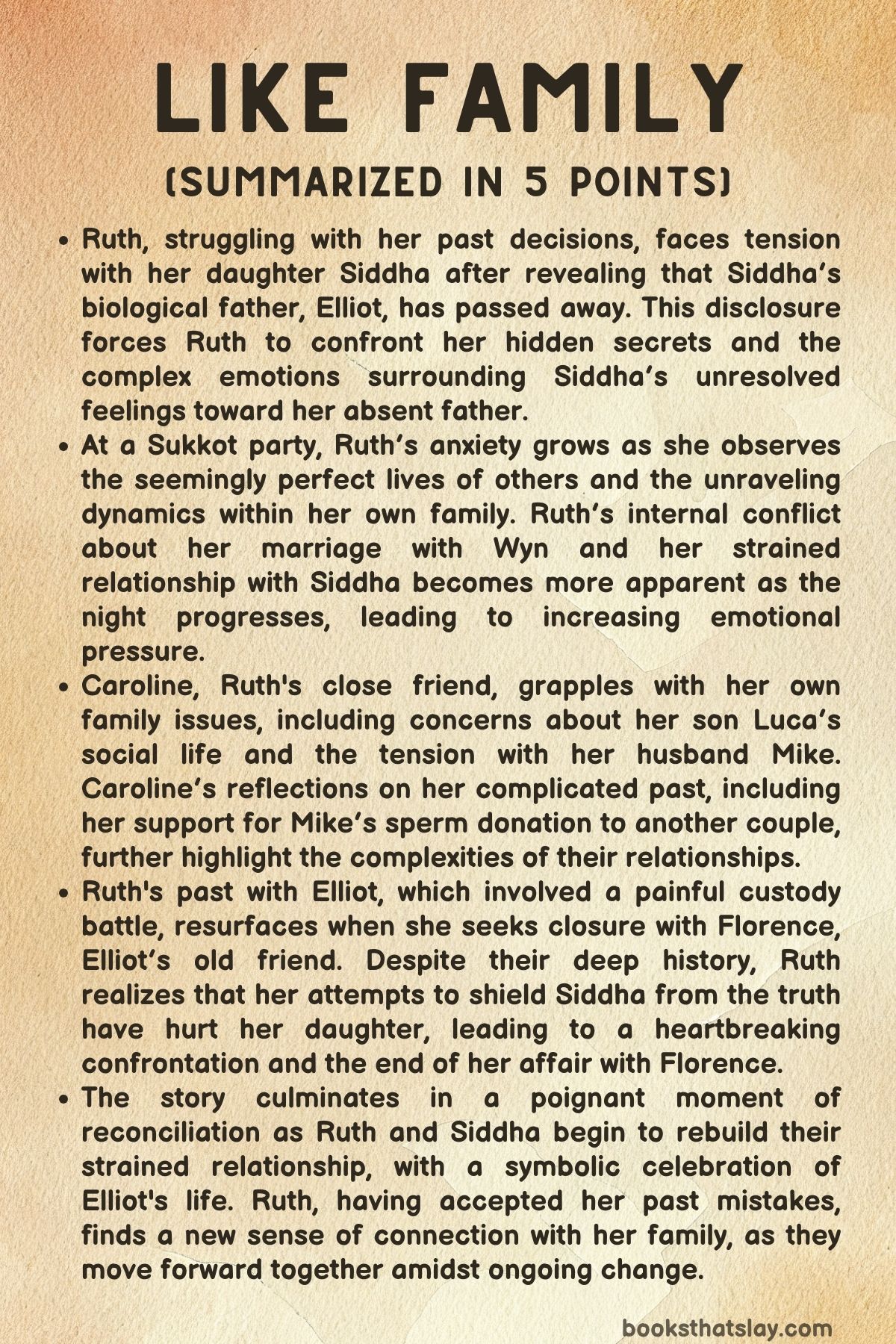
Like Family centers around Ruth and her family as they navigate personal and emotional turmoil. The novel opens with Caroline Caruso waiting for her friend Ruth by a pond, where they often swim together.
Ruth is late, which is unusual, and Caroline becomes concerned when Ruth explains she has been rushing. Ruth, visibly stressed, reveals that her daughter Siddha’s biological father, Elliot, has passed away.
The revelation shocks Siddha, who is furious and confused about Elliot’s death, especially since Ruth had kept her parentage a secret. Ruth is unsure how to handle the situation, asking Caroline for advice.
At the same time, Ruth is struggling with her family dynamics, especially her relationship with her wife, Wyn, and their daughter Siddha. Ruth’s anxiety heightens as she wonders how to approach the past and the complexities surrounding Siddha’s biological father.
The tension between Ruth and Siddha grows as the latter becomes more withdrawn, and Ruth continues to worry about Siddha’s unresolved emotions. This situation comes to a head during a Sukkot celebration at their home, where Ruth struggles to keep the evening peaceful while dealing with the emotional weight of the situation.
Ruth is also grappling with her own dissatisfaction with life. After moving multiple times and the upheaval of the pandemic years, she feels lost and uncertain about her next steps.
At a dinner party for the Jewish holiday, Ruth finds herself comparing her life to that of other families, including Tobi and Evie, a lesbian couple who seem to have it all together. Ruth is envious of their seemingly perfect family, and her feelings are compounded by her own marriage issues with Wyn, who is calm and pragmatic in contrast to Ruth’s growing anxiety.
As Ruth compares her family to others, she comes to realize how complex relationships can be, and how life and family dynamics are never as simple as they seem.
The tension between Ruth and Siddha intensifies, and Ruth’s fears about their strained relationship only deepen as the night continues. Ruth is particularly troubled when she realizes that Siddha, who has been hiding her feelings, has secretly been spending time with Elliot’s family, especially after the memorial.
Siddha’s rebellious actions, like giving herself a tattoo in honor of Elliot, ignite a major confrontation between mother and daughter. Ruth spirals into guilt and regret, torn between wanting to protect Siddha and her own feelings about Elliot’s past.
As Ruth reflects on her own past, she recalls the struggles she faced with Elliot when Siddha was born. Ruth’s decision to raise Siddha without Elliot in her life was driven by his increasing alcoholism and lack of responsibility.
When Elliot’s drinking led to a serious car accident, Ruth decided to sever ties and keep Siddha from knowing her biological father. Now, years later, Ruth feels conflicted and unsure how to help Siddha reconcile with the truth about her parentage.
Meanwhile, Caroline is dealing with her own set of challenges. She is concerned about her son Luca, who has become increasingly isolated after his best friend moved away.
Caroline is also struggling with her relationship with her husband Mike, who seems distant and less emotionally available. Their argument about parenting becomes a turning point for Caroline, as she begins to feel frustrated with Mike’s harsh approach to raising Luca, especially as she believes his difficult childhood is shaping his parenting style.
Caroline’s internal struggles intensify after a series of interactions with her close friends, including Tobi and Evie. As she reflects on her life and the choices she’s made, Caroline begins to feel disconnected from her own sense of identity.
She is still haunted by the past, particularly the decision to allow Mike to donate sperm to Tobi and Evie so they could have children. Caroline has complicated feelings about the donation and the bond it created between their families, and these feelings resurface when she realizes that Mike has been confiding in Tobi.
In the midst of these struggles, Ruth faces even more emotional turmoil when she confronts the reality of her affair with Florence, an old friend of Elliot’s. Ruth ends the affair, realizing that she is still in love with Wyn and cannot continue living in a relationship filled with lies and guilt.
This decision leaves Ruth devastated, as she feels the weight of her own choices, but she also acknowledges the necessity of being honest with herself and the people she loves.
The story culminates in a series of emotional moments where Ruth and Siddha face the aftermath of their confrontations, including Ruth’s apology to Siddha for keeping secrets about her father. Siddha, in turn, expresses her anger and confusion but agrees to come home.
The resolution of this conflict is marked by a symbolic act: Siddha hosts a spring party at Elliot’s hardware store, where the families gather to celebrate his life. At the party, Siddha leads a toast to Elliot, surprising everyone by releasing origami boats into the creek, symbolizing the acceptance of the new family dynamics and the reconciliation of past hurts.
In the end, Like Family offers a nuanced exploration of the complexities of modern family life, identity, and love. Ruth and Siddha’s journey toward understanding and forgiveness reflects the difficult yet necessary process of navigating family secrets, personal regrets, and the evolving nature of relationships.
The novel is a heartfelt portrayal of how people can create new definitions of family and find acceptance, even in the most unexpected ways.
Characters
Ruth Schwartz-Huntley
Ruth is a complex character who is both emotionally and psychologically conflicted throughout Like Family. As a mother, she is constantly striving to protect her family, particularly her daughter Siddha, but her well-intentioned actions often lead to tension and misunderstandings.
Ruth has a deep sense of guilt for keeping Siddha’s biological father, Elliot, a secret and hiding his troubled past from her daughter. Her internal struggle intensifies after Elliot’s death, and the revelation that Siddha has been secretly connecting with Elliot’s family forces Ruth to confront her own feelings of failure and betrayal.
Ruth is also dealing with the emotional weight of her marriage to Wyn, who is more calm and pragmatic compared to Ruth’s anxiety-driven personality. Ruth’s interactions with friends, such as Caroline, reveal her deep insecurities, especially when comparing her own life to the seemingly perfect lives of others.
Ruth’s character arc revolves around coming to terms with her past mistakes and learning to navigate the complexity of family dynamics, particularly her relationship with Siddha. Her eventual apology to Siddha signifies her growth as a mother and her ability to accept the evolving nature of familial love.
Wyn Schwartz-Huntley
Wyn is Ruth’s wife, a stabilizing force in the household and a contrast to Ruth’s often frantic nature. Wyn is pragmatic and calm, offering a voice of reason when Ruth becomes overwhelmed by her emotions.
Though their relationship is enduring, Wyn’s quiet, composed demeanor often clashes with Ruth’s more emotional and anxious responses to their family challenges. Wyn’s role as a mother and wife reveals her ability to handle the difficulties of their blended family, including Siddha’s turmoil over her biological father’s death and her strained relationship with Ruth.
Wyn is also portrayed as someone who has found contentment in rural life, reconnecting with the kind of environment she loves, though she, too, is affected by the uncertainties of their moving and shifting family dynamics. Despite Ruth’s emotional volatility, Wyn’s constant support and sense of practicality help anchor the family through their trials, though it’s clear that she feels the strain of Ruth’s emotional outbursts.
Her more pragmatic approach allows Ruth to open up and work through their issues, even when Ruth is reluctant to confront them head-on.
Siddha Schwartz-Huntley
Siddha is Ruth and Wyn’s teenage daughter, who grapples with feelings of confusion, anger, and betrayal throughout Like Family. She is initially hurt by the revelation that her biological father, Elliot, is deceased and that her mothers had kept his identity and past a secret from her.
Siddha’s struggle with her own identity is compounded by the emotional tension at home, as she resents her mothers for sheltering her from the truth about Elliot’s troubled past. Siddha’s journey is one of self-discovery, as she forms connections with Elliot’s other children and struggles to reconcile the image of her father with the reality of his life.
Her rebellion manifests in her decision to get a tattoo in honor of Elliot, a gesture that symbolizes both her connection to him and her defiance against the secrecy surrounding her upbringing. Siddha’s character is marked by her search for autonomy and a desire to understand the complexities of her own family’s history.
By the end of the book, Siddha begins to understand that forgiveness and acceptance are key to moving forward, though her emotional journey is far from over.
Caroline Caruso
Caroline is a close friend of Ruth and Wyn, and her perspective provides insight into the complexities of family and friendship in Like Family. She is a concerned mother to her son, Luca, and often finds herself anxious about his social life and his place within the family dynamic.
Caroline’s relationship with her husband, Mike, is strained as they both struggle with different approaches to parenting, particularly when it comes to Luca. Caroline is caught in a whirlwind of emotions, ranging from jealousy over Ruth’s past relationships to her own feelings of failure after being rejected for a grant she had hoped for.
Her internal conflict is amplified by her complex feelings toward Mike’s past sperm donation to Tobi and Evie, which has created an intricate web of family connections that Caroline is still coming to terms with. Caroline’s journey is one of self-reflection and realization, as she navigates the pressures of motherhood, marriage, and her own personal ambitions.
By the end of the book, Caroline begins to accept the ambiguity of family relationships and seeks to find peace with the people around her, especially Ruth.
Mike Caruso
Mike, Caroline’s husband, plays a more background role in Like Family, yet his presence is still felt throughout the narrative. He is depicted as a straightforward, sometimes abrasive character who is more focused on practical matters than emotional nuances.
Mike’s relationship with Caroline is marked by tension, particularly in their differing approaches to parenting their son, Luca. While Caroline is anxious and protective, Mike takes a more hands-off approach, believing that Luca needs resilience and independence.
This difference in parenting styles causes friction between them, as Caroline feels unsupported and Mike becomes frustrated with her overprotection. Mike’s past sperm donation to Tobi and Evie complicates matters further, as it creates an emotional and moral grey area for Caroline.
Mike’s character is often seen through Caroline’s eyes, making him seem more distant and emotionally unavailable. However, by the end of the book, Mike’s willingness to listen and support Caroline shows that, despite their differences, he is committed to their family’s well-being.
Tobi and Evie
Tobi and Evie are a lesbian couple who run a pottery business and are close friends of Ruth and Wyn. Tobi is a strong, independent woman who has a complicated relationship with her body and identity.
Her decision to consider top surgery reveals her desire to take control of her physical appearance in a way that feels empowering to her. Tobi’s internal conflict about her body and her relationship with Evie is a central theme in her character arc.
While she loves Evie, she struggles with the secrecy surrounding her decision to pursue top surgery, and this causes tension between them. Evie, on the other hand, is more outwardly supportive, though she too feels a sense of loss and jealousy when Tobi keeps certain things from her.
Their relationship is marked by a deep love for one another, but also by the complexity of understanding one another’s individual needs and desires. As the book progresses, Tobi and Evie navigate their own issues with vulnerability, leading to moments of healing and reconnection.
Their dynamic exemplifies the challenges and rewards of maintaining intimacy and trust in a long-term partnership.
Florence Howe
Florence is a significant figure from Ruth’s past, representing both the unspoken secrets and the complexities of Ruth’s earlier life. Florence was once a close friend of Ruth’s and Elliot’s, and their shared history resurfaces when Ruth reconnects with her to handle the sale of her old home.
Florence’s role in the story is pivotal, as she represents the past that Ruth is reluctant to confront. Florence’s calm, accepting nature contrasts with Ruth’s emotional turmoil, and her ability to accept Ruth’s decision to end their affair highlights her maturity and understanding.
Florence’s connection to Elliot and her role in Ruth’s life serve as a reminder of the emotional baggage Ruth carries with her. Despite the difficult history, Florence’s ability to let go of the past and move forward demonstrates her own emotional resilience.
Themes
Family and Identity
The complexity of family relationships and the exploration of identity is central to Like Family. The novel delves into the nuanced and often strained connections that define what it means to be a family.
Ruth and Wyn’s family is a blend of biological and chosen bonds, with the hidden history of Siddha’s biological father, Elliot, creating tension between Ruth and Siddha. The tension arises as Siddha uncovers the truth about her biological father, which Ruth had kept secret for years.
Siddha’s response—anger, confusion, and her eventual involvement with Elliot’s family—underscores the tension between biological identity and emotional connection. This conflict is also present in Caroline’s life, where her relationship with her son Luca is influenced by her fear of not fulfilling societal expectations of motherhood.
The notion of family extends beyond biology to include chosen families and communities, such as the friendships Ruth has with Caroline, Tobi, and Evie, where loyalty, support, and shared experiences create a sense of belonging. As the characters navigate the complexities of their family dynamics, the book explores how identity within a family can be fluid, how secrets can erode trust, and how forgiveness and understanding are key in maintaining familial bonds.
Change and Acceptance
The theme of change—both personal and within relationships—runs through the book as characters confront various transitions. Ruth’s journey of self-discovery, particularly her reflections on her marriage to Wyn and her own feelings toward Elliot’s death, signifies the difficulty of accepting change, both in one’s life and in one’s identity.
Ruth’s internal conflict about her affair with Florence and her subsequent decision to end it shows how deeply personal transformations are tied to one’s capacity for acceptance, not only of external changes but also of the shifts within oneself. Siddha’s evolution in response to the revelation of her biological father’s past highlights the complexity of accepting new facets of one’s identity and familial history.
The way Ruth and Siddha navigate this change—their hurt, their eventual understanding, and their attempt to reconcile with one another—emphasizes how change can be unsettling, yet essential for growth. In addition, Caroline’s struggles with her own identity as a mother and her increasing distance from Mike reflect the tensions that arise when individuals fail to adapt to change, both in their personal lives and in their relationships.
The characters’ journey towards acceptance—of themselves, each other, and the inevitable changes they face—demonstrates that while change is difficult, it is an inevitable part of life that often leads to personal and relational growth.
Secrets and Disclosure
The theme of secrets and their eventual disclosure is a driving force in Like Family. Ruth’s concealed history regarding Siddha’s biological father, Elliot, creates emotional turbulence within the family, ultimately revealing the consequences of keeping secrets.
The tension between Ruth and Siddha deepens when Siddha discovers the truth, as Ruth’s decision to shield her from Elliot’s past, including his struggles with alcoholism, causes a rift. The secrets, though initially protective, eventually reveal themselves to be burdens that weigh down relationships.
This is mirrored in the dynamic between Caroline and Mike, as Caroline’s hesitancy to disclose her feelings and frustrations about Mike’s parenting creates an emotional distance between them. Secrets, while often seen as protective mechanisms, are shown to have far-reaching consequences when they disrupt the trust and openness essential in relationships.
As the novel progresses, characters learn the importance of vulnerability and honesty, realizing that the truth, though painful, is essential for healing and connection. The resolution of these secrets, as Ruth confronts her past and Siddha uncovers the full story of her biological father, reflects the liberating power of disclosure and the relief that comes with shedding the weight of hidden truths.
Friendship and Support
Like Family also explores the significance of friendship as a form of emotional support and community. Ruth’s friendships with Caroline, Tobi, and Evie provide her with moments of solace and understanding, especially in times of emotional turmoil.
Caroline, who often struggles with her relationship with her son Luca and her own identity, finds in Ruth and the others a network of support, offering her both a sense of stability and the space to express her concerns. These friendships are not without tension; however, the way the characters manage their conflicts and support each other reflects the importance of mutual care and understanding.
Tobi and Evie’s bond, particularly in their handling of Tobi’s decision about top surgery, showcases how friendship can become a form of emotional intimacy that transcends romantic or familial ties. The willingness of these characters to lean on one another, to listen and to share in each other’s struggles, speaks to the power of chosen families.
These friendships are not only a source of strength but also a lens through which the characters come to terms with their own identities, aspirations, and vulnerabilities. The novel suggests that, while blood relations are important, the relationships we build with others outside of our immediate families can be just as significant in shaping who we are and how we navigate life’s challenges.
Marriage and Partnership
The complexities of marriage and partnership are explored in Like Family through Ruth and Wyn’s relationship, which serves as a focal point for the theme of emotional strain within intimate partnerships. Ruth’s growing anxiety and internal turmoil, largely stemming from her affair with Florence and her unresolved feelings about Siddha’s biological father, contrast with Wyn’s calm, pragmatic approach to their life together.
Their differing emotional responses to the challenges they face—Ruth’s spiraling anxiety and Wyn’s steady pragmatism—highlight the difficulties in maintaining a partnership when both individuals are not on the same emotional wavelength. The strain between them deepens as Ruth is forced to confront her own fears and regrets, particularly in her interactions with Siddha, whose anger and pain mirror Ruth’s unresolved guilt.
Meanwhile, Caroline’s struggles with Mike reflect the increasing emotional distance between them. Caroline’s anxieties about Mike’s approach to parenting and his often harsh demeanor toward their son suggest deeper issues in their partnership, where communication and emotional intimacy are fraying.
The theme of marriage and partnership, then, is not just about romantic love but about the emotional labor involved in maintaining a connection with a partner through difficult and transformative times. The novel illustrates how couples navigate the challenges of love, loyalty, and individual growth, suggesting that partnerships are often tested in the face of personal crises, but can also be strengthened when both partners are willing to confront their vulnerabilities and work through them together.
Guilt and Redemption
Guilt and the potential for redemption are significant themes that run throughout the novel. Ruth’s journey is marked by guilt over her past decisions, particularly her decision to shield Siddha from the truth about her biological father and his troubled past.
This guilt manifests in her relationship with Siddha, as she tries to make amends for her perceived failures as a mother. The emotional turmoil Ruth experiences as she grapples with her actions reflects the universal struggle with guilt and the desire for forgiveness, both from others and oneself.
The idea of redemption is tied closely to this guilt; Ruth’s attempts to reconnect with Siddha, to accept her past mistakes, and to understand the pain she has caused all point to the possibility of redemption, though it is clear that it requires more than simple apologies. Similarly, Caroline’s internal struggle, particularly in her relationship with Mike and her son, is laced with guilt over what she perceives as her own shortcomings as a mother and a wife.
This theme suggests that while guilt is an unavoidable part of the human experience, the path to redemption lies in facing one’s mistakes with honesty, seeking forgiveness, and learning to move forward in relationships. Ultimately, Like Family shows that redemption is not a final destination but an ongoing process that requires patience, understanding, and a willingness to grow.