Like This, But Funnier Summary, Characters and Themes
Like This, But Funnier by Hallie Cantor is a sharp contemporary novel about creative ambition, marriage, artistic compromise, and the uncertain choices that shape adult life. The story follows Caroline Neumann, a TV comedy writer in Los Angeles whose career has slowed just as her personal life has become harder to avoid.
As Caroline searches for her next big break, she crosses an ethical line by using private material from her husband’s therapy notes as inspiration for a television pitch. What begins as professional desperation soon becomes a deeper reckoning with honesty, success, motherhood, and the cost of turning real pain into entertainment.
Summary
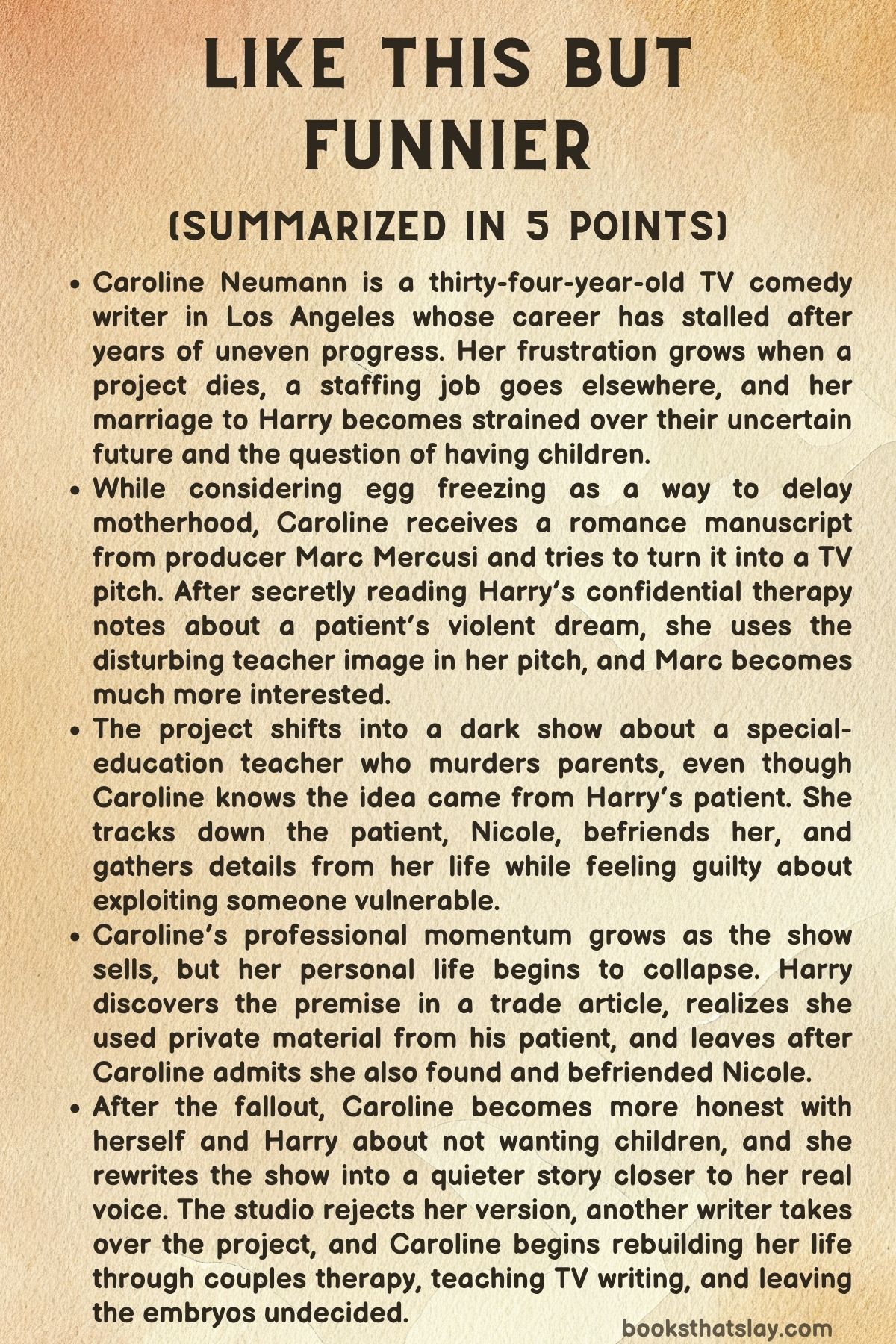
Caroline Neumann is a thirty-four-year-old comedy writer living in Los Angeles, but her life is nowhere near the version of success she once imagined. She has worked in television, has credits, and understands the rhythms of the industry, yet she is stuck in a slow, humiliating career dry spell.
The jobs are not coming. The meetings feel empty.
Her ideas seem to vanish into the same Hollywood fog that swallows countless promising projects. At the start of the story, she takes a bland Zoom general meeting with Marc Mercusi at Goode Seed Productions, where everyone talks in polished industry language without saying much of value.
Afterward, Caroline checks in with her agents and receives the kind of news she has come to dread: her animated project Octopocalypse is essentially dead, and a staffing job she wanted has gone to other writers.
The professional disappointment follows her home. Caroline’s husband, Harry, is a clinical psychologist, and their marriage is loving but strained by questions they keep circling rather than resolving.
The largest question is whether to have children. Harry has become more open to parenthood, maybe even eager for it, while Caroline remains deeply unsure.
Her uncertainty is not a simple fear of timing or money. It is more basic than that.
She does not know whether she wants to be a mother at all, and the fact that she cannot give Harry a clean answer makes her feel guilty, defensive, and trapped. Their conversations about the subject become tense because neither of them can fully say what they need without hurting the other.
Caroline’s discomfort grows sharper when she attends a baby shower. Surrounded by women who seem to have entered a stage of life she has not chosen and may never choose, she feels awkward and judged, even when no one is openly judging her.
She compares herself to friends with children and feels both superior and inadequate, dismissive and envious. During the event, she hears about an egg-freezing clinic called Keepsake.
The idea appeals to her not because it answers the question of motherhood, but because it seems to delay the question. Fertility preservation offers the illusion of more time, and Caroline is drawn to that promise.
It lets her imagine that she can keep living in uncertainty without closing any doors.
Around the same time, Marc sends Caroline a romance manuscript called The Bartender’s Guide to Living, Laughing, and Dying Alone and asks her to think of a television adaptation. The book does not inspire her.
She tries to shape it into a bar comedy, but the idea feels weak and familiar. Caroline knows she needs something sharper if she wants Marc, Goode Seed Productions, or anyone else to pay attention.
Her career frustration makes her more willing to look for material in places she knows she should not.
One day, while at home, Caroline snoops in Harry’s desk and finds confidential notes from one of his therapy sessions. The patient is identified only as “the Teacher,” but the notes describe a disturbing dream in which the Teacher strangles students’ parents, feeds them through a meat grinder, and uses the remains in a school garden.
Caroline knows immediately that she should stop reading. These notes belong to Harry’s patient, and Harry’s work depends on trust and privacy.
Still, the image is too vivid for her to forget. It has the kind of dark, marketable hook her own pitch is missing.
During a call with Marc, Caroline gives in to temptation and uses the idea. She presents the violent teacher image as if it were her own creative invention.
Marc responds with far more excitement than he showed for the original bar comedy. Suddenly, Caroline has attention.
The project begins to shift away from the romance manuscript and toward a darker story about a special-education teacher who murders parents. Caroline understands that the new direction is built on stolen material from a real patient’s private session, but the momentum feels too valuable to stop.
After so many months of rejection and silence, she tells herself that she is only using a fragment, only transforming it, only doing what writers do.
The situation becomes more complicated when Caroline meets Poppy Goode, the actress-producer behind Goode Seed. Poppy’s interest gives the project legitimacy, and Caroline starts to see a path back into the professional world she has been desperate to rejoin.
The more the producers respond to the murderous-teacher concept, the more Caroline lets the original source fade from her conscience. Yet guilt keeps pressing in.
She wants to know who the Teacher really is, partly to understand the person behind the dream and partly to gather more material. This curiosity leads her to investigate Harry’s patient.
Caroline learns that the Teacher is a woman named Nicole. Instead of keeping her distance, she goes to Nicole’s yoga studio and eventually engineers a connection with her.
Nicole turns out not to be the monstrous figure suggested by the dream, but a kind, tired special-education teacher carrying the emotional weight of her job. She is generous, lonely, overworked, and far more ordinary than the sensational version Caroline is helping to create.
As Caroline befriends Nicole, she feels increasingly guilty, yet she also keeps listening for details she can use. Their friendship becomes contaminated from the beginning because Caroline knows something Nicole does not: Nicole’s private pain has become the secret engine of Caroline’s career revival.
Caroline’s past also returns in the form of Raf Medina, an old coworker and former crush from her New York days. Raf represents a version of Caroline who was younger, hungrier, and more certain that her life would become exciting.
She later works with him in a mini-room for another show called Fulfilled, and their old chemistry unsettles her. Raf then begins dating Nicole after Caroline’s separate worlds accidentally move closer together.
This creates a web of anxiety for Caroline. Nicole is Harry’s patient, Caroline’s secret source, Raf’s new romantic interest, and a real person who could be badly hurt if the truth comes out.
Meanwhile, the Goode Seed project keeps growing. Caroline receives an if-come deal, which gives her a stronger foothold but not full security.
She drafts and revises the concept, trying to satisfy executives whose notes push the show further into crime drama and away from the comedy she originally hoped to write. The premise becomes more lurid and less connected to Nicole’s reality.
Caroline is disturbed by this, but she is also complicit. She wants the sale, the credit, and the proof that she still belongs in television.
Her ethical discomfort does not stop her from taking meetings, writing pages, and accepting praise.
At the same time, Caroline begins fertility treatments. The egg retrieval process is physically and emotionally demanding.
She gives herself hormone injections, monitors her body, and moves through medical appointments that make the question of motherhood impossible to ignore. She and Harry create embryos, but the procedure does not resolve their conflict.
Instead, it places their uncertainty into storage. The embryos become another form of delay, another way to postpone a decision that neither of them can escape forever.
The television project eventually sells to EmbiFree under the title The Good Girl’s Guide to Life, with Poppy and actor Logan Scudder attached. A public trade article announces the premise, describing a special-education teacher who becomes the “Kindergarten Killer.” What had once been a stolen image in Harry’s private notes is now public entertainment news.
The exposure makes Caroline’s deception impossible to contain. Harry sees the article and understands what Caroline has done.
He realizes that she used confidential material from one of his patients, violating not only his trust but the privacy at the center of his profession.
Their confrontation is brutal. Harry is angry and horrified, and Caroline’s first instinct is to defend herself, minimize the damage, and explain the pressures she was under.
But the truth is worse than Harry initially knows. Caroline eventually admits that she not only read the notes but also found Nicole, befriended her, and allowed Nicole to become part of her social and professional life without knowing the truth.
For Harry, this is a deep betrayal. Caroline has crossed boundaries in his work, their marriage, and another person’s life.
Harry leaves for a while, and Caroline is forced to sit with the wreckage she has caused.
In the aftermath, Caroline spirals. She briefly turns toward Raf, tempted by the comfort of being seen by someone outside the damage of her marriage.
But Raf cannot rescue her from what she has done, and the possibility of validation from him feels empty. Caroline begins to understand that her need for approval has driven many of her worst choices.
She wanted executives to approve of her work, wanted Harry to accept her uncertainty, wanted Raf to reflect back a more attractive version of herself, and wanted Nicole to remain unaware of the harm being done. None of that can hold.
Caroline returns to Harry and begins speaking more honestly. Most importantly, she finally admits that she does not really want children.
This confession is painful, but it is also clarifying. Harry admits that, on some level, he already knew.
Their marriage does not magically heal, but the truth changes the shape of their conflict. For once, they are not hiding behind postponement, medical options, or half-answers.
They are facing the fact that love does not erase incompatible desires, and honesty may hurt less than years of avoidance.
Professionally, Caroline also tries to reclaim her voice. She rewrites the script into something closer to what she wanted from the beginning.
She removes the sensational murders and returns to a smaller, more ordinary bar story. This version is less flashy and less marketable, but it feels more honest to her.
The studio rejects it and shelves her draft. Later, another writer is announced as showrunner of The Good Girl’s Guide to Life, now reshaped as a dramatic miniseries.
Caroline chooses not to fight for credit. It is not a triumphant decision, but it shows that she no longer wants to attach herself to the project at any cost.
By the end of Like This, But Funnier, Caroline is living with unresolved consequences rather than easy closure. She anonymously donates money to Nicole’s classroom, a gesture that cannot undo what she did but suggests a desire to make some small repair.
She and Harry enter couples therapy, trying to decide what their marriage can become after betrayal and honesty. The embryos remain undecided, a symbol of the future they have not chosen.
Caroline takes a part-time job teaching television writing, stepping into a role that is less glamorous than the success she chased but perhaps more grounded. The story closes with her beginning a class, introducing herself as the teacher, and asking whether anyone has a pencil she can borrow.
In that modest moment, Caroline is not fully redeemed, but she is starting again with fewer illusions about herself.
Characters
Caroline Neumann
Caroline Neumann is the central character of Like This, But Funnier, and her journey drives the emotional, professional, and ethical conflict of the book. She is a thirty-four-year-old television comedy writer in Los Angeles who begins the story feeling trapped in a career slump.
Her stalled professional life makes her especially vulnerable to any opportunity that promises relevance, recognition, or creative momentum. Caroline is intelligent, observant, funny, and self-aware in certain ways, but she is also deeply avoidant when it comes to confronting uncomfortable truths about herself.
Her ambition does not come from simple vanity; it comes from the fear that she is becoming invisible in an industry that constantly rewards novelty, youth, and proximity to power.
Caroline’s greatest flaw is her willingness to cross moral boundaries while convincing herself that the situation is more complicated than it really is. When she reads Harry’s confidential therapy notes, she knows she has violated something sacred, yet she continues to build a project around the disturbing image she finds there.
Her later decision to track down Nicole and befriend her shows how far Caroline is willing to go once professional desperation and creative excitement take hold. What makes Caroline compelling is that she is not written as a villain.
She feels guilt, discomfort, and shame, but those feelings do not immediately stop her. Instead, they become part of the emotional mess she tries to manage while still benefiting from what she has done.
Caroline’s ambivalence about motherhood adds another layer to her character. She is not merely unsure about having children; she is afraid of what either decision might reveal about her.
Around friends with children, she feels inadequate and alienated, as though adulthood has moved forward without her. Her fertility treatments and embryo creation with Harry show that she is trying to buy time, but they also reveal her difficulty in admitting what she already suspects: she does not truly want children.
This conflict is closely tied to her career anxiety, because both motherhood and writing force her to ask what kind of future she wants and whether she is brave enough to choose it honestly.
By the end of the story, Caroline’s growth comes not through public triumph but through a quieter recognition of responsibility. She loses control of the project, damages her marriage, and sees how easily her comedy idea becomes a sensational crime drama built on someone else’s private pain.
Her decision to rewrite the script into something smaller and more humane shows that she finally understands the danger of turning real vulnerability into entertainment without care. Caroline ends the book not fully redeemed, but more honest.
Her new role as a television writing teacher suggests that she is beginning again from a humbler place, one where her authority is no longer based on pretending to have everything figured out.
Harry
Harry is Caroline’s husband and a clinical psychologist whose presence in the book represents emotional steadiness, professional ethics, and the painful limits of intimacy. He is thoughtful and patient, but he is not passive.
His desire to have children has grown stronger, and this creates a quiet but persistent tension in his marriage. Harry seems more willing than Caroline to imagine a traditional family future, yet he also knows that pushing her too hard would only deepen the distance between them.
His restraint makes him sympathetic, but it also contributes to the couple’s long avoidance of a clear conversation about what they both want.
Harry’s profession is central to his character because it makes Caroline’s betrayal especially serious. His therapy notes are not casual private thoughts; they are part of a confidential relationship with a patient.
When Caroline reads them and then uses them creatively, she violates not only Harry’s privacy but also the trust at the heart of his work. Harry’s reaction is therefore not only personal hurt but ethical horror.
He understands the damage that could be done if a patient’s private material is exposed, distorted, or commercialized. His anger is intensified by the fact that Caroline does not simply misuse the notes once; she builds an entire professional opportunity around them.
At the same time, Harry is not portrayed as perfectly innocent in every emotional sense. He and Caroline have both participated in the silence around children, marriage, and dissatisfaction.
He already senses that Caroline does not truly want motherhood, but he does not force the issue until the crisis makes honesty unavoidable. This makes him a realistic partner rather than a flawless moral judge.
He is wounded by Caroline’s choices, yet the collapse also forces him to confront what their marriage has been avoiding for a long time.
Harry’s temporary departure after Caroline’s confession shows the seriousness of the rupture between them. However, his eventual movement toward couples therapy suggests that he still sees value in the relationship, even if trust must be rebuilt slowly.
His character helps the book explore how love can exist alongside resentment, disappointment, and incompatible desires. Harry’s importance lies in the way he forces Caroline to face the consequences of treating private pain as raw material.
Nicole
Nicole is one of the most morally important characters in the book because she is the person whose private emotional life is transformed into Caroline’s professional opportunity. At first, she exists for Caroline only as “the Teacher,” a mysterious patient described through a disturbing therapy note.
This limited view makes Nicole seem like a dark creative possibility rather than a full person. When Caroline later meets her, that illusion begins to collapse.
Nicole is not a monstrous figure or a sensational character concept; she is a kind, exhausted special-education teacher who is overwhelmed by the emotional and practical pressures of her work.
Nicole’s role exposes the gap between real suffering and the entertainment industry’s appetite for dramatic material. The violent dream from Harry’s note becomes exciting to Marc, Poppy, and the studio because it can be shaped into a marketable premise.
But Nicole herself is far more ordinary, vulnerable, and human than the “Kindergarten Killer” version of her. This contrast gives her character tragic weight.
She is not publicly aware of the full extent to which her private pain has been mined, yet the reader understands how deeply she has been exploited.
Nicole also serves as a mirror for Caroline’s guilt. The more Caroline gets to know her, the harder it becomes for Caroline to pretend that the project is harmless.
Nicole’s warmth and sincerity make Caroline’s deception more painful. Their friendship is built on false pretenses, because Caroline is gathering emotional and observational material while hiding the true reason for her interest.
This makes Nicole’s innocence in the relationship especially significant. She offers trust while Caroline responds with concealment.
Nicole’s connection with Raf adds another layer of tension because it brings Caroline’s professional theft, personal guilt, and old romantic feelings into the same social space. Nicole becomes unknowingly entangled in Caroline’s marriage, career, and emotional confusion.
Her character’s importance does not depend on dramatic confrontation; instead, she represents the quiet harm that can be done when powerful or ambitious people turn someone else’s vulnerability into content. Through Nicole, the book asks whether a story can be clever or successful if it is built on a betrayal of another person’s dignity.
Marc Mercusi
Marc Mercusi is the development executive at Goode Seed Productions who becomes the first industry figure to respond enthusiastically to Caroline’s borrowed idea. He initially appears through a pointless general meeting, the kind of professional interaction that captures Caroline’s frustration with the entertainment business.
Yet once Caroline introduces the darker teacher concept, Marc becomes energized. His excitement reveals how quickly the industry can reward the most sensational version of a story, even when that version moves far away from the original material.
Marc is not necessarily cruel, but he is opportunistic. He recognizes marketable potential, and his instincts are shaped by what can sell rather than by what is ethically clean or emotionally honest.
His interest in Caroline increases only when she offers something more provocative than the bar comedy adaptation. This makes him an important force in Caroline’s moral decline, because he gives her external validation at the exact moment when she should turn back.
The more excited Marc becomes, the easier it is for Caroline to treat her violation as creative progress.
Marc also represents the casual pressure of Hollywood development culture. He does not need to directly order Caroline to behave unethically; the system around him encourages her to keep feeding the machine.
Notes, pitches, attachments, and deal momentum all make the project feel increasingly real and therefore harder to abandon. Marc’s character shows how ethical responsibility can become blurred when everyone is focused on making the idea stronger, darker, clearer, or more sellable.
As a character, Marc functions less as an emotional confidant and more as a professional catalyst. He helps transform Caroline’s private wrongdoing into a public project.
His presence in the story demonstrates that exploitation often becomes possible not because one person is purely malicious, but because many people are rewarded for not asking where the material came from.
Poppy Goode
Poppy Goode is the actress-producer behind Goode Seed Productions, and she embodies the glamour, influence, and creative power that Caroline longs to access. When Caroline meets her, the project begins to feel more legitimate and exciting.
Poppy’s involvement gives Caroline the sense that her career might finally be moving again. This makes Poppy both alluring and dangerous within the story, because her approval encourages Caroline to continue down an ethically compromised path.
Poppy’s character reflects the way celebrity power can reshape a project. The original adaptation gradually becomes less important as the darker teacher premise takes over.
Poppy is drawn to the boldness and marketability of the new concept, and her attachment helps push the idea further into the world of prestige crime drama. She is not presented as someone deeply concerned with the real person behind the premise.
Instead, she is focused on what the story can become as a vehicle, a brand, and a successful show.
Poppy also reveals Caroline’s hunger for validation from people who seem to control access to success. Caroline wants to be seen by someone like Poppy, not only as competent but as special.
This desire makes her less willing to challenge the direction of the project, even when the material grows more exploitative. Poppy’s influence therefore works through charisma and status.
She does not need to threaten Caroline; her approval is enough.
In the larger structure of the book, Poppy represents the seductive surface of the entertainment industry. She makes ambition feel glamorous, but her presence also shows how quickly a creative idea can be absorbed into a system that values impact over integrity.
Through Poppy, the story examines how power can reward moral compromise while making that compromise look like success.
Raf Medina
Raf Medina is Caroline’s old coworker and former crush from her New York days, and he represents an alternate version of Caroline’s life. When she runs into him again, he reawakens feelings connected to youth, possibility, and professional identity.
Raf is tied to a past in which Caroline may have felt more alive, more promising, or less trapped by the disappointments of her current life. His return complicates her already unstable emotional state.
Raf’s appeal lies partly in the fact that he seems to offer recognition without the burdens of marriage. Caroline’s relationship with Harry is filled with difficult conversations about children, ethics, and disappointment, while Raf appears as someone who can reflect back a more desirable version of herself.
This makes him tempting, especially when Caroline’s life begins to unravel. However, the book does not treat Raf as a true solution.
He cannot repair Caroline’s marriage, fix her career, or absolve her guilt.
His relationship with Nicole intensifies the story’s web of secrets. Caroline inadvertently brings Raf and Nicole into proximity, and their dating relationship makes Caroline’s deception even more dangerous.
Raf becomes connected to the very person whose private life Caroline has exploited, which increases Caroline’s anxiety about discovery. His role therefore shifts from romantic possibility to another reminder that Caroline cannot keep the parts of her life separate forever.
Raf is important because he reveals Caroline’s tendency to seek escape rather than confrontation. When she nearly turns to him for validation after Harry leaves, she is trying to avoid the full weight of what she has done.
Her realization that Raf cannot fix anything marks a moment of emotional clarity. He remains significant not because he is the great lost love of Caroline’s life, but because he helps her see that fantasy, flirtation, and nostalgia cannot replace honesty.
Logan Scudder
Logan Scudder is the actor attached to The Good Girl’s Guide to Life after the project sells to EmbiFree. Although he is not as emotionally central as Caroline, Harry, or Nicole, his presence matters because he signals the project’s transformation from a morally questionable idea into a real industry property.
Once a recognizable actor becomes attached, the show gains momentum, visibility, and legitimacy. This makes it even harder for Caroline to pretend that her choices exist only in the private realm of development.
Logan represents the machinery of prestige television, where a provocative premise becomes more powerful as names, deals, and announcements gather around it. His attachment helps turn Nicole’s private pain into something packaged for public consumption.
He is part of the process by which the project becomes less Caroline’s uneasy secret and more an official entertainment product.
As a character, Logan does not need extensive personal development to serve an important function. His significance lies in what his involvement reveals about scale.
Caroline’s initial act of snooping grows into something much larger than she can control. By the time actors, producers, studios, and trade articles are involved, the story has moved beyond one writer’s bad decision.
Logan’s role emphasizes how quickly an unethical creative choice can become institutionalized once powerful people find it useful.
Themes
Ambition and Moral Compromise
Caroline’s career frustration creates the pressure that drives many of her worst choices in Like This, But Funnier. She is not presented as simply greedy or heartless; she is someone who has spent years trying to stay relevant in an industry that constantly makes her feel replaceable.
When Marc responds more strongly to the disturbing material from Harry’s confidential notes than to her own original pitch, Caroline understands that she has found the kind of idea producers want. Her decision to use it reveals how ambition can blur ethical limits when professional survival feels urgent.
The more attention the project receives, the harder it becomes for her to stop, because each step gives her the validation she has been missing. Her compromise begins with one stolen image but grows into deception, manipulation, and betrayal.
The theme shows that success gained through dishonesty does not simply damage others; it also damages the person who accepts that bargain.
Motherhood, Choice, and Uncertainty
Caroline’s uncertainty about motherhood is treated as a serious emotional conflict rather than a simple fear of responsibility. She feels pressure from friends, from social expectations, from her marriage, and from the biological timeline suggested by fertility treatment.
The baby shower makes her feel outside the world of women who seem certain about children, while the egg-freezing clinic offers the comfort of postponement. Yet postponement does not remove the question; it only gives Caroline more time to avoid saying what she already suspects.
Harry’s growing desire for a family adds another layer because the issue is not only personal but marital. Their embryo creation becomes a symbol of possibility without commitment, a future held in suspension.
Caroline’s eventual honesty matters because it replaces vague anxiety with a clearer truth: not wanting children is not a failure, but refusing to admit it can become harmful. The theme examines how difficult it can be to separate genuine desire from expectation.
Privacy, Betrayal, and Consequences
The violation of Harry’s confidential therapy notes becomes the central betrayal that reshapes Caroline’s life. At first, she treats the information as a private mistake, something she can hide because it seems useful and distant from real harm.
But the patient behind the note is not an abstract idea; Nicole is a real person with exhaustion, kindness, and vulnerability. Caroline’s decision to seek Nicole out makes the betrayal worse because she crosses from accidental discovery into active exploitation.
She enters Nicole’s life while secretly turning parts of it into professional material. The damage also reaches Harry, whose work depends on trust and confidentiality.
When he discovers the truth, his anger is not only about the stolen idea but about Caroline’s willingness to invade a protected space and then lie repeatedly. The theme shows that privacy is not a technical rule but a moral boundary.
Once Caroline breaks it, every relationship connected to that act becomes unstable.
Reinvention and Accountability
Caroline’s ending is not a neat victory but a quieter form of accountability. After the project moves beyond her control, she tries to rewrite it into something smaller and more honest, removing the sensational violence that had made it marketable.
This creative shift reflects a personal shift: she no longer wants to keep feeding the version of herself that chased approval at any cost. The studio’s rejection of her new direction shows that doing the right thing does not automatically restore success.
Still, Caroline’s refusal to fight for credit, her anonymous donation to Nicole’s classroom, and her decision to enter couples therapy suggest that accountability begins with accepting loss. Her teaching job also marks a change in how she understands work.
Instead of chasing status through a corrupted project, she enters a space where she can share knowledge without pretending to be someone else. The final moment suggests reinvention through humility, not fame.
Caroline has not fixed everything, but she has begun choosing honesty over performance.