London Falling Summary, Characters and Themes
London Falling by Patrick Radden Keefe is a true-crime narrative about Zac Brettler, a gifted young Londoner whose life ended in mystery beside the Thames. The book examines wealth, identity, family pressure, and the seductive power of status in a city reshaped by global money.
Keefe follows Zac from a warm, clever childhood into a disturbing double life built on fantasy, deception, and proximity to powerful people. More than a story about one young man’s death, London Falling is also a portrait of modern London, where hidden fortunes, private apartments, and invented identities can blur reality until the truth becomes dangerously hard to find.
Summary
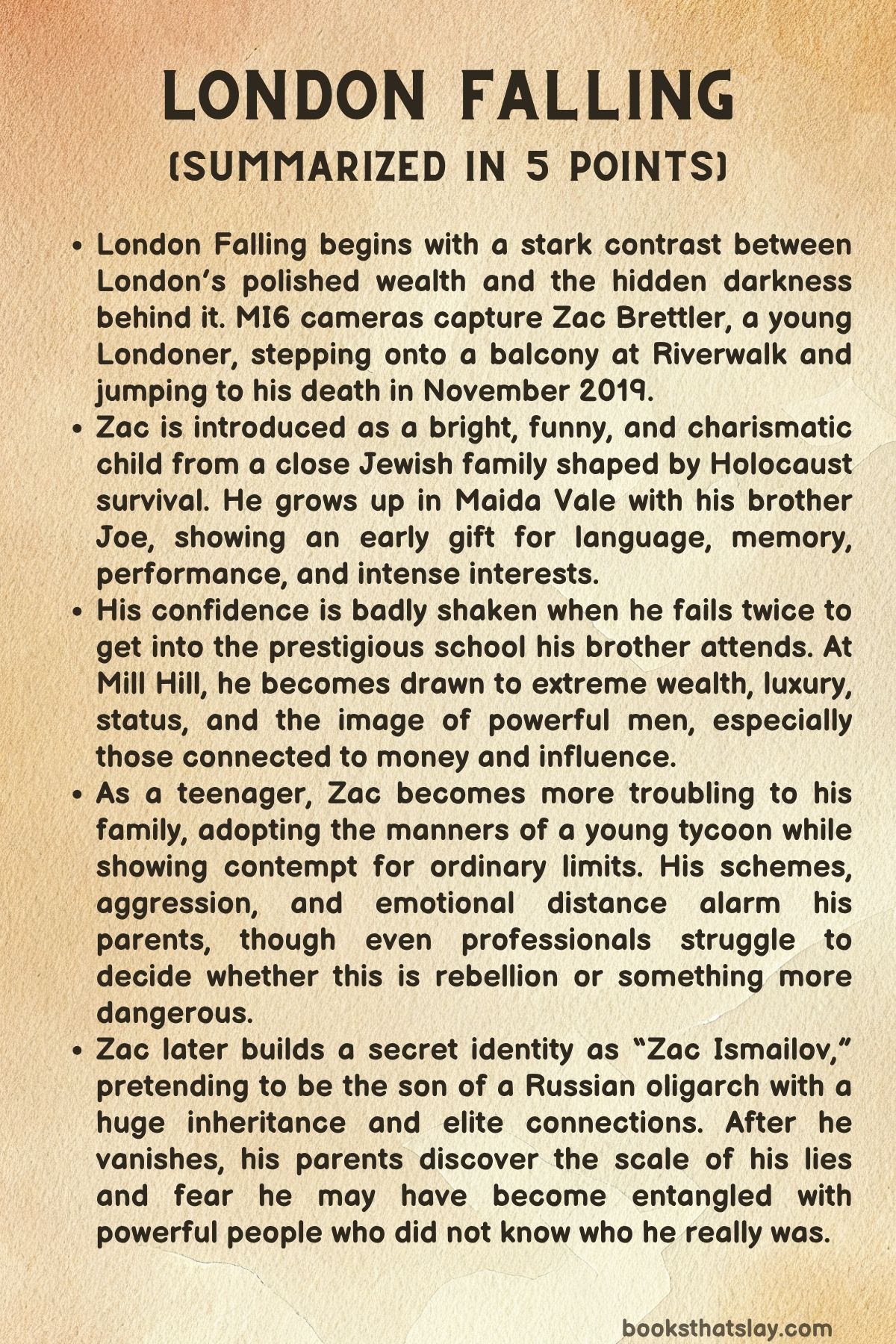
London Falling opens in a London that has been dramatically remade. The city once defined by docks, industry, and working riverfronts has become a showcase for international wealth.
Along the Thames stand luxury towers, expensive apartments, and properties owned through opaque structures. Some homes sit empty, functioning less as places to live than as containers for capital.
Across the river from the Riverwalk apartments stands the headquarters of MI6, Britain’s foreign intelligence service. Its cameras quietly watch the area.
In the early hours of November 29, 2019, one of those cameras records a young man stepping onto the balcony of unit 504. He pauses at the edge, then jumps into the dark.
The young man is Zac Brettler. He is nineteen years old.
His death at Riverwalk becomes the central mystery of London Falling, but the story begins long before that final moment. Zac was born in London in 2000 to Matthew and Rachelle Brettler.
His family history carried the memory of survival and reinvention. Both of his grandfathers had escaped or endured Nazi persecution and later built new lives in Britain.
That past gave the family a strong sense of gratitude, ambition, and resilience. Zac grew up in Maida Vale with his older brother, Joe, in a home that valued education, humor, warmth, and achievement.
As a child, Zac was bright, funny, and unusually quick. He had a remarkable memory and a talent for language.
He could imitate adults, remember lyrics, repeat details from catalogues, and absorb information with surprising speed. He became fascinated by cars, gadgets, music, and the signs of adult life.
He was sociable and entertaining, often drawing people toward him with his energy and confidence. Among neighborhood children, he was a lively figure.
He was close to Joe, though their bond also contained rivalry. Zac wanted to match or surpass his older brother, especially in sports and school.
A painful turning point came when Zac failed to gain admission to University College School, the academically respected school that Joe attended. He tried twice and was rejected twice.
The rejection hurt him badly. To his parents, it was a disappointment but not a disaster.
To Zac, it seemed to mark him as lesser than his brother and excluded from an elite world he wanted to enter. Instead, he went to Mill Hill, a private school with a less prestigious reputation but a student body that exposed him to a different kind of status.
There he encountered wealthy international students, including children from former Soviet and oligarchic circles.
At Mill Hill, Zac became increasingly fascinated by extreme wealth and the behavior of men who seemed to move through life with power and ease. He noticed luxury cars, designer clothes, expensive watches, and the confidence of people who appeared to have unlimited money.
Popular films about fast-talking hustlers and reckless ambition appealed to him. He admired characters who bent rules, made money quickly, and treated life like a contest.
He began talking about wanting to become richer and more successful than his father. What had once seemed like boyish enthusiasm started to harden into a hunger for status.
During his teenage years, Zac changed sharply at home. He became more difficult, more secretive, and more contemptuous of ordinary family limits.
He wore suits and carried himself like a businessman. He spoke admiringly of Vladimir Putin, wealth, strength, and power.
He seemed drawn to a worldview in which money mattered above almost everything else. He started small schemes, reselling clothes, selling cigarettes at school, and looking for ways to present himself as older and richer than he was.
At one point, he hired a limousine simply to experience the feeling of arriving like someone important.
Matthew and Rachelle were increasingly worried. They did not know whether Zac was going through an extreme version of adolescence or whether something more troubling was happening.
His attitude toward them became colder. He seemed to reject the family’s values and to resent their authority.
One frightening incident forced the issue. During a confrontation, Zac briefly put his hands around Rachelle’s throat.
The family sought psychiatric help. The psychiatrist did not find signs of psychosis or a mood disorder, but he did note narcissistic and antisocial traits, along with Zac’s limited insight into his own behavior.
Therapy was recommended, but Zac resisted it.
For a time, life appeared to stabilize. Zac moved from Mill Hill to Ashbourne College, where he had more freedom in London.
This freedom gave him access to the city’s business districts, wealthy neighborhoods, and social spaces. He began seeking out older men who could offer advice, connections, or opportunities.
He interned with Adam Bawany and launched a company called Omega Stratton, giving himself the appearance of a young entrepreneur. He also became involved with Akbar Shamji, an older, wealthy businessman based in Mayfair.
Akbar represented the kind of life Zac admired. Through him, Zac entered spaces associated with privilege, private clubs, luxury property, and international money.
He spent time with Akbar, Akbar’s family, and their dog. He visited places such as Annabel’s, One Hyde Park, and Berkeley Square.
To Zac, this world seemed to confirm the identity he wanted to create for himself. He told his parents about business deals, real estate projects, car import plans, mining ventures, and large sums of money.
He implied that he was moving in circles where serious wealth and opportunity were normal.
At one point, Zac also spent time at Riverwalk, the luxury apartment building across from MI6. He said this arrangement involved a rubber tycoon named Verinder Sharma.
To his family, these stories were confusing but not always easy to disprove. Zac was secretive, but he was also persuasive.
He had always been quick with words, and now that ability served a darker purpose. He could tell stories with confidence, adjust details when challenged, and make his ambitions sound plausible.
Then Zac vanished. On November 28, 2019, he told Rachelle that he was going to Riverwalk for a “phone detox.” The explanation was strange but not impossible.
He left behind his keys, credit cards, and jacket. Later he sent a short final email saying, “All good x.” The message seemed designed to reassure, but it gave no real information.
The next morning, a strange man came to the Brettler family home looking for Zac. At the same time, a voice on the phone claimed that Zac’s mother was in Dubai.
This made no sense and alarmed Rachelle.
Rachelle began contacting friends, police, and Akbar. The family’s fear grew quickly.
Zac had not behaved like someone simply taking time away. The missing keys, cards, and jacket suggested something was wrong.
Matthew and Rachelle soon met with Akbar and began to understand that their son’s life had been far more complicated than they knew.
To Akbar, Verinder, and others, Zac Brettler had not presented himself as Zac Brettler at all. He had called himself Zac Ismailov.
In this invented identity, he was the son of a Russian oligarch. He claimed to have a Swiss model mother, a dead billionaire father, and a vast inheritance.
He said he lived in or was connected to One Hyde Park, one of London’s most exclusive residential addresses. He created stories of family conflict, homelessness, wealth, danger, and even heroin addiction.
These claims were dramatic, but they were delivered with such confidence that older and more experienced people believed him.
Akbar and Verinder had taken him seriously. They had housed him, advised him, introduced him to people, and included him in business conversations.
Zac’s youth did not seem to prevent them from accepting his story. In the world he had entered, where wealth could be hidden behind shell companies and family fortunes could be difficult to verify, an extravagant background was not automatically impossible.
London itself helped make Zac’s lie believable. In a city filled with secret money and private lives, a teenage boy could pretend to be the heir to a foreign fortune and be treated as credible.
As Matthew and Rachelle learned more, they realized Zac had built an enormous structure of falsehoods. He had not merely exaggerated his wealth or inflated his prospects.
He had created a second self. The discovery was devastating.
It also raised frightening questions. Had Zac deceived people who might punish him?
Had he borrowed money, promised deals, or angered dangerous men? Was he hiding, harmed, or dead?
The parents did not yet know about the MI6 camera footage. They only knew that their son was missing and that the people around him had known a fictional version of him.
The family hired investigator Clive Strong to help find answers. Strong went to Riverwalk to examine CCTV footage from the night Zac disappeared.
The search for Zac became a search through layers of performance, wealth, and secrecy. Every person who had known him seemed to have seen a different version of him.
His parents remembered a brilliant, funny child who had become troubled and unreachable. His business contacts knew a confident young man with claims to foreign money.
His mentors saw a mysterious heir in distress. Zac himself seemed to have become trapped inside the role he had invented.
The mystery at the center of London Falling is not only why Zac jumped, but how he came to that balcony in the first place. The book shows a young man shaped by intelligence, insecurity, envy, ambition, and fantasy.
Zac wanted to escape the limits of ordinary life and become someone grander. He wanted the respect that came with money before he had earned money itself.
He wanted access to power before he had real power. London, with its luxury towers and hidden fortunes, gave him the stage on which to act out that dream.
Yet the performance became dangerous. Zac’s lies separated him from the people who loved him and bound him to people who did not truly know him.
He created a persona that impressed strangers but left him isolated. By the time he told his mother he was going to Riverwalk, his real life and invented life had collided.
His final message, “All good x,” was the last small fiction, a reassurance sent when things were anything but good.
In the end, London Falling presents Zac Brettler’s story as both intimate and social. It is the story of a family trying to understand a son they loved but could not fully reach.
It is also a story about a city where money can conceal origins, where identity can be performed, and where people may accept unlikely stories if those stories come wrapped in wealth. Zac’s death remains haunting because it sits at the meeting point of private pain and public glamour.
Behind the shining apartments and elite clubs was a frightened young man who had built a life on illusion and found no safe way out.
Key Figures
Zac Brettler
Zac Brettler is the central and most psychologically complex figure in London Falling. He begins the book as a bright, funny, affectionate, and unusually gifted child, someone with a sharp memory, quick language skills, and a natural ability to entertain the people around him.
His early charm is important because it shows that Zac is not presented as a simple deceiver from the beginning; rather, he is a young person whose personality gradually bends under pressure, insecurity, ambition, and fantasy. His failure to enter University College School becomes a major emotional wound, because it separates him from the academic path followed by his brother Joe and leaves him feeling diminished.
This rejection seems to feed a hunger to reinvent himself as someone richer, more powerful, and more impressive than the ordinary boy he fears he may be.
As Zac grows older, his fascination with wealth becomes one of his defining traits. At Mill Hill, he enters a social world where extreme privilege, foreign money, luxury cars, designer clothes, and oligarchic glamour surround him.
Instead of merely admiring this world from a distance, Zac begins to shape himself around it. His interest in hustlers, businessmen, fast money, and powerful men suggests that he is searching for an identity that will protect him from shame and ordinary limits.
His suits, schemes, admiration for figures associated with power, and desire to outdo his father all reveal a boy who is trying to turn status into armor. Yet this ambition is unstable because it is not rooted in real achievement; it increasingly depends on performance, exaggeration, and deception.
Zac’s double life as “Zac Ismailov” shows both his imaginative brilliance and his emotional danger. He invents an entire identity involving oligarch wealth, a Swiss model mother, a dead billionaire father, inheritance, family conflict, homelessness, and addiction.
This false self is not a small lie but a complete alternate existence, convincing enough to draw in wealthy adults such as Akbar and Verinder. Zac’s tragedy lies in the fact that he appears to understand the language, gestures, and fantasies of elite wealth so well that he can temporarily pass inside that world, but he cannot truly belong to it.
His lies give him access, attention, housing, mentorship, and business conversations, but they also trap him inside a performance that becomes harder and harder to escape.
Zac is also troubling because his charm coexists with cruelty, contempt, and emotional volatility. His aggression toward Rachelle, his rejection of therapy, his lack of insight, and the psychiatrist’s observation of narcissistic and antisocial traits all suggest that his transformation is not simply normal teenage rebellion.
At the same time, the book does not reduce him to those traits alone. He remains a young man shaped by longing, insecurity, family pressure, fantasy, and a desperate need to be seen as exceptional.
His final disappearance and death make him one of the most tragic figures in the book because his invented life seems to have overtaken his real one. Zac’s story becomes a portrait of a young man seduced by power and status until the boundary between aspiration and self-destruction collapses.
Rachelle Brettler
Rachelle Brettler is Zac’s mother and one of the most emotionally grounded figures in the book. She is presented as a parent who knows her son intimately, remembers his childhood brightness, and senses the danger in his later transformation before the full truth is visible.
Her concern is not simply that Zac is becoming rebellious, but that something deeper in his values and personality is changing. She sees his growing contempt, his obsession with wealth, his admiration for power, and his emotional distance from the family.
Because she remembers the affectionate and charismatic child he once was, her fear carries a particular sadness: she is not only worried about what Zac is doing, but also grieving the person he seems to be losing.
Rachelle’s role becomes especially important during Zac’s disappearance. When he tells her he is going to Riverwalk for a “phone detox,” leaves behind essential belongings, and sends the brief message “All good x,” she recognizes that the situation is not normal.
Her alarm intensifies when a strange man comes to the family home and a voice on the phone gives a false claim about her being in Dubai. These details place Rachelle in the position of a mother trying to interpret fragments of a life her son has hidden from her.
Her actions show urgency, instinct, and love, as she contacts friends, police, and Akbar in an effort to find Zac.
Rachelle also represents the pain of parental helplessness. She and Matthew see signs that Zac is changing, but they cannot fully understand the scale of his deception until after he vanishes.
Even the violent incident in which Zac puts his hands around her throat does not give them a clear path forward, because the psychiatrist finds no psychosis or mood disorder and Zac resists therapy. Rachelle is therefore caught between love, fear, and uncertainty.
Her character shows how difficult it can be for parents to respond when a child’s behavior falls into a confusing space between adolescence, ambition, manipulation, and psychological distress.
Matthew Brettler
Matthew Brettler, Zac’s father, stands in the book as a figure of family stability, achievement, and comparison. Zac’s desire to become “bigger and richer” than his father reveals that Matthew occupies an important symbolic role in Zac’s imagination.
He is not merely a parent; he becomes a benchmark that Zac feels compelled to exceed. This makes Matthew central to understanding Zac’s ambition.
Zac’s hunger for wealth and status is partly directed outward toward the glittering world of London money, but it is also directed inward toward the family, where he wants to prove that he is not lesser, rejected, or ordinary.
Matthew is also part of the family history of survival and rebuilding. Through the Brettler family’s Holocaust background, he belongs to a lineage shaped by trauma, endurance, and the creation of a secure life in Britain.
This history gives Zac’s story a deeper emotional contrast. The family’s past is marked by survival from persecution and the careful building of new lives, while Zac becomes drawn to a world of reckless wealth, false identity, and dangerous glamour.
Matthew’s presence therefore helps highlight the gap between inherited stability and Zac’s restless desire for reinvention.
As a father, Matthew appears alarmed but also uncertain. Like Rachelle, he sees Zac’s changes but cannot immediately know whether they are temporary adolescent behavior or signs of something far more serious.
His meeting with Akbar after Zac’s disappearance becomes a devastating moment of discovery, as he learns that his son has been living behind an elaborate invented identity. Matthew’s character embodies the shock of realizing that a child has become unknowable.
His importance lies not in dramatic action, but in the emotional weight of a father confronted with the collapse of what he thought he understood about his son.
Joe Brettler
Joe Brettler, Zac’s older brother, plays a quieter but significant role in the book. He is important because he represents one of the earliest standards against which Zac measures himself.
Joe attends University College School, the academically prestigious institution that Zac fails twice to enter, and this difference becomes a painful dividing line in Zac’s life. Zac’s closeness with Joe is mixed with competition, especially in sports, which suggests that their brotherly bond contains affection as well as rivalry.
Joe is not portrayed as the cause of Zac’s insecurity, but his success becomes part of the emotional landscape through which Zac understands his own rejection.
Joe’s role also helps explain why Zac’s school failure matters so deeply. The rejection is not only academic; it becomes personal and comparative.
Zac is forced onto a different path from his brother, and that path leads him into Mill Hill’s world of wealth, foreign privilege, and status performance. In this way, Joe functions as a reminder of the life Zac might have imagined for himself before he began chasing a more extravagant identity.
His presence in the story helps show that Zac’s later obsession with power and money may have roots in a wounded sense of being left behind.
Although Joe is not described in as much detail as Zac, he is essential to the family dynamic. He belongs to the ordinary, recognizable structure of Zac’s early life: home, childhood, sibling rivalry, and shared upbringing.
Against that background, Zac’s later reinvention as “Zac Ismailov” appears even more dramatic. Joe helps anchor the reader’s understanding of who Zac was before the false identities, luxury settings, and business fantasies took over.
Zac’s Grandfathers
Zac’s grandfathers are significant because their histories place the Brettler family within a larger story of survival, displacement, and rebuilding. Both men escaped or survived Nazi persecution and went on to build new lives in Britain.
Their presence in the family background gives the book a powerful historical dimension. Zac is not simply a young man from a comfortable London family; he is descended from people who endured some of the darkest violence of the twentieth century and created stability after catastrophe.
This family history deepens the tragedy of Zac’s life. His grandfathers’ survival suggests values of endurance, resilience, memory, and hard-won security, while Zac becomes fascinated by a very different set of values: spectacle, wealth, dominance, luxury, and invented status.
The contrast does not mean that Zac rejects his family history directly, but it does show how far his imagination travels from the world his ancestors fought to rebuild. Their legacy makes Zac’s pursuit of false grandeur feel especially painful, because it unfolds against a background of real suffering and real survival.
The grandfathers also help explain the moral seriousness of the family setting. Their lives suggest that identity is not something light or disposable; it is tied to history, danger, and survival.
Zac’s creation of a fake identity therefore carries a deeper irony. He comes from a family whose real history is already extraordinary, yet he invents another history for himself, one filled with oligarch money and glamorous mythology.
This contrast makes his deception feel not only reckless but deeply sad.
Akbar Shamji
Akbar Shamji is one of the most important figures in Zac’s double life. As a wealthy older businessman in Mayfair, he represents the world Zac longs to enter: private clubs, luxury residences, elite social spaces, and business networks shaped by money and influence.
Akbar’s importance lies in the fact that he does not merely observe Zac from a distance. He brings Zac into his family circle, spends time with him, mentors him, and involves him in business conversations.
For Zac, Akbar becomes a gateway into the adult world of power that he has been trying to imitate.
Akbar is also significant because he believes in Zac’s invented identity. To him, Zac is not Zac Brettler but “Zac Ismailov,” a young man connected to Russian oligarch wealth, inheritance, family drama, and hidden privilege.
Akbar’s belief shows how effective Zac’s performance has become. It also reveals something about the environment around them: in a world already filled with secretive money, foreign wealth, and extravagant personal histories, Zac’s lies may not seem impossible.
Akbar’s acceptance of Zac’s story suggests that the culture of elite London can make fantasy appear plausible when it is wrapped in the right symbols of wealth and confidence.
At the same time, Akbar is not simply a foolish or comic figure. His relationship with Zac appears to contain genuine investment and concern.
He houses him, mentors him, and treats him as someone worth helping. When Zac disappears, Akbar becomes part of the painful process through which Matthew and Rachelle discover the scale of their son’s deception.
His character therefore serves two purposes: he shows the seductive world Zac enters, and he also becomes one of the people deceived by Zac’s desperate performance.
Verinder Sharma
Verinder Sharma is another key figure in Zac’s invented life. He is described as a rubber tycoon and is connected to Zac’s supposed move into Riverwalk.
Like Akbar, Verinder believes in the false identity Zac has created. His willingness to house and support Zac shows how successfully Zac manages to present himself as a young man from an extraordinary background rather than as a teenager from Maida Vale living behind a web of lies.
Verinder’s role is important because Riverwalk becomes the physical center of Zac’s final mystery. The apartment is not just a setting; it represents the world Zac has entered through deception.
It is luxurious, secretive, and connected to the transformed London landscape of foreign money and hidden ownership. Verinder’s connection to that space makes him part of the machinery that allows Zac’s fantasy life to become real enough to inhabit.
Zac’s presence in Riverwalk is not merely symbolic; it is the place where his false identity and his real vulnerability meet.
Verinder also helps reveal how Zac’s deception depended on adult belief. Zac could not have sustained his invented identity alone; he needed people who were willing to accept the story, provide shelter, and treat him as someone important.
Verinder’s character therefore shows how Zac’s lies moved beyond imagination and became social reality. His role adds to the sense that Zac’s tragedy unfolded not in isolation, but within a network of wealth, trust, secrecy, and illusion.
Adam Bawany
Adam Bawany represents an earlier stage of Zac’s attempt to enter the business world. Zac’s internship with him shows that before the full construction of the “Zac Ismailov” identity, he was already trying to attach himself to entrepreneurship, money-making, and adult professional circles.
Adam’s role is not as central as Akbar’s or Verinder’s, but he matters because he helps mark Zac’s transition from schoolboy schemes to more serious attempts at business involvement.
Through Adam, Zac’s ambition appears more structured and outward-facing. He is not only fantasizing about wealth; he is actively seeking contacts, internships, ventures, and opportunities.
This helps make Zac’s development more believable. His later lies do not emerge from nowhere, because he has already been practicing the habits of a young hustler: networking, pitching ideas, forming companies, and imagining himself as a businessman.
Adam’s presence helps show that Zac’s hunger for status had practical expression before it became dangerously theatrical.
Adam also belongs to the wider adult world that Zac wants to impress. In Zac’s mind, figures like Adam may represent access to seriousness, legitimacy, and business identity.
Zac wants to be treated not as a teenager but as a young man of consequence. Adam’s role therefore contributes to the book’s portrait of Zac as someone who is constantly trying to move faster than his age, faster than his experience, and faster than the truth can support.
Clive Strong
Clive Strong enters the book as an investigator hired after Zac disappears. His role is important because he represents the movement from confusion to inquiry.
By the time Clive becomes involved, Zac’s family is no longer dealing with ordinary worry; they are confronting a situation filled with false identities, strange visitors, suspicious phone calls, and the possibility that Zac may have deceived dangerous people. Clive’s presence signals that the search for Zac has become urgent, organized, and investigative.
Clive’s examination of CCTV footage at Riverwalk connects him directly to the central mystery of Zac’s final hours. The surveillance image of Zac stepping onto the balcony and jumping into the darkness is one of the most haunting elements of the book.
Clive’s role is to help uncover what can be known from evidence, especially when so much of Zac’s life has been built out of lies. In a story filled with performance and invention, Clive stands for the attempt to recover fact.
He also functions as a contrast to Zac’s world of fantasy. Zac’s life has become crowded with invented names, false histories, imaginary fortunes, and misleading stories, while Clive’s work depends on footage, timelines, and concrete details.
His character matters because the truth of Zac’s death must be approached through fragments rather than clear explanations. Clive helps move the story from emotional panic toward investigation, even though the emotional mystery of Zac remains larger than any single piece of evidence.
Themes
Wealth, Status, and the Performance of Power
London Falling presents wealth not only as money but as a language of belonging, influence, and self-invention. Zac becomes drawn to luxury because it seems to offer a faster route to importance than school, family approval, or ordinary achievement.
Designer clothes, private clubs, expensive apartments, limousines, and business talk become signs through which he tries to construct a new identity. His fascination with men who appear powerful shows how status can become seductive when it promises escape from insecurity.
The London around him strengthens this desire, because the city itself has been reshaped by hidden money, foreign capital, and property that signals wealth even when it is empty. Zac learns to imitate this world before he truly understands it.
His invented identity as the son of an oligarch works because the people around him are already prepared to believe in extreme wealth. The theme shows how money can distort judgment, making performance seem like proof and appearance seem like truth.
Identity, Reinvention, and the Fragility of Self
Zac’s false identity grows from more than simple dishonesty; it reflects a deep need to become someone grander, richer, and more impressive than the person he feels himself to be. His rejection from an elite school leaves a lasting wound, and his later behavior suggests that he tries to repair that wound by creating a version of himself who cannot be dismissed.
“Zac Ismailov” gives him what ordinary life does not: mystery, power, tragedy, danger, and access. Through this invented self, he gains attention from older men, entry into elite spaces, and a sense of control over how others see him.
Yet the more successful the performance becomes, the more unstable it grows. He must keep adding new lies to protect the old ones, until his identity becomes a structure too heavy to carry.
The theme reveals how reinvention can become dangerous when it is built on shame, fantasy, and the fear of being ordinary.
Family Love, Fear, and Helplessness
Matthew and Rachelle’s relationship with Zac is marked by love, confusion, alarm, and a growing sense of helplessness. They remember him as a gifted, funny, affectionate child, which makes his later coldness and aggression even harder to understand.
Their concern is not simple parental disapproval; they sense that something in him is moving beyond normal teenage rebellion, but they cannot fully name it or stop it. The violent moment with his mother reveals a frightening break in family trust, yet even then they seek help rather than abandon him.
Their struggle shows the pain of watching a child become unreachable while still hoping that he can return to himself. After his disappearance, their search is driven by panic but also by the need to understand the hidden life he has built.
This theme captures the limits of parental protection: love can notice danger, respond to it, and search for answers, but it cannot always prevent collapse.
Deception, Trust, and the Desire to Believe
Zac’s lies succeed because deception depends not only on the liar but also on the listeners’ desires. Akbar, Verinder, and others accept his stories partly because they fit the world they already inhabit, where wealth is secretive, family histories are dramatic, and young men with access to vast fortunes seem believable.
Zac understands what people expect from privilege and gives them the details that make his story convincing: elite addresses, family conflict, inheritance, foreign connections, and emotional vulnerability. His deception is bold, but it is also carefully shaped around what others want to see.
This theme exposes how trust can be manipulated when people are impressed by money, mystery, or social status. It also shows how lies can create real relationships, at least for a time, because those who believe Zac offer him housing, guidance, and companionship.
The tragedy lies in the fact that the false story becomes powerful enough to replace reality until the consequences can no longer be controlled.