You with the Sad Eyes Summary and Analysis
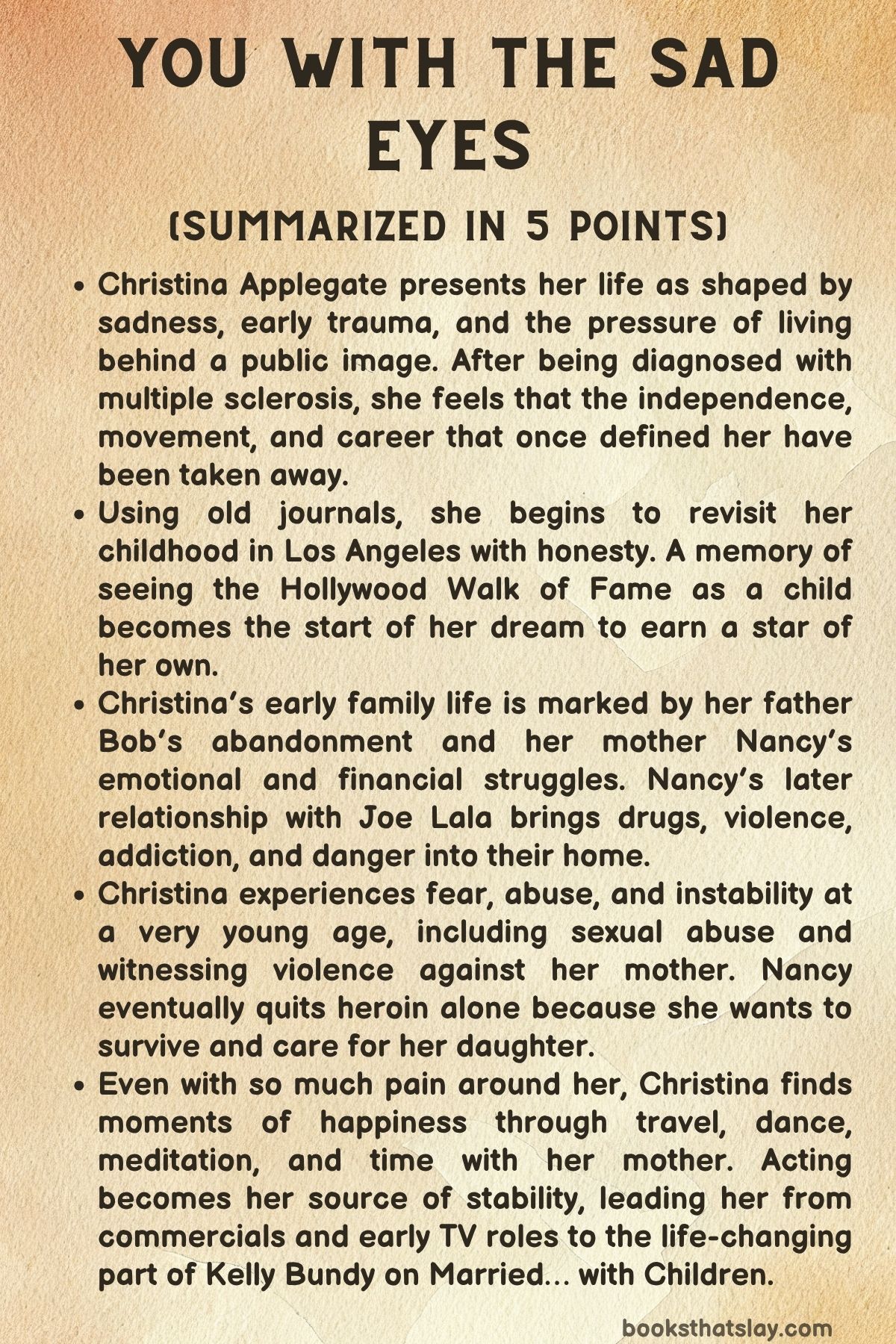
You with the Sad Eyes by Christina Applegate is a memoir about identity, survival, fame, illness, and the hidden pain behind a public life. Applegate writes from the difficult present of living with multiple sclerosis, looking back at the experiences that shaped her long before audiences knew her as a television star.
The book traces her childhood in Los Angeles, her bond with her mother, early abandonment by her father, exposure to addiction and violence, and the way acting and dance became forms of escape. It is a story about a woman trying to reclaim her own truth from behind the image of “Christina Applegate.”
Summary
You with the Sad Eyes begins with Christina Applegate reflecting on how people have often described her as sad. She does not treat that sadness as a simple mood or personality trait.
Instead, she sees it as something formed by abandonment, fear, abuse, secrecy, and the pressure of living under a famous name. From the beginning, she separates the public figure called “Christina Applegate” from the private person who has carried pain for most of her life.
That divide becomes even sharper after she is diagnosed with multiple sclerosis.
In the present, Applegate describes a life changed by illness. Multiple sclerosis has taken away many of the things that once made her feel powerful and alive: movement, dancing, independence, work, and ease in her own body.
She spends much of her time in bed, in pain, exhausted, and limited by symptoms that make ordinary tasks difficult. The body that once performed, moved, and entertained now feels unreliable.
Facing this new reality, she decides to tell the truth about her life. She opens a locked box of old journals, written from adolescence onward, and prepares to revisit her past without hiding behind fame, humor, or performance.
The story returns to Los Angeles in 1977, when Christina is five years old and standing in line with her mother, Nancy Priddy, outside Grauman’s Chinese Theatre to see Star Wars. While waiting, Christina notices the stars on the Hollywood Walk of Fame.
The idea of having a name fixed into the sidewalk, remembered by strangers, captures her imagination. At that young age, she forms a dream: one day she wants a star of her own.
That moment gives her an early sense of ambition, but it also connects fame with the desire to be seen, remembered, and safe from being forgotten.
Christina and Nancy live in Laurel Canyon, a place with a glamorous musical past but a much darker reality inside their home. Their house is small and difficult, and the world around them is filled with drugs, danger, and unstable adults.
Laurel Canyon may carry the mythology of creativity and freedom, but for Christina it becomes a place of fear and confusion. Her childhood is marked by a constant tension between the beauty of Los Angeles and the chaos behind closed doors.
The memoir then turns to Christina’s parents. Nancy Priddy is a singer from Indiana who spends time in the Greenwich Village music scene and forms connections with artists such as Leonard Cohen and Stephen Stills.
She eventually meets Bob Applegate, a music promoter. Their relationship begins with romance and possibility, and they move into the world of Laurel Canyon together.
Christina is born on Thanksgiving Day in 1971. Soon after, however, Bob leaves Nancy and their daughter.
He moves to Big Sur and begins a new relationship, leaving Nancy emotionally crushed and financially vulnerable.
Bob’s abandonment becomes one of the first wounds in Christina’s life. Even before she fully understands it, she grows up in the shadow of his absence.
Nancy is left to raise her daughter alone while trying to survive her own pain. The departure does not only create practical hardship; it shapes the emotional atmosphere of Christina’s childhood.
She learns early that love can vanish, adults can leave, and safety can disappear without warning.
After Bob leaves, Nancy becomes involved with Joe Lala, a musician whose presence brings danger into the home. Christina describes him as abusive, alcoholic, and addicted to heroin.
Lala introduces Nancy to heroin by giving her China White and presenting it as something that will help her sleep. Nancy becomes addicted, and Christina’s home becomes a place filled with drugs, fear, and unpredictable behavior.
People using drugs come and go. Lala nods out with lit cigarettes.
The child Christina watches things no child should have to understand.
During this period, Christina is also sexually abused by an older girl who is supposed to be caring for her. The abuse leaves her with shame and confusion that affect her relationship with her body, touch, and sexuality for the rest of her life.
She carries the memory silently, as many children do, without the language or safety needed to explain what happened. This experience becomes another hidden wound beneath the image she later presents to the world.
The violence in the house grows worse. In one terrifying moment, Lala brutally attacks Nancy and knocks her unconscious.
Christina screams for him to stop. Instead of stopping, he grabs Christina by the hair, throws her into her bedroom wall, and orders her to stay out of it.
The scene shows how trapped she is: too young to protect her mother, yet unable to look away. Afterward, Christina refuses to leave Nancy.
She stays close to her mother’s unconscious body, brushing her teeth again and again while waiting for Nancy to wake. The repeated brushing becomes a child’s desperate attempt to create order in a world that has become unbearable.
More chaos follows. Bob takes Christina from school, creating another rupture in her already unstable life.
Nancy, overwhelmed by despair, attempts suicide. Eventually, Nancy reaches a turning point.
She quits heroin alone on the bathroom floor because she wants to be present for her daughter. This moment is painful but important.
Nancy is not shown as a perfect mother, but as a damaged woman fighting to survive and to return to the child who needs her.
Despite everything, Christina’s memories of Nancy are not only dark. Their relationship contains joy, closeness, and imagination.
They go to Magic Mountain, roller-skate at Venice Beach, spend weekends in Laguna Beach, and visit family in South Bend, Indiana. Nancy introduces Christina to meditation, creative visualization, and dance.
These experiences give Christina moments of freedom and wonder. They also show that Nancy, even while struggling, tries to give her daughter beauty, creativity, and hope.
Dance becomes Christina’s greatest escape. Through dance, she finds a way to leave fear behind and live inside her body with joy.
Movement gives her control, expression, and release. It becomes a major part of who she is, which makes her later loss of mobility from multiple sclerosis even more painful.
The memoir links the child who found safety in movement with the adult who now grieves what her body can no longer do.
As Christina grows older, she becomes more aware of the danger around her. Laurel Canyon is not just a strange neighborhood; it is a place shaped by drugs, crime, and violence.
The Wonderland murders nearby both disturb and fascinate her. They confirm what she already senses: the adult world around her is not safe.
The fear of those early years settles deeply into her mind.
In adolescence, Christina struggles with depression, body image, disordered eating, and suicidal thoughts. Her diaries reveal the emotional weight she is carrying.
She feels sadness, anger, shame, and confusion, often without a clear way to process them. At the same time, acting begins to give her structure.
Work becomes more than ambition; it becomes survival. Acting gives her a schedule, a purpose, and a way to help support the household.
Christina begins appearing in commercials and television as a child. She earns money and learns the discipline of performance.
At one point, she thinks about quitting, but she realizes that work is one of the few steady things in her life. Acting becomes an anchor when everything else feels uncertain.
Early roles on shows such as Charles in Charge, Washingtoon, and Heart of the City help prepare her for the part that will change her future.
That role is Kelly Bundy on Married… with Children. At first, Christina rejects the show because she thinks it is crude and beneath her.
But after watching the pilot, she sees that it is genuinely funny. During a chemistry read with David Faustino, she feels a connection that helps her understand the energy of the show.
She accepts the role, stepping into the part that will make her famous.
By the end of this section of You with the Sad Eyes, Christina Applegate has shown how fame grew out of a childhood marked by instability, fear, love, ambition, and survival. The public success that follows is not presented as a simple dream come true.
It is built on years of pain, responsibility, and the need to keep moving forward. The memoir frames her rise not as an escape from sadness, but as part of a lifelong effort to live with it, understand it, and finally speak about it honestly.
Key Figures
In You with the Sad Eyes, the figures are deeply connected to the narrator’s memories of abandonment, survival, trauma, ambition, and identity. Each person in the story shapes Christina’s emotional world in a different way, either by giving her love, causing her pain, or helping her understand the person she becomes.
Christina Applegate
Christina Applegate is the central figure of the book, and her character is presented as someone who has lived for years behind a public image while carrying private pain. From childhood, she is marked by sadness, fear, and emotional insecurity, but she is also observant, imaginative, and deeply sensitive.
Her fascination with the Hollywood Walk of Fame shows her early desire to be remembered, admired, and made permanent in a world where so much of her life feels unstable. As a child, she experiences abandonment, abuse, addiction, violence, and fear, yet she learns to survive by watching carefully, hiding her feelings, and finding structure through performance.
Christina’s character is especially complex because she is both vulnerable and resilient. She is frightened by the adults around her, but she is also protective, especially toward her mother.
When Nancy is attacked, Christina does not behave like a passive child; she screams, resists, and stays beside her mother afterward. This shows her fierce emotional loyalty and her early loss of innocence.
Her repeated tooth-brushing after the violence suggests a child trying to create order, cleanliness, and control after witnessing something terrifying. These details make her character emotionally powerful because her trauma is not presented as a simple memory, but as something that shaped her body, habits, relationships, and sense of self.
As she grows older, Christina becomes a young person struggling with depression, body image, eating issues, and suicidal thoughts. Her diaries reveal that her sadness is not a surface-level personality trait but the result of years of emotional injury.
Acting becomes more than a career for her; it becomes a lifeline. Work gives her purpose, routine, and a sense of usefulness in a life that has often felt chaotic.
Her role as Kelly Bundy becomes important not only because it changes her public life, but because it gives her a stable place to belong. Christina’s character is therefore defined by the tension between the girl who is wounded and afraid and the performer who learns how to function, succeed, and be seen.
In the present-day frame of the story, Christina’s diagnosis with multiple sclerosis adds another layer to her character. She feels that the illness has taken away movement, dancing, independence, and parts of her identity that once helped her survive.
By opening her journals and choosing to tell the truth, she becomes a narrator who is no longer willing to hide behind fame or polished versions of herself. Her character arc is not simply about becoming successful; it is about confronting the painful truth of her past and reclaiming her voice.
Nancy Priddy
Nancy Priddy is one of the most important characters in the book because she is both Christina’s mother and one of the central emotional forces in Christina’s life. Nancy is portrayed as artistic, talented, loving, and wounded.
Her background as a singer connects her to music, creativity, and the cultural world of Laurel Canyon, but her life also becomes marked by heartbreak, addiction, financial struggle, and danger. After Bob leaves, Nancy is devastated and left to raise Christina largely on her own.
This abandonment places her under emotional and practical pressure, and her vulnerability makes her more exposed to destructive relationships.
Nancy’s relationship with Christina is complicated but deeply loving. She is not a perfect mother, and her addiction places Christina in unsafe situations, but the story does not present her as uncaring.
Instead, Nancy is shown as a woman who is damaged, overwhelmed, and trapped in painful circumstances. Her relationship with Joe Lala introduces violence and heroin into the home, and this has devastating effects on Christina’s childhood.
Yet Nancy’s character also contains strength. Her decision to quit heroin alone on the bathroom floor so she can be present for her daughter is one of the most important signs of her love and determination.
Nancy also gives Christina beauty and imagination. She takes her to joyful places, introduces her to meditation and creative visualization, and encourages dance.
These moments show that Nancy is not only associated with trauma; she is also a source of wonder, creativity, and emotional connection. Through Nancy, Christina receives both wounds and gifts.
Nancy’s character represents the painful reality that a parent can deeply love a child while still being unable to fully protect that child from chaos. This makes her one of the most human and emotionally layered figures in the story.
Bob Applegate
Bob Applegate is Christina’s father, and his character is defined largely through absence. As a music promoter who falls in love with Nancy and begins a family with her, he initially seems connected to the artistic and musical world surrounding Christina’s early life.
However, soon after Christina’s birth, he leaves Nancy and Christina, moves to Big Sur, and begins a new relationship. This abandonment becomes one of the earliest emotional wounds in Christina’s life.
Bob’s importance in the story comes not from his constant presence, but from the space he leaves behind. His departure affects Nancy deeply and contributes to the financial and emotional instability that shapes Christina’s childhood.
For Christina, his absence becomes part of the larger pattern of insecurity that makes her feel unwanted, unsafe, and emotionally unprotected. Even when he appears later by taking Christina from school, his actions are connected to confusion and conflict rather than comfort.
Bob’s character represents the damage caused by parental abandonment, especially when a child is left to grow up wondering why one parent did not stay.
At the same time, Bob is not described as a cartoonish villain. His role is more emotionally subtle because the harm he causes comes through leaving, failing, and not providing the stability Christina needs.
His character helps explain why Christina’s sadness begins so early. He is part of the emotional foundation of the story because his abandonment shapes both Nancy’s collapse and Christina’s lifelong fear of being left behind.
Joe Lala
Joe Lala is one of the darkest and most damaging figures in the book. He enters Christina and Nancy’s life as a musician, but his presence quickly becomes associated with addiction, violence, fear, and danger.
He is described as abusive, alcoholic, and addicted to heroin, and he plays a direct role in Nancy’s addiction by introducing her to China White under the false idea that it will help her sleep. This makes him not only destructive in his own behavior, but also actively harmful to Nancy’s stability and Christina’s safety.
Lala’s character represents the terrifying adult presence that destroys a child’s sense of home. Through him, Christina is exposed to drug use, dangerous strangers, physical violence, and emotional terror.
His violence toward Nancy is especially significant because Christina witnesses it directly and is harmed when she tries to intervene. When he throws Christina into her bedroom wall and orders her to stay out of it, he reveals his cruelty and his willingness to injure a child who is only trying to protect her mother.
Lala is important because he embodies the chaos Christina must survive before she is old enough to understand it. He turns the home into a place of fear rather than safety.
His addiction and violence leave lasting marks on Christina’s memory, body, and emotional development. As a character, he functions as a source of trauma and danger, showing how destructive adults can shape a child’s entire understanding of love, safety, and trust.
David Faustino
David Faustino appears in the story as part of Christina’s professional life, especially when she is being considered for the role of Kelly Bundy on Married… with Children.
His role is very different from the darker figures in Christina’s childhood because he is connected to opportunity, chemistry, and the beginning of a major turning point in her career. During the chemistry read, Christina connects with him, and that connection helps her accept a role that eventually changes her life.
David’s character is not presented as a source of trauma or conflict. Instead, he represents the working world that gives Christina structure and direction.
His presence helps mark the shift from Christina’s chaotic private life into a more defined professional identity. While he is not explored as deeply as Christina, Nancy, Bob, or Lala, his role matters because he is part of the moment when Christina begins stepping into the career that will shape her public life.
Leonard Cohen
Leonard Cohen is mentioned through Nancy’s earlier artistic life and musical connections. His presence in the story helps establish the creative world Nancy once belonged to before her life became dominated by abandonment, addiction, and instability.
He is not a developed character in the emotional center of the story, but his mention contributes to the atmosphere surrounding Nancy’s past.
As a figure connected to music and artistry, Leonard Cohen helps show that Nancy’s life once had beauty, ambition, and creative possibility. His role is indirect, but it helps the reader understand the world Nancy came from and the cultural environment surrounding Christina’s early years.
He is less a personal influence on Christina and more part of the artistic background that shapes the setting of the story.
Stephen Stills
Stephen Stills, like Leonard Cohen, appears as part of Nancy’s musical history and the creative circles connected to her earlier life. He helps establish Nancy as someone who was close to important artistic spaces and people.
His role is not central to the emotional drama, but it adds context to Nancy’s identity as a singer and artist.
Stephen’s mention also strengthens the contrast between the glamour or freedom associated with the music world and the darker reality Christina experiences in Laurel Canyon. The creative world around Nancy may seem exciting from the outside, but Christina’s childhood shows that this environment also contains drugs, instability, and danger.
In this way, Stephen Stills functions as part of the cultural background rather than as a fully developed character.
Kelly Bundy
Kelly Bundy is Christina’s fictional role, but she is important because she becomes a major part of Christina’s life and career. At first, Christina rejects the show as crude and beneath her, which shows that she is uncertain about how she wants to be seen.
However, after watching the pilot and realizing the humor of the role, she accepts the part. Kelly becomes the character that changes Christina’s public life and gives her a new level of recognition.
Kelly matters because she represents Christina’s movement from childhood instability into professional success. The role gives Christina structure, visibility, and a place in television history.
At the same time, Kelly is also part of the public image that may not reflect Christina’s private pain. This creates an important contrast between the performer seen by audiences and the person behind the performance.
Through Kelly, the story shows how acting can be both an escape and a mask.
Themes
Sadness as a Result of Hidden Trauma
In You with the Sad Eyes, sadness is not presented as a simple personality trait, but as the visible result of years of abandonment, fear, shame, and emotional survival. The narrator explains that people have always seen her as sad, yet the sadness comes from experiences she was forced to carry long before she had the language to understand them.
Her father’s departure leaves her with an early wound of rejection, while the violence and addiction in her home teach her that safety can disappear at any moment. The abuse she suffers creates deep shame and changes how she relates to her own body, touch, and intimacy.
Because she becomes famous while still carrying these private wounds, her public image hides the real pain underneath. The theme becomes even stronger when her illness removes the movement, work, and independence that once helped her escape herself.
Her sadness is therefore not weakness; it is the emotional record of a life spent surviving things that were often invisible to others.
Fame and the Loss of the Private Self
Fame appears as both a dream and a burden. As a child, the narrator is fascinated by the idea of being remembered, especially when she sees the stars on the Hollywood Walk of Fame.
That desire gives her hope, ambition, and a sense of direction during a chaotic childhood. Acting becomes more than a career; it becomes a structure that helps her feel useful, needed, and in control.
However, public identity also creates a split between the person the world sees and the person who is suffering privately. The name “Christina Applegate” becomes almost like a mask that protects her but also traps her.
People know the performer, the dancer, the comic actress, and the celebrity, but they do not fully know the frightened child, the wounded daughter, or the adult living with pain. When multiple sclerosis limits her body and career, the identity built through fame begins to collapse.
The theme shows how public success cannot erase private damage, and how being recognized is not the same as being truly known.
Motherhood, Dependence, and Survival
The relationship between the narrator and her mother is marked by pain, danger, love, and fierce dependence. Nancy is not shown as a perfect protector, because addiction and abusive relationships expose her daughter to fear and instability.
Yet she is also shown as a wounded woman trying to survive abandonment, poverty, and her own emotional devastation. The bond between mother and daughter becomes complicated because the child often feels responsible for the adult.
When violence erupts, the narrator does not simply run away or wait for rescue; she stays close to her mother, watches over her, and clings to her presence. This reverses the usual parent-child role and forces the narrator into emotional maturity far too early.
Nancy’s decision to quit heroin alone so she can be present for her daughter becomes a powerful moment of love and survival. The theme does not excuse the harm caused by addiction, but it shows that love can exist inside damaged circumstances.
Their relationship becomes one of the reasons the narrator endures.
The Body as Both Escape and Prison
The body carries great meaning throughout the narrator’s life. Dance gives her freedom, joy, discipline, and escape from the fear surrounding her childhood.
Movement allows her to feel powerful in a world where she often feels unsafe. Acting also depends on the body: appearance, timing, performance, beauty, comedy, and control all become part of how she survives and succeeds.
At the same time, the body becomes a place of pain and conflict. Early abuse creates shame and discomfort around touch, while adolescence brings depression, body image struggles, eating issues, and suicidal thoughts.
Later, multiple sclerosis changes her relationship with the body even more severely. The same body that once danced, worked, and carried her through fame becomes painful, exhausted, and unreliable.
This loss is not only physical; it threatens her identity, independence, and sense of purpose. The theme shows how deeply a person’s body can hold memory, trauma, pleasure, ambition, and grief.
Her story becomes a fight to accept a body that has both saved her and betrayed her.