American Revolutions Summary and Analysis
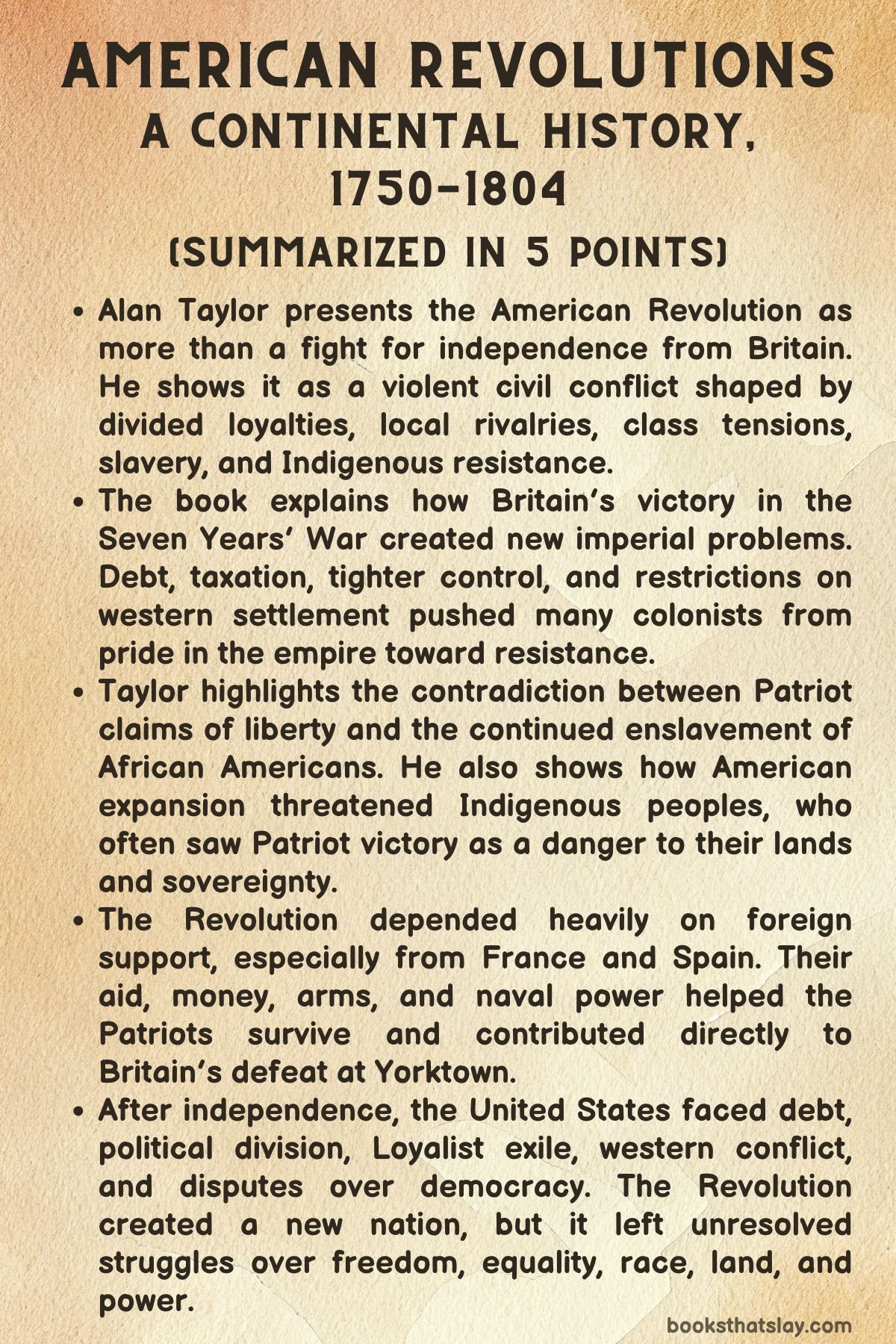
American Revolutions: A Continental History, 1750-1804 by Alan Taylor is a broad, unsentimental account of the American Revolution and its aftermath. Rather than treating independence as a clean struggle between liberty-loving colonists and British tyranny, Taylor presents it as a violent, divided, and unfinished transformation.
The book emphasizes civil conflict, Loyalist suffering, Indigenous resistance, slavery, class tension, foreign alliances, and the fragile politics of the early republic. In this telling, the Revolution did not simply create freedom; it exposed who was allowed to claim freedom and who was excluded from it. Taylor’s central concern is the cost of independence and the contradictions built into the new nation.
Summary
American Revolutions presents the American Revolution as a long, disorderly struggle that changed far more than the relationship between Britain and its colonies. Alan Taylor begins by challenging the familiar heroic version of the Revolution.
He argues that the conflict was also a civil war, a contest over land, a crisis of empire, and a test of who could claim the language of liberty. The Revolution produced independence, but it also brought violence, exile, racial injustice, political rivalry, and new pressures on Indigenous peoples.
The story opens in the years after Britain’s victory in the Seven Years’ War. Colonists in British America celebrated the empire’s triumph and took pride in belonging to it.
Yet that victory created new problems. Britain had gained territory and power, but it had also taken on large debts.
Imperial officials wanted the colonies to contribute more revenue and accept tighter regulation. Colonists, however, believed they possessed the rights of Englishmen and should not be taxed by a Parliament in which they had no direct representation.
This disagreement widened into a deeper conflict over authority. Britain saw the colonies as dependent parts of an empire; many colonists saw themselves as partners with their own legislatures and rights.
Land became one of the strongest sources of tension. Population growth pushed settlers westward, especially after Britain’s victory over France seemed to open lands beyond the Appalachian Mountains.
Indigenous nations viewed this expansion as a direct threat to their survival, while British officials tried to limit settlement through measures such as the Proclamation of 1763. Colonists often ignored those limits.
Their hunger for land brought them into conflict with Indigenous communities and with the imperial government. For many settlers, British restraint became another sign that the empire stood in the way of their ambitions.
Taylor also stresses the contradiction between colonial talk of liberty and the reality of slavery. Many colonists described British taxation and parliamentary power as forms of enslavement, even while they enslaved African Americans.
The language of freedom was central to Patriot resistance, but it was applied unevenly. Enslaved people, free Black people, and some British critics of slavery understood this contradiction clearly.
Developments in Britain, including legal challenges to slavery, alarmed enslavers in the colonies, who feared that imperial authority might threaten their human property. Thus, for some colonists, resistance to Britain was tied not only to liberty but also to the defense of slavery.
As tensions rose, resistance hardened into rebellion. Protests, boycotts, and confrontations led to the Boston Tea Party and then to Britain’s harsh response through the Coercive Acts.
British leaders underestimated colonial anger and assumed the rebellion could be crushed with limited force. They believed many colonists remained loyal and that only a radical minority had stirred trouble.
The fighting at Lexington and Concord proved that resistance had become armed and organized. The conflict then spread, drawing ordinary people into a war that divided towns, families, and former friends.
George Washington’s appointment to command the Continental Army gave the Patriot cause military leadership and symbolic unity, but the colonies themselves remained divided.
The Revolution depended heavily on foreign support. The Patriots lacked the weapons, supplies, money, and naval power needed to defeat Britain alone.
France and Spain saw an opportunity to weaken Britain, although both monarchies were uneasy about supporting a republican revolt. American leaders wanted independence without becoming dependent on old European powers, but necessity forced compromise.
French aid, credit, arms, and later naval support became essential. Spain also acted against British interests, especially in the Gulf region and West Florida.
The Revolution was therefore not only an American conflict but part of a wider struggle among empires.
Taylor repeatedly rejects the idea that Americans were united against Britain. Patriot, Loyalist, and neutral populations lived beside one another, and allegiance often depended on region, religion, family, class, safety, and opportunity.
Many people tried to avoid choosing sides, but war made neutrality dangerous. British attempts to mobilize Loyalists often intensified local violence.
Patriot and Loyalist forces punished one another, seized property, and drove enemies from communities. In places such as New Jersey and the Carolinas, the war became especially bitter.
The Revolution destroyed relationships as well as governments.
On the frontier, the Revolution increased pressure on Indigenous peoples. Many Indigenous nations understood that Patriot victory would likely mean more settlement and more land loss.
Some tried to remain neutral, while others sided with the British or, in some cases, with the Patriots. The British eventually made greater use of Indigenous allies, while American settlers treated Indigenous resistance as justification for destructive campaigns against villages and crops.
Leaders such as Joseph Brant and Dragging Canoe recognized that the war was also a struggle over the future of the continent. For Indigenous peoples, American independence often meant not liberation but further invasion.
Naval power shaped the war’s outcome. Britain possessed a great navy, but it had to defend trade routes and colonies across the Atlantic world.
Patriot privateers disrupted British commerce, while French and Spanish entry into the war stretched British resources. The Caribbean became strategically important because of its rich sugar colonies.
In the decisive phase of the war, French naval action helped trap British forces under Cornwallis at Yorktown. Without French control of the waters there, the American and French armies might not have forced the British surrender.
The victory at Yorktown effectively ended major fighting in North America.
Independence did not bring simple peace. British evacuation created uncertainty for Loyalists and formerly enslaved people who had sought British protection.
Many Loyalists left for Canada, the Bahamas, Britain, or other imperial territories. Some formerly enslaved people also departed with the British, hoping for freedom elsewhere.
In the United States, Patriots reclaimed lands and punished enemies, especially in the South. At the same time, the new nation remained weak.
Congress struggled to manage debt, diplomacy, western settlement, and conflict with Indigenous confederations. Spain controlled access to New Orleans, Britain held frontier forts, and the United States had to prove it could survive.
The postwar republics faced internal conflict over class and power. Many elites believed government should remain in the hands of educated, wealthy men, while ordinary voters expected the Revolution to expand political opportunity.
War debts, taxes, inflation, and economic hardship deepened resentment. Some states tried debtor relief, while others protected creditors.
The Revolution raised hopes for equality, but wealth and influence remained unevenly distributed. The question of who counted as “the people” became a major problem for the new political order.
The 1790s brought new partisan conflict. Federalists, led by figures such as Alexander Hamilton and supported by George Washington’s authority, favored a strong central government, public credit, taxation, and national power.
Republicans, led by Thomas Jefferson and James Madison, feared centralized authority and preferred a more agrarian, decentralized republic. The French Revolution intensified these divisions.
Federalists feared disorder and radicalism; Republicans saw France’s revolution as connected to their own ideals. The Alien and Sedition Acts damaged the Federalists by making them appear hostile to free expression.
Jefferson’s election in 1800 marked a major political shift, though his presidency also exposed contradictions, especially through expansion, slavery, and policies toward Indigenous peoples.
Taylor ends by emphasizing the Revolution’s uneven legacy. It inspired arguments for liberty, equality, popular government, and individual rights, but it did not fulfill those ideals for everyone.
Women gained new symbolic importance as educators of republican citizens, yet remained politically excluded. Slavery survived and expanded, especially as cotton cultivation grew.
Racism hardened as a defense of exclusion. Indigenous peoples faced intensified dispossession.
American Revolutions shows that the Revolution was not a single completed event. It was a beginning filled with unresolved conflicts over power, race, land, citizenship, and freedom.
Key People
Nathaniel Hawthorne’s Robin
Robin functions as an opening figure through whom Alan Taylor frames the disorder and moral shock of revolution. In the referenced story, Robin begins as a young man searching for Major Molineux, expecting family connection, status, and advancement to guide him into colonial society.
His discovery of Molineux humiliated by a crowd forces him to confront a world where old hierarchies can be publicly destroyed. Robin’s laughter after his initial fear marks a psychological shift: he is not merely witnessing rebellion but learning how quickly social order can collapse.
In American Revolutions, Taylor uses Robin less as a conventional character and more as a symbolic observer of revolutionary change. He represents the young, uncertain American subject caught between inherited loyalty and the harsh excitement of rebellion.
His response suggests that revolutions can produce liberation and cruelty at the same time, and that ordinary people may become participants in humiliation and violence before fully understanding what they have joined.
Major Molineux
Major Molineux represents imperial authority, social privilege, and the older order that the Revolution sought to overturn. His public humiliation is not simply personal punishment; it is a symbolic stripping away of British-connected status.
As a figure of wealth and power, he stands for the kind of colonial elite whose position depended on imperial structures and public deference. When he is tarred, feathered, and paraded before the crowd, Taylor presents the scene as an image of political transformation through public violence.
Molineux’s fall shows that revolution is not only fought through speeches, documents, and armies. It is also enacted in streets, through rituals of shame, fear, and collective anger.
He is important because his suffering complicates any clean celebration of rebellion. The scene suggests that the destruction of tyranny can look very much like mob cruelty, and that revolutionary justice can easily become revenge.
King George III
King George III appears as the visible symbol of British authority, even though the deeper conflict involves Parliament, imperial administrators, military leaders, and colonial assemblies. To loyal colonists after the Seven Years’ War, he represented shared imperial pride and victory.
Public celebrations of British success showed that many Americans initially considered themselves proud members of the empire. As imperial policy changed, however, the king came to represent distance, power, and political control.
The colonists’ anger did not emerge from immediate hatred of monarchy but from a growing belief that their rights were being ignored by a government that treated them as subordinates. George III’s importance lies in how he became a political image larger than his personal role.
Patriots could direct frustration toward him as the face of imperial oppression, while Loyalists continued to see him as the anchor of lawful order. Taylor’s portrayal makes clear that the break with monarchy was gradual, contested, and emotionally difficult for many colonists.
George Washington
George Washington stands as the most important military figure in the Patriot cause, but Taylor’s account avoids treating him as a flawless national savior. His appointment to lead the Continental Army gave the rebellion a unifying symbol and a commander who could represent more than one region.
Washington’s leadership mattered because the Patriot movement needed discipline, endurance, and legitimacy. He helped turn scattered resistance into a more organized war effort.
At the same time, his position exposed the weakness of the revolutionary cause: the army lacked supplies, money, arms, and stable support. Washington’s significance therefore rests not only in battlefield command but in his ability to hold together a fragile military and political project.
Later, as president, his prestige helped stabilize the new government, yet his administration also contributed to the rise of partisan conflict. He represents both unity and tension: the figure who helped secure independence, and the leader whose national vision could not prevent Americans from dividing over power, finance, foreign policy, and the meaning of republican government.
John Adams
John Adams appears as a committed Patriot whose political convictions place him at the center of the imperial crisis. His exchange with Jonathan Sewall captures the personal cost of revolution, as former friends become ideological opponents.
Adams represents the colonists who moved from protest to independence because they came to see British authority as incompatible with American liberty. He is also significant in the diplomatic story.
His idea of a model treaty reveals the American desire to gain foreign help without surrendering too much independence to European powers. Adams wanted recognition, commerce, and support, but he feared dangerous obligations.
This tension reflects the larger contradiction of the Patriot cause: a people seeking independence had to rely on powerful monarchies to win it. Adams embodies the legal, political, and diplomatic mind of the Revolution.
His role shows that independence required more than battlefield courage; it required arguments about constitutional rights, careful negotiation, and a willingness to accept compromise under pressure.
Jonathan Sewall
Jonathan Sewall represents the Loyalist position as a matter of principle, friendship, fear, and political judgment. His warning to John Adams reflects the belief that resistance to Britain would bring destruction rather than freedom.
Sewall is not presented as a simple villain. Instead, he stands for those colonists who saw the empire as the best guarantee of order, security, and lawful government.
His break with Adams demonstrates how the Revolution fractured personal relationships and forced people to choose between competing loyalties. Sewall’s importance lies in the way he humanizes Loyalism.
Taylor’s account makes clear that Loyalists were not all cowardly, selfish, or blindly obedient. Some feared mob rule, economic ruin, and civil violence.
Sewall’s position reflects the anxiety that replacing imperial authority might empower local radicals and create thousands of smaller tyrannies. Through him, the Revolution appears not as a unanimous national awakening but as a painful division among people who had once shared communities, professions, and friendships.
Mather Byles
Mather Byles, a Loyalist voice, captures one of the sharpest criticisms of Patriot resistance. His question about whether it is better to be ruled by one distant tyrant or many nearby tyrants cuts to the heart of revolutionary politics.
Byles represents the fear that rebellion against imperial power could produce local oppression, mob rule, and social chaos. His view challenges the Patriot assumption that removing British authority would automatically create liberty.
For him, the danger was not only monarchy but also uncontrolled popular power. His role is important because Taylor uses such Loyalist perspectives to complicate the Revolution’s moral landscape.
Byles reminds readers that the Patriots’ enemies did not always oppose freedom; many believed they were defending stability, law, and civil peace. His presence makes the Revolution feel like a debate over the nature of power itself.
The question was not simply whether Britain had gone too far, but whether ordinary Americans could govern justly once imperial restraint disappeared.
Lord North
Lord North represents British political miscalculation. As a leading figure in the imperial government, he reflects the confidence and blindness of officials who believed the colonies could be forced back into obedience.
Taylor presents British leaders as repeatedly underestimating colonial anger, military capacity, and political commitment. Lord North’s importance lies in his connection to policies that hardened resistance rather than calming it.
The British response to colonial protest relied on punishment and coercion, but these measures convinced many colonists that their liberties were in danger. North also represents the structural weakness of British imperial thinking.
Officials viewed the colonies as subordinate possessions and did not fully grasp how strongly colonists identified with their own assemblies and rights. His failure is therefore not only personal but political.
Through figures like North, Taylor shows that Britain lost the colonies partly because it misunderstood the society it governed and mistook resistance for a temporary disturbance rather than a deep constitutional crisis.
Lord Sandwich
Lord Sandwich stands for British military arrogance and administrative weakness. His view that the colonists lacked the discipline and loyalty needed for sustained resistance reflects one of Britain’s central errors.
Such assumptions shaped strategy and contributed to hesitation, underinvestment, and poor planning. Lord Sandwich’s significance is tied to the naval and military dimensions of the war.
Britain possessed immense imperial resources, but it faced global demands, budget pressures, and later the entry of France and Spain. Confidence in British superiority did not solve the practical problems of fighting across the Atlantic while defending valuable territories elsewhere.
Sandwich represents a ruling class that believed rebellion could be managed without fully respecting its causes or scale. His attitude helps explain why Britain failed to act decisively early enough and why it struggled once the war became international.
In Taylor’s account, figures like him show that imperial power can be weakened by contempt for those it seeks to control.
General Thomas Gage
General Gage embodies the difficulty of enforcing imperial authority on the ground. Stationed in Boston, he had to manage colonial resistance with limited options and uncertain political backing.
His restrained conduct before the outbreak of major fighting reveals the awkward position of British commanders: they were expected to restore order without always having the resources or clarity needed to do so. Gage’s role becomes especially important in the movement toward Lexington and Concord, where British attempts to seize supplies helped ignite open war.
He represents the moment when political conflict became military conflict. Taylor’s treatment suggests that Gage was not simply incompetent; he was caught in a situation shaped by mistrust, poor intelligence, and British underestimation of Patriot resolve.
His character shows how empires can stumble into war when officials believe force will intimidate opponents, only to discover that force confirms the opponents’ worst fears.
Dr. Joseph Warren
Dr. Joseph Warren represents the educated Patriot leadership that helped transform protest into organized resistance. He is associated with the early revolutionary movement and the mobilization that followed the first battles.
Warren’s significance lies in his combination of civic leadership, political courage, and symbolic sacrifice. He belonged to the group of colonial leaders who understood that resistance required public persuasion as well as military readiness.
His presence in the early conflict shows that the Revolution was not led only by distant politicians but by local figures who risked their reputations and lives. Taylor’s account of early Patriot mobilization places Warren within a society rapidly shifting from protest meetings to armed confrontation.
He represents the intensity of that transition. His role also reminds readers that the Revolution created martyrs, and that such deaths helped strengthen Patriot commitment.
Warren is important because he shows how local leadership became national memory.
Benjamin Franklin
Benjamin Franklin appears as both a revolutionary statesman and a figure personally wounded by divided loyalties. His family divisions show how the Revolution entered private life and damaged intimate bonds.
Franklin’s importance also extends to diplomacy, since the Patriot cause depended on European aid, especially from France. He represents the practical intelligence of the American movement: the ability to appeal to foreign powers while presenting the United States as a legitimate new nation.
Yet Taylor’s account also uses Franklin to show that famous founders were not insulated from the civil-war character of the conflict. His relationship with Loyalist family members demonstrates that political allegiance could cut across bloodlines.
Franklin’s character therefore carries two meanings. Publicly, he stands for international persuasion, wit, and revolutionary legitimacy.
Privately, he reveals the emotional costs of choosing a side. His role helps prevent the Revolution from appearing as a simple national consensus.
Gouverneur Morris
Gouverneur Morris represents the elite Patriot class that supported independence while also worrying about social order, property, and political control. Like Franklin, he experienced family division, showing that the Revolution broke apart households as well as governments.
Morris is important because he belongs to the group of educated, well-connected Americans who hoped republican government would preserve leadership by the “better sort.” Taylor’s account of the postwar period shows that such elites often wanted independence without radical democracy. Morris therefore reflects one of the Revolution’s central tensions: the fight against monarchy did not automatically produce trust in ordinary voters.
His presence helps explain why the new republic was shaped by debate over who should govern. He stands between revolutionary change and social conservatism, supporting the break from Britain while fearing excessive popular power.
Through him, Taylor shows that the American founding was not simply a democratic triumph but a contested negotiation among classes.
Robert R. Livingston Jr.
Robert R. Livingston Jr. represents the aristocratic vision of republican leadership. His belief that governance should rest with learned, virtuous, and socially elevated men reveals the limits of revolutionary equality among many elites.
Livingston’s importance lies in his connection to the postwar struggle over political authority. The Revolution had awakened expectations among ordinary men, but figures like Livingston hoped that refinement, education, and property would continue to determine leadership.
He is not portrayed merely as reactionary; rather, he reflects a genuine fear that democracy without elite guidance could become unstable. His character helps illuminate the social structure of the early republic, where old hierarchies survived inside new political language.
Livingston represents the contradiction of a revolution that attacked inherited imperial authority while preserving many domestic forms of privilege. His role shows that independence did not settle the question of equality.
It created new arenas in which elites and common voters fought over republican power.
Alexander Hamilton
Alexander Hamilton represents the Federalist ambition to build a strong, respected, financially stable nation. In Taylor’s account, Hamilton’s policies aimed to give the United States credit, authority, and power in a world dominated by stronger empires.
He understood that independence alone did not guarantee survival. The country needed revenue, institutions, public credit, and the ability to enforce law.
His financial program, however, also intensified political division. Critics saw it as favoring wealth, speculation, and centralized power.
Hamilton’s significance lies in this double role: he helped strengthen the nation while also provoking fears that the new government might resemble the British system Patriots had resisted. He represents energetic state-building, urban finance, and national authority.
For Republicans, he became a symbol of aristocratic danger; for Federalists, he was the architect of stability. His character shows that the Revolution’s aftermath was shaped not by agreement over liberty but by arguments over what kind of republic could survive.
Thomas Jefferson
Thomas Jefferson represents the Republican vision of a decentralized, agrarian republic built around independent citizens and limited federal power. He opposed Federalist policies that seemed to him too close to British monarchy, finance, and aristocracy.
His political imagination centered on landholding farmers, local government, and suspicion of concentrated authority. Yet Taylor’s portrayal highlights Jefferson’s contradictions.
His vision of liberty depended on westward expansion, which threatened Indigenous peoples, and it coexisted with slavery, from which he personally benefited. The Louisiana Purchase embodied his dream of an expanding “empire of liberty,” but that expansion also increased pressure on Native lands and strengthened the future of slavery.
Jefferson’s election marked a major political shift, but it did not resolve the moral conflicts of the Revolution. In American Revolutions, he stands as both a champion of republican language and a symbol of the selective application of freedom.
His character captures the promise and failure of the early United States.
James Madison
James Madison appears as a major Republican thinker and Jefferson’s political ally in resisting Federalist centralization. His role is tied to the debate over the scope of federal power, states’ rights, political liberty, and the fear of government overreach.
Madison represents constitutional intelligence and partisan strategy. He helped shape opposition to Hamilton’s program and to Federalist efforts to suppress dissent.
His significance lies in his ability to translate anxiety about centralized power into organized political resistance. Yet Madison, like Jefferson, also belongs to the world of slaveholding republicanism, which exposes the limits of his liberty language.
He defended political freedom for white citizens while existing within a society that denied freedom to enslaved people and displaced Indigenous communities. Taylor’s account places Madison within the broader conflict between Federalists and Republicans, showing how the Revolution continued through arguments about the Constitution, public finance, foreign policy, and the meaning of popular government.
Comte de Vergennes
Comte de Vergennes, the French foreign minister, represents the calculated diplomacy that made American victory possible. His support for the Patriot cause was not based on pure sympathy for republican liberty.
France wanted to weaken Britain, recover influence, and exploit imperial rivalry. Vergennes understood that open support for the Americans carried risks, especially for a monarchy ruling its own colonies and subjects.
His strategy of covert aid before formal alliance shows careful political timing. He helped the United States while protecting French interests.
Vergennes is important because he reveals that the Revolution was not only an ideological conflict but also a geopolitical contest. The Patriots needed France, but France had its own ambitions.
His role challenges any version of the war that treats American independence as self-made. The new nation survived partly because European powers saw advantage in Britain’s trouble.
Vergennes represents diplomacy as a form of war conducted through money, supplies, secrecy, and timing.
Comte de Grasse
Comte de Grasse represents the decisive importance of French naval power. His fleet’s role at Yorktown prevented British relief of Cornwallis and helped make the American-French victory possible.
De Grasse’s significance lies in the fact that he shows how the outcome of the Revolution depended on control of the sea. American armies could fight on land, but without naval support they could not easily trap British forces or block reinforcements.
His actions also demonstrate that the war had become international by its final stage. Britain’s defeat in North America was tied to French strategy, Atlantic warfare, and the pressure placed on British resources across the empire.
De Grasse is not a symbolic founder in the American memory in the way Washington is, but Taylor’s account makes clear that his contribution was essential. He represents the external force without which Patriot perseverance might not have become victory.
Bernardo de Gálvez
Bernardo de Gálvez represents Spain’s strategic role in weakening Britain during the war. Operating from Louisiana, he acted against British positions in West Florida and expanded Spanish influence.
His campaigns show that Spain’s involvement was shaped by imperial calculation rather than full commitment to American republican ideals. Spain feared the example of colonial rebellion, yet it also wanted to reduce British power and secure its own territorial interests.
Gálvez’s importance lies in the way he broadens the geography of the Revolution. The war was not confined to Boston, Philadelphia, New York, or Yorktown.
It also involved the Gulf Coast, the Mississippi Valley, the Caribbean, and competing imperial ambitions. Through Gálvez, Taylor shows that American independence emerged from a wider Atlantic and continental conflict.
His character represents opportunism, military skill, and the complicated relationship between the Patriot cause and European empires that supported it for their own reasons.
Joseph Brant
Joseph Brant represents Indigenous political intelligence and resistance during the revolutionary crisis. As a Mohawk leader, he recognized that the Patriot push for independence threatened Native lands and autonomy.
For many Indigenous peoples, British power, however imperfect, could serve as a barrier against settler expansion. Brant understood that the rebellion was not only a fight over taxation and representation but also a struggle over who would control the continent.
His importance lies in his clear view of American expansionism. While Patriots spoke of liberty, Indigenous nations saw settlers preparing to claim more land.
Brant’s choices reflect the difficult position of Native leaders forced to navigate between empires and settlers, none of whom fully respected Indigenous sovereignty. He represents diplomacy, military resistance, and tragic realism.
His role makes clear that the Revolution’s victory for Americans could mean disaster for Indigenous peoples.
Dragging Canoe
Dragging Canoe represents militant Indigenous resistance to colonial expansion. As a Cherokee leader, he saw American settlement as an existential threat and responded with armed opposition.
His attacks on settlements and the severe Patriot retaliation that followed reveal the brutality of the frontier war. Dragging Canoe is important because he embodies refusal.
He did not accept the idea that settler expansion was inevitable or legitimate. His resistance shows that Indigenous peoples were active political and military agents, not background victims of the Revolution.
Taylor’s account of retaliatory campaigns against Cherokee towns and populations underscores the high cost of this conflict. Dragging Canoe’s role reveals that the Revolution’s language of liberty was inseparable from conquest in the West.
For settlers, independence promised access to land. For leaders like him, it meant invasion, destruction, and the need to fight for survival.
Sir Guy Carleton
Sir Guy Carleton represents the difficult final phase of British withdrawal and the human consequences of defeat. His task of overseeing evacuations from major cities was not merely logistical.
It involved Loyalists, formerly enslaved people, soldiers, refugees, and civilians whose futures had been overturned by the war. Carleton’s importance lies in his connection to displacement.
British retreat did not simply end a military conflict; it created new crises for people who had trusted imperial protection. Loyalists feared Patriot revenge, and formerly enslaved people who had sought freedom with the British faced uncertain resettlement.
Carleton therefore stands at the boundary between war and aftermath. He represents the empire’s retreat, but also the unresolved moral obligations left behind.
His role shows that peace was not peaceful for everyone. Victory for Patriots meant exile, fear, and instability for many others.
Loyalists
Loyalists are among the most important collective figures in Taylor’s account because they challenge the myth of a united American people. They included officials, merchants, farmers, religious minorities, enslavers, cautious moderates, and people who feared local Patriot power more than distant British rule.
Their motives varied. Some believed in monarchy and empire; others wanted stability, protection, or the preservation of property.
Taylor presents them as participants in a civil war rather than as mere traitors. Their suffering after Patriot victory reveals the harshness of revolutionary politics.
Many faced confiscation, violence, exile, and social ruin. Loyalists make the Revolution morally complicated because they force readers to ask whether independence justified the punishment of those who chose differently.
They also expose how unstable allegiance could be. In many regions, loyalty shifted with military control, personal safety, and local pressure.
As a group, they show that the Revolution divided Americans before it united them.
Patriots
Patriots are presented not as a single noble body but as a coalition with shared resistance and differing goals. Some fought for constitutional rights, some for local power, some for commercial freedom, and many for access to western land.
They used the language of liberty, but their practice of liberty often excluded women, enslaved people, Loyalists, and Indigenous peoples. Taylor’s account does not deny Patriot courage or achievement.
They organized resistance, endured military hardship, built alliances, and created a new republic. Yet their victory also unleashed expansion, punishment, and new inequalities.
Patriots are important because they carry the central contradiction of the Revolution. They resisted imperial control in the name of freedom while often imposing control over others.
As a collective character, they are heroic, fearful, ambitious, divided, and sometimes ruthless. Their success founded the United States, but it also left unresolved conflicts that would shape the nation for generations.
Enslaved African Americans
Enslaved African Americans stand at the moral center of Taylor’s critique of revolutionary liberty. Their existence exposes the contradiction between Patriot claims of oppression and the reality of human bondage.
While colonists described taxation as enslavement, actual enslaved people lived under forced labor, violence, family separation, and legal denial of personhood. The war created danger and opportunity for them.
Some sought freedom by escaping to British lines, where promises of protection offered hope. Others remained trapped in Patriot households and plantations.
Their role is crucial because they reveal that the Revolution’s promises were selective. Independence did not end slavery; in many ways, later economic developments strengthened it.
Enslaved African Americans therefore represent both the deepest hypocrisy of the founding era and a powerful claim to the language of freedom. Their presence forces any honest account of the Revolution to measure liberty not by declarations but by who actually received it.
Indigenous Peoples
Indigenous peoples are central to Taylor’s account because the Revolution was also a war for land. Native nations faced impossible choices as Britain, Patriots, Spain, and settlers competed for territory.
Some Indigenous communities tried neutrality; others allied with Britain or the Patriots based on survival strategies. Their central concern was sovereignty, land, and protection from settler expansion.
Taylor shows that American independence often worsened their position, because the new nation and its citizens pushed westward with greater confidence. Indigenous peoples were not passive victims.
They formed alliances, resisted militarily, negotiated, and created confederations to defend their homelands. Yet disease, warfare, retaliation, and diplomatic betrayal weakened their ability to resist.
As a collective character, they represent the cost of American expansion. Their experience changes the meaning of the Revolution: what looked like liberation from the Atlantic coast often looked like dispossession in the interior.
Women
Women appear in Taylor’s account as people affected by revolutionary ideals but largely excluded from formal political power. The Revolution encouraged new discussions about equality, virtue, education, and citizenship, and women were assigned symbolic importance as “Republican Mothers” who would raise virtuous citizens.
This role gave them cultural significance but kept them within the domestic sphere. Women’s lives were also shaped by war through displacement, household survival, family division, widowhood, and economic strain.
Their importance lies in the gap between ideological recognition and legal or political exclusion. Revolutionary language opened space to question hierarchy, but it did not grant women equal citizenship.
Taylor’s treatment suggests that women were essential to the republic’s moral imagination while denied full participation in its public life. They represent the Revolution’s partial expansion of possibility: enough change to raise expectations, but not enough to overturn gendered limits.
Themes
Liberty and Its Contradictions
The language of liberty drives the revolutionary conflict, but Taylor presents it as a contested and uneven ideal rather than a settled moral truth. Colonists protested British taxation, parliamentary authority, and imperial regulation by claiming the rights of free English subjects.
They feared that unchecked power would reduce them to political dependence. Yet many of the same colonists enslaved African Americans, seized Indigenous lands, and punished Loyalists who made different political choices.
This contradiction is central to the book’s argument. Liberty was not a universal principle in practice; it was often defined by those with the power to claim it for themselves.
Enslaved people understood the hypocrisy of colonists who compared taxation to slavery while holding human beings in bondage. Indigenous peoples understood that Patriot liberty often meant settler freedom to invade Native homelands.
Loyalists learned that revolutionary freedom could include coercion, confiscation, and exile. Taylor’s analysis forces readers to separate the beauty of revolutionary ideals from the social realities that limited them.
The Revolution expanded political imagination, but it did not resolve the question of who deserved freedom. Instead, it left that question open, bitter, and central to the nation’s future.
Revolution as Civil War
Taylor treats the Revolution as a conflict among Americans as much as a war against Britain. Communities split into Patriots, Loyalists, and neutrals, with many people choosing sides because of family ties, religious identity, local rivalries, fear, economic interest, or survival.
This approach changes the emotional shape of the Revolution. It was not simply a united people rising against a foreign oppressor.
It was also a neighbor-against-neighbor struggle marked by intimidation, revenge, property seizure, and social rupture. Former friends such as John Adams and Jonathan Sewall found themselves divided by politics, while families such as Benjamin Franklin’s experienced painful breaks over allegiance.
British leaders misunderstood this internal landscape by assuming that Loyalists formed a suppressed majority waiting to be rescued. In reality, many colonists wanted to remain neutral, and both sides often forced choices upon them.
The civil-war character of the Revolution also explains its brutality. Where armies came and went, local people remembered insults, betrayals, and losses.
Violence could become personal, not just ideological. By emphasizing these divisions, American Revolutions replaces a neat national origin story with a more troubling account of how independence was born through internal conflict.
Land, Expansion, and Indigenous Dispossession
The struggle for land gives the Revolution a continental meaning. For many settlers, independence promised access to western territory beyond the limits Britain had tried to impose after the Seven Years’ War.
British officials hoped to manage expansion and reduce conflict with Indigenous nations, but land-hungry colonists saw such restrictions as obstacles to opportunity. Indigenous peoples recognized the danger clearly.
Patriot victory would likely bring more settlers, more surveys, more land claims, and more violence. Leaders such as Joseph Brant and Dragging Canoe understood that the war over imperial authority was also a war over Native homelands.
Some Indigenous groups tried neutrality, but neutrality became difficult as both British and American forces sought alliances and as settlers continued to push west. Retaliatory campaigns destroyed villages and food supplies, while disease further weakened communities already under pressure.
After independence, treaties did not secure Indigenous safety. The United States lacked stable control over its citizens’ expansionist hunger, and settlers continued to move into Native lands.
Taylor’s account makes land central to the Revolution’s moral cost. American freedom was tied to movement, settlement, and ownership, but those gains depended on the dispossession of peoples who had not consented to become part of the new republic.
The Fragility of the New Republic
Independence created a nation, but Taylor shows that survival remained uncertain. The United States emerged from war with debt, weak central authority, divided states, class tensions, unresolved Loyalist resentments, and dangerous foreign pressures.
Britain still held frontier forts, Spain controlled access to New Orleans, and Indigenous confederations resisted American expansion. At home, ordinary people expected the Revolution to improve their status, while elites often sought to preserve political leadership for educated and wealthy men.
Economic hardship sharpened these conflicts. Taxes, inflation, public debt, and creditor-friendly policies convinced many citizens that the benefits of independence were flowing upward.
The later battle between Federalists and Republicans revealed deeper disagreement about what kind of nation the Revolution had created. Hamilton wanted a strong central government capable of commanding credit and respect.
Jefferson and Madison feared concentrated power and defended a more decentralized agrarian vision. Foreign events, especially the French Revolution, intensified these divisions and turned politics into a struggle over the meaning of liberty itself.
Taylor presents the early republic not as a finished achievement but as an unstable experiment. The Revolution removed British rule, but it left Americans fighting over power, citizenship, economy, expansion, and the limits of democracy.