American Psycho Summary, Characters and Themes
American Psycho is Bret Easton Ellis’s dark satirical novel about Patrick Bateman, a wealthy Wall Street professional in 1980s Manhattan whose polished surface hides extreme violence, emptiness, and mental collapse. The book follows a world ruled by status symbols, designer labels, restaurant reservations, beauty standards, and social competition.
Bateman’s narration moves between luxury routines, shallow conversations, pop-culture commentary, and accounts of murder, creating a cold portrait of consumer culture and moral numbness. The story is also deeply unreliable: by the end, it is unclear how much of Bateman’s violence has happened, how much has been ignored, and how much exists inside his fractured mind.
Summary
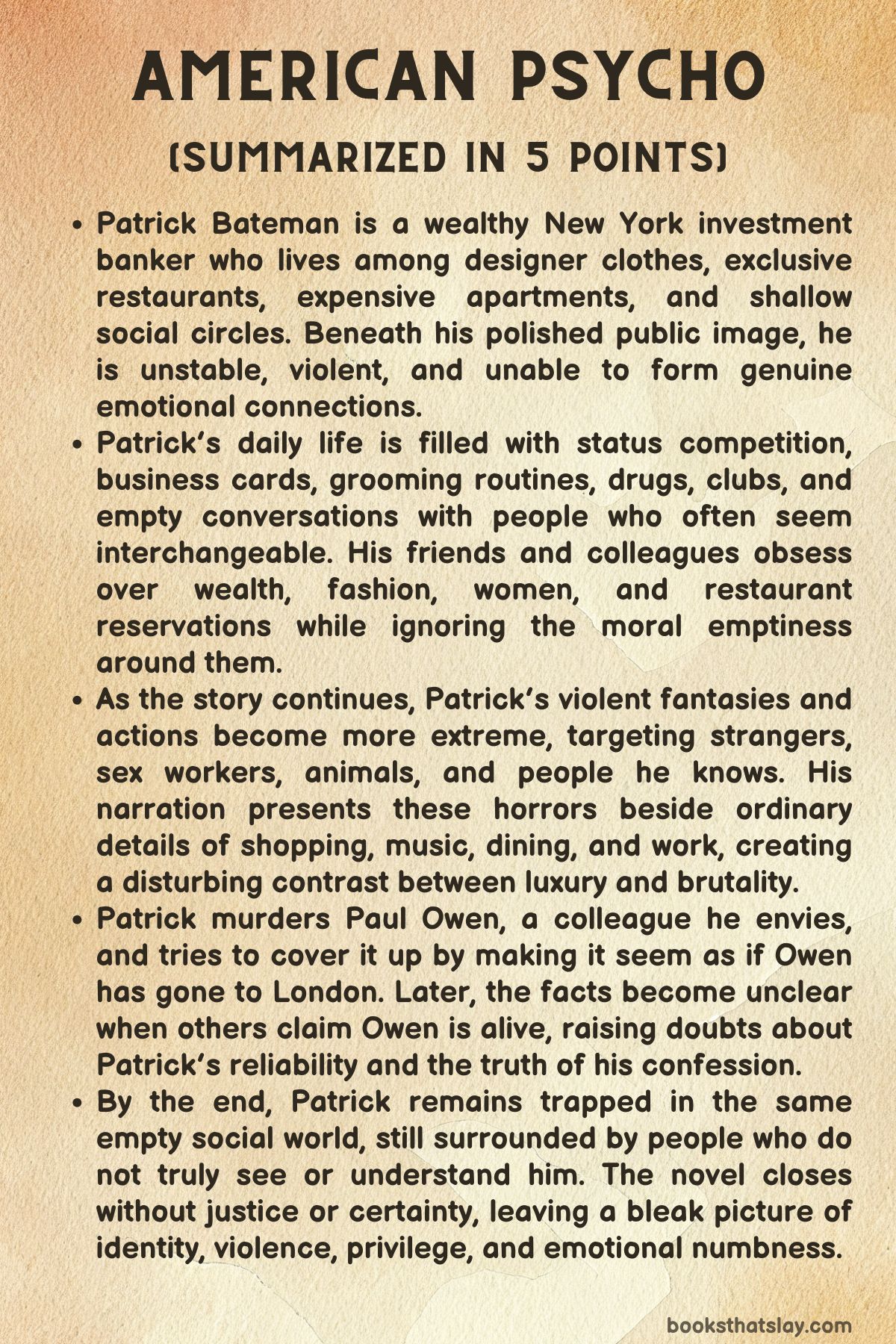
American Psycho follows Patrick Bateman, a young, wealthy investment banker living in Manhattan during the late 1980s. Outwardly, Patrick appears to be the perfect product of his social class: handsome, rich, sharply dressed, obsessed with fitness, and surrounded by equally privileged friends.
His days are filled with expensive restaurants, exclusive clubs, designer clothing, beauty products, business cards, cocaine, and empty social rituals. Beneath that image, however, Patrick is violent, hateful, unstable, and increasingly detached from reality.
The novel opens with Patrick and his friend Timothy Price going to a dinner party hosted by Patrick’s fiancée, Evelyn. The evening shows the world Patrick inhabits: everyone is rich, bored, status-conscious, and cruel in casual ways.
Price flirts with Evelyn, and Patrick suspects they are having an affair, though he shows little real emotional attachment to her. Afterward, he has joyless sex with Evelyn and returns home dissatisfied.
From the start, Patrick’s life is shown as both polished and hollow.
Patrick’s narration often lingers on objects rather than people. He describes his apartment, stereo equipment, furniture, grooming routine, clothes, and skincare products in extreme detail.
He treats these items as markers of identity and worth. His morning routine is almost mechanical, suggesting that his carefully maintained body and lifestyle are performances designed to hide an inner emptiness.
Even his workplace seems nearly meaningless. He goes to the office, gives orders to his secretary Jean, arranges lunches, judges clothing, and performs the role of a successful man without doing much actual work.
His social circle is made up of men like Price, David Van Patten, Craig McDermott, Luis Carruthers, and Paul Owen. They talk endlessly about restaurants, women, money, fashion, business cards, cocaine, and who can get reservations at the most exclusive places.
Their conversations are often sexist, racist, homophobic, and shallow. People constantly mistake one another for someone else, which suggests that these men are almost interchangeable in their appearance, values, and behavior.
Patrick is especially disturbed when others have better business cards or more social access than he does, revealing how fragile his sense of superiority is.
As Patrick moves through this world, his violent thoughts become more frequent. He fantasizes about killing people during ordinary conversations and begins describing brutal attacks on homeless people, sex workers, animals, acquaintances, and strangers.
His violence often appears beside scenes of shopping, dining, grooming, or music criticism, making his cruelty seem part of the same numb culture that surrounds him. At one point, after attacking a homeless man, he casually goes to McDonald’s for a milkshake.
This contrast shows how little moral connection he has to his actions.
Patrick’s relationships with women are marked by control, boredom, and hatred. Evelyn wants marriage and status, but Patrick has no real love for her.
Courtney, the girlfriend of Luis Carruthers, has an affair with him while heavily medicated and emotionally absent. Patricia, Bethany, Jeanette, models, and sex workers all become objects of Patrick’s desire, contempt, or violence.
Jean, his secretary, is the one woman who seems to care for him sincerely. Patrick believes she loves him, and later she admits it.
He is moved by her innocence, yet he also knows she does not understand what he is. His refusal to enter her apartment after dinner suggests that some part of him may want to spare her, though he cannot turn that into real redemption.
Patrick’s violence escalates when he targets Paul Owen, a colleague who repeatedly mistakes him for Marcus Halberstam. Patrick envies Owen because of his wealth and access to important business accounts.
He gets Owen drunk, brings him to his apartment, and murders him with an ax. Then he goes to Owen’s apartment and changes the answering machine message to make it seem as though Owen has gone to London.
Later, a private investigator named Donald Kimball questions Patrick about Owen’s disappearance, but there is no clear evidence against him. The investigation only increases the novel’s uncertainty, because the social world Patrick lives in is so careless and confused that even murder can disappear behind mistaken identities and weak attention.
Luis Carruthers creates another strange pressure on Patrick. Patrick tries to kill Luis in a bathroom, but Luis mistakes the attack for a romantic gesture and becomes convinced that Patrick returns his feelings.
Luis later confronts Patrick and declares his love. Patrick is disgusted and humiliated, partly because Luis’s response ruins his fantasy of control.
This episode also shows how badly people misread each other throughout the novel. Even Patrick’s attempted murder can be interpreted as something else when others are trapped in their own desires and assumptions.
The novel also includes long passages in which Patrick discusses popular musicians such as Genesis, Whitney Houston, and Huey Lewis and the News. These sections sound like polished cultural essays, but they are chilling because of who is speaking.
Patrick praises themes like kindness, hope, romance, and emotional growth while living in complete opposition to them. His clean, confident opinions about pop music contrast with his mental disorder and violence, showing how easily language, taste, and social performance can cover moral emptiness.
Patrick’s life becomes more chaotic as the story continues. His drug use worsens, his apartment fills with signs of violence, and his sense of reality begins to break down.
He sees strange things, loses track of time, and becomes increasingly frantic. In one major sequence, he shoots a street musician, runs from police, kills a cab driver, shoots an officer, and hides in his office.
This scene feels more extreme and unreal than much of what came before, raising the question of whether it happened as described or whether Patrick’s narration has become fully unstable.
Near the end, Patrick returns to Paul Owen’s apartment, expecting evidence of his crimes, but finds it cleaned, changed, and being shown for sale. The estate agent seems to know something is wrong but tells him to leave and never come back.
This moment deepens the uncertainty. It may mean that Patrick imagined some of the murders, or that the crimes were covered up to protect property values and social comfort.
In Patrick’s world, appearances matter more than truth, so even horrifying evidence can be erased if it threatens wealth and order.
Patrick later confesses to a colleague, Carnes, saying that he killed Owen and many others. Carnes laughs it off and says that Patrick could not have killed Owen because he recently had dinner with him in London.
Carnes also misidentifies Patrick, continuing the theme that no one truly knows anyone. Patrick’s confession brings no punishment, no clarity, and no release.
Even when he tells the truth, or what he believes is the truth, the world refuses to hear him.
By the final scenes, Patrick is back in the same kind of social setting where the novel began, sitting with friends in a bar as they discuss dinner reservations. Timothy Price has returned after an earlier disappearance, and Patrick notices strange details that may or may not be real.
His mental condition appears worse, and he believes that cash machines are sending him messages. Yet nothing changes around him.
The people near him remain shallow, distracted, and indifferent.
American Psycho ends without a clear solution. Patrick is not caught, healed, understood, or freed.
The novel leaves readers in a world where identity is unstable, evil is ignored, and violence can hide behind wealth, grooming, charm, and social sameness. Whether every crime happened exactly as Patrick describes is less important than the larger horror: his society is so empty and self-absorbed that it cannot recognize him, even when he tries to reveal himself.
Characters
Patrick Bateman
Patrick Bateman is the central figure of American Psycho, and he is built around contradiction. On the surface, he is wealthy, attractive, disciplined, fashionable, and socially successful.
He works in finance, belongs to elite social circles, lives in an expensive apartment, and understands the codes of status that define his world. Yet beneath that controlled exterior, he is unstable, violent, empty, and almost completely detached from ordinary human feeling.
His narration often gives more attention to brand names, grooming routines, music reviews, and restaurant reservations than to people’s emotions, which shows how deeply his values have been shaped by surfaces. Patrick wants to be admired, feared, envied, and recognized, but he also lives in a society where everyone is too self-absorbed to notice him fully.
His crimes, fantasies, and confessions become part of his desperate need to prove that there is something singular about him. At the same time, his identity is strangely weak.
Other men mistake him for different people, and he is often treated as replaceable. This worsens his rage because he wants to be exceptional but belongs to a world that produces identical men with identical suits, tastes, and ambitions.
Patrick’s violence is not simply personal madness; it reflects a wider moral emptiness around him. He is terrifying because he is both extreme and ordinary within his environment.
Evelyn Williams
Evelyn is Patrick’s fiancée, though their relationship is cold, performative, and built more on social expectation than love. She represents the marriage-market side of Patrick’s social world, where romance is tied to appearances, status, parties, gifts, and public image.
Evelyn wants Patrick to behave like a suitable future husband, but she does not truly know him and often does not listen when he says disturbing things. Her inability or refusal to hear him is one of her most important traits.
She is not innocent in a simple sense; she participates in the same shallow culture that surrounds Patrick. She cares about restaurants, parties, fashion, and the idea of being attached to the right man.
At the same time, she is not shown as evil in Patrick’s way. Rather, she is emotionally limited, self-involved, and trained to ignore what does not fit the image she wants.
Her relationship with Patrick exposes how empty intimacy has become in their world. They are engaged, but there is little tenderness, trust, or understanding between them.
Patrick suspects her of having an affair with Timothy Price, yet even this jealousy feels less like wounded love and more like injured pride. Evelyn functions as a mirror of the social system that enables Patrick: polished, distracted, and more concerned with appearances than truth.
Timothy Price
Timothy Price is Patrick’s friend and one of the clearest examples of the aggressive, arrogant Wall Street masculinity that dominates the story. He is cruel, status-obsessed, sexually predatory, and deeply contemptuous of people he considers beneath him.
Price’s conversations show the casual brutality of Patrick’s social group even before Patrick’s violence becomes central. He ridicules people’s clothing, insults those who lack money or polish, and flirts with Evelyn in a way that seems designed to provoke Patrick.
Price is important because he shows that Patrick is not surrounded by moral opposites. Instead, Patrick’s friends already live by a code of selfishness, competition, and contempt.
Price may not share Patrick’s extreme violence, but he shares many of the attitudes that make Patrick’s world so hostile. His disappearance and later return add to the story’s strange uncertainty.
Like other characters, he becomes hard to pin down as a stable person. His presence at the end suggests that nothing has really changed.
The same men remain in the same bars, making the same reservations, speaking in the same empty language. Price’s role is to show the culture Patrick comes from: loud, cruel, privileged, and spiritually exhausted.
Jean
Jean, Patrick’s secretary, is one of the few characters who appears capable of sincere feeling. She is professional, loyal, attentive, and emotionally open toward Patrick.
He assumes that she is in love with him, and later her affection becomes more direct. Unlike many of the people around him, Jean does not treat life as a competition of restaurants, brands, and sexual conquests.
Her feelings make Patrick uneasy because they suggest a kind of human connection that he cannot comfortably absorb. He criticizes her clothing and controls aspects of her presentation, which shows his need to dominate even someone who cares about him.
Yet Jean also awakens rare hesitation in him. When she invites him into her apartment, he refuses, partly because he seems to recognize that closeness to him would endanger her.
This does not make Patrick good, but it reveals that Jean occupies a different place in his mind from many others. She represents the possibility of ordinary affection, though the story refuses to turn that possibility into redemption.
In American Psycho, Jean’s innocence is not powerful enough to save Patrick, but it does expose how far he has fallen from basic emotional life.
Paul Owen
Paul Owen is both a rival and a symbol of everything Patrick envies. He has access to important business accounts, appears more successful in certain ways, and moves through the same elite world with confidence.
Patrick’s hatred of Owen grows partly from professional jealousy and partly from the repeated insult of being mistaken for someone else. Owen keeps thinking Patrick is Marcus Halberstam, and this mistaken identity becomes central to Patrick’s resentment.
For Patrick, being misidentified is not a minor social error; it attacks his already fragile sense of self. Owen’s murder is one of the most important acts in the story because it seems to be Patrick’s attempt to assert control and prove his superiority.
Yet even after this act, Patrick gains no stable power. The investigation goes nowhere, the answering machine lie seems to work, and later someone claims Owen is alive in London.
Whether Owen is truly dead or whether the facts have been blurred by Patrick’s unstable narration, his role remains the same: he is the man Patrick wants to erase because he represents status, access, and recognition that Patrick cannot bear to see in another person.
Luis Carruthers
Luis Carruthers is Courtney’s boyfriend and one of the few men who responds to Patrick with open emotional vulnerability. He admires Patrick, follows him eagerly, and eventually declares love for him.
This creates one of the story’s strangest reversals. Patrick tries to kill Luis, but Luis mistakes the act for sexual interest.
The scene humiliates Patrick because his intended violence is transformed into intimacy by someone else’s interpretation. Luis’s love is not presented as freeing or noble; it is awkward, misplaced, and unwanted.
Still, it disrupts Patrick’s power. Patrick can control many situations through fear, money, or deception, but Luis’s affection leaves him frozen and confused.
Luis also reveals the panic beneath Patrick’s masculinity. Patrick’s disgust toward him is tied not only to personal rejection but also to the homophobia and image-conscious fear shared by his social group.
Luis wants emotional confirmation from Patrick, while Patrick wants only distance and dominance. Their dynamic shows how badly communication fails in this world.
Luis cannot read Patrick’s hatred, and Patrick cannot understand Luis’s desire except as a threat to his self-image.
Courtney
Courtney is one of the women connected to Patrick through sex, social status, and emotional vacancy. She is Luis Carruthers’s girlfriend, but she has an affair with Patrick while appearing heavily medicated and detached.
Her frequent drug use and passivity make her seem absent from her own life. She moves through expensive restaurants, parties, and sexual encounters without much agency or enthusiasm.
Courtney’s relationship with Patrick is not built on passion or intimacy; it reflects the boredom and carelessness of their class. She is engaged in betrayal, yet the betrayal itself seems almost routine.
Her later plan to marry Luis, despite her lack of feeling, reinforces the idea that marriage in this world is often a social arrangement rather than an emotional commitment. Courtney also helps reveal Patrick’s inability to form meaningful bonds.
He desires her at times, but he does not value her as a person. She is another surface, another body, another sign of status and conquest.
Her sadness is quieter than Patrick’s violence, but it belongs to the same emotionally dead environment.
Craig McDermott
Craig McDermott is one of Patrick’s regular companions and functions as part of the group identity that surrounds him. He is competitive, vulgar, class-conscious, and obsessed with restaurants, gossip, women, and status.
His arguments with Patrick and the others are usually petty, but those petty disputes matter because they show what this social circle values. A restaurant’s reputation, a celebrity endorsement, or a reservation can change their opinions more than any moral principle.
McDermott’s behavior shows how easily taste replaces judgment in their world. He is not presented as especially deep or self-aware; instead, he is one of the men whose sameness makes Patrick’s environment feel airless.
McDermott’s presence also makes Patrick seem less like an isolated monster and more like the worst outcome of a broader culture. The men around Patrick may not all be murderers, but they share a lack of empathy, a hunger for superiority, and a habit of reducing people to looks, money, and usefulness.
McDermott helps create the social noise that Patrick both belongs to and despises.
David Van Patten
David Van Patten is another member of Patrick’s male social group, and like McDermott, he helps define the attitudes of that circle. His conversations are shallow, crude, and often offensive, especially when he talks about sex, disease, and women.
Van Patten’s role is less individual than social: he helps show the collective language of Patrick’s peers. These men speak in a way that normalizes contempt.
They discuss human beings as objects, judge women by tiny physical flaws, and turn serious subjects into displays of ignorance or bravado. Van Patten’s presence is important because the story repeatedly shows Patrick surrounded by men who reinforce his worst instincts.
They may not know the full extent of his violence, but they share the emotional foundation of his worldview: people are ranked, consumed, mocked, or ignored. Van Patten also contributes to the theme of interchangeability.
He is one of several men whose identity is defined by similar clothes, similar jobs, similar restaurants, and similar prejudices. This sameness makes Patrick’s crisis of identity more intense.
Bethany
Bethany, Patrick’s former girlfriend from Harvard, is significant because she belongs to his past and briefly exposes his insecurity. When Patrick meets her for lunch, he is nervous and physically unsettled, which is unusual for someone who tries to project total control.
Bethany has moved on with her life and has a boyfriend connected to Dorsia, the restaurant Patrick desperately wants access to. This detail enrages him because it combines romantic rejection, social envy, and status humiliation.
Bethany’s importance lies in the fact that she reminds Patrick of a self he cannot fully control through money, fashion, or violence. She knew him before his current performance was complete, and that makes her threatening.
His attack on her can be read as an attempt to destroy not only a person but also the vulnerability and failure she represents. Bethany’s fate also shows how Patrick turns embarrassment into violence.
He cannot tolerate feeling inferior, exposed, or emotionally affected, so he responds by trying to dominate completely. She is one of the clearest examples of how his insecurity feeds his cruelty.
Donald Kimball
Donald Kimball, the private investigator looking into Paul Owen’s disappearance, introduces the possibility of consequences, but his presence ultimately reveals how weak accountability is in Patrick’s world. Kimball is calm, professional, and observant enough to make Patrick nervous, yet he never fully breaks through the confusion surrounding Owen’s disappearance.
The investigation is obstructed not only by Patrick’s lies but also by the social environment itself. Men are mistaken for one another, alibis are uncertain, and Owen’s supposed trip to London seems plausible enough to reduce suspicion.
Kimball’s role is important because he briefly brings the language of reality into Patrick’s unstable narration. He asks questions, checks timelines, and points toward facts.
However, the facts do not produce justice. Whether because Patrick is protected by privilege, because the evidence is too unclear, or because Patrick’s account cannot be trusted, Kimball’s investigation fades without resolution.
He represents a system that should uncover truth but cannot overcome wealth, carelessness, and identity confusion.
Christie
Christie is one of the sex workers Patrick targets, and her role exposes the power imbalance at the center of much of his violence. Patrick lures her with money, controls her body, dictates her appearance, and treats her as disposable.
She returns despite earlier abuse because financial need makes her vulnerable to his promises. Christie’s character shows how Patrick’s wealth gives him access to people whose safety can be bought, threatened, or ignored.
Unlike the women in Patrick’s elite circle, Christie is not protected by social status, and Patrick exploits that difference. Her fear and suffering cut through the polished surfaces of his world, showing the brutal cost of his fantasies of control.
She also becomes part of the story’s larger criticism of a society where money can create temporary obedience without respect or care. Patrick does not see Christie as a full person; he sees her as material for his desires and violence.
Her repeated victimization underlines the cruelty of a world where the vulnerable are easiest to erase.
Elizabeth
Elizabeth, the model Patrick brings to his apartment, represents the glamour and beauty standards that dominate his imagination. As a model, she appears to belong to the visual culture Patrick worships: advertisements, bodies, surfaces, and idealized femininity.
Yet her beauty does not protect her. In Patrick’s mind, beauty is not connected to respect; it is connected to possession, evaluation, and destruction.
Elizabeth’s role shows that Patrick’s desire for attractive women is inseparable from contempt. He wants them because they confirm his status, but he also hates them because they have the power to attract, reject, or disappoint him.
Her death alongside Christie also brings together two different kinds of women in Patrick’s world: the glamorous woman who reflects his social fantasies and the sex worker whose vulnerability he purchases. Both are reduced to objects under his control.
Elizabeth’s character therefore helps reveal the violence hidden inside Patrick’s obsession with beauty. For him, the perfect surface is never enough; he must damage it to feel powerful.
Sean Bateman
Sean Bateman, Patrick’s brother, is important because he frustrates Patrick’s belief that status must be earned through discipline, grooming, and social performance. Sean appears careless and less conventionally accomplished, yet he has access and popularity that Patrick envies.
His ability to get a reservation at Dorsia especially irritates Patrick because it touches one of Patrick’s deepest social insecurities. Sean does not need to perform the same kind of perfection Patrick performs, and that makes him threatening.
He suggests that Patrick’s entire system of self-worth may be unstable or meaningless. Patrick despises him, but that hatred carries an undertone of resentment.
Sean’s presence also hints at family emptiness. The Bateman family seems wealthy and emotionally cold, with damaged relationships and little affection.
Patrick’s interaction with Sean shows that rivalry and contempt have replaced brotherly closeness. Sean is not developed as deeply as Patrick, but he serves as a reminder that Patrick’s identity crisis is not limited to his professional circle.
It also exists inside his family.
Patrick’s Mother
Patrick’s mother appears in a brief but revealing way. She is heavily sedated in a private nursing home, and the encounter between mother and son is emotionally barren.
They have little to say to each other, yet she observes that Patrick is unhappy. This moment matters because it suggests that some part of Patrick’s condition is visible, even if most people ignore it.
His mother’s sedation and isolation also reflect the cold privilege of the Bateman family. Wealth provides care, privacy, and distance, but not warmth.
Patrick’s attention to his father’s clothing in a photograph shows how even family memory is filtered through appearance and fashion. His mother is not a source of comfort or moral grounding.
Instead, she represents a damaged family background where emotional life has been numbed, hidden, or institutionalized. Her presence helps explain, without excusing, Patrick’s emptiness.
The scene suggests that Patrick did not emerge from a loving or stable emotional world, but from one where money could conceal suffering rather than heal it.
Jeanette
Jeanette is one of Patrick’s romantic partners near the end of the story, and her situation reveals the casual cruelty with which Patrick treats women connected to him. She is pregnant and getting an abortion, while Patrick speaks about the matter with shocking detachment.
His comments suggest a history of pregnancies and abortions treated as inconveniences rather than human experiences. Jeanette’s role shows another side of Patrick’s destructiveness: not only spectacular violence, but also everyday emotional brutality.
He does not need a weapon to harm her; his indifference is already damaging. She also reflects the failure of intimacy in his life.
Relationships with Patrick lead to fear, neglect, humiliation, or harm, but rarely to genuine recognition. Jeanette is not explored in great depth, yet her presence expands the pattern of women being pulled into Patrick’s orbit and reduced to functions in his life.
She is a reminder that Patrick’s violence is not limited to the most extreme scenes. It also appears in ordinary conversations, sexual relationships, and emotional abandonment.
Harold Carnes
Harold Carnes is crucial because he refuses Patrick’s confession. When Patrick tells him that he killed Paul Owen and many others, Carnes dismisses the confession as impossible.
He claims to have seen Owen alive in London and also fails to properly recognize Patrick. This scene is one of the clearest expressions of the story’s uncertainty.
Carnes may be right, which would suggest that Patrick’s account is partly fantasy or delusion. He may be wrong, which would mean that the social world is so careless and confused that even murder can be denied.
Either way, Carnes prevents Patrick from receiving the recognition he seeks. Patrick wants his confession to matter, but Carnes turns it into a joke or mistake.
This is a devastating moment for Patrick because it means even his evil cannot make him distinct. Carnes represents the final failure of social recognition.
In a world where everyone is interchangeable, even confession loses meaning.
The Homeless Man
The homeless man Patrick attacks early in the story is one of the clearest victims of Patrick’s class hatred. Patrick first speaks to him with false concern, then turns that false sympathy into cruelty.
He blames the man for his poverty, asking why he does not get a job, which exposes the brutal logic of Patrick’s privilege. The homeless man’s later reappearance, blind and begging near Trump Tower, brings Patrick’s violence back into public space.
Yet even then, there is no justice or recognition. Patrick sees him again, but the world has not changed.
The man’s suffering has simply been absorbed into the city’s background. His role is important because he shows how Patrick’s violence is linked to contempt for those without wealth or status.
Patrick’s attack is not random in a moral sense; it is driven by a belief that vulnerable people are worthless. Through this character, the story shows the cruelty beneath the polished language of success.
Themes
Consumer Culture and the Loss of Identity
In American Psycho, consumer culture is not background decoration; it is the language through which people understand themselves and judge others. Patrick and his peers measure value through suits, restaurants, business cards, apartments, electronics, gym memberships, skincare products, and brand names.
The repeated attention to these details creates a world where objects seem more real than emotions. Patrick can describe a stereo system or grooming routine with intense precision, yet he often cannot respond to people with basic empathy.
This obsession with consumption also weakens identity. The men around Patrick dress alike, work in similar jobs, chase the same reservations, and speak in the same shallow patterns.
Because of this, they constantly mistake one another for different people. The confusion is not just comic; it shows that their identities have been outsourced to money and appearance.
Patrick wants objects to make him distinct, but they only make him part of a larger pattern. His rage grows from this failure.
He buys, exercises, dresses, and performs success, yet still feels invisible. The theme suggests that when a culture treats surfaces as the highest form of meaning, the self underneath can become empty, unstable, and desperate.
Violence, Numbness, and Moral Evasion
Violence in the story is shocking, but the even deeper horror is the numbness around it. Patrick describes cruelty in the same controlled voice he uses for music, clothes, and restaurant complaints.
This flatness makes his violence feel connected to the emotional deadness of his society. He is surrounded by people who ignore suffering, speak cruelly, and reduce others to bodies, status, or inconvenience.
His own brutality is extreme, but it grows in a setting already trained to dismiss human value. The reactions of others are just as important as Patrick’s acts.
Evelyn does not hear his disturbing statements. Carnes rejects his confession.
The disappearance of Paul Owen becomes tangled in mistaken identity and social assumptions. Even evidence seems to vanish when it threatens comfort, reputation, or property.
This creates a world where moral truth has no force unless people are willing to recognize it. Patrick sometimes wants to be exposed, but exposure fails because those around him cannot or will not listen.
The theme is not only that one man is violent; it is that a whole social order has become skilled at looking away. Indifference becomes a form of protection, allowing horror to continue without consequence.
Masculinity, Power, and Insecurity
The men in Patrick’s circle perform masculinity through money, sexual conquest, physical discipline, insults, and competition. They constantly rank one another through clothing, business cards, restaurant access, women, and professional status.
Patrick’s identity depends on appearing superior within this hierarchy, but that superiority is fragile. A better business card, a more exclusive reservation, or another man’s access to an important account can unsettle him.
His violence often emerges when he feels embarrassed, rejected, misidentified, or outdone. This makes his brutality inseparable from insecurity.
He wants absolute control because ordinary social comparison makes him feel weak. His body is also part of this performance.
He works out, follows routines, and presents himself as perfectly maintained, but the discipline does not create inner stability. It only sharpens the gap between his polished exterior and his chaotic mind.
Luis Carruthers’s attraction to him further disturbs his masculine self-image because it places Patrick in a situation he cannot dominate through the usual codes of aggression. The theme shows masculinity as a performance built on fear: fear of being ordinary, fear of being humiliated, fear of being desired in the wrong way, and fear of not being recognized as powerful.
Reality, Unreliable Narration, and Social Confusion
Patrick’s narration becomes increasingly difficult to trust. At first, the world seems exaggerated but recognizable: expensive restaurants, office routines, parties, affairs, and social competition.
As the story continues, his accounts of violence become more extreme, his mental state worsens, and events begin to contradict one another. Paul Owen’s supposed death is the clearest example.
Patrick believes he has killed him, but later he is told that Owen has been seen alive in London. Owen’s apartment is cleaned and placed for sale, and the estate agent appears to know something without confirming anything.
These moments do not provide a simple answer. The uncertainty is central to the meaning.
Patrick may be inventing some events, misremembering them, or hallucinating them. It is also possible that crimes are being ignored or covered up because the social world values comfort and money more than truth.
Mistaken identity adds to this instability. Men confuse Patrick with others, and even his confession fails because he is not properly recognized.
Reality itself becomes socially controlled: what matters is not what happened, but what the powerful, distracted, and self-protective world is willing to acknowledge. The result is a disturbing absence of closure.