Live Laugh Love Summary and Analysis
Live Laugh Love by Kristin Kobes du Mez is a historical and cultural examination of how white Christian women helped shape American religion, family life, consumer culture, and conservative politics.
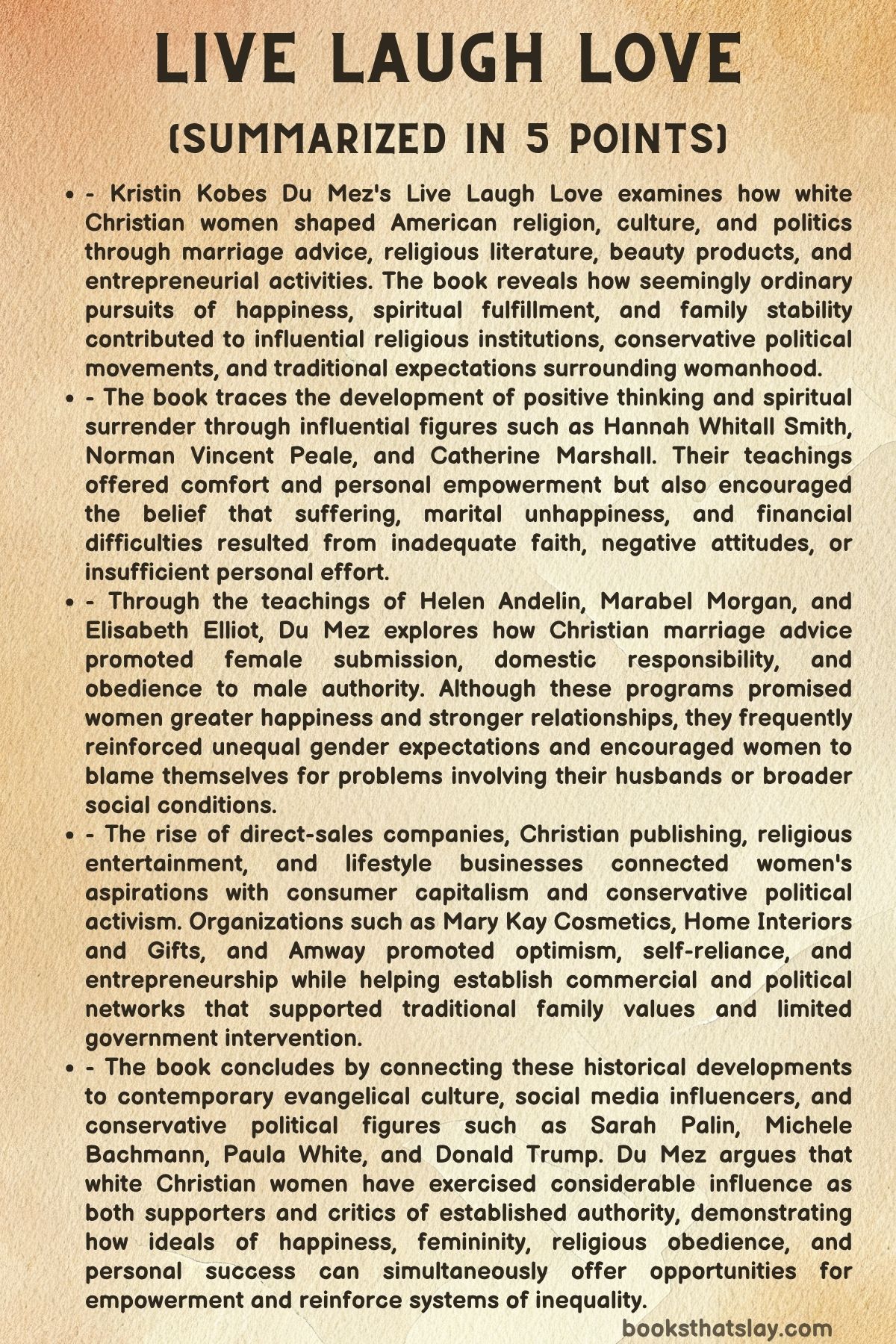
Historian Kristin Kobes Du Mez traces the development of religious ideas that promised happiness, personal success, marital fulfillment, and spiritual security through positive thinking and obedience. Drawing on the lives of influential female writers, evangelists, entrepreneurs, and political figures, she reveals the complicated relationship between women’s empowerment and patriarchal authority. The book demonstrates how ordinary practices involving marriage advice, religious entertainment, beauty products, and domestic ideals contributed to powerful institutions and political movements in the United States.
Summary
Kristin Kobes Du Mez begins Live Laugh Love by challenging conventional accounts of American Christianity that concentrate primarily on male theologians, ministers, and political leaders. She argues that white Christian women have exercised extraordinary cultural influence through activities that historians often consider insignificant, including reading inspirational literature, attending women’s ministries, purchasing beauty products, and participating in religious businesses.
Drawing on her upbringing in a Dutch Calvinist community, Du Mez explains how popular Christian culture shaped her religious understanding as much as formal theology. Through books, music, beauty standards, and expectations surrounding family life, women developed religious identities that crossed denominational boundaries.
The historical foundations of this culture emerged from several influential movements, particularly holiness Christianity, Mormonism, and New Thought. Although these traditions differed considerably, each contributed ideas about spiritual transformation, personal responsibility, and the possibility of achieving happiness through disciplined behavior.
Hannah Whitall Smith, a nineteenth-century Quaker writer and holiness advocate, becomes one of the earliest examples of this complicated tradition. Her influential work, The Christian’s Secret of a Happy Life, encouraged Christians to experience spiritual peace by surrendering their personal desires to God.
Smith’s teachings arose from considerable personal suffering. She experienced the deaths of four children, difficulties in her marriage, and public controversy surrounding her husband’s religious activities.
Despite these hardships, she maintained that spiritual surrender could provide lasting contentment. Her message offered women a way to understand suffering, although subsequent religious movements would use similar ideas to encourage obedience to male authority.
At the same time, New Thought introduced another influential approach to personal transformation. Emerging from nineteenth-century experiments with healing and the relationship between mind and body, the movement claimed that positive beliefs could influence physical circumstances and material success.
Its advocates emphasized optimism, health, prosperity, and individual control over personal experiences. These teachings challenged traditional religious assumptions about suffering while creating opportunities for women to exercise spiritual authority.
However, the philosophy also encouraged individuals to treat their circumstances as consequences of their attitudes. This assumption would eventually become central to religious movements that blamed women for unhappy marriages, financial difficulties, and other conditions beyond their control.
As American evangelicalism developed, religious surrender became increasingly associated with institutional obedience. Influential women such as Aimee Semple McPherson demonstrated that female religious leaders could achieve remarkable independence, public recognition, and organizational influence.
McPherson’s successful Pentecostal ministry challenged conventional restrictions on women’s public roles. Nevertheless, the growing authority of conservative religious institutions increasingly limited women’s leadership opportunities.
Henrietta Mears established a different model of female influence through religious education. Her teaching programs and relationships with influential evangelical leaders allowed her to shape American Christianity while remaining within institutions dominated by men.
Other religious organizations developed systems that emphasized confession, accountability, and obedience. Frank Buchman’s movement, which eventually became Moral Re-Armament, encouraged participants to submit personal decisions to spiritual guidance and maintain group harmony.
These practices could encourage personal discipline, but they also discouraged criticism and strengthened organizational hierarchies.
During the twentieth century, positive thinking became increasingly connected with American business culture and political power. Norman Vincent Peale popularized the belief that optimism, confidence, and religious faith could produce success.
His teachings appealed to wealthy businesspeople, including Fred Trump, while influential evangelicals such as Billy Graham connected Christian identity with anticommunism, capitalism, and American nationalism.
Religious entrepreneurs adopted advertising, fundraising, and corporate organizational strategies. Abraham Vereide established prayer networks among business leaders and politicians, promoting the idea that influencing powerful individuals could transform society.
These developments strengthened relationships among religious organizations, wealthy supporters, and political institutions. Christianity increasingly became associated with economic achievement, personal discipline, and national prosperity.
Within this environment, Christian women developed influential publishing careers. Catherine Marshall gained popularity through religious writings that interpreted suffering through spiritual surrender and encouraged readers to discover fulfillment through faith.
Her perspective combined holiness teachings with the optimism associated with positive thinking. Elisabeth Elliot, however, offered a contrasting interpretation of Christian devotion.
After her missionary husband, Jim Elliot, was killed in Ecuador, Elisabeth struggled with questions about sacrifice and divine purpose. Her writings increasingly emphasized obedience and faithfulness even when suffering remained unresolved.
The differences between these women illustrated competing approaches to religious happiness. While some writers emphasized the possibility of receiving blessings through faith, others treated hardship as an unavoidable part of spiritual commitment.
Religious publishers turned personal testimonies into inspirational literature, sometimes simplifying complicated experiences to satisfy readers’ expectations of uplifting Christian stories.
Marriage advice became another influential part of this expanding religious marketplace. Helen Andelin, a Mormon homemaker, developed Fascinating Womanhood, a program promising that women could improve their marriages by becoming more feminine, cheerful, attractive, and submissive.
Andelin encouraged wives to avoid challenging their husbands and instead focus on changing their own behavior. Her teachings combined traditional gender expectations with New Thought’s assumption that individuals could transform their circumstances through attitude and self-discipline.
The program gained popularity during the feminist movements of the 1960s and 1970s. Andelin opposed women’s liberation, reproductive rights, and policies she believed threatened traditional family structures.
Her teachings made women responsible for marital happiness regardless of their husbands’ behavior. When relationships remained troubled, followers frequently concluded that they had failed to practice the principles correctly.
Marabel Morgan expanded these ideas through her bestselling Total Woman program. After experiencing dissatisfaction in her own marriage, Morgan adopted similar techniques and began instructing Christian wives to prioritize their husbands’ emotional, romantic, and sexual desires.
Her approach transformed female submission into a form of personal empowerment. Women were promised that obedience would produce affection, domestic harmony, and fulfillment.
Meanwhile, conservative evangelical leaders increasingly presented hierarchical marriage as a religious obligation. Although evangelical feminists challenged these interpretations, teachings about male leadership and female submission became defining elements of conservative Christian culture.
Du Mez then examines the relationship between women’s religious lives and direct-sales businesses. Tupperware parties, Home Interiors and Gifts, Mary Kay Cosmetics, and similar organizations offered women opportunities for friendship, recognition, and financial advancement.
These businesses frequently operated within domestic environments, allowing women to pursue entrepreneurial ambitions without openly rejecting conventional family roles.
Mary Crowley and Mary Kay Ash presented business achievement through the language of optimism, beauty, self-improvement, and personal responsibility. Their programs encouraged women to believe that determination and positive thinking could produce success.
Multilevel marketing companies also established hierarchies that rewarded recruitment and encouraged intense loyalty. Participants who experienced financial disappointment were often encouraged to blame their own effort rather than examine the business model.
Rich DeVos and Jay Van Andel, the founders of Amway, connected entrepreneurial success with conservative political principles. Their business networks and financial resources helped support organizations promoting capitalism, religious conservatism, and opposition to government regulation.
Popular Christian fiction reinforced related beliefs about self-reliance and personal responsibility. Janette Oke’s Love Comes Softly presented frontier life through characters who relied on faith, perseverance, family relationships, and hard work.
Du Mez connects these narratives with Laura Ingalls Wilder’s Little House books and the political philosophy of Rose Wilder Lane. Frontier stories frequently celebrated independence while minimizing the role of government assistance and broader social structures.
Such cultural ideals contributed to political attitudes that praised individual achievement and criticized dependence on public welfare. These arguments often carried racial implications, particularly when government assistance recipients were portrayed through negative stereotypes.
Questions about gender, morality, and personal responsibility also shaped evangelical popular entertainment. Christian musician Amy Grant encountered criticism over her clothing, public image, and professional decisions as her career expanded beyond strictly religious audiences.
Women in Christian entertainment faced contradictory expectations. They were encouraged to remain attractive and commercially successful while demonstrating modesty, sexual restraint, and exemplary personal behavior.
The evangelical purity movement intensified these pressures. Elisabeth Elliot’s Passion and Purity, Joshua Harris’s I Kissed Dating Goodbye, and the True Love Waits campaign promoted strict boundaries around romantic relationships and sexuality.
Although these teachings promised emotional and spiritual protection, they frequently placed disproportionate responsibility on women. Female performers and believers could experience severe public criticism when their private lives departed from accepted standards.
As Christian consumer culture expanded, religion increasingly became associated with attractive homes, cheerful families, inspirational products, and carefully managed public identities.
Christian radio executives developed an imaginary suburban mother named Becky to represent their ideal audience. Programming decisions reflected her presumed preference for encouraging, family-friendly entertainment that avoided difficult or controversial subjects.
Celebrity ministries, religious retailers, and television personalities strengthened these expectations. Paula White promoted prosperity-oriented Christianity, while programs featuring the Duggar family and Chip and Joanna Gaines presented recognizable images of Christian domestic success.
Brands such as Hobby Lobby and Altar’d State incorporated religious identity into mainstream shopping experiences. Purchasing products and adopting particular lifestyles became ways of expressing Christian belonging.
However, the expectation of constant happiness often concealed financial problems, family conflicts, and emotional suffering. Positive public appearances could become more important than honestly addressing underlying difficulties.
The emergence of blogging and social media created alternative spaces for women to discuss these contradictions. Ann Voskamp attracted readers through reflections on motherhood, gratitude, and suffering, while Jen Hatmaker, Sarah Bessey, and other writers questioned established religious expectations.
Online communities allowed women to build substantial audiences without formal church authority. Some writers challenged conservative teachings about marriage, sexuality, and gender, while others criticized prosperity theology and religious hypocrisy.
Their independence produced new opportunities but also exposed them to criticism, exclusion, and financial consequences. As successful blogs became commercial platforms, the tension between personal authenticity and marketability remained unresolved.
The book eventually connects this religious and commercial history with contemporary conservative politics. Paula White’s relationship with Donald Trump demonstrates the continuing influence of prosperity theology, celebrity leadership, and positive thinking.
Political figures such as Sarah Palin and Michele Bachmann combined conventional images of Christian motherhood with assertive political rhetoric. Their public identities demonstrated that traditional femininity could serve as a source of political authority rather than merely representing domestic submission.
Right-wing media and social media influencers further developed these models. Tradwife influencers presented idealized images of homemaking, beauty, marriage, and motherhood, frequently overlooking the economic inequalities and restrictions associated with strict patriarchal relationships.
Du Mez also considers scandals involving evangelical leaders whose organizations discouraged criticism and demanded obedience. Such controversies exposed the dangers of institutions that protected authority while placing responsibility for moral conduct disproportionately on women.
In its conclusion, Live Laugh Love returns to the contradiction between promised happiness and lived experience. Across generations, Christian women gained genuine companionship, influence, opportunities, and sometimes independence through religious communities and commercial organizations.
Yet the same institutions frequently encouraged conformity, discouraged criticism, and presented personal suffering as evidence of inadequate faith or insufficient effort.
Du Mez ultimately argues that white Christian women have not simply been passive participants in American religious history. They have actively shaped institutions, supported political movements, challenged authority, and sometimes reinforced systems that restricted their own freedom.
Understanding their cultural influence therefore provides a broader explanation of how religious optimism, traditional gender expectations, consumer capitalism, and conservative political power became closely connected in modern American society.
Key Figures
Hannah Whitall Smith
Hannah Whitall Smith is one of the foundational historical figures in Live Laugh Love, representing the complicated relationship between religious liberation and female submission. As a nineteenth-century Quaker writer and influential holiness advocate, she helped popularize the belief that believers could experience lasting spiritual happiness through surrender to God.
Smith’s religious philosophy developed amid personal tragedy, including the deaths of several children and serious problems within her marriage. These experiences make her teachings particularly significant because her public emphasis on spiritual peace contrasted sharply with the difficulties of her private life.
Her influential writing presented spiritual surrender as a means of escaping anxiety and achieving contentment. Rather than depending on favorable circumstances, believers were encouraged to relinquish their personal desires and trust divine guidance.
Smith was not simply an advocate of female obedience. She supported women’s independence and participated in reform movements, demonstrating that her understanding of spirituality allowed room for female agency.
Her historical importance lies partly in the transformation of her ideas by subsequent generations. Teachings originally intended to provide personal freedom were later adapted into religious arguments for submission to husbands and church leaders.
Du Mez presents Smith as a figure whose legacy reveals how religious ideas can acquire meanings very different from those envisioned by their original advocates.
Robert Pearsall Smith
Robert Pearsall Smith represents the instability and contradictions surrounding nineteenth-century holiness evangelism. As Hannah Whitall Smith’s husband and religious collaborator, he helped spread teachings about spiritual transformation and complete surrender to God.
His public ministry brought him considerable recognition, but accusations of inappropriate conduct involving a young female follower damaged his reputation. The resulting controversy exposed the vulnerability of religious movements organized around charismatic personalities and claims of exceptional spiritual authority.
Robert’s personal struggles also created difficulties for Hannah, whose teachings continued attracting readers despite the collapse of their shared public ministry. His experiences demonstrate how religious communities could celebrate male spiritual leadership while struggling to address misconduct among influential figures.
The contrast between his public religious identity and private behavior becomes an early example of the distance between idealized spiritual authority and human reality.
Aimee Semple McPherson
Aimee Semple McPherson represents female religious independence during a period when many Christian institutions restricted women’s leadership. As a charismatic Pentecostal evangelist, she achieved national recognition through preaching, public performances, and organizational innovation.
Her ministry challenged expectations that women should remain within domestic or subordinate religious roles. She demonstrated that a woman could command public attention, establish a religious institution, and exercise considerable authority over followers.
McPherson also understood the power of modern communication and spectacle. Her public success anticipated later evangelical practices that relied on entertainment, celebrity, and media visibility.
Her importance lies in the contrast between the opportunities available through charismatic religious movements and the restrictions promoted by increasingly institutionalized fundamentalism.
She serves as evidence that conservative religious culture has never produced a single, consistent model of female behavior or leadership.
Henrietta Mears
Henrietta Mears emerges as an influential religious educator whose career demonstrates how women exercised authority within male-dominated evangelical institutions. Through Sunday school programs, mentoring relationships, and organizational leadership, she helped shape the development of twentieth-century American Christianity.
Mears did not primarily challenge established gender hierarchies through direct confrontation. Instead, she worked within recognized religious structures while using education and personal relationships to influence future leaders.
Her efforts contributed to the training of prominent evangelicals and expanded the institutional reach of Christian education. Connections with religious and entertainment figures also enabled her to extend Christian influence beyond church settings.
Mears illustrates a recurring contradiction in the book: women could exercise substantial practical power while belonging to organizations that limited their formal authority.
Her career complicates assumptions that female participation in conservative Christianity necessarily meant political or institutional passivity.
Frank Buchman
Frank Buchman represents the development of religious movements that connected personal transformation with organized systems of obedience. His teachings emphasized confession, moral accountability, spiritual guidance, and disciplined relationships within small groups.
His movement encouraged individuals to examine their behavior and seek moral renewal. However, the expectation that members submit decisions to spiritual guidance also created opportunities for leaders to exercise considerable influence.
As the organization developed into Moral Re-Armament, its goals expanded beyond personal spirituality toward social harmony, political influence, and anticommunism. This transition reflected broader changes in twentieth-century religious activism.
Buchman’s importance lies in demonstrating how ideas about spiritual surrender could support hierarchical institutions. His methods offered participants community and purpose while potentially discouraging independent judgment and disagreement.
Norman Vincent Peale
Norman Vincent Peale occupies an important position in Live Laugh Love because his popularization of positive thinking connected religious belief with business success and modern American optimism. His teachings encouraged readers to develop confidence, overcome negative attitudes, and interpret prosperity as an attainable result of faith.
Peale made religious instruction accessible to audiences interested in practical improvement rather than theological complexity. His approach appealed to professionals, entrepreneurs, and families seeking emotional reassurance and material advancement.
His influence extended into wealthy American business circles, including the Trump family. Through these relationships, his ideas became part of a broader culture celebrating ambition, prosperity, and individual achievement.
Du Mez uses Peale to demonstrate how religious optimism could obscure structural inequalities. When success appeared to depend primarily on confidence and personal belief, failure could easily be interpreted as an individual deficiency.
His legacy helps explain why prosperity-oriented religion became compatible with both consumer capitalism and conservative political ideology.
Billy Graham
Billy Graham represents the growing institutional and political authority of twentieth-century evangelical Christianity. His evangelistic ministry reached national audiences while promoting religious revival, moral discipline, and Christian commitment.
Graham’s activities also connected evangelical religion with anticommunism, American national identity, and support for free enterprise. His prominence helped establish Christianity as an important cultural force within postwar public life.
Although his ministry was centered on evangelism, its methods reflected modern business practices, including advertising, fundraising, and mass communication. These techniques demonstrated the increasing professionalization of religious organizations.
Graham’s inclusion illustrates how public religious leadership and national political ideals became closely associated. His relationships with influential religious educators and business figures also reveal the importance of networks that extended beyond conventional church institutions.
Abraham Vereide
Abraham Vereide is significant for his efforts to connect Christian spirituality with political and economic leadership. He developed influential prayer networks that brought together politicians, business executives, and other powerful individuals.
Vereide believed that transforming the beliefs and behavior of influential people could produce broader social change. His approach therefore concentrated religious attention on elites rather than primarily addressing disadvantaged communities.
This strategy helped establish relationships between religious institutions and existing systems of political and economic authority. It also demonstrated how spiritual language could legitimize relationships among powerful individuals.
Vereide’s role reveals a central tension between Christianity’s concern for moral transformation and religious movements that seek influence through wealth and political access.
Catherine Marshall
Catherine Marshall represents the growth of inspirational Christian publishing and the importance of women’s personal experiences in shaping popular theology. Her career developed through experiences of illness, bereavement, spiritual uncertainty, and eventual literary success.
Marshall’s struggle with tuberculosis and the death of her husband influenced her understanding of suffering and divine guidance. She presented faith as a source of strength that could transform personal hardship into spiritual growth.
Her writings combined ideas about surrender with the optimism of mid-twentieth-century positive thinking. Readers were encouraged to believe that relinquishing control and trusting God could produce fulfillment.
Marshall’s publishing success demonstrated that women’s religious writing could exercise substantial influence outside formal church leadership. Her career also reflects the commercial appeal of personal testimonies presented as models of spiritual perseverance.
Du Mez uses Marshall to explore the tension between authentic suffering and the publishing industry’s preference for reassuring religious narratives.
Elisabeth Elliot
Elisabeth Elliot is one of the most intellectually and morally complex figures examined in the book. Her religious influence emerged partly from the death of her missionary husband, Jim Elliot, an experience that forced her to confront difficult questions about sacrifice, obedience, and divine providence.
Unlike writers who emphasized the possibility of eliminating suffering through faith, Elliot increasingly maintained that Christian commitment required obedience even when circumstances remained painful or unexplained. This approach gave her writings a distinctive seriousness.
Elliot’s public teachings also developed in relation to changing debates about women’s roles in evangelical Christianity. Although she once expressed sympathy toward broader opportunities for women, she eventually became associated with conservative interpretations of marriage and gender hierarchy.
Her writings on romance and sexuality promoted restraint, patience, and submission to religious principles. These teachings influenced later evangelical purity movements.
Elliot demonstrates how personal experiences of suffering can produce religious convictions that offer individuals meaning while also reinforcing restrictive expectations.
Her character illustrates the difficulty of separating spiritual sincerity from the social consequences of religious instruction.
Helen Andelin
Helen Andelin is a central figure in the historical examination of marriage, femininity, and conservative political activism. As the creator of the popular Fascinating Womanhood program, she promoted the belief that women could achieve happier marriages by changing their behavior rather than challenging their husbands.
Her teachings instructed wives to emphasize beauty, cheerfulness, emotional dependence, and deference to male authority. Marriage was presented as a relationship in which women possessed the power to inspire better treatment through properly performed femininity.
Andelin’s philosophy borrowed from Mormon domestic expectations and New Thought’s emphasis on personal transformation. Her program promised empowerment while assigning women responsibility for circumstances that involved the behavior and decisions of others.
Her growing popularity coincided with the feminist movements of the 1960s and 1970s. She opposed major feminist political goals and became an influential advocate of traditional family arrangements.
The psychological consequences of her teachings are particularly important. Women whose marriages remained unhappy often concluded that their own inadequacies were responsible.
Andelin represents the transformation of self-improvement into a disciplinary system that encouraged women to accept inequality as a personal spiritual obligation.
Verna Johnson
Verna Johnson plays a smaller but important role in explaining the development of Fascinating Womanhood. As Helen Andelin’s friend, she helped introduce Andelin to earlier instructional materials concerning feminine behavior and marital relationships.
Her role demonstrates how religious and domestic ideas spread through personal relationships before becoming large commercial movements. Advice exchanged among women could develop into organized educational programs with national audiences.
Johnson also illustrates the importance of informal female networks in American religious culture. Even individuals without prominent public careers contributed to the circulation of ideas that eventually shaped broader social expectations.
Marabel Morgan
Marabel Morgan demonstrates how the principles of Fascinating Womanhood entered mainstream evangelical marriage advice. Dissatisfied with aspects of her marriage, she encountered teachings that persuaded her to believe that changing her own behavior could improve her relationship.
Morgan subsequently developed the Total Woman program, encouraging wives to prioritize their husbands’ desires and cultivate attractive, enthusiastic, and accommodating identities.
Her commercial success reflected widespread demand for practical instruction about marriage and domestic happiness. She presented submission not as a limitation but as a technique through which women could gain affection and satisfaction.
However, her approach placed responsibility for marital fulfillment disproportionately on wives. It also reinforced the belief that personal behavior, rather than unequal relationships, determined domestic outcomes.
Morgan is significant because she translated religious and psychological ideas into a marketable lifestyle program that reached audiences beyond a single denomination.
Charlie Morgan
Charlie Morgan appears through his relationship with Marabel Morgan and the marital dissatisfaction that helped inspire her teachings. His role is important because the program developed around the assumption that wives should adapt to their husbands’ expectations.
Rather than presenting marriage as a relationship requiring equal transformation, the teachings placed greater emphasis on Marabel’s responsibilities. Charlie therefore becomes part of a broader argument about the unequal distribution of emotional labor within traditional marriage advice.
His position illustrates how husbands could benefit from systems that interpreted domestic happiness primarily as a consequence of women’s behavior.
Mary Crowley
Mary Crowley represents the relationship between female entrepreneurship, religious optimism, and conservative family ideals. Through Home Interiors and Gifts, she helped establish a business model that allowed women to sell decorative household products while participating in social networks and commercial activities.
Her approach connected business achievement with traditional femininity. Women were encouraged to view their homes, personal appearance, and entrepreneurial ambitions as compatible expressions of religious and domestic commitment.
Crowley’s business philosophy emphasized optimism, self-discipline, and individual responsibility. These principles resembled New Thought teachings that linked positive attitudes with success.
Her importance lies in demonstrating how entrepreneurship could offer women genuine opportunities while reinforcing the cultural structures that confined their ambitions to particular definitions of womanhood.
Mary Kay Ash
Mary Kay Ash is an influential example of the businesswoman who transformed beauty, motivation, and personal ambition into a powerful commercial identity. Through Mary Kay Cosmetics, she encouraged women to pursue recognition and financial improvement while maintaining conventional family values.
Her sales model presented optimism and self-confidence as essential characteristics of successful entrepreneurs. Consultants were encouraged to believe that determination and disciplined effort could overcome obstacles.
The company’s emphasis on beauty also connected economic opportunity with ideals of femininity. Women could pursue professional achievement without abandoning the appearance and domestic expectations associated with traditional womanhood.
Yet this philosophy could make financial disappointment appear to result from personal inadequacy rather than structural limitations. Ash therefore represents both the genuine possibilities and contradictions of women’s participation in direct-sales capitalism.
Rich DeVos and Jay Van Andel
Rich DeVos and Jay Van Andel are important because their establishment of Amway connected multilevel marketing with conservative religious and political networks. Their business promoted individual achievement, entrepreneurship, and the belief that ordinary people could gain prosperity through sustained effort.
Their commercial philosophy emphasized optimism, loyalty, and personal responsibility. These values overlapped with religious teachings that celebrated economic success as evidence of discipline and appropriate belief.
Their influence extended beyond business operations through financial contributions and relationships with conservative organizations. The networks surrounding Amway became important sources of support for political movements advocating limited government and free-market capitalism.
Du Mez presents their careers as evidence that commercial enterprises could serve as vehicles for broader ideological influence. Their significance lies in the way business relationships, religious beliefs, and political activism reinforced one another.
Janette Oke
Janette Oke represents the cultural influence of Christian fiction in communicating ideals about family, faith, and economic independence. Her novel Love Comes Softly became an influential example of historical romance that celebrated perseverance, religious devotion, and domestic relationships.
Through stories set on the American frontier, Oke portrayed characters overcoming hardship through hard work, family cooperation, and trust in God. These narratives offered readers emotional reassurance while reinforcing recognizable conservative values.
Her success demonstrated the commercial possibilities of fiction written primarily for Christian women. Such literature allowed religious publishers to reach audiences through entertainment rather than direct theological instruction.
Oke’s significance extends beyond storytelling because her narratives helped normalize particular beliefs about marriage, responsibility, and the relationship between individuals and their communities.
Marty and Clark Davis
Marty and Clark Davis are fictional characters from Janette Oke’s Love Comes Softly, used by Du Mez to examine the values promoted through Christian historical romance. Marty begins as a young widow facing severe uncertainty on the American frontier.
Her practical marriage to Clark, a widower, becomes the foundation for a relationship shaped by mutual responsibility, faith, and gradual affection. Their circumstances emphasize survival through cooperation and individual perseverance.
Clark is portrayed as a dependable man whose kindness and work ethic make him an ideal Christian husband. Marty represents a woman who discovers security and belonging through marriage, family, and adaptation to hardship.
Together, they embody a romantic vision of frontier life that prioritizes personal virtue and self-reliance. Their importance lies less in their fictional individuality than in the social and political values their story communicates.
Laura Ingalls Wilder
Laura Ingalls Wilder represents the enduring influence of frontier narratives on American beliefs about independence and personal responsibility. Her Little House books popularized images of pioneer families overcoming hardship through determination, practical skill, and family loyalty.
These narratives became culturally significant because they presented self-reliance as a moral virtue. The challenges of frontier existence were often understood through individual effort rather than broader economic or political conditions.
Du Mez connects Wilder’s literary influence with later conservative interpretations of American history. Her stories helped establish an idealized understanding of national identity centered on independence and suspicion of government assistance.
Wilder’s importance lies in demonstrating how literature intended for families and children could communicate political assumptions without explicitly presenting itself as political instruction.
Rose Wilder Lane
Rose Wilder Lane occupies an important position in the relationship between literature and political ideology. As Laura Ingalls Wilder’s daughter, she contributed to the intellectual environment surrounding frontier narratives while becoming an influential advocate of individual liberty.
Lane opposed government intervention and promoted economic independence as a central principle of American freedom. Her political commitments helped establish ideas later associated with modern libertarianism.
Her beliefs also reveal how apparently domestic or nostalgic stories could reinforce arguments about economic policy. Celebrations of self-sufficiency could discourage sympathy toward individuals requiring public assistance.
Lane demonstrates that women’s participation in conservative political thought often occurred through writing, publishing, and cultural production rather than formal political office.
Amy Grant
Amy Grant represents the contradictory expectations imposed on women within evangelical entertainment. As a Christian singer who achieved considerable commercial success, she encountered public scrutiny regarding her appearance, professional decisions, and personal relationships.
Grant’s growing popularity beyond traditional religious audiences created tensions between artistic ambition and evangelical standards of modesty. Even clothing choices could provoke criticism from religious retailers and consumers.
Her experience illustrates the pressure on Christian women to remain attractive enough for commercial success while avoiding any appearance of sexual independence. Their public identities became objects of collective judgment.
Grant’s significance lies in showing how religious consumer culture could exercise control over women who possessed financial independence and professional recognition.
Her career demonstrates that success did not necessarily protect female performers from restrictive moral expectations.
Joshua Harris
Joshua Harris represents the popularization of evangelical purity teachings among young Christians. Through I Kissed Dating Goodbye, he promoted a model of romantic behavior that discouraged conventional dating and emphasized strict sexual restraint.
His teachings encouraged young believers to interpret romantic relationships through obedience, moral discipline, and future marriage. They became influential within evangelical youth culture.
Although the program presented itself as protection against emotional and sexual harm, it contributed to environments where individual choices were subject to intense religious scrutiny.
Harris’s significance in the book lies in demonstrating how purity teachings entered the everyday lives of young people through bestselling literature and religious movements.
Paula White
Paula White plays a prominent role in Live Laugh Love as a representative of contemporary prosperity Christianity and its connections with political power. Her religious career emphasizes the possibility of obtaining success, confidence, and personal transformation through faith.
Her ministry reflects the continuing influence of positive thinking and prosperity theology. Spiritual commitment is frequently presented through ideas about achievement, abundance, and overcoming adversity.
White’s relationship with Donald Trump demonstrates how celebrity religious leaders can gain political visibility and influence. Their association reflects longstanding connections between prosperity-oriented religion and wealthy business culture.
She also illustrates the possibilities available to women within religious systems that often restrict female authority. Through celebrity status and direct access to powerful individuals, women can exercise influence even when broader institutions remain patriarchal.
Her importance lies in connecting historical developments in religious entrepreneurship with contemporary conservative politics.
Ann Voskamp
Ann Voskamp represents the emergence of female religious authority through blogging and personal storytelling. Her reflections on motherhood, suffering, gratitude, and spiritual development attracted readers seeking more intimate forms of Christian communication.
Voskamp’s writing offered an alternative to institutional religious instruction by emphasizing personal experience. Her audience developed through identification with the emotional and domestic realities she described.
Her career demonstrated that digital platforms could allow women to establish substantial influence without traditional theological credentials. Online writing created opportunities for independent spiritual discussion and community formation.
Voskamp’s significance also reflects the commercialization of personal authenticity. As religious blogs attracted larger audiences, personal reflections increasingly became connected with publishing contracts and lifestyle businesses.
She embodies both the freedom and commercial pressures associated with digital Christian culture.
Jen Hatmaker
Jen Hatmaker represents women who used their growing public platforms to question established evangelical expectations. Through writing and online engagement, she participated in conversations about faith, family, gender, and religious authority.
Her influence developed partly because readers recognized experiences that traditional religious institutions did not always address. Digital communities allowed her to communicate beyond denominational restrictions.
However, questioning conservative doctrines could produce professional and personal consequences. Her career illustrates the risks faced by women whose public religious influence became incompatible with institutional expectations.
Hatmaker demonstrates how female independence within Christian culture remained conditional, particularly when religious leaders and audiences expected public conformity.
Sarah Bessey
Sarah Bessey represents the expansion of independent women’s voices within contemporary Christianity. Through online communities and religious writing, she participated in conversations that challenged restrictive assumptions about gender, authority, and spiritual belonging.
Her work contributed to spaces where women could discuss religious uncertainty and personal difficulties without relying exclusively on established church leadership. Such communities offered alternatives to highly controlled religious environments.
Bessey’s importance lies in demonstrating how digital communication could redistribute religious influence. Women who previously lacked institutional positions could now reach substantial audiences and challenge conventional interpretations.
Her role also illustrates the continuing tension between authentic personal expression and the commercial pressures facing successful religious writers.
Sarah Palin
Sarah Palin represents the emergence of conservative political femininity that combined traditional motherhood with assertive public leadership. Her political identity emphasized family values, religious commitment, and cultural conservatism.
At the same time, Palin adopted confrontational rhetoric and an energetic public style that differed from conventional expectations of female gentleness. This combination enabled her to appeal to audiences that valued traditional gender roles while celebrating strong political personalities.
Her public image demonstrates how motherhood could become a political credential. Rather than preventing women from exercising authority, traditional femininity could strengthen their legitimacy within conservative movements.
Palin’s significance lies in revealing the flexibility of gender expectations when women support established political and religious hierarchies.
Michele Bachmann
Michele Bachmann represents a similar relationship between conservative womanhood and political assertiveness. Her public identity combined devotion to traditional family values with strong positions on religious and political controversies.
Bachmann illustrates how conservative female politicians could exercise considerable authority without explicitly rejecting hierarchical beliefs about marriage and society. Their leadership was often presented as an extension of maternal responsibility and moral commitment.
Her political visibility challenged simplistic assumptions about conservative Christian women’s passivity. Women could become influential public figures while defending institutions that restricted gender equality in other settings.
Bachmann demonstrates the capacity of religious identity to support both conventional femininity and aggressive political mobilization.
Donald Trump
Donald Trump appears as a contemporary political figure whose relationship with evangelical Christianity reflects historical connections among positive thinking, business culture, celebrity, and religious authority. His association with Norman Vincent Peale’s teachings forms an important part of this broader history.
Trump’s public image emphasizes confidence, wealth, individual achievement, and the projection of success. These characteristics resemble values promoted through prosperity-oriented Christianity and entrepreneurial self-improvement movements.
His relationship with Paula White demonstrates the political importance of religious leaders who celebrate personal triumph and access to influential individuals.
Du Mez uses Trump to illustrate the results of cultural developments that began long before his political career. His support among conservative Christians becomes more understandable when viewed within traditions that associated religious identity with success, authority, and national power.
Tradwife Influencers
Tradwife influencers function as a contemporary collective presence rather than a single historical individual. Their online content celebrates homemaking, marriage, beauty, motherhood, and traditional gender relationships.
Their public identities frequently depend on carefully arranged images of domestic satisfaction. Attractive homes, carefully prepared meals, and idealized family relationships become evidence of a desirable lifestyle.
These presentations often minimize the financial independence, commercial income, or practical resources required to maintain such appearances. They may also overlook the unequal relationships and economic vulnerability that can accompany strict gender hierarchies.
Du Mez treats these influencers as contemporary expressions of the historical traditions examined throughout the book. They demonstrate how promises of personal fulfillment and feminine empowerment can continue reinforcing conservative gender expectations through modern commercial platforms.
Themes
Positive Thinking, Happiness, and the Burden of Personal Responsibility
The promise that individuals can achieve happiness by changing their attitudes forms a recurring foundation of Live Laugh Love. Across different historical periods, religious teachers, entrepreneurs, and popular writers encourage women to believe that optimism, faith, and personal discipline can transform their circumstances.
This philosophy initially appears empowering because it offers people a sense of control over uncertain lives. Hannah Whitall Smith’s teachings about spiritual surrender and the development of New Thought both suggest that inner transformation can provide relief from suffering.
However, the consequences become more complicated when happiness is treated as an obligation rather than a possibility. Women experiencing unhappy marriages, financial instability, or emotional distress may begin interpreting their difficulties as evidence of inadequate faith or insufficient effort.
The marriage programs promoted by Helen Andelin and Marabel Morgan demonstrate this problem particularly clearly. By promising that women can improve relationships through attractiveness, obedience, and cheerfulness, these programs shift responsibility away from husbands and unequal marital structures.
Similar assumptions shape the business philosophies of Mary Kay Cosmetics and multilevel marketing organizations. Financial achievement becomes evidence of determination, while failure is attributed to personal shortcomings.
The expectation of constant positivity can also discourage criticism and honesty. Acknowledging mistreatment or institutional problems becomes difficult when dissatisfaction itself is treated as a moral weakness.
Du Mez therefore distinguishes between genuine hope and systems that demand happiness while refusing to confront the conditions producing suffering.
Gender Roles, Female Empowerment, and Patriarchal Authority
The relationship between women’s independence and traditional gender expectations is characterized by persistent contradictions. Women repeatedly gain cultural influence, professional opportunities, and religious authority through institutions that simultaneously defend male leadership.
Historical figures such as Aimee Semple McPherson and Henrietta Mears demonstrate that women could exercise substantial influence within American Christianity. Their careers challenged assumptions that religious women were necessarily confined to private domestic life.
However, female achievement was often more acceptable when it reinforced established institutions. Women could teach, organize, sell products, and influence political movements while remaining publicly committed to conventional ideals of feminine obedience.
Marriage advice literature intensified this contradiction by redefining submission as empowerment. Helen Andelin and Marabel Morgan encouraged women to believe they possessed extraordinary influence over their husbands, provided they accepted masculine authority.
This logic transformed unequal relationships into opportunities for individual self-improvement. Instead of questioning why wives carried disproportionate responsibility for marital happiness, women were encouraged to perfect their behavior.
The political careers of Sarah Palin and Michele Bachmann reveal a different expression of the same tension. Both women exercised public authority while defending traditional family structures and conservative gender expectations.
Their examples demonstrate that patriarchal systems do not necessarily exclude women from power. Instead, they may reward women whose influence strengthens established ideological commitments.
The book ultimately presents female agency as something more complicated than either freedom or oppression. Women can simultaneously benefit from particular institutions, challenge their restrictions, and participate in maintaining inequalities that affect other women.
Consumer Capitalism, Religious Identity, and Political Power
The relationship between religion and commerce develops from the sale of inspirational literature into extensive networks of businesses, media organizations, and political institutions. Christian identity increasingly becomes something expressed through products, brands, entertainment, and carefully managed lifestyles.
Religious publishing helps establish this development by transforming personal testimonies into widely marketed narratives. Writers such as Catherine Marshall demonstrate that experiences of suffering and faith can become the foundation of successful commercial careers.
Direct-sales companies extend these practices into everyday domestic life. Businesses such as Home Interiors and Gifts, Mary Kay Cosmetics, and Amway encourage women to associate entrepreneurial ambition with personal virtue and family responsibility.
Their motivational teachings frequently borrow from New Thought, celebrating optimism and individual achievement while minimizing structural limitations. Financial success becomes a reflection of personal character rather than an outcome influenced by economic circumstances.
Business organizations also develop political influence through wealthy founders, donors, and extensive social networks. The activities of Rich DeVos and Jay Van Andel demonstrate how entrepreneurial culture can support conservative political movements.
Meanwhile, Christian entertainment and retail businesses create recognizable cultural identities through music, television, clothing, and household decorations. Consumers can participate in religious communities through purchasing decisions and lifestyle choices.
These commercial practices influence how religious goodness is understood. Attractive homes, beautiful families, prosperous businesses, and cheerful personalities become visible signs of spiritual success.
Du Mez suggests that this relationship between faith and capitalism has consequences beyond individual purchasing habits. It helps establish political alliances that defend free enterprise, traditional family arrangements, and existing concentrations of economic authority.
Religious Authority, Cultural Conformity, and the Politics of Traditional Womanhood
Religious obedience becomes particularly consequential when personal devotion is treated as a requirement to accept institutional authority. Teachings that originally emphasize spiritual surrender gradually develop into expectations of loyalty toward religious leaders, husbands, and established organizations.
The history presented in Live Laugh Love demonstrates how religious communities can convert voluntary discipline into systems that discourage disagreement. Movements emphasizing confession, accountability, and submission may provide genuine companionship while also protecting leaders from criticism.
These patterns become especially apparent in teachings about marriage and sexuality. Women are encouraged to accept male authority, regulate their appearance, and take responsibility for maintaining moral standards within families and religious communities.
Purity culture extends these expectations to young women, whose romantic choices and personal reputations become subjects of collective judgment. Public scrutiny of female entertainers demonstrates how religious institutions can enforce conformity even among successful women.
The rise of blogging and social media initially offers alternatives to these established systems. Writers such as Ann Voskamp, Jen Hatmaker, and Sarah Bessey create communities where women can discuss suffering, uncertainty, and religious disagreement.
Yet greater independence introduces new pressures as influencers depend on audiences, publishers, and commercial relationships. Women who challenge accepted beliefs may face exclusion or professional consequences.
Contemporary conservative politics brings these historical developments into public view. Female politicians and tradwife influencers transform conventional femininity into a recognizable ideological identity associated with motherhood, beauty, national loyalty, and cultural confrontation.
The resulting political culture demonstrates that submission and assertiveness are not necessarily opposites. Women may defend traditional hierarchies through highly visible, confrontational forms of public leadership.
Du Mez’s broader argument concerns the relationship between personal identity and collective power. When religious loyalty becomes inseparable from political belonging, criticism can be interpreted as betrayal, allowing unequal institutions to preserve their authority while presenting themselves as protectors of faith, family, and moral order.


