Love Felt Like This Summary, Characters and Themes
Love Felt Like This by Julie Olivia is a contemporary romantic novel about finding love after betrayal, rediscovering creative passion, and learning to balance personal happiness with professional ambition.
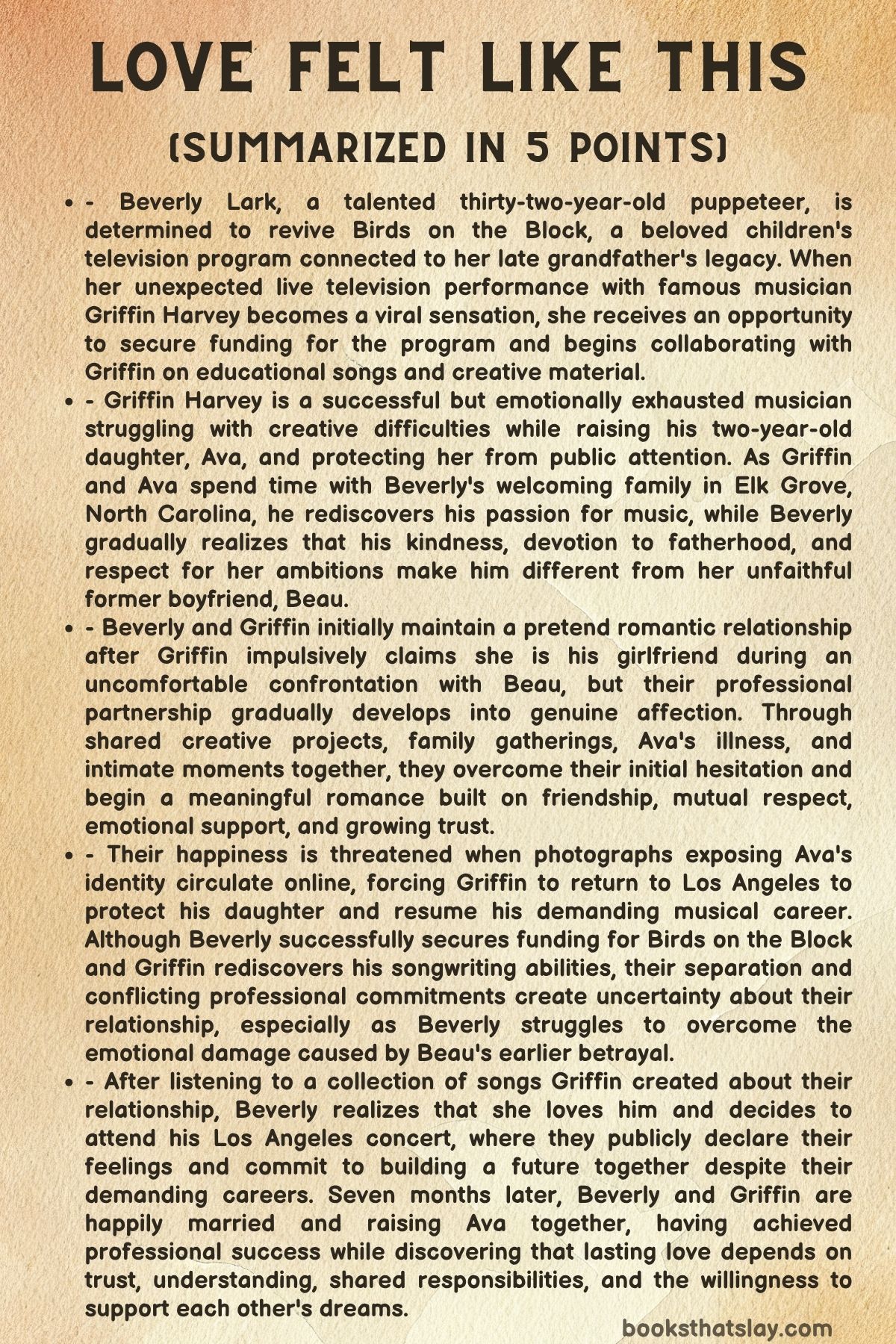
The story follows Beverly Lark, a determined puppeteer fighting to revive a beloved children’s television program, and Griffin Harvey, a famous musician struggling with artistic exhaustion and the responsibilities of single fatherhood. An unexpected television appearance brings them together, leading to a pretend relationship that gradually becomes genuine. Through humor, family relationships, emotional vulnerability, and the pressures of celebrity life, the novel explores how two people with difficult pasts discover the courage to build a future together.
Summary
Beverly Lark is a thirty-two-year-old puppeteer determined to save Birds on the Block, a beloved children’s television program associated with her late grandfather, Albert Starling. After the show’s funding disappears, Beverly invests her savings in purchasing its intellectual property and preserving Flock Workshop, the nonprofit organization responsible for its production.
Her determination brings her to Los Angeles, where she hopes an appearance on The Late Night Laughs Show will generate enough publicity to attract new financial supporters.
During the appearance, Beverly operates Bernie Bird, one of the program’s popular puppet characters. Her mentor, Finch, is delayed in traffic, leaving her to manage the performance without his usual assistance.
The situation becomes more complicated when famous musician Griffin Harvey accidentally enters her segment instead of appearing at his scheduled location.
Griffin is known for his intimidating personality and difficult public reputation. He is also struggling privately with creative exhaustion, pressure from his record label, and the responsibilities of raising his two-year-old daughter, Ava.
Initially irritated by the unexpected situation, Griffin reluctantly participates when he notices Beverly desperately trying to rescue the performance.
Their improvised exchange involves an imaginary door that Bernie repeatedly refuses to let Griffin open. The playful interaction eventually makes Griffin laugh, delighting both Beverly and the audience.
The performance becomes an internet sensation, attracting more than a million views within a day.
The unexpected publicity creates renewed interest in Birds on the Block. Two streaming companies contact Beverly, including Connection, an organization whose emphasis on educational programming aligns with her ambitions.
Connection invites her to prepare a substantial presentation, but she has less than two months to develop scripts, educational materials, character concepts, and music.
Meanwhile, Griffin notices that Ava adores Bernie Bird. Watching his daughter repeatedly enjoy the viral video makes him reconsider the educational songs he has been inventing for her.
Although Griffin has struggled to write commercially successful music, creating songs about ordinary childhood experiences comes naturally to him. He realizes that collaborating with Beverly might restore his artistic confidence while helping her revive the program.
Their professional discussions soon lead to an unexpected complication.
During a restaurant meeting, Beverly encounters Beau, her former boyfriend and another successful musician. Beau previously betrayed her through infidelity, then allowed public accusations to portray Beverly as someone exploiting his wealth.
The scandal exposed her to harassment and severely damaged her confidence.
When Beau behaves condescendingly toward Beverly, Griffin impulsively intervenes and announces that she is his girlfriend.
His declaration creates a pretend relationship that attracts public attention, but it also establishes an unusual bond between them.
Griffin agrees to help Beverly prepare her television proposal, and their collaboration takes them to her hometown of Elk Grove, North Carolina.
Beverly returns to her family home, where her parents, Cheryl and Glenn, her grandmother Alice, and other relatives provide a welcoming environment.
She is surprised when Griffin arrives with Ava, whose existence he has carefully protected from public attention.
Initially, Beverly is uncertain how a famous musician and his toddler will fit into her demanding schedule. However, Griffin’s devotion to Ava reveals a tenderness completely absent from his intimidating public image.
He is patient, protective, and deeply concerned about becoming a good father, although constant exhaustion has left him struggling to balance every responsibility.
Beverly gradually becomes involved in their daily routines. Her ability to entertain children helps Ava feel comfortable, and the little girl affectionately begins calling her B.
Griffin also discovers the warmth of Beverly’s family, enjoying ordinary meals, humorous conversations, and the slower rhythm of small-town life.
Their professional partnership becomes increasingly successful.
Beverly brings her understanding of puppetry, storytelling, and educational entertainment, while Griffin contributes spontaneous melodies and songs.
During one particularly memorable session, he develops music around the letter E and the emotions children experience.
The collaboration restores his enthusiasm for songwriting. For the first time in months, music feels exciting rather than burdensome.
Beverly also discovers that Griffin respects her work. Unlike Beau, he never treats her ambitions as secondary to his celebrity career.
As their friendship develops, Griffin invites Beverly to accompany him to the Grammy Awards.
The invitation frightens her because it means returning to the entertainment industry where she previously experienced humiliation. Nevertheless, encouragement from Finch and her grandmother persuades her to accept.
In Los Angeles, Beverly witnesses Griffin’s extraordinary professional world, including his luxurious home, influential acquaintances, and captivating performances.
Seeing him onstage strengthens her attraction, while Griffin finds himself increasingly inspired by her presence.
Their growing affection becomes difficult to disguise after they return to Elk Grove.
When Ava becomes ill during heavy snowfall, Griffin insists on caring for her despite his own exhaustion. He soon develops a fever himself, forcing Beverly and her family to intervene.
Beverly looks after both father and daughter, bringing food, providing reassurance, and encouraging Griffin to rest.
Her kindness affects him profoundly because he has become accustomed to managing everything alone.
As he recovers, they share increasingly intimate moments, including falling asleep together beneath a blanket.
Griffin finally acknowledges his romantic feelings, telling Beverly that he likes her and making clear that their relationship is no longer merely pretend.
Beverly gradually allows herself to trust him, although Beau’s betrayal continues to influence her expectations.
Their connection becomes romantic around Valentine’s Day.
Rather than demanding elaborate celebrations, Griffin willingly accompanies Beverly while she purchases supplies for her television project. His willingness to participate in her everyday responsibilities reinforces her belief that he values her individuality.
They eventually acknowledge their physical attraction and begin a genuine romantic relationship.
For a brief period, Beverly, Griffin, and Ava experience an almost domestic happiness.
However, their privacy collapses when a video of Griffin and Beverly shopping together appears online. Additional photographs reveal Ava’s existence, exposing the little girl to public speculation.
Griffin is devastated because protecting his daughter from celebrity attention has always been one of his highest priorities.
His manager, Jimmy, intervenes, and Griffin decides to return to Los Angeles with Ava.
The departure deeply hurts Beverly, whose memories of watching Beau leave to pursue his musical career make the separation especially frightening.
Although Griffin promises that he wants to see her again, both recognize that their professional obligations may keep them apart.
Griffin returns to recording and prepares for an international tour, while Beverly works relentlessly to finish her presentation for Connection.
Their communication becomes increasingly difficult as their schedules grow more demanding.
Nevertheless, neither stops thinking about the other.
Beverly eventually travels to Los Angeles for her presentation. Griffin, realizing that supporting her ambitions is more important than demanding her constant presence, contacts Finch and becomes involved in the event.
The presentation is highly successful.
Connection recognizes the potential of the revived Birds on the Block, giving Beverly the opportunity to fulfill the dream she has pursued for years.
Griffin also experiences renewed artistic success, developing a new album titled Bird in Hand.
Despite these achievements, their romantic future remains uncertain.
Three months later, Beverly is living in Los Angeles and working on the revived children’s program. Griffin has been touring extensively, and their relationship has become strained by distance and limited communication.
When Griffin visits Connection Studios with Ava, he is overwhelmed by seeing Beverly again.
He admires everything she has accomplished but worries that she no longer wants a romantic relationship.
Before leaving, he gives her a CD containing music inspired by their time together and invites her to attend his upcoming concert.
Listening to the recording, Beverly realizes how deeply Griffin loves her and how much their relationship has influenced his creativity.
She finally recognizes that avoiding romantic uncertainty has prevented her from pursuing something she genuinely wants.
Her decision to attend Griffin’s concert is briefly interrupted by Beau, who arrives at Finch’s home.
During their confrontation, Beverly learns more about Beau’s involvement in exposing Ava’s identity. Information he overheard at the Grammy Awards, along with Taylor’s actions, contributed to the damaging publicity.
Beverly refuses to tolerate his manipulation any longer.
With support from Rob and Finch, she orders Beau to leave and makes clear that he has no place in her future.
She then rushes to Griffin’s concert.
Although security initially prevents her from reaching him backstage, Beverly finds her way toward the stage.
Griffin spots her while preparing to perform a song dedicated to her and immediately rushes to meet her.
In front of the audience, Beverly declares her love and acknowledges that their careers will inevitably involve periods of separation and difficult decisions.
Rather than demanding a perfect future, she chooses to face those uncertainties with him.
Griffin responds with equal devotion, and they embrace and kiss before the crowd.
Their reunion establishes that their relationship can survive professional ambition, public scrutiny, and geographical distance.
Seven months later, Beverly and Griffin are married and raising Ava together.
They attend another major music awards ceremony as a family, demonstrating how their priorities have changed.
Griffin remains successful in his career, while Beverly continues pursuing her ambitions in children’s entertainment.
When Griffin receives recognition for his music, he publicly thanks Beverly for restoring his creative confidence and helping him discover happiness beyond fame.
Their story concludes with both characters recognizing that love does not require abandoning individual dreams. Instead, their marriage gives them the companionship, trust, and emotional security necessary to pursue those dreams together.
Characters
Beverly Lark
Beverly Lark is the central female protagonist of Love Felt Like This, a creative, determined, and emotionally vulnerable puppeteer whose journey combines professional ambition with the gradual recovery of her romantic confidence. At thirty-two, she has devoted much of her life to children’s entertainment and the preservation of a television program closely connected to her family’s history.
Her commitment to Birds on the Block reveals considerable courage and persistence. Purchasing the program’s intellectual property with her savings demonstrates how seriously she takes her responsibility toward the creative work her grandfather helped establish.
However, Beverly’s determination frequently becomes excessive. She equates professional productivity with personal worth, sacrificing sleep, rest, and emotional well-being because she fears that slowing down might mean failing.
Her relationship with Beau explains much of her insecurity. His infidelity and the public accusations that followed left her distrustful of successful musicians and uncomfortable with celebrity culture.
Meeting Griffin gradually challenges those assumptions. Although she initially expects him to resemble Beau, his respect for her ambitions, devotion to Ava, and willingness to provide practical support reveal an entirely different personality.
Beverly’s kindness is particularly visible in her interactions with Ava. She approaches the little girl with patience and imagination, eventually becoming a trusted presence in her life.
An important aspect of Beverly’s development involves recognizing that independence does not require emotional isolation. She learns that accepting affection and assistance does not diminish her accomplishments.
Her eventual confrontation with Beau demonstrates how much confidence she has regained. Instead of allowing his behavior to influence her self-image, she openly rejects his interference and establishes firm boundaries.
By the conclusion, Beverly has successfully revived her television program and built a loving family with Griffin and Ava. Her development shows that professional achievement and romantic fulfillment can strengthen rather than undermine one another.
Griffin Harvey
Griffin Harvey is the central male protagonist of Love Felt Like This, an internationally successful musician whose intimidating public reputation conceals grief, exhaustion, tenderness, and a powerful sense of responsibility.
Although he has achieved extraordinary professional recognition, Griffin begins the novel struggling with creative exhaustion. His record label expects new music, his manager worries about his reputation, and an approaching international tour adds pressure to an already demanding life.
His greatest responsibility is raising Ava. Griffin’s devotion to his daughter shapes nearly every decision he makes, including his determination to protect her identity from public attention.
This protectiveness, however, sometimes becomes an obstacle to his own happiness. Griffin believes that being a responsible father means managing every difficulty himself, leaving him reluctant to accept help.
His unexpected encounter with Beverly introduces a different way of approaching creativity and personal relationships. Their improvised television performance reminds him that artistic expression can be playful and spontaneous.
Through their collaboration, Griffin rediscovers the pleasure of writing music. Beverly encourages him to recognize that composing educational songs is as legitimate as creating material for his conventional musical career.
His romantic development is equally important. Griffin becomes attracted to Beverly’s humor, intelligence, determination, and ability to appreciate him without being intimidated by his fame.
Unlike Beau, he consistently respects Beverly’s professional identity. He understands that loving her should never require her to abandon the television program she has worked so hard to preserve.
Griffin’s emotional conflict becomes especially clear after Ava’s privacy is compromised. His decision to leave Elk Grove reflects genuine parental concern, but it also exposes his fear that personal happiness might interfere with responsibility.
Eventually, Griffin learns that love and responsibility do not have to exist in opposition. His marriage to Beverly represents his willingness to build a life that accommodates fatherhood, music, and romantic companionship.
By the end, Griffin’s greatest transformation is not simply regaining his ability to write songs. He learns to accept care, express vulnerability, and recognize that his identity extends far beyond professional fame.
Ava Harvey
Ava Harvey is Griffin’s two-year-old daughter and one of the most influential figures in Love Felt Like This. Although she is too young to understand the complicated emotional circumstances surrounding her father, her needs and responses repeatedly shape the adults’ decisions.
Ava represents innocence within a world dominated by celebrity expectations, professional pressure, and public judgment. Her enjoyment of Bernie Bird helps inspire Griffin’s decision to collaborate with Beverly.
Her presence also reveals Griffin’s private personality. Through his efforts to comfort, entertain, and protect Ava, readers see the loving father beneath his intimidating public image.
Ava’s relationship with Beverly develops naturally through simple interactions. Beverly’s patience and creativity help her adjust to unfamiliar surroundings, and her affectionate nickname for Beverly demonstrates increasing trust.
The little girl’s illness becomes particularly important because it creates opportunities for Beverly and Griffin to care for one another. Their shared concern for Ava strengthens the emotional foundation of their relationship.
The exposure of Ava’s identity creates the novel’s most serious external conflict. Because she cannot understand or consent to celebrity attention, the circulation of her photographs becomes a clear violation of her privacy.
Ava ultimately becomes part of the family Beverly and Griffin create together. Her presence gives their relationship a purpose that extends beyond romantic attraction.
Albert Starling
Albert Starling is Beverly’s late grandfather and one of the most influential figures in her personal and professional development. Although he does not participate directly in the present-day events, his memory shapes Beverly’s ambitions throughout the novel.
Albert helped establish the creative traditions associated with Birds on the Block and encouraged Beverly’s interest in puppetry. Through him, she learned that children’s entertainment could be artistically meaningful while helping young audiences understand emotions and everyday experiences.
His influence explains why Beverly refuses to abandon the struggling program. For her, preserving it means protecting both an educational mission and the work of someone she deeply admired.
Albert also represents the relationship between creativity and personal legacy. His contribution survives through the characters, traditions, and artistic principles Beverly works to maintain.
However, Beverly’s attachment to his memory contributes to her fear of failure. She sometimes treats the revival as a responsibility she must fulfill at any personal cost.
His marriage to Alice also becomes relevant when Beverly considers the difficulties of loving someone whose career requires travel. Their relationship provides evidence that meaningful partnerships can survive complicated circumstances.
Albert’s lasting importance lies in the values he passes to later generations: imagination, generosity, persistence, and the belief that creative work can improve people’s lives.
Alice Lark (Nana)
Alice, affectionately known as Nana, is Beverly’s grandmother and one of the story’s most important sources of emotional wisdom.
Her personality combines humor, curiosity, affection, and a willingness to involve herself in the romantic affairs of her family members. She frequently recognizes Beverly’s feelings before Beverly is prepared to acknowledge them.
Nana serves as a counterbalance to Beverly’s excessive focus on professional achievement. She encourages her granddaughter to recognize that a successful career cannot replace companionship, personal enjoyment, or emotional connection.
Her perspective is shaped by her marriage to Albert. Having experienced the difficulties of loving someone with substantial professional commitments, Alice understands that separation does not necessarily weaken a relationship.
She explains that their marriage involved sacrifices but insists that the happiness they shared made those difficulties worthwhile.
This advice becomes particularly meaningful after Griffin returns to Los Angeles. Beverly fears repeating her unsuccessful relationship with Beau, but Nana encourages her to distinguish between past betrayal and future possibility.
Alice also helps welcome Griffin and Ava into the Lark family. Her acceptance contributes to the atmosphere of belonging that makes Elk Grove important to them.
Through Nana, the novel presents wisdom as something acquired through lived experience rather than idealized expectations about romance.
Finch
Finch is Beverly’s mentor, professional collaborator, and one of the strongest supporters of her efforts to revive Birds on the Block.
He understands both the artistic importance of the program and the personal history behind Beverly’s attachment to it. His encouragement helps sustain her confidence when financial difficulties make the future seem hopeless.
Following Beverly’s viral television appearance, Finch immediately recognizes the possibilities created by her interaction with Griffin. His suggestion that they collaborate demonstrates his practical understanding of publicity and creative opportunity.
Finch also recognizes Beverly’s limitations more clearly than she sometimes does. He notices her exhaustion and encourages her to protect her well-being rather than sacrificing everything to professional ambition.
His support is not restricted to work. He becomes increasingly involved in helping Beverly navigate her feelings for Griffin and the uncertainty surrounding their relationship.
When Beverly secures funding for the program, Finch continues providing practical assistance, including a place for her to stay in Los Angeles.
His willingness to help arrange her journey to Griffin’s concert further demonstrates his importance as a trusted figure in her life.
Finch represents mentorship at its most constructive: supporting another person’s ambitions while encouraging them to become emotionally healthier and more independent.
Beau
Beau is Beverly’s former boyfriend and the principal antagonistic figure in Love Felt Like This. A successful musician whose infidelity caused the collapse of their relationship, he represents the destructive consequences of selfishness, celebrity entitlement, and emotional manipulation.
His betrayal becomes particularly damaging because it is followed by public accusations suggesting that Beverly exploited him financially. The resulting online harassment damages her reputation and leaves her deeply distrustful of famous musicians.
Beau’s behavior demonstrates his unwillingness to accept responsibility for the harm he causes. When he encounters Beverly again, he continues behaving condescendingly rather than respecting her independence.
His involvement in the exposure of Ava’s identity reveals an even more troubling disregard for other people’s welfare. By allowing private information to contribute to public speculation, he places celebrity gossip above a child’s security.
Beau also functions as a contrast to Griffin. Both men are successful musicians, but their attitudes toward responsibility, loyalty, and Beverly’s ambitions differ substantially.
Where Beau undermines Beverly’s confidence, Griffin encourages her professional growth. Where Beau uses public attention irresponsibly, Griffin makes protecting Ava’s privacy a priority.
Beverly’s eventual confrontation with Beau represents the final weakening of his influence over her life. She no longer allows his judgment to determine her emotional decisions.
Through Beau, the novel examines how damaging relationships can continue influencing people long after the relationship itself has ended.
Jimmy
Jimmy is Griffin’s manager and an important representative of the professional responsibilities surrounding his musical career.
His primary concern is ensuring that Griffin fulfills his obligations to his record label, collaborators, and audiences. With Griffin experiencing creative difficulties, Jimmy faces the challenge of managing expectations while protecting the musician’s reputation.
Although he approaches situations from a professional perspective, Jimmy is not indifferent to Griffin’s personal struggles. He recognizes that exhaustion, fatherhood, and public pressure have affected his client’s ability to work.
The viral Bernie Bird appearance presents an opportunity to improve Griffin’s public image. Jimmy understands that the audience’s positive reaction might benefit a musician whose serious demeanor has often been interpreted negatively.
His importance becomes especially clear when Ava’s identity is exposed. Jimmy responds quickly, helping Griffin address the public relations consequences and consider how best to protect his daughter.
Jimmy represents the organizational demands that accompany celebrity success. His responsibilities sometimes conflict with Griffin’s desire for privacy, but they also provide necessary structure and support.
Robin
Robin is Ava’s mother and an important figure in Griffin’s emotional history.
Although she is absent from the present-day action, Griffin’s memories establish her as a warm, confident woman who valued him as an ordinary person rather than treating him primarily as a celebrity.
Her importance is revealed through Griffin’s conversations with Beverly. Speaking about Robin requires emotional openness because their relationship remains closely connected to his experiences of love, loss, and fatherhood.
Robin’s influence also helps explain Griffin’s protectiveness toward Ava. His daughter connects him to a meaningful part of his past while giving him an enduring responsibility in the present.
Beverly’s response to learning about Robin demonstrates her emotional maturity. She does not treat Griffin’s previous relationship as a threat or demand that he minimize its importance.
Instead, she recognizes that loving Griffin includes respecting the experiences that shaped him.
Robin’s role reinforces the idea that finding love again does not require erasing earlier attachments or denying the significance of past relationships.
Rob Lark
Rob is Beverly’s brother and an important member of her supportive family.
His personality includes teasing humor, curiosity, and a protective attitude toward his sister. He frequently uses jokes to address situations that Beverly finds emotionally complicated.
Rob becomes particularly important when the public exposure of Ava’s identity creates tension within the family.
His concern reflects the seriousness of the situation and the importance of honesty within the relationships that have developed around Griffin and Beverly.
Despite moments of confusion or frustration, Rob remains loyal to his sister. His willingness to confront difficult circumstances demonstrates that his humor does not diminish his sense of responsibility.
During Beau’s unexpected appearance at Finch’s home, Rob intervenes decisively and tells him to leave Beverly alone.
This moment establishes him as a dependable family member who refuses to tolerate someone mistreating his sister.
Rob’s presence helps maintain the novel’s balance between emotional conflict and ordinary family humor.
Cheryl and Glenn Lark
Cheryl and Glenn are Beverly’s parents, and their welcoming household provides an emotional foundation for much of the story.
Their relationship with Beverly reflects familiarity, affection, and a willingness to support her unconventional professional ambitions.
When Beverly returns to Elk Grove, their home offers her a sense of security during a period of financial uncertainty and emotional exhaustion.
They also welcome Griffin and Ava despite the unusual circumstances surrounding their arrival.
Their relaxed humor and ordinary family routines contrast with the formal expectations Griffin experiences in celebrity environments.
Through Cheryl and Glenn, Griffin encounters a type of domestic companionship that has become increasingly rare in his demanding professional life.
Although they are supporting characters, they help establish why Beverly values family relationships so strongly and why Elk Grove becomes meaningful to Griffin.
Taylor
Taylor is a secondary antagonistic character associated with the unpleasant social environment surrounding Beverly’s former relationship with Beau.
Her interactions with Beverly revive memories of judgment, humiliation, and the social pressures Beverly experienced while dating a famous musician.
Taylor’s importance grows when her involvement in the circulation of information about Ava becomes apparent.
After learning private information connected to Griffin’s daughter, she contacts Beau, contributing to the circumstances that eventually expose Ava to public attention.
Her actions demonstrate how celebrity gossip can produce consequences far more serious than the people spreading it acknowledge.
Taylor also represents the persistence of Beverly’s past. Even after leaving her relationship with Beau, Beverly remains vulnerable to individuals associated with that period of her life.
Her behavior reinforces the novel’s criticism of treating private relationships and children as material for public entertainment.
Dom
Dom is one of Griffin’s musical associates and provides an important perspective on the pressures of fatherhood.
During a conversation in Los Angeles, Dom reassures Griffin that no parent can anticipate or prevent every possible difficulty.
His advice challenges Griffin’s belief that being a good father requires complete control over Ava’s safety and future.
This becomes especially relevant after the exposure of Ava’s identity, an event Griffin regards as a personal failure despite circumstances beyond his control.
Dom helps him recognize the distinction between reasonable responsibility and unrealistic expectations.
As a supporting character, Dom contributes to Griffin’s emotional development by encouraging a healthier understanding of parenting.
Greta
Greta is the professional stylist who assists Beverly with her appearance before the Grammy Awards.
Her role introduces Beverly to the elaborate preparation and public presentation associated with major celebrity events.
For Beverly, the transformation is both exciting and unsettling. She worries that her glamorous appearance makes her seem like someone pretending to belong in Griffin’s world.
Greta’s work therefore becomes part of Beverly’s larger confrontation with insecurity and public judgment.
Although her role is relatively limited, Greta helps establish the contrast between Beverly’s ordinary creative life and the highly controlled environment of celebrity entertainment.
Uncle Greg
Uncle Greg is a member of Beverly’s extended family whose presence contributes to the lively domestic atmosphere of Elk Grove.
His participation in family gatherings demonstrates the close relationships and informal humor that characterize the Lark household.
He also provides a memorable interruption when Ava begins climbing onto a table just as Beverly and Griffin are approaching an emotional breakthrough.
The moment reinforces the practical realities of Griffin’s life as a father. Romantic attraction cannot completely separate him from the everyday demands of caring for a young child.
Uncle Greg’s role is modest but useful in establishing the family-centered atmosphere that makes Beverly’s hometown such an important setting.
Themes
Love, Trust, and Healing After Betrayal
The emotional consequences of betrayal shape Beverly’s understanding of love long before Griffin enters her life. Her relationship with Beau leaves her questioning whether affection can exist without manipulation, humiliation, or the loss of personal independence.
Because Beau’s infidelity becomes a public scandal, Beverly’s suffering extends beyond private disappointment. She must contend with online harassment, damaged confidence, and the uncomfortable feeling that strangers have been allowed to judge her personal life.
These experiences make her suspicious of successful musicians. When Griffin first approaches her, his professional identity reminds her of the qualities she associates with Beau.
However, Griffin gradually demonstrates that similar careers do not necessarily produce similar personalities. His respect for Beverly’s ambitions, devotion to his daughter, and consistent consideration challenge the expectations created by her previous relationship.
Trust develops through ordinary actions rather than dramatic declarations. Griffin helps Beverly with her work, looks after her when she becomes exhausted, and respects her choices even when they are inconvenient for him.
Beverly’s development is equally important because healing requires more than finding someone trustworthy. She must recognize that protecting herself from every possible disappointment also prevents her from experiencing meaningful relationships.
Her confrontation with Beau represents a decisive rejection of the influence he once exercised over her confidence.
In Love Felt Like This, emotional recovery is presented as a gradual process involving self-respect, vulnerability, and the willingness to distinguish present possibilities from past experiences.
The conclusion does not suggest that love eliminates uncertainty. Instead, Beverly learns that a healthy relationship provides enough trust for two people to face uncertainty without allowing fear to determine every decision.
Personal Ambition and the Balance Between Career and Relationships
Beverly and Griffin initially experience professional ambition as a source of exhaustion rather than uncomplicated fulfillment. Both have devoted themselves to creative careers, but their responsibilities have gradually displaced rest, emotional connection, and personal happiness.
Beverly believes that preserving Birds on the Block is a responsibility she cannot afford to neglect. Her attachment to her grandfather’s legacy gives the project enormous personal meaning, but it also encourages her to measure her value through constant productivity.
Griffin experiences a similar problem from a different perspective. His successful musical career has become dominated by commercial expectations, contractual obligations, and the pressure to maintain his public standing.
Their collaboration introduces an alternative understanding of achievement. Instead of competing for professional recognition, they begin using their individual talents to support a project that matters to both of them.
As their romantic relationship develops, however, they must confront practical differences in their professional lives. Griffin’s international tour requires extensive travel, while Beverly’s television revival demands her continued attention and involvement.
Their initial response is to assume that meaningful romance may be incompatible with their ambitions.
The distance separating them after Griffin’s departure forces both characters to reconsider this assumption. Beverly fears repeating her experiences with Beau, while Griffin worries that remaining together might require her to sacrifice her dreams.
Nana’s advice becomes influential because it challenges the expectation that successful relationships must offer constant companionship.
Ultimately, Beverly and Griffin recognize that mutual support does not require identical schedules or the abandonment of professional goals.
Their eventual marriage demonstrates that ambition becomes healthier when it exists alongside emotional fulfillment rather than replacing it.
The novel presents partnership as an ongoing process of negotiation, patience, and respect for the individual identities of both people involved.
Family, Belonging, and the Meaning of Home
Family provides the emotional stability that Beverly and Griffin frequently lack in their professional environments. The welcoming atmosphere of Elk Grove creates a contrast with the isolation, pressure, and public scrutiny associated with celebrity life.
Beverly’s family is affectionate, humorous, and deeply involved in one another’s lives. Their gatherings offer a form of companionship that does not depend on professional achievement or social status.
When Griffin arrives with Ava, he initially feels uncomfortable receiving so much informal attention. His usual environment requires him to remain cautious about strangers and protective of his personal boundaries.
Gradually, however, the Lark household becomes a place where he can experience ordinary family routines without being judged primarily as a famous musician.
Ava plays an essential role in this transformation. Her developing attachment to Beverly demonstrates how relationships can create a sense of family beyond biological connections.
Beverly’s willingness to help during Ava’s illness also reveals that belonging involves practical care and emotional responsibility.
Griffin’s experience in Elk Grove challenges his understanding of home. His luxurious Los Angeles residence provides material comfort, but its atmosphere feels empty after he returns without Beverly.
This contrast suggests that home is defined less by possessions or geographical location than by the people who provide acceptance and companionship.
The novel also explores how families can grow through new relationships without diminishing existing attachments. Beverly’s increasing involvement in Ava’s life does not require Griffin to disregard Robin’s importance.
By the conclusion, Beverly, Griffin, and Ava have established a family shaped by trust, shared responsibilities, and affection.
Their happiness demonstrates that belonging is created through repeated choices to care for one another, especially when circumstances become difficult.
Creativity, Self-Discovery, and Freedom from Public Expectations
Creative expression provides the foundation for Beverly and Griffin’s professional partnership and gradually becomes a means of personal transformation. Both characters are artists, but their relationships with creativity have been affected by financial pressure, personal insecurity, and external expectations.
Beverly approaches puppetry as a meaningful form of educational storytelling. Her work with Birds on the Block reflects her belief that entertainment can help children understand feelings, relationships, and everyday experiences.
However, the threat of losing the program transforms her artistic commitment into a source of anxiety. She becomes so focused on preserving the project that she struggles to enjoy the creative process itself.
Griffin faces a different artistic problem. Despite his success as a musician, he has become disconnected from the excitement that originally motivated him to write songs.
His record label expects commercially successful material, causing him to dismiss the simple educational compositions he creates for Ava.
Their unexpected television performance challenges these restrictions. The spontaneous humor of Bernie Bird allows Griffin to experience creativity without worrying about commercial expectations.
Working with Beverly strengthens that freedom. Her enthusiasm for developing educational characters and stories helps him recognize the value of writing music for reasons other than popularity or financial success.
Likewise, Griffin’s musical abilities expand Beverly’s understanding of what her revived television program can become.
The collaboration also challenges their public identities. Beverly begins to understand that she deserves recognition beyond her association with Beau, while Griffin discovers that he is more than the intimidating musician presented by celebrity culture.
In Love Felt Like This, creativity becomes a means of reclaiming personal identity rather than simply achieving professional recognition.
The eventual success of both their careers demonstrates that artistic fulfillment emerges most naturally when talent is guided by curiosity, emotional honesty, and genuine enthusiasm.
Their relationship ultimately reinforces this freedom, allowing each character to pursue creative ambitions without sacrificing the individuality that first brought them together.