Mazywood Summary, Characters and Themes
Mazywood by Tananarive Due is a supernatural horror novel that explores the complicated relationship between love, family inheritance, racial identity, and the consequences of wishes that refuse to die.
Moving between the early years of Black Hollywood and a modern family’s terrifying experience in the California wilderness, the story follows Mazelle Washington, a former child star whose extraordinary animal companion changes her life forever. Decades later, her descendants encounter the mysterious creature that shaped her career and damaged her family. Through their experiences, the novel examines the difference between devotion and possession, the lasting effects of historical injustice, and the possibility of understanding what previous generations feared.
Summary
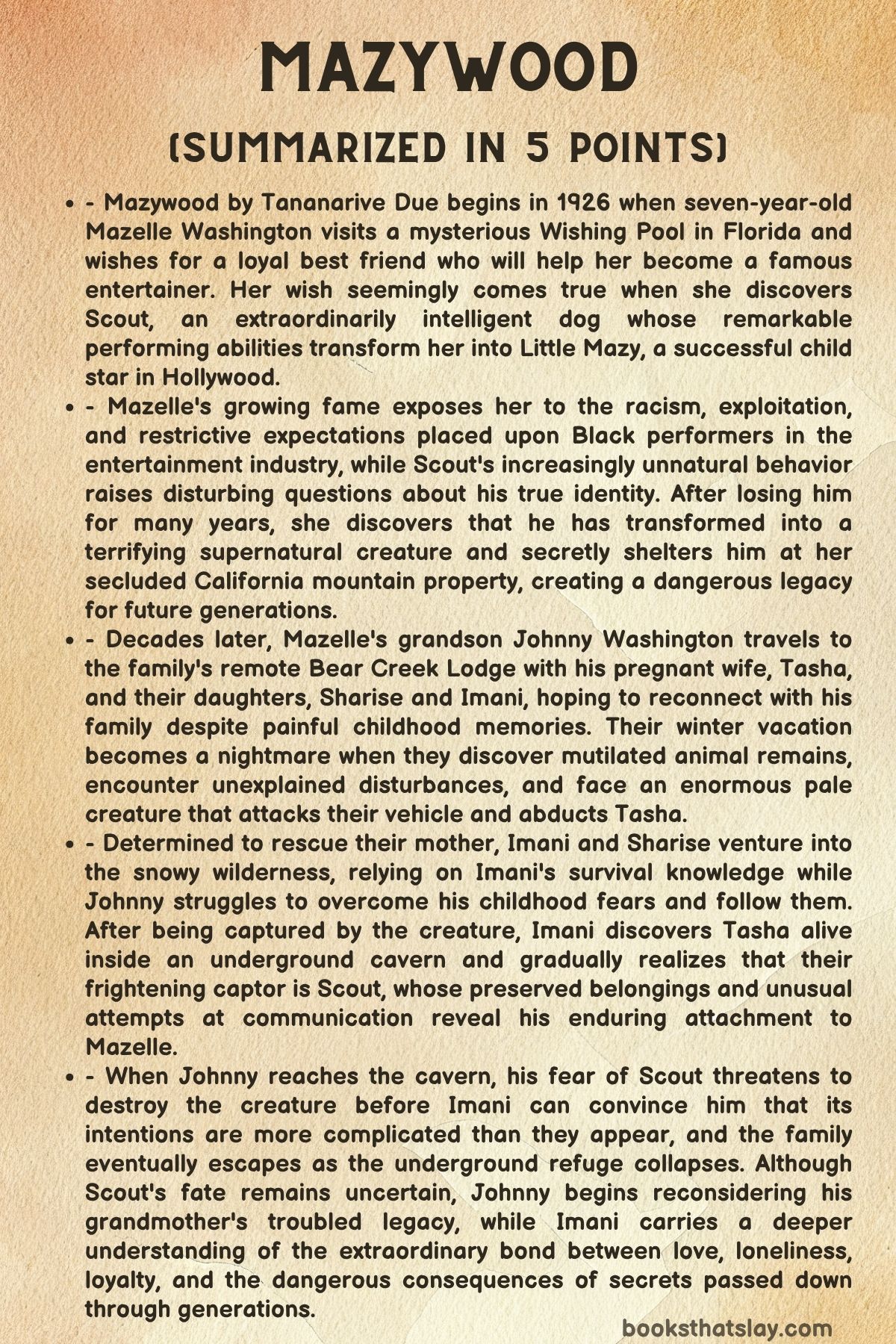
In the summer of 1926, seven-year-old Mazelle Washington lives in Gracetown, Florida, with her family, who once performed together in vaudeville. Although she possesses considerable talent and dreams of becoming a famous entertainer, she often feels overlooked by her older siblings and longs for someone who will appreciate her abilities.
One day, Mazelle ventures into the woods searching for a mysterious Wishing Pool. She throws a penny into the water and wishes for a best friend who will love and protect her while performing alongside her in the greatest entertainment act imaginable.
While returning home, she encounters a strange, mud-covered dog. The animal displays astonishing intelligence, following commands, dancing, and responding to her movements with extraordinary precision.
Mazelle names him Scout and quickly becomes convinced that her wish has been granted. When she presents their act to her family, everyone is amazed by Scout’s abilities, particularly his apparent refusal to perform for anyone except her.
Recognizing the possibilities, the Washington family travels to Norman Studios in Jacksonville. There, filmmaker Richard Norman witnesses Mazelle and Scout’s extraordinary partnership and suggests that their talents might attract attention in Hollywood.
However, Norman warns that the entertainment industry frequently exploits Black performers and that producers might attempt to separate Scout from Mazelle. Despite these concerns, her parents consider the opportunities because the family desperately needs financial security.
Within two years, Mazelle has become Little Mazy, a successful child star working in California with Scout the Wonder Dog. Their performances bring substantial wealth, allowing the family to purchase a comfortable home.
Yet her success comes at a cost. Mazelle works under demanding contracts, faces racial stereotypes, and gradually realizes that her family’s financial well-being depends upon her continued employment.
Scout also begins displaying disturbing characteristics. He rarely sleeps, prefers hunting living animals, possesses an unpleasant swamp-like smell, and sometimes seems capable of understanding Mazelle’s unspoken thoughts.
Although she recognizes that he is unlike an ordinary dog, her devotion prevents her from questioning their relationship too closely. Meanwhile, tensions develop between Scout and her strict Aunt Ruby, who distrusts the animal.
Mazelle’s mother’s declining health makes the household increasingly unstable. Eventually, a frightening confrontation involving Scout contributes to the destruction of the partnership that established Mazelle’s career.
Scout disappears, leaving Mazelle devastated. Without him, her professional opportunities and family finances deteriorate, and she spends years mourning the extraordinary companion she believes she has lost forever.
As Mazelle grows older, she continues pursuing acting while confronting the severe limitations imposed upon Black performers in Hollywood. Encounters with influential actresses such as Hattie McDaniel and Lena Horne expose the contradictions of an industry that celebrates Black talent while denying Black performers equal opportunities.
Mazelle dreams of obtaining serious dramatic roles instead of repeatedly portraying degrading characters. She becomes interested in a screenplay called Reaper, hoping it might finally allow her to demonstrate the full extent of her abilities.
Her professional frustrations are complicated by her relationships with powerful men. Jerry Lorenzo, the producer who helped establish her career, repeatedly exercises authority over her, while her romantic relationship with musician Richard raises questions about whether marriage will limit her independence.
By 1950, Mazelle has become a mother and is grieving her father’s death. During a return to Gracetown, she revisits the woods associated with her childhood wish and encounters an extraordinary white-furred creature.
The animal possesses unnatural appendages and frightening physical abilities, but Mazelle begins to recognize something familiar in its behavior. She realizes that the creature may be Scout, transformed into a being vastly different from the dog she once loved.
Rather than rejecting him, Mazelle becomes determined to reclaim their relationship. Her devotion gradually leads her to conceal his existence, even from those closest to her.
By 1958, she has established a secluded property near Mount Shasta in California, which she calls Mazywood. The location eventually becomes associated with Bear Creek Lodge, a mountain retreat that provides the privacy necessary to shelter Scout.
However, Scout’s enormous strength and unsettling appearance make him increasingly dangerous. Mazelle’s attempts to protect him involve secrecy, isolation, and a willingness to manipulate other people.
Her resentment toward those who exploited her also takes a darker direction. She invites Jerry Lorenzo to the remote property, where he discovers Scout’s transformed body and experiences overwhelming terror.
For Mazelle, the encounter represents a reversal of power. The man who once controlled important aspects of her life is now helpless before something she understands and he cannot comprehend.
As the decades pass, Mazelle becomes increasingly isolated from her family. By December 1980, she is seriously ill and approaching death, worried about what will happen to Scout after she is gone.
Her son Ricky fears the creature, while her grandson Johnny remembers frightening childhood experiences involving his grandmother and the mysterious animal. Mazelle recognizes that her secrecy and anger have permanently damaged important family relationships.
Many years later, Johnny Washington works in the entertainment industry as a filmmaker. He hopes to create work that challenges conventional portrayals of Black people, but an important meeting concerning his film La Petite Mort ends disastrously.
The executives want changes that threaten his artistic intentions. When someone mentions his grandmother’s historical connection to Lorenzo Studios, Johnny becomes uncomfortable because he associates Mazelle with degrading racial caricatures and painful childhood memories.
At home, his wife Tasha is dealing with an unexpected pregnancy. Although Johnny attempts to reassure her, she senses his reluctance about having another child, and their emotional distance begins troubling their marriage.
Tasha, a professor specializing in Black cinema and Afrofuturism, has a different perspective on Mazelle. She believes her career deserves serious historical examination and hopes to recover the achievements obscured by her controversial performances.
The family decides to visit Bear Creek Lodge, accompanied by their daughters, Sharise and thirteen-year-old Imani. The girls initially believe the unexpected trip might signal problems in their parents’ marriage.
Imani, who loves wilderness survival and snowboarding, welcomes the opportunity to explore the mountains. Sharise is more cautious and worries about the family’s emotional tensions.
Another visitor, paranormal investigator Rory De Santo, reaches the remote property before the Washingtons. Seriously ill with cancer, Rory hopes that investigating mysterious phenomena might reveal something about existence beyond conventional understanding.
However, he encounters an extraordinarily fast presence in the woods, establishing that the wilderness contains a genuine threat.
When the Washington family arrives, heavy snowfall makes the roads increasingly dangerous. Although the lodge initially appears impressive and welcoming, Johnny experiences disturbing memories of his childhood visits.
Tasha becomes fascinated by Mazelle’s belongings and feels an inexplicable familiarity with the property. Her interest deepens when she explores Mazelle’s private rooms and clothing.
Meanwhile, Imani discovers a horribly mutilated deer in the snow. She and Sharise conceal the discovery from their parents, although both girls become frightened by the possibility that an unusually dangerous predator is nearby.
Inside the lodge, Imani discovers an old freezer filled with packages of meat. Johnny later recognizes that the supplies may be connected to something his grandmother once concealed.
The family briefly enjoys renewed closeness when Johnny and Tasha announce the pregnancy to their daughters. Their happiness disappears when unexplained noises, strange movements, and an electrical failure suggest that something is approaching the property.
Johnny ventures outside to operate the emergency generator and observes disturbing movements beneath the snow. Soon afterward, he discovers a severed human hand bearing a class ring near the property.
Convinced that the family must escape, Johnny attempts to drive everyone away. Their departure ends in catastrophe when a massive pale creature attacks their vehicle and abducts Tasha.
Johnny is injured and loses consciousness. Believing their mother may still be alive, Imani and Sharise leave him a message, collect survival equipment, and follow the creature’s trail through the snow.
Their journey becomes increasingly dangerous as the weather worsens and the animal’s tracks lead toward rocky terrain. Imani uses her survival knowledge to help them endure the cold, although she fears that Tasha may be seriously injured.
Johnny eventually regains consciousness and experiences what appears to be an encounter with his deceased uncle Ricky. Whether supernatural or psychological, Ricky’s presence encourages him to stop surrendering to fear and concentrate on rescuing his family.
Johnny follows his daughters into the wilderness and eventually reunites with them. However, Imani insists that she can hear her mother’s voice, even though Tasha remains missing.
Johnny worries that fear and exhaustion are affecting his daughter’s judgment. Imani refuses to abandon the possibility that her mother is communicating with her.
Acting on this conviction, she races away on her snowboard and encounters the creature. It captures her with enormous furred appendages and carries her into an underground cavern.
There, Imani discovers Tasha alive but injured. Their reunion confirms that the mysterious voice she heard was not merely an invention of her imagination.
As Imani explores the cavern, she discovers photographs of young Mazelle and Scout, along with clothing and possessions associated with her great-grandmother. The objects reveal that the creature has preserved physical reminders of its former companion.
Imani begins reconsidering its intentions. Although its appearance is terrifying, it has not deliberately injured her and even brings supplies to help her and Tasha.
Through strange mental impressions and images, Imani recognizes the creature as Scout. She realizes that the bond between Mazelle and her childhood companion may have survived decades of separation and transformation.
Meanwhile, Johnny and Sharise follow the trail into the cavern. Johnny enters carrying a rifle, convinced that the creature responsible for his childhood terror intends to kill his family.
When he encounters Scout, his fear threatens to produce another tragedy. Imani desperately tries to prevent him from shooting, recognizing that the animal’s behavior is more complicated than Johnny believes.
As the confrontation unfolds, the cavern becomes unstable. The family struggles to escape through the underground passages while assisting the injured Tasha.
Johnny discovers Mazelle’s emerald dress among Scout’s preserved possessions. The garment reminds him that his grandmother possessed artistic ambitions and achievements beyond the humiliating performances he has always associated with her.
The cavern eventually collapses, leaving Scout’s fate uncertain and much of the evidence of his existence inaccessible.
The Washington family survives and receives assistance from U.S. Forest Service rangers. Although Imani possesses video footage, she realizes that outsiders may dismiss the recording or misunderstand the creature’s intentions.
Johnny begins reconsidering his grandmother’s legacy, recognizing that fear and resentment prevented him from appreciating the complexity of her life.
For Imani, the experience becomes a private inheritance. She understands that Scout was both dangerous and capable of extraordinary attachment, and that Mazelle’s childhood wish created consequences extending far beyond her own lifetime.
Characters
Mazelle Washington
Mazelle Washington is the central historical figure in Mazywood, and her life establishes the emotional and supernatural foundations of the novel. Beginning as a lonely child who dreams of becoming a famous entertainer, she develops into an ambitious actress whose achievements are shaped by both extraordinary opportunities and systematic discrimination.
Her childhood wish reveals a deep desire for affection and recognition. Although her family possesses a theatrical background, Mazelle feels overshadowed by her older siblings and yearns for someone who will appreciate her talents without reservation.
Scout’s arrival transforms her circumstances almost immediately. Their partnership gives her the companionship she desires while providing access to professional opportunities that would otherwise remain difficult to obtain.
However, Mazelle’s dependence on Scout gradually complicates her development. Because the creature represents love, success, and personal identity, losing him becomes more devastating than an ordinary childhood separation.
Her experiences in Hollywood expose her to the contradictions of celebrity. She enjoys considerable financial success while being expected to portray characters that reinforce degrading stereotypes about Black Americans.
These experiences produce a combination of determination and resentment. Mazelle refuses to accept that professional recognition should require complete surrender of her dignity, yet she cannot easily escape the industry that controls her opportunities.
Her encounters with Hattie McDaniel and Lena Horne encourage her to imagine a career based on artistic achievement rather than racial caricature. Nevertheless, repeated disappointments leave her increasingly distrustful of powerful individuals.
When Scout returns in a transformed form, Mazelle sees him as the fulfillment of an emotional promise that ordinary relationships have repeatedly failed to satisfy. Her attachment becomes possessive, encouraging secrecy and dangerous decisions.
The decision to shelter Scout at her isolated mountain property reveals her moral contradictions. She can demonstrate extraordinary devotion while exposing others to serious harm, particularly when her resentment influences how she uses Scout’s power.
Her treatment of Johnny also illustrates her difficulty separating love from anger. Although she regrets the damage done to their relationship, she struggles to communicate her feelings before death.
Mazelle ultimately emerges as a tragic and morally complicated woman whose desire for unconditional companionship gradually isolates her from the very human connections that might have sustained her.
Scout
Scout is the supernatural heart of Mazywood, embodying the uncertain boundary between faithful companionship and destructive attachment. Initially appearing as an unusually intelligent dog, he gradually reveals abilities that challenge every ordinary explanation of animal behavior.
His first connection with Mazelle appears almost magical. He responds to her unspoken wishes, performs alongside her with perfect coordination, and refuses to demonstrate the same abilities for other people.
These characteristics make him an ideal companion for a lonely child. His devotion offers Mazelle the emotional security she believes her family cannot provide.
However, his unsettling habits suggest that his nature contains something beyond familiar animal loyalty. His sleeplessness, unusual appetite, and apparent ability to perceive thoughts make him increasingly frightening.
As his body transforms over the decades, Scout becomes an enormous creature with extraordinary speed, strength, and unusual appendages. His physical appearance encourages observers to interpret him as a monster.
Yet his actions frequently contradict that judgment. He preserves Mazelle’s possessions, responds to emotional connections, and demonstrates concern for Tasha and Imani despite abducting them.
His behavior raises difficult questions about intention and responsibility. Although he appears capable of affection, his attachment can place human beings in mortal danger, and his inability to communicate normally makes peaceful coexistence extremely difficult.
Scout’s relationship with Imani reveals another dimension of his character. Her willingness to observe his behavior without relying entirely on fear allows her to recognize intelligence and emotional needs beneath his frightening appearance.
He represents both the permanence and the danger of a wish fulfilled too completely. His devotion outlasts ordinary expectations of time, but that endurance also prevents him from existing comfortably within the human world.
Johnny Washington
Johnny Washington represents the modern generation struggling with the unresolved legacy of Mazelle’s life. In Mazywood, his experiences demonstrate how childhood trauma can distort family memory and influence adult relationships.
As a filmmaker, Johnny wants to challenge racist representations of Black people. His professional ambitions reflect a desire to create meaningful work that differs from the degrading entertainment associated with his grandmother.
Nevertheless, his rejection of Mazelle’s career is inseparable from his personal fear of her. Childhood experiences at Bear Creek Lodge left him with painful memories that he never fully understood.
Instead of confronting those experiences, Johnny distances himself from the property and from the historical significance of his grandmother’s achievements.
His emotional avoidance also influences his marriage. When Tasha announces her pregnancy, Johnny struggles to communicate his concerns, creating tension between them despite their longstanding affection.
The return to Bear Creek Lodge forces him to confront the past. Familiar surroundings awaken his fears, while unexplained disturbances suggest that the creature he dreaded as a child may still exist.
After Tasha’s abduction, Johnny initially struggles with terror and helplessness. However, his responsibility toward his daughters gradually compels him to act.
His encounters with the apparent spirit of Uncle Ricky symbolize the guidance he needs to move beyond paralysis. Ricky’s encouragement helps him recognize that protecting his family requires action rather than continued avoidance.
Johnny’s relationship with Imani exposes another limitation in his thinking. He initially dismisses her belief that she can communicate with Tasha, partly because he has spent his life rejecting experiences that cannot be explained rationally.
His eventual confrontation with Scout reveals how completely fear has shaped his judgment. He sees only the creature’s dangerous appearance, while Imani recognizes evidence of attachment and intelligence.
By the end of the story, Johnny begins acknowledging that Mazelle’s life contained both suffering and achievement. This change does not erase his childhood trauma, but it allows him to approach his inheritance with greater understanding.
Tasha Washington
Tasha Washington is an intellectually curious and emotionally perceptive character whose experiences connect historical memory with the modern family’s supernatural ordeal. Her profession as a scholar of Black cinema gives her a perspective on Mazelle that differs significantly from Johnny’s.
Where Johnny sees shame and trauma, Tasha recognizes artistic accomplishment and historical significance. She understands that performers working within discriminatory institutions often faced difficult choices that cannot be judged without considering their circumstances.
Her interest in Mazelle’s career is therefore more than academic curiosity. She believes that recovering forgotten Black achievements can challenge incomplete accounts of American entertainment history.
Tasha’s unexpected pregnancy introduces another dimension of her character. She confronts uncertainty about her health, her marriage, and the possibility of raising another child later in life.
Her emotional struggle becomes especially difficult because Johnny avoids expressing his true feelings. Although she values their marriage, his reluctance makes her question whether they remain equally committed to their future.
At Bear Creek Lodge, Tasha experiences an unusual familiarity with Mazelle’s surroundings. Her visions and emotional impressions suggest that inherited history may operate through experiences that ordinary scholarship cannot explain.
After Scout abducts her, Tasha demonstrates considerable resilience. Despite serious injuries and overwhelming fear, she concentrates on survival and attempts to protect Imani.
Her first instinct is to interpret the creature as a predator, an understandable reaction to its frightening appearance and violent behavior. However, observing its attempts to provide supplies gradually complicates that understanding.
Tasha’s character ultimately brings together intellectual openness and maternal determination. Her willingness to reconsider evidence, even under extraordinary circumstances, contributes to the family’s survival.
Imani Washington
Imani Washington is one of the most important characters in Mazywood, particularly because her experiences parallel Mazelle’s childhood relationship with Scout. At thirteen, she possesses an adventurous spirit, a strong sense of independence, and an intense interest in wilderness survival.
Her enthusiasm for snowboarding and outdoor exploration initially makes the trip to Bear Creek Lodge seem exciting. Unlike her father, she approaches the mountain with curiosity rather than suspicion.
Imani also struggles with ADHD, impulsiveness, and contamination-related fears. These difficulties sometimes create tension with her family, particularly when adults underestimate her abilities or question her decisions.
However, the qualities that appear troublesome in ordinary circumstances become valuable during the crisis. Her detailed knowledge of emergency equipment, fire-making, and navigation repeatedly helps the family survive.
When Tasha disappears, Imani refuses to remain passive. Her decision to pursue Scout through the wilderness demonstrates courage, although it also exposes her and Sharise to considerable danger.
Her belief that she can hear her mother’s voice becomes particularly significant. Rather than dismissing the experience because it contradicts conventional expectations, she trusts the emotional connection guiding her.
This openness eventually allows her to communicate with Scout. Where others see only his frightening body, Imani begins noticing his responses, preserved possessions, and apparent concern for the people he has captured.
Her relationship with Scout resembles Mazelle’s original connection but develops under very different circumstances. Imani recognizes the creature’s emotional capacity without sharing Mazelle’s lifelong dependence upon him.
She ultimately represents the possibility of breaking inherited patterns. Instead of allowing fear or possessiveness to determine her understanding, she combines courage, observation, and compassion.
Her experience also changes her relationship with Johnny. His recognition of her practical abilities challenges his assumptions about what his daughter can accomplish.
By the end, Imani possesses knowledge that the outside world may never fully accept. Her willingness to preserve a compassionate understanding of Scout demonstrates an emotional maturity that contrasts with the fear dominating much of her family’s history.
Sharise Washington
Sharise Washington provides a grounded and protective presence within the younger generation of the family. As Imani’s older sister, she frequently approaches situations with greater caution and skepticism.
Before the trip, Sharise notices the emotional tension between their parents and suspects that their marriage may be in serious trouble. Her observations reveal sensitivity to family dynamics that Imani initially dismisses.
Although she sometimes criticizes Imani’s impulsiveness, Sharise genuinely cares about her younger sister. Their disagreements reflect the frustrations of sibling relationships rather than an absence of affection.
When the sisters discover the mutilated deer, Sharise recognizes the danger of exploring the wilderness alone. Her insistence on caution contrasts with Imani’s fascination with survival challenges.
After Tasha’s abduction, Sharise joins Imani’s rescue mission despite her fear. Her decision demonstrates loyalty and courage rather than the passive caution she initially appears to represent.
As the search progresses, exhaustion and uncertainty place considerable strain on their relationship. Yet the sisters continue supporting one another, especially when the mountain conditions become threatening.
Sharise also provides an important counterbalance to Imani’s extraordinary perceptions. She questions explanations that seem impossible, forcing Imani to consider how her unusual experiences might be understood by others.
Her character demonstrates that bravery does not always require extraordinary abilities. Sometimes courage means remaining beside someone you love while confronting circumstances that terrify you.
Uncle Ricky
Uncle Ricky is an important connection between Johnny’s childhood and the unresolved mysteries surrounding Mazelle. His character occupies a complicated position because he belongs to the generation that knew more about Scout than Johnny did.
During Mazelle’s later life, Ricky fears the transformed creature and worries about the consequences of keeping it hidden. His concerns demonstrate that the family understood at least some of the danger associated with Scout.
However, Ricky also represents the difficulty of protecting younger relatives from secrets that adults themselves cannot fully control.
After his death, Ricky appears to Johnny during the crisis at Bear Creek Lodge. These encounters may be supernatural visitations or experiences produced by injury, exhaustion, and emotional distress.
Regardless of their explanation, Ricky’s presence serves a practical and psychological purpose. He encourages Johnny to overcome his fear and concentrate on rescuing his family.
His guidance helps Johnny recognize that he possesses responsibilities greater than his personal suffering. Rather than offering complete explanations about the past, Ricky pushes him toward immediate action.
Ricky therefore represents ancestral guidance and the possibility that family relationships can remain meaningful beyond death. His appearances also reinforce the novel’s uncertain boundary between supernatural reality and psychological experience.
Jerry Lorenzo
Jerry Lorenzo serves as one of the principal representatives of institutional power and exploitation in Mazywood. As the producer who helps establish Little Mazy’s Hollywood career, he possesses substantial influence over her financial security and public image.
Initially, Lorenzo offers opportunities that might otherwise remain unavailable to a young Black performer. However, these opportunities come with demands shaped by racial prejudice and commercial calculation.
His productions depend upon stereotypes that reduce Black characters to simplified and degrading roles. Although Mazelle benefits financially, the arrangement restricts her ability to develop an independent artistic identity.
Lorenzo’s authority also extends beyond professional decisions. His interactions with Mazelle reveal how powerful men can exploit the vulnerability of women whose careers depend upon their approval.
As Mazelle becomes older and more successful, she begins challenging his assumptions. Her increasing confidence reflects her determination to claim authority over her own work and identity.
Their later reunion at Bear Creek Lodge reverses the relationship. Lorenzo, who once exercised control over Mazelle, encounters Scout’s transformed body and realizes that she now possesses a power he cannot understand.
His terror exposes the fragility of authority when familiar social hierarchies no longer apply. However, Mazelle’s satisfaction also demonstrates how resentment can transform a desire for justice into personal revenge.
Rory De Santo
Rory De Santo is a paranormal investigator whose brief involvement establishes the danger surrounding Bear Creek Lodge before the Washington family fully understands it.
His struggle with cancer provides a personal reason for investigating unusual phenomena. Facing mortality, Rory becomes increasingly interested in possibilities that challenge conventional explanations of existence.
His curiosity distinguishes him from characters who approach the supernatural primarily through fear or denial. He deliberately seeks extraordinary experiences because he hopes they might reveal something beyond the limitations of his illness.
Nevertheless, his investigation also demonstrates the hazards of pursuing mysteries without understanding their consequences.
When he encounters the extraordinarily fast presence in the woods, his confidence begins collapsing. The disturbing evidence surrounding his disappearance later confirms the danger that Scout represents.
Rory’s character also introduces the connection between supernatural curiosity and human vulnerability. His desire for knowledge is understandable, but the wilderness offers no guarantee that extraordinary discoveries will provide comfort or enlightenment.
Hattie McDaniel
Hattie McDaniel represents the difficult choices facing accomplished Black performers during Hollywood’s discriminatory early decades. Her appearance provides Mazelle with a perspective informed by professional success and the limitations accompanying it.
Although Hattie has achieved recognition within the industry, she continues experiencing disrespect and restricted opportunities. Her accomplishments do not protect her from racial prejudice.
Through their conversations, Mazelle learns that professional survival often requires careful negotiation with people who control access to roles and financial security.
Hattie’s character illustrates the difference between artistic recognition and institutional equality. A performer may achieve prominence while remaining confined to roles that reflect society’s prejudices.
Her determination encourages Mazelle to seek opportunities without abandoning her ambitions. At the same time, her experiences demonstrate that individual success cannot easily dismantle an entire discriminatory system.
Lena Horne
Lena Horne represents an alternative model of Black stardom that Mazelle finds inspiring. Her elegance, professional standing, and determination suggest possibilities beyond the restrictive roles commonly assigned to Black actresses.
When Mazelle encounters Lena at a Hollywood gathering, their discussion reveals shared dissatisfaction with the industry’s treatment of Black performers.
Their conversation about the screenplay Reaper becomes particularly important. Mazelle hopes the project might provide a substantial dramatic role, while Lena recognizes its artistic potential.
However, the discovery that MGM controls the rights demonstrates how institutional authority can prevent promising work from reaching audiences.
Lena’s character symbolizes artistic ambition and the importance of representation. Her presence encourages Mazelle to imagine a professional identity defined by talent rather than stereotypes.
Richard
Richard, the musician who courts Mazelle, introduces the conflict between romantic commitment and personal independence. His relationship with her initially offers affection and the possibility of a future beyond the demands of Hollywood.
He approaches Mazelle’s family respectfully and expresses serious intentions, creating the impression that he can provide stability and companionship.
However, his assumption that Mazelle’s acting career might become merely a hobby after marriage exposes a significant difference between their expectations.
For Mazelle, performance is an essential part of her identity. Richard’s comments suggest that he imagines marriage within traditional gender roles that could restrict her ambitions.
His character illustrates how control can emerge even within relationships founded upon genuine affection. The conflict challenges Mazelle to consider whether romantic love can coexist with professional autonomy.
Aunt Ruby
Aunt Ruby represents strict family authority and the growing suspicion surrounding Scout during Mazelle’s childhood.
She enforces discipline within the Washington household, often making Mazelle feel controlled and misunderstood. Her treatment contributes to the girl’s desire for companionship outside ordinary family relationships.
Ruby’s hostility toward Scout creates an important source of conflict. Unlike Mazelle, she does not interpret the animal’s extraordinary behavior primarily as evidence of affection.
Her distrust suggests that she recognizes the danger hidden beneath Scout’s entertaining abilities. Yet her harshness prevents her from establishing the kind of relationship with Mazelle that might encourage honest discussion.
As tensions escalate, Ruby becomes associated with the frightening consequences of Scout’s protective instincts.
Her character reveals how family discipline, fear, and emotional distance can intensify rather than resolve conflict. Her suspicions may be reasonable, but the manner in which she expresses them contributes to the household’s instability.
Mazelle’s Parents
Mazelle’s parents are important influences on her childhood ambitions and professional development. Their background in vaudeville gives them experience in entertainment, but it also makes them aware of the financial insecurity and racial discrimination facing Black performers.
Her father recognizes Mazelle’s talent while remaining cautious about the opportunities presented by Hollywood. His concerns about Scout and the motives of producers demonstrate a protective instinct shaped by experience.
He also defends Mazelle’s right to make decisions about her future, particularly when Richard assumes that marriage will determine the direction of her career.
Mazelle’s mother plays a more direct role in managing her daughter’s professional life. She understands the financial opportunities associated with Little Mazy’s success and works to preserve the family’s stability.
However, her declining health and the family’s financial dependence upon Mazelle create additional pressure for the young performer.
Together, the parents illustrate the complicated relationship between parental protection and economic necessity. Their decisions reflect genuine concern for Mazelle alongside the difficult compromises required to survive within a discriminatory society.
Themes
The Difference Between Love and Possession
Love becomes dangerous when the desire to preserve a relationship overrides respect for freedom, boundaries, and the welfare of others. This conflict shapes Mazywood through Mazelle’s lifelong relationship with Scout.
When Mazelle first wishes for a companion, her desire is understandable. She feels overlooked by her siblings and hopes to find someone who will recognize her abilities and remain devoted to her.
Scout initially appears to fulfill this need perfectly. His loyalty gives her confidence, companionship, and professional success, creating a relationship that seems more dependable than her interactions with ordinary people.
However, their connection gradually becomes inseparable from Mazelle’s sense of identity. Because Scout represents both affection and achievement, she begins treating the preservation of their relationship as more important than the concerns of those around her.
This emotional dependence becomes especially dangerous after Scout returns in his transformed body. Mazelle recognizes that he possesses extraordinary physical abilities, yet she continues concealing him despite the threat he presents to others.
Her decision to isolate herself at Bear Creek Lodge demonstrates how devotion can become possessive. Instead of seeking a way to reconcile Scout’s existence with human safety, she organizes her life around maintaining exclusive control over their extraordinary bond.
Scout’s own attachment complicates the theme further. His behavior suggests genuine affection, but his attempts to protect and preserve relationships can result in frightening acts, including the abduction of Tasha.
Imani offers a contrasting interpretation of love. She recognizes Scout’s emotional needs without assuming that affection makes his actions harmless.
The novel consequently distinguishes between caring for another being and claiming ownership over that being. Lasting affection requires responsibility, and loyalty becomes destructive when it is allowed to justify harm.
Racism, Representation, and the Cost of Success
The entertainment industry offers Mazelle extraordinary opportunities while repeatedly demanding that she compromise her dignity. Her experiences reveal how professional achievement can exist alongside discrimination and exploitation.
As a child performer, Mazelle becomes financially successful because audiences enjoy her partnership with Scout. Nevertheless, the producers controlling her career frequently rely upon stereotypes that diminish Black performers.
Her fame therefore produces a difficult contradiction. She receives recognition and material comfort while participating in an industry that reinforces prejudices against people who share her identity.
The conversations with Hattie McDaniel and Lena Horne expand this conflict beyond Mazelle’s individual experience. Both women understand that talent and public admiration do not automatically provide creative independence.
Even accomplished Black performers encounter restrictions on the roles they can obtain and the stories they can tell. Their professional lives demonstrate that representation alone does not guarantee equality.
Mazelle’s interest in Reaper illustrates her desire to move beyond these limitations. She wants challenging dramatic work that acknowledges her artistic abilities rather than reducing her to a familiar racial caricature.
The industry’s control over scripts, casting, and production decisions makes achieving this goal difficult. Wealth and celebrity cannot completely compensate for the absence of authority over her professional identity.
Johnny’s experiences reveal how similar conflicts persist across generations. Although he works in a different era, executives still attempt to reshape his creative work according to commercial expectations.
His frustration with his grandmother’s career also reflects the burden of historical representation. He initially judges her participation in degrading productions without fully understanding the limited choices available to her.
Through these parallel experiences, Mazywood demonstrates that genuine artistic progress requires more than visibility. It depends upon the ability of marginalized creators to determine how their lives, experiences, and communities are represented.
Generational Trauma, Family Secrets, and Inherited Memory
Unresolved experiences can influence later generations even when the people responsible for those experiences are no longer alive. The Washington family’s relationship with Bear Creek Lodge demonstrates how fear and secrecy can become an inheritance.
Mazelle’s decision to conceal Scout begins as an attempt to preserve their extraordinary companionship. Over time, however, her secrecy damages her relationships with her children and grandson.
Johnny grows up associating his grandmother with frightening experiences that he cannot adequately explain. His memories become so painful that he rejects not only the mysterious creature but also much of Mazelle’s personal history.
This rejection shapes his adult identity. His resistance to returning to the lodge reveals that physical distance has not freed him from the emotional consequences of childhood trauma.
Johnny also struggles to communicate difficult feelings within his marriage. His response to Tasha’s pregnancy suggests that emotional avoidance has become one of his habitual methods of dealing with uncertainty.
The family’s return to the mountain forces these buried conflicts into the open. Events Johnny previously dismissed as childhood nightmares begin acquiring new significance when the mysterious creature reappears.
Tasha’s scholarly interest provides a different approach to inherited history. Rather than avoiding Mazelle’s life, she believes that understanding it may reveal achievements and circumstances obscured by family resentment.
Imani takes this process further through her direct connection with Scout. Her willingness to examine his behavior challenges the assumptions that have shaped Johnny’s memories for decades.
The visions of Uncle Ricky also reinforce the importance of generational relationships. Whether interpreted as supernatural encounters or psychological experiences, they provide guidance rooted in Johnny’s family history.
By confronting the past together, the Washingtons begin changing their relationship with their inheritance. The novel suggests that family secrets cannot simply be erased through silence, but their influence can change when younger generations seek understanding rather than repeating inherited judgments.
Fear, Otherness, and the Limits of Human Understanding
Fear frequently emerges when people encounter beings or experiences that cannot be explained through familiar categories. Scout’s transformation turns this uncertainty into a central conflict between appearance and intention.
As a young dog, Scout possesses unusual abilities that people initially celebrate because they make him entertaining. His intelligence and responsiveness appear remarkable but remain acceptable while his body resembles an ordinary animal.
Once he becomes an enormous white-furred creature with unnatural appendages, those same extraordinary qualities become sources of terror. His unfamiliar appearance encourages observers to assume that he is dangerous without considering the complexity of his behavior.
Johnny’s response demonstrates the power of this assumption. His childhood experiences have convinced him that Scout is monstrous, and he approaches the creature expecting violence.
Although his fear is understandable, it limits his ability to interpret new evidence. When he encounters Scout in the cavern, he initially sees confirmation of his worst memories rather than an opportunity to reconsider them.
Imani approaches the creature differently. Despite experiencing genuine terror, she pays attention to his actions and recognizes that he sometimes behaves protectively rather than aggressively.
The preserved photographs and clothing also reveal the importance of memory. Scout has maintained a connection with Mazelle long after her death, suggesting that his motivations involve loneliness and attachment rather than simple predatory instinct.
His attempts to provide supplies further complicate the distinction between monster and companion. The same being capable of terrifying violence may also possess intelligence, affection, and a desire for connection.
The theme does not suggest that frightening creatures are necessarily harmless. Scout remains dangerous, and his actions have consequences regardless of his intentions.
Instead, the novel questions the assumption that unfamiliarity automatically proves evil. Understanding requires examining behavior, history, and motivation without allowing appearance alone to determine judgment.
The unresolved ending reinforces this uncertainty. Although the family survives, the collapse of the cavern leaves many questions unanswered, and Imani recognizes that even visual evidence cannot fully communicate what she experienced.
Her final understanding reflects the novel’s broader argument that reality may contain forms of life and affection beyond familiar human expectations. Accepting that uncertainty does not eliminate danger, but it creates the possibility of responding to the unknown with both caution and compassion.