Loon Point Summary, Characters and Themes
Loon Point by Carrie Classon is a warm contemporary novel about people whose carefully maintained lives are disrupted by loss, addiction, loneliness, and unexpected responsibility.
Set around a small resort beside a remote Minnesota lake, the story follows Norry Last, a middle-aged resort owner; Lizzie, a neglected young girl; and Wendell Eklund, an elderly man convinced that life has disappointed him. Their separate difficulties gradually bring them into the same community, where practical kindness begins changing what each person believes about family, independence, and belonging. The novel treats change not as a sudden miracle but as something created through ordinary choices, repeated acts of care, and the willingness to accept other people.
Summary
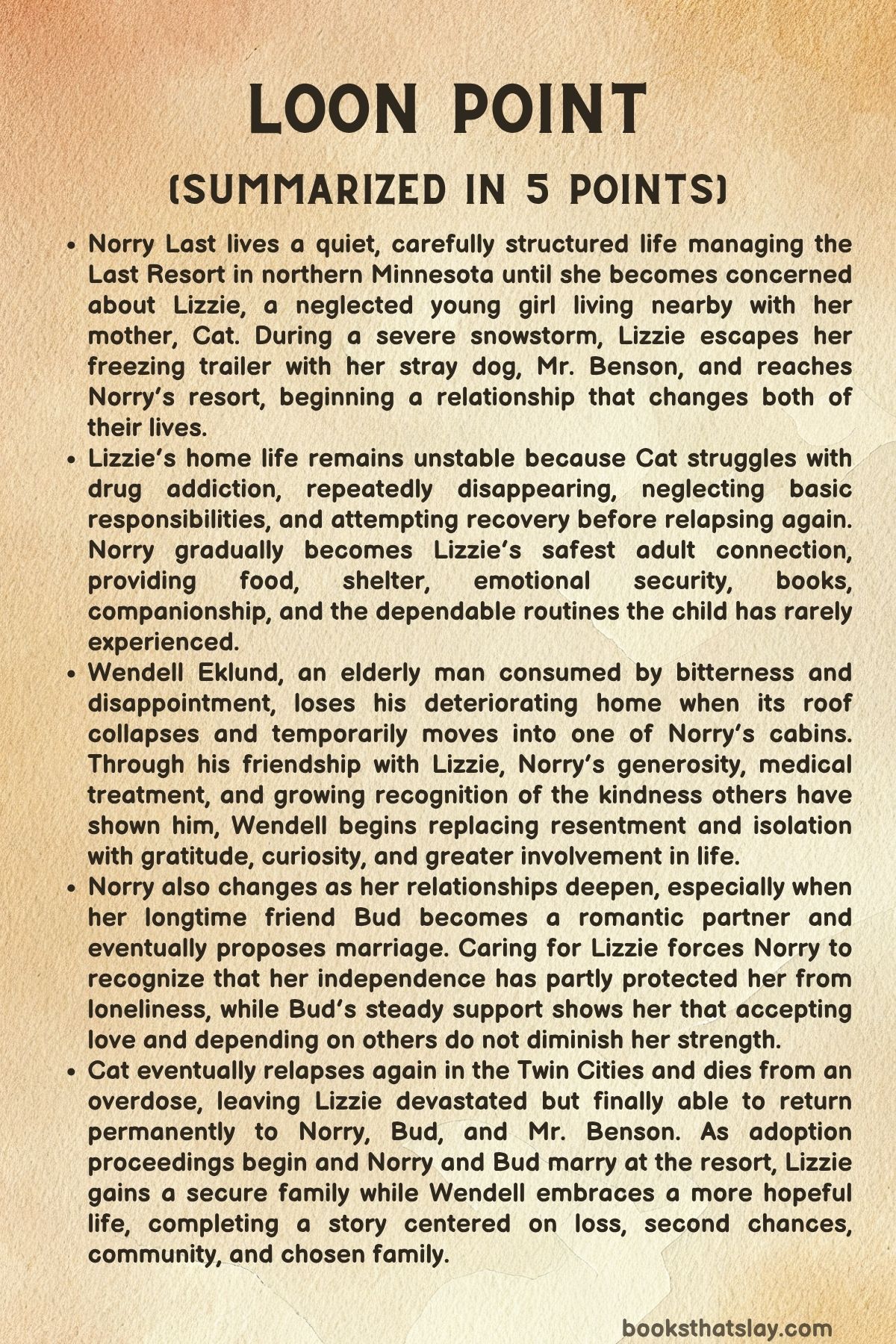
Norry Last lives alone at the Last Resort, a collection of old cabins beside a northern Minnesota lake. She inherited the place from her father, Ned, after returning from an unsuccessful marriage, and over the years the resort has become both her livelihood and the structure around which she organizes nearly every part of her existence.
One spring, Norry notices a poorly dressed young girl named Lizzie walking toward a run-down trailer. Although Norry tries to respect the idea that families live in different circumstances, she cannot dismiss her concern about the child or the conditions surrounding her.
Lizzie lives with her mother, Cat, whose dependence on pills has increasingly left Lizzie responsible for herself. Food is scarce, clothing is often dirty or poorly fitting, and Lizzie regularly checks whether her unconscious mother is still breathing, yet school remains a source of stability that she works hard to preserve.
A starving stray dog begins following Lizzie home, and she eventually allows him inside and feeds him despite having little food herself. She names him Mr. Benson after a former teacher she remembers fondly, and the dog quickly becomes a source of companionship and protection.
Elsewhere, seventy-two-year-old Wendell Eklund lives alone in his deteriorating childhood home. He once imagined becoming a successful screenwriter, but he never left the area or achieved the career he wanted, and he has spent years surrounded by manuscripts, possessions, memories, and complaints about opportunities he believes life denied him.
A powerful snowstorm forces all three lives toward a crisis. Cat disappears, the furnace in Lizzie’s trailer stops working, and the temperature inside becomes dangerously cold, leaving Lizzie with no reliable adult to help her.
Knowing about the Last Resort, Lizzie decides that remaining in the trailer is more dangerous than attempting the journey through the storm. Wearing oversized boots and layers of clothing, she leaves with Mr. Benson, but exhaustion and cold nearly overcome her before the dog’s barking keeps her moving.
At the same time, snow causes Wendell’s neglected roof to collapse. He survives only because part of his bedroom remains intact, and volunteer rescuers led by Bud Gustafson pull him from the wreckage before the structure deteriorates further.
Norry receives her own shock when Lizzie and Mr. Benson finally appear at her door. She brings them inside immediately, warms Lizzie, gives her clean clothes, food, cocoa, and a safe bed, and becomes increasingly disturbed as she learns more about Cat’s condition and Lizzie’s life.
Wendell has no insurance and very little money, leaving him effectively homeless. Bud suggests that Norry temporarily house him in one of the resort cabins rather than send him to a senior-care facility, and Norry agrees.
Cat eventually contacts Norry and arrives after the roads reopen. Norry angrily confronts her about leaving Lizzie without adequate food, heat, or supervision, but instead of immediately contacting protective services, she offers Cat a chance to stabilize her life.
Cat accepts help, finds work at a potato-processing plant, restores heat and food to the trailer, and takes Lizzie home. For a while, the improvement appears genuine, although Lizzie has already developed a strong attachment to Norry, the lake, the resort, and the feeling of being safe.
Wendell settles into the Chickadee Cabin but reacts to the destruction of his old home with despair rather than gratitude. He interprets the loss as confirmation of his belief that life is fundamentally disappointing, while Norry quietly continues making his temporary home comfortable.
During this period, Norry’s own tightly controlled life begins changing. Bud, her longtime friend, unexpectedly asks her to attend a classical piano concert with him, forcing Norry to consider how thoroughly she has hidden behind routine since her marriage ended.
She agrees to the date and discovers that being with Bud in a new context awakens emotions she has deliberately avoided. Their longstanding friendship begins taking on romantic possibilities just as Lizzie’s fragile stability begins collapsing again.
Cat starts missing work, disappears again, and eventually suffers a fentanyl overdose. Police become involved, and Norry and Bud collect Lizzie and Mr. Benson from the sheriff’s office while Cat is taken to the hospital.
Cat survives and agrees to enter a month-long rehabilitation program. Lizzie chooses to stay with Norry rather than travel to distant relatives, and Norry realizes that the temporary arrangement carries much more emotional weight than she expected.
Seeing the inside of the neglected trailer intensifies Norry’s anger about what Lizzie has endured. Yet instead of viewing the child as an obligation, she recognizes that Lizzie has trusted her, and she begins treating that trust as something valuable.
Lizzie also reaches Wendell during his darkest period. He has become seriously depressed and has been contemplating suicide, but Lizzie casually invites him to a beach bonfire, giving him a reason to shower, dress, leave his cabin, and join other people.
The small gathering becomes an important moment for everyone. Norry begins understanding that a life she once considered settled and self-contained is expanding through the very interruptions she would previously have resisted.
Soon afterward, Lizzie notices Wendell collapsing near the lake and quickly gets help. He has suffered a major heart attack, and hospital examinations also reveal severe cataracts that have greatly limited his vision.
Initially disappointed that he survived, Wendell decides he should at least remain alive long enough to write down what he considers his profound observations about life’s disappointments. He asks for a notebook and unknowingly chooses a bright, glittering unicorn design because his poor eyesight makes it appear dull and gray.
As Wendell begins writing, however, the past refuses to fit his preferred story of universal mistreatment. He remembers that his mother supported his writing and encouraged him, forcing him to recognize kindness that his bitterness had previously minimized.
Successful cataract surgery restores Wendell’s vision. He discovers that his cabin is filled with colors he could not previously see and that his supposedly serious notebook is pink and cheerful, creating a comic but meaningful contrast with the bleak worldview he has carried for decades.
Cat eventually completes rehabilitation and returns for Lizzie. Norry knows that the child belongs with her mother if Cat can remain stable, but watching Lizzie leave exposes how deeply Norry has come to love her.
Bud comforts Norry, and their relationship finally becomes openly romantic. Norry admits that Lizzie’s presence revealed something she had not wanted to recognize: beneath her independence and competence, she had also been profoundly lonely.
Cat’s recovery soon proves unstable. After another disappearance, Lizzie returns to the resort, but Cat later arrives intoxicated, crashes her car near the entrance, and angrily accuses Norry of taking her daughter.
Cat survives with significant injuries, and tests reveal opioids and other substances in her system. Norry begins seeing Cat with greater complexity, recognizing that addiction has not erased her love for Lizzie even though it has repeatedly prevented her from providing the safety Lizzie needs.
Despite the relapse, Cat refuses another rehabilitation stay. She still intends to move with Lizzie to the Twin Cities, and because the planned accommodation will not accept Mr. Benson, Lizzie is forced to leave her dog behind.
The move is deeply distressing. Lizzie finds the city unfamiliar and isolating, while Cat offers promises of a better future without having a dependable plan for creating one.
Meanwhile, Wendell accepts an apartment at Sleepy Pines. The man who once resisted every change begins examining his own behavior and recognizes that his habit of expecting disappointment has influenced how he interprets almost everything around him.
He remembers how consistently his neighbor Lucille helped both him and his late mother. Realizing that he ignored years of quiet friendship, Wendell deliberately visits her and thanks her for saving his life when his house collapsed.
He also begins going to a local diner, making small decisions more easily, speaking with people, and allowing ordinary experiences to challenge his belief that isolation proves his superior understanding of the world. His life remains imperfect, but he is finally participating in it instead of merely judging it.
Norry undergoes a similar shift. Bud tells her that he loves her and asks her to marry him, and although her previous marriage makes her cautious about promises, she ultimately accepts because she trusts the partnership they have gradually created.
In the Twin Cities, Cat relapses again. She disappears for extended periods, returns visibly high, refuses to work, and eventually leaves once more without coming back.
Laura, the woman housing them, can no longer remain responsible for Lizzie. She contacts Norry, who immediately drives south with Bud and Mr. Benson to collect the child.
Lizzie is ready with her belongings packed, accustomed to never knowing when she will be forced to leave another temporary home. When she reunites with Mr. Benson and returns to the lake, Bud tells her that they are home, while Norry quietly puts Lizzie’s bag high in a closet so that she will not have to remain prepared for another departure.
Their relief is followed almost immediately by tragedy. Laura calls with the news that Cat has died from an overdose.
Norry becomes Lizzie’s temporary guardian with family consent. At Cat’s memorial, Norry learns more about Cat’s painful history, including the loss of her mother during childhood and a destructive relationship, and she regrets having judged Cat without understanding how much unresolved suffering shaped her life.
Lizzie struggles with grief differently. She becomes angry when people tell her that she resembles Cat because she fears inheriting the qualities she associates with her mother’s lies and addiction.
Norry assures Lizzie that she is her own person while refusing to erase Cat’s love for her. With Norry and Bud beside her, Lizzie finally allows herself to mourn.
Summer gradually changes grief into a new family structure. Norry and Bud begin adoption proceedings, giving Lizzie the permanence she has lacked throughout the story.
They also plan a September wedding at the resort, wanting Lizzie to have a joyful memory during a year marked by fear and loss. Virgie helps organize the celebration, Lizzie becomes the flower girl, Mr. Benson carries the rings, and Wendell agrees to officiate.
Wendell has changed considerably as well. He repairs his teeth, walks regularly, studies Spanish, forms new relationships, and fills his unicorn notebook not with complaints but with observations about the interesting and generous people he has encountered.
At the wedding, Wendell acknowledges that disappointment is unavoidable but argues that it can create opportunities to choose differently afterward. Norry and Bud marry surrounded by the community that has formed around them, while Lizzie recognizes the celebration as a memory she can preserve even when painful experiences remain part of her life.
By the end of Loon Point, none of the central characters has escaped loss. Instead, they have learned that loss does not have to become the only explanation for what comes afterward.
Norry remains herself and keeps the identity connected with the Last Resort, but her once carefully limited existence now contains a husband, a daughter, a dog, friendships, and a community she never planned to build. The resort that once symbolized her isolation has become the place where several people discover that home can be created through commitment rather than simply inherited or found.
Characters
Norry Last
Norry Last is the emotional center of Loon Point, a capable middle-aged woman who has built her identity around independence, routine, and the Last Resort. Her competence is genuine, but it also protects her from confronting how much of her adult life has been structured around avoiding emotional uncertainty.
Her failed marriage taught her to associate intimacy with possible disappointment, while her father’s attachment to the resort supplied a model for living within a narrow but dependable world. She does not initially think of herself as lonely because she has work, familiar surroundings, friendships, and practical responsibilities.
Lizzie changes Norry because caring for the child gives her no opportunity to remain emotionally neutral. Norry can provide food, clothing, heat, shelter, books, and transportation, but these practical actions gradually become expressions of maternal attachment.
Her relationship with Cat also reveals an important development in her judgment. Norry initially sees Cat chiefly through the harm her addiction causes Lizzie, but after learning more about Cat’s past, she recognizes that understanding someone does not require excusing the damage they have caused.
Bud challenges another part of Norry’s isolation. She has known him for years, yet accepting romance requires her to stop treating independence as proof that she needs nobody.
By the ending, Norry has not abandoned the strength that allowed her to manage the resort alone. Instead, she has redefined strength to include dependence, love, grief, commitment, and the possibility of building a family after believing that part of her life was finished.
Lizzie
Lizzie is the child whose presence changes nearly every major relationship in Loon Point. Her intelligence and resourcefulness are impressive, but the novel makes clear that many of these qualities have developed because she has been forced to manage circumstances that should never have been a child’s responsibility.
She monitors Cat’s condition, worries about food, values perfect school attendance, handles periods of abandonment, and learns to recognize the signs of her mother’s drug use. Her ability to function should therefore not be mistaken for emotional security.
Mr. Benson becomes important because their relationship gives Lizzie companionship without uncertainty. The dog follows her, protects her during the storm, waits for her school bus, and provides the consistency she desperately wants from the adults around her.
Norry’s home offers a different form of security. Clean clothes, pancakes, books, predictable meals, lake outings, and ordinary routines matter precisely because Lizzie has lived without dependable ordinary experiences.
Her response to Cat is emotionally complex. Lizzie loves her mother intensely and wants to believe every promise of recovery, but repeated relapses teach her to anticipate abandonment even when she desperately hopes for another outcome.
Cat’s death also leaves Lizzie worried that resemblance might equal destiny. When she rejects comparisons between herself and her mother, she is trying to establish a separate identity rather than simply expressing anger at Cat.
The adoption process finally gives Lizzie something she has rarely possessed: the expectation that home will remain home. Her development is not about forgetting Cat but about learning that love for her mother and belonging with Norry and Bud can exist together.
Wendell Eklund
Wendell begins Loon Point as a man who has turned disappointment into an identity. He considers himself someone who understands reality more clearly than optimistic people, but this supposed realism often serves as a defense against admitting how frequently fear, passivity, and resentment have shaped his choices.
His destroyed home initially appears to confirm his bleak philosophy. Because he has tied his sense of self to old possessions, unfinished manuscripts, and abandoned ambitions, losing the house feels like evidence that his entire life has amounted to failure.
His suicidal thinking reveals the depth of his despair, yet the novel changes him through interruptions rather than dramatic persuasion. Lizzie invites him to a bonfire, Norry gives him shelter, Bud repeatedly helps him, doctors restore his eyesight, and Lucille’s past generosity becomes impossible to ignore.
The unicorn notebook becomes a particularly effective symbol of Wendell’s character. Before surgery, he interprets its appearance according to what he expects to see; afterward, the bright design exposes how unreliable his gloomy perception has been.
His writing changes for the same reason. He intends to document injustice but repeatedly remembers people who encouraged, rescued, fed, housed, or cared for him.
Wendell’s eventual transformation is therefore not a conversion into constant optimism. He accepts that disappointment exists, but he stops using it as an excuse for refusing participation, gratitude, relationships, and change.
Cat
Cat is one of the most painful and complicated figures in Loon Point because she simultaneously loves Lizzie and repeatedly places her in danger. Her addiction destroys reliability, making promises that may be sincere when she gives them impossible for her to sustain consistently.
The conditions in the trailer show the practical consequences of her illness. Lizzie experiences hunger, inadequate clothing, dangerous cold, abandonment, and the responsibility of monitoring whether her mother is alive.
Cat nevertheless cannot be understood only through neglect. She seeks work, enters rehabilitation, expresses affection, imagines a better future, and repeatedly attempts to recover enough control to care for her daughter.
Her repeated relapses demonstrate the difference between wanting change and being able to sustain it. Each return to drugs damages Lizzie’s trust while also increasing Cat’s shame and instability.
Norry’s understanding of Cat develops only after the consequences become irreversible. Learning about Cat’s early bereavement and destructive relationship does not erase her failures, but it gives those failures a history.
Cat’s death prevents reconciliation or lasting recovery, making her role especially tragic. She remains both a mother who caused profound harm and a woman who loved her daughter, and the story refuses to simplify either truth.
Bud Gustafson
Bud initially appears to be the dependable local man who solves practical problems, but his importance grows because his reliability is emotional as well as physical. He helps rescue Wendell, arranges temporary housing, assists Cat in obtaining rehabilitation, supports Lizzie, and repeatedly responds to crises without turning his assistance into a performance.
His relationship with Norry is grounded in long familiarity. Because he already knows her habits, strengths, fears, and history, romance develops from an established trust rather than from idealization.
Bud is patient with Norry without becoming passive. He clearly states that he loves her and eventually proposes marriage, but he does not demand that she abandon her independence to prove commitment.
His treatment of Cat also reveals his character. Even when she arrives intoxicated and accuses him and Norry of wrongdoing, Bud focuses on her injuries and gets her to medical care.
With Lizzie, he behaves increasingly like a parent before any legal relationship exists. Fishing trips, explanations about addiction, transportation, protection, and the declaration that they are finally home give Lizzie the steady adult presence she has repeatedly lacked.
Bud represents a form of goodness based less on dramatic statements than on consistency. He becomes a suitable partner for Norry and parent for Lizzie because he continues showing up when circumstances become difficult.
Mr. Benson
Mr. Benson begins as a starving stray dog but becomes one of the story’s clearest representations of loyalty. His bond with Lizzie is immediate because both are vulnerable, underfed, and uncertain where they truly belong.
During the snowstorm, his barking prevents Lizzie from giving up in the snow, making him directly responsible for helping her survive. Afterward, his presence continues to provide physical and emotional reassurance.
His routine of accompanying Lizzie and anticipating her return from school gives her an experience of dependability that contrasts sharply with Cat’s disappearances. He cannot promise anything verbally, but his behavior remains consistent.
The forced separation when Lizzie moves to the Twin Cities therefore carries enormous emotional weight. Their reunion when Norry and Bud collect Lizzie reinforces the idea that returning home means recovering relationships as much as returning to a physical place.
Virgie
Virgie is Norry’s close friend and an important counterweight to Norry’s tendency toward isolation. Even when away for part of the year, she remains someone with whom Norry can discuss unexpected guests, personal changes, and her developing relationship with Bud.
She also provides a useful perspective on change. Virgie suggests that transformations that appear sudden often result from internal developments that have been occurring quietly for a long time.
Her initial concern about Norry marrying again shows that her friendship includes skepticism rather than automatic approval. Once satisfied that Norry understands her decision, she embraces the relationship and participates enthusiastically in the wedding.
As maid of honor and organizer, Virgie becomes part of the community surrounding Norry’s new family. She represents friendship that allows people to change without requiring them to remain the versions of themselves they once were.
Lucille
Lucille initially appears largely through Wendell’s irritated perspective. She talks extensively, brings food and donated clothing, watches what happens in the neighborhood, and repeatedly involves herself in circumstances Wendell would prefer to manage alone.
The later revelation about her treatment of Wendell’s mother changes the meaning of her behavior. Lucille provided food, laundry, companionship, household assistance, and practical support during the older woman’s final years.
She also calls emergency services when Wendell’s roof collapses, effectively saving his life. Wendell’s failure to appreciate her becomes evidence of how thoroughly his resentment has filtered his interpretation of other people.
His eventual visit to thank Lucille is therefore more important than a simple expression of gratitude. It marks his willingness to correct an old judgment and actively acknowledge another person’s goodness.
Ned Last
Ned, Norry’s late father, remains influential even though he is absent from the present action. After the death of Norry’s mother, he bought the resort and eventually became so attached to it that he resisted leaving even for vacations and medical needs.
Norry recognizes that she has begun repeating his pattern. This realization is significant because Ned’s attachment represents both genuine love of place and the danger of allowing one familiar environment to become the boundary of an entire life.
His remembered observation that people live in many different ways initially influences Norry’s response to Lizzie’s circumstances. Yet Norry eventually learns that tolerance cannot mean ignoring genuine danger.
Ned’s legacy therefore shapes both the life Norry inherits and the limits she must eventually move beyond. She keeps the resort and her identity connected with it while creating a much less isolated existence than the one she initially inherited.
Jodie Johansson
Jodie functions primarily as Lizzie’s school bully. She targets Lizzie’s ill-fitting and worn clothing, turning visible signs of poverty and neglect into reasons for humiliation.
Her behavior helps establish why school, despite being Lizzie’s refuge, is not entirely safe. Lizzie’s determination to maintain perfect attendance despite this treatment shows both her resilience and her need for dependable structure.
Later, Lizzie confronts Jodie when she begins targeting another student. That moment demonstrates Lizzie’s increasing confidence because she moves from enduring cruelty to actively opposing it when directed at someone else.
Deputy Calvin Webb
Deputy Calvin Webb plays a limited but important practical role during Cat’s overdose. His message to Norry interrupts her evening with Bud and brings the adults quickly into the crisis surrounding Lizzie.
The sheriff’s office temporarily becomes a holding place for Lizzie after Cat is hospitalized. Calvin’s involvement represents the formal systems that appear when Cat’s addiction reaches a level at which informal family arrangements are no longer enough.
His presence is not developed extensively on a personal level, but he helps move Lizzie from immediate uncertainty back toward people she trusts. In a story heavily focused on informal community support, he represents necessary institutional intervention during an emergency.
Bonnie
Bonnie temporarily houses Cat and Lizzie after rehabilitation. Her role shows how fragile Cat’s recovery remains even when another person provides a relatively stable place for them to stay.
When Cat disappears again, Bonnie cannot indefinitely reorganize her own life around Cat’s instability. Lizzie’s suggestion that they call Norry reveals how thoroughly Norry has become the person she associates with rescue and safety.
Bonnie is not portrayed as cruel for having limits. Instead, her situation shows the enormous pressure addiction can place on friends and temporary caregivers who may care about a family without being capable of assuming permanent responsibility.
Laura
Laura provides temporary accommodation in the Twin Cities and eventually becomes one of the adults forced to confront the reality of Cat’s relapse. Her home is supposed to support Cat’s attempt at a new beginning, but the arrangement cannot compensate for Cat’s continuing addiction.
Laura becomes especially important when Cat repeatedly disappears. She recognizes that she cannot indefinitely care for Lizzie while also managing the uncertainty surrounding Cat.
By contacting Norry, Laura makes the decision that returns Lizzie to the safest available environment. She therefore serves as an important link between the collapse of Cat’s final attempt at independence and Lizzie’s permanent return north.
Cindy
Cindy supervises Lizzie during part of her time in the Twin Cities, but the arrangement provides little emotional connection. Lizzie spends much of her time reading while Cindy watches television, emphasizing the difference between being technically supervised and genuinely cared for.
Her presence helps show why the city never becomes home for Lizzie. The environment may contain adults, housing, and routines, but it lacks the personal attention and relationships she experienced at the resort.
Cindy is not presented as actively harmful. Instead, she illustrates an impersonal form of care that meets only the most basic definition of supervision.
Shelby
Shelby, the server Wendell meets at a local diner, participates in one of his smaller but meaningful experiments with change. Rather than agonizing over every decision, Wendell allows her to recommend his breakfast.
The success of this ordinary choice matters because Wendell has spent much of his life treating decisions as opportunities for regret. Trusting Shelby’s recommendation demonstrates a new willingness to participate in life without demanding certainty first.
She also tells him about Norry and Bud’s engagement, and Wendell’s sincere happiness for them reveals another development. He is becoming capable of responding to other people’s good fortune without immediately filtering it through his own disappointments.
Esther
Esther, Cat’s great-aunt, has little direct presence but becomes legally significant after Cat’s death. Her consent helps Norry become Lizzie’s temporary guardian while longer-term arrangements are established.
Her role reflects the broader family network surrounding Lizzie, even though those relatives have not been central to her daily life. The fact that Norry becomes the practical caregiver despite the existence of biological relatives reinforces the distinction the book draws between family by connection and family by sustained responsibility.
Ms. Hart
Ms. Hart becomes Lizzie’s teacher after the major upheavals surrounding Cat’s death. Although the story gives limited information about her personality, her presence signals Lizzie’s return to an ordinary school routine.
For a child who values attendance and depends on school as a source of predictability, beginning the school year with a regular teacher is meaningful. Ms. Hart belongs to the stable everyday world that begins replacing the emergency-driven existence Lizzie previously knew.
Lulu
Lulu appears primarily as a sign of Wendell’s continuing development. His decision to study Spanish because he hopes to ask her to dinner shows how dramatically his orientation toward the future has changed.
Earlier Wendell considers death because he sees no meaningful possibilities ahead of him. Interest in Lulu requires him to imagine companionship, make an effort, learn something new, and accept the possibility that another person might respond unpredictably.
The significance of Lulu therefore lies less in a developed relationship and more in what Wendell’s interest reveals. He has begun acting like someone who expects life might still contain experiences worth pursuing.
Themes
Home, Belonging, and Chosen Family
Home repeatedly changes meaning according to the relationships surrounding a place. Lizzie technically has a home with Cat, yet the trailer offers neither reliable safety nor the confidence that food, heat, or parental care will be available when needed.
The Last Resort begins as Norry’s inherited property and workplace, but Lizzie’s arrival transforms its emotional purpose. Clean clothing, meals, books, conversations, the dog, lake outings, and predictable routines gradually turn the cabins into evidence that security can be created through repeated care.
For Wendell, losing his house initially appears equivalent to losing his identity. His experience later shows that keeping possessions and remaining in one building are not the same as belonging anywhere.
By the end of Loon Point, family has also become something created through behavior rather than biology alone. Norry and Bud do not replace Cat by pretending that she never mattered; instead, they give Lizzie the consistency her mother could not sustain.
The decision to place Lizzie’s packed bag high in the closet expresses this idea especially clearly. For much of her childhood, she has needed to remain ready for another disruption, but returning north means she can finally stop treating departure as inevitable.
The wedding and adoption process complete the theme without suggesting that grief disappears. Home becomes the place where painful history can be carried without determining every future relationship.
Addiction, Love, and the Limits of Good Intentions
Cat’s relationship with Lizzie establishes a difficult distinction between loving someone and being capable of caring for them safely. Cat’s affection for her daughter is repeatedly shown as genuine, but addiction makes affection insufficient as a foundation for dependable parenting.
Her promises to recover are therefore not presented simply as calculated lies. At several points she appears to believe that employment, rehabilitation, relocation, or determination will allow her to regain control, yet her behavior repeatedly collapses under the pressure of dependency.
Lizzie experiences the contradiction most painfully. She loves Cat, wants each recovery attempt to succeed, and continually invents hopeful explanations when her mother disappears, but she also develops the vigilance of someone who knows that promises may be followed by abandonment.
Norry initially responds mostly to the consequences. She sees hunger, filth, dangerous cold, and emotional instability, making anger a reasonable reaction.
Only later does Norry learn about Cat’s childhood loss and destructive adult relationship. This information does not cancel responsibility, but it expands the moral picture by showing that addiction can grow within a history of unresolved suffering.
Cat’s death ultimately prevents the comforting possibility that love alone will rescue her. The story instead asks readers to hold two truths together: Cat profoundly harms Lizzie, and Cat also genuinely loves her daughter.
Change, Perspective, and Personal Responsibility
Wendell’s damaged eyesight provides the clearest physical expression of the difference between circumstances and interpretation. Before cataract surgery, he chooses what he believes is a gray, miserable-looking notebook, only to discover afterward that it is covered with a bright pink unicorn.
The joke exposes something serious about his worldview. Wendell has spent years interpreting experiences through expectations of disappointment, reinforcing his belief that he is uniquely cursed even when other explanations are available.
His planned book about injustice begins collapsing as soon as memory provides inconvenient evidence. His mother encouraged him, Lucille supported his family, Norry housed him, Bud rescued him, Lizzie invited him into companionship, and medical professionals saved and restored parts of his life.
Norry undergoes a less extreme version of the same process. She has told herself that independence equals contentment until caring for Lizzie and becoming romantically involved with Bud reveal that self-protection has also limited her.
Loon Point does not suggest that changing perspective magically eliminates hardship. Houses collapse, addiction causes devastating damage, relationships fail, people die, and uncertainty remains.
What changes is the characters’ willingness to examine their own responses. Wendell starts taking action instead of blaming fate, while Norry allows attachment despite knowing it creates vulnerability.
Personal growth therefore emerges from recognizing the difference between what cannot be controlled and what can still be chosen afterward.
Community, Kindness, and the Courage to Need Others
Small acts of assistance repeatedly accomplish more than dramatic declarations. Bud pulls Wendell from danger, Norry gives Lizzie warmth and food, Lucille brings meals, Lizzie invites Wendell to a bonfire, Mr. Benson stays beside Lizzie, and numerous people respond when someone else is unable to cope alone.
These actions gradually challenge the assumption that self-sufficiency is the ideal form of adulthood. Norry initially takes pride in managing everything herself, while Wendell interprets dependence as humiliation and Lizzie has learned to survive by becoming far too self-reliant for her age.
Their circumstances demonstrate the limits of that belief. Lizzie survives the storm because she seeks Norry, Wendell survives because neighbors and rescuers intervene, and Norry becomes happier only when she allows Bud and Lizzie to become part of her private life.
Receiving help also requires its own form of courage. Wendell’s development becomes visible when he stops treating assistance as evidence of personal failure and begins recognizing it as evidence that he belongs within a human community.
The same pattern appears in Norry’s acceptance of marriage and motherhood. Loving people exposes her to fear, grief, and possible loss, but isolation has its own cost.
The final gathering at the wedding shows a community created from people whose lives crossed through emergencies, ordinary favors, friendships, and repeated choices to remain present. Their connections do not guarantee protection from future pain, but they give each person others with whom that pain no longer has to be faced alone.