Mattering by Jennifer Breheny Wallace Summary and Analysis
Mattering by Jennifer Breheny Wallace is a nonfiction exploration of a basic human need: the need to feel that we are valued by others and that our presence has a meaningful effect on the world around us.
Wallace examines this idea through firefighters, caregivers, teachers, students, workers, friends, families, community leaders, and ordinary people facing major life changes. Rather than treating purpose as something found only through extraordinary achievement, she shows how recognition, usefulness, emotional attention, mutual investment, and belonging can make everyday life more sustaining. The book ultimately presents mattering as both a personal experience and a social condition that communities can deliberately create.
Summary
Mattering begins by examining recognition, the experience of knowing that other people notice what we do and understand the effect we have on them. Wallace illustrates this through Greg Bulanow and the North Charleston Fire Department, where firefighters performed obviously valuable work yet frequently struggled with exhaustion and discouragement because they rarely discovered what happened to the people they rescued.
Greg recognized that meaningful work did not automatically make employees feel meaningful. Firefighters also needed tangible evidence that their choices, skill, courage, and daily effort had produced results, so he created systems that allowed crews to learn about patient outcomes, review firefighting tactics, and receive more direct recognition.
He also encouraged an informal culture of appreciation through handwritten notes, public acknowledgment, the “I’m telling” practice, and Chief’s Coins. These gestures were often simple, but they allowed people to see themselves through the eyes of others and understand that their contributions had been noticed.
Wallace expands this lesson beyond emergency services by encouraging people to pay closer attention to their own influence. Appreciative messages can be preserved in an “impact file,” while people can strengthen others by telling them specifically what qualities or actions have made a difference.
Recognition also requires connecting apparently ordinary work to a larger purpose. Greg’s decision to leave Chief’s Coins at the memorials of nine firefighters killed in the Charleston Sofa Super Store fire demonstrates that a person’s effect can continue long after the original action or even after death.
The book next turns to reliance, the feeling that someone genuinely needs us and that our actions fulfill a real responsibility. Julie Plaut Mahoney experiences the loss of this feeling after caring for her mother Linda through terminal brain cancer and then confronting the emptiness that follows Linda’s death.
Caring for Linda had been difficult, but it had also organized Julie’s days around a clear purpose. When those responsibilities disappeared, Julie lost not only her mother but also the structure that had made her feel essential to another person.
She eventually transformed that loss by founding Welcome Home with Mindy Frankel Peckler. The nonprofit provides donated household goods to people rebuilding their lives, allowing Julie to convert her capacity for care into an ongoing form of service.
Wallace describes meaningful responsibility as a “good weight,” suggesting that being needed can strengthen people when the responsibility is supported and purposeful. Michael finds this through adopting his cat Blue, while an unemployed graduate named Ethan becomes more energized after regularly driving his neighbor Joan to chemotherapy.
Other examples show that usefulness does not always require a dramatic commitment. A person can use an existing skill to address an immediate need, whether that means providing free dry cleaning to job seekers, repairing broken objects, offering transportation, or simply becoming someone another person can consistently depend upon.
Dependability is especially important because mattering grows through repetition. Wallace cautions people to ask what kind of help is wanted rather than assuming they know what another person needs, turning reliance into mutual trust rather than unwanted intervention.
The book then considers the danger of being needed too much. Danna Thomas enters teaching with tremendous commitment, but the demands placed on her become unsustainable as she finds herself caring for thirty-nine kindergartners with insufficient time, resources, and opportunities to meet even her own basic needs.
Danna works while sick, stays late, and interprets exhaustion as evidence that she is doing her job properly. Her eventual breakdown in front of fellow teacher Heather exposes the cost of living in a system where a person matters enormously because of what she provides while simultaneously receiving little evidence that her own needs matter.
Regular lunches with Heather and Amanda help Danna understand that care cannot operate in only one direction. A healthy sense of mattering requires people to know they have value apart from their productivity, service, availability, or willingness to sacrifice themselves.
Wallace applies this problem to parents, teachers, medical professionals, military spouses, and other caregivers whose responsibilities can become overwhelming when high demands are combined with inadequate support. Examples involving Simone Gorrindo and other communities show that dependable friendship and protected personal routines can restore balance.
Danna eventually creates Happy Teacher Revolution, a community designed to help educators establish boundaries, discuss vulnerability, acknowledge struggles, and support one another as human beings. Her experience demonstrates that commitment becomes more sustainable when caregivers themselves receive care.
Another form of mattering comes from having people who are genuinely invested in our growth. Rehan Staton’s life demonstrates the power of these relationships as he moves through family hardship, educational difficulty, financial insecurity, a failed boxing ambition, sanitation work, college, and eventually Harvard Law School.
Rehan encounters many situations that could persuade him to accept a diminished view of himself. Yet individuals repeatedly enter his life who recognize possibilities that he cannot fully see on his own.
A tutor named Jamil helps him recover academically for a period, while sanitation coworkers Bones and Craig recognize his intelligence and insist that he should pursue college. Their belief becomes practical rather than merely encouraging, leading Rehan toward Brent, counselors, professors, and others who provide guidance and opportunities.
Wallace calls such people “cornermen.” They are people who believe in someone’s abilities, offer honest feedback, contribute time or resources, and remain invested in that person’s future.
Rehan’s experience challenges the idea of the entirely self-made individual. Achievement is presented instead as something made possible by networks of people who notice potential, create access, demand effort, and refuse to let another person face every obstacle alone.
Rehan eventually applies the same principle at Harvard through the Reciprocity Effect, an effort that recognizes custodians and staff members whose contributions can easily become invisible. Being supported therefore creates a responsibility to become a source of support for others.
Emotional attunement becomes another essential dimension of mattering. Wallace introduces it through Peggy Winckowski and her Wednesday Breakfast Club, where teenagers receive food, conversation, consistency, and the experience of being closely noticed by a trusted adult.
Peggy remembers details and recognizes changes in mood, allowing her to respond when a young person is worried, grieving, or simply in need of additional attention. Wallace defines this kind of attunement as an effort to understand another person’s internal emotional state rather than merely observing what is happening on the surface.
The discussion extends to relationships affected by screens, distraction, canceled plans, and declining face-to-face contact. Small habits such as listening without interruption, noticing shifts in expression or tone, maintaining rituals, and responding specifically to another person’s needs can rebuild closeness.
Greg Bulanow’s fire department provides a more serious example when a firefighter experiences a severe psychological crisis. Greg responds by establishing routine mental-health checkups, trauma support, and empathic-listening training, treating emotional care as a normal responsibility rather than an emergency measure.
Wallace encourages people to become “emotion scientists” who approach behavior with curiosity instead of immediate judgment. This attitude can even improve conversations between people with strong ideological disagreements because understanding another person’s emotional reality does not require agreeing with that person.
After the death of Peggy’s grandson Sam, the Breakfast Club remains important to both Peggy and the teenagers. The gathering becomes a shared environment where grief and care can coexist, showing how relationships built through consistent attention can support people through severe loss.
Life transitions create another challenge because mattering is often connected to particular roles, routines, relationships, and places. Psychologist Nancy Schlossberg becomes central to this discussion after her own difficult relocation motivates her to study how people respond when familiar structures disappear.
Nancy distinguishes between anticipated transitions, unexpected transitions, and expected events that never happen. Wallace shows that retirement, relocation, bereavement, divorce, career change, or children leaving home can disturb a person’s sense of value even when the transition itself is positive or voluntary.
The book proposes looking at these experiences through specific dimensions of mattering: recognition, reliance, importance, attunement, and investment from others. Identifying which element has been disrupted makes rebuilding more practical because a person can seek the particular type of connection that has been lost.
Nancy uses “me-search,” examining how other people successfully navigate retirement and other major changes. She discovers the importance of initiative, invitations, goals, supportive relationships, continued contribution, and the willingness to form an identity that is not limited to a previous role.
Sean Butler’s experience with regenerative farming expands this discussion beyond individual transition. He responds to environmental and economic pressures by changing the way he understands farming, demonstrating how adaptation can preserve a deeper identity even when established methods must be abandoned.
Both Nancy and Sean show that rebuilding mattering does not necessarily mean restoring life to its previous form. The more useful question is where a person can contribute next and what new relationships, responsibilities, or communities can support that contribution.
Wallace also gives extensive attention to the workplace because jobs occupy a significant part of adult life and can powerfully influence whether people feel respected or replaceable. Burnout, disengagement, and quiet quitting are connected to environments where workers are ignored, controlled, disconnected from results, or treated primarily as units of labor.
She contrasts “dirty fuel,” driven by fear and excessive competition, with “clean fuel,” based on trust, purpose, appreciation, and healthy human connection. Organizations can improve recognition by showing employees exactly who benefits from their work, while meaningful responsibility can strengthen reliance when leaders trust employees rather than micromanaging them.
Importance requires organizations to respect workers’ needs outside their professional roles. Attunement asks leaders to notice individual emotional strain, while investment means giving employees opportunities to learn and grow instead of treating them as fixed or disposable resources.
Examples from companies including BW Papersystems, Trek, Jersey Mike’s, Drury Hotels, and Barry-Wehmiller demonstrate different ways these principles can be built into workplace culture. Wallace argues that such treatment affects far more than productivity because workplace experiences follow employees home and shape health, confidence, relationships, and participation in community life.
The final major focus is physical space and the way ordinary locations can help people become familiar, expected, and connected. At the Bedford, a London pub, Wallace observes a setting that supports children’s events, comedy, yoga, nightlife, bridge, parent gatherings, and regular customers who have returned for years.
Staff members Becky and Ethan treat the pub as more than a commercial establishment. Their approach illustrates the idea of “mattering spaces,” locations where repeated contact gradually turns strangers into recognizable members of a community.
Wallace connects these spaces to the sociological idea of third places outside home and work. Cafés, libraries, gyms, parks, pubs, laundromats, driveways, and neighborhood gatherings can all encourage belonging when people have reasons to stay, interact, return, and become known.
Projects such as Chatty Cafés, community gatherings, mental-health initiatives in barbershops through the Confess Project, and Shamichael Hallman’s redesign of Memphis’s Cossitt Library show that social connection can be supported through intentional environments. The key is not expensive infrastructure but consistency, accessibility, and opportunities for repeated human contact.
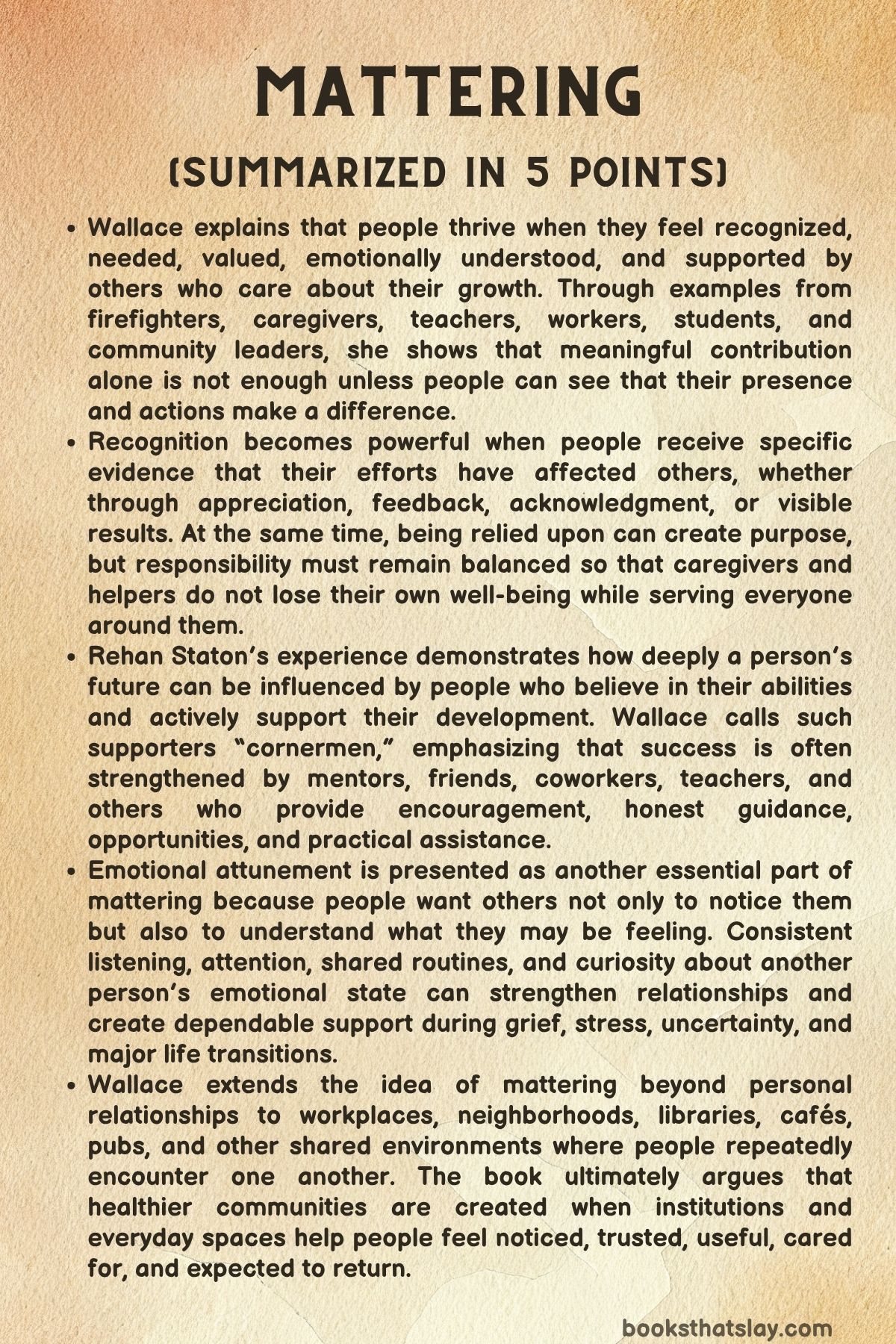
Mattering ultimately argues that people flourish when they can see that they are noticed, needed, cared for, understood, supported, and connected to places where their presence is expected. Mattering is therefore not merely a private feeling to be discovered inside oneself; it is something people create for one another through everyday habits, dependable relationships, responsible institutions, and communities designed to make human presence count.
Key People
Greg Bulanow
Greg Bulanow is one of the clearest examples of leadership built around recognition. In Mattering, he understands that firefighters can perform unquestionably valuable work yet still become emotionally exhausted when they receive little information about outcomes and rarely hear that their actions have been noticed.
His response reveals a practical understanding of human motivation. Rather than relying on ceremonial praise alone, Greg changes systems so firefighters can learn what happened to patients, examine the effectiveness of their tactics, and receive specific acknowledgment through notes, public recognition, and Chief’s Coins.
Greg also develops as a figure associated with institutional compassion. When a firefighter experiences a serious psychological crisis, he helps establish routine mental-health support and empathic-listening practices, showing that strong leadership involves noticing emotional needs before they become disasters.
Julie Plaut Mahoney
Julie Plaut Mahoney represents the complicated relationship between responsibility, loss, and purpose. Caring for her terminally ill mother Linda is demanding, yet the responsibility also gives Julie a strong sense that another person depends upon her.
Linda’s death therefore removes two things at once: a beloved relationship and an organizing purpose. Julie’s decision to establish Welcome Home demonstrates her ability to transform the capacity she developed through caregiving into a new form of usefulness that can benefit people rebuilding their lives.
Her story shows that grief can involve losing a role as well as losing a person. Julie does not replace her mother or erase her loss; instead, she finds another way for care and responsibility to remain active parts of her identity.
Linda
Linda’s presence is primarily understood through her relationship with Julie, but she plays an essential role in explaining why being needed can be psychologically sustaining. Her illness places Julie in a demanding caregiving position, yet it also creates a powerful sense of responsibility and closeness.
After Linda dies, the sudden absence of these daily duties demonstrates how strongly purpose can become connected to another person’s dependence on us. Linda therefore remains important even after her death because Julie’s experience of caring for her becomes the foundation for a broader understanding of service.
Mindy Frankel Peckler
Mindy Frankel Peckler appears as Julie’s partner in establishing Welcome Home. Her role is significant because the organization transforms private grief and individual concern into a collaborative structure capable of helping a larger community.
Mindy also represents the social side of purposeful work. The nonprofit is not built through isolated generosity but through cooperation, shared responsibility, and the recognition that sustainable service often requires people to combine their abilities.
Michael
Michael illustrates the fact that reliance does not need to involve a dramatic public responsibility. His adoption of the cat Blue gives him another living being to care for and creates a dependable routine in which his actions have immediate importance.
His example broadens the book’s definition of usefulness. A person can recover a sense of purpose through modest responsibilities when those responsibilities provide consistency and make that person’s presence necessary.
Ethan, the Graduate
Ethan demonstrates how helping another person can restore energy during a period when one’s own direction feels uncertain. Unemployment leaves him without the ordinary structure and validation that work often provides, but driving his neighbor Joan to chemotherapy creates a concrete responsibility.
The importance of his role lies in its regularity rather than its scale. Joan has a need, Ethan is capable of meeting it, and repeatedly doing so allows him to experience himself as useful even while other areas of his life remain unsettled.
Joan
Joan’s role highlights the mutual nature of dependence. Her need for transportation gives Ethan an opportunity to contribute, but the relationship is not presented merely as a story about a helper and a passive recipient.
Her situation demonstrates how openly needing assistance can create meaningful connection. By accepting Ethan’s help, Joan also gives him a responsibility that restores purpose during a difficult period in his own life.
Danna Thomas
Danna Thomas is one of the strongest examples of the danger that arises when usefulness becomes excessive. She enters teaching with deep commitment but gradually accepts unhealthy conditions, including overwhelming responsibility, insufficient support, long hours, and working while ill.
In Mattering, Danna’s breakdown reveals an important contradiction: a person can be desperately needed by others while simultaneously feeling that her own well-being is treated as unimportant. Her eventual recognition that she has value beyond what she gives becomes central to her recovery.
By creating Happy Teacher Revolution, Danna turns her personal experience into collective action. She encourages educators to establish boundaries, acknowledge vulnerability, and create communities where teachers are treated as whole people rather than endless sources of labor and care.
Heather
Heather becomes important at the moment when Danna can no longer maintain the appearance that she is managing successfully. Danna’s breakdown in front of her creates the opportunity for a different kind of relationship, one based on support rather than professional performance.
Through regular lunches with Heather and Amanda, Danna begins to experience friendship as a stabilizing force. Heather represents the people who help caregivers remember that they deserve attention and concern even when they are accustomed to directing almost all their energy toward others.
Amanda
Amanda forms part of the supportive friendship structure that helps Danna reconsider her understanding of dedication. Her role is less individually developed than Danna’s, but she contributes to the recurring social connection through which Danna begins to recognize her own needs.
Amanda therefore represents consistency rather than dramatic intervention. Regular contact, shared meals, and reliable presence can provide meaningful emotional protection even when no single conversation solves the pressures a person is experiencing.
Simone Gorrindo
Simone Gorrindo is included among examples showing how demanding roles can become more sustainable when people deliberately create supportive relationships. Her connection to the experiences of military spouses emphasizes how responsibility, frequent disruption, and isolation can make dependable community especially important.
Her example reinforces the argument that support does not require constant communication. What matters is knowing that certain relationships are reliable and that personal needs will not always be pushed aside by external responsibilities.
Rehan Staton
Rehan Staton embodies the idea that individual success is rarely as individual as it appears. Family disruption, financial hardship, academic difficulty, the end of his boxing ambitions, and sanitation work could have narrowed his expectations, but people repeatedly recognize abilities in him that circumstances have obscured.
Mattering presents Rehan’s progress toward college and Harvard Law School as the result of effort strengthened by human investment. Tutors, coworkers, counselors, professors, and mentors provide encouragement, practical help, honest assessment, and opportunities that change the direction of his life.
His creation of the Reciprocity Effect shows that he does not treat received support as a private advantage. He eventually uses his position to recognize custodians and staff who are frequently overlooked, becoming for others the kind of affirming presence that others had once been for him.
Jamil
Jamil is an early example of someone who sees academic possibility in Rehan. His tutoring provides Rehan with a period of recovery and demonstrates how focused attention from another person can interrupt a negative trajectory.
Although Jamil’s role is temporary, it remains important because it establishes a recurring pattern in Rehan’s life. At critical moments, another person’s willingness to invest time and belief gives Rehan access to possibilities that might otherwise have remained closed.
Bones
Bones is one of the sanitation coworkers who refuses to judge Rehan according to his job or circumstances. Instead, he recognizes Rehan’s intelligence and pushes him toward an educational future that Rehan might not have pursued without external encouragement.
His significance lies in seeing beyond social status. Bones demonstrates that a powerful mentor or “cornerman” does not need an impressive title; meaningful investment can come from anyone willing to recognize another person’s ability and insist that it should not be wasted.
Craig
Craig shares with Bones the crucial role of recognizing Rehan’s potential during his sanitation work. Rather than treating Rehan as permanently defined by his current circumstances, Craig helps reinforce the idea that college is both appropriate and achievable for him.
Craig represents belief translated into pressure toward action. His support matters because it does not merely comfort Rehan about his situation; it encourages movement toward a different future.
Brent
Brent forms part of the wider support network that develops once Rehan begins pursuing higher education. His presence shows how one relationship can lead to another, gradually creating a network of people invested in a person’s success.
Within Mattering, Brent helps demonstrate that opportunities often become accessible through human connection rather than solitary determination. Support accumulates as people introduce resources, offer advice, and help another person move through institutions that might otherwise feel difficult to navigate.
Peggy Winckowski
Peggy Winckowski represents emotional attunement through consistent, ordinary attention. Her Wednesday Breakfast Club gives teenagers a dependable place where someone remembers details about them, notices changes in their mood, and responds when they appear troubled.
Mattering uses Peggy to show that emotional care often begins with curiosity and presence rather than sophisticated solutions. She pays attention closely enough to distinguish between someone who merely appears quiet and someone who may be carrying fear, grief, or another burden.
After her grandson Sam dies, the Breakfast Club continues and grows in emotional importance. Peggy is no longer only the person offering care; she also becomes someone who receives companionship through shared grief, demonstrating the reciprocal nature of genuine belonging.
Sam
Sam is Peggy’s grandson, and his death changes the emotional meaning of the Breakfast Club. Although his direct presence is limited in the material, his loss creates a situation in which the community Peggy has built becomes a source of support for her as well as for the teenagers.
His role therefore reinforces the durability of relationships created through consistent attention. When severe loss occurs, previously established connections can become places where grief is acknowledged rather than endured in isolation.
Nancy Schlossberg
Nancy Schlossberg provides the intellectual framework for understanding how transitions disrupt mattering. Her own difficult relocation becomes the starting point for a career examining what happens when people lose familiar roles, routines, relationships, or identities.
Nancy’s distinction between anticipated changes, unexpected changes, and expected events that fail to occur broadens the definition of transition. Retirement, relocation, bereavement, career change, or family changes can all produce uncertainty about whether a person will ever again feel as useful or valued.
Her use of “me-search” also makes her an example of active adaptation. Instead of trying to recreate a previous identity exactly, she studies how others navigate change and looks for new forms of engagement, contribution, connection, and purpose.
Sean Butler
Sean Butler demonstrates how the loss or alteration of a familiar role can occur through economic, technological, and environmental change. His movement away from damaging modern farming practices toward regenerative agriculture requires him to reconsider not simply how he farms but what kind of farmer he wants to become.
His example is important because adaptation is not portrayed as surrendering identity. Sean preserves the deeper values associated with his work while changing the methods through which those values are expressed, showing how people can maintain purpose without remaining trapped in old practices.
Becky
Becky is one of the staff members at the Bedford who intentionally treats the pub as a center of community life. Her role demonstrates how employees in ordinary public spaces can influence whether visitors feel like anonymous customers or recognized participants in a shared environment.
Through consistent hospitality and support for varied gatherings, Becky helps create conditions in which repeated contact can become familiarity. Her importance lies in showing that community is often produced by people who make room for interaction rather than by formal programs alone.
Ethan, the Bedford Staff Member
Ethan shares Becky’s role in shaping the Bedford into a place where community can develop. The pub supports many kinds of activities and age groups, and his involvement helps demonstrate how flexible public spaces can serve social needs beyond their commercial purpose.
He represents the human element required to turn a location into a genuine “mattering space.” Architecture alone cannot create belonging; people must help establish habits of recognition, welcome, and repeated participation.
Shamichael Hallman
Shamichael Hallman represents intentional community design through his work connected to Memphis’s Cossitt Library. Rather than assuming what a public institution should provide, his approach centers the actual needs of the people who use it.
His example expands the book’s argument from interpersonal relationships to civic infrastructure. A library can become more than a place that stores resources when it is organized to encourage participation, recognition, shared activity, and regular contact among members of a community.
Themes
Recognition and the Need to See Our Impact
People can perform work that clearly matters and still feel invisible if they never receive evidence that their actions have affected anyone. Mattering therefore separates objective usefulness from the subjective experience of knowing that usefulness has been seen and understood.
The North Charleston firefighters make this distinction especially clear. Their work involves rescue and public safety, yet limited information about outcomes leaves them disconnected from the consequences of their actions, showing why even obviously purposeful jobs cannot sustain people through purpose alone.
Recognition becomes more meaningful when it is specific. Greg’s notes, public praise, Chief’s Coins, and systems for sharing patient outcomes give firefighters concrete evidence that particular actions, qualities, or decisions made a difference.
The idea also applies to ordinary relationships. Preserving appreciative messages, directly telling someone how they have influenced us, and linking small tasks to a larger purpose allow people to understand that their presence has consequences that might otherwise remain invisible.
Recognition is therefore not presented as flattery or constant praise. It is accurate information about impact, and withholding that information can leave people unsure whether their effort matters even when everyone around them quietly benefits from it.
Being Needed Without Being Consumed by Need
Responsibility can give life structure because another person, animal, organization, or community depends on what we provide. Julie’s care for Linda, Michael’s responsibility for Blue, and Ethan’s transportation of Joan demonstrate that usefulness can create motivation even in periods shaped by grief, unemployment, or uncertainty.
Yet the same need can become destructive when responsibility expands without corresponding support. Danna’s experience as an overwhelmed teacher shows what happens when people are treated as indispensable providers while their physical and emotional needs receive little protection.
The distinction rests on whether responsibility functions as a “good weight” or an impossible one. Healthy reliance gives people the satisfaction of contributing while preserving their ability to rest, seek help, maintain relationships, and recognize value in themselves beyond performance.
This theme challenges cultures that treat exhaustion as proof of devotion. Parents, teachers, medical professionals, military spouses, and other caregivers may internalize the belief that good people continually give more, but the book argues that sustainable care requires reciprocity.
Boundaries therefore do not undermine mattering. They protect it by ensuring that a person remains both someone who is needed and someone whose own needs deserve serious attention.
Growth Through Mutual Investment
Rehan Staton’s experience challenges the familiar ideal of the completely self-made individual. His progress depends on his own effort, but effort becomes effective because other people repeatedly identify ability, provide guidance, open opportunities, and refuse to let his current circumstances define his future.
The idea of the “cornerman” captures this kind of relationship. A cornerman does more than offer encouragement; such a person provides honest feedback, practical assistance, resources, expectations, and continued belief in another individual’s ability to develop.
This form of mattering is future-oriented. Recognition tells people that what they have already done is valuable, while investment communicates that who they may become is also worth someone’s time and attention.
The theme also creates an ethical cycle. People who have benefited from mentors, friends, teachers, coworkers, or family members are encouraged to become investors in someone else’s growth rather than treating their own success as proof of personal independence.
Rehan’s Reciprocity Effect completes that movement. After being supported by others, he intentionally recognizes workers who might otherwise remain invisible, suggesting that the strongest communities are built when receiving support gradually creates a desire to provide it.
Belonging Through Attention, Transition, Work, and Place
Human connection becomes durable when it is built into ordinary routines rather than reserved for emergencies. Peggy Winckowski’s Breakfast Club, supportive workplace practices, public gathering spaces, and community-focused institutions all demonstrate that repeated attention helps people feel expected rather than incidental.
Attunement is essential because physical presence alone does not guarantee connection. People experience importance when someone notices changes in tone, expression, behavior, or mood and responds with curiosity rather than indifference.
Transitions make this especially significant because retirement, relocation, bereavement, career change, and other disruptions can remove the roles and places through which people once experienced recognition and usefulness. Nancy Schlossberg’s work suggests that recovery comes from identifying what form of mattering has been lost and intentionally rebuilding that element somewhere new.
Workplaces and community spaces carry the same responsibility on a larger scale. Organizations that provide trust, recognition, personal concern, and opportunities for growth can strengthen employees, while third places such as libraries, cafés, parks, pubs, and neighborhood gatherings can turn repeated contact into familiarity.
By the end of Mattering, belonging emerges not as a vague emotional state but as something that can be deliberately supported through relationships, institutions, routines, and environments. People matter most reliably when the structures of everyday life repeatedly tell them that they are noticed, that their presence is useful, that their needs count, and that there is a place where others expect them to return.