Love and Other Brain Experiments Summary, Characters and Themes
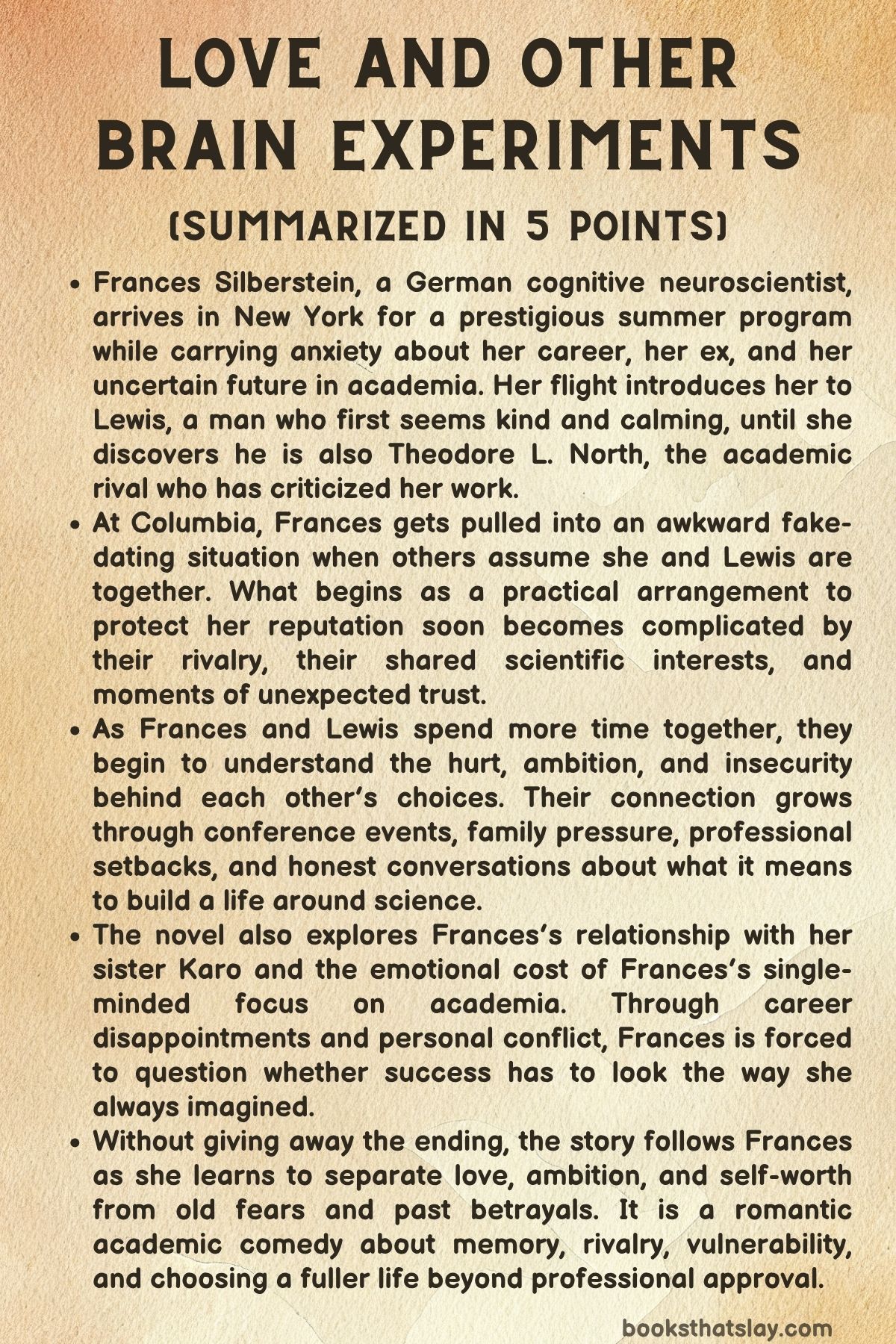
Love and Other Brain Experiments by Hannah Brohm is a contemporary academic romance about ambition, rivalry, fear, and the difficult work of building a life beyond professional validation. The story follows Frances Silberstein, a German cognitive neuroscientist whose career feels increasingly fragile, as she attends an elite summer program in New York and unexpectedly reconnects with Theodore “Lewis” North, the scholar she believes damaged her work and reputation.
What begins as conflict and a fake relationship becomes a test of trust, desire, and self-worth. The novel blends science, humor, family pressure, and romance while asking what success really means.
Summary
Frances Silberstein is a German cognitive neuroscientist living in the Netherlands, traveling from Berlin to Newark for the Sawyer’s Summer Seminars at Columbia University. She is already anxious before the trip begins.
She oversleeps, rushes to the airport, and realizes she has forgotten the allergy pills she usually uses to sleep through flights. Flying terrifies her, so she boards the plane tense and unprepared.
During the flight, a flight attendant notices that Frances’s passport identifies her as “Dr.” and asks for help. Frances explains that she has a PhD in neuroscience, not medicine, but the emergency turns out not to be medical.
A man nearby needs help cutting a conference abstract from about one thousand words to five hundred. He introduces himself as Lewis.
When turbulence shakes the plane, Frances panics, and Lewis gently helps her breathe, holds her hand, and distracts her with conversation.
They discuss academia, unstable postdoc funding, research, and why they continue in science despite its difficulties. Frances admits she is going to New York for networking and career prospects, but she is uneasy because her ex-boyfriend, Jacob Bellingham, is organizing the program.
Jacob once made her feel as if she would fail professionally and personally. She also talks about Theodore L. North, an academic rival who has criticized her work and, in her view, once used her ideas without credit.
Then Lewis reveals that he is Theodore L. North. Lewis is his middle name, the name he uses socially.
Frances is furious and humiliated. She has been honest with the person she considers her professional enemy.
They argue about his reviews, the old paper, and the damage she believes he caused. Even so, she helps him edit his abstract, then tells him he owes her a favor.
In New York, Frances returns to Columbia and reflects on how she became interested in neuroscience. As a teenager, she saw her sister Karo suffer a concussion and temporary memory problems after a ski accident.
That experience pushed Frances toward the study of memory and the brain. She also thinks about her unstable career, her repeated postdoc moves, and her hope that Sawyer’s will open a path to a secure future.
At registration, Frances meets Lewis again while reading his latest criticism of her paper. They argue, but when they both reach for his slipping phone, they accidentally appear to be holding hands.
Vivienne Duchamps, Jacob’s postdoc and the event coordinator, arrives and assumes Frances and Lewis are together. Vivienne also reveals that she and Jacob are engaged and living together.
Frances has a panic attack, and Lewis helps her calm down again. Because correcting the misunderstanding feels embarrassing and risky, Frances lets Vivienne believe that she and Lewis are dating.
Frances later worries that the lie could harm her reputation if exposed. Karo suggests a fake-dating solution, and Frances decides to ask Lewis to cooperate.
At first, Lewis resists. Frances explains that the alternative could make her look dishonest among people who may shape her career.
Eventually, Lewis agrees to pretend to be her boyfriend for two weeks, but with rules: they will not spy on each other’s research, they will treat each other as conflicted reviewers in future academic situations, and Frances must attend his brother Benjamin’s graduation as his girlfriend.
Their fake relationship begins awkwardly. At a dinner hosted by Jacob and Vivienne, Frances is shaken by seeing Jacob again and by the settled life he seems to have built with Vivienne.
Lewis steadies her with quiet physical support. Frances networks successfully, but the act nearly fails when old acquaintances question how she and Lewis got together.
Lewis saves them by inventing a story based on their turbulent flight, and he surprises everyone by answering Jacob in German.
After dinner, Frances and Lewis realize they need a better plan. They walk through Manhattan and agree on details: how long the fake relationship will last, how they met, how they behave in public, and what boundaries they should maintain.
While practicing hand-holding, their closeness starts to feel real. Frances impulsively kisses Lewis on the cheek before leaving.
As Sawyer’s continues, their public act becomes more convincing. Lewis sits close to Frances, lets her take his coffee, and behaves affectionately in front of others.
Vivienne offers Frances a possible teaching lead in New York. But Brady, an old friend of Lewis’s, notices that Frances is not staying at his hotel, which threatens the illusion.
To fix this, Frances and Lewis go to a romantic Italian restaurant near his hotel.
Their fake date turns serious when they argue about the old paper Frances believes he stole from her. Lewis admits he was wrong and apologizes.
Later, a storm pushes them into his hotel, where Brady casually reveals that Lewis had wanted Frances credited on the paper, but his advisor forced him to remove her name. Frances ends up in Lewis’s room, where she hears his full explanation.
He apologizes sincerely and tells her he has long admired her work. His critiques, he says, were meant as serious engagement with her science, not dismissal.
Frances begins to question the version of him she has held onto for years.
The tension between them grows. Frances attends Benjamin’s graduation party with Lewis and sees how cold and controlling his wealthy parents can be.
When they corner him, she steps in, praises his scientific achievements, and pulls him away. On the boat’s stargazing deck, Lewis thanks her and admits he agreed to fake date partly because he felt responsible for hurting her career.
Their trust deepens.
Back at Sawyer’s, Frances meets Professor Rosanna Alderkamp, one of her academic idols. Rosanna praises Frances’s paper, asks for her slides and code, and suggests lunch.
Frances is thrilled. Soon after, Frances and Lewis are assigned a joint “Growing Up in Science” Q&A session.
During Lewis’s lecture, Frances helps him slow down by asking a useful question, and the talk improves. Later, they discuss a new scientific paper over the phone, and Frances realizes she is starting to truly like him.
At a student event, Frances receives devastating news: her major grant application has been rejected. She spirals, fearing that her funding will run out and she will have to move yet again.
Lewis follows her outside and tries to comfort her. Frances lashes out, comparing their careers and accusing him of having advantages she does not.
Lewis pushes back, insisting that she is brilliant and exactly the kind of scientist academia should value. Overwhelmed, Frances kisses him, but he freezes.
She thinks he has rejected her.
Instead of leaving her alone, Lewis takes her to a donut shop and lets her cry. He suggests a weekend away at a friend’s cabin upstate.
Frances agrees, telling herself he can at least be her friend. During a hike, she apologizes for kissing him, but Lewis tells her he does not want to be only friends.
He froze because he wanted their kiss to happen for the right reasons, not because of panic or the fake relationship. They kiss for real, go to the cabin, and spend the night together.
In the middle of the night, Frances panics. She fears repeating the patterns of her past, especially the way Jacob made her feel like an accessory to his career.
Lewis shows her years of unsent apology emails about the old paper, proving that he has carried guilt for a long time. They admit they like each other but are afraid.
They decide to spend one honest week together at Sawyer’s without pretending.
At the final Sawyer’s picnic, Frances gives her presentation and meets Maria, Rosanna’s wife, who runs an e-learning start-up called Codify. Maria is interested in Frances’s programming skills.
Rosanna also mentions possible funding for a postdoc in her lab, which sounds close to Frances’s dream job. Then Maria congratulates Lewis on winning the Dutch Young Investigators Starting Grant.
Frances realizes Lewis has won the kind of opportunity she desperately wanted, and that Rosanna’s postdoc may be tied to his project.
Frances feels betrayed. Lewis explains that he and Rosanna wrote the grant months earlier, inspired partly by Frances’s work, and he only learned it had succeeded after their weekend away.
He kept quiet because he feared losing what was growing between them. Frances sees it as another case of someone fitting her into his plans.
Their argument becomes cruel, and Lewis walks away hurt.
Frances travels to Seattle to stay with Karo. The sisters are tense at first, but they reconnect during a trip around the Olympic Peninsula.
Frances apologizes for relying on Karo only during crises and admits she has built too much of her life around academia. Karo helps her see that Lewis is not Jacob and that Frances must decide what she wants beyond professional survival.
Back in the Netherlands, Frances declines Rosanna’s postdoc, starts therapy, and explores other paths. She reads Lewis’s grant proposal and sees how deeply he respects her work.
She also interviews at Codify, realizing she wants a fuller life, not just another fragile academic position.
When Frances learns that Lewis is giving a lecture in Maastricht, she goes to him. In an empty auditorium, she apologizes and tells him she loves him.
Lewis has prepared a “revision letter” for their relationship, listing the changes and promises he wants to make. Frances adds her own promises: stronger boundaries, a life beyond academia, and a future chosen freely.
They reconcile.
Seven months later, Frances lives in Amsterdam, works at Codify, does research on Fridays, and has built a more balanced life. With Rosanna’s mentorship, she wins a major five-year grant.
Lewis arrives with a framed brain drawing and asks to move in with her. Frances realizes Amsterdam has become home, and she says yes.
Characters
Frances Silberstein
Frances Silberstein is the emotional and intellectual center of Love and Other Brain Experiments. She is a German cognitive neuroscientist living in the Netherlands, and much of her character is shaped by the instability of academic life.
She is brilliant, hardworking, ambitious, and deeply committed to memory research, but she is also exhausted by the constant pressure to prove herself. Her fear of flying in the opening scenes immediately reveals her vulnerability, while her willingness to help Lewis cut his abstract even after discovering his identity shows her professionalism and stubborn generosity.
Frances is not simply a scientist chasing success; she is someone whose entire sense of identity has become tied to academia. This makes every rejection, every professional slight, and every career uncertainty feel personal and existential.
Frances’s conflict with Lewis exposes one of her central wounds: she fears being used, overlooked, or treated as an accessory to someone else’s career. Her past with Jacob taught her to distrust professional intimacy, especially with men who seem more secure or powerful than she is.
Because of this, she initially sees Lewis through the lens of betrayal and rivalry. Her anger over the old paper is not petty; it represents years of feeling that her ideas and labor can be taken without recognition.
At the same time, Frances can be defensive, reactive, and sometimes unfair. When she feels threatened, she assumes the worst, as seen in her response to Lewis’s grant success.
Her harsh words to him reveal how fear can make her cruel before she is able to reflect.
Her relationship with Karo is equally important because it reveals both Frances’s tenderness and her self-absorption. Karo’s accident helped inspire Frances’s interest in memory, so her scientific career is rooted in love and fear.
Yet over time, Frances allows her academic anxieties to dominate her conversations with her sister. Karo’s confrontation forces Frances to see that she has narrowed her life too much.
This becomes a major turning point: Frances begins to understand that ambition is not the same as fulfillment, and that success should not require sacrificing every other part of herself.
By the end of the story, Frances grows into someone more balanced, honest, and self-aware. Her decision not to take Rosanna’s postdoc is not a failure but an act of self-definition.
She chooses Codify, therapy, boundaries, independent research, and a relationship with Lewis that is based on mutual respect rather than professional dependence. Frances’s arc is about reclaiming agency.
She learns that she can love science without letting academia consume her, and she can love Lewis without disappearing into his plans.
Lewis North / Theodore L. North
Lewis North, professionally known as Theodore L. North, is one of the most complex figures in Love and Other Brain Experiments because he begins as Frances’s enemy and gradually becomes someone far more vulnerable, ethical, and emotionally careful than she expects. At first, he represents everything Frances resents: public criticism, academic gatekeeping, and the possibility that her work has been used without proper credit.
His reveal on the airplane is both comic and painful because he has already comforted Frances during turbulence before she learns that he is the person she has hated for years. This contradiction defines him: he can be professionally severe but personally gentle.
Lewis’s character is marked by guilt. He knows the old paper incident harmed Frances, and even though his advisor was largely responsible for removing her name, Lewis still carries responsibility for not fighting harder.
His unsent apology emails show that his remorse is not sudden or convenient; it has been with him for years. His agreement to fake date Frances is partly comic, partly strategic, but also rooted in a desire to repair some of the damage he caused.
He does not simply want to be forgiven; he wants to make himself useful to her without demanding anything in return.
His family background adds another layer to his personality. Lewis comes from wealth and privilege, but his home life is emotionally cold and judgmental.
His father’s dominance and his parents’ lack of support have made him anxious around people who can affect his future. This explains why he can seem confident in academic debates but uneasy in social or familial situations.
Frances’s defense of him at Benjamin’s graduation party matters because she sees the emotional cost of his upbringing and publicly values the part of him his family overlooks: his dedication to science.
Romantically, Lewis is careful because he does not want his relationship with Frances to be built on confusion, fake dating, career desperation, or emotional distress. When he freezes after she kisses him, it is not because he does not want her; it is because he wants the moment to be real and freely chosen.
His “revision letter” near the end of the novel captures his character beautifully. He thinks in academic language, but underneath that structure is a sincere desire to change, communicate, and build something healthier.
Lewis’s growth comes from learning that good intentions are not enough unless they are paired with honesty and courage.
Karo Silberstein
Karo Silberstein, Frances’s sister, is one of the story’s most important emotional anchors. Her teenage ski accident and temporary memory problems shape Frances’s entire career path, making Karo central to the book even when she is not physically present.
Through Karo, the novel connects scientific curiosity with personal love. Frances does not enter memory research in an abstract way; she enters it because someone she loves became frighteningly vulnerable, and the brain suddenly became both mysterious and urgent.
Karo is warm, teasing, practical, and emotionally perceptive. She often acts as Frances’s confidante, especially during the fake-dating chaos and Frances’s growing feelings for Lewis.
Her jokes about romance tropes provide humor, but they also show that she understands Frances’s emotional life better than Frances does herself. Karo sees through Frances’s attempts to intellectualize everything and repeatedly nudges her toward admitting what she wants.
However, Karo is not merely a supportive sister whose purpose is to absorb Frances’s anxiety. Her confrontation with Frances is one of the most necessary moments in the story.
By telling Frances that their conversations have become centered almost entirely on Frances’s career crises, Karo establishes her own boundaries. This moment complicates her character and deepens the sister relationship.
Karo loves Frances, but she refuses to keep functioning as an emotional emergency service.
The Seattle and Olympic Peninsula section shows Karo at her most generous and honest. She helps Frances reconnect with parts of herself beyond academia, partly through shared memories and the Twilight audiobooks that once comforted her after the accident.
Karo’s role is not to solve Frances’s life but to remind her that she has one. She helps Frances see that Lewis is not Jacob, that ambition can become a trap, and that love requires attention in both directions.
Jacob Bellingham
Jacob Bellingham is Frances’s ex-boyfriend and one of the major forces behind her insecurity. Even before he appears directly, he has power over the story because Frances carries his judgment with her.
His prediction that she would end up unsuccessful and alone has lodged itself deep in her mind. Jacob represents the kind of academic relationship in which professional ambition and personal intimacy become dangerously tangled.
Frances’s fear of repeating that dynamic shapes her reactions to Lewis, Rosanna’s postdoc, and the grant situation.
Jacob is not portrayed as a cartoon villain. The story suggests that he has changed, especially through Vivienne’s perspective.
Still, his past impact on Frances is real. He made her feel secondary, as though her value depended on how she fit into his career and life.
This is why seeing his settled New York life with Vivienne is so painful for Frances. She is not simply jealous of the engagement or the townhouse; she is confronting an alternate version of her own life, one in which she might have stayed attached to someone who diminished her.
His presence also tests Frances’s pride. The fake-dating arrangement begins largely because Frances cannot bear to seem humiliated in front of Jacob and Vivienne.
In this way, Jacob functions as a catalyst. He forces Frances into the lie that brings her closer to Lewis, but he also exposes how much of her self-worth is still organized around proving him wrong.
By the end, Frances’s growth requires her to stop living in opposition to Jacob’s old prediction.
Vivienne Duchamps
Vivienne Duchamps initially appears as a potential rival or source of humiliation for Frances, but she becomes one of the book’s more surprising figures of grace. As Jacob’s fiancée and the coordinator of the Sawyer’s event, Vivienne stands at the intersection of Frances’s professional and personal anxieties.
Frances assumes Vivienne has the life she lost or failed to secure: a stable relationship, a home in New York, and proximity to powerful academic networks. Because of this, Frances projects a great deal onto her before truly knowing her.
Vivienne’s warmth complicates Frances’s assumptions. She welcomes Frances, hopes they can be friends, and continues to treat her kindly despite the awkwardness around Jacob.
Her misunderstanding that Frances and Lewis are dating creates the fake-dating setup, but Vivienne herself is not malicious. She is socially perceptive, competent, and generous, though not always aware of the panic her comments trigger in Frances.
Later, Vivienne becomes especially important when Frances breaks down after learning about Lewis’s grant. Instead of judging her, Vivienne helps her calm down and gives her a fuller understanding of Jacob.
She explains that she knows about Frances’s past with him and that their current relationship is not exactly what Frances imagined. This conversation helps Frances loosen her grip on old assumptions.
Vivienne’s role is to challenge Frances’s tendency to turn other women into symbols of her own failure. She becomes a reminder that people’s lives are more complicated than they appear from the outside.
Brady
Brady is a secondary character, but she plays an important role in testing the credibility of Frances and Lewis’s fake relationship. As someone who knows Lewis from his PhD days and understands the history between him and Frances, Brady is harder to fool than Vivienne or Jacob.
Her surprise at their supposed romance creates tension because she recognizes that their professional rivalry does not easily fit the image of a happy couple.
Brady’s presence pushes Frances and Lewis to refine their act. She notices inconsistencies, such as Frances not staying at Lewis’s hotel, and her skepticism forces them into situations where their emotional chemistry becomes harder to deny.
In this way, Brady functions almost like a pressure point in the plot. She unintentionally moves the fake relationship toward real intimacy by making them perform closeness until the performance begins to reveal genuine feeling.
Her revelation in the hotel elevator is also crucial. By casually mentioning that Lewis had wanted Frances on the old paper, Brady changes Frances’s understanding of the betrayal.
She does not erase Lewis’s responsibility, but she adds context. Because of Brady, Frances begins to see that the past was more complicated than she believed.
Brady therefore helps shift Lewis from enemy to wounded, flawed human being in Frances’s eyes.
Professor Rosanna Alderkamp
Professor Rosanna Alderkamp is Frances’s academic idol and represents the kind of scientific recognition Frances has long desired. When Rosanna praises Frances’s paper, asks for her slides and code, and suggests lunch, Frances feels seen in a way that academia has rarely allowed her to feel.
Rosanna’s approval matters because it validates Frances’s intellectual worth at a moment when she is deeply insecure about her future.
Rosanna is also connected to one of the story’s central conflicts. Her potential postdoc opportunity initially seems like Frances’s dream, but it becomes entangled with Lewis’s successful grant.
This complicates Rosanna’s role. She is not trying to harm Frances, but the opportunity she offers risks placing Frances inside someone else’s project again.
For Frances, this echoes the painful pattern of being folded into a more powerful person’s career path.
By the end, Rosanna becomes a healthier kind of mentor. Frances declines the postdoc, but Rosanna still supports her and later mentors her through a major five-year grant.
This is significant because it shows that professional support does not have to mean dependency. Rosanna’s best role in Frances’s life is not as an employer who absorbs her into a lab, but as a respected senior scientist who helps Frances build her own path.
Maria
Maria, Rosanna’s wife and the founder of Codify, represents an alternative future for Frances. Unlike the academic world, which is defined by unstable funding, competition, and constant relocation, Maria’s e-learning start-up offers Frances a way to use her intelligence and programming skills outside the narrow structure of university research.
Maria’s interest in Frances is practical and affirming. She sees value in Frances beyond grants, postdocs, and publications.
Maria’s importance lies in the fact that she expands Frances’s imagination. Until this point, Frances has treated leaving or stepping sideways from academia almost as a defeat.
Maria shows her that there are other intellectually meaningful ways to work. Codify does not require Frances to abandon science; rather, it gives her enough stability to rebuild her life and continue research on her own terms.
Through Maria, the story argues that career fulfillment does not have to follow one prestigious path. Frances’s eventual work at Codify becomes part of her healing.
It gives her balance, independence, and a daily life that is not organized entirely around scarcity and rejection.
Benjamin North
Benjamin, or Ben, is Lewis’s younger brother, and his graduation brings Frances into Lewis’s family world. Though he is not developed as deeply as Frances or Lewis, Ben serves an important narrative purpose.
His graduation event exposes the emotional dynamics Lewis has grown up with, especially the pressure and judgment from his parents. Through Ben’s party, Frances sees Lewis not as a confident academic rival but as a son and brother navigating a difficult family system.
Ben also becomes part of Lewis’s growth. Frances encourages Lewis to call him, suggesting that Lewis’s relationships with his family do not have to remain frozen in old patterns.
Ben therefore represents the possibility of repair within Lewis’s personal life. He is connected to Lewis’s vulnerability and to the small steps Lewis begins taking toward emotional openness.
Lewis’s Father
Lewis’s father is a domineering investment-firm CEO whose values clash sharply with Lewis’s scientific life. He represents wealth, authority, control, and conventional success.
His lack of appreciation for Lewis’s academic achievements helps explain why Lewis is so anxious around people who might influence his career. Even though Lewis is accomplished, he has grown up in an environment where his chosen path is not fully respected.
The father’s function in the story is to show that privilege does not protect Lewis from emotional damage. Financial advantage gives him opportunities, but it does not give him approval, warmth, or security.
This complexity matters because Frances initially sees Lewis partly through the lens of privilege. Meeting his family forces her to recognize that his life has its own wounds, even if those wounds are different from hers.
Lewis’s Mother
Lewis’s mother appears as part of the difficult family structure that Frances encounters at Benjamin’s graduation party. She contributes to the atmosphere of judgment and emotional distance surrounding Lewis.
While she is less individually defined than Lewis’s father, her presence reinforces the sense that Lewis’s family does not provide the kind of support he needs.
Her role helps reveal why Frances’s defense of Lewis matters so much. By praising his scientific achievements in front of his parents, Frances gives him the recognition his family withholds.
Lewis’s mother is therefore important less as an independent figure and more as part of the emotional background that shaped Lewis into someone guarded, anxious, and deeply affected by approval.
Ada
Ada is Lewis’s sister and part of the wealthy, complicated family circle that Frances has to understand before attending the graduation event. Although she does not dominate the plot, her presence helps flesh out Lewis’s family life and shows that he comes from a larger network of expectations, relationships, and social performance.
Ada’s inclusion makes Lewis’s background feel lived-in rather than abstract.
As Lewis prepares Frances for the event, mentioning Ada, John, and Alice also shows his willingness to let Frances into parts of his private world. This matters because Lewis is usually controlled and careful.
Talking about his family is one of the ways he begins to trust Frances.
John
John, Ada’s husband, is a minor figure connected to Lewis’s family background. His role is mainly social and contextual, helping establish the family environment Frances is entering.
Through characters like John, the graduation gathering becomes more than a simple meeting with parents; it becomes a full family event where Frances has to perform as Lewis’s girlfriend while also observing the tensions that shape him.
Though John does not have a major emotional arc, his presence contributes to the contrast between Lewis’s polished family world and the private discomfort Lewis feels inside it. He helps complete the picture of the social class and family structure Lewis comes from.
Alice
Alice, Ada and John’s daughter, is another minor family figure who helps humanize Lewis’s background. Her presence suggests that Lewis’s family is not only defined by parental pressure but also by ordinary family connections across generations.
Even though Alice is not central to the plot, she adds texture to the family setting and makes the graduation event feel more realistic.
Alice also indirectly emphasizes the difference between public family appearances and private emotional realities. From the outside, Lewis’s family may look successful and complete, but Frances quickly sees the tension underneath.
Alice is part of that outwardly composed family world.
Themes
Academic Insecurity and the Cost of Ambition
Frances’s career is shaped by unstable contracts, rejected grants, professional rivalry, and the constant pressure to prove that she belongs in science. Her ambition is sincere, but it also traps her in a cycle where every opportunity feels like survival and every failure feels like personal judgment.
Love and Other Brain Experiments shows how academia can turn passion into anxiety when success depends on funding, visibility, networking, and approval from powerful people. Frances does not simply want prestige; she wants security, recognition, and the chance to continue the work that gives her life meaning.
Yet her fear of being pushed aside makes her interpret events through old wounds, especially when Lewis’s grant success appears to threaten her future. The theme becomes most powerful when Frances begins to see that a meaningful scientific life does not have to follow one narrow path.
Her move toward Codify, therapy, and a more balanced routine suggests that ambition becomes healthier when it serves the person rather than consuming them.
Trust, Misjudgment, and Emotional Revision
Frances and Lewis begin with a history of professional hurt, misunderstanding, and resentment. Frances sees him as the person who damaged her career, while Lewis sees himself as someone who failed to correct a wrong and has carried guilt for years.
Their relationship develops through a slow process of revising first impressions. The fake dating arrangement forces them into closeness, but real trust only grows when they begin explaining what earlier silence, fear, and pride had hidden.
Lewis’s unsent apology emails matter because they reveal that his guilt was not sudden or convenient; it existed long before romance entered the picture. Frances must also confront how her past with Jacob has trained her to expect betrayal from academically successful men.
The emotional movement of the novel depends on both characters learning that hurt can be real even when intention is complicated. Trust here is not instant forgiveness; it is built through honesty, accountability, and the courage to listen after anger has made listening difficult.
Love as Support Without Possession
The romance in Love and Other Brain Experiments becomes meaningful because it challenges both characters to support each other without taking control of each other’s futures. Frances has already experienced a relationship where her identity was reduced to someone else’s career story, so she fears becoming an accessory again.
Lewis, for his part, wants to help but initially fails by imagining Frances inside plans he has already made. Their conflict over the grant exposes the difference between care and control.
Love cannot mean secretly arranging opportunities, however well-intentioned, because that risks repeating the very pattern Frances needs to escape. Their reconciliation works because both begin making promises that respect choice, boundaries, and independence.
Lewis’s “revision letter” is important not because it solves every practical problem, but because it treats the relationship as something that can be edited with humility. The novel presents love as partnership: not rescue, not possession, and not career convenience, but a shared commitment to growth without erasing individuality.
Rebuilding Identity Beyond One Dream
Frances has built much of her identity around neuroscience, partly because of Karo’s accident and partly because research gives her a sense of purpose. That purpose is valuable, but it becomes dangerous when every part of her life is measured against academic success.
Her grant rejection feels devastating because it threatens not only her job prospects but her entire sense of self. The tension with Karo reveals the personal cost of this narrow focus: Frances has leaned on her sister emotionally while failing to notice Karo’s own needs.
Her time in Seattle becomes a turning point because it allows her to step outside the conference rooms, rivalries, and funding pressures that have defined her world. By choosing therapy, industry work, research on limited terms, and later a grant pursued with more balance, Frances does not abandon science.
She rebuilds her relationship to it. The ending suggests that fulfillment comes from expanding life, not shrinking it around a single dream until everything else disappears.