Love Redesigned by Lauren Asher Summary, Characters and Themes
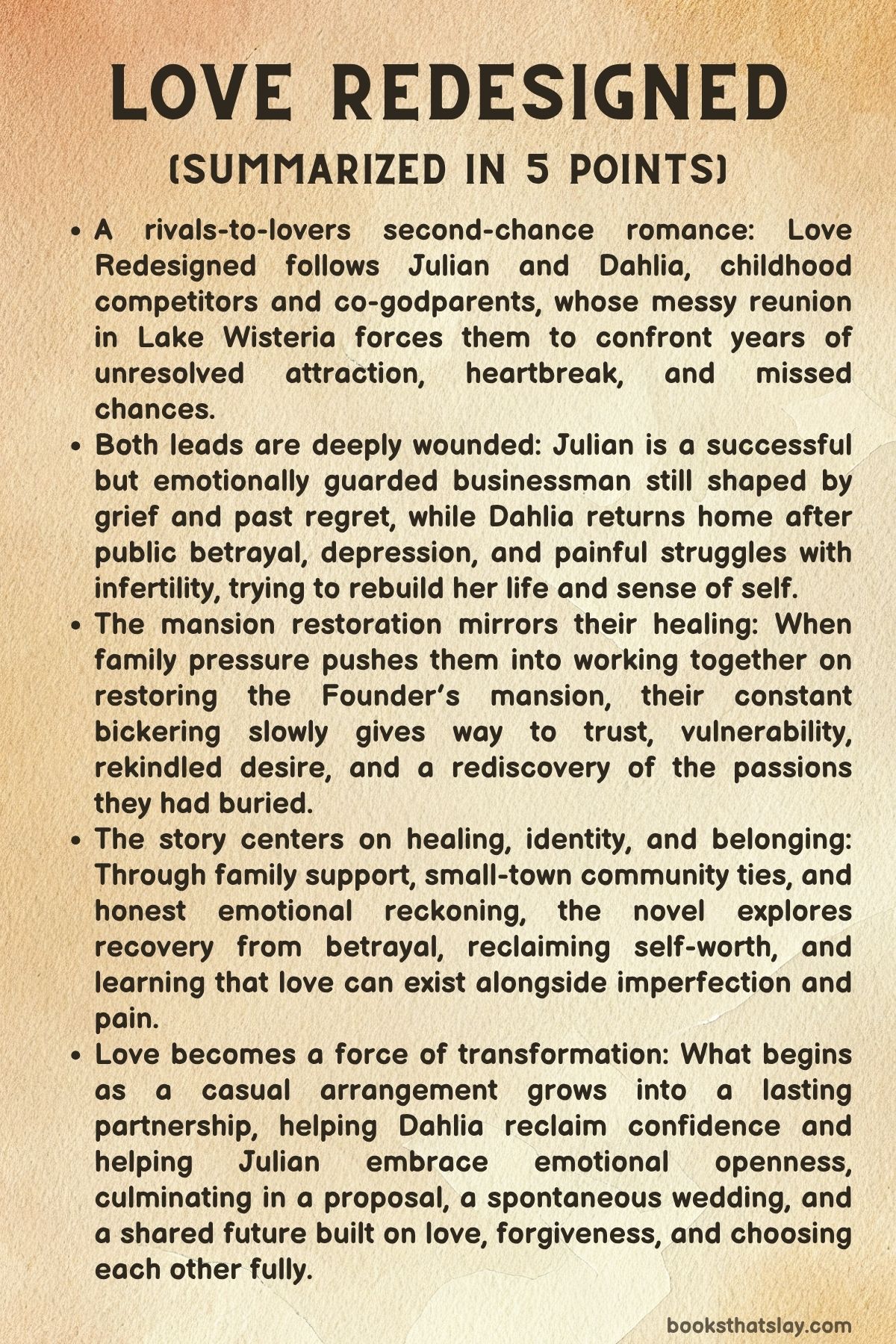
Love Redesigned by Lauren Asher is a contemporary romance set in the cozy backdrop of Lake Wisteria, where past rivalries, broken hearts, and second chances collide. The novel follows Julian and Dahlia, childhood competitors and reluctant co-godparents, who find themselves forced back into each other’s lives after years apart.
Julian, a successful yet emotionally guarded businessman, and Dahlia, a once-celebrated interior designer reeling from betrayal and personal struggles, discover that their old rivalry masks unresolved feelings. As they embark on a joint restoration project and navigate family ties, heartbreaks, and rekindled desires, they must confront the past and decide whether love is worth rebuilding from the ground up.
Summary
The story opens with Julian racing through town in his McLaren, desperate to catch his godson Nico’s school talent show. Delayed behind another car, his frustration mounts when he learns Nico is performing first.
Impatient, he tries to overtake but crashes into the car ahead. To his shock, the driver is Dahlia Muñoz—his childhood rival, Nico’s other godparent, and a woman tied deeply to his past.
Their reunion is sharp and awkward, with unresolved tension simmering beneath their banter. Family members and townsfolk soon swarm the accident scene, escalating the embarrassment.
Though Dahlia insists she is fine, both are unsettled by their unexpected confrontation.
Dahlia, recently returned to Lake Wisteria, reflects on how overwhelming her first day back has been: a panic attack, a car accident, and an awkward encounter with Julian. Once a star interior designer with her own TV show, her career and confidence have been fractured by a broken engagement to Oliver, Julian’s former college roommate.
Worse still, Dahlia secretly struggles with infertility, a truth that fuels her insecurities and isolates her. Despite her resentment toward Julian’s dismissiveness, she agrees to let him drive her home, where their interactions remain laced with sarcasm, buried history, and fleeting sparks of attraction.
Julian eventually arrives at Nico’s show, watching with pride as the boy excels at the piano. His cousin Rafael reminds him of a long-ago confession—that Julian once admitted he’d change things if given another chance with Dahlia.
Now that she’s back, Rafael warns him not to repeat old mistakes. Julian, though outwardly detached, cannot ignore his inner turmoil.
Meanwhile, Dahlia struggles with depression following her breakup. Therapy sessions reveal her ongoing grief over Oliver’s betrayal and the painful reality of her inability to have children.
At a family gathering, her godson’s innocent enthusiasm overwhelms her, and she breaks down privately to Rafael, confessing why she avoids children. His promise to keep her secret brings her some comfort, but she remains determined to reclaim her strength.
Their paths soon intertwine again at Sunday dinner, where Julian’s mother tasks him with helping Dahlia regain her footing through a home restoration project. Despite his resistance, he agrees in exchange for freedom from her constant matchmaking.
Their partnership begins contentiously, with old wounds resurfacing. Yet, their shared passion for the historic Founder’s mansion—Dahlia for its design and Julian for its land value—pushes them into a reluctant collaboration.
Dahlia hopes restoring the home will reignite her creative spark, while Julian views it as another profitable investment.
As they work together, the edges of their rivalry blur. Julian encourages Dahlia to symbolically discard her engagement ring by tossing it into a cement mixer, marking her attempt to move forward.
Their interactions evolve from combative banter into moments of vulnerability and camaraderie. Slowly, their attraction resurfaces, complicated by memories of a college romance that ended when Julian, reeling from his father’s death, pushed her away.
Their relationship intensifies when Dahlia suggests a casual arrangement, meant to be “fun and simple” until she leaves town at New Year’s. But the boundaries they set soon crumble.
Julian’s protectiveness surfaces when Dahlia drunkenly reveals the truth about her infertility, a burden she believes makes her unworthy of love. Instead of pity, Julian offers understanding and quiet reassurance.
Their connection deepens, though both hesitate to name it love.
As they support each other through festivals, family moments, and work on the mansion, the line between temporary and permanent blurs. Julian begins to rediscover joy in building and designing, passions buried under his relentless drive for success.
Dahlia, in turn, starts reclaiming her identity outside of Oliver’s shadow. Yet, lingering jealousy, unresolved hurts, and the secrecy of their relationship threaten to unravel what they are building together.
When news breaks that Oliver has remarried, Dahlia is shaken but not destroyed. Instead, bolstered by Julian’s support, she begins to see her worth beyond her failed engagement.
Julian, realizing how deeply he loves her, refuses to let their connection remain casual. Despite her fears, Dahlia reciprocates, and together they choose to face the future as partners.
Their relationship faces its public test at the Creswells’ holiday party, where Dahlia confronts Oliver and his new wife. With Julian at her side, she reclaims her confidence, showing that she is no longer broken by their betrayal.
Julian’s loyalty and love bolster her courage, cementing their bond. Soon after, Dahlia decides to permanently leave behind her life in San Francisco and return to Lake Wisteria.
Back home, they merge their families’ traditions, celebrate Christmas, and pour their hearts into the restoration project. Julian surprises Dahlia with a hand-built gazebo at the mansion, fulfilling her childhood dream.
In turn, Dahlia gifts him a symbolic “First Choice” trophy, recognizing that he has always been more than the second-best rival of their youth. Their love story culminates in Julian’s heartfelt proposal, followed by a spontaneous wedding at the mansion they restored together.
In the end, Dahlia and Julian find healing not only in each other but also in the community and family that shaped them. Their journey from rivals to lovers, from brokenness to wholeness, is a testament to the power of forgiveness, second chances, and choosing love—again and again.
Characters
Julian
Julian is portrayed as a man of ambition, discipline, and deep emotional conflict in Love Redesigned. Outwardly, he embodies success and control—his wealth, professional accomplishments, and sleek lifestyle reflect someone who has mastered appearances.
Yet beneath this polished exterior lies a man still grappling with grief, unresolved desires, and the complexities of his past. His relationship with his father’s death shaped much of his emotional withdrawal, while his complicated history with Dahlia lingers in every interaction.
Though he initially engages with her in combative and dismissive tones, his sharpness masks vulnerability and a longing for genuine connection. Julian’s arc is driven by a desire to reconcile the person he has become with the boy who once loved Dahlia.
His rediscovery of working with his hands—renovating houses, building the gazebo, or restoring cars—symbolizes his yearning for authenticity and meaning. Ultimately, Julian evolves from a guarded perfectionist into a man who dares to embrace love, vulnerability, and permanence, choosing Dahlia as both his first choice and his forever.
Dahlia Muñoz
Dahlia’s journey in Love Redesigned is one of self-reclamation. Once a celebrity interior designer and television personality, she begins the story fractured by betrayal, public humiliation, and personal heartbreak.
Oliver’s infidelity and the Creswells’ cruelty stripped her of confidence, but her deepest wound comes from her inability to have children—a secret that feeds her shame and feelings of inadequacy. Her return to Lake Wisteria places her at the intersection of nostalgia and pain, as she must confront Julian, her childhood rival and unresolved love.
Dahlia’s character resonates with resilience and vulnerability: she oscillates between moments of self-doubt and fierce determination to honor her father’s motto, “A Muñoz never quits.” Her creativity, humor, and stubborn independence re-emerge as she reconnects with her roots, rediscovers her artistic passion through the Founder’s house, and gradually rebuilds her identity outside of Oliver’s shadow. With Julian, she finds a partner who not only sees her strength but also accepts her perceived flaws, allowing her to embrace both love and self-worth without compromise.
Rafael (Rafa)
Rafael, Julian’s cousin and Nico’s father, embodies both toughness and tenderness. At first glance, Rafa appears gruff, blunt, and protective of his son, yet beneath his stern exterior lies a man of loyalty and quiet compassion.
His protective instincts extend beyond his immediate family, as shown in the way he comforts Dahlia during her most vulnerable confession about her infertility. His role in the story is vital as both Julian’s grounding confidant and Dahlia’s unexpected ally.
While he warns Julian against rekindling the past, his presence highlights the stakes of Julian’s choices, reminding him of the messy history that could repeat itself. Rafa’s relationship with his son Nico also emphasizes the theme of family, showcasing his softer side as a devoted father.
In many ways, Rafa is a stabilizing force within the narrative, a man whose honesty and integrity make him both a foil and a balance to Julian’s emotional turbulence.
Nico
Nico, though young, serves as an emotional anchor in Love Redesigned. His innocence and enthusiasm contrast sharply with the tension and guardedness of the adults around him.
As Julian’s godson and Dahlia’s too, Nico represents not only family but also the possibility of renewal and hope. His piano performance early in the story marks a pivotal moment for Julian, who nearly misses it due to his reckless impatience, symbolizing Julian’s struggle to balance ambition and personal relationships.
For Dahlia, Nico embodies both joy and pain—her love for him is untainted, but her inability to have children makes interactions with him a bittersweet reminder of what she has lost. Nico’s presence throughout the book highlights the ways in which love, whether platonic, familial, or romantic, can heal and transform.
Rosa Muñoz
Rosa, Dahlia’s mother, is the epitome of maternal warmth and strength. She anchors Dahlia to her family roots and offers unconditional love, even when Dahlia is at her most withdrawn and broken.
Rosa’s protectiveness is evident in moments like the accident scene, where she rushes to Dahlia’s side, fiercely ensuring her daughter’s safety. Yet she is not simply a comforter; Rosa represents the heritage and values that Dahlia has momentarily lost but gradually reclaims.
Through Rosa’s presence, the story reminds readers of the strength that comes from family bonds and the healing power of unconditional love.
Themes
Rivalry and Second Chances
The dynamic between Julian and Dahlia in Love Redesigned begins with their long-standing rivalry, rooted in childhood competition and sharpened by heartbreak in adolescence. Their combative history is evident from the very first scene, where a seemingly petty fender bender erupts into accusations, barbs, and a revival of old wounds in front of their families.
What makes this theme rich is the way rivalry evolves into an opportunity for renewal. Julian and Dahlia’s competition once defined them, keeping them apart even when attraction lingered beneath the surface.
As adults, their rivalry transforms into a channel for reconnection, as their sharp exchanges mask vulnerability and desire. Their eventual partnership on the restoration of the Founder’s mansion becomes a metaphor for restoring their fractured bond—both are forced to confront the past, accept responsibility for their mistakes, and build something lasting out of ruins.
The theme suggests that rivalry is not always destructive; it can also push two people to face truths they’ve long avoided. By presenting love as a second chance forged through old enmity, the book explores how relationships once marred by pride and misunderstanding can evolve into something resilient when revisited with honesty and growth.
Healing from Betrayal and Loss
At its heart, Love Redesigned is about the scars left by betrayal and the journey toward healing. Dahlia’s engagement to Oliver, Julian’s former friend, becomes the crux of her heartbreak, not only because of the broken promises but because of the way she lost herself in trying to meet his family’s suffocating expectations.
Julian, too, carries grief—the loss of his father and the bitterness of seeing his college roommate steal both Dahlia and trust. These betrayals shaped their adulthood, leaving them guarded and wary of intimacy.
Healing is shown as neither linear nor swift. Dahlia’s depression, panic attacks, and struggle with infertility weigh heavily on her, reminding readers that pain does not disappear simply because love reenters her life.
Julian’s success in business masks his dissatisfaction, his achievements a poor substitute for meaningful connection. Through one another, they learn that healing comes not from erasing the past but from acknowledging it.
Julian’s tenderness when Dahlia reveals her inability to have children exemplifies this, showing how acceptance from someone who truly sees you can mend wounds that once seemed permanent. The theme reinforces that healing is communal—it requires the presence of people who love unconditionally, even when pain has made vulnerability seem dangerous.
Identity, Self-Worth, and Reclamation
Dahlia’s journey is inseparable from the theme of reclaiming identity. Once a vibrant interior designer with a thriving career, she loses herself in Oliver’s world, molded into someone who fit the Creswells’ rigid standards rather than her own creative spirit.
Her infertility further compounds her struggle, making her feel “defective” and unworthy of love or family. The return to Lake Wisteria becomes not just a geographical homecoming but a spiritual one, where she reconnects with her roots, her family, and the simple joys that remind her of who she used to be.
The Founder’s mansion project becomes symbolic of this reclamation—it is a house steeped in history and neglect, much like Dahlia herself, yet with care and creativity, it can be restored to something beautiful and whole. Julian’s role in this theme is equally important.
His wealth and status provide no sense of fulfillment until he begins rediscovering what truly matters: building, creating, and being present in relationships rather than chasing external validation. Together, their journeys show how self-worth is not about societal approval but about returning to the authentic self that had been lost.
The theme underscores the necessity of courage in walking away from toxic expectations and daring to choose one’s own joy.
Family, Community, and Belonging
The backdrop of Lake Wisteria emphasizes the theme of family and belonging. Both Julian and Dahlia’s families are deeply interwoven in their story, and the small-town community becomes a constant presence in their conflicts and reconciliations.
From the public spectacle of their car accident to the warmth of family dinners and festivals, their relationship plays out in a collective space where love, gossip, and support collide. Dahlia’s family reminds her of unconditional acceptance, particularly in contrast to the Creswells, whose conditional love depended on her ability to provide heirs and fit their mold.
Julian’s family, especially his mother, pushes him toward reconciliation with Dahlia, showing how family can act as both a source of pressure and guidance. Beyond blood ties, community serves as a mirror—witnessing their mistakes, offering second chances, and creating an environment where vulnerability cannot be hidden.
Nico, their godson, is particularly symbolic of this belonging; he ties them together and reminds them that love extends beyond romance into shared responsibility and joy. This theme reflects the idea that true belonging lies not in perfection but in being surrounded by people who accept flaws, celebrate resilience, and provide space for new beginnings.
Love as Transformation
Ultimately, the novel presents love not as a simple emotion but as a transformative force. Julian and Dahlia’s romance is born out of years of tension, rivalry, and broken trust, yet love becomes the catalyst that reshapes their lives.
Their initial agreement to keep things “fun and simple” collapses under the weight of genuine affection, revealing that real love refuses to stay constrained by artificial boundaries. Love, in this story, transforms grief into hope, rivalry into partnership, and self-doubt into confidence.
Julian learns to prioritize meaning over wealth, realizing that his greatest achievement is not a project or a company but the life he can build with Dahlia. Dahlia learns to shed the labels that others imposed on her—failed fiancée, infertile woman, discarded celebrity—and embraces her true self as an artist, partner, and daughter of a family that cherishes her.
The progression toward their spontaneous wedding underscores the transformative nature of their bond: it is impulsive yet deeply rooted in years of history, signaling that sometimes love is not about starting fresh but about seeing the past differently. The theme reinforces the idea that love’s greatest gift is not perfection but the courage to embrace imperfection, rebuild broken foundations, and begin again with hope.